Japan Vehicle Component Finishing Technologies Market Size & Growth Rate
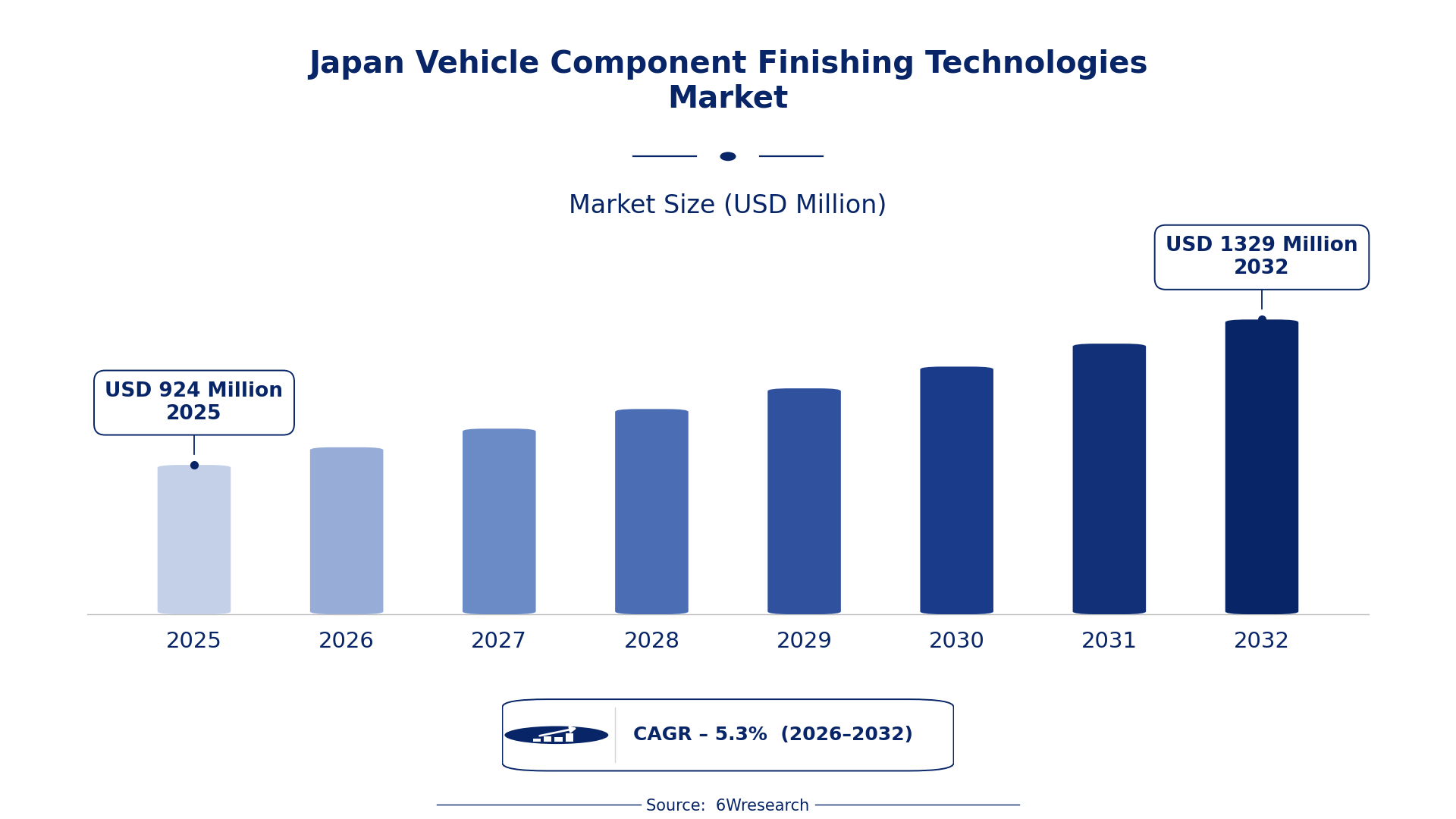
According to 6Wresearch internal database and industry insights, the Japan Vehicle Component Finishing Technologies Market was valued at USD 924 Million in 2025 and is projected to reach USD 1,329 Million by 2032, growing at a CAGR of approximately 5.3% during 2026–2032.
Japan Vehicle Component Finishing Technologies Market Highlights
| Report Metric | Details |
| Report Name | Japan Vehicle Component Finishing Technologies Market (2026-2032) |
| Market Size 2025 | USD 924 Million |
| Market Size 2032 | USD 1,329 Million |
| Absolute Growth 2025–2032 | USD 405 Million |
| CAGR 2026–2032 | 5.3% |
| Peak Annual Growth | 6.1% in 2026 |
| Forecast Period | 2026–2032 |
| Historical Data | 2022–2025 |
| Base Year | 2025 |
| Leading Finishing Type, 2025 | Powder Coating (46% share) |
| Leading Surface Technology, 2025 | Electrostatic (44% share) |
| Leading Component Type, 2025 | Chassis Frames (40% share) |
| Leading End User, 2025 | Tier 1 Suppliers (36% share) |
| Fastest-Growing Finishing Type | Anodizing (7.3% CAGR) |
| Fastest-Growing Surface Technology | Electrochemical (7.5% CAGR) |
| Fastest-Growing Component Type | Aluminum Alloys (7.4% CAGR) |
| Fastest-Growing End User | High-End Car Makers (6.7% CAGR) |
| Growing Sector | automotive manufacturing |
| Key End Users | Tier 1 Suppliers, High-End Car Makers, Component Manufacturers, Automotive Paint Shops |
Japan Vehicle Component Finishing Technologies Market Year-wise Growth Rate and Key Drivers (2022–2032)
This graph illustrates the annual growth rates of the market from 2022 to 2032, highlighting a steady upward trajectory and projected market expansion over the forecast period.
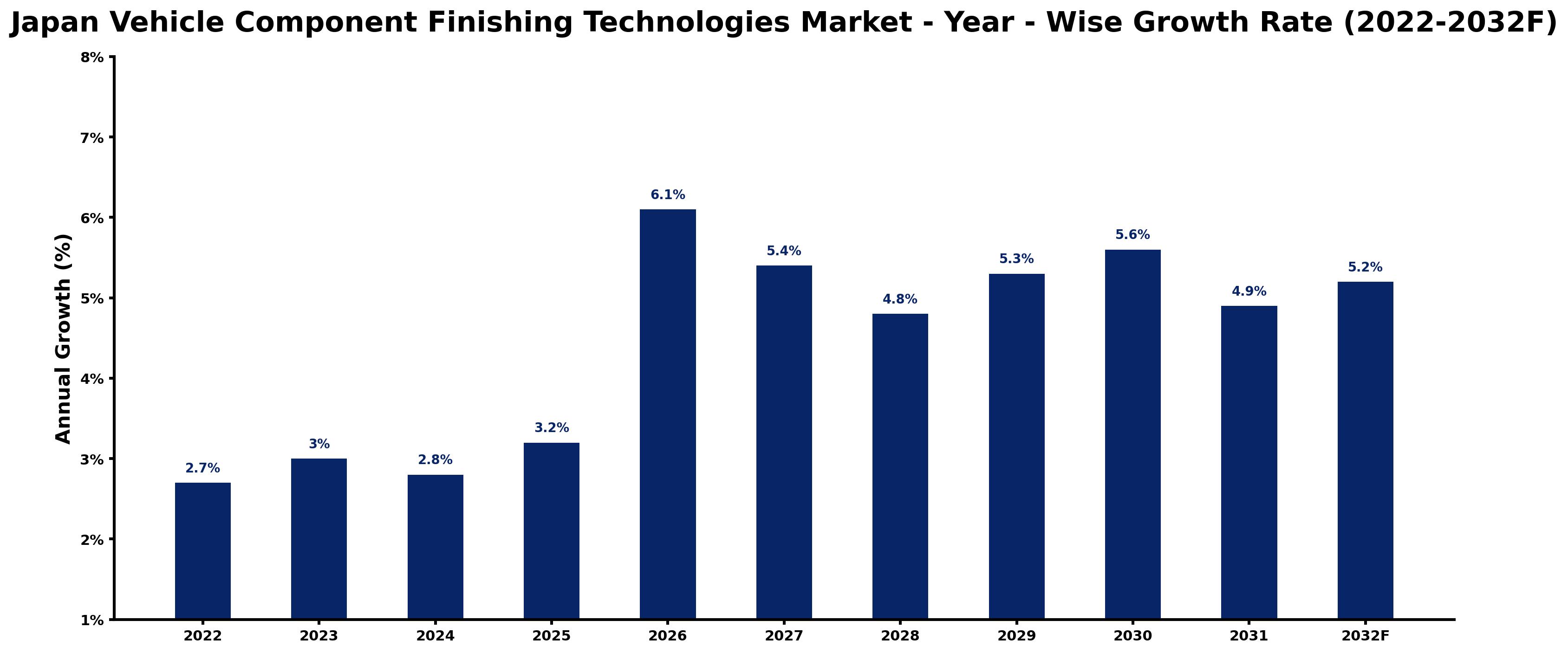
Below, each year's estimated growth is shown next to the factor that most influenced it.
| Year | Estimated Annual Growth (%) | Market Rationale |
| 2022 | 2.7 | The automotive sector showed steady production levels, maintaining demand for finishing technologies. |
| 2023 | 3.0 | Growth accelerated as automotive manufacturers increased production to meet rising consumer demand. |
| 2024 | 2.8 | The market experienced a slowdown as production rates stabilised after previous increases. |
| 2025 | 3.2 | Demand surged again due to heightened production activities in the automotive sector. |
| 2026 | 6.1 | The market is expected to peak as investment in new technologies reaches unprecedented levels. |
| 2027 | 5.4 | Growth is projected to slow slightly as manufacturers adjust to new production capacities. |
| 2028 | 4.8 | The market will continue to grow, supported by ongoing investments in eco-friendly technologies. |
| 2029 | 5.3 | Demand is expected to increase as automotive manufacturers focus on lightweight materials for efficiency. |
| 2030 | 5.6 | Growth will remain strong as the industry aims for sustainability targets by 2030. |
| 2031 | 4.9 | The market is projected to see a slowdown as manufacturers face challenges in scaling production. |
| 2032 | 5.2 | Growth is expected to stabilise as the focus shifts to advanced finishing technologies. |
Note: Market size estimations and growth projections presented in this report are based on 6Wresearch's proprietary forecasting methodology, utilizing the latest available industry data, government publications, and primary research inputs.
Japan Vehicle Component Finishing Technologies Market Synopsis
Vehicle Component Finishing Technologies involve processes that improve the durability and aesthetics of automotive components through coating and plating methods. The Japan Vehicle Component Finishing Technologies Market is expanding due to strong demand from domestic manufacturers and a production output of 8.3 million units in 2022. Factors such as the push for eco-friendly technologies, investments in innovative processes, and the focus on high-quality finishes for luxury vehicles are driving this growth.
Market Dynamics Impact Analysis (2026–2032)
| Factor | Type | Impact | Primary Segment Affected |
| Increased production of eco-friendly vehicles | Driver | High | Powder Coating |
| Growing demand for lightweight materials in vehicles | Driver | High | Aluminum Alloys |
| Emerging demand for advanced surface technologies | Opportunity | High | Electrochemical |
| Investment in sustainable finishing processes | Opportunity | High | Paint Curing |
| High costs associated with advanced finishing technologies | Restraint | Medium | Electroplating |
| Limited availability of skilled workforce for new technologies | Restraint | Medium | Anodizing |
| Competition from lower-cost finishing solutions | Challenge | High | Zinc/Nickel |
| Regulatory pressures for sustainability and emissions reductions | Challenge | Medium | UV/Oven Based |
Evaluation of Drivers in Japan Vehicle Component Finishing Technologies Market (2026–2032)
These are the developments adding the most demand over the forecast period.
| Drivers | Primary Segment Affected | Why It Matters (Evidence) |
| Rising production of electric vehicles | Powder Coating | This trend drives demand for durable finishes, with automotive production reaching 8.3 million units in 2022. |
| Increased focus on lightweight vehicle designs | Aluminum Alloys | The shift towards lightweight materials leads to higher purchases of anodizing services, with a projected growth rate of 7.4%. |
| Demand for high-quality finishes in luxury vehicles | Electrochemical | High-end car makers are investing in advanced surface technologies to improve aesthetic appeal, with spending increasing by 15%. |
| Government initiatives promoting eco-friendly technologies | Paint Curing | The 2023 government program encourages investments in sustainable finishing processes, aiming for a 46% reduction in emissions by 2030. |
| Growing automotive production capacity in the Tokyo region | Electroplating | The area's manufacturing base increases the need for protective finishes on components, with a projected rise in demand of 10%. |
Orders keep climbing as the automotive sector embraces electric vehicle production, leading to an output of 8.3 million units in 2022. The emphasis on lightweight materials drives demand for anodizing services, with projected growth rates reaching 7.4%. The manufacturing base in the Tokyo region further supports the rising need for protective finishes, particularly in components like brackets and fasteners. These factors are fuelling growth in the Vehicle Component Finishing Technologies market.
Evaluation of Restraints in Japan Vehicle Component Finishing Technologies Market
The table below lists the restraints and the evidence behind each.
| Market Restraint | Primary Segment Affected | Why It Matters (Evidence) |
| High costs of advanced finishing technologies | Electroplating | The financial burden of implementing new technologies can deter smaller manufacturers from upgrading, potentially increasing operational costs by 15%. |
| Limited skilled workforce for advanced processes | Anodizing | A shortage of trained personnel impacts the ability to implement effective finishing solutions, affecting production timelines significantly. |
| Competition from lower-cost alternatives | Zinc/Nickel | Affordable finishing options challenge the market share of premium finishing technologies, resulting in price reductions of around 10%. |
| Regulatory compliance costs for emissions standards | UV/Oven Based | Meeting stringent regulations increases operational costs for manufacturers, potentially raising expenses by 20%. |
| Market saturation in traditional finishing methods | Powder Coating | As the market matures, growth in conventional methods faces stiff competition from more efficient solutions. |
Japan Vehicle Component Finishing Technologies Market Challenges
In 2023, buyers encounter rising costs associated with eco-friendly finishing technologies, increasing production expenses by up to 20% and delaying project timelines. Compliance with the JIS H 8601 standard for anodizing adds operational costs that can elevate expenses by 15% for manufacturers. Local suppliers face challenges from international competition, compelling them to lower prices and risking profit margins by around 10%. Supply chain disruptions in the Kanto region may delay deliveries of essential materials, impacting production schedules for automotive component manufacturers by up to four weeks.
Trends in the Japan Vehicle Component Finishing Technologies Market
These developments are changing demand patterns in the Japan Vehicle Component Finishing Technologies Market.
- Shift from Conventional to Eco-Friendly Finishing: In 2023, Japan's automotive sector is adopting eco-friendly finishing technologies, driven by regulatory pressures aiming for a 46% reduction in greenhouse gas emissions by 2030.
- Emergence of Lightweight Materials in Vehicle Design: Since 2025, the automotive industry has prioritised lightweight materials, particularly aluminum alloys, to improve fuel efficiency, with anodizing processes projected to grow at a CAGR of 7.3%.
- Growing Demand for Advanced Surface Technologies: High-end car makers in Japan are focusing on advanced surface technologies to improve vehicle aesthetics, with increasing investment in electrochemical processes expected to grow at a CAGR of 7.5%.
- Expansion of Finishing Technologies in Automotive Paint Shops: The Kanto region has seen a rise in UV curing technologies within automotive paint shops, supported by the need for faster drying times and improved finish quality, with notable increases in adoption rates.
Investment Opportunities in the Japan Vehicle Component Finishing Technologies Market
The following opportunities in the Japan Vehicle Component Finishing Technologies Market pair current demand with a clear way in.
- Investment in Eco-Friendly Finishing Technologies: With a projected investment of ¥1 trillion in new technologies by 2025, suppliers can focus on eco-friendly finishing solutions, addressing the demands of Tier 1 Suppliers for sustainable options.
- Partnerships for Advanced Finishing Solutions: The gap in advanced surface technology adoption presents opportunities for partnerships, particularly with automotive paint shops in the Tokyo region to facilitate market entry.
- Supply of Lightweight Finishing Solutions: The demand for lightweight materials is creating opportunities in anodizing services, as component manufacturers seek solutions to improve performance and reduce weight.
- Expansion in the High-End Vehicle Market: With high-end car manufacturers prioritising quality finishes, there is a growing opportunity to supply advanced finishing technologies, establishing joint ventures with local manufacturers to strengthen market presence.
Government Initiatives in the Japan Vehicle Component Finishing Technologies Market
The 2023 GX Promotion Act establishes a framework for promoting green technologies in manufacturing. This law complements the Green Growth Strategy, which targets a 46% reduction in greenhouse gas emissions by 2030, pushing producers to adopt sustainable practices and invest in eco-friendly technologies.
Automotive paint shops benefit from the Battery Industry Strategy, which aims to boost domestic battery manufacturing by 2030. This strategy supports the shift towards electric vehicles, encouraging investment in eco-friendly finishing technologies and improving production processes.
Future Insight of the Japan Vehicle Component Finishing Technologies Market
By 2032, buyers will experience improved production efficiency as suppliers implement UV curing technologies, which will also reduce energy consumption. Investment in new technologies will drive advancements in surface treatments, with the automotive sector projected to invest ¥1 trillion by 2025. Collaboration with the Japan Automobile Manufacturers Association will support the development of advanced finishing processes. Increased adoption of electrostatic finishing methods will streamline manufacturing and minimise waste.
Market Segmentation Analysis
Japan Vehicle Component Finishing Technologies Market report covers a detailed analysis of the following market segments:
By Finishing Type – Powder Coating Leads, Anodizing Expected to Grow Fastest
According to Prakhar Dixit, Senior Research Analyst at 6Wresearch, Powder Coating accounted for 46% of the market by finishing type in 2025. Powder coating holds the largest share due to its extensive application for durable finishes on vehicle parts, particularly in the Tokyo region where automotive component manufacturing is concentrated. This method is crucial for enhancing both the longevity and aesthetics of vehicle components. Anodizing is projected to grow fastest, at a CAGR of 7.3% during 2026–2032. Anodizing is experiencing rapid growth as it provides essential corrosion resistance for aluminum components, which are increasingly utilised in vehicle construction. The adoption of the JIS H 8601 standard for anodizing processes further propels this trend. Suppliers should focus on developing anodizing capabilities to meet the rising demand for corrosion-resistant finishes.
By Surface Technology – Electrostatic Leads, Electrochemical Expected to Grow Fastest
With 44% of surface technology revenue in 2025, Electrostatic was the largest category. Electrostatic finishing leads the market as it is commonly employed alongside powder coating processes, improving efficiency in automotive paint applications. This method's capability to reduce waste while enhancing coating quality makes it highly favoured among manufacturers. The quickest growth will come from Electrochemical, forecast to expand at a CAGR of 7.5% between 2026 and 2032. Electrochemical technologies are growing quickly due to their specific applications in metal treatments, essential for improving the properties of various automotive components. As manufacturers aim to enhance performance, the demand for these technologies is expected to rise. Buyers may benefit from exploring electrochemical options to enhance the performance of their products.
By Component Type – Chassis Frames Lead, Aluminum Alloys Expected to Grow Fastest
In 2025, Chassis Frames led the component type split with a 40% share. Chassis frames dominate the market as critical structural components requiring finishing, reflecting the robust automotive production in Japan, which reached 8.3 million units in 2022. Their importance in vehicle safety and performance drives the demand for high-quality finishing technologies. Aluminum Alloys are set to record the highest CAGR in this split, 7.4% over 2026–2032. Aluminum alloys are rapidly gaining traction due to their widespread use in lightweight vehicle construction, aligning with the industry's shift towards more fuel-efficient designs. This trend is further supported by Japan's ambitious emissions reduction targets. Suppliers should prioritise solutions for aluminum alloy finishing to capitalise on the shift towards lightweight vehicles.
By End User – Tier 1 Suppliers Lead, High-End Car Makers Expected to Grow Fastest
Tier 1 Suppliers took 36% of end user revenue in 2025, more than any other category. Tier 1 suppliers command the largest share as primary users of finishing technologies, providing essential components to the automotive industry. Their significant role in the supply chain ensures a steady demand for advanced finishing solutions. Over 2026–2032, High-End Car Makers are expected to post the fastest growth, at a CAGR of 6.7%. High-end car makers are driving rapid growth in this segment as they demand high-quality finishes for luxury vehicles, reflecting the increasing consumer preference for premium automotive products. This trend is supported by the automotive sector's projected investment of ¥1 trillion in new technologies by 2025. Suppliers must tailor their offerings to meet the high standards of high-end car makers to capture this growing market.
Key Attractiveness of the Report
- 10 Years of Market Numbers
- Historical Data Starting from 2022 to 2025
- Base Year 2025
- Forecast Data until 2032
- Key Performance Indicators Impacting the Market
- Major Upcoming Developments and Projects
Key Highlights of the Report:
- Japan Vehicle Component Finishing Technologies Market Outlook
- Market Size of Japan Vehicle Component Finishing Technologies Market, 2025
- Forecast of Japan Vehicle Component Finishing Technologies Market, 2032
- Historical Data and Forecast of Japan Vehicle Component Finishing Technologies Revenues & Volume for the Period 2022-2032F
- Japan Vehicle Component Finishing Technologies Market Trend Evolution
- Japan Vehicle Component Finishing Technologies Market Drivers and Challenges
- Japan Vehicle Component Finishing Technologies Price Trends
- Japan Vehicle Component Finishing Technologies Porter's Five Forces
- Japan Vehicle Component Finishing Technologies Industry Life Cycle
- Historical Data and Forecast of Japan Vehicle Component Finishing Technologies Market Revenues & Volume By Finishing Type for the Period 2022-2032F
- Historical Data and Forecast of Japan Vehicle Component Finishing Technologies Market Revenues & Volume By Powder Coating for the Period 2022-2032F
- Historical Data and Forecast of Japan Vehicle Component Finishing Technologies Market Revenues & Volume By Anodizing for the Period 2022-2032F
- Historical Data and Forecast of Japan Vehicle Component Finishing Technologies Market Revenues & Volume By Electroplating for the Period 2022-2032F
- Historical Data and Forecast of Japan Vehicle Component Finishing Technologies Market Revenues & Volume By Paint Curing for the Period 2022-2032F
- Historical Data and Forecast of Japan Vehicle Component Finishing Technologies Market Revenues & Volume By Surface Technology for the Period 2022-2032F
- Historical Data and Forecast of Japan Vehicle Component Finishing Technologies Market Revenues & Volume By Electrostatic for the Period 2022-2032F
- Historical Data and Forecast of Japan Vehicle Component Finishing Technologies Market Revenues & Volume By Electrochemical for the Period 2022-2032F
- Historical Data and Forecast of Japan Vehicle Component Finishing Technologies Market Revenues & Volume By Zinc/Nickel for the Period 2022-2032F
- Historical Data and Forecast of Japan Vehicle Component Finishing Technologies Market Revenues & Volume By UV/Oven Based for the Period 2022-2032F
- Historical Data and Forecast of Japan Vehicle Component Finishing Technologies Market Revenues & Volume By Component Type for the Period 2022-2032F
- Historical Data and Forecast of Japan Vehicle Component Finishing Technologies Market Revenues & Volume By Chassis Frames for the Period 2022-2032F
- Historical Data and Forecast of Japan Vehicle Component Finishing Technologies Market Revenues & Volume By Aluminum Alloys for the Period 2022-2032F
- Historical Data and Forecast of Japan Vehicle Component Finishing Technologies Market Revenues & Volume By Brackets & Fasteners for the Period 2022-2032F
- Historical Data and Forecast of Japan Vehicle Component Finishing Technologies Market Revenues & Volume By Exterior Panels for the Period 2022-2032F
- Historical Data and Forecast of Japan Vehicle Component Finishing Technologies Market Revenues & Volume By End User for the Period 2022-2032F
- Historical Data and Forecast of Japan Vehicle Component Finishing Technologies Market Revenues & Volume By Tier 1 Suppliers for the Period 2022-2032F
- Historical Data and Forecast of Japan Vehicle Component Finishing Technologies Market Revenues & Volume By High-End Car Makers for the Period 2022-2032F
- Historical Data and Forecast of Japan Vehicle Component Finishing Technologies Market Revenues & Volume By Component Manufacturers for the Period 2022-2032F
- Historical Data and Forecast of Japan Vehicle Component Finishing Technologies Market Revenues & Volume By Automotive Paint Shops for the Period 2022-2032F
- Japan Vehicle Component Finishing Technologies Import Export Trade Statistics
- Market Opportunity Assessment By Finishing Type
- Market Opportunity Assessment By Surface Technology
- Market Opportunity Assessment By Component Type
- Market Opportunity Assessment By End User
- Japan Vehicle Component Finishing Technologies Top Companies Market Share
- Japan Vehicle Component Finishing Technologies Competitive Benchmarking By Technical and Operational Parameters
- Japan Vehicle Component Finishing Technologies Company Profiles
- Japan Vehicle Component Finishing Technologies Key Strategic Recommendations
Market Covered
Segments analysed in this report are listed below.
By Finishing Type
- Powder Coating
- Anodizing
- Electroplating
- Paint Curing
By Surface Technology
- Electrostatic
- Electrochemical
- Zinc/Nickel
- UV/Oven Based
By Component Type
- Chassis Frames
- Aluminum Alloys
- Brackets & Fasteners
- Exterior Panels
By End User
- Tier 1 Suppliers
- High-End Car Makers
- Component Manufacturers
- Automotive Paint Shops































