Japan Vehicle Component Market Size & Growth Rate
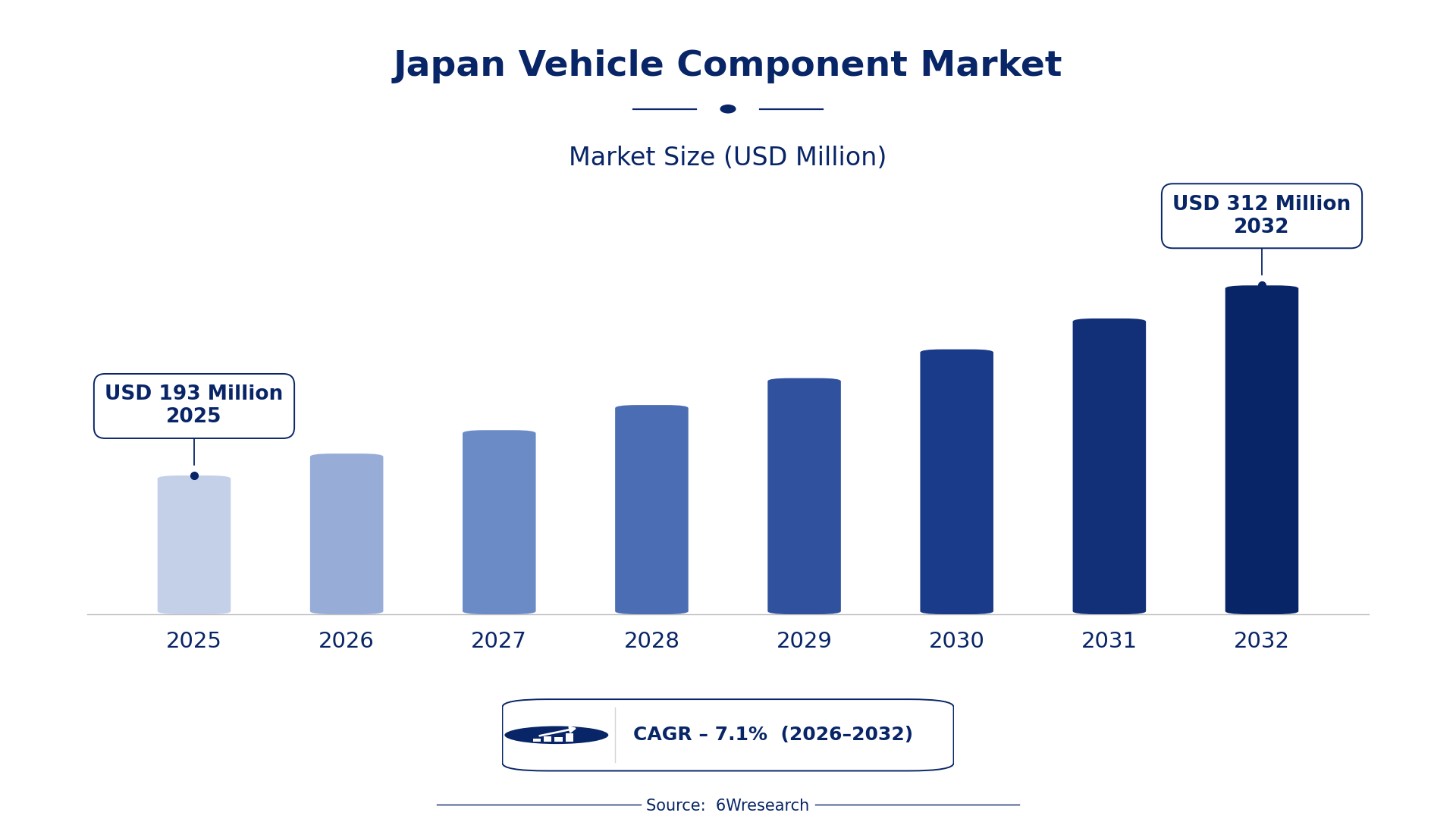
According to 6Wresearch internal database and industry insights, the Japan Vehicle Component Market was valued at USD 193 Million in 2025 and is projected to reach USD 312 Million by 2032, growing at a CAGR of approximately 7.1% during 2026–2032.
Japan Vehicle Component Market Highlights
| Report Metric | Details |
| Report Name | Japan Vehicle Component Market (2026-2032) |
| Market Size 2025 | USD 193 Million |
| Market Size 2032 | USD 312 Million |
| Absolute Growth 2025–2032 | USD 119 Million |
| CAGR 2026–2032 | 7.1% |
| Peak Annual Growth | 8.0% in 2030 |
| Forecast Period | 2026–2032 |
| Historical Data | 2022–2025 |
| Base Year | 2025 |
| Leading Component Type, 2025 | Engine Components (52% share) |
| Leading Application System, 2025 | Powertrain (49% share) |
| Leading Material Type, 2025 | Cast Iron/Steel (42% share) |
| Leading End User, 2025 | Internal Combustion OEMs (47% share) |
| Fastest-Growing Component Type | Suspension Parts (9.7% CAGR) |
| Fastest-Growing Application System | Chassis (9.2% CAGR) |
| Fastest-Growing Material Type | Forged Steel (10.1% CAGR) |
| Fastest-Growing End User | Aftermarket Retailers (9.3% CAGR) |
| Growing Sector | Automotive aftermarket |
| Key End Users | Internal Combustion OEMs, Aftermarket Retailers, Vehicle OEMs |
Japan Vehicle Component Market Year-wise Growth Rate and Key Drivers (2022–2032)
This graph illustrates the annual growth rates of the market from 2022 to 2032, highlighting a steady upward trajectory and projected market expansion over the forecast period.
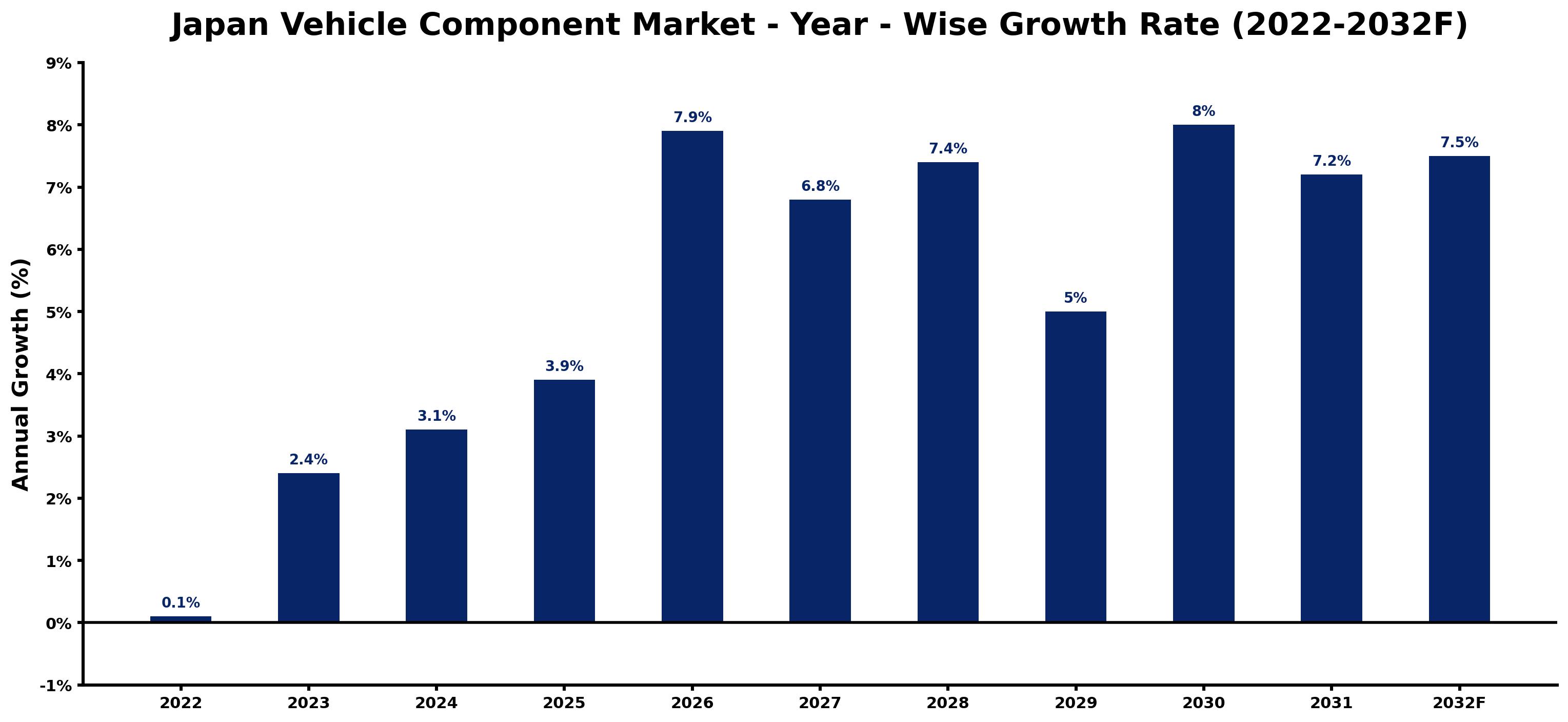
For each year, the table pairs the estimated growth rate with the leading influence on demand, showing how the drivers changed across the period.
| Year | Estimated Annual Growth (%) | Market Rationale |
| 2022 | 0.1 | The market experienced modest growth, reflecting stability in automotive production and demand. |
| 2023 | 2.4 | Growth accelerated as automotive production rebounded, driven by increased consumer confidence and spending. |
| 2024 | 3.1 | Continued recovery in production led to higher demand for vehicle components, supporting further growth. |
| 2025 | 3.9 | The market peaked in growth as investments in electric vehicle technologies gained momentum. |
| 2026 | 7.9 | Investment in electric vehicle components surged, significantly boosting market demand and production capacity. |
| 2027 | 6.8 | Growth slowed slightly as manufacturers adjusted to new technologies and production processes. |
| 2028 | 7.4 | Demand picked up again as consumer interest in electric vehicles strengthened, driving component sales. |
| 2029 | 5.0 | A slowdown occurred as market growth stabilised, reflecting adjustments in production and supply chains. |
| 2030 | 8.0 | The market witnessed a surge in growth due to heightened investments in electric vehicle technologies. |
| 2031 | 7.2 | Growth moderated as the market adjusted to new standards and consumer preferences evolved. |
| 2032 | 7.5 | Demand remains strong as ongoing investments in R&D enhance component efficiency and safety. |
Note: Market size estimations and growth projections presented in this report are based on 6Wresearch's proprietary forecasting methodology, utilizing the latest available industry data, government publications, and primary research inputs.
Japan Vehicle Component Market Synopsis
Vehicle components are essential parts used in automobiles, including engines, brakes, and electronics, manufactured through processes like casting and forging. The Japan Vehicle Component Market is experiencing growth driven by a rebound in automotive production, which reached 8.3 million units in 2022. Key factors include rising investments in electric vehicle technologies and the expansion of the automotive aftermarket, valued at approximately $30 billion, which is increasing demand for replacement parts and services.
Market Dynamics Impact Analysis (2026–2032)
| Factor | Type | Impact | Primary Segment Affected |
| Rising investments in electric vehicle technologies | Driver | High | Powertrain |
| Increased automotive production levels | Driver | High | Engine Components |
| Expansion of the automotive aftermarket | Opportunity | High | Aftermarket Retailers |
| Growing demand for connected vehicle technologies | Opportunity | Medium | Connected Vehicle Providers |
| High production costs for advanced components | Restraint | High | Electronics |
| Stringent quality standards in manufacturing | Restraint | Medium | Brake Assemblies |
| Limited availability of skilled labour | Challenge | High | Suspension Parts |
| Rising raw material costs affecting profitability | Challenge | Medium | Chassis |
Evaluation of Drivers in Japan Vehicle Component Market (2026–2032)
Below are the drivers that matter most for revenue growth, with supporting evidence.
| Drivers | Primary Segment Affected | Why It Matters (Evidence) |
| Investment in electric vehicle technologies | Powertrain | This investment will increase demand for components, with the government targeting 150 GWh of domestic battery manufacturing capacity by 2030. |
| Recovery in automotive production | Engine Components | Japan's automotive production reached 8.3 million units in 2022, leading to higher demand for essential parts. |
| Growth in the automotive aftermarket | Aftermarket Retailers | The automotive aftermarket in Japan is valued at approximately $30 billion, driving demand for replacement parts. |
| Expansion of connected vehicle technologies | Electronics | Japan's focus on developing connected vehicle technologies is raising the need for advanced electronic components. |
| Rising consumer preferences for vehicle safety features | Brake Assemblies | Consumer demand for high-quality safety systems is driving the need for reliable brake components. |
Several shifts outside the market lift sales. Investment in electric vehicle technologies will increase demand for components, as Japan aims for substantial domestic battery manufacturing capacity by 2030. Recovery in automotive production, which reached 8.3 million units in 2022, leads to higher demand for essential parts. The automotive aftermarket, valued at approximately $30 billion, drives the need for replacement components. Rising consumer preferences for high-quality safety features further increase the demand for reliable brake systems, particularly among Internal Combustion OEMs.
Evaluation of Restraints in Japan Vehicle Component Market
The key brakes on demand, and where they bite hardest, are shown below.
| Market Restraint | Primary Segment Affected | Why It Matters (Evidence) |
| High production costs for advanced components | Electronics | Production costs for advanced electronic components are rising, impacting profitability for manufacturers, with costs increasing by 15% over the last year. |
| Stringent quality standards in manufacturing | Brake Assemblies | Compliance with JIS standards adds complexity and costs to the manufacturing process, raising production costs by approximately 10%. |
| Limited availability of skilled labour | Suspension Parts | A shortage of skilled workers in the automotive sector limits production efficiency, affecting output by around 20%. |
| Rising raw material costs affecting profitability | Chassis | Increasing prices for raw materials are squeezing margins for chassis manufacturers, with costs rising by 12% in the last year. |
| Regulatory compliance costs for safety standards | Safety System | Meeting ISO 26262 standards for functional safety raises costs for producers, increasing expenses by 8%. |
Japan Vehicle Component Market Challenges
Intense rivalry among manufacturers reduces prices, forcing producers to cut corners, which compromises component quality for buyers. Rapid technological changes require heavy investment in modern production techniques, yet many producers struggle to keep pace, delaying the introduction of advanced features for buyers. Compliance with strict regulations, such as JIS standards, incurs additional costs for producers, potentially elevating prices for buyers. The transition to electric vehicle components demands substantial capital, leaving many producers under-resourced and resulting in supply shortages for buyers in this growing sector.
Trends in the Japan Vehicle Component Market
Several trends are reshaping the Japan Vehicle Component Market; the most important are set out below.
- Shift towards Electric Vehicle Components: Japan is increasingly focusing on electric vehicle components, with the government launching a programme in 2023 to promote their production. This shift is expected to drive a rise in component demand as manufacturers adapt to new technologies.
- Growth in Aftermarket Services: The automotive aftermarket in Japan is valued at approximately $30 billion, reflecting a trend of more consumers seeking replacement parts and services. This shift indicates a growing opportunity for suppliers to cater to this expanding market.
- Emphasis on Connected Vehicle Technologies: Japan is prioritising connected vehicle technologies, focusing on developing systems that enhance vehicle connectivity. This trend is likely to increase demand for advanced electronic components and systems.
- Increase in Safety Standards: The year 2023 marked a greater emphasis on safety standards in vehicle manufacturing, with stricter regulations being implemented. This change is driving demand for high-quality safety components across the industry.
Investment Opportunities in the Japan Vehicle Component Market
Investors looking at the Japan Vehicle Component Market should consider the following areas.
- Automotive Manufacturing Hubs: The Tokyo region is a major hub for automotive manufacturing, presenting opportunities for suppliers to engage with local OEMs. With automotive production reaching 8.3 million units in 2022, there is strong demand for components.
- Investment in Electric Vehicle Technologies: With the government targeting 150 GWh of domestic battery manufacturing capacity by 2030, there is a growing gap for suppliers of electric vehicle components. Engaging with local manufacturers can facilitate entry into this expanding market.
- Partnerships with Aftermarket Retailers: The automotive aftermarket, valued at approximately $30 billion, offers opportunities for suppliers to partner with retailers for replacement parts. Establishing joint ventures can strengthen market presence.
- Focus on Advanced Safety Systems: With rising consumer demand for enhanced safety features, there is a need for high-quality safety components. Suppliers can target Internal Combustion OEMs to provide these essential parts.
Government Initiatives in the Japan Vehicle Component Market
The Battery Industry Strategy, launched by the Ministry of Economy, Trade and Industry in August 2022, aims to boost domestic battery manufacturing capacity by 2030. This initiative is important for the production of electric vehicle components, ensuring a steady supply of essential parts for buyers.
In 2023, the government initiated the GX Promotion Act, aiming for substantial public-private decarbonisation investment. This initiative, overseen by the Ministry of the Environment, is projected to fund projects that support the production and adoption of environmentally friendly vehicle components.
Future Insight of the Japan Vehicle Component Market
Advancements in electric vehicle components will redefine the market by 2032, as Japan targets a 46% reduction in greenhouse-gas emissions from 2013 levels. Increased investment in R&D will improve component efficiency and safety, benefiting both buyers and suppliers. The implementation of ISO 26262 will ensure functional safety across automotive electronics, building consumer confidence. The Tokyo Motor Show will continue to be a key venue for showcasing innovations, encouraging collaboration between producers and technology developers to meet evolving market demands.
Market Segmentation Analysis
Japan Vehicle Component Market report covers a detailed analysis of the following market segments:
By Component Type – Engine Components Lead, Suspension Parts Expected to Grow Fastest
According to Saurav Kr Singh, Senior Research Analyst at 6Wresearch, Engine Components held 52% of the Japan Vehicle Component Market by component type in 2025. Engine components are essential for vehicle operation, which positions them as a primary focus for manufacturers. The substantial automotive production of 8.3 million units in 2022 highlights the ongoing demand for these critical parts. Suspension Parts are set to record the highest CAGR in this split, 9.7% over 2026–2032. Suspension parts are experiencing rapid growth due to the increasing focus on vehicle stability and comfort. This trend is reflected in Japan's commitment to improving automotive performance, suggesting sustained demand for advanced suspension systems. Suppliers must prioritise advancements in suspension technologies to address the growing market needs.
By Application System – Powertrain Leads, Chassis Expected to Grow Fastest
The largest application system category in 2025 was Powertrain, at 49% of revenue. Powertrain systems are crucial for vehicle propulsion, securing a significant share of automotive component sales. The compliance with stringent JIS standards further solidifies their market position by ensuring consistent quality and reliability. Over 2026–2032, Chassis is expected to post the fastest growth, at a CAGR of 9.2%. Chassis systems are rapidly expanding as manufacturers place greater emphasis on structural integrity and safety. The focus on vehicle safety regulations is driving substantial investments in advanced chassis technologies, propelling this segment's growth. Buyers can expect improved safety features as suppliers enhance chassis technologies.
By Material Type – Cast Iron/Steel Leads, Forged Steel Expected to Grow Fastest
In 2025, Cast Iron/Steel led the material type split with a 42% share. Cast iron and steel are widely used due to their durability, making them the preferred materials for various automotive components. Their established presence is supported by the high volume of vehicles produced in Japan, ensuring steady demand. Forged Steel is projected to grow fastest, at a CAGR of 10.1% during 2026–2032. Forged steel is becoming increasingly popular for its strength in critical components, particularly in performance vehicles. The industry's shift towards high-performance models is stimulating growth in this material segment, indicating a trend towards stronger components. Suppliers should concentrate on developing high-strength forged steel products to leverage this growing demand.
By End User – Internal Combustion OEMs Lead, Aftermarket Retailers Expected to Grow Fastest
Internal Combustion OEMs accounted for 47% of the market by end user in 2025. Internal combustion OEMs represent a major segment in Japan, driven by the large number of registered vehicles exceeding 78 million. Their established production processes create a steady demand for various vehicle components. The quickest growth will come from Aftermarket Retailers, forecast to expand at a CAGR of 9.3% between 2026 and 2032. Aftermarket retailers are experiencing rapid growth, driven by the need for replacement parts in an ageing vehicle fleet. The automotive aftermarket's valuation at approximately $30 billion highlights this expanding opportunity. Suppliers should consider strategies to engage with aftermarket retailers to maximise their market reach.
Key Attractiveness of the Report
- 10 Years of Market Numbers
- Historical Data Starting from 2022 to 2025
- Base Year 2025
- Forecast Data until 2032
- Key Performance Indicators Impacting the Market
- Major Upcoming Developments and Projects
Key Highlights of the Report:
- Japan Vehicle Component Market Outlook
- Market Size of Japan Vehicle Component Market, 2025
- Forecast of Japan Vehicle Component Market, 2032
- Historical Data and Forecast of Japan Vehicle Component Revenues & Volume for the Period 2022-2032F
- Japan Vehicle Component Market Trend Evolution
- Japan Vehicle Component Market Drivers and Challenges
- Japan Vehicle Component Price Trends
- Japan Vehicle Component Porter's Five Forces
- Japan Vehicle Component Industry Life Cycle
- Historical Data and Forecast of Japan Vehicle Component Market Revenues & Volume By Component Type for the Period 2022-2032F
- Historical Data and Forecast of Japan Vehicle Component Market Revenues & Volume By Engine Components for the Period 2022-2032F
- Historical Data and Forecast of Japan Vehicle Component Market Revenues & Volume By Suspension Parts for the Period 2022-2032F
- Historical Data and Forecast of Japan Vehicle Component Market Revenues & Volume By Infotainment Modules for the Period 2022-2032F
- Historical Data and Forecast of Japan Vehicle Component Market Revenues & Volume By Brake Assemblies for the Period 2022-2032F
- Historical Data and Forecast of Japan Vehicle Component Market Revenues & Volume By Application System for the Period 2022-2032F
- Historical Data and Forecast of Japan Vehicle Component Market Revenues & Volume By Powertrain for the Period 2022-2032F
- Historical Data and Forecast of Japan Vehicle Component Market Revenues & Volume By Chassis for the Period 2022-2032F
- Historical Data and Forecast of Japan Vehicle Component Market Revenues & Volume By Electronics for the Period 2022-2032F
- Historical Data and Forecast of Japan Vehicle Component Market Revenues & Volume By Safety System for the Period 2022-2032F
- Historical Data and Forecast of Japan Vehicle Component Market Revenues & Volume By Material Type for the Period 2022-2032F
- Historical Data and Forecast of Japan Vehicle Component Market Revenues & Volume By Cast Iron/Steel for the Period 2022-2032F
- Historical Data and Forecast of Japan Vehicle Component Market Revenues & Volume By Forged Steel for the Period 2022-2032F
- Historical Data and Forecast of Japan Vehicle Component Market Revenues & Volume By Plastics/Electronics for the Period 2022-2032F
- Historical Data and Forecast of Japan Vehicle Component Market Revenues & Volume By Composite/Metal for the Period 2022-2032F
- Historical Data and Forecast of Japan Vehicle Component Market Revenues & Volume By End User for the Period 2022-2032F
- Historical Data and Forecast of Japan Vehicle Component Market Revenues & Volume By Internal Combustion OEMs for the Period 2022-2032F
- Historical Data and Forecast of Japan Vehicle Component Market Revenues & Volume By Aftermarket Retailers for the Period 2022-2032F
- Historical Data and Forecast of Japan Vehicle Component Market Revenues & Volume By Connected Vehicle Providers for the Period 2022-2032F
- Historical Data and Forecast of Japan Vehicle Component Market Revenues & Volume By Vehicle OEMs for the Period 2022-2032F
- Japan Vehicle Component Import Export Trade Statistics
- Market Opportunity Assessment By Component Type
- Market Opportunity Assessment By Application System
- Market Opportunity Assessment By Material Type
- Market Opportunity Assessment By End User
- Japan Vehicle Component Top Companies Market Share
- Japan Vehicle Component Competitive Benchmarking By Technical and Operational Parameters
- Japan Vehicle Component Company Profiles
- Japan Vehicle Component Key Strategic Recommendations
Market Covered
The following segment groups are covered in the report.
By Component Type
- Engine Components
- Suspension Parts
- Infotainment Modules
- Brake Assemblies
By Application System
- Powertrain
- Chassis
- Electronics
- Safety System
By Material Type
- Cast Iron/Steel
- Forged Steel
- Plastics/Electronics
- Composite/Metal
By End User
- Internal Combustion OEMs
- Aftermarket Retailers
- Connected Vehicle Providers
- Vehicle OEMs































