Japan Vehicle Control Components Market Size & Growth Rate
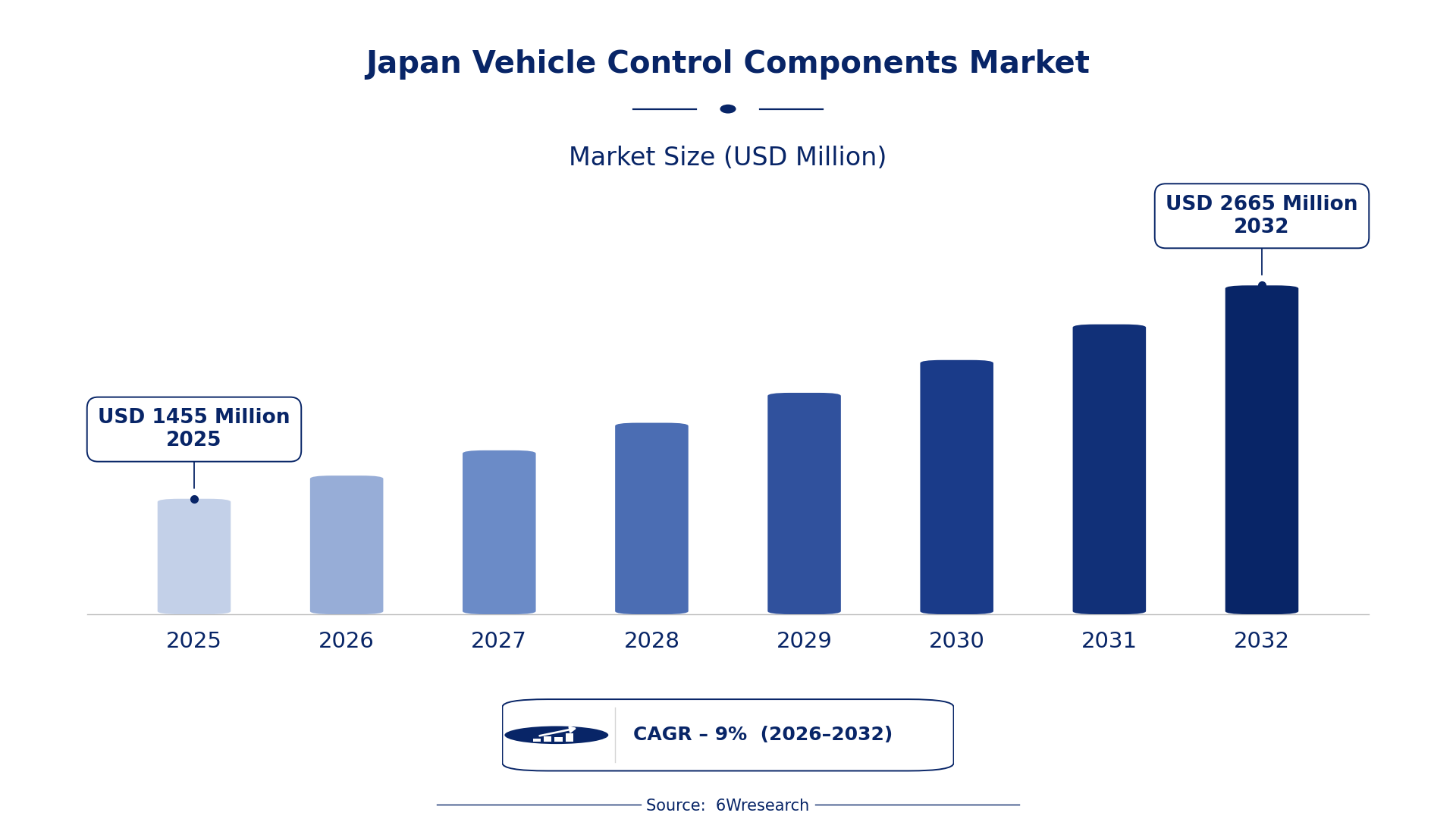
According to 6Wresearch internal database and industry insights, the Japan Vehicle Control Components Market was valued at USD 1,455 Million in 2025 and is projected to reach USD 2,665 Million by 2032, growing at a CAGR of approximately 9% during 2026–2032.
Japan Vehicle Control Components Market Highlights
| Report Metric | Details |
| Report Name | Japan Vehicle Control Components Market (2026-2032) |
| Market Size 2025 | USD 1,455 Million |
| Market Size 2032 | USD 2,665 Million |
| Absolute Growth 2025–2032 | USD 1,210 Million |
| CAGR 2026–2032 | 9% |
| Peak Annual Growth | 9.7% in 2032 |
| Forecast Period | 2026–2032 |
| Historical Data | 2022–2025 |
| Base Year | 2025 |
| Leading Component Type, 2025 | Pedal Assemblies (42% share) |
| Leading Control Function, 2025 | Driver Input (45% share) |
| Leading Integration Area, 2025 | Footwell Area (42% share) |
| Leading End User, 2025 | Automotive OEMs (43% share) |
| Fastest-Growing Component Type | Rotary Knobs & Switches (13.0% CAGR) |
| Fastest-Growing Control Function | Dashboard Interface (11.5% CAGR) |
| Fastest-Growing Integration Area | Instrument Panel (10.8% CAGR) |
| Fastest-Growing End User | Interior Designers (11.6% CAGR) |
| Growing Sector | Interior Designers |
| Key End Users | Automotive OEMs, Interior Designers, Component Suppliers, Sports & Utility Vehicles |
Japan Vehicle Control Components Market Year-wise Growth Rate and Key Drivers (2022–2032)
This graph illustrates the annual growth rates of the market from 2022 to 2032, highlighting a steady upward trajectory and projected market expansion over the forecast period.
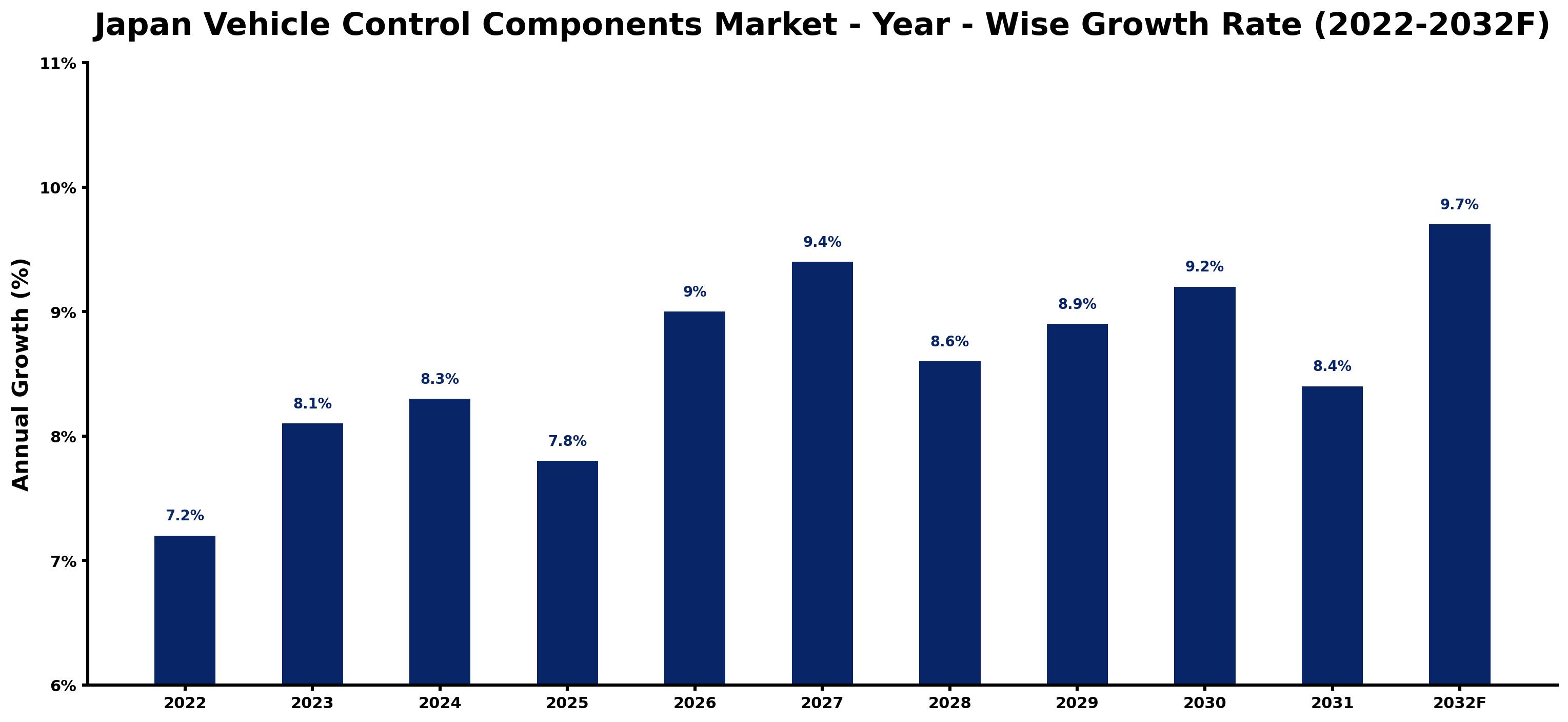
The yearly estimates that follow link every growth rate to its principal driver, so readers can see why the pace changed in each period.
| Year | Estimated Annual Growth (%) | Market Rationale |
| 2022 | 7.2 | The market showed steady growth due to consistent automotive production levels. |
| 2023 | 8.1 | Demand increased as automotive manufacturers ramped up production in response to market recovery. |
| 2024 | 8.3 | Growth continued as vehicle production reached 8.3 million units, driving component needs. |
| 2025 | 7.8 | The growth rate slowed slightly as manufacturers faced challenges in sourcing materials. |
| 2026 | 9.0 | Demand is expected to rise as the automotive sector invests in advanced technologies. |
| 2027 | 9.4 | The market will grow as domestic manufacturers expand their production capacities. |
| 2028 | 8.6 | Growth is projected to slow due to market saturation and increased competition. |
| 2029 | 8.9 | The market will see renewed growth as exports of vehicle components increase. |
| 2030 | 9.2 | Demand is expected to rise as Japan targets a 46% cut in greenhouse gas emissions by 2030. |
| 2031 | 8.4 | Growth will slow as manufacturers adjust to evolving regulatory standards. |
| 2032 | 9.7 | The market is projected to peak as investments in electric vehicle components surge. |
Note: Market size estimations and growth projections presented in this report are based on 6Wresearch's proprietary forecasting methodology, utilizing the latest available industry data, government publications, and primary research inputs.
Japan Vehicle Control Components Market Synopsis
Vehicle control components are crucial for automotive systems, ensuring both operation and safety. The Japan Vehicle Control Components Market is growing due to increased production levels, with Japan's automotive output reaching 8.3 million units in 2022. Demand arises from the need for advanced safety features and the transition to electric vehicles, bolstered by government initiatives aimed at achieving carbon neutrality by 2050. This growth is fuelled by domestic manufacturers and exports, presenting substantial opportunities for suppliers.
Market Dynamics Impact Analysis (2026–2032)
| Factor | Type | Impact | Primary Segment Affected |
| Increased automotive production | Driver | High | Pedal Assemblies |
| Growing demand for advanced safety features | Driver | High | Driver Input |
| Expansion of electric vehicle production | Opportunity | High | Rotary Knobs & Switches |
| Rising exports of vehicle components | Opportunity | Medium | Footwell Area |
| Supply chain disruptions | Restraint | High | Levers & Actuators |
| Fluctuating material costs | Restraint | Medium | Directional Control |
| Compliance with safety standards | Challenge | High | Dashboard Interface |
| Capacity constraints in manufacturing | Challenge | Medium | Transmission Interface |
Evaluation of Drivers in Japan Vehicle Control Components Market (2026–2032)
The main growth drivers and the segments they affect most are set out below.
| Drivers | Primary Segment Affected | Why It Matters (Evidence) |
| Rising automotive production levels | Pedal Assemblies | Japan's automotive production reached 8.3 million units in 2022, increasing demand for essential components. |
| Growing consumer preference for advanced safety features | Driver Input | The average age of vehicles in Japan is 11.5 years, leading to higher demand for replacement parts. |
| Investment in electric vehicle manufacturing | Rotary Knobs & Switches | The Battery Industry Strategy aims for 150 GWh of domestic battery manufacturing capacity by 2030. |
| Increased exports of vehicle components | Footwell Area | Exports of vehicle components were valued at approximately $12 billion in 2022. |
| Technological advancements in automotive systems | Dashboard Interface | ISO 26262 is driving the need for functional safety in automotive components. |
A wider customer base explains much of the growth, as Japan's automotive production reached 8.3 million units in 2022, increasing the need for essential components. The average age of vehicles, currently 11.5 years, drives the demand for replacement parts, particularly in the Driver Input segment. Investment in electric vehicle manufacturing is expected to create further demand for components. Exports of vehicle components, valued at approximately $12 billion in 2022, also contribute to market growth. Technological advancements, especially the adoption of safety standards, are pushing manufacturers to improve features in vehicle control systems.
Evaluation of Restraints in Japan Vehicle Control Components Market
Below are the constraints most often cited by buyers and suppliers, with the segment each affects.
| Market Restraint | Primary Segment Affected | Why It Matters (Evidence) |
| Supply chain disruptions from reliance on domestic sourcing | Pedal Assemblies | Delays in component availability increase production costs by up to 15%. |
| Skills shortages in precision engineering | Driver Input | Longer training periods may reduce output for suppliers by 20%. |
| Technology adoption lags due to high costs | Dashboard Interface | Outdated manufacturing processes can delay product launches by six months. |
| Regulatory compliance with standards like JIS D 0202 | Rotary Knobs & Switches | Manufacturers face operational costs increasing by approximately 10%. |
| Market saturation leading to increased competition | Footwell Area | This may limit growth potential for existing manufacturers. |
Japan Vehicle Control Components Market Challenges
Domestic sourcing limits supply options, causing delays in component availability for manufacturers and increasing production costs by up to 15%. A lack of skilled workers in precision engineering extends training periods, which can reduce output by 20% for suppliers. High expenses associated with technology adoption force manufacturers to depend on outdated processes, potentially delaying product launches by six months for buyers. Stricter compliance with standards like JIS D 0202 complicates operations, raising operational costs by around 10% for manufacturers striving to meet these regulations.
Trends in the Japan Vehicle Control Components Market
Four trends stand out in the Japan Vehicle Control Components Market.
- Shift from Traditional to Advanced Safety Features: The Tokyo region is seeing a shift towards advanced safety features in vehicle control components, driven by consumer demand for improved safety. In 2023, over 70% of new vehicles featured advanced safety technologies.
- Transition from Mechanical to Electronic Controls: The industry is moving from mechanical to electronic controls, particularly in the Footwell Area. This transition began in 2022, with a 15% rise in electronic control adoption in new vehicles.
- Emergence of Smart Vehicle Interfaces: Smart vehicle interfaces are becoming more popular, with the Dashboard Interface segment expanding rapidly. In 2023, this segment represented 25% of new component designs, reflecting evolving consumer preferences.
- Prioritisation of Eco-Friendly Components: The government’s Green Growth Strategy has emphasised eco-friendly components in vehicle manufacturing. By 2025, 30% of new vehicle components are projected to meet sustainability criteria.
Investment Opportunities in the Japan Vehicle Control Components Market
The opportunities below stand out in the Japan Vehicle Control Components Market for new entrants and existing suppliers.
- Partnerships for Innovation: Now is an opportune moment for joint ventures in the Tokyo region, where automotive innovation is flourishing. With the market size anticipated to reach USD 1,455 Million by 2025, suppliers can gain from collaborating with local manufacturers.
- Investment in Replacement Parts: The average vehicle age of 11.5 years creates a strong demand for replacement parts. Component suppliers in the automotive sector should capitalise on this opportunity, particularly in urban areas with high vehicle density.
- Expansion into Electric Vehicle Components: With Japan's commitment to carbon neutrality by 2050, there is an increasing demand for electric vehicle components. Suppliers can penetrate this market by securing relevant certifications and aligning with local manufacturers.
- Focus on Safety Standards Compliance: As safety regulations tighten, manufacturers must invest in compliant vehicle control components. The JIS D 0202 standard offers a pathway for suppliers to improve their product offerings.
Government Initiatives in the Japan Vehicle Control Components Market
The Electrical Appliance and Material Safety Act of 1961 governs the safety of electrical appliances and materials sold in Japan, ensuring that vehicle control components adhere to safety standards. This legislation has played a key role in shaping the quality and reliability of automotive components, requiring manufacturers to follow stringent testing protocols.
The Ministry of Economy, Trade and Industry supervises the Battery Industry Strategy launched in August 2022, which aims for 150 GWh of domestic battery manufacturing capacity by 2030. This initiative supports the automotive sector's shift to electric vehicles, allowing manufacturers to access advanced technologies and funding for innovation.
Future Insight of the Japan Vehicle Control Components Market
Japan's commitment to reducing greenhouse-gas emissions will accelerate the shift to eco-friendly vehicle control components, prompting suppliers to innovate. Government programmes promoting automotive innovation will encourage collaborations between manufacturers and technology firms. By 2032, advancements in safety standards will improve product reliability, providing buyers with safer vehicles. With automotive production projected to reach 9 million units, the demand for high-quality replacement parts will rise significantly, creating new opportunities for suppliers.
Market Segmentation Analysis
Japan Vehicle Control Components Market report covers a detailed analysis of the following market segments:
By Component Type – Pedal Assemblies Lead, Rotary Knobs & Switches Expected to Grow Fastest
According to Saurav Kr Singh, Senior Research Analyst at 6Wresearch, with 42% of component type revenue in 2025, Pedal Assemblies was the largest category. Pedal assemblies are essential for vehicle operation, providing critical control and safety features. Their significance is reflected in the automotive production of 8.3 million units in 2022, which drives demand for these components. Over 2026–2032, Rotary Knobs & Switches are expected to post the fastest growth, at a CAGR of 13.0%. The rapid growth of rotary knobs and switches is fuelled by their integral role in managing various vehicle functions. With the Ministry of Economy, Trade and Industry launching a programme to support automotive innovation, the need for modern replacements is expected to surge. Suppliers should focus on enhancing the production of rotary knobs and switches to meet the rising demand for vehicle functionality.
By Control Function – Driver Input Leads, Dashboard Interface Expected to Grow Fastest
Driver Input held 45% of the Japan Vehicle Control Components Market by control function in 2025. Driver input systems are critical for user interaction, ensuring that drivers can effectively control their vehicles. This importance is underscored by the automotive sector's contribution of approximately 20% to Japan's manufacturing GDP. Dashboard Interface is set to record the highest CAGR in this split, 11.5% over 2026–2032. The dashboard interface is gaining traction as it plays an integral role in displaying vital vehicle information. As automotive innovation progresses, the demand for advanced dashboard features is expected to surge. Buyers will benefit from investing in advanced dashboard interfaces to improve driver experience and vehicle functionality.
By Integration Area – Footwell Area Leads, Instrument Panel Expected to Grow Fastest
The largest integration area category in 2025 was Footwell Area, at 42% of revenue. The footwell area is crucial for driver comfort, housing essential components that improve the driving experience. This area's importance is highlighted by the Tokyo region being a hub for automotive manufacturing and innovation, ensuring a steady demand for related parts. Instrument Panel is projected to grow fastest, at a CAGR of 10.8% during 2026–2032. The instrument panel plays a central role in vehicle operation, delivering vital information to drivers. As the average age of vehicles increases, the push for advanced instrument panels that integrate new technologies will likely accelerate growth. Suppliers need to prioritise the development of advanced instrument panels to align with the evolving technological landscape in vehicles.
By End User – Automotive OEMs Lead, Interior Designers Expected to Grow Fastest
Automotive OEMs accounted for 43% of the market by end user in 2025. Automotive OEMs are the primary users of vehicle control components, relying on these parts for their production lines. With over 5 million people employed in Japan's automotive market, the scale of OEM operations drives substantial demand. The quickest growth will come from Interior Designers, forecast to expand at a CAGR of 11.6% between 2026 and 2032. Interior designers influence design aesthetics, leading to a growing need for components that align with modern styling trends. As consumer preferences shift towards more personalised vehicles, this segment is expected to see rapid growth. Suppliers should engage with interior designers to create components that meet contemporary aesthetic demands.
Key Attractiveness of the Report
- 10 Years of Market Numbers
- Historical Data Starting from 2022 to 2025
- Base Year 2025
- Forecast Data until 2032
- Key Performance Indicators Impacting the Market
- Major Upcoming Developments and Projects
Key Highlights of the Report:
- Japan Vehicle Control Components Market Outlook
- Market Size of Japan Vehicle Control Components Market, 2025
- Forecast of Japan Vehicle Control Components Market, 2032
- Historical Data and Forecast of Japan Vehicle Control Components Revenues & Volume for the Period 2022-2032F
- Japan Vehicle Control Components Market Trend Evolution
- Japan Vehicle Control Components Market Drivers and Challenges
- Japan Vehicle Control Components Price Trends
- Japan Vehicle Control Components Porter's Five Forces
- Japan Vehicle Control Components Industry Life Cycle
- Historical Data and Forecast of Japan Vehicle Control Components Market Revenues & Volume By Component Type for the Period 2022-2032F
- Historical Data and Forecast of Japan Vehicle Control Components Market Revenues & Volume By Pedal Assemblies for the Period 2022-2032F
- Historical Data and Forecast of Japan Vehicle Control Components Market Revenues & Volume By Rotary Knobs & Switches for the Period 2022-2032F
- Historical Data and Forecast of Japan Vehicle Control Components Market Revenues & Volume By Levers & Actuators for the Period 2022-2032F
- Historical Data and Forecast of Japan Vehicle Control Components Market Revenues & Volume By Joysticks & Shifters for the Period 2022-2032F
- Historical Data and Forecast of Japan Vehicle Control Components Market Revenues & Volume By Control Function for the Period 2022-2032F
- Historical Data and Forecast of Japan Vehicle Control Components Market Revenues & Volume By Driver Input for the Period 2022-2032F
- Historical Data and Forecast of Japan Vehicle Control Components Market Revenues & Volume By Dashboard Interface for the Period 2022-2032F
- Historical Data and Forecast of Japan Vehicle Control Components Market Revenues & Volume By Mechanic-to-Electronic for the Period 2022-2032F
- Historical Data and Forecast of Japan Vehicle Control Components Market Revenues & Volume By Directional Control for the Period 2022-2032F
- Historical Data and Forecast of Japan Vehicle Control Components Market Revenues & Volume By Integration Area for the Period 2022-2032F
- Historical Data and Forecast of Japan Vehicle Control Components Market Revenues & Volume By Footwell Area for the Period 2022-2032F
- Historical Data and Forecast of Japan Vehicle Control Components Market Revenues & Volume By Instrument Panel for the Period 2022-2032F
- Historical Data and Forecast of Japan Vehicle Control Components Market Revenues & Volume By Steering/Doors for the Period 2022-2032F
- Historical Data and Forecast of Japan Vehicle Control Components Market Revenues & Volume By Transmission Interface for the Period 2022-2032F
- Historical Data and Forecast of Japan Vehicle Control Components Market Revenues & Volume By End User for the Period 2022-2032F
- Historical Data and Forecast of Japan Vehicle Control Components Market Revenues & Volume By Automotive OEMs for the Period 2022-2032F
- Historical Data and Forecast of Japan Vehicle Control Components Market Revenues & Volume By Interior Designers for the Period 2022-2032F
- Historical Data and Forecast of Japan Vehicle Control Components Market Revenues & Volume By Component Suppliers for the Period 2022-2032F
- Historical Data and Forecast of Japan Vehicle Control Components Market Revenues & Volume By Sports & Utility Vehicles for the Period 2022-2032F
- Japan Vehicle Control Components Import Export Trade Statistics
- Market Opportunity Assessment By Component Type
- Market Opportunity Assessment By Control Function
- Market Opportunity Assessment By Integration Area
- Market Opportunity Assessment By End User
- Japan Vehicle Control Components Top Companies Market Share
- Japan Vehicle Control Components Competitive Benchmarking By Technical and Operational Parameters
- Japan Vehicle Control Components Company Profiles
- Japan Vehicle Control Components Key Strategic Recommendations
Market Covered
This report examines the market across the segments below.
By Component Type
- Pedal Assemblies
- Rotary Knobs & Switches
- Levers & Actuators
- Joysticks & Shifters
By Control Function
- Driver Input
- Dashboard Interface
- Mechanic-to-Electronic
- Directional Control
By Integration Area
- Footwell Area
- Instrument Panel
- Steering/Doors
- Transmission Interface
By End User
- Automotive OEMs
- Interior Designers
- Component Suppliers
- Sports & Utility Vehicles































