Japan Vehicle Innovation Lifecycle Market Size & Growth Rate
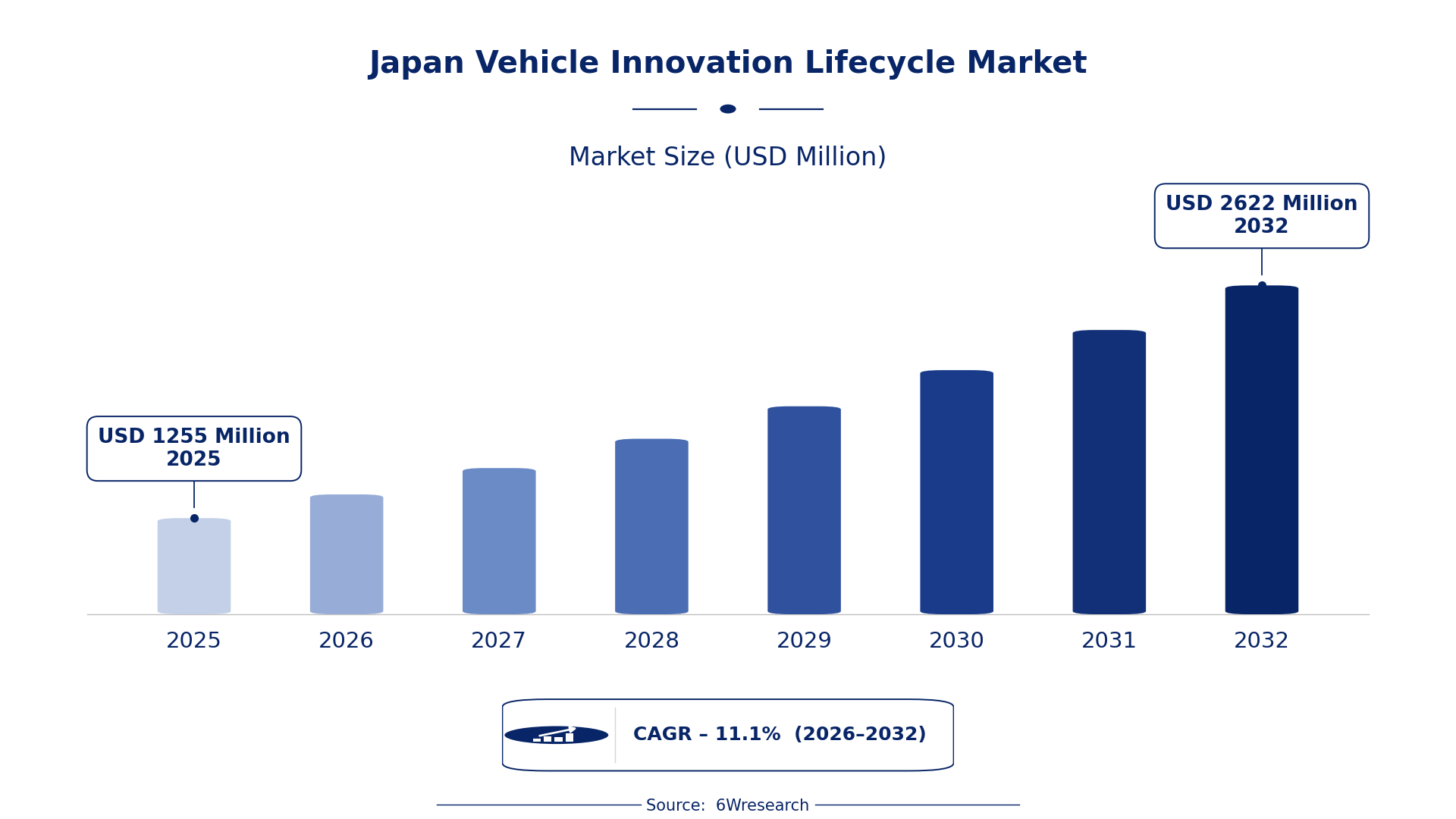
According to 6Wresearch internal database and industry insights, the Japan Vehicle Innovation Lifecycle Market was valued at USD 1,255 Million in 2025 and is projected to reach USD 2,622 Million by 2032, growing at a CAGR of approximately 11.1% during 2026–2032.
Japan Vehicle Innovation Lifecycle Market Highlights
| Report Metric | Details |
| Report Name | Japan Vehicle Innovation Lifecycle Market (2026-2032) |
| Market Size 2025 | USD 1,255 Million |
| Market Size 2032 | USD 2,622 Million |
| Absolute Growth 2025–2032 | USD 1,367 Million |
| CAGR 2026–2032 | 11.1% |
| Peak Annual Growth | 13.1% in 2032 |
| Forecast Period | 2026–2032 |
| Historical Data | 2022–2025 |
| Base Year | 2025 |
| Leading Innovation Stage, 2025 | Commercialization (43% share) |
| Leading Technology Area, 2025 | Electrification (40% share) |
| Leading Distribution Channel, 2025 | Internal R&D (39% share) |
| Leading End User, 2025 | Automotive OEMs (41% share) |
| Fastest-Growing Innovation Stage | Prototyping (15.2% CAGR) |
| Fastest-Growing Technology Area | Smart Mobility (13.8% CAGR) |
| Fastest-Growing Distribution Channel | Collaborations (14.4% CAGR) |
| Fastest-Growing End User | EV Companies (14.8% CAGR) |
| Growing Sector | automotive technology |
| Key End Users | automotive OEMs, technology firms, research institutions, suppliers |
Japan Vehicle Innovation Lifecycle Market Year-wise Growth Rate and Key Drivers (2022–2032)
This graph illustrates the annual growth rates of the market from 2022 to 2032, highlighting a steady upward trajectory and projected market expansion over the forecast period.
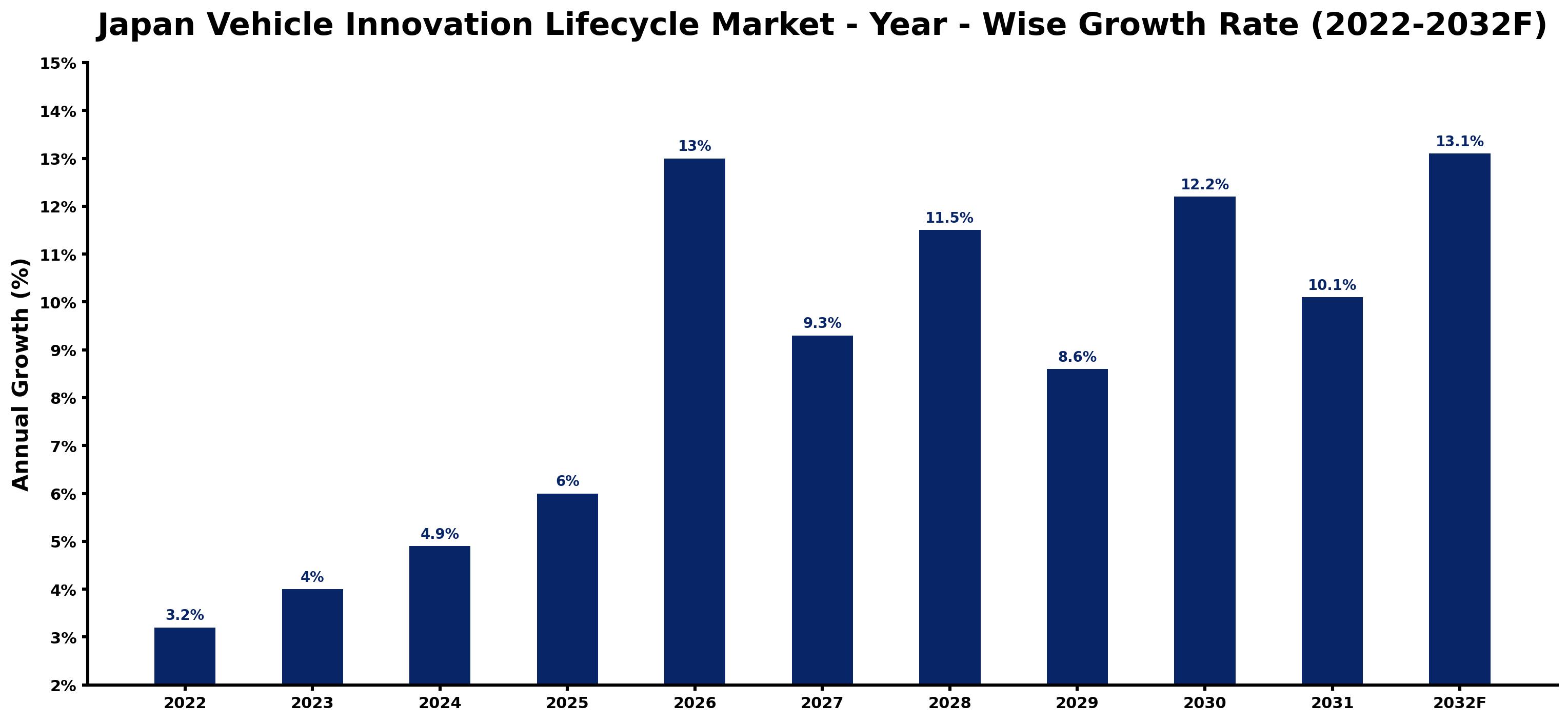
For each year, the table pairs the estimated growth rate with the leading influence on demand, showing how the drivers changed across the period.
| Year | Estimated Annual Growth (%) | Market Rationale |
| 2022 | 3.2 | The market experienced steady growth, reflecting ongoing demand for advanced vehicle technologies. |
| 2023 | 4.0 | Growth accelerated due to increased investments in electrification and connectivity solutions. |
| 2024 | 4.9 | The rise in development activities for autonomous systems contributed to higher growth rates. |
| 2025 | 6.0 | The market peaked as major automotive OEMs ramped up production of electric vehicles. |
| 2026 | 13.0 | Demand surged as the focus on sustainable transport and emissions reduction intensified. |
| 2027 | 9.3 | Growth slowed slightly as the market adjusted to the rapid expansion of the previous year. |
| 2028 | 11.5 | A renewed interest in smart mobility solutions drove growth back up. |
| 2029 | 8.6 | The market experienced a slowdown, reflecting a maturation phase in vehicle innovation. |
| 2030 | 12.2 | Growth accelerated again as government targets for electric vehicles spurred investments. |
| 2031 | 10.1 | The market slowed as companies consolidated their positions and focused on efficiency. |
| 2032 | 13.1 | Demand peaked as advancements in technology and infrastructure aligned with consumer needs. |
Note: Market size estimations and growth projections presented in this report are based on 6Wresearch's proprietary forecasting methodology, utilizing the latest available industry data, government publications, and primary research inputs.
Japan Vehicle Innovation Lifecycle Market Synopsis
The Vehicle Innovation Lifecycle encompasses the development stages of advanced automotive technologies such as electrification, connectivity, and autonomous systems, aimed at improving performance and safety. The Japan Vehicle Innovation Lifecycle Market is expanding due to strong domestic demand from automotive OEMs, substantial investments in R&D exceeding $10 billion annually, and government initiatives targeting 50% of new vehicles to be electric by 2030. This growth reflects a collaborative approach among manufacturers, technology firms, and research institutions.
Market Dynamics Impact Analysis (2026–2032)
| Factor | Type | Impact | Primary Segment Affected |
| Increased investments in electrification technologies | Driver | High | Electrification |
| Growing demand for connected vehicle features | Driver | High | Connectivity |
| Expansion of testing facilities for automotive innovations | Opportunity | Medium | Testing Facilities |
| Emergence of collaborations between tech firms and automotive OEMs | Opportunity | High | Collaborations |
| High costs associated with R&D in automotive technologies | Restraint | High | Internal R&D |
| Limited availability of skilled workforce in advanced automotive technologies | Restraint | Medium | Electrification |
| Rising competition from global automotive markets | Challenge | High | Automotive OEMs |
| Challenges in meeting stringent safety and environmental regulations | Challenge | Medium | Product Design |
Evaluation of Drivers in Japan Vehicle Innovation Lifecycle Market (2026–2032)
The table below links each growth driver to the segment it affects and the evidence for it.
| Drivers | Primary Segment Affected | Why It Matters (Evidence) |
| Investments in electrification initiatives | Electrification | The government aims for 50% of new vehicles to be electric by 2030, driving demand for EV technologies. |
| Consumer demand for connected vehicles | Connectivity | The Tokyo Motor Show showcases innovations, reflecting a growing interest in smart vehicle features. |
| Focus on autonomous vehicle development | Autonomous Tech | The GX Promotion Act supports advancements in self-driving technologies, leading to more investments. |
| Collaboration between automotive OEMs and technology firms | Collaborations | Partnerships are essential for sharing resources and knowledge, driving innovation in vehicle technology. |
| Expansion of automotive testing facilities | Testing Facilities | Japan has over 200 testing facilities, enabling rigorous validation of vehicle performance and safety. |
The Tokyo Motor Show highlights increasing consumer demand for connected vehicles, prompting OEMs to improve smart features. Partnerships between automotive manufacturers and technology firms are vital for resource sharing, while Japan's extensive network of over 200 testing facilities supports rigorous validation processes. These factors drive demand across the Vehicle Innovation Lifecycle.
Evaluation of Restraints in Japan Vehicle Innovation Lifecycle Market
The following restraints limit how fast demand can grow.
| Market Restraint | Primary Segment Affected | Why It Matters (Evidence) |
| High costs associated with R&D in advanced automotive technologies | Internal R&D | R&D expenditures exceed $10 billion annually, limiting funds available for other operational needs. |
| Limited availability of skilled workforce in advanced automotive technologies | Electrification | The shortage of qualified professionals hampers the pace of innovation and development in the sector. |
| Stringent safety and environmental regulations | Product Design | Compliance with ISO 26262 and other standards increases production costs and complexity. |
| Competition from global automotive manufacturers | Automotive OEMs | Intense competition pressures local firms to innovate rapidly, straining resources and focus. |
| Market saturation in certain vehicle segments | Commercialization | The oversupply of conventional vehicles limits growth opportunities for new innovations. |
Japan Vehicle Innovation Lifecycle Market Challenges
Buyers face increasing costs as the government mandates that 50% of new vehicles be electric by 2030, compelling them to invest in new technologies. Competition intensifies among over 30 major automotive OEMs, which can erode profit margins for buyers and producers alike. Regulatory requirements, such as compliance with ISO 26262, demand extensive testing and documentation, delaying product launches for manufacturers and impacting market readiness. Skills shortages in advanced automotive technologies hinder innovation, making it difficult for producers to adapt to evolving market demands and affecting the employment of over 5 million people in the sector.
Trends in the Japan Vehicle Innovation Lifecycle Market
The shifts below are changing how Japan Vehicle Innovation Lifecycle Market products are bought and supplied.
- Shift towards Electric Vehicles: The automotive sector is increasingly adopting electric vehicles, driven by government targets for sustainability. The GX Basic Policy aims for 50% of new vehicles to be electric by 2030, resulting in a surge in EV production.
- Increase in Collaborative Innovations: Collaborations between automotive OEMs and technology firms are on the rise, particularly in Tokyo. This trend is demonstrated by numerous partnerships formed to improve vehicle connectivity and performance, reflecting a shift in innovation strategies.
- Growing Focus on Smart Mobility Solutions: The demand for smart mobility solutions is expanding, particularly in urban areas. The Smart Mobility Challenge program supports startups, fostering innovation in transportation solutions and addressing urban congestion.
- Advancements in Autonomous Technologies: The development of autonomous vehicle technologies is accelerating, with significant investments from various stakeholders. The Future Automotive Strategy aims to advance self-driving capabilities, reflecting a shift towards automation in transportation.
Investment Opportunities in the Japan Vehicle Innovation Lifecycle Market
Investors looking at the Japan Vehicle Innovation Lifecycle Market should consider the following areas.
- Tokyo as a Hub for Automotive R&D: Tokyo is a leading region for automotive innovation, with over 100 active industry associations. Investment in R&D facilities is essential now as the market seeks to develop advanced technologies.
- Collaborative Ventures in Automotive Technology: Collaborations between firms are important for innovation. Engaging with local automotive OEMs and tech firms can facilitate entry into the market, especially in electrification and connectivity.
- Growing Demand for EV Infrastructure: The need for EV charging infrastructure is rising, particularly in urban areas. Investing in charging stations can meet the needs of automotive OEMs and local governments aiming for electric vehicle targets.
- Investment in Testing Facilities: With over 200 automotive testing facilities in Japan, there is a notable opportunity to improve validation processes. Partnering with local testing centres can streamline product development and compliance.
Government Initiatives in the Japan Vehicle Innovation Lifecycle Market
The GX Basic Policy, adopted in 2023, aims for about JPY 150 trillion of public-private decarbonisation investment over 10 years. This policy framework promotes the Vehicle Innovation Lifecycle by encouraging investments in electrification and connectivity, which are essential for sustainable automotive technologies.
The Battery Industry Strategy, launched by METI in August 2022, focuses on increasing domestic battery manufacturing capacity by 2030. This initiative aims to strengthen the EV market by ensuring a stable supply of batteries for electric vehicles, directly impacting the Vehicle Innovation Lifecycle and its buyers.
Future Insight of the Japan Vehicle Innovation Lifecycle Market
By 2032, buyers will benefit from enhanced vehicle performance due to the government's push for electric vehicles, with 50% of new vehicles expected to meet this target. The introduction of the 'Connected Car Strategy' will improve vehicle connectivity, providing consumers with smarter options. Investment in R&D will surpass $10 billion annually, driving technological advancements in the automotive sector. New standards like JIS D 0001 will streamline design and manufacturing processes, enabling suppliers to operate more efficiently and respond better to market needs.
Market Segmentation Analysis
Japan Vehicle Innovation Lifecycle Market report covers a detailed analysis of the following market segments:
By Innovation Stage – Commercialization Leads, Prototyping Expected to Grow Fastest
According to Saurav Kr Singh, Senior Research Analyst at 6Wresearch, in 2025, Commercialization led the innovation stage split with a 43% share. The commercialization stage holds the largest share due to its vital role in effectively launching new automotive technologies. The Tokyo Motor Show exemplifies this importance as a key venue for promoting innovations to potential buyers and stakeholders. Prototyping is projected to grow fastest, at a CAGR of 15.2% during 2026–2032. Prototyping is rapidly expanding as it becomes essential for validating design concepts prior to mass production. The presence of over 200 automotive testing facilities in Japan underscores the increasing need for rigorous testing in this sector. Suppliers must enhance their prototyping capabilities to meet the growing demand for validated designs.
By Technology Area – Electrification Leads, Smart Mobility Expected to Grow Fastest
Electrification held 40% of the Japan Vehicle Innovation Lifecycle Market by technology area in 2025. Electrification leads the market as it significantly impacts the shift towards electric vehicles, aligning with Japan's target for 50% of new vehicles to be electric by 2030. This strong governmental support for EV development highlights its critical importance in the automotive sector. The quickest growth will come from Smart Mobility, forecast to expand at a CAGR of 13.8% between 2026 and 2032. Smart mobility is the fastest-growing area, driven by the urgent need for enhanced urban transportation solutions. Initiatives such as the 'Connected Car Strategy' introduced in 2023 reflect the increasing focus on advancements in this field. Buyers should prioritise partnerships that advance smart mobility solutions to remain competitive in the changing market.
By Distribution Channel – Internal R&D Leads, Collaborations Expected to Grow Fastest
With 39% of distribution channel revenue in 2025, Internal R&D was the largest category. Internal R&D dominates as it is crucial for fostering innovation within automotive companies, ensuring they stay at the forefront of technology development. The substantial annual investment in R&D, exceeding $10 billion, illustrates this commitment to innovation. Over 2026–2032, Collaborations are expected to post the fastest growth, at a CAGR of 14.4%. Collaborations are experiencing rapid growth as they facilitate knowledge sharing and resource pooling among various stakeholders in the automotive industry. The government's encouragement of international collaborations further propels this trend forward. Suppliers should pursue strategic partnerships to effectively leverage shared expertise and resources.
By End User – Automotive OEMs Lead, EV Companies Expected to Grow Fastest
Automotive OEMs accounted for 41% of the market by end user in 2025. Automotive OEMs represent the largest user group as they are the primary drivers of the innovation lifecycle, directly influencing market trends and technology adoption. Their significant contribution to Japan's GDP highlights their pivotal role in the automotive sector. EV Companies are set to record the highest CAGR in this split, 14.8% over 2026–2032. EV companies are the fastest-growing segment, reflecting the surge in demand for electric vehicle technologies. Their involvement in developing sustainable transport solutions aligns with Japan's environmental objectives and government initiatives. Suppliers must align their offerings with the evolving needs of EV companies to capitalise on this growth.
Key Attractiveness of the Report
- 10 Years of Market Numbers
- Historical Data Starting from 2022 to 2025
- Base Year 2025
- Forecast Data until 2032
- Key Performance Indicators Impacting the Market
- Major Upcoming Developments and Projects
Key Highlights of the Report:
- Japan Vehicle Innovation Lifecycle Market Outlook
- Market Size of Japan Vehicle Innovation Lifecycle Market, 2025
- Forecast of Japan Vehicle Innovation Lifecycle Market, 2032
- Historical Data and Forecast of Japan Vehicle Innovation Lifecycle Revenues & Volume for the Period 2022-2032F
- Japan Vehicle Innovation Lifecycle Market Trend Evolution
- Japan Vehicle Innovation Lifecycle Market Drivers and Challenges
- Japan Vehicle Innovation Lifecycle Price Trends
- Japan Vehicle Innovation Lifecycle Porter's Five Forces
- Japan Vehicle Innovation Lifecycle Industry Life Cycle
- Historical Data and Forecast of Japan Vehicle Innovation Lifecycle Market Revenues & Volume By Innovation Stage for the Period 2022-2032F
- Historical Data and Forecast of Japan Vehicle Innovation Lifecycle Market Revenues & Volume By Concept Development for the Period 2022-2032F
- Historical Data and Forecast of Japan Vehicle Innovation Lifecycle Market Revenues & Volume By Product Design for the Period 2022-2032F
- Historical Data and Forecast of Japan Vehicle Innovation Lifecycle Market Revenues & Volume By Prototyping for the Period 2022-2032F
- Historical Data and Forecast of Japan Vehicle Innovation Lifecycle Market Revenues & Volume By Commercialization for the Period 2022-2032F
- Historical Data and Forecast of Japan Vehicle Innovation Lifecycle Market Revenues & Volume By Technology Area for the Period 2022-2032F
- Historical Data and Forecast of Japan Vehicle Innovation Lifecycle Market Revenues & Volume By Electrification for the Period 2022-2032F
- Historical Data and Forecast of Japan Vehicle Innovation Lifecycle Market Revenues & Volume By Connectivity for the Period 2022-2032F
- Historical Data and Forecast of Japan Vehicle Innovation Lifecycle Market Revenues & Volume By Autonomous Tech for the Period 2022-2032F
- Historical Data and Forecast of Japan Vehicle Innovation Lifecycle Market Revenues & Volume By Smart Mobility for the Period 2022-2032F
- Historical Data and Forecast of Japan Vehicle Innovation Lifecycle Market Revenues & Volume By Distribution Channel for the Period 2022-2032F
- Historical Data and Forecast of Japan Vehicle Innovation Lifecycle Market Revenues & Volume By Internal R&D for the Period 2022-2032F
- Historical Data and Forecast of Japan Vehicle Innovation Lifecycle Market Revenues & Volume By Collaborations for the Period 2022-2032F
- Historical Data and Forecast of Japan Vehicle Innovation Lifecycle Market Revenues & Volume By Tech Labs for the Period 2022-2032F
- Historical Data and Forecast of Japan Vehicle Innovation Lifecycle Market Revenues & Volume By Online Startups for the Period 2022-2032F
- Historical Data and Forecast of Japan Vehicle Innovation Lifecycle Market Revenues & Volume By End User for the Period 2022-2032F
- Historical Data and Forecast of Japan Vehicle Innovation Lifecycle Market Revenues & Volume By Automotive OEMs for the Period 2022-2032F
- Historical Data and Forecast of Japan Vehicle Innovation Lifecycle Market Revenues & Volume By Tier 1 Suppliers for the Period 2022-2032F
- Historical Data and Forecast of Japan Vehicle Innovation Lifecycle Market Revenues & Volume By Testing Facilities for the Period 2022-2032F
- Historical Data and Forecast of Japan Vehicle Innovation Lifecycle Market Revenues & Volume By EV Companies for the Period 2022-2032F
- Japan Vehicle Innovation Lifecycle Import Export Trade Statistics
- Market Opportunity Assessment By Innovation Stage
- Market Opportunity Assessment By Technology Area
- Market Opportunity Assessment By Distribution Channel
- Market Opportunity Assessment By End User
- Japan Vehicle Innovation Lifecycle Top Companies Market Share
- Japan Vehicle Innovation Lifecycle Competitive Benchmarking By Technical and Operational Parameters
- Japan Vehicle Innovation Lifecycle Company Profiles
- Japan Vehicle Innovation Lifecycle Key Strategic Recommendations
Market Covered
The report covers the following segments.
By Innovation Stage
- Concept Development
- Product Design
- Prototyping
- Commercialization
By Technology Area
- Electrification
- Connectivity
- Autonomous Tech
- Smart Mobility
By Distribution Channel
- Internal R&D
- Collaborations
- Tech Labs
- Online Startups
By End User
- Automotive OEMs
- Tier 1 Suppliers
- Testing Facilities
- EV Companies































