Japan Vehicle Interface Systems Market Size & Growth Rate
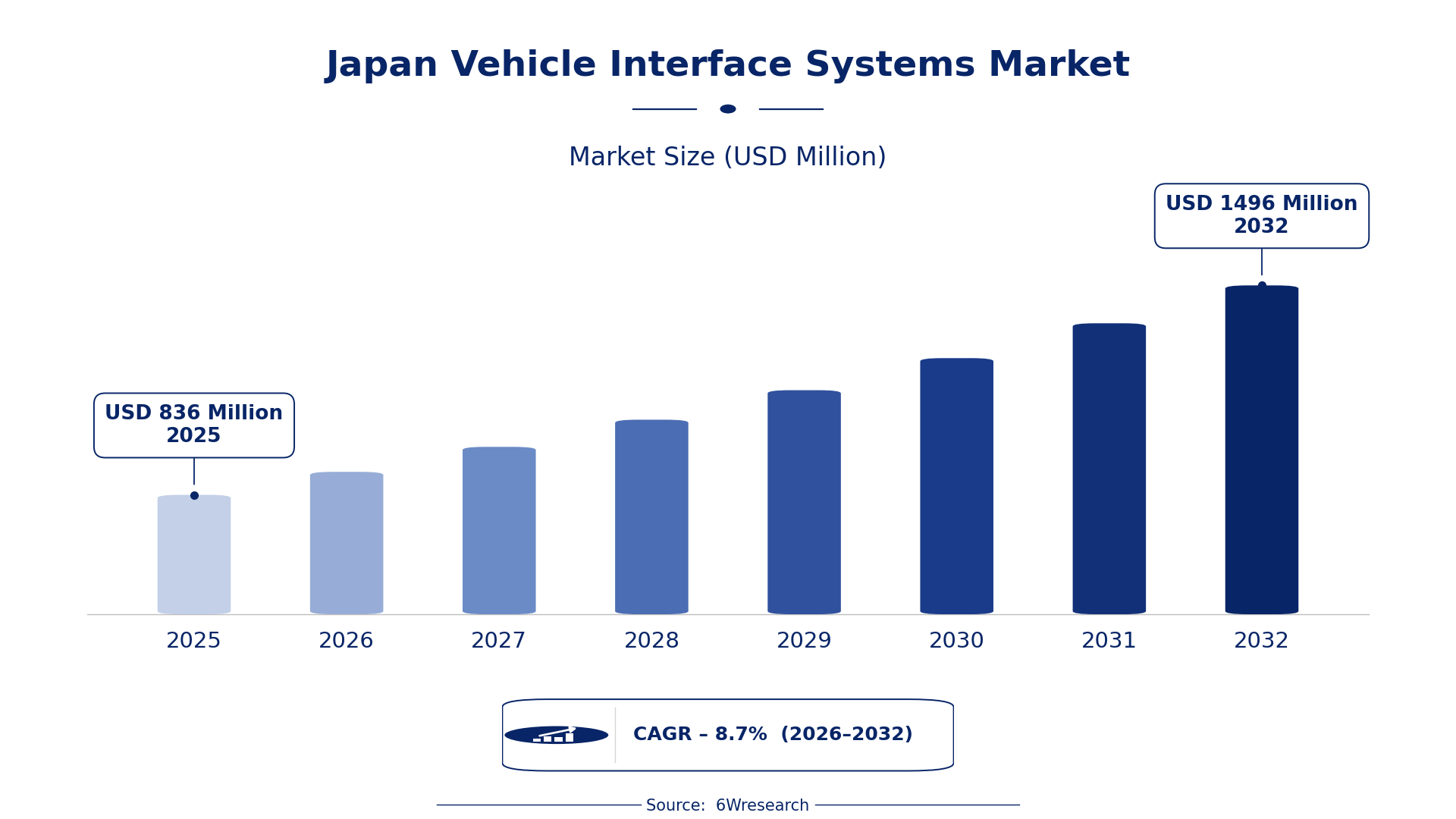
According to 6Wresearch internal database and industry insights, the Japan Vehicle Interface Systems Market was valued at USD 836 Million in 2025 and is projected to reach USD 1,496 Million by 2032, growing at a CAGR of approximately 8.7% during 2026–2032.
Japan Vehicle Interface Systems Market Highlights
| Report Metric | Details |
| Report Name | Japan Vehicle Interface Systems Market (2026-2032) |
| Market Size 2025 | USD 836 Million |
| Market Size 2032 | USD 1,496 Million |
| Absolute Growth 2025–2032 | USD 660 Million |
| CAGR 2026–2032 | 8.7% |
| Peak Annual Growth | 9.8% in 2027 |
| Forecast Period | 2026–2032 |
| Historical Data | 2022–2025 |
| Base Year | 2025 |
| Leading Interface Type, 2025 | Touchscreen Panels (40% share) |
| Leading Control Mechanism, 2025 | Capacitive (51% share) |
| Leading Distribution Channel, 2025 | OEMs (51% share) |
| Leading End User, 2025 | Infotainment Systems (42% share) |
| Fastest-Growing Interface Type | Voice Command Interfaces (12.1% CAGR) |
| Fastest-Growing Control Mechanism | AI-Driven (11.7% CAGR) |
| Fastest-Growing Distribution Channel | Aftermarket (11.3% CAGR) |
| Fastest-Growing End User | Premium Cars (11.6% CAGR) |
| Growing Sector | automotive technology |
| Key End Users | automotive manufacturers, aftermarket suppliers, technology developers |
Japan Vehicle Interface Systems Market Year-wise Growth Rate and Key Drivers (2022–2032)
This graph illustrates the annual growth rates of the market from 2022 to 2032, highlighting a steady upward trajectory and projected market expansion over the forecast period.
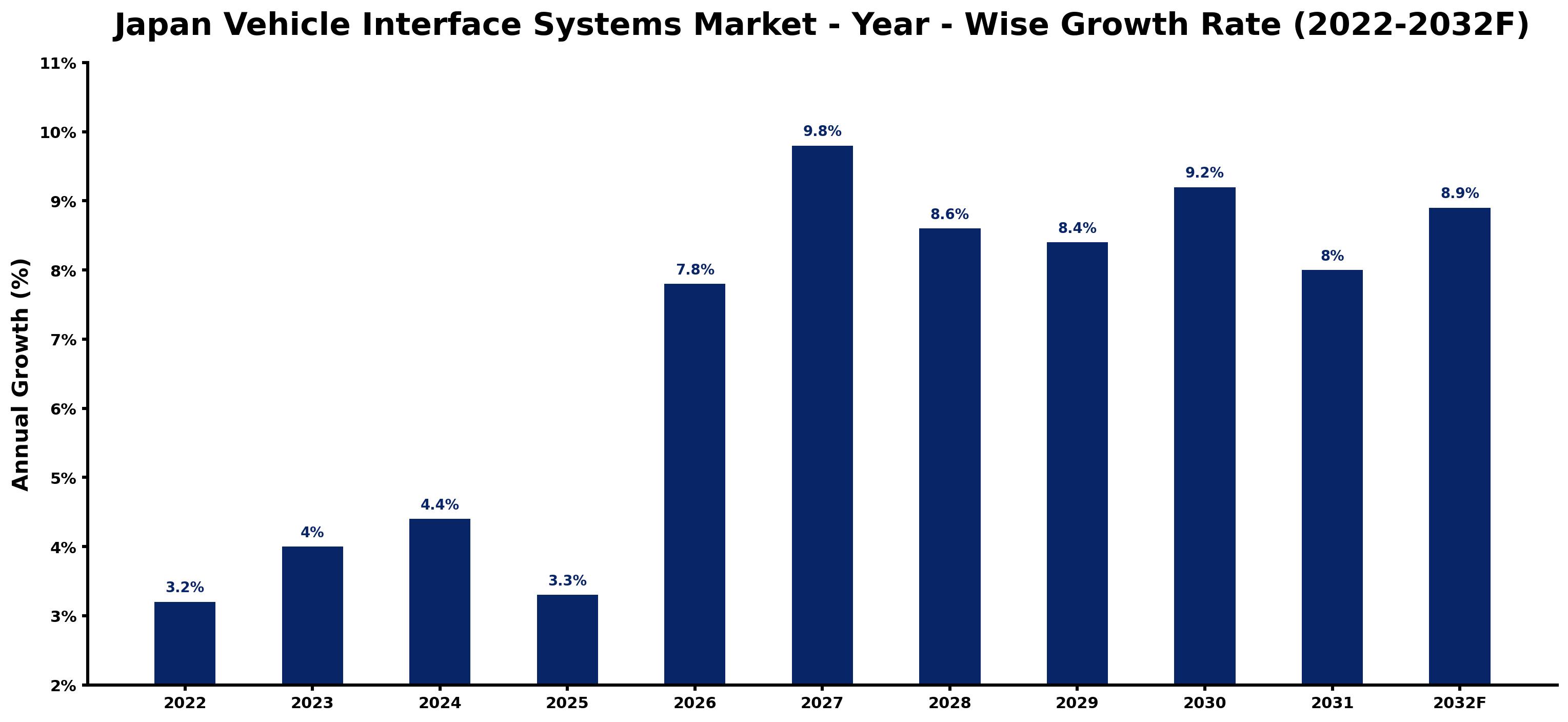
The table below sets out the estimated growth rate for each year and the main factor behind it.
| Year | Estimated Annual Growth (%) | Market Rationale |
| 2022 | 3.2 | The market experienced steady growth due to ongoing demand from domestic manufacturers. |
| 2023 | 4.0 | Growth accelerated as more vehicles adopted advanced infotainment technologies. |
| 2024 | 4.4 | The market continued to expand with increasing integration of touchscreen panels. |
| 2025 | 3.3 | Growth slowed as the market adjusted to saturation in certain segments. |
| 2026 | 7.8 | A rise in demand is anticipated with the introduction of AI-driven systems. |
| 2027 | 9.8 | The peak growth year will see a surge in voice command interfaces. |
| 2028 | 8.6 | Growth is expected to slow slightly as the market stabilises. |
| 2029 | 8.4 | Demand will remain strong, though growth rates will continue to moderate. |
| 2030 | 9.2 | A boost in advanced systems adoption will drive renewed growth. |
| 2031 | 8.0 | The market will see a slowdown as it approaches saturation in some areas. |
| 2032 | 8.9 | Growth will pick up again with new innovations in vehicle interface technologies. |
Note: Market size estimations and growth projections presented in this report are based on 6Wresearch's proprietary forecasting methodology, utilizing the latest available industry data, government publications, and primary research inputs.
Japan Vehicle Interface Systems Market Synopsis
Vehicle Interface Systems facilitate interaction between drivers and vehicles through touchscreens, voice commands, and other controls. The Japan Vehicle Interface Systems Market is growing due to the automotive sector's emphasis on advanced infotainment technologies and the rise of electric and autonomous vehicles. In 2022, 45% of new vehicles sold included these systems, reflecting a shift towards improved driver experience and connectivity. The Tokyo region remains a hub for automotive technology innovation, further supporting market expansion.
Market Dynamics Impact Analysis (2026–2032)
| Factor | Type | Impact | Primary Segment Affected |
| Growing adoption of advanced infotainment systems | Driver | High | Infotainment Systems |
| Increased integration of AI-driven technologies | Driver | High | AI-Driven |
| Expansion of aftermarket services for upgrades | Opportunity | Medium | Aftermarket |
| Rising demand for voice command interfaces in vehicles | Opportunity | High | Voice Command Interfaces |
| High costs associated with advanced technology development | Restraint | High | Capacitive |
| Regulatory compliance requirements for safety standards | Restraint | Medium | Touchscreen Panels |
| Limited availability of skilled workforce in technology sectors | Challenge | High | AI-Driven |
| Intense competition among local manufacturers | Challenge | Medium | OEMs |
Evaluation of Drivers in Japan Vehicle Interface Systems Market (2026–2032)
The main growth drivers and the segments they affect most are set out below.
| Drivers | Primary Segment Affected | Why It Matters (Evidence) |
| Growing demand for electric vehicles | Next-Gen Vehicles | In 2023, over 8 million vehicles were produced, increasing the need for advanced interfaces. |
| Rising consumer preference for integrated infotainment systems | Infotainment Systems | In 2022, 45% of new vehicles sold featured advanced infotainment systems, driving purchases. |
| Technological advancements in AI and machine learning | AI-Driven | Japan's automotive R&D investment was approximately $10 billion in 2023, supporting system capabilities. |
| Increased focus on driver safety and convenience | Voice Command Interfaces | The average age of vehicles in Japan exceeds 13 years, prompting upgrades to modern systems. |
| Expansion of automotive technology hubs in urban areas | Touchscreen Panels | The Tokyo region is a hub for automotive technology innovation, boosting local demand. |
What keeps demand rising is the growing adoption of electric vehicles, with over 8 million vehicles produced in 2023, leading to increased requirements for advanced vehicle interfaces. The preference for integrated infotainment systems is clear, as 45% of new vehicles sold in 2022 featured these technologies, prompting manufacturers to improve their offerings. Japan's automotive R&D investment of approximately $10 billion in 2023 supports advancements in AI and machine learning, further driving demand. The average age of vehicles in Japan exceeds 13 years, compelling consumers to upgrade to modern systems for better safety and convenience. The Tokyo region's status as a hub for automotive technology innovation also contributes to the rising demand for touchscreen panels and voice command interfaces.
Evaluation of Restraints in Japan Vehicle Interface Systems Market
The following restraints limit how fast demand can grow.
| Market Restraint | Primary Segment Affected | Why It Matters (Evidence) |
| High development costs for advanced technologies | AI-Driven | The average price of advanced infotainment systems is around $1,500, impacting affordability. |
| Regulatory compliance for safety and performance standards | Touchscreen Panels | JIS standards govern vehicle interface system safety, requiring significant investment for compliance. |
| Limited availability of skilled workforce in technology sectors | Capacitive | The automotive industry employs approximately 5 million people, but skilled tech workers are in short supply. |
| Intense competition among local manufacturers | OEMs | Japan's automotive exports reached 4.5 million units in 2023, increasing competitive pressure. |
| Slow adoption of gesture-based controls in mainstream vehicles | Gesture-Based Controls | These controls are primarily found in premium models, limiting broader market penetration. |
Japan Vehicle Interface Systems Market Challenges
In 2023, buyers face high costs as the average price of advanced infotainment systems reaches around $1,500, limiting access for many consumers. Producers struggle with delays due to a shortage of skilled workers in technology integration, impacting production timelines for the automotive sector employing approximately 5 million people. Importers deal with compliance to JIS standards, leading to longer delivery times and increased costs for distributors. Buyers are also affected by the average age of vehicles in Japan exceeding 13 years, which drives up demand for aftermarket solutions and strains resources across the market.
Trends in the Japan Vehicle Interface Systems Market
Four trends stand out in the Japan Vehicle Interface Systems Market.
- Shift from Traditional to AI-Driven Interfaces: AI-driven systems are becoming increasingly prevalent, with a projected growth rate of 11.7% in the next five years. This shift improves user interaction and vehicle functionality, appealing to tech-savvy consumers.
- Transition from Physical to Touchscreen Controls: Touchscreen panels are now standard in over 70% of new vehicles, reflecting a shift towards digital interfaces. This change is driven by consumer demand for modern, intuitive controls.
- Premium Vehicles Prioritising Advanced Interfaces: The demand for advanced vehicle interface systems in premium cars is rising, with a CAGR of 11.6%. This trend highlights the importance of technology in attracting high-end buyers.
- Emergence of Gesture-Based Controls in Luxury Models: Gesture-based controls are increasingly integrated into luxury vehicles, with a notable rise expected by 2025. This trend showcases the industry's focus on improving user experience.
Investment Opportunities in the Japan Vehicle Interface Systems Market
Where to invest in the Japan Vehicle Interface Systems Market: the main openings are set out below.
- Vehicle Interface Systems for Electric Vehicles: With Japan targeting a 46% cut in greenhouse-gas emissions by 2030, there is a growing need for advanced vehicle interface systems in electric vehicles. This presents an opportunity for suppliers to engage with automotive manufacturers.
- Aftermarket Upgrades for Aging Vehicles: The average age of vehicles in Japan is over 13 years, indicating a market for aftermarket upgrades. Suppliers can target this segment by offering advanced infotainment systems and controls.
- Investment in Automotive Technology Hubs: The Tokyo region is a hub for automotive technology innovation, attracting investments in advanced vehicle interface systems. Companies can enter this market through partnerships with local manufacturers.
- Expansion of AI-Driven Systems in New Models: With AI-driven systems expected to grow, suppliers can focus on developing these technologies for next-gen vehicles. Engaging with automotive manufacturers will be vital for market entry.
Government Initiatives in the Japan Vehicle Interface Systems Market
The Battery Industry Strategy, initiated by the Ministry of Economy, Trade and Industry in August 2022, aims to boost domestic battery manufacturing capacity by 2030. This initiative supports the development of electric vehicles, which rely heavily on advanced vehicle interface systems for functionality. The GX Promotion Act, adopted in 2023, provides the legal framework for the GX strategy, promoting decarbonisation efforts in the automotive sector.
The Ministry of Economy, Trade and Industry oversees the implementation of various automotive technology development schemes. For instance, the Connected Mobility program improves vehicle connectivity, allowing manufacturers to integrate advanced interface systems. This program supports the automotive industry by facilitating research and development, ensuring that buyers benefit from the latest technologies in vehicle interfaces.
Future Insight of the Japan Vehicle Interface Systems Market
By 2032, the average buyer will benefit from enhanced vehicle connectivity through the government's 'Connected Mobility' program, which will streamline interactions with vehicles. Suppliers will see increased automotive R&D investment, reaching approximately $10 billion, which will drive advancements in vehicle interface technologies. The integration of gesture-based controls in luxury models will improve user interaction. AI-driven systems are projected to significantly enhance functionality and safety features in new vehicles, shaping the future of automotive technology.
Market Segmentation Analysis
Japan Vehicle Interface Systems Market report covers a detailed analysis of the following market segments:
By Interface Type – Touchscreen Panels Lead, Voice Command Interfaces Expected to Grow Fastest
According to Saurav Kr Singh, Senior Research Analyst at 6Wresearch, the largest interface type category in 2025 was Touchscreen Panels, at 40% of revenue. Touchscreen panels dominate the market because they are essential for user interaction, with over 70% of new vehicles in Japan incorporating this technology. Their popularity stems from consumer demand for intuitive controls that significantly enhance the driving experience. Voice Command Interfaces are set to record the highest CAGR in this split, 12.1% over 2026–2032. Voice command interfaces are witnessing rapid growth as they support hands-free operation, addressing the increasing need for safer driving solutions. This trend is further propelled by government initiatives promoting enhanced vehicle connectivity, ensuring a growing market for these systems. Suppliers should focus on developing advanced voice command technologies to meet the rising consumer expectations for safer driving options.
By Control Mechanism – Capacitive Leads, AI-Driven Expected to Grow Fastest
With 51% of control mechanism revenue in 2025, Capacitive was the largest category. Capacitive controls lead the market due to their extensive use in touch interfaces, providing responsive interactions that users prefer. Their established presence in the automotive sector makes them a reliable choice for manufacturers aiming for high-quality user experiences. The quickest growth will come from AI-Driven, forecast to expand at a CAGR of 11.7% between 2026 and 2032. AI-driven mechanisms are set for rapid expansion as they seamlessly integrate with smart systems, reflecting the industry's shift towards automation. This growth is supported by substantial investments in automotive research and development, ensuring a competitive edge in user interaction. Buyers will benefit from a broader range of advanced solutions that improve vehicle functionality and user engagement.
By Distribution Channel – OEMs Lead, Aftermarket Expected to Grow Fastest
OEMs held 51% of the Japan Vehicle Interface Systems Market by distribution channel in 2025. OEMs are the primary distribution channel for new vehicles, ensuring that the latest vehicle interface systems are integrated during manufacturing. This direct connection with vehicle manufacturers solidifies their leading position in the market. Aftermarket is projected to grow fastest, at a CAGR of 11.3% during 2026–2032. The aftermarket segment is growing swiftly as consumers increasingly seek to upgrade and replace existing systems, driven by the average age of vehicles in Japan surpassing 13 years. This trend highlights the rising demand for modernisation in older vehicles, creating opportunities for suppliers. Suppliers should enhance their aftermarket product offerings to capitalise on the increasing demand for upgrades in the ageing vehicle fleet.
By End User – Infotainment Systems Lead, Premium Cars Expected to Grow Fastest
Infotainment Systems took 42% of end user revenue in 2025, more than any other category. Infotainment systems are the leading end user category, representing the core application area for vehicle interface technologies. This is underscored by the fact that 45% of new vehicles sold in 2022 were equipped with advanced infotainment systems, demonstrating their critical role in the market. Over 2026–2032, Premium Cars are expected to post the fastest growth, at a CAGR of 11.6%. Premium cars are experiencing the fastest growth in demand for advanced systems, reflecting consumer preferences for high-quality features and technology. This trend is expected to continue as luxury models increasingly adopt state-of-the-art interface solutions, driving further market expansion. Suppliers must tailor their products to meet the specific requirements of premium car manufacturers to capture this growing segment.
Key Attractiveness of the Report
- 10 Years of Market Numbers
- Historical Data Starting from 2022 to 2025
- Base Year 2025
- Forecast Data until 2032
- Key Performance Indicators Impacting the Market
- Major Upcoming Developments and Projects
Key Highlights of the Report:
- Japan Vehicle Interface Systems Market Outlook
- Market Size of Japan Vehicle Interface Systems Market, 2025
- Forecast of Japan Vehicle Interface Systems Market, 2032
- Historical Data and Forecast of Japan Vehicle Interface Systems Revenues & Volume for the Period 2022-2032F
- Japan Vehicle Interface Systems Market Trend Evolution
- Japan Vehicle Interface Systems Market Drivers and Challenges
- Japan Vehicle Interface Systems Price Trends
- Japan Vehicle Interface Systems Porter's Five Forces
- Japan Vehicle Interface Systems Industry Life Cycle
- Historical Data and Forecast of Japan Vehicle Interface Systems Market Revenues & Volume By Interface Type for the Period 2022-2032F
- Historical Data and Forecast of Japan Vehicle Interface Systems Market Revenues & Volume By Touchscreen Panels for the Period 2022-2032F
- Historical Data and Forecast of Japan Vehicle Interface Systems Market Revenues & Volume By Voice Command Interfaces for the Period 2022-2032F
- Historical Data and Forecast of Japan Vehicle Interface Systems Market Revenues & Volume By Gesture-Based Controls for the Period 2022-2032F
- Historical Data and Forecast of Japan Vehicle Interface Systems Market Revenues & Volume By Haptic Feedback Systems for the Period 2022-2032F
- Historical Data and Forecast of Japan Vehicle Interface Systems Market Revenues & Volume By Control Mechanism for the Period 2022-2032F
- Historical Data and Forecast of Japan Vehicle Interface Systems Market Revenues & Volume By Capacitive for the Period 2022-2032F
- Historical Data and Forecast of Japan Vehicle Interface Systems Market Revenues & Volume By AI-Driven for the Period 2022-2032F
- Historical Data and Forecast of Japan Vehicle Interface Systems Market Revenues & Volume By Optical Sensors for the Period 2022-2032F
- Historical Data and Forecast of Japan Vehicle Interface Systems Market Revenues & Volume By Tactile Touchpads for the Period 2022-2032F
- Historical Data and Forecast of Japan Vehicle Interface Systems Market Revenues & Volume By Distribution Channel for the Period 2022-2032F
- Historical Data and Forecast of Japan Vehicle Interface Systems Market Revenues & Volume By OEMs for the Period 2022-2032F
- Historical Data and Forecast of Japan Vehicle Interface Systems Market Revenues & Volume By Aftermarket for the Period 2022-2032F
- Historical Data and Forecast of Japan Vehicle Interface Systems Market Revenues & Volume By Online Stores for the Period 2022-2032F
- Historical Data and Forecast of Japan Vehicle Interface Systems Market Revenues & Volume By Dealerships for the Period 2022-2032F
- Historical Data and Forecast of Japan Vehicle Interface Systems Market Revenues & Volume By End User for the Period 2022-2032F
- Historical Data and Forecast of Japan Vehicle Interface Systems Market Revenues & Volume By Infotainment Systems for the Period 2022-2032F
- Historical Data and Forecast of Japan Vehicle Interface Systems Market Revenues & Volume By Premium Cars for the Period 2022-2032F
- Historical Data and Forecast of Japan Vehicle Interface Systems Market Revenues & Volume By Next-Gen Vehicles for the Period 2022-2032F
- Historical Data and Forecast of Japan Vehicle Interface Systems Market Revenues & Volume By Luxury Vehicles for the Period 2022-2032F
- Japan Vehicle Interface Systems Import Export Trade Statistics
- Market Opportunity Assessment By Interface Type
- Market Opportunity Assessment By Control Mechanism
- Market Opportunity Assessment By Distribution Channel
- Market Opportunity Assessment By End User
- Japan Vehicle Interface Systems Top Companies Market Share
- Japan Vehicle Interface Systems Competitive Benchmarking By Technical and Operational Parameters
- Japan Vehicle Interface Systems Company Profiles
- Japan Vehicle Interface Systems Key Strategic Recommendations
Market Covered
The following segment groups are covered in the report.
By Interface Type
- Touchscreen Panels
- Voice Command Interfaces
- Gesture-Based Controls
- Haptic Feedback Systems
By Control Mechanism
- Capacitive
- AI-Driven
- Optical Sensors
- Tactile Touchpads
By Distribution Channel
- OEMs
- Aftermarket
- Online Stores
- Dealerships
By End User
- Infotainment Systems
- Premium Cars
- Next-Gen Vehicles
- Luxury Vehicles































