Japan Vehicle Lifecycle Management Market Size & Growth Rate
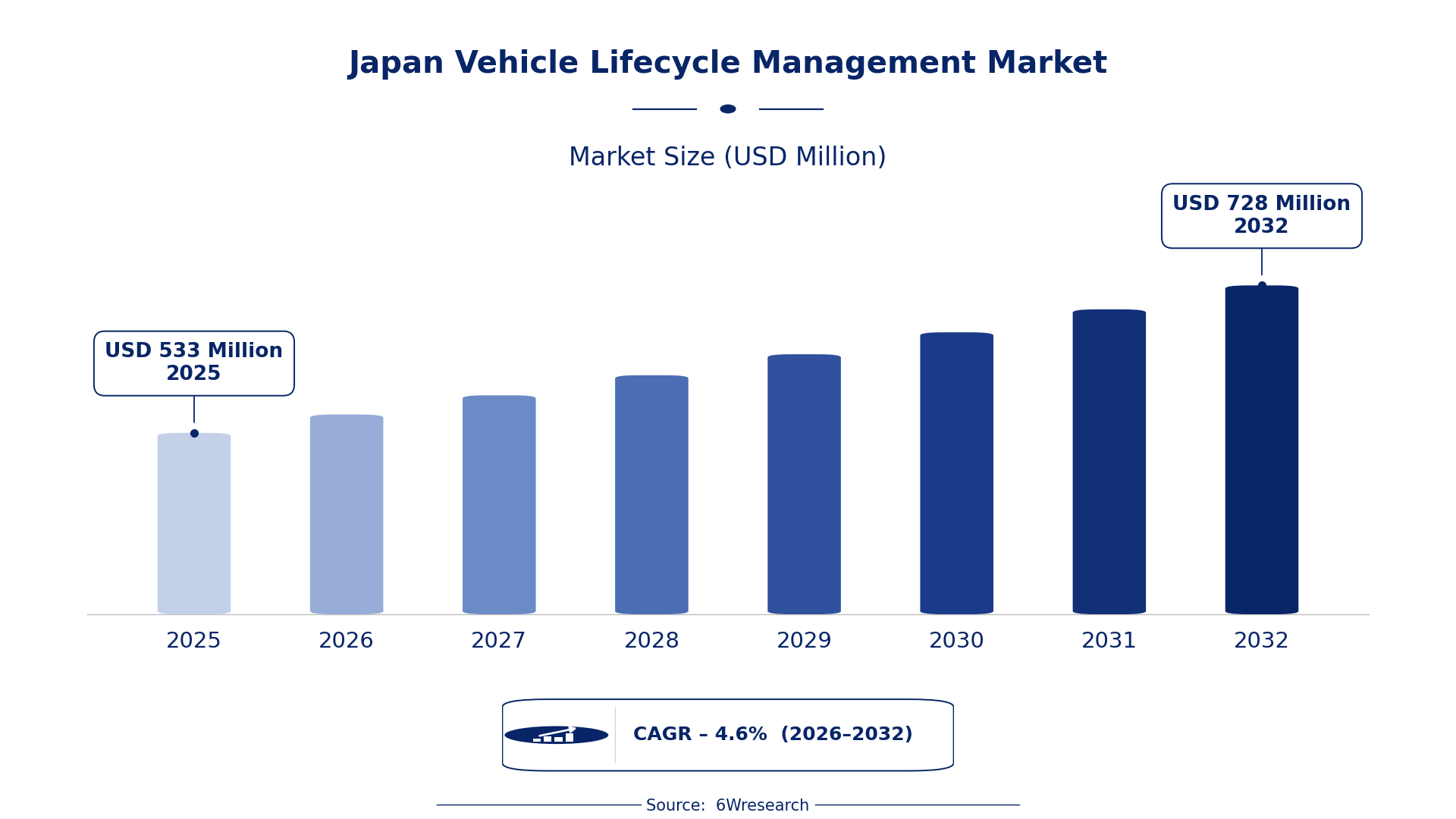
According to 6Wresearch internal database and industry insights, the Japan Vehicle Lifecycle Management Market was valued at USD 533 Million in 2025 and is projected to reach USD 728 Million by 2032, growing at a CAGR of approximately 4.6% during 2026–2032.
Japan Vehicle Lifecycle Management Market Highlights
| Report Metric | Details |
| Report Name | Japan Vehicle Lifecycle Management Market (2026-2032) |
| Market Size 2025 | USD 533 Million |
| Market Size 2032 | USD 728 Million |
| Absolute Growth 2025–2032 | USD 195 Million |
| CAGR 2026–2032 | 4.6% |
| Peak Annual Growth | 5.0% in 2028 |
| Forecast Period | 2026–2032 |
| Historical Data | 2022–2025 |
| Base Year | 2025 |
| Leading Lifecycle Stage, 2025 | Design & Development (37% share) |
| Leading Digital Solution, 2025 | CAD Software (49% share) |
| Leading Distribution Channel, 2025 | OEMs (45% share) |
| Leading End User, 2025 | Vehicle Engineers (45% share) |
| Fastest-Growing Lifecycle Stage | Usage & Service (6.9% CAGR) |
| Fastest-Growing Digital Solution | Telematics & IoT (6.2% CAGR) |
| Fastest-Growing Distribution Channel | Software Vendors (5.9% CAGR) |
| Fastest-Growing End User | Fleet Managers (5.7% CAGR) |
| Growing Sector | automotive manufacturing |
| Key End Users | fleet managers, vehicle engineers, automotive plants, software vendors |
Japan Vehicle Lifecycle Management Market Year-wise Growth Rate and Key Drivers (2022–2032)
This graph illustrates the annual growth rates of the market from 2022 to 2032, highlighting a steady upward trajectory and projected market expansion over the forecast period.
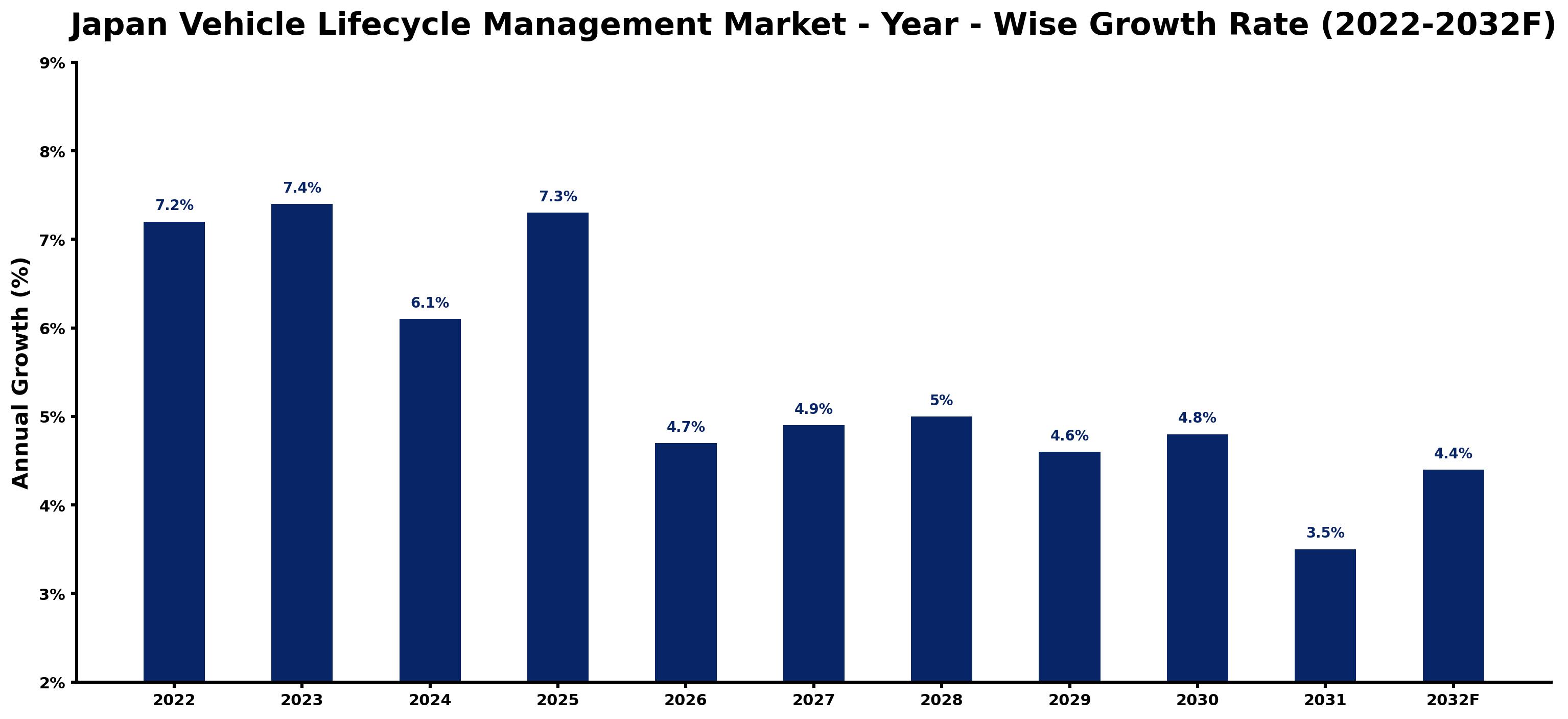
Below, each year's estimated growth is shown next to the factor that most influenced it.
| Year | Estimated Annual Growth (%) | Market Rationale |
| 2022 | 7.2 | The market exhibited strong demand from domestic manufacturers and fleet operators. |
| 2023 | 7.4 | Growth was driven by increased vehicle production and technological advancements in VLM. |
| 2024 | 6.1 | A slowdown occurred as manufacturers adjusted to changing regulatory requirements. |
| 2025 | 7.3 | Demand accelerated again due to rising investments in automotive technology. |
| 2026 | 4.7 | Growth is expected to slow as the market stabilises after rapid expansion. |
| 2027 | 4.9 | Increased adoption of telematics systems is projected to contribute to higher demand. |
| 2028 | 5.0 | A peak in growth is anticipated as manufacturers focus on sustainability. |
| 2029 | 4.6 | Growth is expected to slow as market saturation begins to set in. |
| 2030 | 4.8 | Demand will increase again with new electric vehicle targets set by the government. |
| 2031 | 3.5 | A further slowdown is projected as the market adjusts to evolving standards. |
| 2032 | 4.4 | Growth is expected to pick up as new technologies are integrated into vehicle lifecycle management. |
Note: Market size estimations and growth projections presented in this report are based on 6Wresearch's proprietary forecasting methodology, utilizing the latest available industry data, government publications, and primary research inputs.
Japan Vehicle Lifecycle Management Market Synopsis
Vehicle Lifecycle Management (VLM) encompasses the entire lifecycle of a vehicle, from design and development to retirement and recycling. This technology optimises vehicle performance and sustainability through various software solutions. The Japan Vehicle Lifecycle Management Market is expanding due to strong demand from domestic manufacturers, fleet operators, and the growing adoption of telematics systems. With the automotive industry contributing approximately 20% to the GDP, the market is set for growth driven by investments in electric vehicles and advancements in recycling technologies.
Market Dynamics Impact Analysis (2026–2032)
| Factor | Type | Impact | Primary Segment Affected |
| Increased vehicle production rates | Driver | High | Manufacturing |
| Growing emphasis on sustainability practices | Driver | High | Retirement & Recycling |
| Rising demand for telematics systems | Opportunity | High | Telematics & IoT |
| Investment in electric vehicle infrastructure | Opportunity | High | Design & Development |
| High competition among software vendors | Restraint | Medium | Software Vendors |
| Regulatory compliance costs for manufacturers | Restraint | High | Manufacturing |
| Technological integration challenges | Challenge | High | Usage & Service |
| Market saturation in traditional automotive solutions | Challenge | Medium | Design & Development |
Evaluation of Drivers in Japan Vehicle Lifecycle Management Market (2026–2032)
Below are the drivers that matter most for revenue growth, with supporting evidence.
| Drivers | Primary Segment Affected | Why It Matters (Evidence) |
| Increased vehicle production rates | Manufacturing | Over 5 million vehicles produced annually drive demand for VLM solutions to optimise processes. |
| Growing emphasis on sustainability practices | Retirement & Recycling | The Automotive Industry Association promotes sustainable practices, leading to increased recycling efforts. |
| Rising demand for telematics systems | Telematics & IoT | Telematics systems are implemented in 60% of new vehicles, improving connectivity and management. |
| Investment in electric vehicle infrastructure | Design & Development | The government targets a 20% electric vehicle adoption by 2025, boosting demand for VLM technologies. |
| Adoption of CAD software | CAD Software | CAD software is widely used in over 80% of automotive design processes, driving demand for VLM. |
Much of the new demand traces back to the Tokyo region, where the automotive industry thrives, contributing approximately 20% to Japan's GDP. The production of over 5 million vehicles annually necessitates efficient manufacturing processes, driving the adoption of VLM solutions. The target to increase electric vehicle adoption to 20% by 2025 encourages manufacturers to invest in new technologies. The implementation of telematics systems in 60% of new vehicles improves real-time monitoring and management. Consequently, fleet managers are increasingly utilising VLM to optimise fleet performance and maintenance schedules.
Evaluation of Restraints in Japan Vehicle Lifecycle Management Market
The main factors holding the market back are set out below.
| Market Restraint | Primary Segment Affected | Why It Matters (Evidence) |
| High competition among software vendors | Software Vendors | The presence of numerous software vendors increases costs and complicates decision-making for buyers. |
| Regulatory compliance costs for manufacturers | Manufacturing | Compliance with ISO 26262 and other standards raises operational costs for automotive manufacturers. |
| Integration challenges with existing systems | Usage & Service | Integrating new technologies into existing systems can delay implementation and increase costs. |
| Market saturation in traditional automotive solutions | Design & Development | As the market matures, demand for traditional solutions may plateau, limiting growth potential. |
| Limited awareness of VLM benefits | Retirement & Recycling | Many manufacturers are unaware of the advantages of VLM, hindering widespread adoption. |
Japan Vehicle Lifecycle Management Market Challenges
Over 5 million vehicles produced annually in Japan indicates a pressing need for advanced technology in vehicle lifecycle management. Many manufacturers still depend on outdated systems, raising production costs by up to 15% for producers. Regulatory compliance with standards from the Ministry of Land, Infrastructure, Transport and Tourism often delays product launches for buyers by an average of six months. Fleet operators encounter escalating operational costs, as over 200,000 registered fleets necessitate substantial investment in management software to stay competitive. A shortage of skilled automotive engineers can result in a potential 10% decrease in productivity for companies reliant on advanced engineering talent.
Trends in the Japan Vehicle Lifecycle Management Market
Below are the shifts with the largest effect on the Japan Vehicle Lifecycle Management Market.
- Shift towards Sustainable Practices: In 2023, Japan launched a program to enhance vehicle recycling technologies, aiming for a 46% cut in greenhouse-gas emissions by 2030. This shift prioritises sustainable practices in the automotive sector, encouraging manufacturers to adopt VLM solutions.
- Increase in Telematics Adoption: Telematics & IoT are becoming essential, with 60% of new vehicles implementing these systems. This trend reflects the growing need for real-time vehicle monitoring, driving demand for VLM technologies.
- Focus on Electric Vehicle Infrastructure: The government aims for 20% electric vehicle adoption by 2025, prompting manufacturers to invest in VLM solutions. This focus on electric vehicles is reshaping the automotive sector in Japan.
- Integration of Advanced CAD Software: CAD Software accounted for 49% of the Digital Solution segment in 2025, highlighting its critical role in automotive design processes. This integration improves efficiency and innovation in vehicle lifecycle management.
Investment Opportunities in the Japan Vehicle Lifecycle Management Market
Where to invest in the Japan Vehicle Lifecycle Management Market: the main openings are set out below.
- Investment in Electric Vehicle Technologies: With the government's target of 20% electric vehicle adoption by 2025, there is an opportunity for investment in VLM solutions tailored for electric vehicles. Fleet managers are increasingly seeking advanced tools to manage their electric fleets.
- Expansion of Telematics Solutions: The growing implementation of telematics systems in 60% of new vehicles presents an opportunity for software vendors to provide innovative VLM solutions. Collaborating with automotive plants can facilitate market entry.
- Development of Recycling Technologies: The recent program launched in 2023 to enhance vehicle recycling technologies creates an opportunity for investment in sustainable practices. Sustainability agencies are key partners in this initiative.
- Enhancement of Design Processes: The high adoption of CAD software in over 80% of design processes indicates a strong market for advanced design tools. Collaborating with vehicle engineers can lead to successful product development.
Government Initiatives in the Japan Vehicle Lifecycle Management Market
The GX Promotion Act (2023) establishes a legal framework for decarbonisation efforts, complementing the Green Growth Strategy aimed at achieving carbon neutrality by 2050. This act mobilises JPY 150 trillion in public-private investment over the next decade, promoting sustainable practices in the automotive sector and impacting Vehicle Lifecycle Management by encouraging the adoption of eco-friendly technologies.
Fleet managers benefit from the Battery Industry Strategy (METI, August 2022), which supports the transition to electric vehicles by targeting domestic battery manufacturing capacity. This strategy enables fleet operators to adopt VLM solutions that optimise fleet performance and sustainability.
Future Insight of the Japan Vehicle Lifecycle Management Market
Investment in vehicle recycling technologies will rise, creating demand for efficient solutions that benefit suppliers who adapt. The implementation of telematics systems in 60% of new vehicles will enhance connectivity, improving operational efficiency for fleet operators. As manufacturers aim for a target of 20% electric vehicle adoption by 2025, the emphasis on sustainable practices will transform the market landscape. By 2032, the integration of advanced software solutions will streamline processes, leading to improved performance and sustainability across the automotive sector.
Market Segmentation Analysis
Japan Vehicle Lifecycle Management Market report covers a detailed analysis of the following market segments:
By Lifecycle Stage – Design & Development Leads, Usage & Service Expected to Grow Fastest
According to Saurav Kr Singh, Senior Research Analyst at 6Wresearch, Design & Development took 37% of lifecycle stage revenue in 2025, more than any other category. The Design & Development sub-segment holds the largest share due to its critical role in vehicle innovation and compliance with safety regulations like ISO 26262. With Japan producing over 5 million vehicles annually, the need for advanced design solutions is substantial. The quickest growth will come from Usage & Service, forecast to expand at a CAGR of 6.9% between 2026 and 2032. Usage & Service is the fastest-growing sub-segment, primarily due to the increasing implementation of telematics systems in 60% of new vehicles, which enhances vehicle performance management. This segment's growth will likely accelerate as fleet operators focus on optimising maintenance schedules and operational efficiency. This indicates that suppliers must prioritise advancements in Usage & Service solutions to meet the increasing needs of fleet operators.
By Digital Solution – CAD Software Leads, Telematics & IoT Expected to Grow Fastest
CAD Software held 49% of the Japan Vehicle Lifecycle Management Market by digital solution in 2025. CAD Software leads the market due to its critical role in automotive design processes, with over 80% of manufacturers relying on this technology. Its widespread use highlights its importance in the development of new vehicles and compliance with industry standards. Telematics & IoT is set to record the highest CAGR in this split, 6.2% over 2026–2032. Telematics & IoT is the fastest-growing segment, driven by the increasing demand for real-time vehicle monitoring and management, aligning with government initiatives for improved vehicle connectivity. This trend is expected to accelerate as more vehicles adopt these advanced systems. Buyers should prioritise investments in Telematics & IoT solutions to remain competitive in the automotive sector.
By Distribution Channel – OEMs Lead, Software Vendors Expected to Grow Fastest
OEMs accounted for 45% of the market by distribution channel in 2025. OEMs are the leading distribution channel as they are the primary users of VLM solutions for vehicle production, ensuring a steady demand for these technologies. Their central role in the automotive supply chain solidifies their market position. Software Vendors are projected to grow fastest, at a CAGR of 5.9% during 2026–2032. Software Vendors represent the fastest-growing channel, providing essential tools and platforms for VLM, which are increasingly sought after by manufacturers aiming to optimise their operations. This growth is likely to continue as digital transformation in the automotive sector accelerates. Suppliers should consider partnerships with Software Vendors to expand their reach in the market.
By End User – Vehicle Engineers Lead, Fleet Managers Expected to Grow Fastest
With 45% of end user revenue in 2025, Vehicle Engineers was the largest category. Vehicle Engineers represent the largest end user group as they directly utilise VLM tools in their daily activities, ensuring the successful implementation of these technologies. Their expertise is vital for integrating VLM solutions into vehicle design and development processes. Over 2026–2032, Fleet Managers are expected to post the fastest growth, at a CAGR of 5.7%. Fleet Managers are the fastest-growing end user group, utilising VLM for effective fleet management, particularly as the number of registered fleet operators surpasses 200,000. Their increasing reliance on VLM tools reflects a broader trend towards operational efficiency in fleet operations. Vendors should tailor their solutions to meet the specific needs of Fleet Managers to capture this expanding market segment.
Key Attractiveness of the Report
- 10 Years of Market Numbers
- Historical Data Starting from 2022 to 2025
- Base Year 2025
- Forecast Data until 2032
- Key Performance Indicators Impacting the Market
- Major Upcoming Developments and Projects
Key Highlights of the Report:
- Japan Vehicle Lifecycle Management Market Outlook
- Market Size of Japan Vehicle Lifecycle Management Market, 2025
- Forecast of Japan Vehicle Lifecycle Management Market, 2032
- Historical Data and Forecast of Japan Vehicle Lifecycle Management Revenues & Volume for the Period 2022-2032F
- Japan Vehicle Lifecycle Management Market Trend Evolution
- Japan Vehicle Lifecycle Management Market Drivers and Challenges
- Japan Vehicle Lifecycle Management Price Trends
- Japan Vehicle Lifecycle Management Porter's Five Forces
- Japan Vehicle Lifecycle Management Industry Life Cycle
- Historical Data and Forecast of Japan Vehicle Lifecycle Management Market Revenues & Volume By Lifecycle Stage for the Period 2022-2032F
- Historical Data and Forecast of Japan Vehicle Lifecycle Management Market Revenues & Volume By Design & Development for the Period 2022-2032F
- Historical Data and Forecast of Japan Vehicle Lifecycle Management Market Revenues & Volume By Manufacturing for the Period 2022-2032F
- Historical Data and Forecast of Japan Vehicle Lifecycle Management Market Revenues & Volume By Usage & Service for the Period 2022-2032F
- Historical Data and Forecast of Japan Vehicle Lifecycle Management Market Revenues & Volume By Retirement & Recycling for the Period 2022-2032F
- Historical Data and Forecast of Japan Vehicle Lifecycle Management Market Revenues & Volume By Digital Solution for the Period 2022-2032F
- Historical Data and Forecast of Japan Vehicle Lifecycle Management Market Revenues & Volume By CAD Software for the Period 2022-2032F
- Historical Data and Forecast of Japan Vehicle Lifecycle Management Market Revenues & Volume By PLM Tools for the Period 2022-2032F
- Historical Data and Forecast of Japan Vehicle Lifecycle Management Market Revenues & Volume By Telematics & IoT for the Period 2022-2032F
- Historical Data and Forecast of Japan Vehicle Lifecycle Management Market Revenues & Volume By EOL Mgmt Software for the Period 2022-2032F
- Historical Data and Forecast of Japan Vehicle Lifecycle Management Market Revenues & Volume By Distribution Channel for the Period 2022-2032F
- Historical Data and Forecast of Japan Vehicle Lifecycle Management Market Revenues & Volume By OEMs for the Period 2022-2032F
- Historical Data and Forecast of Japan Vehicle Lifecycle Management Market Revenues & Volume By Software Vendors for the Period 2022-2032F
- Historical Data and Forecast of Japan Vehicle Lifecycle Management Market Revenues & Volume By Online Platforms for the Period 2022-2032F
- Historical Data and Forecast of Japan Vehicle Lifecycle Management Market Revenues & Volume By Sustainability Agencies for the Period 2022-2032F
- Historical Data and Forecast of Japan Vehicle Lifecycle Management Market Revenues & Volume By End User for the Period 2022-2032F
- Historical Data and Forecast of Japan Vehicle Lifecycle Management Market Revenues & Volume By Vehicle Engineers for the Period 2022-2032F
- Historical Data and Forecast of Japan Vehicle Lifecycle Management Market Revenues & Volume By Automotive Plants for the Period 2022-2032F
- Historical Data and Forecast of Japan Vehicle Lifecycle Management Market Revenues & Volume By Fleet Managers for the Period 2022-2032F
- Historical Data and Forecast of Japan Vehicle Lifecycle Management Market Revenues & Volume By Regulatory Bodies for the Period 2022-2032F
- Japan Vehicle Lifecycle Management Import Export Trade Statistics
- Market Opportunity Assessment By Lifecycle Stage
- Market Opportunity Assessment By Digital Solution
- Market Opportunity Assessment By Distribution Channel
- Market Opportunity Assessment By End User
- Japan Vehicle Lifecycle Management Top Companies Market Share
- Japan Vehicle Lifecycle Management Competitive Benchmarking By Technical and Operational Parameters
- Japan Vehicle Lifecycle Management Company Profiles
- Japan Vehicle Lifecycle Management Key Strategic Recommendations
Market Covered
Coverage by segment is as follows.
By Lifecycle Stage
- Design & Development
- Manufacturing
- Usage & Service
- Retirement & Recycling
By Digital Solution
- CAD Software
- PLM Tools
- Telematics & IoT
- EOL Mgmt Software
By Distribution Channel
- OEMs
- Software Vendors
- Online Platforms
- Sustainability Agencies
By End User
- Vehicle Engineers
- Automotive Plants
- Fleet Managers
- Regulatory Bodies































