Japan Vehicle Lighting Electronics Market Size & Growth Rate
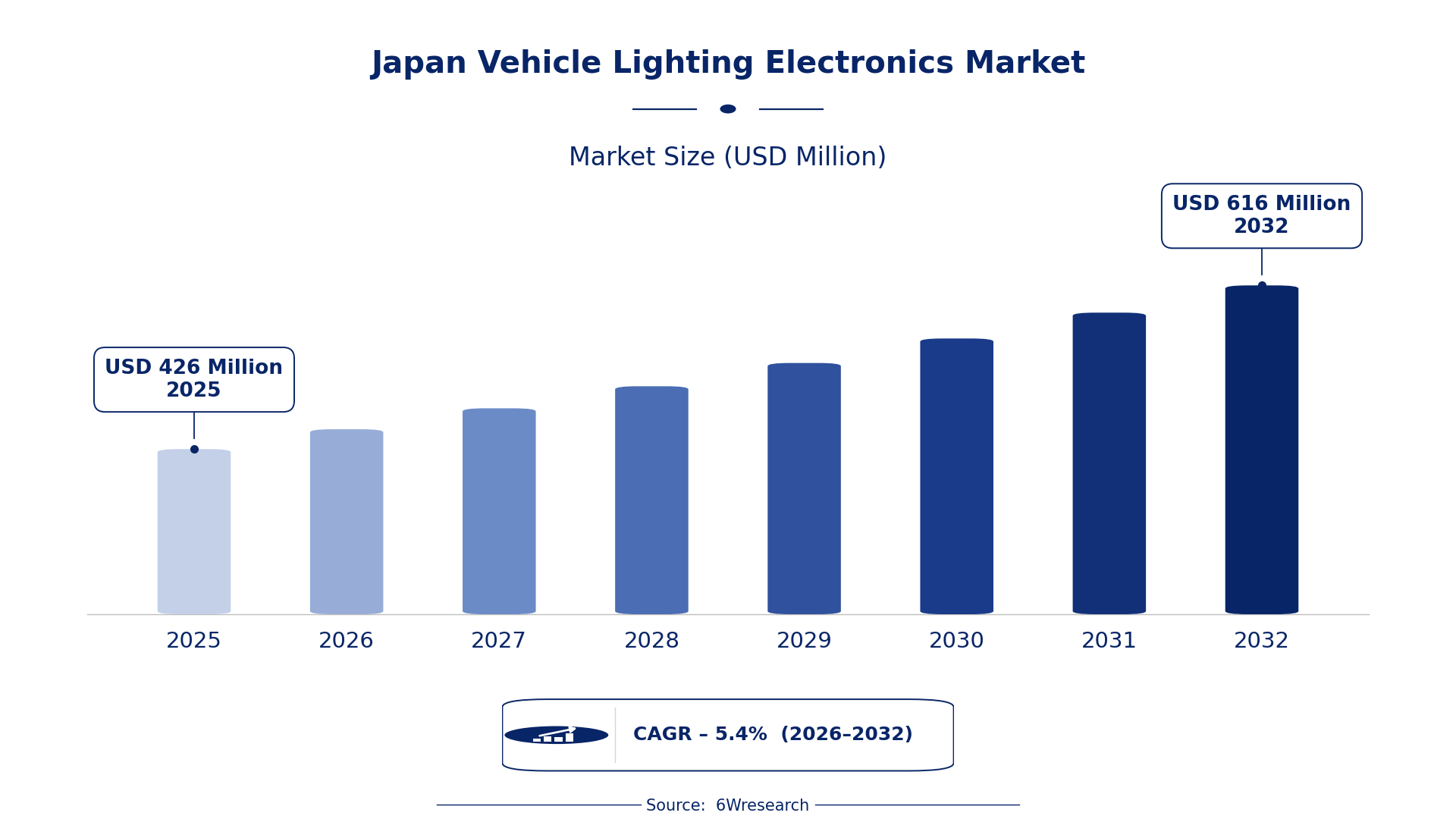
According to 6Wresearch internal database and industry insights, the Japan Vehicle Lighting Electronics Market was valued at USD 426 Million in 2025 and is projected to reach USD 616 Million by 2032, growing at a CAGR of approximately 5.4% during 2026–2032.
Japan Vehicle Lighting Electronics Market Highlights
| Report Metric | Details |
| Report Name | Japan Vehicle Lighting Electronics Market (2026-2032) |
| Market Size 2025 | USD 426 Million |
| Market Size 2032 | USD 616 Million |
| Absolute Growth 2025–2032 | USD 190 Million |
| CAGR 2026–2032 | 5.4% |
| Peak Annual Growth | 6.1% in 2028 |
| Forecast Period | 2026–2032 |
| Historical Data | 2022–2025 |
| Base Year | 2025 |
| Leading Electronic Module Type, 2025 | LED Drivers (44% share) |
| Leading Lighting Application, 2025 | Headlights (40% share) |
| Leading Distribution Channel, 2025 | OEMs (46% share) |
| Leading End User, 2025 | Passenger Cars (45% share) |
| Fastest-Growing Electronic Module Type | Control Units (7.7% CAGR) |
| Fastest-Growing Lighting Application | Adaptive Lighting (7.1% CAGR) |
| Fastest-Growing Distribution Channel | Electronics Distributors (6.9% CAGR) |
| Fastest-Growing End User | Luxury Vehicles (7.2% CAGR) |
| Growing Sector | Passenger Cars |
| Key End Users | OEMs, Luxury Vehicle Manufacturers, Electronics Distributors |
Japan Vehicle Lighting Electronics Market Year-wise Growth Rate and Key Drivers (2022–2032)
This graph illustrates the annual growth rates of the market from 2022 to 2032, highlighting a steady upward trajectory and projected market expansion over the forecast period.
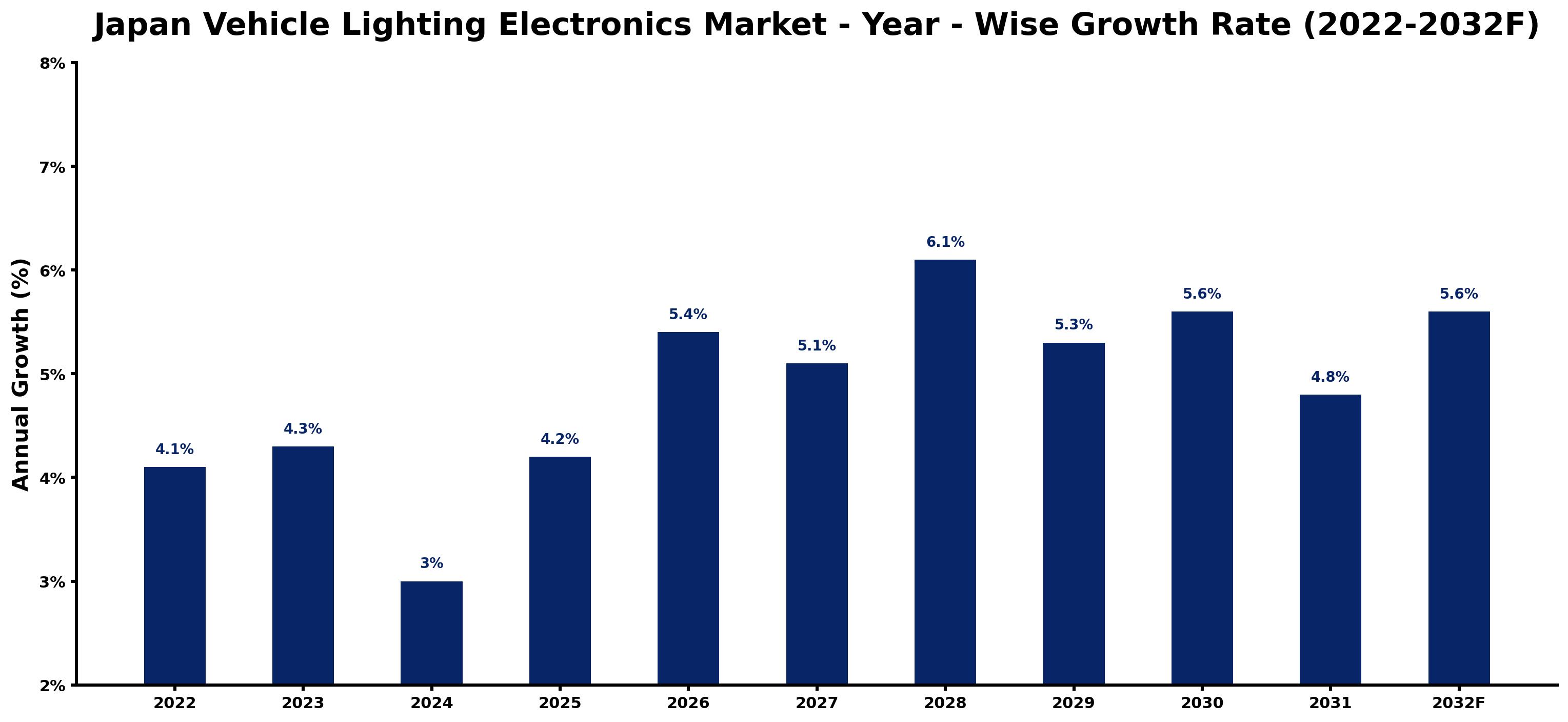
The following figures match every annual growth estimate with the main market development of that year, giving the reasoning behind each rise or slowdown.
| Year | Estimated Annual Growth (%) | Market Rationale |
| 2022 | 4.1 | The automotive sector produced approximately 8.3 million vehicles, driving demand for lighting electronics. |
| 2023 | 4.3 | The adoption of adaptive lighting systems in over 50% of luxury vehicles boosted market activity. |
| 2024 | 3.0 | Growth slowed as manufacturers adjusted to supply chain challenges and market conditions. |
| 2025 | 4.2 | Demand for smart vehicle technologies spurred a faster growth rate in lighting electronics. |
| 2026 | 5.4 | Investment in semiconductor manufacturing is expected to boost production capabilities and market confidence. |
| 2027 | 5.1 | A slight slowdown is projected as the market stabilises after rapid growth in previous years. |
| 2028 | 6.1 | The introduction of advanced adaptive lighting systems will drive market expansion. |
| 2029 | 5.3 | Growth is expected to slow as the market begins to normalise after reaching peak demand levels. |
| 2030 | 5.6 | Increased focus on electric vehicle lighting upgrades will spur renewed market interest. |
| 2031 | 4.8 | The market is projected to experience a slowdown as manufacturers face rising production costs. |
| 2032 | 5.6 | Sustained demand for luxury vehicles with advanced lighting features will support growth. |
Note: Market size estimations and growth projections presented in this report are based on 6Wresearch's proprietary forecasting methodology, utilizing the latest available industry data, government publications, and primary research inputs.
Japan Vehicle Lighting Electronics Market Synopsis
Vehicle lighting electronics are critical components such as LED drivers, control units, and light sensors that improve automotive visibility and safety. The Japan Vehicle Lighting Electronics Market is growing due to strong demand from domestic manufacturers, with adaptive lighting systems increasingly adopted in luxury vehicles. The shift towards smart vehicle technologies and the rising integration of energy-efficient LED lighting are primary growth drivers, supported by government initiatives that promote innovation in the automotive sector.
Market Dynamics Impact Analysis (2026–2032)
| Factor | Type | Impact | Primary Segment Affected |
| Increasing adoption of LED lighting in new vehicles | Driver | High | LED Drivers |
| Growth in luxury vehicle registrations | Driver | High | Adaptive Lighting |
| Expansion of online retail channels for automotive components | Opportunity | Medium | Electronics Distributors |
| Government subsidies for electric vehicle lighting upgrades | Opportunity | High | Control Units |
| Supply chain disruptions affecting component availability | Restraint | High | Light Sensors |
| Rising production costs for semiconductor components | Restraint | Medium | Ballasts & Igniters |
| High costs associated with advanced lighting technology development | Challenge | High | Headlights |
| Competition from international manufacturers in the automotive sector | Challenge | Medium | HID Lights |
Evaluation of Drivers in Japan Vehicle Lighting Electronics Market (2026–2032)
Demand rests on the following drivers, each shown with the segment it touches most.
| Drivers | Primary Segment Affected | Why It Matters (Evidence) |
| Growing demand for energy-efficient lighting solutions | LED Drivers | Around 70% of new vehicles sold in Japan are adopting LED technology, driving demand for efficient lighting solutions. |
| Rising registrations of luxury vehicles | Adaptive Lighting | Over 50% of luxury vehicles in Japan are now equipped with adaptive lighting systems, improving safety and visibility. |
| Increased focus on smart vehicle technologies | Control Units | Smart vehicle technologies are becoming essential, as control units are critical for modern vehicle lighting systems. |
| Expansion of the online retail market for automotive parts | Electronics Distributors | Online retail sales of vehicle lighting components increased by 15% in 2023, expanding consumer access. |
| Government initiatives promoting innovation in vehicle technologies | Ballasts & Igniters | The Automotive Industry Association of Japan supports innovation, encouraging investment in advanced lighting technologies. |
Behind the steady rise in orders sits a shift towards energy-efficient lighting solutions. Approximately 70% of new vehicles sold in Japan now utilise LED technology, which drives demand for LED drivers. Luxury vehicle registrations are increasing, with over 50% of these vehicles equipped with adaptive lighting systems, improving safety. The focus on smart vehicle technologies is clear, as control units are critical for modern systems. The online retail market for vehicle lighting components has expanded, with sales increasing by 15% in 2023, allowing consumers easier access to products.
Evaluation of Restraints in Japan Vehicle Lighting Electronics Market
Below are the constraints most often cited by buyers and suppliers, with the segment each affects.
| Market Restraint | Primary Segment Affected | Why It Matters (Evidence) |
| Supply chain disruptions affecting semiconductor availability | Light Sensors | Supply chain issues have led to delays in component availability, impacting production timelines for lighting systems. |
| Rising production costs for semiconductor components | Ballasts & Igniters | Increased costs for raw materials have raised production expenses, affecting pricing strategies for manufacturers. |
| High development costs for advanced lighting technologies | Headlights | Investing in advanced lighting technologies requires substantial capital, limiting smaller manufacturers' ability to compete. |
| Intense competition from international manufacturers | HID Lights | Domestic manufacturers face pressure from international players, impacting market share and pricing strategies. |
| Regulatory compliance costs for safety standards | Control Units | Compliance with standards like ISO 26262 increases operational costs for manufacturers, affecting profitability. |
Japan Vehicle Lighting Electronics Market Challenges
Buyers face rising costs as the shift towards LED lighting, now present in 70% of new vehicles, requires higher investments in semiconductor technologies. Supply chain disruptions arise because the Tokyo region, a key hub for automotive electronics, struggles with capacity constraints, leading to delays in vehicle assembly. Skills shortages in semiconductor manufacturing impede production efficiency, as the average age of passenger cars in Japan is around 13 years, necessitating skilled workers for system upgrades. Increasing raw material costs raise production expenses, forcing buyers to adjust their pricing strategies and manage tighter margins.
Trends in the Japan Vehicle Lighting Electronics Market
These developments are changing demand patterns in the Japan Vehicle Lighting Electronics Market.
- Shift towards Smart Vehicle Technologies: In 2023, a programme was launched to promote smart vehicle technologies, improving vehicle safety and efficiency. This initiative aligns with Japan's target to cut greenhouse-gas emissions by 46% by 2030.
- Increase in LED Lighting Adoption: Approximately 70% of new vehicles sold in Japan now feature LED lighting, reflecting a shift towards energy-efficient solutions. This trend is expected to drive further demand for LED drivers and related components.
- Growth of Online Retail Channels: The online retail market for vehicle lighting components has expanded, with sales increasing by 15% in 2023. This shift allows consumers easier access to automotive lighting products, influencing purchasing behaviour.
- Rising Demand for Adaptive Lighting Systems: The adoption rate of adaptive lighting systems in luxury vehicles has surpassed 50%, indicating a growing preference for advanced safety features. This trend is likely to influence future vehicle designs and lighting technologies.
Investment Opportunities in the Japan Vehicle Lighting Electronics Market
The opportunities below stand out in the Japan Vehicle Lighting Electronics Market for new entrants and existing suppliers.
- Establish Joint Ventures for Local Manufacturing: Local partnerships can facilitate entry into the Japanese market, especially for lighting electronics. With the automotive sector producing approximately 8.3 million vehicles in 2022, there is a strong demand for locally manufactured components.
- Supply Advanced Lighting Components: Investment in high-efficiency LED drivers is important as the market shifts towards energy-efficient solutions. The luxury vehicle segment, with over 5 million registered vehicles, presents a strong opportunity for suppliers.
- Expand Online Retail Presence: Online retailers can capitalise on the 15% increase in sales of vehicle lighting components by enhancing their product offerings. This trend is particularly relevant in urban areas like Tokyo, where consumer access is growing.
- Target Electric Vehicle Upgrades: With government subsidies available for electric vehicle lighting upgrades, suppliers can focus on providing compliant components. This opportunity is particularly relevant for manufacturers looking to enter the electric vehicle market.
Government Initiatives in the Japan Vehicle Lighting Electronics Market
The GX Promotion Act of 2023 establishes a framework for promoting green technologies, supporting the development of sustainable automotive lighting solutions, which aligns with Japan's commitment to achieving net zero emissions by 2050.
In 2023, funding of approximately USD 300 million was allocated for the Semiconductor and Digital Industry Strategy, administered by the Ministry of Economy, Trade and Industry. This initiative aims to secure domestic semiconductor manufacturing, essential for the production of vehicle lighting electronics.
Future Insight of the Japan Vehicle Lighting Electronics Market
By 2032, buyers will benefit from advancements in vehicle lighting technologies driven by government programmes promoting smart vehicle initiatives. The adoption of new lighting systems will increase, with luxury vehicles expected to feature more adaptive lighting solutions, catering to consumer preferences for improved safety. Implementation of the ISO 26262 standard will ensure compliance with strict functional safety requirements, providing a framework for suppliers to innovate. With approximately 8.3 million vehicles produced in 2022, the demand for cutting-edge lighting components will present substantial opportunities for suppliers to introduce new offerings.
Market Segmentation Analysis
Japan Vehicle Lighting Electronics Market report covers a detailed analysis of the following market segments:
By Electronic Module Type – LED Drivers Lead, Control Units Expected to Grow Fastest
According to Saurav Kr Singh, Senior Research Analyst at 6Wresearch, with 44% of electronic module type revenue in 2025, LED Drivers was the largest category. LED drivers are crucial for powering the LED lights that dominate modern vehicles, making them indispensable in Japan's automotive sector. The prevalence of LED lighting in 70% of new vehicles sold underscores their importance in this market. Control Units are set to record the highest CAGR in this split, 7.7% over 2026–2032. Control units are witnessing rapid growth due to their essential role in managing intricate lighting functions, particularly with the rise of smart vehicle technologies. The 2023 government programme promoting these technologies is likely to accelerate their adoption further. Suppliers should focus on developing control units to meet the rising demand from manufacturers.
By Lighting Application – Headlights Lead, Adaptive Lighting Expected to Grow Fastest
Headlights held 40% of the Japan Vehicle Lighting Electronics Market by lighting application in 2025. Headlights are the primary application in vehicle lighting, providing essential visibility and safety for drivers, thus holding a substantial market share in Japan. With around 8.3 million vehicles produced in 2022, headlights are a critical component of these vehicles. The quickest growth will come from Adaptive Lighting, forecast to expand at a CAGR of 7.1% between 2026 and 2032. Adaptive lighting systems are quickly gaining traction, particularly in luxury vehicles where improvements in safety and visibility are paramount. The adoption rate exceeding 50% in luxury vehicles indicates a significant shift towards these advanced systems. Manufacturers should prioritise advancements in adaptive lighting technologies to capitalise on the growing luxury vehicle market.
By Distribution Channel – OEMs Lead, Electronics Distributors Expected to Grow Fastest
OEMs took 46% of distribution channel revenue in 2025, more than any other category. OEMs serve as the main distribution channel for vehicle manufacturers, ensuring consistent demand for lighting electronics. This channel's significance is reinforced by Japan's vehicle production, which reached approximately 8.3 million units in 2022. Over 2026–2032, Electronics Distributors are expected to post the fastest growth, at a CAGR of 6.9%. Electronics distributors are experiencing rapid growth as they supply various automotive sectors, reflecting the increasing complexity of vehicle lighting systems. Their role is becoming more vital as manufacturers seek specialised components to meet evolving standards. Suppliers must strengthen partnerships with electronics distributors to expand their market reach.
By End User – Passenger Cars Lead, Luxury Vehicles Expected to Grow Fastest
Passenger Cars accounted for 45% of the market by end user in 2025. Passenger cars represent the largest segment of vehicle lighting usage, driven by the high number of registered vehicles in Japan. With the average age of passenger cars around 13 years, there is a continuous need for lighting replacements and upgrades. Luxury Vehicles are projected to grow fastest, at a CAGR of 7.2% during 2026–2032. Luxury vehicles are seeing increased demand for high-end lighting features, which is driving their rapid growth in the market. The presence of over 5 million registered luxury vehicles as of 2022 underscores this trend. Suppliers should tailor their products to meet the specific lighting needs of luxury vehicle manufacturers.
Key Attractiveness of the Report
- 10 Years of Market Numbers
- Historical Data Starting from 2022 to 2025
- Base Year 2025
- Forecast Data until 2032
- Key Performance Indicators Impacting the Market
- Major Upcoming Developments and Projects
Key Highlights of the Report:
- Japan Vehicle Lighting Electronics Market Outlook
- Market Size of Japan Vehicle Lighting Electronics Market, 2025
- Forecast of Japan Vehicle Lighting Electronics Market, 2032
- Historical Data and Forecast of Japan Vehicle Lighting Electronics Revenues & Volume for the Period 2022-2032F
- Japan Vehicle Lighting Electronics Market Trend Evolution
- Japan Vehicle Lighting Electronics Market Drivers and Challenges
- Japan Vehicle Lighting Electronics Price Trends
- Japan Vehicle Lighting Electronics Porter's Five Forces
- Japan Vehicle Lighting Electronics Industry Life Cycle
- Historical Data and Forecast of Japan Vehicle Lighting Electronics Market Revenues & Volume By Electronic Module Type for the Period 2022-2032F
- Historical Data and Forecast of Japan Vehicle Lighting Electronics Market Revenues & Volume By LED Drivers for the Period 2022-2032F
- Historical Data and Forecast of Japan Vehicle Lighting Electronics Market Revenues & Volume By Control Units for the Period 2022-2032F
- Historical Data and Forecast of Japan Vehicle Lighting Electronics Market Revenues & Volume By Light Sensors for the Period 2022-2032F
- Historical Data and Forecast of Japan Vehicle Lighting Electronics Market Revenues & Volume By Ballasts & Igniters for the Period 2022-2032F
- Historical Data and Forecast of Japan Vehicle Lighting Electronics Market Revenues & Volume By Lighting Application for the Period 2022-2032F
- Historical Data and Forecast of Japan Vehicle Lighting Electronics Market Revenues & Volume By Headlights for the Period 2022-2032F
- Historical Data and Forecast of Japan Vehicle Lighting Electronics Market Revenues & Volume By Adaptive Lighting for the Period 2022-2032F
- Historical Data and Forecast of Japan Vehicle Lighting Electronics Market Revenues & Volume By Ambient Light Control for the Period 2022-2032F
- Historical Data and Forecast of Japan Vehicle Lighting Electronics Market Revenues & Volume By HID Lights for the Period 2022-2032F
- Historical Data and Forecast of Japan Vehicle Lighting Electronics Market Revenues & Volume By Distribution Channel for the Period 2022-2032F
- Historical Data and Forecast of Japan Vehicle Lighting Electronics Market Revenues & Volume By OEMs for the Period 2022-2032F
- Historical Data and Forecast of Japan Vehicle Lighting Electronics Market Revenues & Volume By Electronics Distributors for the Period 2022-2032F
- Historical Data and Forecast of Japan Vehicle Lighting Electronics Market Revenues & Volume By Online Retailers for the Period 2022-2032F
- Historical Data and Forecast of Japan Vehicle Lighting Electronics Market Revenues & Volume By Aftermarket for the Period 2022-2032F
- Historical Data and Forecast of Japan Vehicle Lighting Electronics Market Revenues & Volume By End User for the Period 2022-2032F
- Historical Data and Forecast of Japan Vehicle Lighting Electronics Market Revenues & Volume By Passenger Cars for the Period 2022-2032F
- Historical Data and Forecast of Japan Vehicle Lighting Electronics Market Revenues & Volume By Luxury Vehicles for the Period 2022-2032F
- Historical Data and Forecast of Japan Vehicle Lighting Electronics Market Revenues & Volume By Smart Vehicles for the Period 2022-2032F
- Historical Data and Forecast of Japan Vehicle Lighting Electronics Market Revenues & Volume By Sports Cars for the Period 2022-2032F
- Japan Vehicle Lighting Electronics Import Export Trade Statistics
- Market Opportunity Assessment By Electronic Module Type
- Market Opportunity Assessment By Lighting Application
- Market Opportunity Assessment By Distribution Channel
- Market Opportunity Assessment By End User
- Japan Vehicle Lighting Electronics Top Companies Market Share
- Japan Vehicle Lighting Electronics Competitive Benchmarking By Technical and Operational Parameters
- Japan Vehicle Lighting Electronics Company Profiles
- Japan Vehicle Lighting Electronics Key Strategic Recommendations
Market Covered
The following segment groups are covered in the report.
By Electronic Module Type
- LED Drivers
- Control Units
- Light Sensors
- Ballasts & Igniters
By Lighting Application
- Headlights
- Adaptive Lighting
- Ambient Light Control
- HID Lights
By Distribution Channel
- OEMs
- Electronics Distributors
- Online Retailers
- Aftermarket
By End User
- Passenger Cars
- Luxury Vehicles
- Smart Vehicles
- Sports Cars































