Japan Vehicle Perception Systems Market Size & Growth Rate
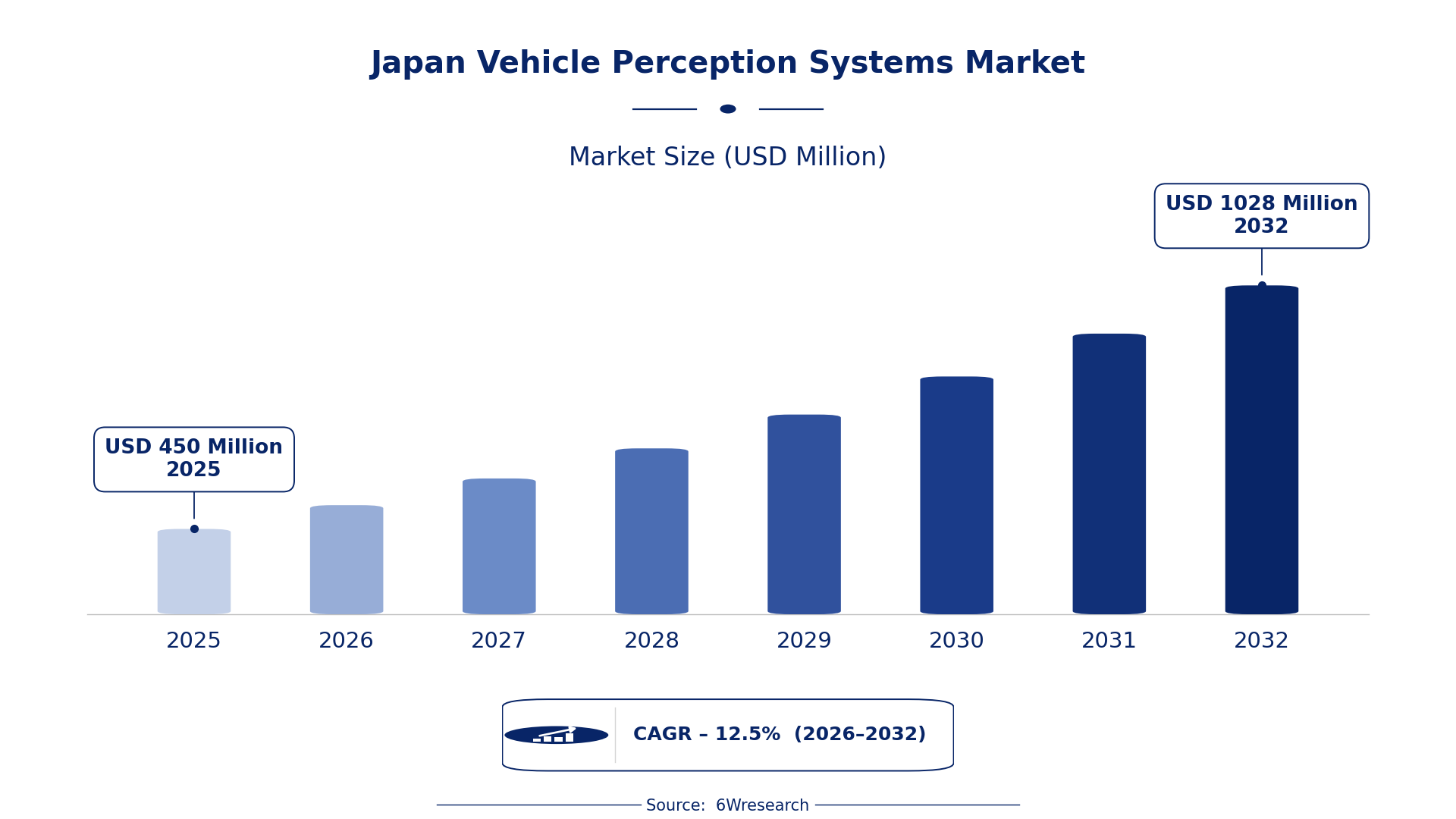
According to 6Wresearch internal database and industry insights, the Japan Vehicle Perception Systems Market was valued at USD 450 Million in 2025 and is projected to reach USD 1,028 Million by 2032, growing at a CAGR of approximately 12.5% during 2026–2032.
Japan Vehicle Perception Systems Market Highlights
| Report Metric | Details |
| Report Name | Japan Vehicle Perception Systems Market (2026-2032) |
| Market Size 2025 | USD 450 Million |
| Market Size 2032 | USD 1,028 Million |
| Absolute Growth 2025–2032 | USD 578 Million |
| CAGR 2026–2032 | 12.5% |
| Peak Annual Growth | 13.4% in 2028 |
| Forecast Period | 2026–2032 |
| Historical Data | 2022–2025 |
| Base Year | 2025 |
| Leading Product Type, 2025 | Vision Cameras (44% share) |
| Leading Sensor Type, 2025 | CMOS Sensors (44% share) |
| Leading Distribution Channel, 2025 | OEM Integration (42% share) |
| Leading End User, 2025 | Electric Vehicles (36% share) |
| Fastest-Growing Product Type | Radar Modules (17.1% CAGR) |
| Fastest-Growing Sensor Type | Millimeter-wave (17.8% CAGR) |
| Fastest-Growing Distribution Channel | System Integrators (16.3% CAGR) |
| Fastest-Growing End User | Connected Cars (16.6% CAGR) |
| Growing Sector | Electric Vehicles |
| Key End Users | Automotive manufacturers, technology developers, system integrators, regulatory bodies |
Japan Vehicle Perception Systems Market Year-wise Growth Rate and Key Drivers (2022–2032)
This graph illustrates the annual growth rates of the market from 2022 to 2032, highlighting a steady upward trajectory and projected market expansion over the forecast period.
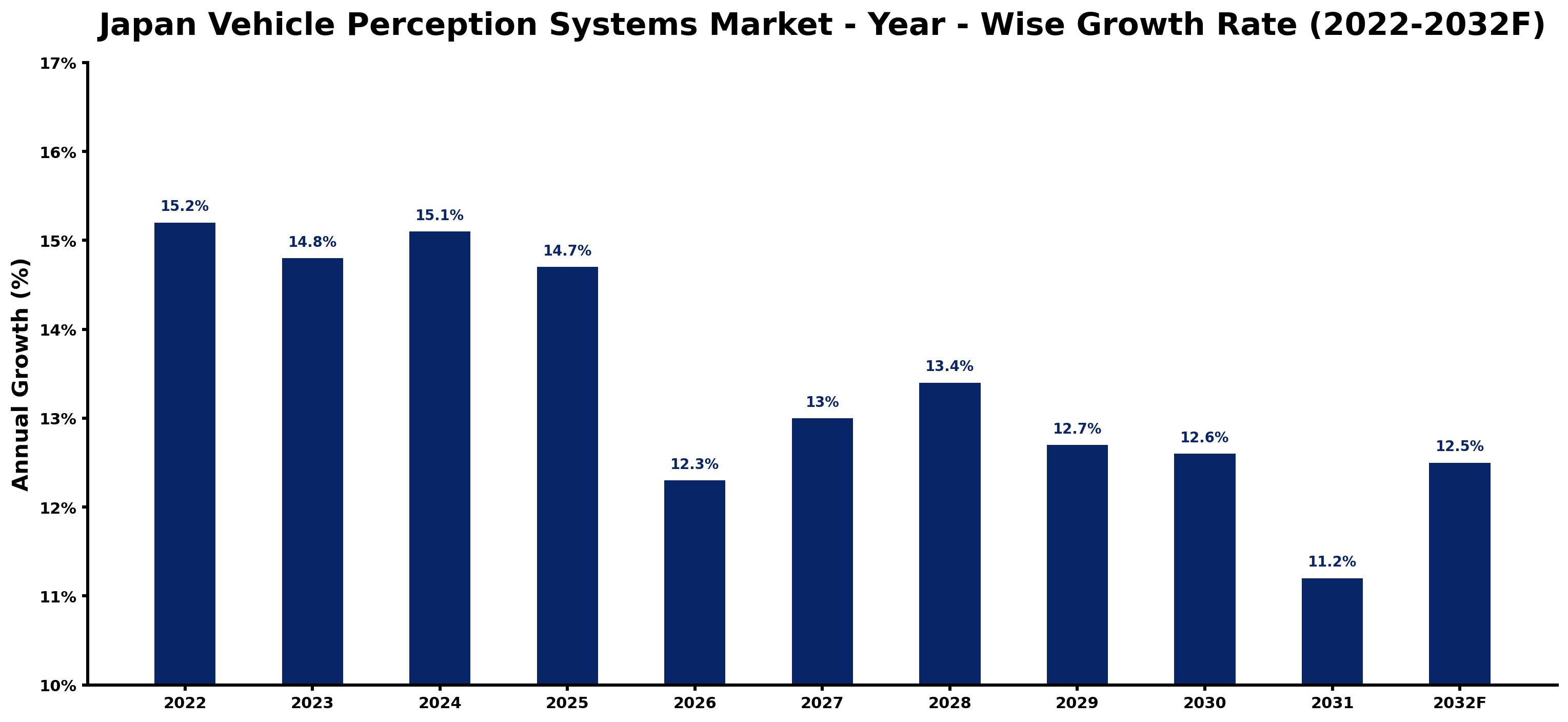
The yearly estimates that follow link every growth rate to its principal driver, so readers can see why the pace changed in each period.
| Year | Estimated Annual Growth (%) | Market Rationale |
| 2022 | 15.2 | The automotive sector experienced strong demand driven by technological advancements. |
| 2023 | 14.8 | Growth slowed slightly due to market saturation in certain vehicle segments. |
| 2024 | 15.1 | Demand increased as manufacturers adopted more advanced perception technologies. |
| 2025 | 14.7 | A slight slowdown occurred as the market adjusted to new regulations. |
| 2026 | 12.3 | Investment in R&D is expected to decline, impacting growth rates in perception systems. |
| 2027 | 13.0 | Demand is projected to rebound as electric vehicle production ramps up. |
| 2028 | 13.4 | The introduction of new autonomous vehicle models will drive higher growth rates. |
| 2029 | 12.7 | Growth is expected to slow as competition intensifies among perception system providers. |
| 2030 | 12.6 | Market expansion will continue despite regulatory challenges affecting timelines. |
| 2031 | 11.2 | Demand is projected to stabilise as manufacturers focus on improving existing technologies. |
| 2032 | 12.5 | Growth will accelerate again with increased investment in connected vehicle technologies. |
Note: Market size estimations and growth projections presented in this report are based on 6Wresearch's proprietary forecasting methodology, utilizing the latest available industry data, government publications, and primary research inputs.
Japan Vehicle Perception Systems Market Synopsis
Vehicle Perception Systems are advanced technologies used in vehicles to detect and interpret surrounding environments through various sensors and cameras. The Japan Vehicle Perception Systems Market is growing due to rising demand for electric and autonomous vehicles, driven by substantial investments in automotive research and development. The government's commitment to carbon neutrality by 2050 and its promotion of autonomous vehicle technology are key factors behind this growth, encouraging manufacturers to adopt these advanced systems.
Market Dynamics Impact Analysis (2026–2032)
| Factor | Type | Impact | Primary Segment Affected |
| Rising demand for autonomous vehicles is driving the need for advanced perception systems. | Driver | High | Autonomous Vehicles |
| Increased production of electric vehicles is creating opportunities for perception system integration. | Driver | High | Electric Vehicles |
| The expansion of connected car technology presents significant market opportunities. | Opportunity | High | Connected Cars |
| Growing urbanisation in regions like Tokyo is increasing the demand for advanced vehicle technologies. | Opportunity | Medium | Vision Cameras |
| High competition among manufacturers can lead to price wars affecting margins. | Restraint | High | Radar Modules |
| Regulatory compliance costs for safety standards can limit market entry for new players. | Restraint | Medium | LIDAR Systems |
| The need for continuous innovation in perception technologies poses a challenge for existing players. | Challenge | High | CMOS Sensors |
| Supply chain disruptions can delay the production of essential components for perception systems. | Challenge | Medium | Night Vision Systems |
Evaluation of Drivers in Japan Vehicle Perception Systems Market (2026–2032)
The following drivers explain most of the expected growth.
| Drivers | Primary Segment Affected | Why It Matters (Evidence) |
| Increased investment in R&D for perception technologies is driving demand. | CMOS Sensors | The automotive industry invests billions annually in R&D, boosting image processing capabilities in vehicles. |
| The push for electric vehicles is accelerating the adoption of perception systems. | Electric Vehicles | With over 1.5 million electric vehicles registered in Japan, demand for advanced safety features is rising. |
| Urbanisation in major cities is increasing the need for advanced vehicle technologies. | LIDAR Systems | As urban areas expand, LIDAR systems are increasingly adopted in new vehicle models for navigation. |
| The growth of autonomous vehicles is creating a surge in demand for perception systems. | Radar Modules | Radar modules are essential for adaptive cruise control systems, which are becoming standard in new models. |
| Connected car technology is expanding rapidly, driving demand for integrated systems. | Connected Cars | The anticipated growth in connected vehicles is leading to higher integration of perception technologies. |
Behind the steady rise in orders sits substantial investment in research and development within the automotive sector, estimated at billions annually. This investment is driving demand for advanced perception technologies, as manufacturers seek to enhance safety and automation in vehicles. The surge in electric vehicle registrations, surpassing 1.5 million, is pushing manufacturers to integrate these systems to meet consumer expectations. The growth of autonomous vehicles is creating demand for radar modules, essential for adaptive cruise control systems. Urbanisation in regions like Tokyo is further increasing the need for advanced vehicle technologies, including LIDAR systems for navigation.
Evaluation of Restraints in Japan Vehicle Perception Systems Market
The main factors holding the market back are set out below.
| Market Restraint | Primary Segment Affected | Why It Matters (Evidence) |
| High competition among manufacturers can lead to price wars that affect profitability. | Radar Modules | With numerous players in the market, price competition can erode profit margins for manufacturers. |
| Regulatory compliance costs for safety standards can limit market entry for new players. | LIDAR Systems | Meeting stringent standards such as ISO 26262 can be costly for emerging companies. |
| Supply chain disruptions can delay the production of essential components for perception systems. | Night Vision Systems | Recent global supply chain issues have affected the availability of critical components. |
| Rapid technological advancements require continuous innovation, which can strain resources. | CMOS Sensors | Manufacturers must invest heavily to keep pace with evolving technology demands. |
| Market saturation in certain vehicle segments can limit growth opportunities. | Vision Cameras | As the market matures, finding new customers becomes increasingly challenging. |
Japan Vehicle Perception Systems Market Challenges
High costs of advanced sensors burden buyers, as vehicle perception systems can increase vehicle prices by up to 15%. Regulatory hurdles complicate compliance for suppliers, with the Ministry of Land, Infrastructure, Transport and Tourism enforcing stringent vehicle safety standards that can delay product launches by six months. Technology gaps exist among suppliers, as many lack the capability to integrate LIDAR systems, resulting in a competitive disadvantage and potential loss of market share. Buyers face limited options due to the slow adoption of connected car technologies, which can hinder their ability to meet consumer demands for enhanced safety features.
Trends in the Japan Vehicle Perception Systems Market
The following changes are redrawing the Japan Vehicle Perception Systems Market.
- Shift from Traditional to Advanced Sensor Technologies: The Tokyo region is experiencing a transition towards advanced sensor technologies in vehicles, particularly LIDAR systems, which are increasingly adopted in urban areas. In 2023, the adoption rate rose as manufacturers sought to improve navigation capabilities.
- Transition from Conventional to Autonomous Vehicles: Japan is moving towards autonomous vehicles, with a notable increase in the integration of perception systems. In 2023, the government launched a program to promote autonomous vehicle technology, reflecting this trend.
- Emergence of Connected Vehicle Technologies: Connected vehicle technologies are gaining traction, with significant investments in infrastructure to support data exchange. The anticipated growth in connected cars is projected to increase by 16.6% between 2026 and 2032.
- Prioritisation of Safety Standards in Vehicle Design: The automotive industry is focusing on compliance with safety standards such as ISO 26262, which is essential for functional safety. This shift is evident as manufacturers concentrate on improving safety features in new models.
Investment Opportunities in the Japan Vehicle Perception Systems Market
Where to invest in the Japan Vehicle Perception Systems Market: the main openings are set out below.
- Partnerships with Local Manufacturers: Establishing partnerships with local manufacturers to supply advanced perception systems is timely, as demand is rising. The Tokyo region is a key hub for automotive technology development, presenting opportunities for collaboration.
- Investment in Electric Vehicle Technologies: With over 1.5 million electric vehicles registered, there is an opportunity to invest in perception systems tailored for electric vehicles. Engaging with the Japan Automobile Manufacturers Association can facilitate market entry.
- Expansion into Autonomous Vehicle Market: The growing focus on autonomous vehicles presents an opportunity to supply advanced perception technologies. The government’s support for autonomous vehicle technology creates a favourable environment for investment.
- Development of Advanced Safety Features: There is a gap in the market for advanced safety features in vehicles, with a projected increase in demand. Collaborating with system integrators can help develop and implement these features effectively.
Government Initiatives in the Japan Vehicle Perception Systems Market
The Green Growth Strategy identifies automotive technologies as a key growth sector, aiming for carbon neutrality by 2050. This initiative encourages manufacturers to adopt advanced perception systems, thus supporting the market's expansion. The Battery Industry Strategy, initiated by the Ministry of Economy, Trade and Industry in August 2022, aims to strengthen domestic battery manufacturing capacity, which is essential for the growth of electric vehicles and their associated technologies.
The Ministry of Land, Infrastructure, Transport and Tourism oversees vehicle safety standards and approves new technologies for compliance. The Japan Standards Association develops standards for automotive sensors and systems, ensuring that manufacturers meet safety requirements. This regulatory framework supports the integration of advanced perception systems in vehicles, promoting innovation and safety.
Future Insight of the Japan Vehicle Perception Systems Market
Investment in vehicle perception systems will surge, with government initiatives promoting autonomous technology and a target for 100% electric vehicle sales by 2035. By 2032, the integration of LIDAR and radar modules will become standard in new models, improving safety and automation. The Tokyo Motor Show will showcase breakthroughs in perception technologies, further stimulating market interest. As R&D funding in the automotive sector reaches billions annually, suppliers will innovate rapidly, creating a more competitive environment that benefits buyers with advanced products.
Market Segmentation Analysis
Japan Vehicle Perception Systems Market report covers a detailed analysis of the following market segments:
By Product Type – Vision Cameras Lead, Radar Modules Expected to Grow Fastest
According to Saurav Kr Singh, Senior Research Analyst at 6Wresearch, with 44% of product type revenue in 2025, Vision Cameras was the largest category. Vision Cameras hold the largest share due to their essential role in capturing visual data for safety and navigation in vehicles. Their integration in a substantial number of vehicles produced in Japan underscores their widespread adoption. Over 2026–2032, Radar Modules are expected to post the fastest growth, at a CAGR of 17.1%. Radar Modules are experiencing rapid growth as they are critical for distance measurement and obstacle detection, particularly in urban environments. The increasing demand for advanced safety features in new vehicle models is a key factor behind this growth. Suppliers should focus on enhancing the capabilities of Radar Modules to meet the rising demand for safety technologies.
By Sensor Type – CMOS Sensors Lead, Millimeter-wave Expected to Grow Fastest
The largest sensor type category in 2025 was CMOS Sensors, at 44% of revenue. CMOS Sensors dominate the market as they are fundamental for image processing in vehicle cameras, which are crucial for safety and automation. Their extensive application in the automotive sector reinforces their leading position. The quickest growth will come from Millimeter-wave, forecast to expand at a CAGR of 17.8% between 2026 and 2032. Millimeter-wave sensors are growing quickly due to their importance in providing high-resolution distance measurements, which are vital for advanced driver-assistance systems. The push for enhanced safety features in vehicles is propelling this segment forward. Buyers should prioritise vehicles equipped with Millimeter-wave sensors to ensure superior safety and performance.
By Distribution Channel – OEM Integration Leads, System Integrators Expected to Grow Fastest
OEM Integration took 42% of distribution channel revenue in 2025, more than any other category. OEM Integration is the leading distribution channel as it is key for embedding vehicle perception systems in new vehicles during manufacturing. This direct integration ensures that the latest technologies are available in the vast majority of vehicles produced in Japan. System Integrators are projected to grow fastest, at a CAGR of 16.3% during 2026–2032. System Integrators are seeing the fastest growth as they are important for implementing complex systems that require specialised knowledge and expertise. The increasing complexity of vehicle technologies necessitates their services, driving demand. Suppliers should consider partnerships with System Integrators to effectively implement advanced perception systems in vehicles.
By End User – Electric Vehicles Lead, Connected Cars Expected to Grow Fastest
In 2025, Electric Vehicles led the end user split with a 36% share. Electric Vehicles represent the largest end user segment as they are rapidly adopting advanced perception systems to enhance safety and automation. The growing number of registered electric vehicles in Japan underscores this trend. Connected Cars are set to record the highest CAGR in this split, 16.6% over 2026–2032. Connected Cars are the fastest-growing segment as they are integral for communication and data exchange, essential for modern driving experiences. The anticipated expansion of connected car technology in the next decade is a major growth driver. Suppliers must invest in technologies that support connectivity to capitalise on the growth of Connected Cars.
Key Attractiveness of the Report
- 10 Years of Market Numbers
- Historical Data Starting from 2022 to 2025
- Base Year 2025
- Forecast Data until 2032
- Key Performance Indicators Impacting the Market
- Major Upcoming Developments and Projects
Key Highlights of the Report:
- Japan Vehicle Perception Systems Market Outlook
- Market Size of Japan Vehicle Perception Systems Market, 2025
- Forecast of Japan Vehicle Perception Systems Market, 2032
- Historical Data and Forecast of Japan Vehicle Perception Systems Revenues & Volume for the Period 2022-2032F
- Japan Vehicle Perception Systems Market Trend Evolution
- Japan Vehicle Perception Systems Market Drivers and Challenges
- Japan Vehicle Perception Systems Price Trends
- Japan Vehicle Perception Systems Porter's Five Forces
- Japan Vehicle Perception Systems Industry Life Cycle
- Historical Data and Forecast of Japan Vehicle Perception Systems Market Revenues & Volume By Product Type for the Period 2022-2032F
- Historical Data and Forecast of Japan Vehicle Perception Systems Market Revenues & Volume By Vision Cameras for the Period 2022-2032F
- Historical Data and Forecast of Japan Vehicle Perception Systems Market Revenues & Volume By Radar Modules for the Period 2022-2032F
- Historical Data and Forecast of Japan Vehicle Perception Systems Market Revenues & Volume By LIDAR Systems for the Period 2022-2032F
- Historical Data and Forecast of Japan Vehicle Perception Systems Market Revenues & Volume By Night Vision Systems for the Period 2022-2032F
- Historical Data and Forecast of Japan Vehicle Perception Systems Market Revenues & Volume By Sensor Type for the Period 2022-2032F
- Historical Data and Forecast of Japan Vehicle Perception Systems Market Revenues & Volume By CMOS Sensors for the Period 2022-2032F
- Historical Data and Forecast of Japan Vehicle Perception Systems Market Revenues & Volume By Millimeter-wave for the Period 2022-2032F
- Historical Data and Forecast of Japan Vehicle Perception Systems Market Revenues & Volume By Infrared Sensors for the Period 2022-2032F
- Historical Data and Forecast of Japan Vehicle Perception Systems Market Revenues & Volume By Thermal Imaging for the Period 2022-2032F
- Historical Data and Forecast of Japan Vehicle Perception Systems Market Revenues & Volume By Distribution Channel for the Period 2022-2032F
- Historical Data and Forecast of Japan Vehicle Perception Systems Market Revenues & Volume By OEM Integration for the Period 2022-2032F
- Historical Data and Forecast of Japan Vehicle Perception Systems Market Revenues & Volume By System Integrators for the Period 2022-2032F
- Historical Data and Forecast of Japan Vehicle Perception Systems Market Revenues & Volume By Online Platforms for the Period 2022-2032F
- Historical Data and Forecast of Japan Vehicle Perception Systems Market Revenues & Volume By Specialty Distributors for the Period 2022-2032F
- Historical Data and Forecast of Japan Vehicle Perception Systems Market Revenues & Volume By End User for the Period 2022-2032F
- Historical Data and Forecast of Japan Vehicle Perception Systems Market Revenues & Volume By Electric Vehicles for the Period 2022-2032F
- Historical Data and Forecast of Japan Vehicle Perception Systems Market Revenues & Volume By Connected Cars for the Period 2022-2032F
- Historical Data and Forecast of Japan Vehicle Perception Systems Market Revenues & Volume By Autonomous Vehicles for the Period 2022-2032F
- Historical Data and Forecast of Japan Vehicle Perception Systems Market Revenues & Volume By Premium Vehicles for the Period 2022-2032F
- Japan Vehicle Perception Systems Import Export Trade Statistics
- Market Opportunity Assessment By Product Type
- Market Opportunity Assessment By Sensor Type
- Market Opportunity Assessment By Distribution Channel
- Market Opportunity Assessment By End User
- Japan Vehicle Perception Systems Top Companies Market Share
- Japan Vehicle Perception Systems Competitive Benchmarking By Technical and Operational Parameters
- Japan Vehicle Perception Systems Company Profiles
- Japan Vehicle Perception Systems Key Strategic Recommendations
Market Covered
The study includes the following segmentation.
By Product Type
- Vision Cameras
- Radar Modules
- LIDAR Systems
- Night Vision Systems
By Sensor Type
- CMOS Sensors
- Millimeter-wave
- Infrared Sensors
- Thermal Imaging
By Distribution Channel
- OEM Integration
- System Integrators
- Online Platforms
- Specialty Distributors
By End User
- Electric Vehicles
- Connected Cars
- Autonomous Vehicles
- Premium Vehicles































