Japan Vehicle Performance Sensors Market Size & Growth Rate
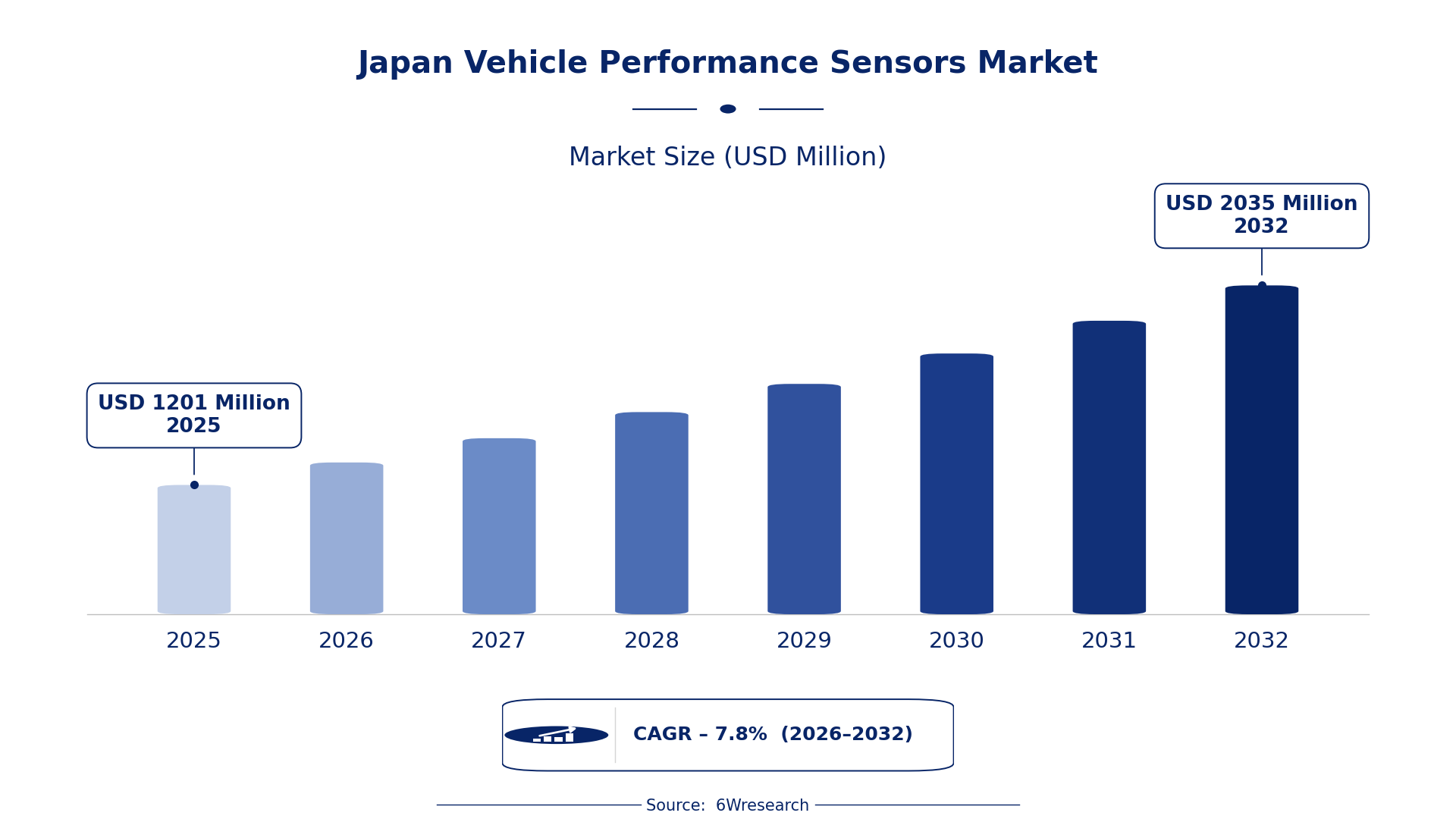
According to 6Wresearch internal database and industry insights, the Japan Vehicle Performance Sensors Market was valued at USD 1,201 Million in 2025 and is projected to reach USD 2,035 Million by 2032, growing at a CAGR of approximately 7.8% during 2026–2032.
Japan Vehicle Performance Sensors Market Highlights
| Report Metric | Details |
| Report Name | Japan Vehicle Performance Sensors Market (2026-2032) |
| Market Size 2025 | USD 1,201 Million |
| Market Size 2032 | USD 2,035 Million |
| Absolute Growth 2025–2032 | USD 834 Million |
| CAGR 2026–2032 | 7.8% |
| Peak Annual Growth | 9.8% in 2026 |
| Forecast Period | 2026–2032 |
| Historical Data | 2022–2025 |
| Base Year | 2025 |
| Leading Sensor Type, 2025 | Oxygen Sensors (43% share) |
| Leading Application Area, 2025 | Fuel System (38% share) |
| Leading Distribution Channel, 2025 | OEM Supply Chain (39% share) |
| Leading End User, 2025 | Passenger Cars (52% share) |
| Fastest-Growing Sensor Type | Knock Sensors (11.0% CAGR) |
| Fastest-Growing Application Area | Engine Monitoring (8.9% CAGR) |
| Fastest-Growing Distribution Channel | Parts Retailers (9.8% CAGR) |
| Fastest-Growing End User | High-performance Cars (10.2% CAGR) |
| Growing Sector | automotive aftermarket |
| Key End Users | automotive manufacturers, aftermarket service providers, parts retailers, vehicle owners |
Japan Vehicle Performance Sensors Market Year-wise Growth Rate and Key Drivers (2022–2032)
This graph illustrates the annual growth rates of the market from 2022 to 2032, highlighting a steady upward trajectory and projected market expansion over the forecast period.
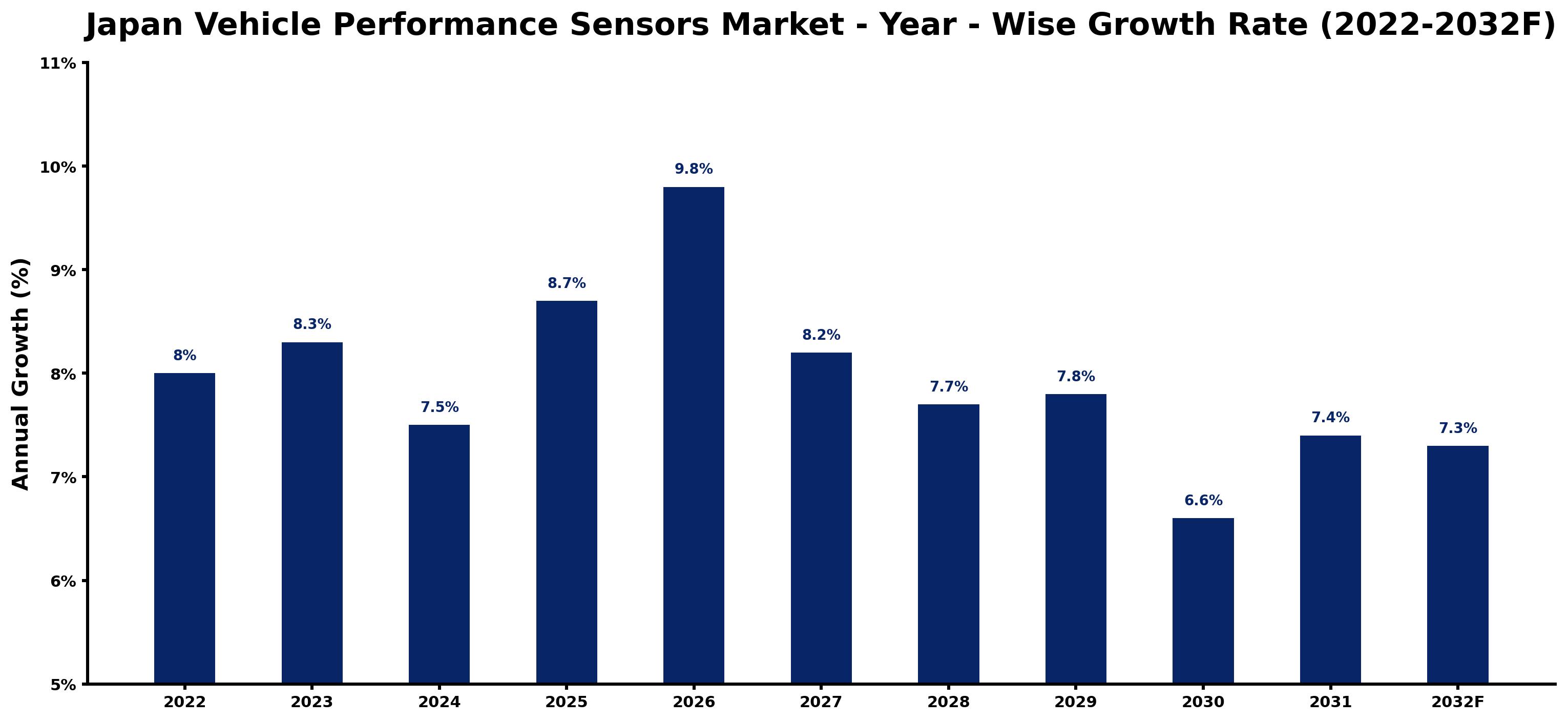
The following figures match every annual growth estimate with the main market development of that year, giving the reasoning behind each rise or slowdown.
| Year | Estimated Annual Growth (%) | Market Rationale |
| 2022 | 8.0 | The market experienced steady growth with strong automotive production figures. |
| 2023 | 8.3 | Growth accelerated as vehicle manufacturers increased sensor integration in new models. |
| 2024 | 7.5 | Demand slowed slightly due to market saturation in certain sensor types. |
| 2025 | 8.7 | Growth picked up again as emissions regulations prompted sensor upgrades. |
| 2026 | 9.8 | The peak growth year is expected to see heightened investments in performance technology. |
| 2027 | 8.2 | Growth is projected to decelerate as the market adjusts to previous peaks in demand. |
| 2028 | 7.7 | A further slowdown is anticipated as competition intensifies among sensor providers. |
| 2029 | 7.8 | Demand is expected to rebound as hybrid vehicle registrations surge, boosting sensor needs. |
| 2030 | 6.6 | Growth will slow again as the market faces regulatory compliance challenges. |
| 2031 | 7.4 | An increase in demand is projected as new standards emerge for vehicle safety. |
| 2032 | 7.3 | The market will continue to grow, albeit at a slower pace due to maturity. |
Note: Market size estimations and growth projections presented in this report are based on 6Wresearch's proprietary forecasting methodology, utilizing the latest available industry data, government publications, and primary research inputs.
Japan Vehicle Performance Sensors Market Synopsis
Vehicle performance sensors are electronic devices that monitor critical parameters such as emissions and engine performance, utilising advanced semiconductor technology. The Japan Vehicle Performance Sensors Market is expanding, driven by the automotive sector's production of 8.3 million vehicles in 2022 and the integration of over 70% of new cars with oxygen sensors. Stricter emissions regulations and the rising adoption of hybrid vehicles are propelling market growth, creating opportunities for manufacturers and suppliers alike.
Market Dynamics Impact Analysis (2026–2032)
| Factor | Type | Impact | Primary Segment Affected |
| Stringent emissions regulations are driving demand for advanced sensors. | Driver | High | Oxygen Sensors |
| The growing hybrid vehicle market is increasing the need for performance sensors. | Driver | High | Knock Sensors |
| The automotive aftermarket is valued at approximately 2 trillion yen, presenting opportunities for suppliers. | Opportunity | High | Parts Retailers |
| Rising electric vehicle adoption creates demand for innovative sensor solutions. | Opportunity | Medium | Hybrid Vehicles |
| Market saturation in certain sensor types limits growth potential. | Restraint | High | Speed Sensors |
| Increased competition among sensor manufacturers may lead to price pressures. | Restraint | Medium | Temperature Sensors |
| Supply chain disruptions can delay sensor production and delivery. | Challenge | High | Fuel System |
| Technological advancements require constant investment to remain competitive. | Challenge | Medium | Engine Monitoring |
Evaluation of Drivers in Japan Vehicle Performance Sensors Market (2026–2032)
Demand rests on the following drivers, each shown with the segment it touches most.
| Drivers | Primary Segment Affected | Why It Matters (Evidence) |
| Increasing vehicle production is boosting demand for performance sensors. | Oxygen Sensors | Japan produced 8.3 million vehicles in 2022, leading to higher sensor integration. |
| Stricter emissions regulations are necessitating advanced sensor technologies. | Knock Sensors | The Ministry of the Environment promotes emissions standards under the 2030 Environmental Plan. |
| Growing hybrid vehicle registrations are driving sensor demand. | Temperature Sensors | Over 4 million registered hybrid vehicles in Japan as of 2023 require advanced monitoring. |
| Technological advancements in automotive systems are improving sensor capabilities. | Speed Sensors | ISO 26262 standard for functional safety in automotive systems boosts sensor adoption. |
| The automotive aftermarket's growth is increasing demand for replacement sensors. | Parts Retailers | The aftermarket in Japan is valued at approximately 2 trillion yen, indicating strong demand. |
Orders keep climbing as vehicle production rises, with Japan manufacturing 8.3 million vehicles in 2022. The increasing number of hybrid vehicles, which surpassed 4 million in 2023, necessitates enhanced performance monitoring. The automotive aftermarket, valued at approximately 2 trillion yen, is fuelling demand for replacement parts and sensors. Continuous advancements in automotive systems are improving sensor capabilities, encouraging wider adoption across the sector.
Evaluation of Restraints in Japan Vehicle Performance Sensors Market
Below are the constraints most often cited by buyers and suppliers, with the segment each affects.
| Market Restraint | Primary Segment Affected | Why It Matters (Evidence) |
| Market saturation in certain sensor types limits growth potential. | Speed Sensors | As most new vehicles are already equipped with essential sensors, demand is stabilising. |
| Price pressures from increased competition may affect profit margins. | Temperature Sensors | Numerous manufacturers are entering the market, resulting in aggressive pricing strategies. |
| Supply chain disruptions can delay sensor production and delivery. | Fuel System | Global semiconductor shortages have impacted the availability of critical components. |
| Technological advancements require constant investment to remain competitive. | Engine Monitoring | Manufacturers must invest heavily in R&D to keep up with evolving standards. |
| Regulatory compliance challenges may slow down sensor adoption. | Knock Sensors | New regulations require additional testing and certification, delaying market entry. |
Japan Vehicle Performance Sensors Market Challenges
New vehicle emissions standards impose stricter requirements on performance sensors, increasing compliance costs for manufacturers by up to 15%. These regulations, advocated by Japan's Ministry of the Environment, can delay product launches by six months for producers. A shortage of skilled workers in semiconductor technology complicates sensor development, forcing companies to allocate millions for training initiatives. Heightened competition among local manufacturers pressures prices downward, resulting in reduced margins for suppliers while buyers incur additional expenses for retrofitting older vehicles with compliant sensors.
Trends in the Japan Vehicle Performance Sensors Market
Below are the shifts with the largest effect on the Japan Vehicle Performance Sensors Market.
- Shift towards Advanced Emissions Monitoring: The Tokyo region is experiencing a shift towards advanced emissions monitoring technologies, with over 70% of new cars now featuring oxygen sensors. This trend reflects the Ministry of the Environment's stringent emissions standards.
- Passenger Cars Prioritised over Commercial Vehicles: Sensor integration is prioritised in passenger cars, which hold a 52% market share in 2025. This focus reflects manufacturers' efforts to improve performance features to meet consumer demand.
- Engine Monitoring Gaining Importance: Engine monitoring is increasingly important, with a projected CAGR of 8.9% for this segment. The rising complexity of engine systems necessitates advanced monitoring solutions for optimal performance.
- Parts Retailers Expanding Market Reach: Parts retailers are expanding their market reach, with a projected growth rate of 9.8%. This shift is evident as consumers increasingly seek aftermarket solutions for vehicle performance enhancements.
Investment Opportunities in the Japan Vehicle Performance Sensors Market
Below are the investment opportunities with the strongest case in the Japan Vehicle Performance Sensors Market.
- Timing is Right for Sensor Innovations: With the automotive aftermarket valued at approximately 2 trillion yen, now is the time to invest in advanced sensor technologies. Parts retailers are seeking solutions to meet consumer demands.
- Partnering with Local Manufacturers: Local partnerships can facilitate entry into the growing hybrid vehicle market. Collaborating with regional manufacturers can provide access to established distribution channels.
- High-performance Cars Demand Advanced Sensors: High-performance cars are becoming increasingly popular, presenting opportunities for suppliers of performance sensors. The growing consumer interest in enhanced vehicle capabilities drives this demand.
- Investing in Electric Vehicle Sensors: The rising adoption of electric vehicles creates a need for specialised sensors. Engaging with the Japan Automobile Manufacturers Association can provide insights into market requirements.
Government Initiatives in the Japan Vehicle Performance Sensors Market
The Semiconductor and Digital Industry Strategy, established by METI in June 2021, aims to secure domestic semiconductor manufacturing. This measure supports vehicle performance sensor producers by ensuring a stable supply of essential components for sensor production. The strategy targets a 46% cut in greenhouse-gas emissions from fiscal 2013 levels by fiscal 2030, promoting the adoption of advanced technologies in the automotive sector.
The Economic Security Promotion Act, enacted in 2022, supports supply-chain resilience for critical products. This act, overseen by METI, facilitates the approval of projects aimed at boosting local manufacturing capacity for vehicle performance sensors, ensuring that producers can meet growing demand.
Future Insight of the Japan Vehicle Performance Sensors Market
By 2032, buyers will benefit from advanced vehicle performance sensors that significantly enhance fuel efficiency and reduce emissions. Government incentives will drive the transition to electric vehicles, leading to a notable rise in registered hybrid vehicles, which reached over 4 million in 2023. Innovations showcased at the Tokyo Motor Show will further propel sensor technology advancements, creating new opportunities for suppliers. Compliance with ISO 26262 will ensure functional safety in automotive systems, boosting buyer confidence in next-generation sensor solutions.
Market Segmentation Analysis
Japan Vehicle Performance Sensors Market report covers a detailed analysis of the following market segments:
By Sensor Type – Oxygen Sensors Lead, Knock Sensors Expected to Grow Fastest
According to Saurav Kr Singh, Senior Research Analyst at 6Wresearch, the largest sensor type category in 2025 was Oxygen Sensors, at 43% of revenue. Oxygen sensors hold the largest share as they are essential for monitoring emissions and optimising fuel efficiency in vehicles. Their integration in over 70% of new cars in Japan underscores their importance in meeting stringent environmental regulations. Knock Sensors are set to record the highest CAGR in this split, 11.0% over 2026–2032. Knock sensors are experiencing rapid growth due to their critical role in engine performance and damage prevention, particularly in high-performance vehicles. Their mandatory inclusion in all new passenger vehicles since 2018 has notably increased their market presence. Suppliers should focus on enhancing the production of knock sensors to meet the growing demand in the automotive industry.
By Application Area – Fuel System Leads, Engine Monitoring Expected to Grow Fastest
In 2025, Fuel System led the application area split with a 38% share. The fuel system application area leads the market because it is integral for effective fuel delivery and efficiency in vehicles. Japan's commitment to reducing greenhouse gas emissions further drives the demand for advanced fuel systems. The quickest growth will come from Engine Monitoring, forecast to expand at a CAGR of 8.9% between 2026 and 2032. Engine monitoring is the fastest-growing application area, propelled by its vital role in performance and diagnostics as vehicles adopt more advanced technologies. The push for stricter emissions regulations also fuels the need for sophisticated engine monitoring solutions. Buyers should prioritise investments in advanced engine monitoring technologies to enhance vehicle performance and ensure compliance with regulations.
By Distribution Channel – OEM Supply Chain Leads, Parts Retailers Expected to Grow Fastest
OEM Supply Chain took 39% of distribution channel revenue in 2025, more than any other category. The OEM supply chain dominates the market as it serves as the primary channel for new vehicle production, ensuring that vehicles are equipped with the latest performance sensors. This channel's established relationships with manufacturers facilitate the integration of sensors into new models. Parts Retailers are projected to grow fastest, at a CAGR of 9.8% during 2026–2032. Parts retailers are the fastest-growing distribution channel as they support aftermarket repairs and replacements, catering to the increasing number of vehicles on the road. The automotive aftermarket in Japan, valued at approximately 2 trillion yen, is driving this growth. Suppliers should strengthen partnerships with parts retailers to capitalise on the expanding aftermarket opportunities.
By End User – Passenger Cars Lead, High-performance Cars Expected to Grow Fastest
Passenger Cars held 52% of the Japan Vehicle Performance Sensors Market by end user in 2025. Passenger cars represent the largest segment of vehicle performance sensor usage, reflecting robust demand in Japan's automotive market. The production of 8.3 million vehicles in 2022 highlights the significance of this segment in driving market growth. Over 2026–2032, High-performance Cars are expected to post the fastest growth, at a CAGR of 10.2%. High-performance cars are the fastest-growing end user segment, spurred by consumer interest in performance enhancement. This trend is likely to persist as the market for high-performance vehicles continues to expand. Manufacturers should tailor their offerings to meet the specific needs of high-performance car enthusiasts to capitalise on this growth opportunity.
Key Attractiveness of the Report
- 10 Years of Market Numbers
- Historical Data Starting from 2022 to 2025
- Base Year 2025
- Forecast Data until 2032
- Key Performance Indicators Impacting the Market
- Major Upcoming Developments and Projects
Key Highlights of the Report:
- Japan Vehicle Performance Sensors Market Outlook
- Market Size of Japan Vehicle Performance Sensors Market, 2025
- Forecast of Japan Vehicle Performance Sensors Market, 2032
- Historical Data and Forecast of Japan Vehicle Performance Sensors Revenues & Volume for the Period 2022-2032F
- Japan Vehicle Performance Sensors Market Trend Evolution
- Japan Vehicle Performance Sensors Market Drivers and Challenges
- Japan Vehicle Performance Sensors Price Trends
- Japan Vehicle Performance Sensors Porter's Five Forces
- Japan Vehicle Performance Sensors Industry Life Cycle
- Historical Data and Forecast of Japan Vehicle Performance Sensors Market Revenues & Volume By Sensor Type for the Period 2022-2032F
- Historical Data and Forecast of Japan Vehicle Performance Sensors Market Revenues & Volume By Oxygen Sensors for the Period 2022-2032F
- Historical Data and Forecast of Japan Vehicle Performance Sensors Market Revenues & Volume By Knock Sensors for the Period 2022-2032F
- Historical Data and Forecast of Japan Vehicle Performance Sensors Market Revenues & Volume By Speed Sensors for the Period 2022-2032F
- Historical Data and Forecast of Japan Vehicle Performance Sensors Market Revenues & Volume By Temperature Sensors for the Period 2022-2032F
- Historical Data and Forecast of Japan Vehicle Performance Sensors Market Revenues & Volume By Application Area for the Period 2022-2032F
- Historical Data and Forecast of Japan Vehicle Performance Sensors Market Revenues & Volume By Fuel System for the Period 2022-2032F
- Historical Data and Forecast of Japan Vehicle Performance Sensors Market Revenues & Volume By Engine Monitoring for the Period 2022-2032F
- Historical Data and Forecast of Japan Vehicle Performance Sensors Market Revenues & Volume By Drivetrain for the Period 2022-2032F
- Historical Data and Forecast of Japan Vehicle Performance Sensors Market Revenues & Volume By Exhaust System for the Period 2022-2032F
- Historical Data and Forecast of Japan Vehicle Performance Sensors Market Revenues & Volume By Distribution Channel for the Period 2022-2032F
- Historical Data and Forecast of Japan Vehicle Performance Sensors Market Revenues & Volume By OEM Supply Chain for the Period 2022-2032F
- Historical Data and Forecast of Japan Vehicle Performance Sensors Market Revenues & Volume By Parts Retailers for the Period 2022-2032F
- Historical Data and Forecast of Japan Vehicle Performance Sensors Market Revenues & Volume By Online Distributors for the Period 2022-2032F
- Historical Data and Forecast of Japan Vehicle Performance Sensors Market Revenues & Volume By Industrial Suppliers for the Period 2022-2032F
- Historical Data and Forecast of Japan Vehicle Performance Sensors Market Revenues & Volume By End User for the Period 2022-2032F
- Historical Data and Forecast of Japan Vehicle Performance Sensors Market Revenues & Volume By Passenger Cars for the Period 2022-2032F
- Historical Data and Forecast of Japan Vehicle Performance Sensors Market Revenues & Volume By High-performance Cars for the Period 2022-2032F
- Historical Data and Forecast of Japan Vehicle Performance Sensors Market Revenues & Volume By Commercial Vehicles for the Period 2022-2032F
- Historical Data and Forecast of Japan Vehicle Performance Sensors Market Revenues & Volume By Hybrid Vehicles for the Period 2022-2032F
- Japan Vehicle Performance Sensors Import Export Trade Statistics
- Market Opportunity Assessment By Sensor Type
- Market Opportunity Assessment By Application Area
- Market Opportunity Assessment By Distribution Channel
- Market Opportunity Assessment By End User
- Japan Vehicle Performance Sensors Top Companies Market Share
- Japan Vehicle Performance Sensors Competitive Benchmarking By Technical and Operational Parameters
- Japan Vehicle Performance Sensors Company Profiles
- Japan Vehicle Performance Sensors Key Strategic Recommendations
Market Covered
Coverage by segment is as follows.
By Sensor Type
- Oxygen Sensors
- Knock Sensors
- Speed Sensors
- Temperature Sensors
By Application Area
- Fuel System
- Engine Monitoring
- Drivetrain
- Exhaust System
By Distribution Channel
- OEM Supply Chain
- Parts Retailers
- Online Distributors
- Industrial Suppliers
By End User
- Passenger Cars
- High-performance Cars
- Commercial Vehicles
- Hybrid Vehicles































