Japan Vehicle Radar Market Size & Growth Rate
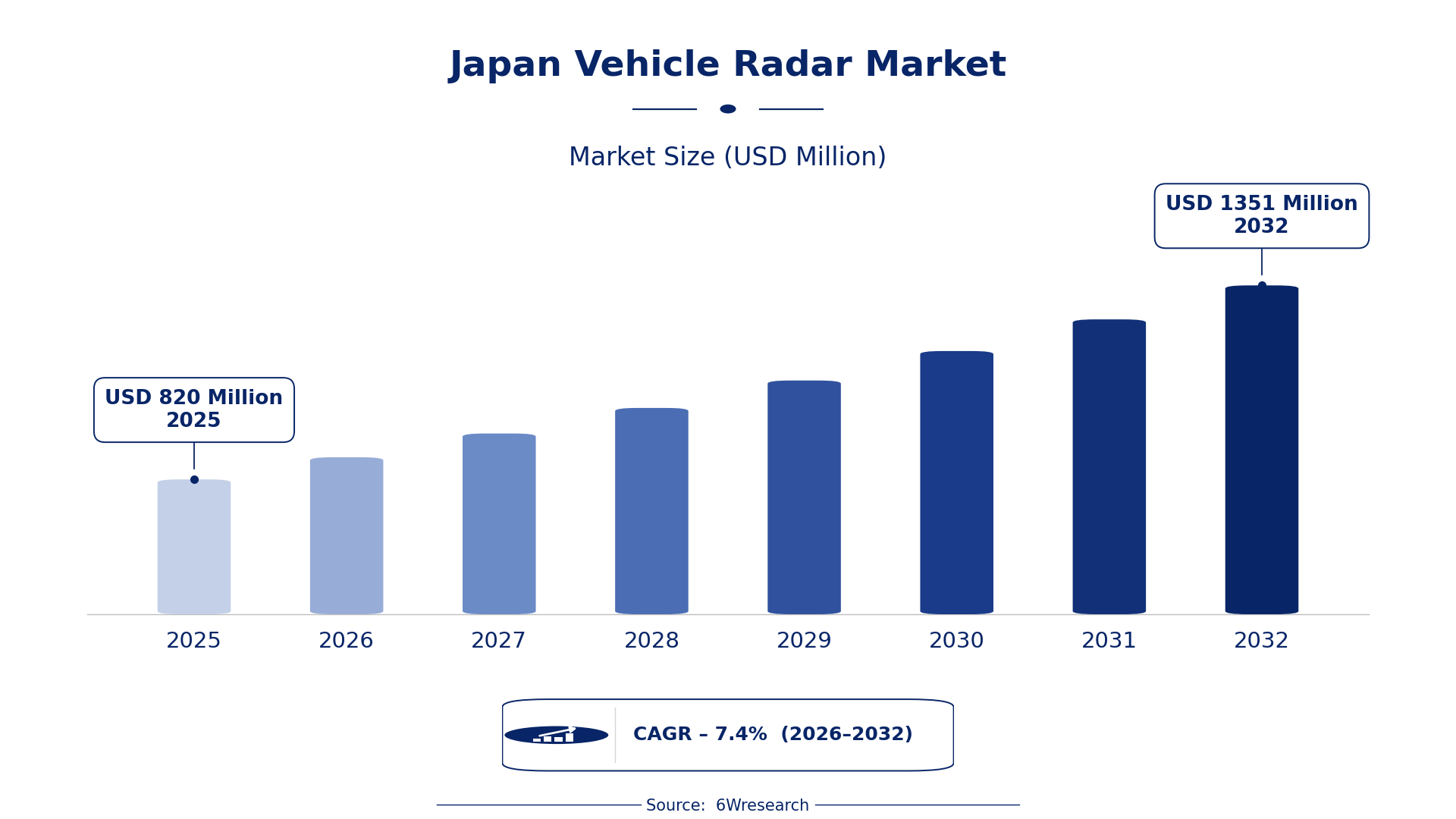
According to 6Wresearch internal database and industry insights, the Japan Vehicle Radar Market was valued at USD 820 Million in 2025 and is projected to reach USD 1,351 Million by 2032, growing at a CAGR of approximately 7.4% during 2026–2032.
Japan Vehicle Radar Market Highlights
| Report Metric | Details |
| Report Name | Japan Vehicle Radar Market (2026-2032) |
| Market Size 2025 | USD 820 Million |
| Market Size 2032 | USD 1,351 Million |
| Absolute Growth 2025–2032 | USD 531 Million |
| CAGR 2026–2032 | 7.4% |
| Peak Annual Growth | 9.1% in 2026 |
| Forecast Period | 2026–2032 |
| Historical Data | 2022–2025 |
| Base Year | 2025 |
| Leading Product Type, 2025 | Adaptive Cruise Radar (45% share) |
| Leading Frequency Band, 2025 | 77 GHz (47% share) |
| Leading Distribution Channel, 2025 | OEMs (40% share) |
| Leading End User, 2025 | Passenger Vehicles (37% share) |
| Fastest-Growing Product Type | Blind Spot Radar (9.9% CAGR) |
| Fastest-Growing Frequency Band | 79 GHz (9.2% CAGR) |
| Fastest-Growing Distribution Channel | Tier 1 Suppliers (9.3% CAGR) |
| Fastest-Growing End User | Electric Vehicles (9.5% CAGR) |
| Growing Sector | Electric Vehicles |
| Key End Users | OEMs, Tier 1 Suppliers, Commercial Vehicle Manufacturers, Luxury Car Makers |
Japan Vehicle Radar Market Year-wise Growth Rate and Key Drivers (2022–2032)
This graph illustrates the annual growth rates of the market from 2022 to 2032, highlighting a steady upward trajectory and projected market expansion over the forecast period.
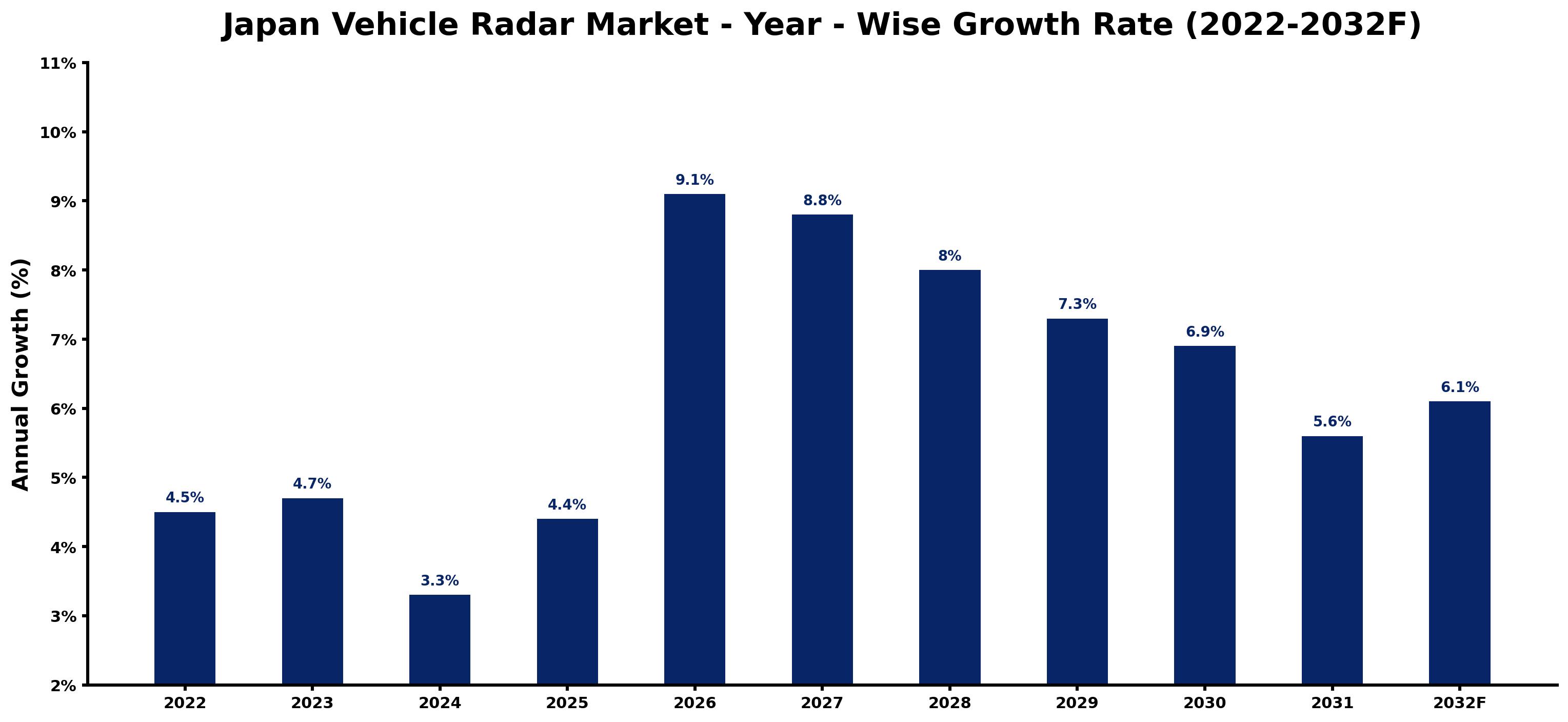
Year by year, the estimates below pair each growth rate with the development that shaped it.
| Year | Estimated Annual Growth (%) | Market Rationale |
| 2022 | 4.5 | The market experienced steady growth, driven by ongoing vehicle registrations and safety feature adoption. |
| 2023 | 4.7 | Growth accelerated as adaptive cruise control became standard in over 30% of new vehicles sold. |
| 2024 | 3.3 | A slowdown occurred as the market adjusted to previous rapid growth rates and new technology integration. |
| 2025 | 4.4 | Growth picked up again, supported by increasing demand for advanced safety features in vehicles. |
| 2026 | 9.1 | The market is expected to peak, propelled by investments in automotive radar technologies and electric vehicles. |
| 2027 | 8.8 | Growth is projected to slow slightly as the market stabilises after peak demand in the previous year. |
| 2028 | 8.0 | The trend of slowing growth is anticipated to continue, reflecting market saturation in certain segments. |
| 2029 | 7.3 | The market is expected to maintain a slower growth rate as competition intensifies among suppliers. |
| 2030 | 6.9 | Growth is projected to continue slowing as the focus shifts towards improving existing technologies rather than new introductions. |
| 2031 | 5.6 | The market is expected to see further deceleration, indicating a maturing phase in vehicle radar technology. |
| 2032 | 6.1 | Growth is anticipated to pick up again as new regulations mandate advanced safety features in all new vehicles. |
Note: Market size estimations and growth projections presented in this report are based on 6Wresearch's proprietary forecasting methodology, utilizing the latest available industry data, government publications, and primary research inputs.
Japan Vehicle Radar Market Synopsis
Vehicle radar systems are advanced sensing technologies used in automobiles that improve safety and driving convenience. The Japan Vehicle Radar Market is expanding due to over 5 million new vehicle registrations annually and a government target for 100% of new vehicles to feature advanced safety technologies by 2030. The Tokyo region serves as a hub for automotive technology development, driving demand for innovative radar solutions and enhancing overall vehicle safety.
Market Dynamics Impact Analysis (2026–2032)
| Factor | Type | Impact | Primary Segment Affected |
| Increasing vehicle registrations and safety feature adoption | Driver | High | Adaptive Cruise Radar |
| Government mandates for advanced safety technologies in vehicles | Driver | High | Collision Avoidance Radar |
| Growing demand for electric vehicles with advanced safety features | Opportunity | High | Electric Vehicles |
| Expansion of smart mobility technologies in urban areas | Opportunity | Medium | Passenger Vehicles |
| High costs associated with advanced radar system integration | Restraint | High | Collision Avoidance Radar |
| Limited awareness of radar technology benefits among consumers | Restraint | Medium | Blind Spot Radar |
| Rising competition among suppliers affecting pricing strategies | Challenge | High | Adaptive Cruise Radar |
| Technological advancements requiring continuous R&D investment | Challenge | Medium | Rear Cross Traffic Radar |
Evaluation of Drivers in Japan Vehicle Radar Market (2026–2032)
The main growth drivers and the segments they affect most are set out below.
| Drivers | Primary Segment Affected | Why It Matters (Evidence) |
| High annual vehicle registrations | Adaptive Cruise Radar | Over 5 million new vehicles registered annually in Japan drive demand for adaptive features. |
| Government targets for safety features | Collision Avoidance Radar | The government aims for 100% of new vehicles to have advanced safety features by 2030. |
| Growth in electric vehicle sales | Blind Spot Radar | Electric vehicles are projected to reach 1 million units by 2025, increasing radar demand. |
| Standardisation of safety regulations | Rear Cross Traffic Radar | ISO 26262 sets safety standards that encourage adoption of radar systems in vehicles. |
| Technological advancements in radar systems | Adaptive Cruise Radar | Innovations in radar technology attract more buyers seeking improved safety features. |
Purchasing is picking up as over 5 million new vehicles are registered annually in Japan, driving demand for adaptive cruise control systems. The target for 100% of new vehicles to feature advanced safety technologies by 2030 is prompting manufacturers to integrate collision avoidance systems. The Tokyo region is projected to see electric vehicle sales reach 1 million units by 2025, increasing the need for radar systems. The ISO 26262 standard encourages the adoption of safety features, leading to more purchases from consumers prioritising safety. Recent technological advancements are attracting buyers seeking the latest developments in vehicle safety features.
Evaluation of Restraints in Japan Vehicle Radar Market
Several factors work against faster growth; the main ones are summarised below.
| Market Restraint | Primary Segment Affected | Why It Matters (Evidence) |
| High integration costs for advanced radar systems | Collision Avoidance Radar | The average cost of a vehicle radar system is around ¥30,000, impacting affordability. |
| Limited consumer awareness of radar benefits | Blind Spot Radar | Many consumers are unaware of the advantages of radar systems, hindering adoption. |
| Market saturation in certain segments | Adaptive Cruise Radar | As the market matures, growth potential diminishes in established segments. |
| Intense competition affecting pricing | Rear Cross Traffic Radar | Increased competition among suppliers leads to price wars, impacting profitability. |
| Regulatory compliance costs for manufacturers | Collision Avoidance Radar | Compliance with safety standards increases operational costs for manufacturers. |
Japan Vehicle Radar Market Challenges
A root cause arises from reliance on semiconductor components, leading to supply chain disruptions that can delay production schedules by up to six months for producers. Regulatory pressures require advanced safety features in all new vehicles by 2030, compelling manufacturers to invest heavily in compliance, costing approximately ¥10 billion in R&D. The slow integration of ISO 26262 standards hampers technology adoption, extending development timelines for new radar systems by 20% for producers. Buyers face rising costs as the average price of vehicle radar systems reaches ¥30,000, making new vehicles less affordable for consumers.
Trends in the Japan Vehicle Radar Market
Buyers and suppliers in the Japan Vehicle Radar Market are adjusting to the following trends.
- Transition to Electric Vehicles: The Tokyo region is transitioning towards electric vehicles, with projections of 1 million units by 2025. This shift drives demand for advanced radar systems that improve safety features in these vehicles.
- Implementation of ISO 26262 Standard: The adoption of the ISO 26262 standard is reshaping the automotive radar market, ensuring safety in radar systems. This standard is becoming a benchmark for manufacturers, influencing design and production.
- Launch of Smart Mobility Programme: The launch of the smart mobility programme in 2023 is promoting the integration of advanced radar systems in urban transport. This initiative aims to improve safety and efficiency in city driving.
- Increase in Luxury Vehicle Demand: The luxury car segment is prioritising advanced safety features, leading to increased demand for vehicle radar systems. This trend is clear as luxury vehicles adopt more sophisticated radar technologies.
Investment Opportunities in the Japan Vehicle Radar Market
The following opportunities in the Japan Vehicle Radar Market pair current demand with a clear way in.
- Expansion of Electric Vehicle Infrastructure: The Tokyo region is expanding its electric vehicle infrastructure, creating opportunities for radar system suppliers. With a projected 1 million electric vehicles by 2025, investment in charging stations and safety technologies is essential.
- Partnerships with Tier 1 Suppliers: Collaborating with Tier 1 suppliers can facilitate market entry for new radar technologies. These suppliers play a crucial role in integrating advanced safety features into vehicles, ensuring compliance with safety standards.
- Investment in Commercial Vehicle Safety: Commercial vehicles are increasingly adopting radar systems for safety features, presenting an opportunity for suppliers. With collision avoidance systems mandated by 2025, investment in this area is timely.
- Development of Niche Radar Applications: The emergence of niche applications for radar technology is creating new market opportunities. As demand for specialised radar systems grows, suppliers can cater to unique industry needs.
Government Initiatives in the Japan Vehicle Radar Market
Recent policies have been established to improve vehicle safety, including the GX Promotion Act of 2023, which mandates advanced safety features in new vehicles. This act supports the automotive sector by ensuring compliance with safety standards, ultimately benefiting consumers through better safety technologies and funding for R&D initiatives.
The Ministry of Economy, Trade and Industry oversees the implementation of the smart mobility programme launched in 2023. This initiative promotes the adoption of advanced radar systems in vehicles, providing funding and support for manufacturers to develop new safety technologies.
Future Insight of the Japan Vehicle Radar Market
Japan's commitment to reducing greenhouse-gas emissions will drive a shift towards electric vehicles and advanced safety technologies by 2032, prompting suppliers to innovate. The target for 100% of new vehicles to have advanced safety features will create demand for enhanced radar systems. The Tokyo region will continue to be a hub for automotive technology development, facilitating collaboration among over 200 registered firms. Investments in R&D are expected to boost advancements in vehicle radar technology, improving safety and convenience for buyers.
Market Segmentation Analysis
Japan Vehicle Radar Market report covers a detailed analysis of the following market segments:
By Product Type – Adaptive Cruise Radar Leads, Blind Spot Radar Expected to Grow Fastest
According to Saurav Kr Singh, Senior Research Analyst at 6Wresearch, Adaptive Cruise Radar took 45% of product type revenue in 2025, more than any other category. Adaptive cruise radar holds the largest share due to its integration in over 30% of new vehicles sold in Japan, fulfilling consumer demand for enhanced driving convenience. This technology is essential for automated speed control, making it a preferred choice among manufacturers. Blind Spot Radar is projected to grow fastest, at a CAGR of 9.9% during 2026–2032. The blind spot radar segment is experiencing rapid growth as safety regulations tighten, with collision avoidance systems mandated in all new commercial vehicles by 2025. This trend indicates a rising focus on safety features, further driving adoption. Suppliers should prioritise the development of adaptive cruise and blind spot radar technologies to align with market demands.
By Frequency Band – 77 GHz Leads, 79 GHz Expected to Grow Fastest
77 GHz held 47% of the Japan Vehicle Radar Market by frequency band in 2025. The 77 GHz frequency band dominates the market as it is the most commonly used frequency for automotive radar applications, ensuring compatibility with existing systems. Its established presence makes it the preferred choice for manufacturers aiming for reliability. 79 GHz is set to record the highest CAGR in this split, 9.2% over 2026–2032. The 79 GHz frequency band is gaining traction due to its suitability for specific applications, reflecting a shift towards more advanced radar technologies. As manufacturers seek to enhance functionality, this frequency is likely to see increased adoption. Suppliers must invest in 79 GHz technology to capture the growing interest in advanced automotive radar applications.
By Distribution Channel – OEMs Lead, Tier 1 Suppliers Expected to Grow Fastest
With 40% of distribution channel revenue in 2025, OEMs was the largest category. OEMs lead the distribution channel as they are the primary manufacturers of vehicle radar systems, providing a direct link to the automotive supply chain. Their established relationships with vehicle manufacturers ensure a steady demand for radar technologies. Over 2026–2032, Tier 1 Suppliers are expected to post the fastest growth, at a CAGR of 9.3%. Tier 1 suppliers are experiencing the fastest growth as they supply essential components to OEMs, reflecting an increasing reliance on specialised suppliers for advanced radar systems. This trend indicates a shift in how radar technologies are integrated into vehicles. Suppliers should strengthen partnerships with Tier 1 suppliers to enhance their market presence.
By End User – Passenger Vehicles Lead, Electric Vehicles Expected to Grow Fastest
Passenger Vehicles accounted for 37% of the market by end user in 2025. Passenger vehicles represent the largest segment using vehicle radar, driven by consumer demand for safety and convenience features in everyday vehicles. With over 5 million new vehicle registrations annually, this segment remains robust. The quickest growth will come from Electric Vehicles, forecast to expand at a CAGR of 9.5% between 2026 and 2032. Electric vehicles are the fastest-growing segment as they increasingly utilise advanced radar technology to meet safety standards and consumer expectations. The projected rise to 1 million electric vehicles by 2025 will significantly boost radar demand. Suppliers should focus on developing radar solutions tailored for electric vehicles to capitalise on this growth opportunity.
Key Attractiveness of the Report
- 10 Years of Market Numbers
- Historical Data Starting from 2022 to 2025
- Base Year 2025
- Forecast Data until 2032
- Key Performance Indicators Impacting the Market
- Major Upcoming Developments and Projects
Key Highlights of the Report:
- Japan Vehicle Radar Market Outlook
- Market Size of Japan Vehicle Radar Market, 2025
- Forecast of Japan Vehicle Radar Market, 2032
- Historical Data and Forecast of Japan Vehicle Radar Revenues & Volume for the Period 2022-2032F
- Japan Vehicle Radar Market Trend Evolution
- Japan Vehicle Radar Market Drivers and Challenges
- Japan Vehicle Radar Price Trends
- Japan Vehicle Radar Porter's Five Forces
- Japan Vehicle Radar Industry Life Cycle
- Historical Data and Forecast of Japan Vehicle Radar Market Revenues & Volume By Product Type for the Period 2022-2032F
- Historical Data and Forecast of Japan Vehicle Radar Market Revenues & Volume By Adaptive Cruise Radar for the Period 2022-2032F
- Historical Data and Forecast of Japan Vehicle Radar Market Revenues & Volume By Blind Spot Radar for the Period 2022-2032F
- Historical Data and Forecast of Japan Vehicle Radar Market Revenues & Volume By Collision Avoidance Radar for the Period 2022-2032F
- Historical Data and Forecast of Japan Vehicle Radar Market Revenues & Volume By Rear Cross Traffic Radar for the Period 2022-2032F
- Historical Data and Forecast of Japan Vehicle Radar Market Revenues & Volume By Frequency Band for the Period 2022-2032F
- Historical Data and Forecast of Japan Vehicle Radar Market Revenues & Volume By 77 GHz for the Period 2022-2032F
- Historical Data and Forecast of Japan Vehicle Radar Market Revenues & Volume By 24 GHz for the Period 2022-2032F
- Historical Data and Forecast of Japan Vehicle Radar Market Revenues & Volume By 79 GHz for the Period 2022-2032F
- Historical Data and Forecast of Japan Vehicle Radar Market Revenues & Volume By 60 GHz for the Period 2022-2032F
- Historical Data and Forecast of Japan Vehicle Radar Market Revenues & Volume By Distribution Channel for the Period 2022-2032F
- Historical Data and Forecast of Japan Vehicle Radar Market Revenues & Volume By OEMs for the Period 2022-2032F
- Historical Data and Forecast of Japan Vehicle Radar Market Revenues & Volume By Tier 1 Suppliers for the Period 2022-2032F
- Historical Data and Forecast of Japan Vehicle Radar Market Revenues & Volume By Online Platforms for the Period 2022-2032F
- Historical Data and Forecast of Japan Vehicle Radar Market Revenues & Volume By Retail Distributors for the Period 2022-2032F
- Historical Data and Forecast of Japan Vehicle Radar Market Revenues & Volume By End User for the Period 2022-2032F
- Historical Data and Forecast of Japan Vehicle Radar Market Revenues & Volume By Passenger Vehicles for the Period 2022-2032F
- Historical Data and Forecast of Japan Vehicle Radar Market Revenues & Volume By Commercial Vehicles for the Period 2022-2032F
- Historical Data and Forecast of Japan Vehicle Radar Market Revenues & Volume By Electric Vehicles for the Period 2022-2032F
- Historical Data and Forecast of Japan Vehicle Radar Market Revenues & Volume By Luxury Cars for the Period 2022-2032F
- Japan Vehicle Radar Import Export Trade Statistics
- Market Opportunity Assessment By Product Type
- Market Opportunity Assessment By Frequency Band
- Market Opportunity Assessment By Distribution Channel
- Market Opportunity Assessment By End User
- Japan Vehicle Radar Top Companies Market Share
- Japan Vehicle Radar Competitive Benchmarking By Technical and Operational Parameters
- Japan Vehicle Radar Company Profiles
- Japan Vehicle Radar Key Strategic Recommendations
Market Covered
The following segment groups are covered in the report.
By Product Type
- Adaptive Cruise Radar
- Blind Spot Radar
- Collision Avoidance Radar
- Rear Cross Traffic Radar
By Frequency Band
- 77 GHz
- 24 GHz
- 79 GHz
- 60 GHz
By Distribution Channel
- OEMs
- Tier 1 Suppliers
- Online Platforms
- Retail Distributors
By End User
- Passenger Vehicles
- Commercial Vehicles
- Electric Vehicles
- Luxury Cars































