Japan Vehicle Recognition Camera Market Size & Growth Rate
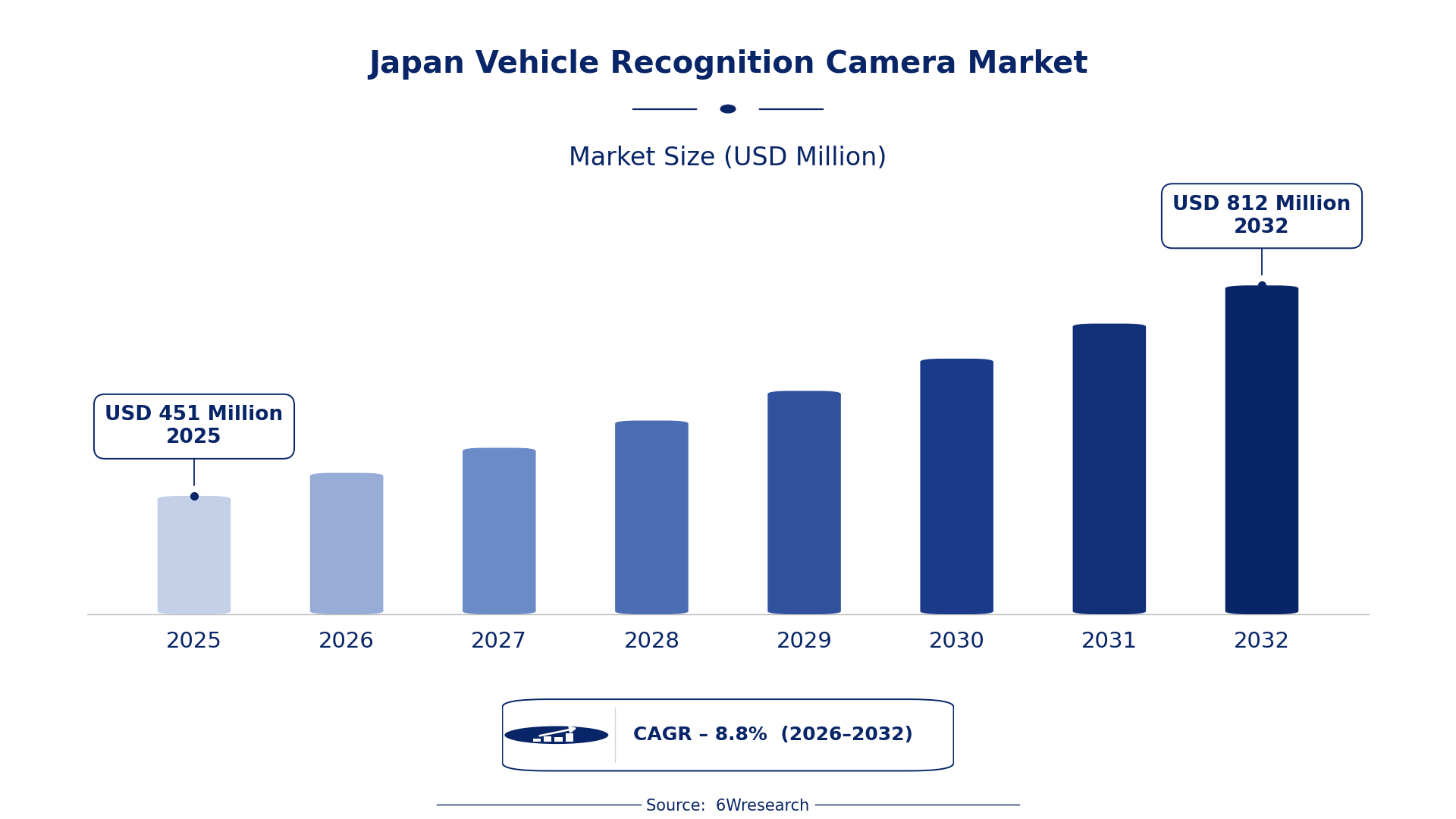
According to 6Wresearch internal database and industry insights, the Japan Vehicle Recognition Camera Market was valued at USD 451 Million in 2025 and is projected to reach USD 812 Million by 2032, growing at a CAGR of approximately 8.8% during 2026–2032.
Japan Vehicle Recognition Camera Market Highlights
| Report Metric | Details |
| Report Name | Japan Vehicle Recognition Camera Market (2026-2032) |
| Market Size 2025 | USD 451 Million |
| Market Size 2032 | USD 812 Million |
| Absolute Growth 2025–2032 | USD 361 Million |
| CAGR 2026–2032 | 8.8% |
| Peak Annual Growth | 9.6% in 2032 |
| Forecast Period | 2026–2032 |
| Historical Data | 2022–2025 |
| Base Year | 2025 |
| Leading Camera Type, 2025 | Front Recognition Cam (49% share) |
| Leading Technology Used, 2025 | CMOS Sensor (40% share) |
| Leading Distribution Channel, 2025 | OEM Integration (44% share) |
| Leading End User, 2025 | Passenger Cars (38% share) |
| Fastest-Growing Camera Type | Rear Recognition Cam (12.4% CAGR) |
| Fastest-Growing Technology Used | Night Vision (12.9% CAGR) |
| Fastest-Growing Distribution Channel | Online Platforms (11.5% CAGR) |
| Fastest-Growing End User | SUVs & Crossovers (11.7% CAGR) |
| Growing Sector | Traffic Management |
| Key End Users | Transportation authorities, commercial fleets, security integrators, tolling authorities |
Japan Vehicle Recognition Camera Market Year-wise Growth Rate and Key Drivers (2022–2032)
This graph illustrates the annual growth rates of the market from 2022 to 2032, highlighting a steady upward trajectory and projected market expansion over the forecast period.
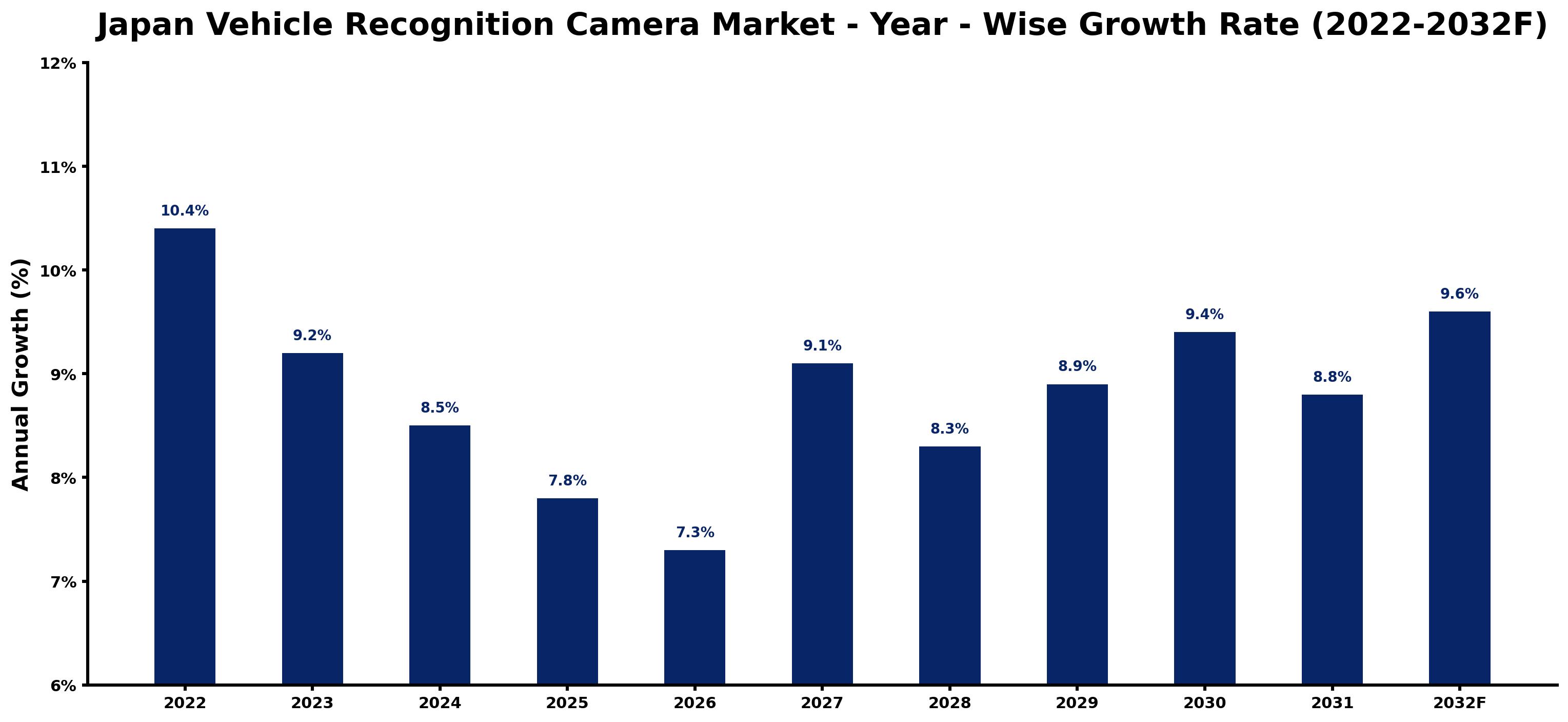
For each year, the table pairs the estimated growth rate with the leading influence on demand, showing how the drivers changed across the period.
| Year | Estimated Annual Growth (%) | Market Rationale |
| 2022 | 10.4 | The market experienced strong demand due to increased urbanisation and traffic management needs. |
| 2023 | 9.2 | Growth slowed as market saturation began to impact new installations and upgrades. |
| 2024 | 8.5 | Continued demand for security solutions contributed to a further slowdown in growth rates. |
| 2025 | 7.8 | Steady growth occurred as urban traffic systems were upgraded with advanced technologies. |
| 2026 | 7.3 | A slight slowdown in growth rate is expected as the vehicle recognition camera sector matures. |
| 2027 | 9.1 | Demand is projected to rise as commercial fleets adopt advanced cameras for improved monitoring. |
| 2028 | 8.3 | Growth is anticipated to slow as the market adjusts to the saturation of installed units. |
| 2029 | 8.9 | Renewed interest in advanced surveillance systems for urban areas is expected to boost the market. |
| 2030 | 9.4 | An upturn in growth will occur as initiatives for smart city projects gain momentum. |
| 2031 | 8.8 | Growth is projected to slow as the market stabilises after a period of rapid expansion. |
| 2032 | 9.6 | The market is expected to peak as new technologies and applications drive demand for vehicle recognition cameras. |
Note: Market size estimations and growth projections presented in this report are based on 6Wresearch's proprietary forecasting methodology, utilizing the latest available industry data, government publications, and primary research inputs.
Japan Vehicle Recognition Camera Market Synopsis
Vehicle Recognition Cameras are advanced imaging devices designed for identifying and tracking vehicles, primarily used in traffic monitoring, toll collection, and security surveillance. The Japan Vehicle Recognition Camera Market is expanding due to urbanisation and government initiatives promoting smart traffic systems. With a population of approximately 125 million, demand is driven by urban areas like Tokyo and Osaka, where advanced surveillance technologies are being integrated into infrastructure, supported by a budget of ¥5 billion for smart city projects by the government.
Market Dynamics Impact Analysis (2026–2032)
| Factor | Type | Impact | Primary Segment Affected |
| Increased urbanisation and traffic congestion drive demand for vehicle recognition cameras in urban areas. | Driver | High | Front Recognition Cam |
| The rise in commercial fleet management requires advanced monitoring solutions, boosting demand for AI-enhanced cameras. | Driver | High | Commercial Fleets |
| Government initiatives for smart city development create opportunities for advanced surveillance technology integration. | Opportunity | High | Front Recognition Cam |
| Growing interest in automated toll collection systems presents a market opportunity for LPR technology. | Opportunity | Medium | Tolling Authorities |
| Market saturation in urban areas limits growth potential for new installations and upgrades. | Restraint | High | Front Recognition Cam |
| High initial investment costs for advanced vehicle recognition systems can deter potential buyers. | Restraint | Medium | Commercial Fleets |
| Competition from alternative surveillance technologies poses challenges for market players. | Challenge | High | Front Recognition Cam |
| Rapid technological advancements require continuous investment, straining resources for smaller players. | Challenge | Medium | AI-enhanced |
Evaluation of Drivers in Japan Vehicle Recognition Camera Market (2026–2032)
The following drivers explain most of the expected growth.
| Drivers | Primary Segment Affected | Why It Matters (Evidence) |
| Urbanisation increases traffic management needs, driving demand for vehicle recognition cameras in cities. | Front Recognition Cam | In 2022, the population of Japan was approximately 125 million, influencing demand for traffic management solutions. |
| The adoption of advanced cameras improves monitoring capabilities for commercial fleets, boosting sales. | Commercial Fleets | AI technology is increasingly used for monitoring driver behaviour, improving safety outcomes. |
| Government support for smart traffic systems encourages investment in vehicle recognition technologies. | Front Recognition Cam | The government allocated a budget of ¥5 billion for smart city initiatives involving vehicle recognition systems. |
| The need for automated toll collection systems drives demand for LPR technology across the country. | Tolling Authorities | As of 2023, there are over 10,000 toll booths in Japan utilizing LPR technology. |
| Increased focus on public safety enhances demand for vehicle recognition cameras in security applications. | Front Recognition Cam | The Japan Traffic Safety Association promotes the use of vehicle recognition cameras for public safety. |
Most of the extra volume comes from urbanisation, as cities face increased traffic management needs. The adoption of advanced cameras is gaining traction, improving monitoring capabilities and driving sales. The need for automated toll collection systems also boosts demand for LPR technology, with many toll booths currently in operation utilizing these systems.
Evaluation of Restraints in Japan Vehicle Recognition Camera Market
Below are the constraints most often cited by buyers and suppliers, with the segment each affects.
| Market Restraint | Primary Segment Affected | Why It Matters (Evidence) |
| Market saturation in urban areas limits growth potential for new installations and upgrades. | Front Recognition Cam | The concentration of vehicle recognition cameras in cities like Tokyo and Osaka has led to market saturation. |
| High initial investment costs for advanced vehicle recognition systems can deter potential buyers. | Commercial Fleets | The cost of implementing advanced cameras may be prohibitive for some fleet operators. |
| Limited awareness among smaller businesses about the benefits of vehicle recognition technology hampers adoption. | Front Recognition Cam | Many smaller security providers are unaware of the advantages offered by advanced vehicle recognition systems. |
| Technological complexity may discourage some users from adopting advanced vehicle recognition solutions. | Tolling Authorities | The integration of sophisticated systems can be daunting for less technologically savvy authorities. |
| Regulatory hurdles can delay the deployment of vehicle recognition systems in certain regions. | Front Recognition Cam | Compliance with local regulations may slow down the implementation of new technologies. |
Japan Vehicle Recognition Camera Market Challenges
Producers of vehicle recognition cameras in Japan face intense competition in urban areas like Tokyo and Osaka, which drives down prices and compresses profit margins. Regulatory compliance with JIS specifications can delay product launches, costing manufacturers valuable time in a fast-evolving market. Buyers encounter integration difficulties with existing traffic management systems, leading to potential cost increases of up to 20% and disruptions in operations. A skills shortage in AI and image processing hampers the advancement of camera features, compelling companies to divert resources towards training instead of product development.
Trends in the Japan Vehicle Recognition Camera Market
Four trends stand out in the Japan Vehicle Recognition Camera Market.
- Shift from Traditional to Advanced Cameras: A noticeable shift towards advanced vehicle recognition cameras has occurred, particularly in commercial fleets. This change is evidenced by the growing adoption of AI technologies, with a projected increase of 12.9% CAGR in the Night Vision segment.
- Transition from Manual to Automated Toll Collection: Tolling authorities are increasingly adopting automated systems for toll collection, reducing wait times and improving efficiency. As of 2023, over 10,000 toll booths in Japan utilize LPR technology, streamlining the tolling process.
- Emergence of Smart City Initiatives: Several smart city projects aim to integrate advanced surveillance technologies into urban infrastructure. With a budget of ¥5 billion allocated for these initiatives, the demand for vehicle recognition cameras is expected to rise significantly.
- Growing Demand for Improved Security Solutions: The need for improved public safety has led to an increased focus on vehicle recognition cameras in security applications. The Japan Traffic Safety Association's promotion of these cameras highlights a growing trend towards enhanced surveillance.
Investment Opportunities in the Japan Vehicle Recognition Camera Market
The following opportunities in the Japan Vehicle Recognition Camera Market pair current demand with a clear way in.
- Commercial Fleets Seeking Advanced Monitoring Solutions: Commercial fleets are increasingly looking for advanced cameras to improve driver monitoring and safety. With a projected growth rate of 12.9% for Night Vision technology, suppliers can tap into this demand by partnering with fleet operators.
- Urban Areas Upgrading Traffic Management Systems: Urban areas are investing in smart traffic management systems that require advanced vehicle recognition cameras. The government's budget of ¥5 billion for smart city initiatives presents a prime opportunity for suppliers to engage with local authorities.
- Tolling Authorities Adopting Automated Solutions: Tolling authorities are in need of automated toll collection systems, creating demand for LPR technology. Suppliers can enter this market by collaborating with local governments to provide integrated solutions.
- Security Integrators Expanding Their Offerings: Security integrators are looking to broaden their product offerings with advanced vehicle recognition technologies. This trend is supported by the Japan Traffic Safety Association's promotion of these systems, creating opportunities for suppliers.
Government Initiatives in the Japan Vehicle Recognition Camera Market
The GX Basic Policy adopted in 2023 aims to promote decarbonisation and supports the adoption of smart traffic systems. This policy encourages manufacturers to invest in vehicle recognition technologies that comply with new standards, ensuring they meet the evolving needs of urban infrastructure and traffic management. The policy targets a decarbonisation investment of about JPY 150 trillion over the next decade.
A budget of ¥5 billion for smart city initiatives involving vehicle recognition systems is overseen by the Ministry of Land, Infrastructure, Transport and Tourism. This funding supports the integration of advanced surveillance technologies into urban planning, benefiting both producers and buyers by improving traffic management and public safety.
Future Insight of the Japan Vehicle Recognition Camera Market
Japan's shift towards smart traffic systems will reshape the vehicle recognition camera market by 2032, driven by government initiatives. The commitment to upgrade urban traffic systems will encourage suppliers to innovate and meet new standards. Enhanced surveillance capabilities will improve public safety, leading to broader acceptance in diverse sectors. With a budget of ¥5 billion allocated for smart city initiatives, the market will demand over 1 million units, prompting suppliers to create solutions that integrate effectively with current infrastructure.
Market Segmentation Analysis
Japan Vehicle Recognition Camera Market report covers a detailed analysis of the following market segments:
By Camera Type – Front Recognition Cam Leads, Rear Recognition Cam Expected to Grow Fastest
According to Saurav Kr Singh, Senior Research Analyst at 6Wresearch, Front Recognition Cam took 49% of camera type revenue in 2025, more than any other category. The Front Recognition Camera holds the largest share due to its primary role in identifying vehicles ahead, which is essential for efficient traffic management. Major urban centres like Tokyo heavily rely on these cameras for effective surveillance and monitoring. Over 2026–2032, Rear Recognition Cam is expected to post the fastest growth, at a CAGR of 12.4%. The Rear Recognition Camera is experiencing rapid growth as it is increasingly used for monitoring vehicles behind, addressing the rising need for thorough vehicle tracking solutions. This trend is particularly evident in densely populated urban areas. Suppliers should focus on enhancing features of rear recognition cameras to align with the growing market demand.
By Technology Used – CMOS Sensor Leads, Night Vision Expected to Grow Fastest
CMOS Sensor accounted for 40% of the market by technology used in 2025. CMOS Sensor technology leads the market as it is vital for image capture in vehicle recognition cameras, ensuring high-quality imaging. This technology is widely utilised across various applications, particularly in urban traffic monitoring. The quickest growth will come from Night Vision, forecast to expand at a CAGR of 12.9% between 2026 and 2032. Night Vision technology is witnessing swift growth as it enhances visibility in low-light conditions, making it crucial for night-time surveillance. The increasing focus on safety during night hours is driving this trend. Buyers should prioritise cameras with night vision capabilities to ensure effective monitoring at all times.
By Distribution Channel – OEM Integration Leads, Online Platforms Expected to Grow Fastest
The largest distribution channel category in 2025 was OEM Integration, at 44% of revenue. OEM Integration is the leading distribution channel as it facilitates seamless incorporation into vehicle manufacturing, ensuring vehicles are equipped with advanced recognition technologies from the outset. This method is commonly adopted by major automotive manufacturers in Japan. Online Platforms are set to record the highest CAGR in this split, 11.5% over 2026–2032. Online Platforms are rapidly gaining traction as they enable sales through e-commerce, appealing to a tech-savvy consumer base seeking convenient purchasing options. The shift towards online shopping is increasingly clear in the automotive accessories market. Suppliers must enhance their online presence to capture the rising demand for vehicle recognition cameras through digital channels.
By End User – Passenger Cars Lead, SUVs & Crossovers Expected to Grow Fastest
In 2025, Passenger Cars led the end user split with a 38% share. Passenger Cars represent the largest end-user segment as they are the main application for vehicle recognition cameras in personal vehicles, reflecting the high ownership rates in Japan. This segment is particularly prominent in urban areas where traffic management is critical. SUVs & Crossovers are projected to grow fastest, at a CAGR of 11.7% during 2026–2032. SUVs & Crossovers are the fastest-growing segment as they are increasingly equipped with vehicle recognition systems, reflecting the trend towards larger vehicles among consumers. The rising popularity of these vehicle types is driving demand for advanced safety features. Suppliers should tailor their offerings to meet the specific needs of SUV and crossover owners to capitalise on this growth.
Key Attractiveness of the Report
- 10 Years of Market Numbers
- Historical Data Starting from 2022 to 2025
- Base Year 2025
- Forecast Data until 2032
- Key Performance Indicators Impacting the Market
- Major Upcoming Developments and Projects
Key Highlights of the Report:
- Japan Vehicle Recognition Camera Market Outlook
- Market Size of Japan Vehicle Recognition Camera Market, 2025
- Forecast of Japan Vehicle Recognition Camera Market, 2032
- Historical Data and Forecast of Japan Vehicle Recognition Camera Revenues & Volume for the Period 2022-2032F
- Japan Vehicle Recognition Camera Market Trend Evolution
- Japan Vehicle Recognition Camera Market Drivers and Challenges
- Japan Vehicle Recognition Camera Price Trends
- Japan Vehicle Recognition Camera Porter's Five Forces
- Japan Vehicle Recognition Camera Industry Life Cycle
- Historical Data and Forecast of Japan Vehicle Recognition Camera Market Revenues & Volume By Camera Type for the Period 2022-2032F
- Historical Data and Forecast of Japan Vehicle Recognition Camera Market Revenues & Volume By Front Recognition Cam for the Period 2022-2032F
- Historical Data and Forecast of Japan Vehicle Recognition Camera Market Revenues & Volume By Rear Recognition Cam for the Period 2022-2032F
- Historical Data and Forecast of Japan Vehicle Recognition Camera Market Revenues & Volume By Multi-view Cameras for the Period 2022-2032F
- Historical Data and Forecast of Japan Vehicle Recognition Camera Market Revenues & Volume By LPR Cameras for the Period 2022-2032F
- Historical Data and Forecast of Japan Vehicle Recognition Camera Market Revenues & Volume By Technology Used for the Period 2022-2032F
- Historical Data and Forecast of Japan Vehicle Recognition Camera Market Revenues & Volume By CMOS Sensor for the Period 2022-2032F
- Historical Data and Forecast of Japan Vehicle Recognition Camera Market Revenues & Volume By Night Vision for the Period 2022-2032F
- Historical Data and Forecast of Japan Vehicle Recognition Camera Market Revenues & Volume By AI-enhanced for the Period 2022-2032F
- Historical Data and Forecast of Japan Vehicle Recognition Camera Market Revenues & Volume By Optical Zoom for the Period 2022-2032F
- Historical Data and Forecast of Japan Vehicle Recognition Camera Market Revenues & Volume By Distribution Channel for the Period 2022-2032F
- Historical Data and Forecast of Japan Vehicle Recognition Camera Market Revenues & Volume By OEM Integration for the Period 2022-2032F
- Historical Data and Forecast of Japan Vehicle Recognition Camera Market Revenues & Volume By Online Platforms for the Period 2022-2032F
- Historical Data and Forecast of Japan Vehicle Recognition Camera Market Revenues & Volume By Security Integrators for the Period 2022-2032F
- Historical Data and Forecast of Japan Vehicle Recognition Camera Market Revenues & Volume By Surveillance Dealers for the Period 2022-2032F
- Historical Data and Forecast of Japan Vehicle Recognition Camera Market Revenues & Volume By End User for the Period 2022-2032F
- Historical Data and Forecast of Japan Vehicle Recognition Camera Market Revenues & Volume By Passenger Cars for the Period 2022-2032F
- Historical Data and Forecast of Japan Vehicle Recognition Camera Market Revenues & Volume By SUVs & Crossovers for the Period 2022-2032F
- Historical Data and Forecast of Japan Vehicle Recognition Camera Market Revenues & Volume By Commercial Fleets for the Period 2022-2032F
- Historical Data and Forecast of Japan Vehicle Recognition Camera Market Revenues & Volume By Tolling Authorities for the Period 2022-2032F
- Japan Vehicle Recognition Camera Import Export Trade Statistics
- Market Opportunity Assessment By Camera Type
- Market Opportunity Assessment By Technology Used
- Market Opportunity Assessment By Distribution Channel
- Market Opportunity Assessment By End User
- Japan Vehicle Recognition Camera Top Companies Market Share
- Japan Vehicle Recognition Camera Competitive Benchmarking By Technical and Operational Parameters
- Japan Vehicle Recognition Camera Company Profiles
- Japan Vehicle Recognition Camera Key Strategic Recommendations
Market Covered
Coverage by segment is as follows.
By Camera Type
- Front Recognition Cam
- Rear Recognition Cam
- Multi-view Cameras
- LPR Cameras
By Technology Used
- CMOS Sensor
- Night Vision
- AI-enhanced
- Optical Zoom
By Distribution Channel
- OEM Integration
- Online Platforms
- Security Integrators
- Surveillance Dealers
By End User
- Passenger Cars
- SUVs & Crossovers
- Commercial Fleets
- Tolling Authorities































