Japan Vehicle Ride Management Market Size & Growth Rate
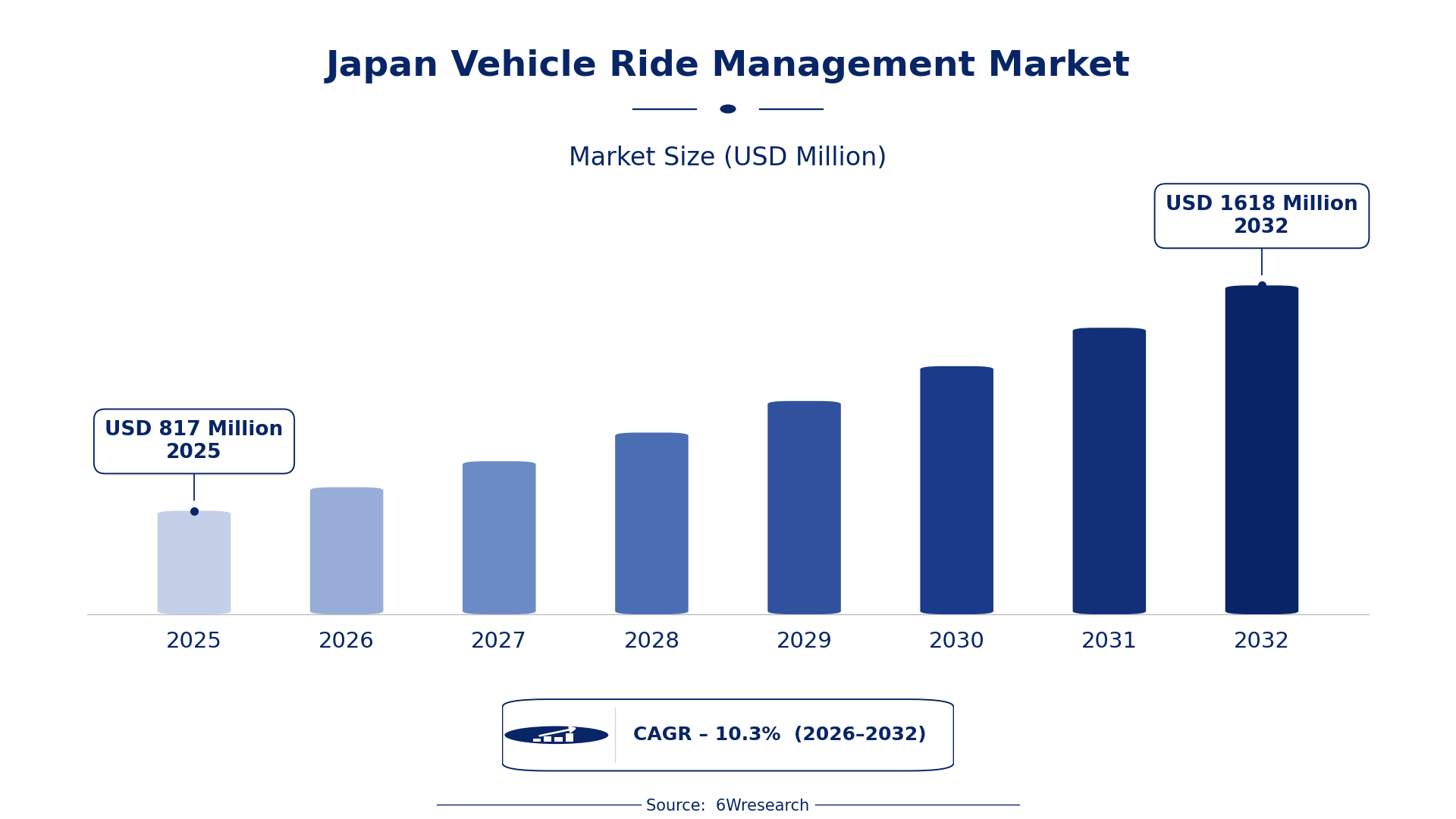
According to 6Wresearch internal database and industry insights, the Japan Vehicle Ride Management Market was valued at USD 817 Million in 2025 and is projected to reach USD 1,618 Million by 2032, growing at a CAGR of approximately 10.3% during 2026–2032.
Japan Vehicle Ride Management Market Highlights
| Report Metric | Details |
| Report Name | Japan Vehicle Ride Management Market (2026-2032) |
| Market Size 2025 | USD 817 Million |
| Market Size 2032 | USD 1,618 Million |
| Absolute Growth 2025–2032 | USD 801 Million |
| CAGR 2026–2032 | 10.3% |
| Peak Annual Growth | 11.0% in 2031 |
| Forecast Period | 2026–2032 |
| Historical Data | 2022–2025 |
| Base Year | 2025 |
| Leading Solution Type, 2025 | Predictive Maintenance (43% share) |
| Leading Connectivity, 2025 | IoT Sensors (51% share) |
| Leading Distribution Channel, 2025 | Fleet Management Co. (43% share) |
| Leading End User, 2025 | Commercial Fleets (41% share) |
| Fastest-Growing Solution Type | Real-time Monitoring (14.2% CAGR) |
| Fastest-Growing Distribution Channel | SaaS Providers (13.3% CAGR) |
| Fastest-Growing End User | Logistics Firms (13.1% CAGR) |
| Growing Sector | Logistics |
| Key End Users | Commercial Fleets, Logistics Firms, Ride-sharing Firms |
Japan Vehicle Ride Management Market Year-wise Growth Rate and Key Drivers (2022–2032)
This graph illustrates the annual growth rates of the market from 2022 to 2032, highlighting a steady upward trajectory and projected market expansion over the forecast period.
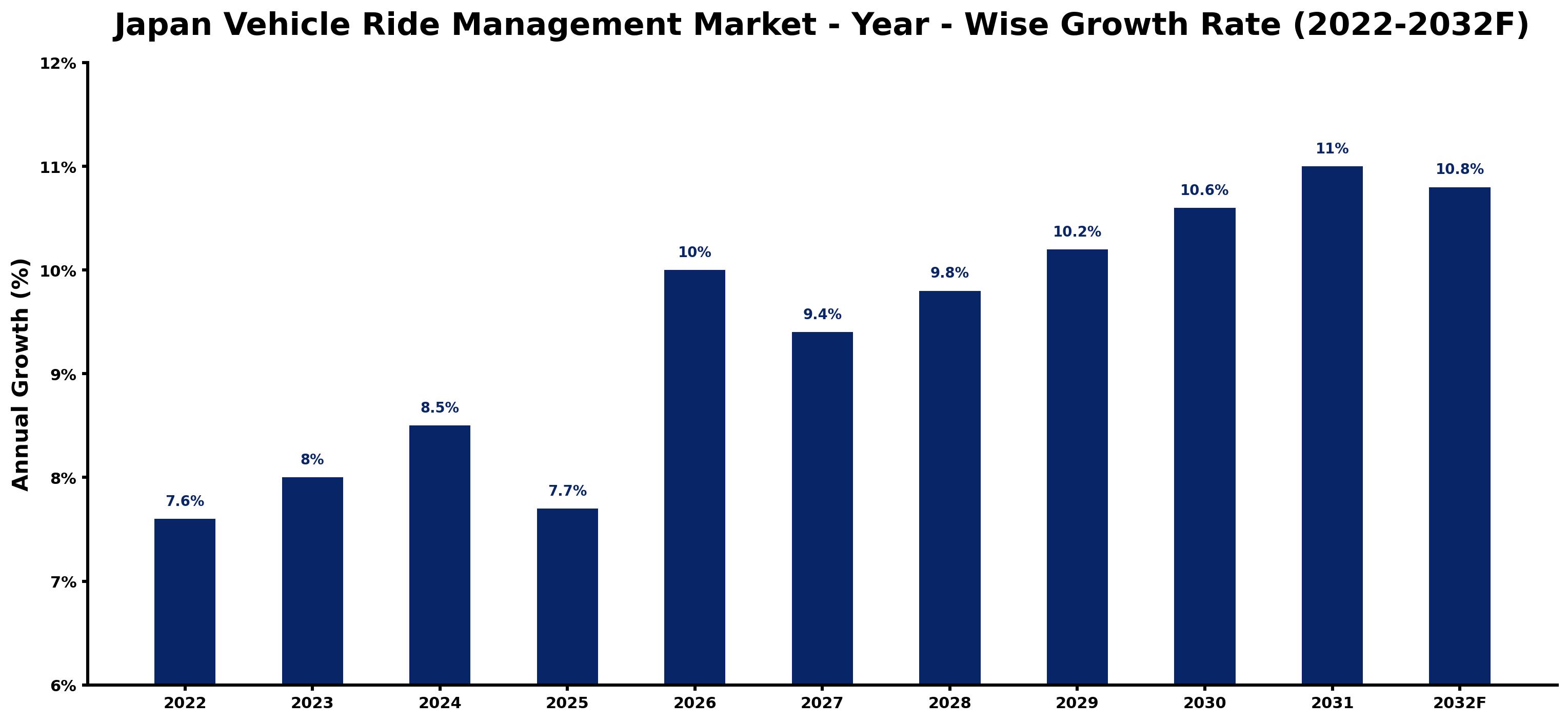
For each year, the table pairs the estimated growth rate with the leading influence on demand, showing how the drivers changed across the period.
| Year | Estimated Annual Growth (%) | Market Rationale |
| 2022 | 7.6 | Demand was steady, with active participation from commercial fleets and logistics firms. |
| 2023 | 8.0 | Growth accelerated as logistics firms increasingly adopted ride management technologies. |
| 2024 | 8.5 | The market expanded further, driven by a heightened focus on predictive maintenance practices. |
| 2025 | 7.7 | Growth slowed slightly as some firms consolidated their existing systems and technologies. |
| 2026 | 10.0 | Investment is expected to surge as companies seek to improve operational efficiency through advanced technology. |
| 2027 | 9.4 | Demand will continue to rise, although at a slower pace due to market saturation and competition. |
| 2028 | 9.8 | Growth is projected to pick up again with innovations in real-time monitoring solutions. |
| 2029 | 10.2 | The market will see increased adoption of route optimization technologies among logistics fleets. |
| 2030 | 10.6 | Demand is expected to strengthen as more firms embrace IoT sensors for vehicle management. |
| 2031 | 11.0 | The peak growth year will reflect heightened investments in smart vehicle technologies and solutions. |
| 2032 | 10.8 | Growth is projected to moderate slightly as the market matures and competition intensifies. |
Note: Market size estimations and growth projections presented in this report are based on 6Wresearch's proprietary forecasting methodology, utilizing the latest available industry data, government publications, and primary research inputs.
Japan Vehicle Ride Management Market Synopsis
Vehicle Ride Management encompasses technologies that enhance vehicle operations through the integration of software and hardware solutions. Key applications include predictive maintenance, real-time monitoring, and route optimization, which are essential for improving efficiency and safety. The Japan Vehicle Ride Management Market is expanding rapidly, driven by strong demand from commercial fleets and logistics firms, with over 5 million commercial vehicles actively using these solutions. Government initiatives promote vehicle efficiency, while the Tokyo metropolitan area accounts for 30% of total demand, highlighting the market's potential.
Market Dynamics Impact Analysis (2026–2032)
| Factor | Type | Impact | Primary Segment Affected |
| Increased adoption of predictive maintenance solutions | Driver | High | Predictive Maintenance |
| Rising demand for real-time monitoring systems | Driver | High | Real-time Monitoring |
| Growing need for efficient logistics operations | Opportunity | High | Logistics Firms |
| Expansion of the ride-sharing market | Opportunity | Medium | Ride-sharing Firms |
| High initial investment costs for technology implementation | Restraint | High | Fleet Management Co. |
| Limited awareness about advanced ride management solutions | Restraint | Medium | Commercial Fleets |
| Technological integration challenges in legacy systems | Challenge | High | Fleet Management Co. |
| Competition from emerging technologies and solutions | Challenge | Medium | Logistics Firms |
Evaluation of Drivers in Japan Vehicle Ride Management Market (2026–2032)
The table below links each growth driver to the segment it affects and the evidence for it.
| Drivers | Primary Segment Affected | Why It Matters (Evidence) |
| Investment in predictive maintenance technologies | Predictive Maintenance | Over 70% of logistics firms utilize these technologies to anticipate vehicle issues effectively. |
| Demand for real-time vehicle monitoring | Real-time Monitoring | The Tokyo metropolitan area accounts for 30% of ride management demand, driving technology adoption. |
| Growth of logistics firms seeking operational efficiency | Logistics Firms | The average fleet size in Japan is approximately 15 vehicles per company, prompting efficiency improvements. |
| Integration of IoT sensors in vehicles | IoT Sensors | The IoT sensor market for vehicles is projected to reach 1.2 billion units by 2025, enhancing data collection. |
| Adoption of JIS standards for quality assurance | Fleet Management Co. | JIS standards ensure safety and quality in vehicle management systems, encouraging investment by firms. |
Volumes increase due to investments in predictive maintenance technologies, with over 70% of logistics firms implementing these systems to foresee vehicle issues. The demand for real-time monitoring systems is particularly pronounced in the Tokyo metropolitan area, which accounts for 30% of the total market. The average fleet size in Japan, around 15 vehicles per company, compels logistics firms to pursue more efficient solutions. The anticipated growth of the IoT sensor market, projected to reach 1.2 billion units by 2025, fuels demand for advanced vehicle management technologies. The adoption of JIS standards for vehicle management systems guarantees quality and safety, motivating more firms to invest in these technologies.
Evaluation of Restraints in Japan Vehicle Ride Management Market
These restraints slow adoption and weigh on supplier margins.
| Market Restraint | Primary Segment Affected | Why It Matters (Evidence) |
| High initial investment costs for implementing ride management solutions | Fleet Management Co. | Many companies face challenges in allocating budgets for new technologies, impacting adoption rates significantly. |
| Limited awareness about advanced ride management technologies | Commercial Fleets | Some fleet operators lack knowledge about the benefits of these solutions, hindering growth opportunities. |
| Technological integration challenges with legacy systems | Fleet Management Co. | Older systems may not easily integrate with new technologies, causing delays in implementation processes. |
| Competition from emerging technologies and solutions | Logistics Firms | New entrants may offer alternatives, impacting market share for established vehicle management solutions. |
| Regulatory compliance costs associated with vehicle management systems | Commercial Fleets | Meeting JIS standards may require additional investments, affecting overall profitability for operators. |
Japan Vehicle Ride Management Market Challenges
Buyers encounter rising operational costs due to intense competition among logistics firms, which pressures them to lower service rates and shrink profit margins. Producers face delays from supply chain disruptions, as dependence on imported components for ride management systems can prolong lead times, affecting delivery schedules for distributors. Many distributors grapple with inefficiencies from outdated technologies, leading to heightened costs; for example, over 70% of logistics firms report difficulties with route optimisation. Skills shortages in advanced technology applications impede producers' ability to innovate, resulting in slower adoption of new solutions and missed market opportunities.
Trends in the Japan Vehicle Ride Management Market
Below are the shifts with the largest effect on the Japan Vehicle Ride Management Market.
- Shift towards Real-time Monitoring: The Tokyo metropolitan area is increasingly embracing real-time monitoring solutions to enhance fleet efficiency. This shift illustrates a growing emphasis on operational effectiveness, highlighting the demand for advanced technologies in vehicle management.
- Transition from Traditional to Predictive Maintenance: Japan's logistics firms are transitioning from traditional maintenance practices to predictive maintenance technologies. This shift is motivated by a need to minimise downtime and costs, indicating a trend in operational management.
- IoT Sensors Gaining Prominence: The integration of IoT sensors in vehicles is becoming more common among logistics firms. With the IoT sensor market expected to reach 1.2 billion units by 2025, this trend reflects a strong demand for data-driven vehicle management solutions.
- Expansion of Smart Mobility Initiatives: Government initiatives are promoting the adoption of smart vehicle technologies throughout Japan. This effort aims to boost vehicle efficiency, with substantial investments anticipated to support its implementation.
Investment Opportunities in the Japan Vehicle Ride Management Market
Where to invest in the Japan Vehicle Ride Management Market: the main openings are set out below.
- Partnerships with Fleet Management Companies: Local partnerships can ease entry into the expanding vehicle management market. With over 5 million commercial vehicles using these solutions, collaboration with fleet management companies can significantly enhance market reach and penetration.
- Investment in Predictive Maintenance Solutions: The market gap for predictive maintenance solutions is considerable, with a projected growth rate of 10.3% from 2026 to 2032. Targeting logistics firms can yield positive returns given their reliance on these technologies.
- Expansion into the Ride-sharing Sector: The ride-sharing market is expected to expand, with over 2 million users projected by 2025. Focusing on this sector can provide promising opportunities for technology providers aiming to broaden their offerings.
- Development of IoT Sensor Technologies: With the IoT sensor market anticipated to reach 1.2 billion units by 2025, investing in sensor technologies can satisfy the rising demand from commercial fleets and logistics firms.
Government Initiatives in the Japan Vehicle Ride Management Market
The GX Promotion Act, adopted in 2023, creates a framework for advancing green technologies, including vehicle management systems. This act builds on previous measures like the Green Growth Strategy, which identifies growth sectors and targets for emissions reduction, thereby improving the regulatory environment for producers and buyers alike. This framework stimulates investment in modern vehicle management solutions.
In 2023, the Japan government allocated JPY 150 trillion for public-private decarbonisation investment over the next decade. The Ministry of Land, Infrastructure, Transport and Tourism supervises the implementation of these initiatives, ensuring compliance and support for vehicle management technologies, which improves operational efficiency for buyers.
Future Insight of the Japan Vehicle Ride Management Market
The launch of the Smart Mobility Strategy will propel advancements in vehicle management systems by 2032, enhancing efficiency for buyers and suppliers. The integration of JIS standards will improve quality and safety across the market. As the ride-sharing market expands, suppliers will need to adjust to meet the needs of over 2 million projected users by 2025. The rise of cloud analytics platforms in fleet management solutions will streamline operations, enabling producers to enhance service delivery and reduce downtime.
Market Segmentation Analysis
Japan Vehicle Ride Management Market report covers a detailed analysis of the following market segments:
By Solution Type – Predictive Maintenance Leads, Real-time Monitoring Expected to Grow Fastest
According to Saurav Kr Singh, Senior Research Analyst at 6Wresearch, Predictive Maintenance took 43% of solution type revenue in 2025, more than any other category. Predictive maintenance holds the largest share due to its critical role in preventing vehicle failures, which is essential for the operational efficiency of commercial fleets. This technology is widely implemented across Japan's over 5 million commercial vehicles that depend on it for maintaining optimal performance. The quickest growth will come from Real-time Monitoring, forecast to expand at a CAGR of 14.2% between 2026 and 2032. Real-time monitoring is witnessing rapid growth as businesses increasingly recognise the importance of continuous tracking of vehicle performance. The 2023 launch of the Smart Mobility Strategy is expected to further boost the adoption of these monitoring technologies. Suppliers should focus on enhancing predictive maintenance capabilities to meet the growing demand for efficient vehicle management solutions.
By Connectivity – IoT Sensors Lead and Record the Fastest Growth
The largest connectivity category in 2025 was IoT Sensors, at 51% of revenue. IoT sensors lead the connectivity segment as they are essential for gathering real-time data from vehicles, enabling effective management and maintenance. Their importance is underscored by the fact that over 70% of logistics firms in Japan rely on these sensors for operational efficiency. Its lead should widen, with a projected CAGR of 11.5% during 2026–2032, the highest in this split. The growth of IoT sensors is accelerating as their role in vehicle data collection becomes increasingly vital with the rise of smart vehicle technologies. The projected increase to 1.2 billion IoT sensors by 2025 highlights their critical significance in the market. Buyers should prioritise investments in IoT sensor technologies to enhance their vehicle management capabilities and ensure competitiveness.
By Distribution Channel – Fleet Management Co. Leads, SaaS Providers Expected to Grow Fastest
Fleet Management Co. accounted for 43% of the market by distribution channel in 2025. Fleet management companies dominate this segment as they offer comprehensive services that integrate ride management solutions tailored for various clients. Their established presence in the market allows them to effectively cater to the needs of commercial fleets. SaaS Providers are projected to grow fastest, at a CAGR of 13.3% during 2026–2032. SaaS providers are experiencing rapid growth due to the rising demand for flexible and scalable software solutions for vehicle management. The shift towards cloud-based platforms is encouraging more firms to adopt SaaS offerings for their fleet operations. Suppliers should consider forming partnerships with SaaS providers to expand their market reach and deliver adaptable solutions to clients.
By End User – Commercial Fleets Lead, Logistics Firms Expected to Grow Fastest
In 2025, Commercial Fleets led the end user split with a 41% share. Commercial fleets represent the largest user group as they are the primary adopters of ride management technologies to ensure operational efficiency and reduce costs. Their extensive use of these systems is reflected in the high number of commercial vehicles in Japan. Logistics Firms are set to record the highest CAGR in this split, 13.1% over 2026–2032. Logistics firms are the fastest-growing user segment, driven by their need to optimise delivery routes and improve transport efficiency. The rise in demand for smart vehicle technologies is particularly beneficial for logistics operations. Suppliers should tailor their offerings to meet the specific needs of logistics firms to capitalise on this growth opportunity.
Key Attractiveness of the Report
- 10 Years of Market Numbers
- Historical Data Starting from 2022 to 2025
- Base Year 2025
- Forecast Data until 2032
- Key Performance Indicators Impacting the Market
- Major Upcoming Developments and Projects
Key Highlights of the Report:
- Japan Vehicle Ride Management Market Outlook
- Market Size of Japan Vehicle Ride Management Market, 2025
- Forecast of Japan Vehicle Ride Management Market, 2032
- Historical Data and Forecast of Japan Vehicle Ride Management Revenues & Volume for the Period 2022-2032F
- Japan Vehicle Ride Management Market Trend Evolution
- Japan Vehicle Ride Management Market Drivers and Challenges
- Japan Vehicle Ride Management Price Trends
- Japan Vehicle Ride Management Porter's Five Forces
- Japan Vehicle Ride Management Industry Life Cycle
- Historical Data and Forecast of Japan Vehicle Ride Management Market Revenues & Volume By Solution Type for the Period 2022-2032F
- Historical Data and Forecast of Japan Vehicle Ride Management Market Revenues & Volume By Predictive Maintenance for the Period 2022-2032F
- Historical Data and Forecast of Japan Vehicle Ride Management Market Revenues & Volume By Real-time Monitoring for the Period 2022-2032F
- Historical Data and Forecast of Japan Vehicle Ride Management Market Revenues & Volume By Driver Behavior Tracking for the Period 2022-2032F
- Historical Data and Forecast of Japan Vehicle Ride Management Market Revenues & Volume By Route Optimization for the Period 2022-2032F
- Historical Data and Forecast of Japan Vehicle Ride Management Market Revenues & Volume By Connectivity for the Period 2022-2032F
- Historical Data and Forecast of Japan Vehicle Ride Management Market Revenues & Volume By Cloud Analytics for the Period 2022-2032F
- Historical Data and Forecast of Japan Vehicle Ride Management Market Revenues & Volume By IoT Sensors for the Period 2022-2032F
- Historical Data and Forecast of Japan Vehicle Ride Management Market Revenues & Volume By GPS Integration for the Period 2022-2032F
- Historical Data and Forecast of Japan Vehicle Ride Management Market Revenues & Volume By AI Algorithms for the Period 2022-2032F
- Historical Data and Forecast of Japan Vehicle Ride Management Market Revenues & Volume By Distribution Channel for the Period 2022-2032F
- Historical Data and Forecast of Japan Vehicle Ride Management Market Revenues & Volume By Fleet Management Co. for the Period 2022-2032F
- Historical Data and Forecast of Japan Vehicle Ride Management Market Revenues & Volume By SaaS Providers for the Period 2022-2032F
- Historical Data and Forecast of Japan Vehicle Ride Management Market Revenues & Volume By Online Apps for the Period 2022-2032F
- Historical Data and Forecast of Japan Vehicle Ride Management Market Revenues & Volume By Tech Integrators for the Period 2022-2032F
- Historical Data and Forecast of Japan Vehicle Ride Management Market Revenues & Volume By End User for the Period 2022-2032F
- Historical Data and Forecast of Japan Vehicle Ride Management Market Revenues & Volume By Commercial Fleets for the Period 2022-2032F
- Historical Data and Forecast of Japan Vehicle Ride Management Market Revenues & Volume By Vehicle Owners for the Period 2022-2032F
- Historical Data and Forecast of Japan Vehicle Ride Management Market Revenues & Volume By Ride-sharing Firms for the Period 2022-2032F
- Historical Data and Forecast of Japan Vehicle Ride Management Market Revenues & Volume By Logistics Firms for the Period 2022-2032F
- Japan Vehicle Ride Management Import Export Trade Statistics
- Market Opportunity Assessment By Solution Type
- Market Opportunity Assessment By Connectivity
- Market Opportunity Assessment By Distribution Channel
- Market Opportunity Assessment By End User
- Japan Vehicle Ride Management Top Companies Market Share
- Japan Vehicle Ride Management Competitive Benchmarking By Technical and Operational Parameters
- Japan Vehicle Ride Management Company Profiles
- Japan Vehicle Ride Management Key Strategic Recommendations
Market Covered
Segments analysed in this report are listed below.
By Solution Type
- Predictive Maintenance
- Real-time Monitoring
- Driver Behavior Tracking
- Route Optimization
By Connectivity
- Cloud Analytics
- IoT Sensors
- GPS Integration
- AI Algorithms
By Distribution Channel
- Fleet Management Co.
- SaaS Providers
- Online Apps
- Tech Integrators
By End User
- Commercial Fleets
- Vehicle Owners
- Ride-sharing Firms
- Logistics Firms































