Japan Vehicle Safety Sensors Market Size & Growth Rate
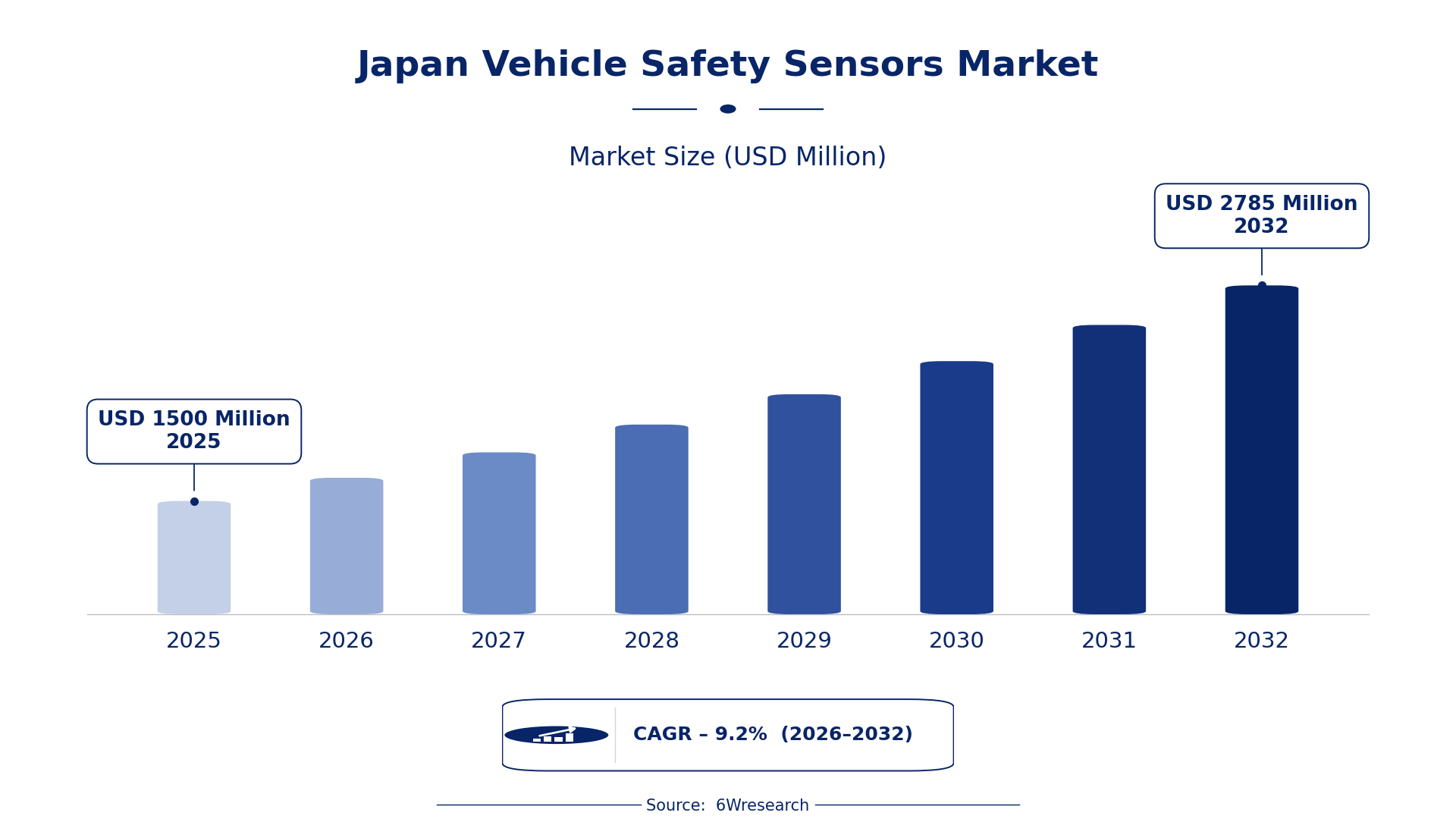
According to 6Wresearch internal database and industry insights, the Japan Vehicle Safety Sensors Market was valued at USD 1,500 Million in 2025 and is projected to reach USD 2,785 Million by 2032, growing at a CAGR of approximately 9.2% during 2026–2032.
Japan Vehicle Safety Sensors Market Highlights
| Report Metric | Details |
| Report Name | Japan Vehicle Safety Sensors Market (2026-2032) |
| Market Size 2025 | USD 1,500 Million |
| Market Size 2032 | USD 2,785 Million |
| Absolute Growth 2025–2032 | USD 1,285 Million |
| CAGR 2026–2032 | 9.2% |
| Peak Annual Growth | 10.1% in 2028 |
| Forecast Period | 2026–2032 |
| Historical Data | 2022–2025 |
| Base Year | 2025 |
| Leading Segment Type, 2025 | Proximity (42% share) |
| Leading Sensor Type, 2025 | Ultrasonic Sensors (39% share) |
| Leading Sensing Technology, 2025 | Ultrasonic (50% share) |
| Leading Application, 2025 | Parking Assistance (46% share) |
| Fastest-Growing Segment Type | Camera-Based (12.6% CAGR) |
| Fastest-Growing Sensor Type | Millimeter Wave Radar (13.5% CAGR) |
| Fastest-Growing Sensing Technology | Optical Recognition (13.3% CAGR) |
| Fastest-Growing Application | Lane Detection (12.1% CAGR) |
| Growing Sector | automotive safety |
| Key End Users | automotive manufacturers, consumers, government agencies, safety technology developers |
Japan Vehicle Safety Sensors Market Year-wise Growth Rate and Key Drivers (2022–2032)
This graph illustrates the annual growth rates of the market from 2022 to 2032, highlighting a steady upward trajectory and projected market expansion over the forecast period.
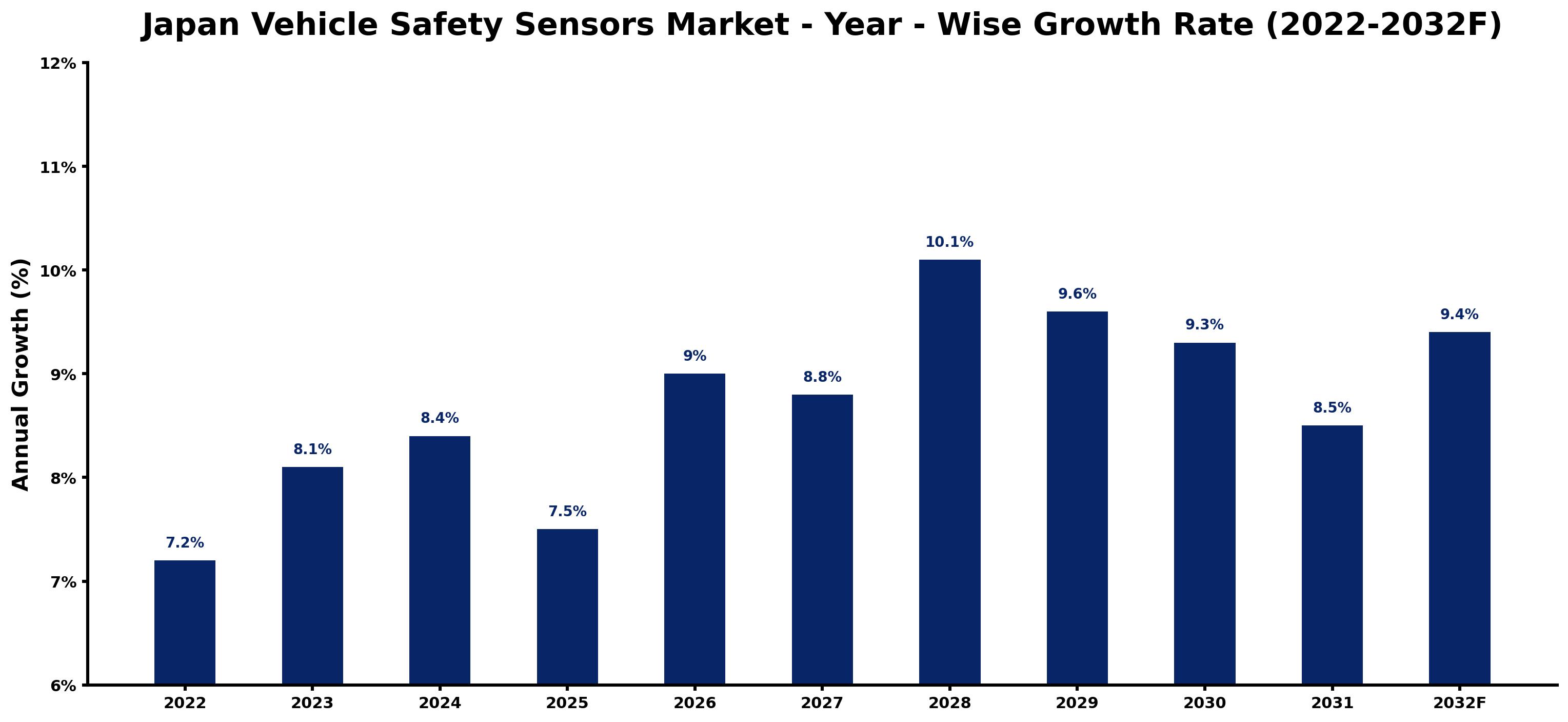
The table below sets out the estimated growth rate for each year and the main factor behind it.
| Year | Estimated Annual Growth (%) | Market Rationale |
| 2022 | 7.2 | The market exhibited steady growth due to strong domestic vehicle production. |
| 2023 | 8.1 | Consumer awareness of vehicle safety features accelerated growth rates. |
| 2024 | 8.4 | The adoption of advanced driver-assistance systems led to increased demand. |
| 2025 | 7.5 | Growth slowed as the market adjusted to previous rapid expansions. |
| 2026 | 9.0 | Stricter safety regulations are expected to significantly boost sensor demand. |
| 2027 | 8.8 | Market growth will continue as more vehicles integrate safety technologies. |
| 2028 | 10.1 | Technological advancements in sensors will drive peak growth rates. |
| 2029 | 9.6 | Demand will remain strong, although growth rates will moderate slightly. |
| 2030 | 9.3 | Focus on reducing traffic fatalities will sustain market momentum. |
| 2031 | 8.5 | Growth will slow as the market stabilises after rapid expansions. |
| 2032 | 9.4 | Consumer demand for safety upgrades will drive renewed growth. |
Note: Market size estimations and growth projections presented in this report are based on 6Wresearch's proprietary forecasting methodology, utilizing the latest available industry data, government publications, and primary research inputs.
Japan Vehicle Safety Sensors Market Synopsis
Vehicle safety sensors are advanced electronic systems that detect obstacles and monitor conditions, with primary applications in parking assistance and collision avoidance. The Japan Vehicle Safety Sensors Market is growing due to the automotive industry's production of over 8 million vehicles in 2022 and an increasing demand for advanced driver-assistance systems, which have adoption rates exceeding 50%. The government's aim to reduce traffic fatalities by 50% by 2030 further stimulates this demand, presenting opportunities for manufacturers and suppliers.
Market Dynamics Impact Analysis (2026–2032)
| Factor | Type | Impact | Primary Segment Affected |
| Strong domestic vehicle production | Driver | High | Proximity |
| Growing adoption of advanced driver-assistance systems | Driver | High | Camera-Based |
| Increasing need for safety upgrades in older vehicles | Opportunity | High | Tire Monitoring |
| Rising consumer awareness of vehicle safety technologies | Opportunity | High | Collision Avoidance |
| High competition among sensor manufacturers | Restraint | Medium | Radar-Based |
| Limited awareness of the benefits of newer sensor technologies | Restraint | Medium | Ultrasonic Sensors |
| Supply chain disruptions affecting component availability | Challenge | High | Pressure |
| Technological advancements requiring constant updates | Challenge | Medium | Vision Sensors |
Evaluation of Drivers in Japan Vehicle Safety Sensors Market (2026–2032)
The main growth drivers and the segments they affect most are set out below.
| Drivers | Primary Segment Affected | Why It Matters (Evidence) |
| Increased vehicle production | Proximity | Japan's automotive industry produced over 8 million vehicles in 2022, driving demand for proximity sensors. |
| High adoption of ADAS | Camera-Based | Over 50% of new vehicles are equipped with advanced driver-assistance systems, boosting demand for camera-based technologies. |
| Government initiatives for safety upgrades | Tire Monitoring | The government aims to reduce traffic fatalities by 50% by 2030, increasing the need for tire monitoring systems. |
| Urban population growth | Collision Avoidance | Population density in urban areas heightens the demand for collision avoidance technologies. |
| Rising consumer safety awareness | Ultrasonic Sensors | Consumers prioritising safety features lead to greater purchases of ultrasonic sensors. |
The strongest pull on demand comes from Japan's automotive industry, which produced over 8 million vehicles in 2022, driving the need for vehicle safety sensors. With over 50% of new vehicles equipped with advanced driver-assistance systems, demand for camera-based technologies is rising. Population growth in major cities raises demand for collision avoidance technologies. Consumer awareness of safety features leads to greater purchases of ultrasonic sensors, reflecting a shift towards prioritising vehicle safety in consumer decisions.
Evaluation of Restraints in Japan Vehicle Safety Sensors Market
These restraints slow adoption and weigh on supplier margins.
| Market Restraint | Primary Segment Affected | Why It Matters (Evidence) |
| Intense competition among manufacturers | Radar-Based | High competition in the radar-based sensor market limits profit margins for producers. |
| Limited consumer knowledge about advanced technologies | Ultrasonic Sensors | Insufficient awareness of ultrasonic sensor benefits restricts market growth. |
| Supply chain disruptions | Pressure | Ongoing supply chain issues hinder the availability of critical components for sensors. |
| Rapid technological changes | Vision Sensors | Frequent updates in technology require constant investment, challenging smaller players. |
| Regulatory compliance costs | Camera-Based | Compliance with safety standards increases operational costs for manufacturers. |
Japan Vehicle Safety Sensors Market Challenges
Outdated vehicle safety sensors create challenges for buyers, as the average age of vehicles in Japan is around 10 years, leading to increased upgrade costs. Suppliers face hurdles due to the JIS B 9960 standard, which complicates compliance and raises production costs by up to 15%. A lack of skilled technicians in the automotive sector hampers the installation of advanced systems, resulting in longer service times for buyers. Demand fluctuations for vehicle safety technologies, driven by emissions reduction goals, complicate inventory management for suppliers and risk stock shortages.
Trends in the Japan Vehicle Safety Sensors Market
Several trends are reshaping the Japan Vehicle Safety Sensors Market; the most important are set out below.
- Shift Towards Advanced Safety Systems: The automotive industry is transitioning from traditional safety measures to advanced systems, with over 50% of new vehicles now equipped with advanced driver-assistance systems, improving overall vehicle safety.
- Growing Interest in Lane Detection Technologies: Lane detection systems are gaining traction, particularly in urban areas, where the demand for advanced safety features is increasing due to higher population density.
- Integration of Various Sensor Technologies: The integration of different sensor technologies is on the rise, with a notable increase in camera-based systems for lane detection, reflecting a trend towards sophisticated safety solutions.
- Commitment to Environmental Sustainability: Japan's goal to reduce greenhouse gas emissions by 46% by 2030 is driving the development of eco-friendly vehicle safety technologies, aligning with global sustainability initiatives.
Investment Opportunities in the Japan Vehicle Safety Sensors Market
Where to invest in the Japan Vehicle Safety Sensors Market: the main openings are set out below.
- Market Potential for Tire Monitoring Systems: With the average age of vehicles in Japan around 10 years, there is an opportunity to supply tire monitoring systems, addressing safety concerns for older vehicles.
- Growth of Collision Avoidance Technologies: The increasing focus on reducing traffic fatalities presents an opportunity to develop advanced collision avoidance systems, particularly in urban areas.
- Funding for Smart Mobility Solutions: The government's allocation of ¥30 billion for vehicle safety technologies creates opportunities for suppliers to develop effective solutions.
- Increasing Need for Parking Assistance Systems: As urban populations grow, the need for parking assistance systems is rising, particularly in densely populated areas, offering a market for manufacturers.
Government Initiatives in the Japan Vehicle Safety Sensors Market
The Industrial Safety and Health Act of 1972 mandates employer responsibilities for hazardous substances and machinery, ensuring that vehicle safety sensor manufacturers adhere to strict standards. The Semiconductor and Digital Industry Strategy launched in June 2021 aims to secure domestic semiconductor manufacturing, vital for producing advanced vehicle safety sensors.
The Ministry of Land, Infrastructure, Transport and Tourism oversees the implementation of safety standards for vehicle technologies. In 2023, the ministry launched a program to develop vehicle safety technologies, allocating ¥30 billion to support the creation of effective safety solutions, benefiting both manufacturers and consumers.
Future Insight of the Japan Vehicle Safety Sensors Market
By 2032, buyers will see enhanced vehicle safety technologies as the government allocates ¥30 billion for development, targeting a 50% reduction in traffic fatalities. Suppliers will experience increased demand for advanced driver-assistance systems, with adoption rates in new vehicles exceeding 50%. New initiatives from the Ministry of Land, Infrastructure, Transport and Tourism will drive innovation in sensor technology. Tokyo's automotive research efforts will further establish Japan as a leader in vehicle safety advancements.
Market Segmentation Analysis
Japan Vehicle Safety Sensors Market report covers a detailed analysis of the following market segments:
By Segment Type – Proximity Leads, Camera-Based Expected to Grow Fastest
According to Saurav Kr Singh, Senior Research Analyst at 6Wresearch, with 42% of segment type revenue in 2025, Proximity was the largest category. Proximity sensors dominate the market as they are crucial for parking assistance, especially in densely populated areas like Tokyo. The substantial vehicle production, exceeding 8 million units in 2022, supports the high demand for these sensors. Camera-Based is projected to grow fastest, at a CAGR of 12.6% during 2026–2032. Camera-Based systems are witnessing rapid growth due to their importance in advanced driver-assistance systems, with over 50% adoption in new vehicles. This upward trend is fuelled by government initiatives focused on enhancing vehicle safety technologies, which will likely widen the lead of proximity sensors. Suppliers should prioritise advancements in camera-based technologies to meet the escalating demand for sophisticated vehicle safety features.
By Sensor Type – Ultrasonic Sensors Lead, Millimeter Wave Radar Expected to Grow Fastest
Ultrasonic Sensors accounted for 39% of the market by sensor type in 2025. Ultrasonic Sensors lead the market, extensively used in parking assistance systems for their precision in distance measurement, vital for safe vehicle operation. Their established reliability and widespread adoption by automotive manufacturers solidify their market position. Over 2026–2032, Millimeter Wave Radar is expected to post the fastest growth, at a CAGR of 13.5%. Millimeter Wave Radar is rapidly gaining traction due to its efficiency in advanced collision avoidance systems, aligning with national goals to reduce traffic fatalities by 50% by 2030. This growth indicates a shift towards more sophisticated safety technologies in vehicles. Buyers should seek vehicles equipped with millimeter wave radar to improve safety and comply with future regulatory standards.
By Sensing Technology – Ultrasonic Leads, Optical Recognition Expected to Grow Fastest
In 2025, Ultrasonic led the sensing technology split with a 50% share. Ultrasonic technology is the leading sensing method, predominantly used in proximity detection applications essential for safe parking. Its strong market presence ensures a significant installed base among vehicle manufacturers, reinforcing its dominance. Optical Recognition is set to record the highest CAGR in this split, 13.3% over 2026–2032. Optical Recognition is experiencing swift growth as it is vital for camera-based systems increasingly adopted in new vehicles for lane detection. This trend reflects a broader industry movement towards advanced visual recognition technologies for enhanced safety. Suppliers must invest in developing optical recognition technologies to address the rising demand for advanced safety features in vehicles.
By Application – Parking Assistance Leads, Lane Detection Expected to Grow Fastest
Parking Assistance took 46% of application revenue in 2025, more than any other category. Parking Assistance is the leading application, directly aiding drivers in safely parking their vehicles, which is essential in urban environments with high vehicle density. The average age of vehicles in Japan, around 10 years, further necessitates upgrades in this area. The quickest growth will come from Lane Detection, forecast to expand at a CAGR of 12.1% between 2026 and 2032. Lane Detection is experiencing the fastest growth as it is essential for maintaining vehicle lane position, particularly with the increasing adoption of advanced driver-assistance systems. This application aligns with national safety goals, driving further investment. Buyers will increasingly seek vehicles with advanced lane detection systems to ensure compliance with evolving safety regulations.
Key Attractiveness of the Report
- 10 Years of Market Numbers
- Historical Data Starting from 2022 to 2025
- Base Year 2025
- Forecast Data until 2032
- Key Performance Indicators Impacting the Market
- Major Upcoming Developments and Projects
Key Highlights of the Report:
- Japan Vehicle Safety Sensors Market Outlook
- Market Size of Japan Vehicle Safety Sensors Market, 2025
- Forecast of Japan Vehicle Safety Sensors Market, 2032
- Historical Data and Forecast of Japan Vehicle Safety Sensors Revenues & Volume for the Period 2022-2032F
- Japan Vehicle Safety Sensors Market Trend Evolution
- Japan Vehicle Safety Sensors Market Drivers and Challenges
- Japan Vehicle Safety Sensors Price Trends
- Japan Vehicle Safety Sensors Porter's Five Forces
- Japan Vehicle Safety Sensors Industry Life Cycle
- Historical Data and Forecast of Japan Vehicle Safety Sensors Market Revenues & Volume By Segment Type for the Period 2022-2032F
- Historical Data and Forecast of Japan Vehicle Safety Sensors Market Revenues & Volume By Proximity for the Period 2022-2032F
- Historical Data and Forecast of Japan Vehicle Safety Sensors Market Revenues & Volume By Camera-Based for the Period 2022-2032F
- Historical Data and Forecast of Japan Vehicle Safety Sensors Market Revenues & Volume By Radar-Based for the Period 2022-2032F
- Historical Data and Forecast of Japan Vehicle Safety Sensors Market Revenues & Volume By Pressure for the Period 2022-2032F
- Historical Data and Forecast of Japan Vehicle Safety Sensors Market Revenues & Volume By Sensor Type for the Period 2022-2032F
- Historical Data and Forecast of Japan Vehicle Safety Sensors Market Revenues & Volume By Ultrasonic Sensors for the Period 2022-2032F
- Historical Data and Forecast of Japan Vehicle Safety Sensors Market Revenues & Volume By Vision Sensors for the Period 2022-2032F
- Historical Data and Forecast of Japan Vehicle Safety Sensors Market Revenues & Volume By Millimeter Wave Radar for the Period 2022-2032F
- Historical Data and Forecast of Japan Vehicle Safety Sensors Market Revenues & Volume By Tire Pressure Sensors for the Period 2022-2032F
- Historical Data and Forecast of Japan Vehicle Safety Sensors Market Revenues & Volume By Sensing Technology for the Period 2022-2032F
- Historical Data and Forecast of Japan Vehicle Safety Sensors Market Revenues & Volume By Ultrasonic for the Period 2022-2032F
- Historical Data and Forecast of Japan Vehicle Safety Sensors Market Revenues & Volume By Optical Recognition for the Period 2022-2032F
- Historical Data and Forecast of Japan Vehicle Safety Sensors Market Revenues & Volume By Electromagnetic for the Period 2022-2032F
- Historical Data and Forecast of Japan Vehicle Safety Sensors Market Revenues & Volume By Piezoelectric for the Period 2022-2032F
- Historical Data and Forecast of Japan Vehicle Safety Sensors Market Revenues & Volume By Application for the Period 2022-2032F
- Historical Data and Forecast of Japan Vehicle Safety Sensors Market Revenues & Volume By Parking Assistance for the Period 2022-2032F
- Historical Data and Forecast of Japan Vehicle Safety Sensors Market Revenues & Volume By Lane Detection for the Period 2022-2032F
- Historical Data and Forecast of Japan Vehicle Safety Sensors Market Revenues & Volume By Collision Avoidance for the Period 2022-2032F
- Historical Data and Forecast of Japan Vehicle Safety Sensors Market Revenues & Volume By Tire Monitoring for the Period 2022-2032F
- Japan Vehicle Safety Sensors Import Export Trade Statistics
- Market Opportunity Assessment By Segment Type
- Market Opportunity Assessment By Sensor Type
- Market Opportunity Assessment By Sensing Technology
- Market Opportunity Assessment By Application
- Japan Vehicle Safety Sensors Top Companies Market Share
- Japan Vehicle Safety Sensors Competitive Benchmarking By Technical and Operational Parameters
- Japan Vehicle Safety Sensors Company Profiles
- Japan Vehicle Safety Sensors Key Strategic Recommendations
Market Covered
The following segment groups are covered in the report.
By Segment Type
- Proximity
- Camera-Based
- Radar-Based
- Pressure
By Sensor Type
- Ultrasonic Sensors
- Vision Sensors
- Millimeter Wave Radar
- Tire Pressure Sensors
By Sensing Technology
- Ultrasonic
- Optical Recognition
- Electromagnetic
- Piezoelectric
By Application
- Parking Assistance
- Lane Detection
- Collision Avoidance
- Tire Monitoring































