Japan Vehicle Safety Technologies Market Size & Growth Rate
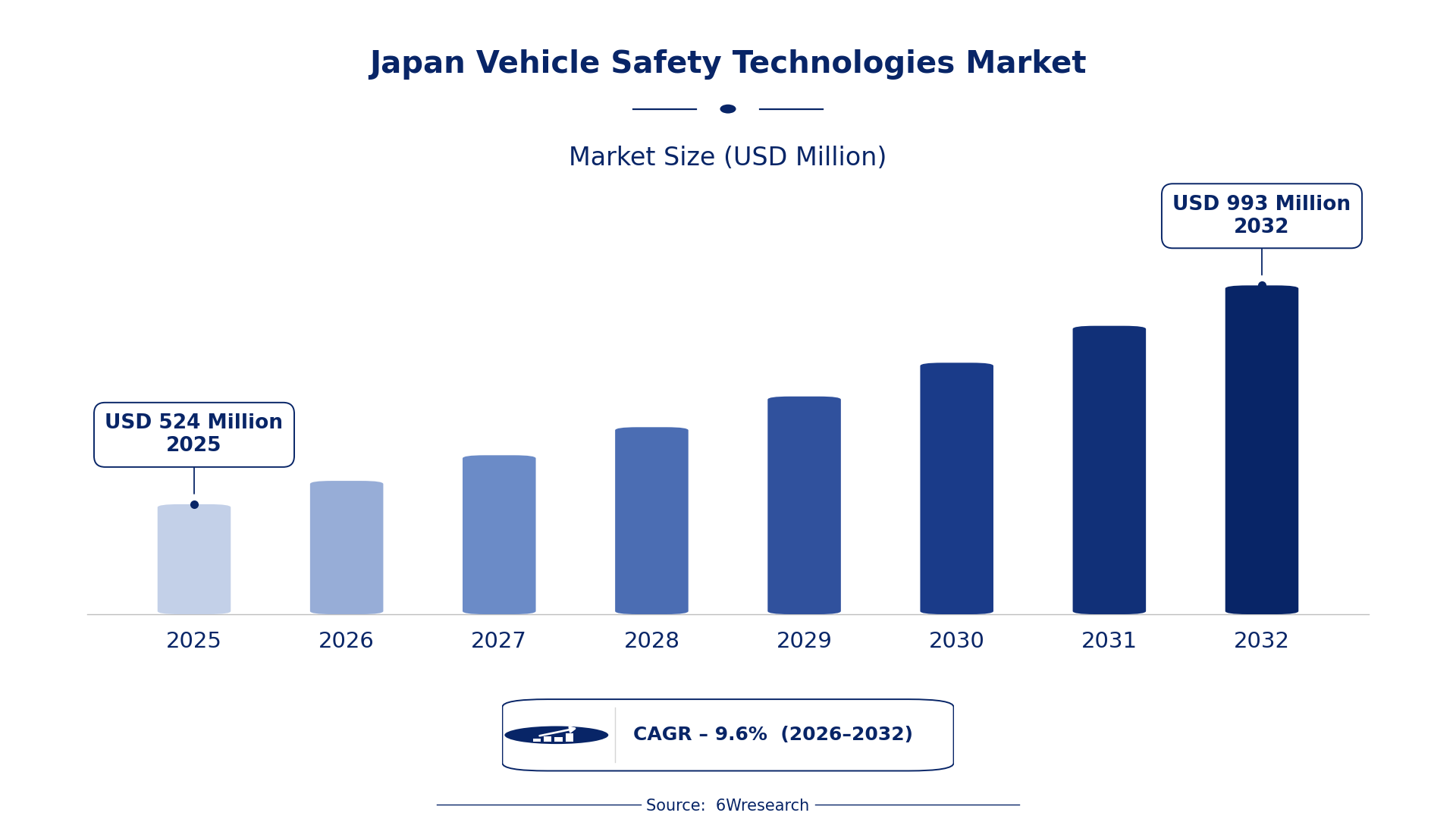
According to 6Wresearch internal database and industry insights, the Japan Vehicle Safety Technologies Market was valued at USD 524 Million in 2025 and is projected to reach USD 993 Million by 2032, growing at a CAGR of approximately 9.6% during 2026–2032.
Japan Vehicle Safety Technologies Market Highlights
| Report Metric | Details |
| Report Name | Japan Vehicle Safety Technologies Market (2026-2032) |
| Market Size 2025 | USD 524 Million |
| Market Size 2032 | USD 993 Million |
| Absolute Growth 2025–2032 | USD 469 Million |
| CAGR 2026–2032 | 9.6% |
| Peak Annual Growth | 10.3% in 2030 |
| Forecast Period | 2026–2032 |
| Historical Data | 2022–2025 |
| Base Year | 2025 |
| Leading Segment Type, 2025 | Driver Assistance (53% share) |
| Leading Technology Name, 2025 | ADAS (34% share) |
| Leading Operation Mode, 2025 | Sensor-Controlled (50% share) |
| Leading Application, 2025 | Collision Prevention (35% share) |
| Fastest-Growing Segment Type | Monitoring Tech (13.1% CAGR) |
| Fastest-Growing Technology Name | DMS (Driver Monitoring) (13.5% CAGR) |
| Fastest-Growing Operation Mode | AI-based Analytics (13.0% CAGR) |
| Fastest-Growing Application | Drowsiness Detection (12.5% CAGR) |
| Growing Sector | automotive safety |
| Key End Users | automotive manufacturers, commercial vehicle operators, technology developers |
Japan Vehicle Safety Technologies Market Year-wise Growth Rate and Key Drivers (2022–2032)
This graph illustrates the annual growth rates of the market from 2022 to 2032, highlighting a steady upward trajectory and projected market expansion over the forecast period.
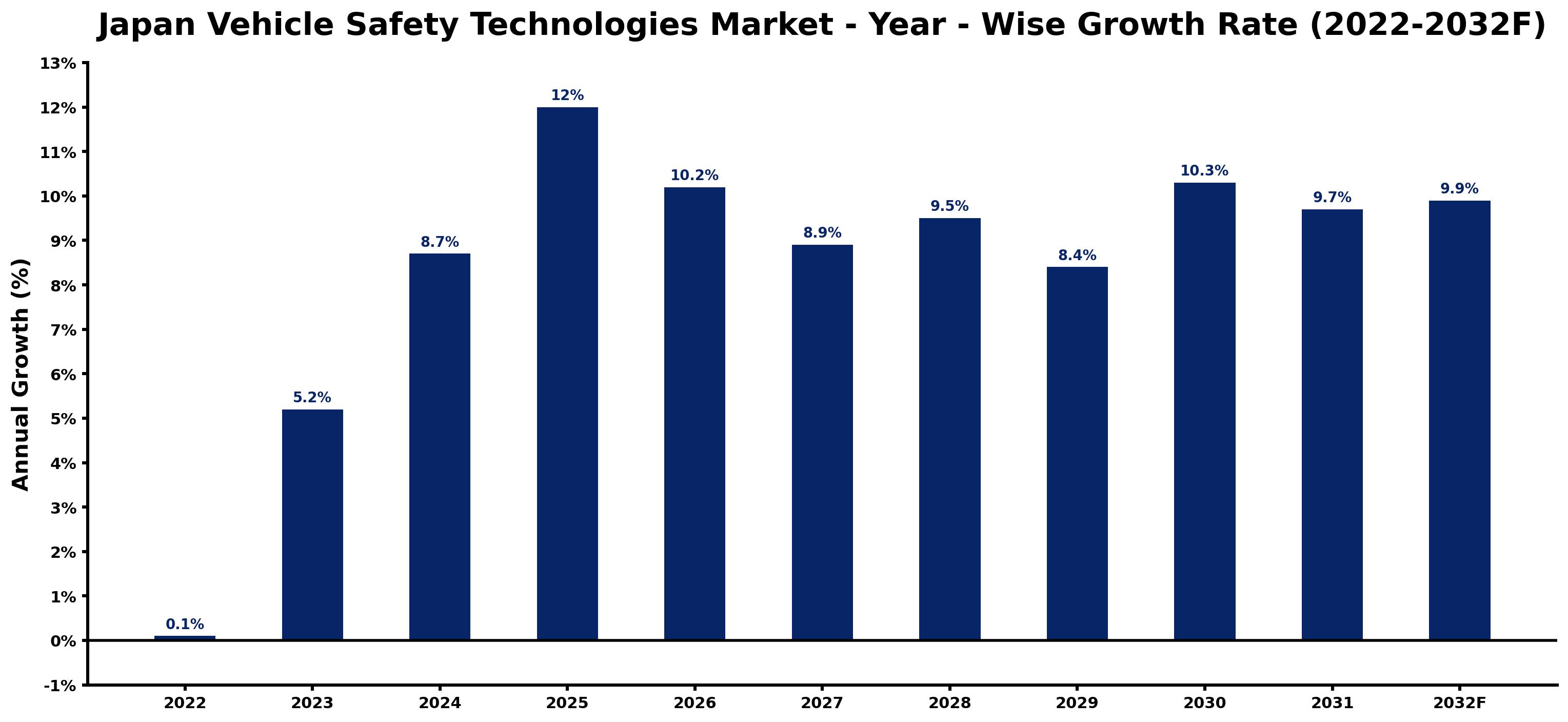
Annual growth estimates for each year appear below with the principal reason behind them, explaining the shifts that set the pace of the market.
| Year | Estimated Annual Growth (%) | Market Rationale |
| 2022 | 0.1 | The market experienced minimal growth due to ongoing adjustments in safety standards. |
| 2023 | 5.2 | Growth accelerated as consumer awareness of vehicle safety technologies increased. |
| 2024 | 8.7 | Demand surged with the introduction of new safety regulations and features. |
| 2025 | 12.0 | A peak in growth occurred as advanced driver assistance systems became standard. |
| 2026 | 10.2 | Growth is expected to slow as the market begins to stabilise after rapid adoption. |
| 2027 | 8.9 | A further slowdown is projected as the market adjusts to previous expansions. |
| 2028 | 9.5 | Growth is expected to pick up again with renewed investment in safety technologies. |
| 2029 | 8.4 | The market will see a slight slowdown as demand stabilises post-peak. |
| 2030 | 10.3 | Growth is projected to accelerate again due to new technological advancements in safety. |
| 2031 | 9.7 | A slowdown is expected as the market adjusts to saturation in some segments. |
| 2032 | 9.9 | Growth is expected to resume as new regulations and technologies reinvigorate demand. |
Note: Market size estimations and growth projections presented in this report are based on 6Wresearch's proprietary forecasting methodology, utilizing the latest available industry data, government publications, and primary research inputs.
Japan Vehicle Safety Technologies Market Synopsis
Vehicle Safety Technologies are systems designed to improve vehicle safety through advanced electronics, sensors, and software algorithms. In Japan, the Vehicle Safety Technologies Market is expanding due to the production of over 8 million vehicles in 2022 and rising consumer demand for advanced safety features. Government initiatives, including substantial funding for automotive safety research, support this trend and create opportunities for manufacturers to innovate and meet evolving standards.
Market Dynamics Impact Analysis (2026–2032)
| Factor | Type | Impact | Primary Segment Affected |
| Rising consumer demand for advanced safety features drives adoption of Driver Assistance systems. | Driver | High | Driver Assistance |
| The increasing focus on reducing traffic accidents presents opportunities for innovative safety solutions. | Opportunity | High | Collision Prevention |
| Strict regulatory requirements can limit the flexibility of manufacturers in product development. | Restraint | High | Driver Assistance |
| The growing urban population increases the demand for effective vehicle safety technologies. | Driver | Medium | Monitoring Tech |
| High costs associated with implementing advanced safety technologies can deter smaller manufacturers from adopting them. | Restraint | Medium | ADAS |
| The need for continuous updates and maintenance of safety technologies can strain resources for manufacturers. | Challenge | Medium | DMS (Driver Monitoring) |
| Technological advancements in safety systems are improving the capabilities of Braking Tech, leading to more purchases. | Challenge | High | Braking Tech |
| Increased awareness of road safety issues is leading to higher adoption rates of Collision Prevention technologies. | Opportunity | Medium | Collision Prevention |
Evaluation of Drivers in Japan Vehicle Safety Technologies Market (2026–2032)
The factors lifting demand, and the evidence behind each, are summarised below.
| Drivers | Primary Segment Affected | Why It Matters (Evidence) |
| Consumer demand for safety features is increasing, prompting higher sales of Driver Assistance systems. | Driver Assistance | In 2022, over 70% of new vehicles sold in Japan included advanced driver assistance systems. |
| Government initiatives are promoting advanced safety technologies, stimulating investment in the sector. | ADAS | The 2023 budget allocated ¥10 billion for automotive safety research and development. |
| The urban population's growth is creating a need for effective vehicle safety solutions in densely populated areas. | Monitoring Tech | The Tokyo metropolitan area, with 14 million residents, drives demand for safety technologies. |
| Increased awareness of road safety issues is leading to higher adoption rates of Collision Prevention technologies. | Collision Prevention | Drowsiness detection systems are mandated in commercial vehicles by 2025. |
| Technological advancements in safety systems are improving the capabilities of Braking Tech, leading to more purchases. | Braking Tech | The AEB system is required for all new passenger vehicles by 2024. |
Much of the new demand traces back to the increasing awareness of road safety among consumers, particularly in urban areas where traffic density is high. In 2022, over 70% of new vehicles sold in Japan included advanced driver assistance systems, reflecting a shift towards improved safety features. The allocation of ¥10 billion for automotive safety research and development has stimulated investment in this sector. The requirement for automatic emergency braking systems in all new passenger vehicles by 2024 is pushing manufacturers to adopt advanced braking technologies. As drowsiness detection systems are mandated in commercial vehicles by 2025, the demand for monitoring technologies is expected to rise significantly.
Evaluation of Restraints in Japan Vehicle Safety Technologies Market
These are the pressures that could keep growth below its potential.
| Market Restraint | Primary Segment Affected | Why It Matters (Evidence) |
| High costs associated with implementing advanced safety technologies can deter smaller manufacturers from adopting them. | ADAS | Many smaller manufacturers struggle with the financial burden of compliance with safety regulations. |
| Strict regulatory requirements can limit the flexibility of manufacturers in product development. | Driver Assistance | Compliance with JIS D 5801 standards can slow down innovation cycles. |
| Market saturation in certain segments can limit growth opportunities for new entrants. | Monitoring Tech | As more vehicles are equipped with existing safety technologies, new innovations may struggle to gain traction. |
| Competition among manufacturers can lead to rapid changes in technology, posing challenges for suppliers. | Vehicle-to-Vehicle | Suppliers need to keep pace with evolving standards and consumer expectations. |
| Ongoing costs for software updates can impact profitability for suppliers. | DMS (Driver Monitoring) | The need for continuous updates and maintenance of safety technologies can strain resources for manufacturers. |
Japan Vehicle Safety Technologies Market Challenges
Producers face high costs due to a shortage of advanced sensors, increasing production expenses by up to 15% for vehicle safety technologies. This issue exists because local manufacturers rely on a limited number of suppliers, causing delays for buyers who need timely product launches. Integration of new technologies proves challenging as many existing vehicles lack the necessary infrastructure, leading to retrofitting costs of approximately ¥300,000 per vehicle for buyers. Skills shortages hinder the development of essential safety features, extending time-to-market for producers by an average of six months.
Trends in the Japan Vehicle Safety Technologies Market
These developments are changing demand patterns in the Japan Vehicle Safety Technologies Market.
- Rise in Adoption of Advanced Driver Assistance Systems: In 2023, over 70% of new vehicles sold in Japan featured ADAS, reflecting a shift in consumer preference towards improved safety. This trend is likely to continue as safety regulations evolve, creating opportunities for suppliers.
- Increase in Drowsiness Detection Technologies: Drowsiness detection systems are becoming standard in commercial vehicles, with mandates set for 2025. This shift is driven by the need to reduce accidents caused by driver fatigue, highlighting a growing market for monitoring technologies.
- Growing Urban Focus on Vehicle Safety: The demand for vehicle safety technologies is rising in urban areas like Tokyo, where traffic density is high. The Tokyo Motor Show 2023 showcased innovations aimed at improving safety in such environments, indicating a shift in focus for manufacturers.
- Integration of Wireless Communication in Safety Systems: Wireless communication technologies are increasingly integrated into vehicle safety systems, improving their functionality. This trend is evident in urban areas of Osaka, where Vehicle-to-Vehicle communication technology is being tested.
Investment Opportunities in the Japan Vehicle Safety Technologies Market
The following areas offer the clearest openings for investors and suppliers in the Japan Vehicle Safety Technologies Market.
- Investment in Advanced Safety Features: With a projected market size of USD 993 million by 2032, there is a clear opportunity for investment in advanced safety technologies. Manufacturers in urban areas can benefit from this growing demand for improved safety features.
- Need for Compliance with New Regulations: As new regulations emerge, particularly around drowsiness detection systems, manufacturers must invest in compliant technologies. The commercial vehicle sector is a key buyer group that will drive this demand.
- Urban Areas as Key Markets: The Tokyo metropolitan area presents a prime opportunity for suppliers of vehicle safety technologies, given its large population. Investing in local partnerships can facilitate market entry and growth.
- Timing for Investment in Monitoring Technologies: With the increasing focus on driver safety, now is the time to invest in monitoring technologies. The demand from commercial vehicle operators for compliance with upcoming regulations presents a clear opportunity.
Government Initiatives in the Japan Vehicle Safety Technologies Market
The Industrial Safety and Health Act (1972) mandates that manufacturers ensure the safety of their vehicles, impacting the production of Vehicle Safety Technologies. Compliance with this act requires manufacturers to implement rigorous safety testing and reporting protocols, which can improve product reliability and consumer trust.
The Ministry of Land, Infrastructure, Transport and Tourism oversees the implementation of the Battery Industry Strategy, which promotes advanced vehicle safety systems. This strategy supports automotive manufacturers by funding research and development initiatives, enabling them to innovate and meet evolving safety standards.
Future Insight of the Japan Vehicle Safety Technologies Market
The 2025 requirement for drowsiness detection systems in commercial vehicles will drive innovations in vehicle safety technologies. By 2032, the integration of wireless communication technologies will enhance vehicle connectivity and safety features. Increased government investment in automotive safety research will further advance vehicle safety systems. Testing of communication technology in Osaka will pave the way for smarter urban safety initiatives, positively impacting buyers and suppliers in the market.
Market Segmentation Analysis
Japan Vehicle Safety Technologies Market report covers a detailed analysis of the following market segments:
By Segment Type – Driver Assistance Leads, Monitoring Tech Expected to Grow Fastest
According to Saurav Kr Singh, Senior Research Analyst at 6Wresearch, Driver Assistance held 53% of the Japan Vehicle Safety Technologies Market by segment type in 2025. Driver Assistance commands the largest share as it is widely adopted for enhancing driver control and safety. With over 70% of new vehicles sold in Japan featuring these systems, they play a crucial role in modern automotive safety. Monitoring Tech is projected to grow fastest, at a CAGR of 13.1% during 2026–2032. Monitoring Tech is rapidly expanding as it becomes essential for assessing driver alertness and behaviour. The upcoming mandate for drowsiness detection systems in commercial vehicles by 2025 is a key factor driving this growth. Suppliers should focus on advancing monitoring technologies to meet regulatory requirements and consumer safety expectations.
By Technology Name – ADAS Leads, DMS (Driver Monitoring) Expected to Grow Fastest
With 34% of technology name revenue in 2025, ADAS was the largest category. ADAS leads the market due to its integral role in modern vehicles, providing essential safety and convenience features. The growing consumer demand for advanced safety technologies and supportive government regulations further solidify its position. Over 2026–2032, DMS (Driver Monitoring) is expected to post the fastest growth, at a CAGR of 13.5%. DMS is witnessing the fastest growth as it is crucial for detecting driver fatigue and distractions. The increasing emphasis on road safety and compliance with emerging regulations are accelerating its adoption. Buyers will gain significant advantages by investing in vehicles equipped with advanced monitoring technologies to enhance safety and adhere to regulations.
By Operation Mode – Sensor-Controlled Leads, AI-based Analytics Expected to Grow Fastest
The largest operation mode category in 2025 was Sensor-Controlled, at 50% of revenue. Sensor-Controlled systems dominate the market as they are widely implemented and support various safety technologies. Their effectiveness in enhancing vehicle safety features contributes to their substantial market presence. The quickest growth will come from AI-based Analytics, forecast to expand at a CAGR of 13.0% between 2026 and 2032. AI-based Analytics is experiencing rapid growth as it becomes increasingly utilised for data processing in safety systems. The integration of advanced analytics capabilities is driving the expansion of this segment. Suppliers must prioritise the incorporation of advanced capabilities into their safety systems to maintain competitiveness and address market demands.
By Application – Collision Prevention Leads, Drowsiness Detection Expected to Grow Fastest
Collision Prevention accounted for 35% of the market by application in 2025. Collision Prevention is the foremost application as it embodies the primary objective of all vehicle safety technologies. The focus on minimising accidents and fatalities drives its extensive implementation across the automotive industry. Drowsiness Detection is set to record the highest CAGR in this split, 12.5% over 2026–2032. Drowsiness Detection is growing swiftly due to its critical role in preventing accidents linked to driver fatigue. The impending regulations requiring such systems in commercial vehicles by 2025 are fuelling this segment's growth. Suppliers should prioritise the development of drowsiness detection systems to comply with regulatory standards and enhance overall vehicle safety.
Key Attractiveness of the Report
- 10 Years of Market Numbers
- Historical Data Starting from 2022 to 2025
- Base Year 2025
- Forecast Data until 2032
- Key Performance Indicators Impacting the Market
- Major Upcoming Developments and Projects
Key Highlights of the Report:
- Japan Vehicle Safety Technologies Market Outlook
- Market Size of Japan Vehicle Safety Technologies Market, 2025
- Forecast of Japan Vehicle Safety Technologies Market, 2032
- Historical Data and Forecast of Japan Vehicle Safety Technologies Revenues & Volume for the Period 2022-2032F
- Japan Vehicle Safety Technologies Market Trend Evolution
- Japan Vehicle Safety Technologies Market Drivers and Challenges
- Japan Vehicle Safety Technologies Price Trends
- Japan Vehicle Safety Technologies Porter's Five Forces
- Japan Vehicle Safety Technologies Industry Life Cycle
- Historical Data and Forecast of Japan Vehicle Safety Technologies Market Revenues & Volume By Segment Type for the Period 2022-2032F
- Historical Data and Forecast of Japan Vehicle Safety Technologies Market Revenues & Volume By Driver Assistance for the Period 2022-2032F
- Historical Data and Forecast of Japan Vehicle Safety Technologies Market Revenues & Volume By Vehicle-to-Vehicle for the Period 2022-2032F
- Historical Data and Forecast of Japan Vehicle Safety Technologies Market Revenues & Volume By Monitoring Tech for the Period 2022-2032F
- Historical Data and Forecast of Japan Vehicle Safety Technologies Market Revenues & Volume By Braking Tech for the Period 2022-2032F
- Historical Data and Forecast of Japan Vehicle Safety Technologies Market Revenues & Volume By Technology Name for the Period 2022-2032F
- Historical Data and Forecast of Japan Vehicle Safety Technologies Market Revenues & Volume By ADAS for the Period 2022-2032F
- Historical Data and Forecast of Japan Vehicle Safety Technologies Market Revenues & Volume By V2V Communication for the Period 2022-2032F
- Historical Data and Forecast of Japan Vehicle Safety Technologies Market Revenues & Volume By DMS (Driver Monitoring) for the Period 2022-2032F
- Historical Data and Forecast of Japan Vehicle Safety Technologies Market Revenues & Volume By AEB for the Period 2022-2032F
- Historical Data and Forecast of Japan Vehicle Safety Technologies Market Revenues & Volume By Operation Mode for the Period 2022-2032F
- Historical Data and Forecast of Japan Vehicle Safety Technologies Market Revenues & Volume By Semi-Autonomous for the Period 2022-2032F
- Historical Data and Forecast of Japan Vehicle Safety Technologies Market Revenues & Volume By Wireless/Cloud for the Period 2022-2032F
- Historical Data and Forecast of Japan Vehicle Safety Technologies Market Revenues & Volume By AI-based Analytics for the Period 2022-2032F
- Historical Data and Forecast of Japan Vehicle Safety Technologies Market Revenues & Volume By Sensor-Controlled for the Period 2022-2032F
- Historical Data and Forecast of Japan Vehicle Safety Technologies Market Revenues & Volume By Application for the Period 2022-2032F
- Historical Data and Forecast of Japan Vehicle Safety Technologies Market Revenues & Volume By Long-Distance Driving for the Period 2022-2032F
- Historical Data and Forecast of Japan Vehicle Safety Technologies Market Revenues & Volume By Urban Safety Networks for the Period 2022-2032F
- Historical Data and Forecast of Japan Vehicle Safety Technologies Market Revenues & Volume By Drowsiness Detection for the Period 2022-2032F
- Historical Data and Forecast of Japan Vehicle Safety Technologies Market Revenues & Volume By Collision Prevention for the Period 2022-2032F
- Japan Vehicle Safety Technologies Import Export Trade Statistics
- Market Opportunity Assessment By Segment Type
- Market Opportunity Assessment By Technology Name
- Market Opportunity Assessment By Operation Mode
- Market Opportunity Assessment By Application
- Japan Vehicle Safety Technologies Top Companies Market Share
- Japan Vehicle Safety Technologies Competitive Benchmarking By Technical and Operational Parameters
- Japan Vehicle Safety Technologies Company Profiles
- Japan Vehicle Safety Technologies Key Strategic Recommendations
Market Covered
Coverage by segment is as follows.
By Segment Type
- Driver Assistance
- Vehicle-to-Vehicle
- Monitoring Tech
- Braking Tech
By Technology Name
- ADAS
- V2V Communication
- DMS (Driver Monitoring)
- AEB
By Operation Mode
- Semi-Autonomous
- Wireless/Cloud
- AI-based Analytics
- Sensor-Controlled
By Application
- Long-Distance Driving
- Urban Safety Networks
- Drowsiness Detection
- Collision Prevention































