Japan Vehicle Signaling Components Market Size & Growth Rate
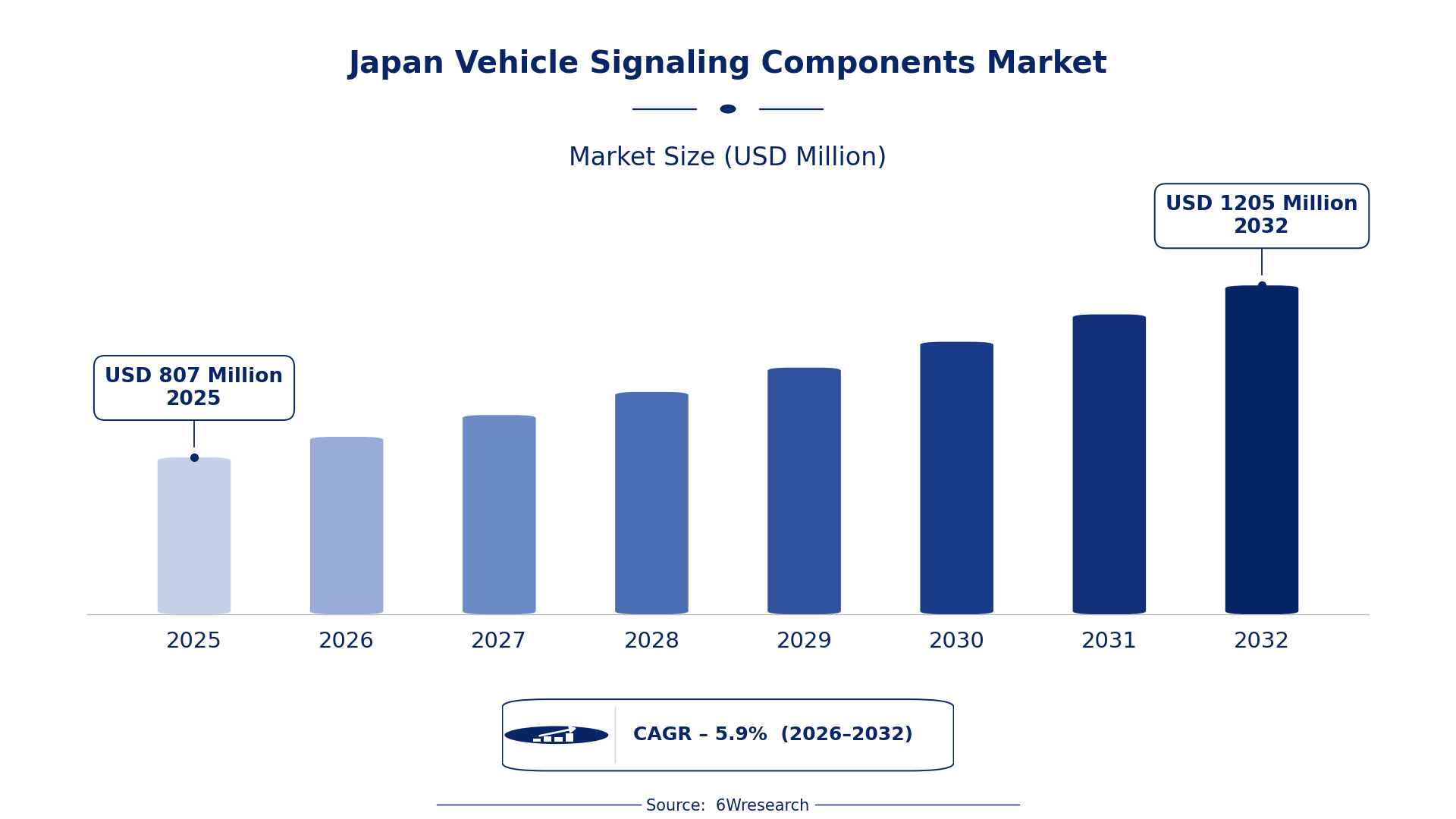
According to 6Wresearch internal database and industry insights, the Japan Vehicle Signaling Components Market was valued at USD 807 Million in 2025 and is projected to reach USD 1,205 Million by 2032, growing at a CAGR of approximately 5.9% during 2026–2032.
Japan Vehicle Signaling Components Market Highlights
| Report Metric | Details |
| Report Name | Japan Vehicle Signaling Components Market (2026-2032) |
| Market Size 2025 | USD 807 Million |
| Market Size 2032 | USD 1,205 Million |
| Absolute Growth 2025–2032 | USD 398 Million |
| CAGR 2026–2032 | 5.9% |
| Peak Annual Growth | 6.8% in 2032 |
| Forecast Period | 2026–2032 |
| Historical Data | 2022–2025 |
| Base Year | 2025 |
| Leading Segment Type, 2025 | Turn Indicators (34% share) |
| Leading Component Type, 2025 | LED Blinkers (37% share) |
| Leading Power Source, 2025 | Battery Powered (41% share) |
| Leading Application Area, 2025 | External Lighting (45% share) |
| Fastest-Growing Segment Type | Horns (8.3% CAGR) |
| Fastest-Growing Component Type | Electromagnetic Horns (8.5% CAGR) |
| Fastest-Growing Power Source | Wired (8.7% CAGR) |
| Fastest-Growing Application Area | Dashboard Control (7.2% CAGR) |
| Growing Sector | automotive safety systems |
| Key End Users | automotive manufacturers, aftermarket suppliers, vehicle safety regulators |
Japan Vehicle Signaling Components Market Year-wise Growth Rate and Key Drivers (2022–2032)
This graph illustrates the annual growth rates of the market from 2022 to 2032, highlighting a steady upward trajectory and projected market expansion over the forecast period.
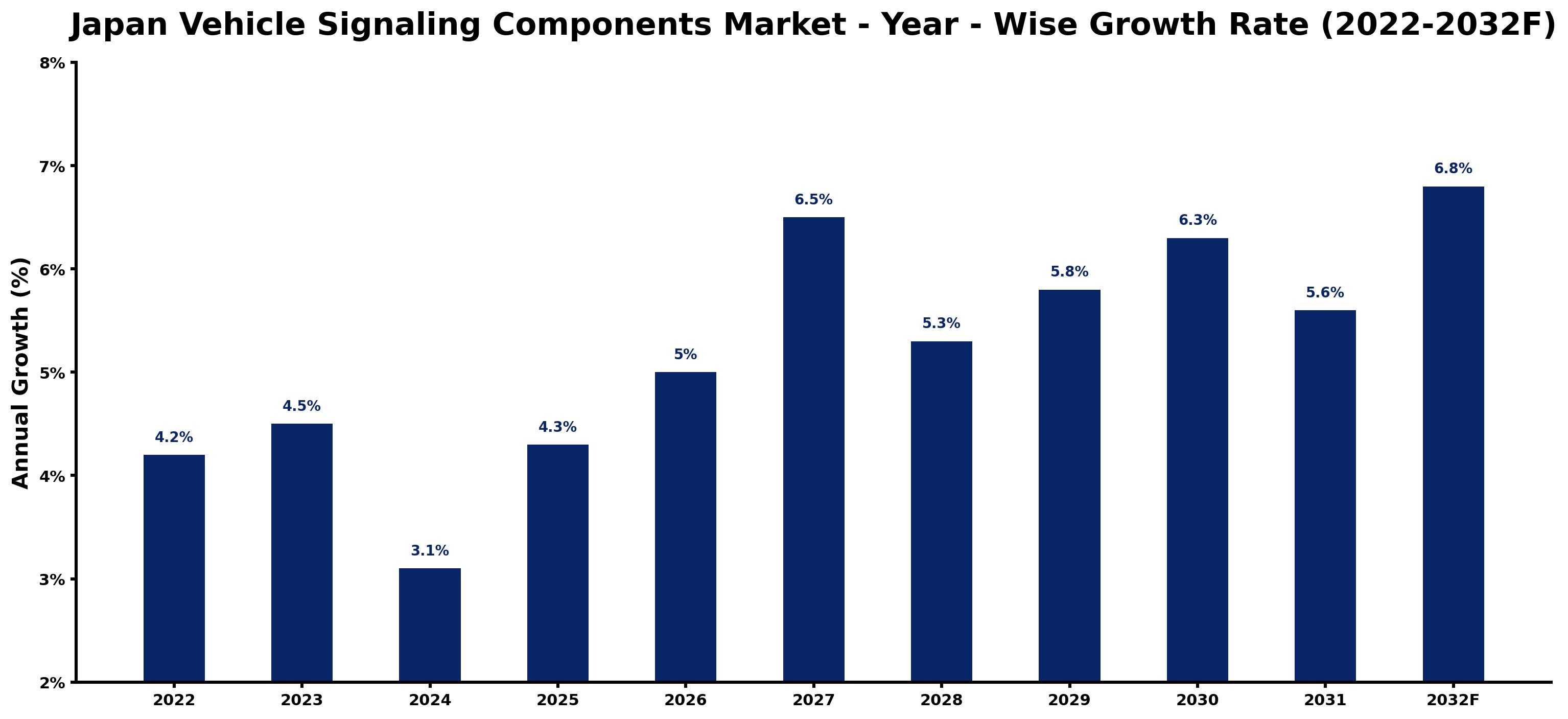
Below, each year's estimated growth is shown next to the factor that most influenced it.
| Year | Estimated Annual Growth (%) | Market Rationale |
| 2022 | 4.2 | The market experienced steady growth due to strong automotive production levels. |
| 2023 | 4.5 | Demand increased as manufacturers focused on vehicle safety features. |
| 2024 | 3.1 | Growth slowed as supply chain issues affected component availability. |
| 2025 | 4.3 | Investment in R&D for safety technologies boosted market performance. |
| 2026 | 5.0 | Rising consumer awareness of safety standards is expected to drive demand higher. |
| 2027 | 6.5 | Technological advancements in signaling components will spur market growth. |
| 2028 | 5.3 | Growth is expected to moderate as the market adjusts to previous high levels. |
| 2029 | 5.8 | Increased vehicle production in key regions will support demand expansion. |
| 2030 | 6.3 | The push for greener technologies will lead to greater investments in signaling. |
| 2031 | 5.6 | Growth is projected to decelerate as the market stabilises after rapid expansion. |
| 2032 | 6.8 | Peak growth is anticipated as new safety regulations come into effect. |
Note: Market size estimations and growth projections presented in this report are based on 6Wresearch's proprietary forecasting methodology, utilizing the latest available industry data, government publications, and primary research inputs.
Japan Vehicle Signaling Components Market Synopsis
Vehicle signaling components are crucial for automotive safety, encompassing turn indicators, horns, and brake signals, primarily crafted from durable plastics and metals. The Japan Vehicle Signaling Components Market is growing due to a strong automotive sector, which contributes over 20% to manufacturing GDP. Key drivers include substantial investments in safety technologies, with ¥1 trillion allocated in 2023, and an increasing demand for LED signaling lights, now standard in over 50% of new vehicles. This trend reflects a broader commitment to improving vehicle safety standards across the industry.
Market Dynamics Impact Analysis (2026–2032)
| Factor | Type | Impact | Primary Segment Affected |
| Increased investment in R&D for safety technologies | Driver | High | Turn Indicators |
| Growing demand for energy-efficient components | Driver | High | LED Blinkers |
| Expansion of the automotive aftermarket | Opportunity | High | Horns |
| Rising consumer preference for advanced signaling systems | Opportunity | High | Brake Signals |
| Supply chain disruptions affecting component availability | Restraint | High | Hazard Lights |
| Stringent regulations on electromagnetic horns | Restraint | Medium | Electromagnetic Horns |
| Competition from alternative signaling technologies | Challenge | Medium | Rear Brake Lights |
| Fluctuations in raw material prices | Challenge | Medium | Emergency Flashers |
Evaluation of Drivers in Japan Vehicle Signaling Components Market (2026–2032)
The factors lifting demand, and the evidence behind each, are summarised below.
| Drivers | Primary Segment Affected | Why It Matters (Evidence) |
| Investment in R&D for safety technologies | Turn Indicators | In 2023, Japan's automotive industry invested ¥1 trillion, increasing demand for advanced signaling components. |
| Growing adoption of LED lighting | LED Blinkers | Over 50% of new vehicles are equipped with LED lights, driving demand for efficient signaling solutions. |
| Rising vehicle production in key regions | Horns | Tokyo and Aichi are major production hubs, contributing to increased demand for signaling components. |
| Consumer preference for safety features | Brake Signals | The automotive sector's focus on safety drives higher purchases of reliable signaling systems. |
| Regulatory compliance for vehicle safety | Hazard Lights | Emergency flashers are mandatory under Japanese law, ensuring consistent demand for compliant components. |
Most of the extra volume comes from substantial investment in safety technologies, with the automotive sector allocating ¥1 trillion in 2023. This funding is driving demand for advanced signaling components, particularly in regions where vehicle production is concentrated. The shift towards LED lighting is notable, as over 50% of new vehicles are now equipped with these energy-efficient solutions. Consumer preferences for safety features are pushing manufacturers to invest in reliable signaling systems, ensuring consistent growth in the market.
Evaluation of Restraints in Japan Vehicle Signaling Components Market
These restraints slow adoption and weigh on supplier margins.
| Market Restraint | Primary Segment Affected | Why It Matters (Evidence) |
| Supply chain disruptions affecting component availability | Hazard Lights | Increased lead times and shortages have limited the supply of essential signaling components. |
| Stringent regulations on electromagnetic horns | Electromagnetic Horns | Compliance with noise control regulations restricts the types of horns that can be used. |
| Competition from alternative signaling technologies | Rear Brake Lights | Emerging technologies may divert demand away from traditional signaling components. |
| Fluctuations in raw material prices | Emergency Flashers | Rising costs of plastics and metals impact profitability for manufacturers. |
| Limited aftermarket growth due to vehicle longevity | Horns | The average lifespan of signaling components is around 10 years, reducing replacement demand. |
Japan Vehicle Signaling Components Market Challenges
In Japan, producers face a shortage of skilled engineers, which leads to delays in product development and increased costs for manufacturers. Stringent regulations on electromagnetic horns for noise control impose compliance burdens, diverting resources from innovation and impacting local producers' competitiveness. Buyers are experiencing rising prices as over 50% of new vehicles now feature LED signaling lights, which are more expensive to produce than traditional options, increasing costs for vehicle manufacturers. Intense competition from international markets pressures local suppliers to lower prices, jeopardising profit margins and threatening the sustainability of domestic operations.
Trends in the Japan Vehicle Signaling Components Market
Four trends stand out in the Japan Vehicle Signaling Components Market.
- Increased Demand for LED Technology in Vehicle Signaling: Automotive manufacturers are increasingly adopting LED technology for signaling components, improving visibility and energy efficiency. In 2023, over 50% of new vehicles featured LED signaling lights, reflecting a shift in consumer preferences.
- Rise in Regulatory Compliance for Safety Features: Stricter safety regulations have led to a rise in demand for compliant vehicle signaling components. Emergency flashers have become mandatory in all vehicles, ensuring consistent market growth.
- Transition to Smart Signaling Systems: The automotive sector is moving towards smart signaling systems that integrate with vehicle technology. By 2026, the demand for advanced signaling components is expected to rise significantly as vehicles become more connected.
- Emergence of Electric Power Sources for Signaling: There is a growing trend towards electric power sources in vehicle signaling components, driven by advancements in battery technology. The Battery Industry Strategy aims for 150 GWh of domestic battery manufacturing capacity by 2030.
Investment Opportunities in the Japan Vehicle Signaling Components Market
Where to invest in the Japan Vehicle Signaling Components Market: the main openings are set out below.
- Investment in Energy-Efficient Signaling Components: The demand for LED signaling lights is increasing, with over 50% of new vehicles adopting this technology. Suppliers can target automotive manufacturers in Tokyo and Aichi to meet this growing need.
- Supply of Advanced Safety Signaling Systems: With the automotive aftermarket valued at ¥3 trillion, there is a strong opportunity to provide advanced signaling systems. Focusing on regions with high vehicle populations can yield substantial returns.
- Development of Smart Vehicle Signaling Solutions: The shift towards smart signaling systems offers a significant opportunity, especially as vehicles become more connected. Investing in R&D can position suppliers to meet future demands.
- Expansion into Electric Power Source Components: The growing trend towards electric power sources in signaling components presents a gap in the market. Suppliers can collaborate with manufacturers to develop innovative solutions.
Government Initiatives in the Japan Vehicle Signaling Components Market
The GX Promotion Act, adopted in 2023, establishes a legal framework for vehicle safety standards, impacting producers of vehicle signaling components. This act mandates compliance with stringent safety regulations, ensuring that manufacturers invest in quality assurance and testing protocols to meet the new standards. The act aims to enhance the overall safety of vehicles on the road, contributing to a safer driving environment. It also targets a 46% reduction in greenhouse gas emissions from fiscal 2013 levels by fiscal 2030, promoting sustainable practices in the automotive sector.
The Ministry of Land, Infrastructure, Transport and Tourism oversees the approval of vehicle safety regulations, including those for signaling components. This agency funds initiatives aimed at improving safety technologies, ensuring that manufacturers adhere to updated standards and invest in compliance measures. In 2023, the ministry allocated significant resources to support the development of advanced safety features, reflecting its commitment to enhancing vehicle safety across Japan.
Future Insight of the Japan Vehicle Signaling Components Market
By 2032, new research and development facilities focused on safety technologies will emerge, supporting Japan's commitment to achieving net zero emissions by 2050. Enhanced manufacturing processes will lead to improved durability and efficiency of vehicle signaling components. As the automotive aftermarket expands, suppliers will need to innovate to meet changing consumer preferences. Stricter safety regulations will drive manufacturers to invest in advanced technologies, ensuring compliance while enhancing product quality.
Market Segmentation Analysis
Japan Vehicle Signaling Components Market report covers a detailed analysis of the following market segments:
By Segment Type – Turn Indicators Lead, Horns Expected to Grow Fastest
According to Saurav Kr Singh, Senior Research Analyst at 6Wresearch, the largest segment type category in 2025 was Turn Indicators, at 34% of revenue. Turn indicators serve a critical role in vehicle safety by signalling intentions to other drivers, which is essential in a country with a vehicle population of around 78 million. This high demand is driven by both domestic manufacturers and stringent safety regulations that prioritise effective communication on the road. The quickest growth will come from Horns, forecast to expand at a CAGR of 8.3% between 2026 and 2032. The expansion of horns is influenced by increasing safety regulations, particularly the mandatory inclusion of emergency flashers in all vehicles. This regulatory framework is likely to sustain the growth of sound alert systems within the automotive sector. Suppliers should prioritise the production of horns to align with regulatory requirements and the rising demand for safety features.
By Component Type – LED Blinkers Lead, Electromagnetic Horns Expected to Grow Fastest
LED Blinkers took 37% of component type revenue in 2025, more than any other category. LED blinkers dominate the market due to their energy efficiency and superior visibility, aligning with Japan's push for greener technologies. Over 50% of new vehicles are now equipped with these lighting solutions, reflecting their widespread acceptance. Over 2026–2032, Electromagnetic Horns are expected to post the fastest growth, at a CAGR of 8.5%. Electromagnetic horns are experiencing rapid growth as manufacturers invest in safety technologies, with a notable ¥1 trillion allocated for R&D in the automotive sector. This trend indicates a strong commitment to improving vehicle alert systems. Buyers may benefit from investing in advanced signaling components that comply with emerging safety standards.
By Power Source – Battery Powered Leads, Wired Expected to Grow Fastest
Battery Powered held 41% of the Japan Vehicle Signaling Components Market by power source in 2025. Battery powered systems dominate the vehicle signaling components market due to their convenience and ease of installation in various automotive applications. Their extensive use across Japan's automotive industry reinforces a strong installed base, ensuring ongoing demand from manufacturers. Wired is projected to grow fastest, at a CAGR of 8.7% during 2026–2032. Wired systems are experiencing growth as they provide reliability and are traditionally favoured in many vehicles, making them a trusted choice for manufacturers. This trend is expected to persist as the industry seeks dependable signaling solutions. Suppliers should consider expanding their product lines to include both battery powered and wired options to meet diverse consumer needs.
By Application Area – External Lighting Leads, Dashboard Control Expected to Grow Fastest
In 2025, External Lighting led the application area split with a 45% share. External lighting plays a crucial role in ensuring vehicle visibility and safety, which is paramount in Japan's automotive market. The adherence to the JIS D 0201 standard and the mandatory use of emergency flashers further solidify its importance among vehicle manufacturers. Dashboard Control is set to record the highest CAGR in this split, 7.2% over 2026–2032. The increasing integration of advanced technology in vehicles is propelling the demand for dashboard control systems, which are essential for internal signaling. This shift is indicative of a broader trend towards enhancing vehicle safety features and user experience. Suppliers must focus on developing innovative solutions for dashboard control systems to capitalise on the growing technological advancements in the automotive sector.
Key Attractiveness of the Report
- 10 Years of Market Numbers
- Historical Data Starting from 2022 to 2025
- Base Year 2025
- Forecast Data until 2032
- Key Performance Indicators Impacting the Market
- Major Upcoming Developments and Projects
Key Highlights of the Report:
- Japan Vehicle Signaling Components Market Outlook
- Market Size of Japan Vehicle Signaling Components Market, 2025
- Forecast of Japan Vehicle Signaling Components Market, 2032
- Historical Data and Forecast of Japan Vehicle Signaling Components Revenues & Volume for the Period 2022-2032F
- Japan Vehicle Signaling Components Market Trend Evolution
- Japan Vehicle Signaling Components Market Drivers and Challenges
- Japan Vehicle Signaling Components Price Trends
- Japan Vehicle Signaling Components Porter's Five Forces
- Japan Vehicle Signaling Components Industry Life Cycle
- Historical Data and Forecast of Japan Vehicle Signaling Components Market Revenues & Volume By Segment Type for the Period 2022-2032F
- Historical Data and Forecast of Japan Vehicle Signaling Components Market Revenues & Volume By Turn Indicators for the Period 2022-2032F
- Historical Data and Forecast of Japan Vehicle Signaling Components Market Revenues & Volume By Horns for the Period 2022-2032F
- Historical Data and Forecast of Japan Vehicle Signaling Components Market Revenues & Volume By Brake Signals for the Period 2022-2032F
- Historical Data and Forecast of Japan Vehicle Signaling Components Market Revenues & Volume By Hazard Lights for the Period 2022-2032F
- Historical Data and Forecast of Japan Vehicle Signaling Components Market Revenues & Volume By Component Type for the Period 2022-2032F
- Historical Data and Forecast of Japan Vehicle Signaling Components Market Revenues & Volume By LED Blinkers for the Period 2022-2032F
- Historical Data and Forecast of Japan Vehicle Signaling Components Market Revenues & Volume By Electromagnetic Horns for the Period 2022-2032F
- Historical Data and Forecast of Japan Vehicle Signaling Components Market Revenues & Volume By Rear Brake Lights for the Period 2022-2032F
- Historical Data and Forecast of Japan Vehicle Signaling Components Market Revenues & Volume By Emergency Flashers for the Period 2022-2032F
- Historical Data and Forecast of Japan Vehicle Signaling Components Market Revenues & Volume By Power Source for the Period 2022-2032F
- Historical Data and Forecast of Japan Vehicle Signaling Components Market Revenues & Volume By Battery Powered for the Period 2022-2032F
- Historical Data and Forecast of Japan Vehicle Signaling Components Market Revenues & Volume By Wired for the Period 2022-2032F
- Historical Data and Forecast of Japan Vehicle Signaling Components Market Revenues & Volume By Electric for the Period 2022-2032F
- Historical Data and Forecast of Japan Vehicle Signaling Components Market Revenues & Volume By Manual/Electronic for the Period 2022-2032F
- Historical Data and Forecast of Japan Vehicle Signaling Components Market Revenues & Volume By Application Area for the Period 2022-2032F
- Historical Data and Forecast of Japan Vehicle Signaling Components Market Revenues & Volume By External Lighting for the Period 2022-2032F
- Historical Data and Forecast of Japan Vehicle Signaling Components Market Revenues & Volume By Dashboard Control for the Period 2022-2032F
- Historical Data and Forecast of Japan Vehicle Signaling Components Market Revenues & Volume By Rear Bumper Area for the Period 2022-2032F
- Historical Data and Forecast of Japan Vehicle Signaling Components Market Revenues & Volume By All Vehicles for the Period 2022-2032F
- Japan Vehicle Signaling Components Import Export Trade Statistics
- Market Opportunity Assessment By Segment Type
- Market Opportunity Assessment By Component Type
- Market Opportunity Assessment By Power Source
- Market Opportunity Assessment By Application Area
- Japan Vehicle Signaling Components Top Companies Market Share
- Japan Vehicle Signaling Components Competitive Benchmarking By Technical and Operational Parameters
- Japan Vehicle Signaling Components Company Profiles
- Japan Vehicle Signaling Components Key Strategic Recommendations
Market Covered
The following segment groups are covered in the report.
By Segment Type
- Turn Indicators
- Horns
- Brake Signals
- Hazard Lights
By Component Type
- LED Blinkers
- Electromagnetic Horns
- Rear Brake Lights
- Emergency Flashers
By Power Source
- Battery Powered
- Wired
- Electric
- Manual/Electronic
By Application Area
- External Lighting
- Dashboard Control
- Rear Bumper Area
- All Vehicles































