Japan Vehicle Software Update Market Size & Growth Rate
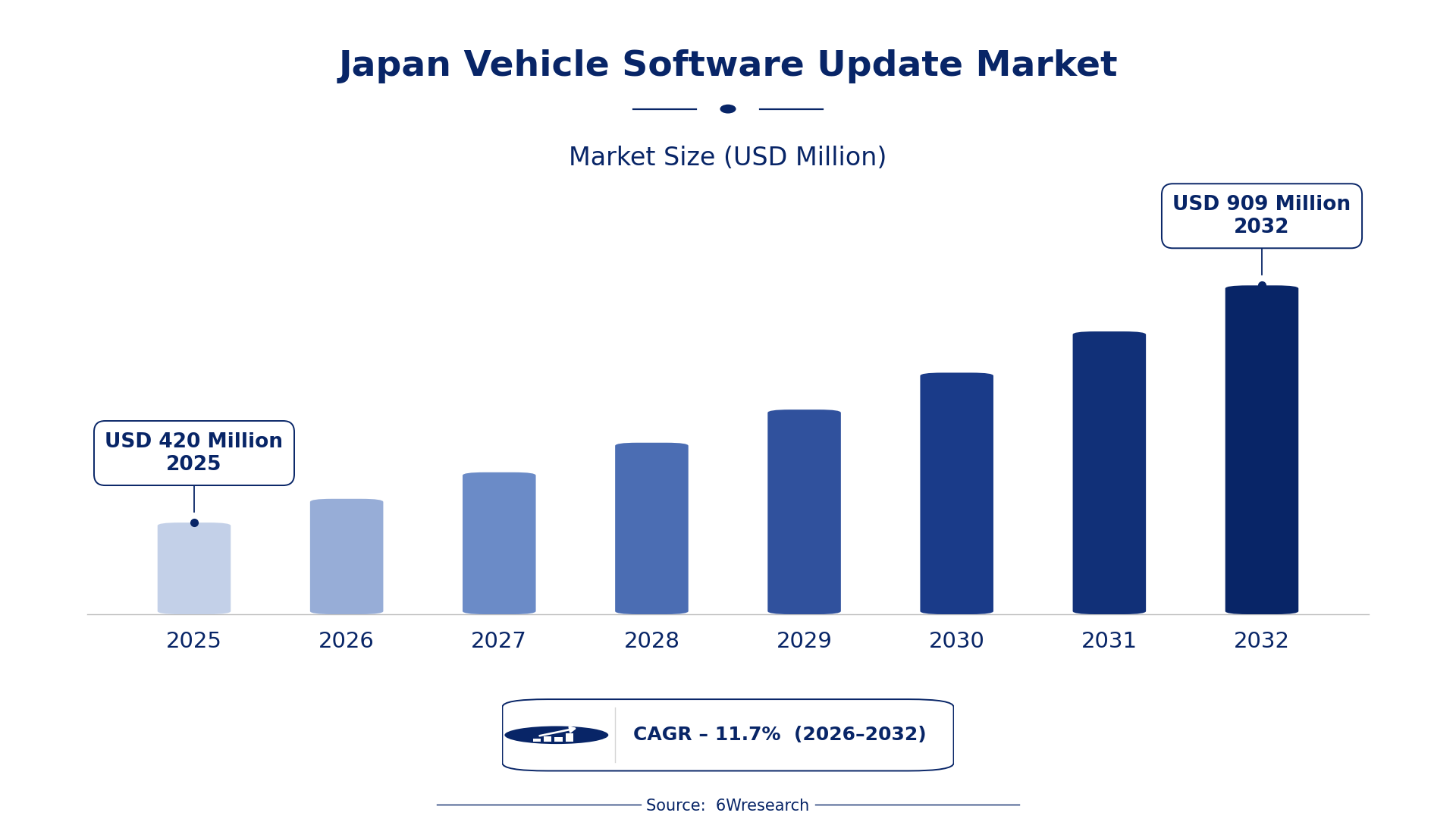
According to 6Wresearch internal database and industry insights, the Japan Vehicle Software Update Market was valued at USD 420 Million in 2025 and is projected to reach USD 909 Million by 2032, growing at a CAGR of approximately 11.7% during 2026–2032.
Japan Vehicle Software Update Market Highlights
| Report Metric | Details |
| Report Name | Japan Vehicle Software Update Market (2026-2032) |
| Market Size 2025 | USD 420 Million |
| Market Size 2032 | USD 909 Million |
| Absolute Growth 2025–2032 | USD 489 Million |
| CAGR 2026–2032 | 11.7% |
| Peak Annual Growth | 12.6% in 2029 |
| Forecast Period | 2026–2032 |
| Historical Data | 2022–2025 |
| Base Year | 2025 |
| Leading Segment Type, 2025 | Firmware Updates (39% share) |
| Leading Update Type, 2025 | Control System Updates (47% share) |
| Leading Delivery Mode, 2025 | OTA (Over the Air) (45% share) |
| Leading Vehicle Type, 2025 | Electric Vehicles (46% share) |
| Fastest-Growing Segment Type | Security Patches (16.2% CAGR) |
| Fastest-Growing Update Type | Anti-theft Upgrades (16.7% CAGR) |
| Fastest-Growing Delivery Mode | Cloud-Based (16.0% CAGR) |
| Fastest-Growing Vehicle Type | Connected Cars (16.6% CAGR) |
| Growing Sector | Automotive Software |
| Key End Users | Automotive manufacturers, vehicle owners, technology providers |
Japan Vehicle Software Update Market Year-wise Growth Rate and Key Drivers (2022–2032)
This graph illustrates the annual growth rates of the market from 2022 to 2032, highlighting a steady upward trajectory and projected market expansion over the forecast period.
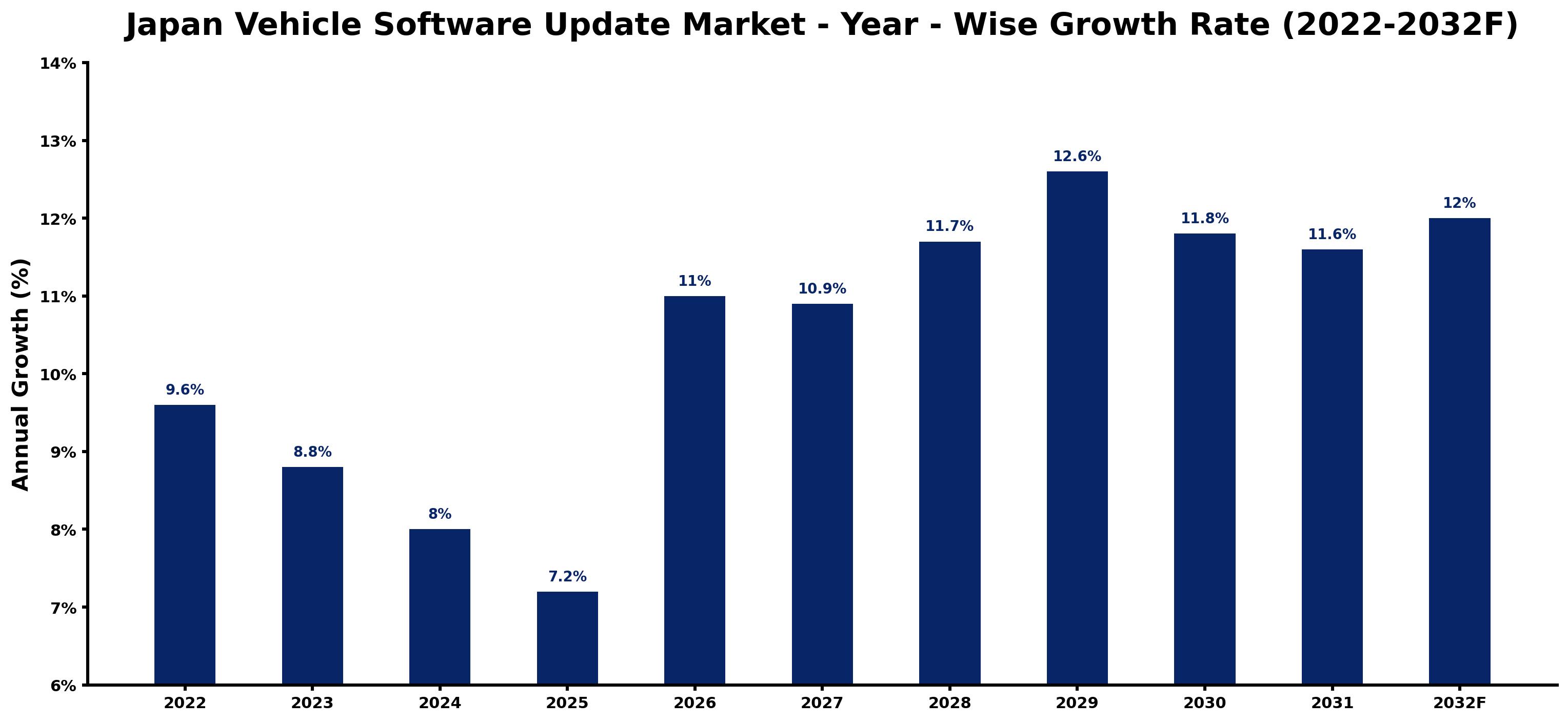
The yearly estimates that follow link every growth rate to its principal driver, so readers can see why the pace changed in each period.
| Year | Estimated Annual Growth (%) | Market Rationale |
| 2022 | 9.6 | The market experienced strong demand due to rising registrations of electric vehicles. |
| 2023 | 8.8 | Growth slowed as the market adjusted to high demand levels and faced supply chain constraints. |
| 2024 | 8.0 | Continued demand for software updates was apparent, though growth rates decreased further. |
| 2025 | 7.2 | Demand remained steady, but growth slowed as the market matured and competition intensified. |
| 2026 | 11.0 | Demand is anticipated to rise as more vehicles become connected and require updates. |
| 2027 | 10.9 | Growth will continue as the adoption of connected cars increases across the country. |
| 2028 | 11.7 | Demand is projected to rise further with advancements in vehicle technology and software. |
| 2029 | 12.6 | The market will peak as the number of connected vehicles reaches new heights. |
| 2030 | 11.8 | Growth will remain strong as technology adoption continues to drive demand for updates. |
| 2031 | 11.6 | Demand is expected to stabilise as the market matures and competition intensifies. |
| 2032 | 12.0 | Growth is projected to increase again as new technologies are introduced to the market. |
Note: Market size estimations and growth projections presented in this report are based on 6Wresearch's proprietary forecasting methodology, utilizing the latest available industry data, government publications, and primary research inputs.
Japan Vehicle Software Update Market Synopsis
Vehicle software updates are vital for maintaining and enhancing the software systems in vehicles, particularly for control systems and infotainment. The Japan Vehicle Software Update Market is expanding due to rising demand from domestic manufacturers and consumers, driven by the increasing number of electric vehicles, which reached 1.5 million in 2023. Government initiatives for improved vehicle connectivity, such as the 'Connected Car Strategy' launched in 2022, further stimulate this market, which is projected to reach USD 909 million by 2032.
Market Dynamics Impact Analysis (2026–2032)
| Factor | Type | Impact | Primary Segment Affected |
| Increasing registrations of electric vehicles drive demand for software updates. | Driver | High | Electric Vehicles |
| The rise of connected cars necessitates regular software updates. | Driver | High | Connected Cars |
| Growing demand for enhanced vehicle security creates opportunities for software updates. | Opportunity | High | Security Patches |
| The push for improved user experience in vehicles opens new avenues for software updates. | Opportunity | Medium | Infotainment |
| High costs associated with software development can limit market growth. | Restraint | High | Firmware Updates |
| Compliance with cybersecurity regulations may slow down update processes. | Restraint | Medium | Security Patches |
| Rising costs of technology development can affect pricing strategies. | Challenge | High | Control System Updates |
| Capacity constraints in production may delay software update rollouts. | Challenge | Medium | OTA (Over the Air) |
Evaluation of Drivers in Japan Vehicle Software Update Market (2026–2032)
Demand rests on the following drivers, each shown with the segment it touches most.
| Drivers | Primary Segment Affected | Why It Matters (Evidence) |
| Rising electric vehicle registrations | Electric Vehicles | In 2023, Japan had 1.5 million registered electric vehicles, increasing demand for software updates. |
| Growing prevalence of connected cars | Connected Cars | The total number of connected cars in Japan is projected to reach 8 million by 2025. |
| Increasing focus on vehicle security | Security Patches | Security patches are mandated under the 'Cybersecurity Management Guidelines' issued in 2021. |
| Demand for improved user experience | Infotainment | The average age of passenger cars in Japan is approximately 13 years, necessitating updates. |
| Technological advancements in vehicle systems | Control System Updates | ISO 26262 is a key standard for automotive functional safety in Japan. |
What keeps demand rising is the growing number of electric vehicles, which reached 1.5 million in 2023, creating a need for regular software updates. The anticipated growth of connected cars to 8 million by 2025 further fuels the demand for updates. With the average age of passenger cars in Japan around 13 years, frequent software improvements are necessary. Compliance with established cybersecurity guidelines ensures that security patches are updated regularly, while adherence to functional safety standards promotes the need for control system updates. These elements contribute to a dynamic market for vehicle software updates.
Evaluation of Restraints in Japan Vehicle Software Update Market
The key brakes on demand, and where they bite hardest, are shown below.
| Market Restraint | Primary Segment Affected | Why It Matters (Evidence) |
| High costs of software development | Firmware Updates | Development costs can reach millions, limiting the ability of smaller manufacturers to compete. |
| Compliance with cybersecurity regulations | Security Patches | Adhering to regulations can delay the rollout of necessary updates, impacting user satisfaction. |
| Limited availability of skilled workforce | Control System Updates | The automotive industry employs over 5 million people, but skilled software engineers are in short supply. |
| Technological obsolescence of older vehicles | Infotainment | The average age of passenger cars is 13 years, limiting the market for updates in older models. |
| Capacity constraints in production | OTA (Over the Air) | Production delays can hinder timely software updates, affecting consumer trust. |
Japan Vehicle Software Update Market Challenges
A critical problem in the vehicle software update market is the limited availability of skilled technicians, which exists due to the rapid evolution of automotive technology. This shortage delays software updates for manufacturers, potentially costing them millions in lost revenue. Compliance with regulations like the Cybersecurity Management Guidelines forces suppliers to allocate resources away from service improvements, increasing operational costs. Buyers face challenges because the average age of passenger cars is approximately 13 years, leading to higher maintenance expenses and limiting access to advanced features, which can deter potential purchases.
Trends in the Japan Vehicle Software Update Market
Below are the shifts with the largest effect on the Japan Vehicle Software Update Market.
- Transition to Over-the-Air Updates: Japan is transitioning from traditional update methods to over-the-air (OTA) technology, now used by over 70% of new connected cars sold. This shift provides greater convenience for consumers and streamlines the update process.
- Focus on Vehicle Cybersecurity: The automotive sector is prioritising cybersecurity, as underscored by the 'Cybersecurity Management Guidelines' issued in 2021. This emphasis is crucial as the number of connected vehicles increases, ensuring better protection against cyber threats.
- Rising Demand for Infotainment Systems: Consumers are increasingly seeking advanced infotainment systems, prompting innovations in user interfaces. The Tokyo Motor Show in 2023 showcased numerous advancements, reflecting this growing trend in vehicle software.
- Growth of Cloud-Based Update Solutions: Cloud-based software update solutions are gaining traction, with a projected growth rate of 16.0%. This trend is apparent in the rising number of connected cars requiring regular updates.
Investment Opportunities in the Japan Vehicle Software Update Market
Several openings in the Japan Vehicle Software Update Market merit attention from investors.
- Investment in Security Software: With the increasing number of connected vehicles, now is an opportune time to invest in security software solutions, as demand is expected to rise. The automotive industry is concentrating on improving vehicle security.
- Expansion of OTA Update Services: There is a substantial opportunity to provide OTA update services, especially as over 70% of new connected cars utilise this method. Collaborating with automotive manufacturers could facilitate market entry.
- Market for Infotainment Enhancements: The demand for infotainment system updates is increasing, with the Tokyo Motor Show in 2023 highlighting new innovations. Suppliers can target this expanding segment to meet consumer expectations.
- Investment in Cloud-Based Solutions: The market for cloud-based update solutions is expanding, with a projected growth rate of 16.0%. Focusing on partnerships with technology firms can strengthen market presence.
Government Initiatives in the Japan Vehicle Software Update Market
The AI Promotion Act, established in 2025, introduces a national framework for AI research and development, supporting the integration of AI in vehicle software updates and ensuring compliance with safety standards. This framework builds on the digital transformation efforts initiated by the Digital Agency in 2021, which aims to streamline processes and improve efficiency in the automotive sector.
The Digital Agency oversees the implementation of common system standards for vehicle software updates, ensuring that manufacturers adhere to best practices. This agency also facilitates funding for projects that improve vehicle connectivity, benefiting both producers and buyers, with numerous projects approved to enhance overall vehicle performance.
Future Insight of the Japan Vehicle Software Update Market
OTA technology will transform demand for vehicle software updates by 2032. The total number of connected cars is projected to reach 8 million by 2025, indicating a shift towards greater vehicle integration. Government initiatives, such as the Connected Car Strategy, will drive improvements in vehicle connectivity and user experience. As Japan targets a 46% reduction in greenhouse-gas emissions by 2030, software updates will play a crucial part in ensuring vehicles meet evolving environmental standards.
Market Segmentation Analysis
Japan Vehicle Software Update Market report covers a detailed analysis of the following market segments:
By Segment Type – Firmware Updates Lead, Security Patches Expected to Grow Fastest
According to Saurav Kr Singh, Senior Research Analyst at 6Wresearch, Firmware Updates accounted for 39% of the market by segment type in 2025. Firmware updates are crucial for maintaining essential vehicle functionality, appealing to both manufacturers and consumers. With over 70% of new connected cars in Japan relying on these updates, the demand remains robust. Over 2026–2032, Security Patches are expected to post the fastest growth, at a CAGR of 16.2%. The increasing prevalence of cybersecurity threats has amplified the need for security patches, especially with the rise in connected vehicles. As regulations like the Cybersecurity Management Guidelines mandate these updates, their adoption is set to increase significantly. Suppliers must prioritise security patch solutions to meet regulatory requirements and consumer expectations.
By Update Type – Control System Updates Lead, Anti-theft Upgrades Expected to Grow Fastest
With 47% of update type revenue in 2025, Control System Updates was the largest category. Control system updates are vital for ensuring optimal vehicle operation, a key concern for both manufacturers and consumers. Given that the average age of passenger cars in Japan is around 13 years, the need for these updates is pronounced. Anti-theft Upgrades are projected to grow fastest, at a CAGR of 16.7% during 2026–2032. The growing emphasis on vehicle security has heightened the demand for anti-theft upgrades, particularly as connected cars become more prevalent. With these vehicles increasingly targeted for theft, the urgency for such upgrades is rising. Buyers should seek comprehensive solutions that include both control system updates and anti-theft measures to enhance vehicle safety.
By Delivery Mode – OTA (Over the Air) Leads, Cloud-Based Expected to Grow Fastest
OTA (Over the Air) held 45% of the Japan Vehicle Software Update Market by delivery mode in 2025. OTA updates are the primary method for delivering software enhancements, making them essential to the modern automotive experience. With a significant percentage of new connected cars in Japan employing OTA technology, this method has established itself as the preferred choice. The quickest growth will come from Cloud-Based, forecast to expand at a CAGR of 16.0% between 2026 and 2032. The shift towards cloud-based solutions is gaining momentum as they enable efficient data storage and processing for updates, thereby improving the overall update experience. This trend is expected to grow as more vehicles become connected and require effective update management. Suppliers should invest in robust cloud-based systems to complement OTA delivery and improve update efficiency.
By Vehicle Type – Electric Vehicles Lead, Connected Cars Expected to Grow Fastest
In 2025, Electric Vehicles led the vehicle type split with a 46% share. Electric vehicles represent a rapidly growing segment that requires frequent software updates to optimise their performance and features. With 1.5 million registered electric vehicles in Japan, the demand for updates in this category is substantial. Connected Cars are set to record the highest CAGR in this split, 16.6% over 2026–2032. Connected cars are central to the modern automotive experience, driving swift growth in their software update needs. As the total number of connected cars is projected to reach 8 million by 2025, this segment is set for considerable expansion. Manufacturers must focus on developing tailored software solutions for both electric and connected vehicles to capitalise on market opportunities.
Key Attractiveness of the Report
- 10 Years of Market Numbers
- Historical Data Starting from 2022 to 2025
- Base Year 2025
- Forecast Data until 2032
- Key Performance Indicators Impacting the Market
- Major Upcoming Developments and Projects
Key Highlights of the Report:
- Japan Vehicle Software Update Market Outlook
- Market Size of Japan Vehicle Software Update Market, 2025
- Forecast of Japan Vehicle Software Update Market, 2032
- Historical Data and Forecast of Japan Vehicle Software Update Revenues & Volume for the Period 2022-2032F
- Japan Vehicle Software Update Market Trend Evolution
- Japan Vehicle Software Update Market Drivers and Challenges
- Japan Vehicle Software Update Price Trends
- Japan Vehicle Software Update Porter's Five Forces
- Japan Vehicle Software Update Industry Life Cycle
- Historical Data and Forecast of Japan Vehicle Software Update Market Revenues & Volume By Segment Type for the Period 2022-2032F
- Historical Data and Forecast of Japan Vehicle Software Update Market Revenues & Volume By Firmware Updates for the Period 2022-2032F
- Historical Data and Forecast of Japan Vehicle Software Update Market Revenues & Volume By Security Patches for the Period 2022-2032F
- Historical Data and Forecast of Japan Vehicle Software Update Market Revenues & Volume By Performance for the Period 2022-2032F
- Historical Data and Forecast of Japan Vehicle Software Update Market Revenues & Volume By Infotainment for the Period 2022-2032F
- Historical Data and Forecast of Japan Vehicle Software Update Market Revenues & Volume By Update Type for the Period 2022-2032F
- Historical Data and Forecast of Japan Vehicle Software Update Market Revenues & Volume By Control System Updates for the Period 2022-2032F
- Historical Data and Forecast of Japan Vehicle Software Update Market Revenues & Volume By Anti-theft Upgrades for the Period 2022-2032F
- Historical Data and Forecast of Japan Vehicle Software Update Market Revenues & Volume By Engine Optimization for the Period 2022-2032F
- Historical Data and Forecast of Japan Vehicle Software Update Market Revenues & Volume By UI/UX & Apps for the Period 2022-2032F
- Historical Data and Forecast of Japan Vehicle Software Update Market Revenues & Volume By Delivery Mode for the Period 2022-2032F
- Historical Data and Forecast of Japan Vehicle Software Update Market Revenues & Volume By OTA (Over the Air) for the Period 2022-2032F
- Historical Data and Forecast of Japan Vehicle Software Update Market Revenues & Volume By Cloud-Based for the Period 2022-2032F
- Historical Data and Forecast of Japan Vehicle Software Update Market Revenues & Volume By USB/Wireless for the Period 2022-2032F
- Historical Data and Forecast of Japan Vehicle Software Update Market Revenues & Volume By Wi-Fi/Cellular for the Period 2022-2032F
- Historical Data and Forecast of Japan Vehicle Software Update Market Revenues & Volume By Vehicle Type for the Period 2022-2032F
- Historical Data and Forecast of Japan Vehicle Software Update Market Revenues & Volume By Electric Vehicles for the Period 2022-2032F
- Historical Data and Forecast of Japan Vehicle Software Update Market Revenues & Volume By Connected Cars for the Period 2022-2032F
- Historical Data and Forecast of Japan Vehicle Software Update Market Revenues & Volume By Sports Cars for the Period 2022-2032F
- Historical Data and Forecast of Japan Vehicle Software Update Market Revenues & Volume By Passenger Cars for the Period 2022-2032F
- Japan Vehicle Software Update Import Export Trade Statistics
- Market Opportunity Assessment By Segment Type
- Market Opportunity Assessment By Update Type
- Market Opportunity Assessment By Delivery Mode
- Market Opportunity Assessment By Vehicle Type
- Japan Vehicle Software Update Top Companies Market Share
- Japan Vehicle Software Update Competitive Benchmarking By Technical and Operational Parameters
- Japan Vehicle Software Update Company Profiles
- Japan Vehicle Software Update Key Strategic Recommendations
Market Covered
Segments analysed in this report are listed below.
By Segment Type
- Firmware Updates
- Security Patches
- Performance
- Infotainment
By Update Type
- Control System Updates
- Anti-theft Upgrades
- Engine Optimization
- UI/UX & Apps
By Delivery Mode
- OTA (Over the Air)
- Cloud-Based
- USB/Wireless
- Wi-Fi/Cellular
By Vehicle Type
- Electric Vehicles
- Connected Cars
- Sports Cars
- Passenger Cars































