Japan Vehicle Surround Vision Systems Market Size & Growth Rate
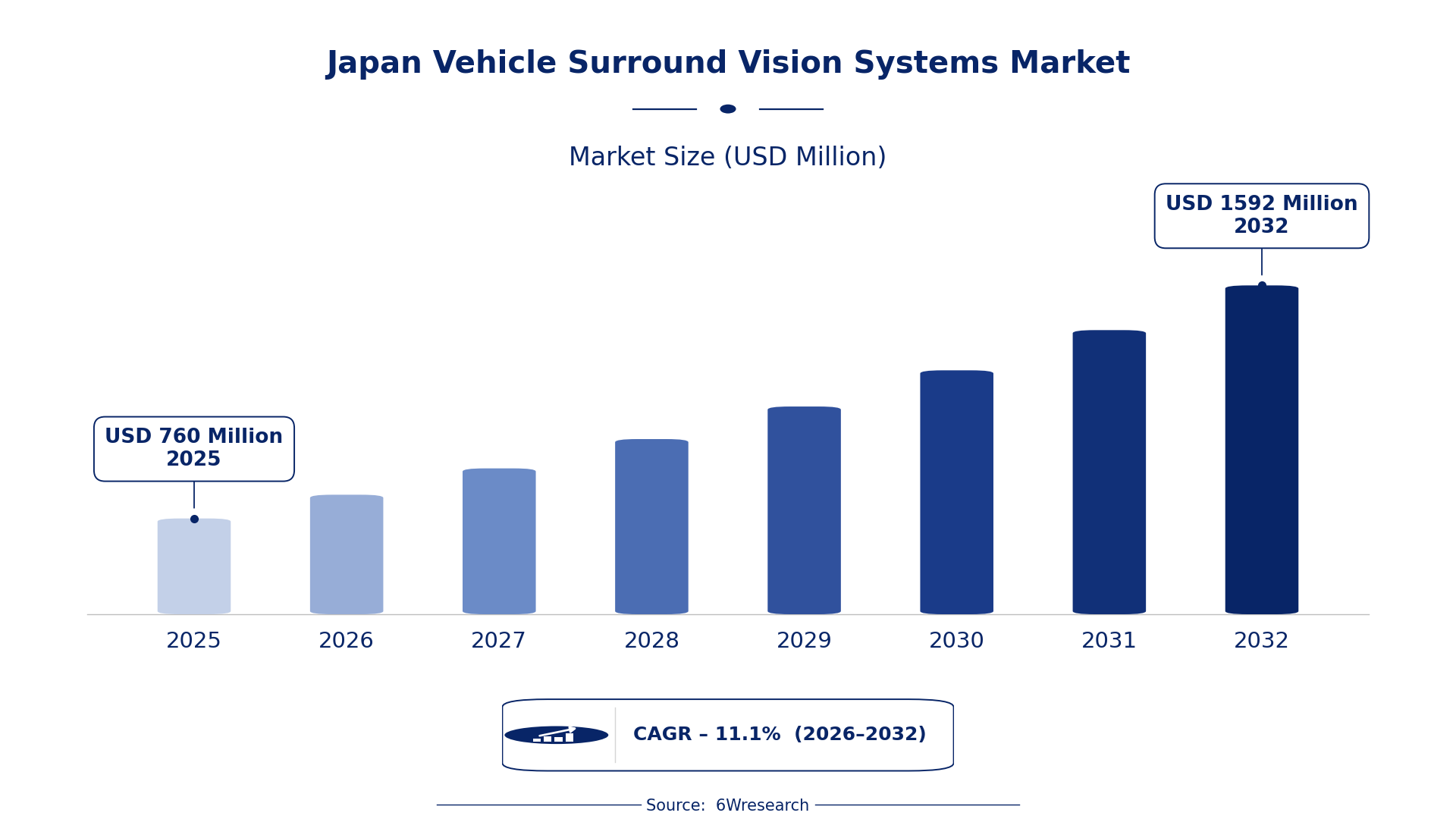
According to 6Wresearch internal database and industry insights, the Japan Vehicle Surround Vision Systems Market was valued at USD 760 Million in 2025 and is projected to reach USD 1,592 Million by 2032, growing at a CAGR of approximately 11.1% during 2026–2032.
Japan Vehicle Surround Vision Systems Market Highlights
| Report Metric | Details |
| Report Name | Japan Vehicle Surround Vision Systems Market (2026-2032) |
| Market Size 2025 | USD 760 Million |
| Market Size 2032 | USD 1,592 Million |
| Absolute Growth 2025–2032 | USD 832 Million |
| CAGR 2026–2032 | 11.1% |
| Peak Annual Growth | 12.1% in 2026 |
| Forecast Period | 2026–2032 |
| Historical Data | 2022–2025 |
| Base Year | 2025 |
| Leading System Type, 2025 | Multi-Camera System (43% share) |
| Leading Sensor Type, 2025 | CMOS Sensor (43% share) |
| Leading Integration Type, 2025 | Embedded (39% share) |
| Leading Distribution Channel, 2025 | Direct Sales (42% share) |
| Fastest-Growing System Type | LIDAR-based Vision (15.6% CAGR) |
| Fastest-Growing Sensor Type | Infrared Sensor (16.2% CAGR) |
| Fastest-Growing Integration Type | AI-Enhanced (15.7% CAGR) |
| Fastest-Growing Distribution Channel | Online Platforms (14.1% CAGR) |
| Growing Sector | automotive safety technology |
| Key End Users | automotive manufacturers, vehicle technology developers, safety system integrators |
Japan Vehicle Surround Vision Systems Market Year-wise Growth Rate and Key Drivers (2022–2032)
This graph illustrates the annual growth rates of the market from 2022 to 2032, highlighting a steady upward trajectory and projected market expansion over the forecast period.
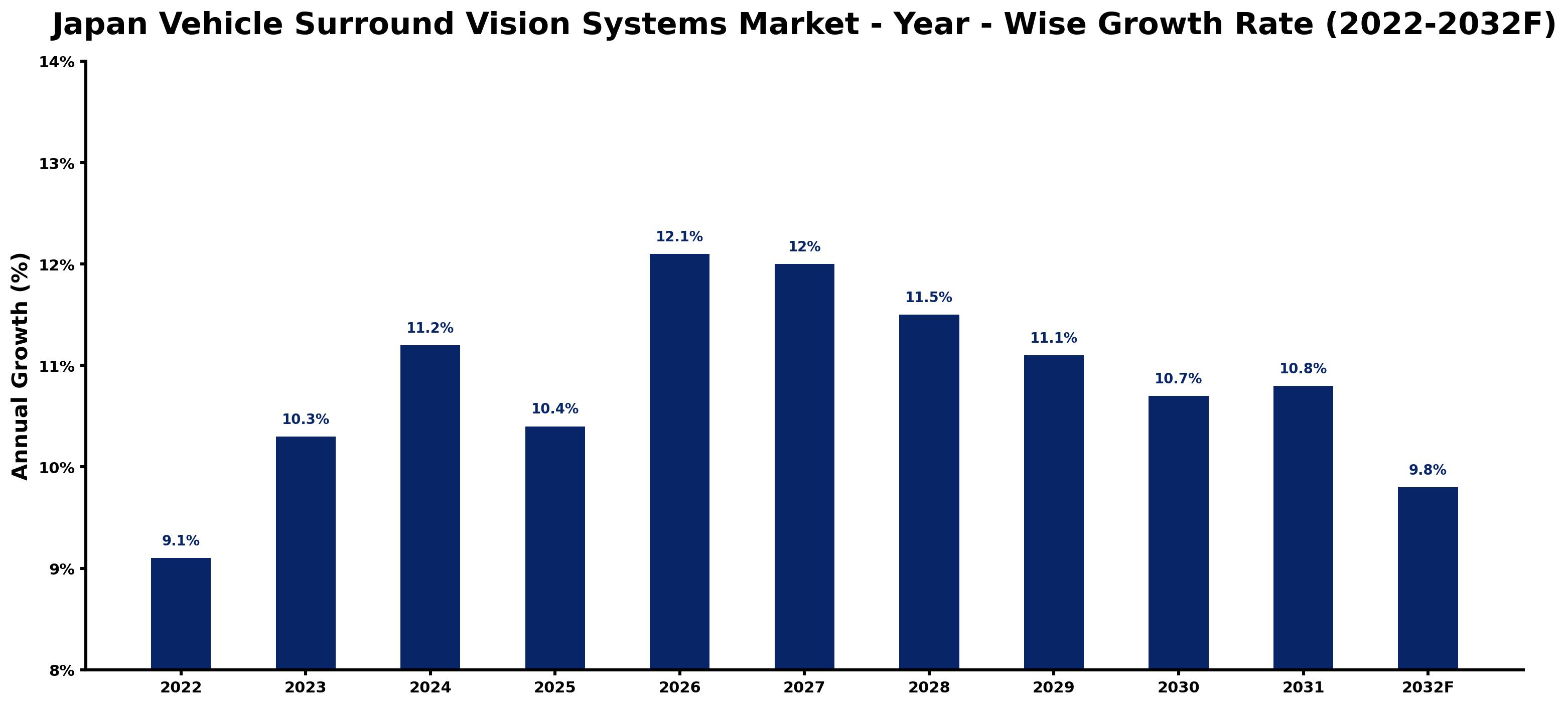
Each row of the following table gives one year's estimated growth and the event or demand shift that explains it.
| Year | Estimated Annual Growth (%) | Market Rationale |
| 2022 | 9.1 | The market showed solid growth due to rising vehicle production and increasing safety awareness. |
| 2023 | 10.3 | Demand accelerated as automotive manufacturers invested in advanced safety technologies. |
| 2024 | 11.2 | The introduction of new models featuring improved safety systems drove further growth. |
| 2025 | 10.4 | Growth slowed slightly as market saturation began to affect new vehicle purchases. |
| 2026 | 12.1 | The market is expected to rebound with heightened demand for LIDAR technology in new vehicles. |
| 2027 | 12.0 | A minor slowdown is projected as consumer preferences stabilise in vehicle features. |
| 2028 | 11.5 | Demand is expected to remain steady as manufacturers continue to innovate in safety technologies. |
| 2029 | 11.1 | Growth is projected to slow as the average vehicle age indicates a need for upgrades. |
| 2030 | 10.7 | A further slowdown is anticipated as safety feature regulations become more stringent. |
| 2031 | 10.8 | Growth is expected to pick up again with increased investments in advanced driver-assistance systems. |
| 2032 | 9.8 | Demand is projected to slow as the market matures and competition intensifies. |
Note: Market size estimations and growth projections presented in this report are based on 6Wresearch's proprietary forecasting methodology, utilizing the latest available industry data, government publications, and primary research inputs.
Japan Vehicle Surround Vision Systems Market Synopsis
Vehicle Surround Vision Systems improve driver awareness and assist in parking by providing a 360-degree view around vehicles. The Japan Vehicle Surround Vision Systems Market is growing due to strong demand from domestic manufacturers and exports. With the average vehicle age at 13.5 years, there is an urgent need for upgrades, while government initiatives aim for 100% of new vehicles to feature advanced safety technologies by 2025.
Market Dynamics Impact Analysis (2026–2032)
| Factor | Type | Impact | Primary Segment Affected |
| Increasing vehicle production drives demand for advanced safety technologies. | Driver | High | Multi-Camera System |
| Growing consumer preference for enhanced safety features creates opportunities for innovation. | Driver | High | LIDAR-based Vision |
| Rising vehicle age necessitates upgrades to safety systems in older models. | Opportunity | High | Radar-Assist Vision |
| The push for sustainable automotive solutions opens avenues for new technologies. | Opportunity | Medium | Hybrid Vision System |
| High costs associated with advanced technologies can limit market expansion. | Restraint | High | CMOS Sensor |
| Regulatory compliance can delay product launches and increase costs. | Restraint | Medium | Embedded |
| Limited availability of skilled labour affects production capabilities. | Challenge | High | AI-Enhanced |
| Intense competition among manufacturers can lead to price wars. | Challenge | Medium | Integrated |
Evaluation of Drivers in Japan Vehicle Surround Vision Systems Market (2026–2032)
These are the developments adding the most demand over the forecast period.
| Drivers | Primary Segment Affected | Why It Matters (Evidence) |
| Rising vehicle production | Multi-Camera System | Japan's automotive production reached 8.3 million units in 2022, increasing demand for safety systems. |
| Consumer demand for safety features | LIDAR-based Vision | The Tokyo Motor Show in 2023 showcased innovations, driving manufacturers to adopt advanced technologies. |
| Government regulations promoting safety standards | Radar-Assist Vision | ISO 26262 is a key standard, ensuring manufacturers invest in compliant safety systems. |
| Technological advancements in sensor technology | Hybrid Vision System | The adoption of LIDAR technology in new vehicle models is improving safety capabilities. |
| Investment in advanced driver-assistance systems | CMOS Sensor | The government aims for 100% of new vehicles to have safety features by 2025. |
Spending increases as vehicle production in Japan reached 8.3 million units in 2022, driving demand for advanced safety technologies. Innovations showcased at the Tokyo Motor Show in 2023 encouraged manufacturers to improve safety features. The rising adoption of LIDAR technology in new models boosts demand for sophisticated systems.
Evaluation of Restraints in Japan Vehicle Surround Vision Systems Market
Several factors work against faster growth; the main ones are summarised below.
| Market Restraint | Primary Segment Affected | Why It Matters (Evidence) |
| High costs of advanced safety technologies limit market access. | CMOS Sensor | The average vehicle age in Japan is 13.5 years, making upgrades costly for consumers. |
| Regulatory compliance can delay product launches and increase costs. | Embedded | Manufacturers must adhere to strict safety standards, impacting time-to-market. |
| Limited availability of skilled labour affects production capabilities. | AI-Enhanced | The automotive sector faces challenges in finding qualified personnel for advanced technologies. |
| Intense competition among manufacturers can lead to price wars. | Integrated | Price reductions to attract buyers can squeeze profit margins for suppliers. |
| Market saturation in certain segments slows growth. | Hybrid Vision System | As more vehicles become equipped with safety technologies, new sales may decline. |
Japan Vehicle Surround Vision Systems Market Challenges
Producers face challenges in integrating LIDAR technology into vehicle systems, resulting in product launch delays of up to six months. Buyers encounter higher upgrade costs as the average vehicle age of 13.5 years necessitates substantial investments in new safety features. Distributors experience supply chain disruptions due to reliance on specific components, causing delivery delays that can extend by three months. Competition escalates as the government mandates that 100% of new vehicles must include advanced safety features by 2025, compelling manufacturers to innovate rapidly while managing costs.
Trends in the Japan Vehicle Surround Vision Systems Market
The shifts below are changing how Japan Vehicle Surround Vision Systems Market products are bought and supplied.
- Shift Towards LIDAR Technology: LIDAR technology adoption in new vehicle models is on the rise, with 8.3 million units produced in 2022. This shift enhances safety and obstacle detection capabilities, benefiting both manufacturers and consumers.
- Transition to Advanced Safety Systems: The 2023 Tokyo Motor Show showcased a transition to advanced safety systems, with a target of 100% of new vehicles featuring such technologies by 2025. This trend motivates manufacturers to innovate and enhance vehicle safety.
- Emergence of AI-Driven Systems: AI-driven systems are gaining momentum, driven by the demand for improved functionality in safety technologies. The government aims for a substantial increase in these systems by 2025, supporting safer driving experiences.
- Growing Demand for Integrated Solutions: Integrated safety solutions are becoming increasingly popular, focusing on effective operation within vehicle architecture. This trend aligns with the government's push for comprehensive safety features in new vehicles.
Investment Opportunities in the Japan Vehicle Surround Vision Systems Market
The following opportunities in the Japan Vehicle Surround Vision Systems Market pair current demand with a clear way in.
- Automotive Manufacturers Seeking Upgrades: Automotive manufacturers in Japan require advanced safety systems to meet regulatory standards, with a target of 100% compliance by 2025. Suppliers should focus on developing effective technologies to meet this demand.
- Supply of Advanced Sensor Technologies: There is a growing need for advanced sensor technologies, particularly LIDAR and CMOS sensors, as vehicle production increases. Collaborating with manufacturers in the Tokyo region can facilitate market entry.
- Partnerships in Safety Technology Development: Collaborating with local automotive manufacturers can improve product offerings in safety technologies. Engaging with the Japan Automobile Manufacturers Association can provide valuable insights and connections.
- Investment in Research and Development: Investing in R&D for effective safety solutions is essential, especially as the government promotes advanced driver-assistance systems. Targeting funding opportunities from the GX Promotion Act can support these initiatives.
Government Initiatives in the Japan Vehicle Surround Vision Systems Market
The Battery Industry Strategy, established by METI in August 2022, aims to increase domestic battery manufacturing capacity to 150 GWh by 2030. This initiative supports the automotive sector's transition to electric vehicles, indirectly benefiting the Vehicle Surround Vision Systems market by promoting advanced safety technologies.
The GX Promotion Act, enacted in 2023, establishes a framework for decarbonisation investments. The Ministry of Land, Infrastructure, Transport and Tourism oversees compliance, ensuring that new vehicles meet safety standards. This act encourages manufacturers to incorporate advanced safety features into their designs.
Future Insight of the Japan Vehicle Surround Vision Systems Market
The automotive sector will experience a shift as new vehicles increasingly integrate advanced driver-assistance systems, improving safety and functionality. By 2032, the Tokyo region will become a key centre for automotive technology, attracting investments and expertise. The government’s programme promoting advanced safety technologies will encourage collaboration among suppliers. With over 5 million registered vehicles equipped with advanced safety systems, demand for upgrades will drive ongoing innovation in the industry.
Market Segmentation Analysis
Japan Vehicle Surround Vision Systems Market report covers a detailed analysis of the following market segments:
By System Type – Multi-Camera System Leads, LIDAR-based Vision Expected to Grow Fastest
According to Saurav Kr Singh, Senior Research Analyst at 6Wresearch, Multi-Camera System held 43% of the Japan Vehicle Surround Vision Systems Market by system type in 2025. The multi-camera system leads the market as it provides comprehensive visibility around the vehicle, which is essential for enhancing driver awareness and safety. Given Japan's automotive production of 8.3 million units in 2022, the demand for this technology is substantial. LIDAR-based Vision is set to record the highest CAGR in this split, 15.6% over 2026–2032. LIDAR-based vision is rapidly growing due to its precise distance measurement capabilities, which are crucial for modern vehicles. The increasing adoption of LIDAR technology in new vehicle models is a key factor in this segment's expansion. Suppliers should focus on enhancing LIDAR technology to meet the growing demand for advanced safety features.
By Sensor Type – CMOS Sensor Leads, Infrared Sensor Expected to Grow Fastest
The largest sensor type category in 2025 was CMOS Sensor, at 43% of revenue. CMOS sensors dominate the market as they are vital for image capture in camera systems, ensuring high-quality visuals for vehicle surround vision systems. The reliance on these sensors in over 5 million registered vehicles underscores their critical role in automotive safety. Over 2026–2032, Infrared Sensor is expected to post the fastest growth, at a CAGR of 16.2%. The infrared sensor segment is experiencing swift growth due to its application in night vision, which significantly enhances safety during low-light conditions. As vehicle manufacturers increasingly incorporate night vision capabilities, the demand for infrared sensors is expected to rise notably. Buyers will benefit from investing in vehicles equipped with advanced sensor technologies to improve safety and driving experience.
By Integration Type – Embedded Leads, AI-Enhanced Expected to Grow Fastest
With 39% of integration type revenue in 2025, Embedded was the largest category. Embedded systems are the market leaders as they are integrated within vehicle systems for seamless operation, providing a more efficient user experience. This integration is vital for the automotive industry, which aims for 100% of new vehicles to have safety features by 2025. AI-Enhanced is projected to grow fastest, at a CAGR of 15.7% during 2026–2032. The AI-enhanced integration segment is witnessing rapid growth as it improves system functionality through intelligent processing, allowing for adaptive safety measures. The increasing emphasis on advanced driver-assistance systems is propelling this segment forward. Suppliers must prioritise enhancements to remain competitive in the rapidly evolving automotive safety market.
By Distribution Channel – Direct Sales Leads, Online Platforms Expected to Grow Fastest
Direct Sales accounted for 42% of the market by distribution channel in 2025. Direct sales remain the primary method for vehicle manufacturers to acquire systems, ensuring a streamlined procurement process. This channel is essential for maintaining strong relationships with automotive producers in Japan's robust market. The quickest growth will come from Online Platforms, forecast to expand at a CAGR of 14.1% between 2026 and 2032. Online platforms are gaining traction as they provide an accessible means for information and potential purchases, catering to tech-savvy consumers. The shift towards digital solutions in procurement is significantly driving this growth. Suppliers should develop strong online strategies to capture the growing interest in digital purchasing channels.
Key Attractiveness of the Report
- 10 Years of Market Numbers
- Historical Data Starting from 2022 to 2025
- Base Year 2025
- Forecast Data until 2032
- Key Performance Indicators Impacting the Market
- Major Upcoming Developments and Projects
Key Highlights of the Report:
- Japan Vehicle Surround Vision Systems Market Outlook
- Market Size of Japan Vehicle Surround Vision Systems Market, 2025
- Forecast of Japan Vehicle Surround Vision Systems Market, 2032
- Historical Data and Forecast of Japan Vehicle Surround Vision Systems Revenues & Volume for the Period 2022-2032F
- Japan Vehicle Surround Vision Systems Market Trend Evolution
- Japan Vehicle Surround Vision Systems Market Drivers and Challenges
- Japan Vehicle Surround Vision Systems Price Trends
- Japan Vehicle Surround Vision Systems Porter's Five Forces
- Japan Vehicle Surround Vision Systems Industry Life Cycle
- Historical Data and Forecast of Japan Vehicle Surround Vision Systems Market Revenues & Volume By System Type for the Period 2022-2032F
- Historical Data and Forecast of Japan Vehicle Surround Vision Systems Market Revenues & Volume By Multi-Camera System for the Period 2022-2032F
- Historical Data and Forecast of Japan Vehicle Surround Vision Systems Market Revenues & Volume By LIDAR-based Vision for the Period 2022-2032F
- Historical Data and Forecast of Japan Vehicle Surround Vision Systems Market Revenues & Volume By Radar-Assist Vision for the Period 2022-2032F
- Historical Data and Forecast of Japan Vehicle Surround Vision Systems Market Revenues & Volume By Hybrid Vision System for the Period 2022-2032F
- Historical Data and Forecast of Japan Vehicle Surround Vision Systems Market Revenues & Volume By Sensor Type for the Period 2022-2032F
- Historical Data and Forecast of Japan Vehicle Surround Vision Systems Market Revenues & Volume By CMOS Sensor for the Period 2022-2032F
- Historical Data and Forecast of Japan Vehicle Surround Vision Systems Market Revenues & Volume By Infrared Sensor for the Period 2022-2032F
- Historical Data and Forecast of Japan Vehicle Surround Vision Systems Market Revenues & Volume By Ultrasonic Sensor for the Period 2022-2032F
- Historical Data and Forecast of Japan Vehicle Surround Vision Systems Market Revenues & Volume By Optical Sensor for the Period 2022-2032F
- Historical Data and Forecast of Japan Vehicle Surround Vision Systems Market Revenues & Volume By Integration Type for the Period 2022-2032F
- Historical Data and Forecast of Japan Vehicle Surround Vision Systems Market Revenues & Volume By Embedded for the Period 2022-2032F
- Historical Data and Forecast of Japan Vehicle Surround Vision Systems Market Revenues & Volume By Modular for the Period 2022-2032F
- Historical Data and Forecast of Japan Vehicle Surround Vision Systems Market Revenues & Volume By Integrated for the Period 2022-2032F
- Historical Data and Forecast of Japan Vehicle Surround Vision Systems Market Revenues & Volume By AI-Enhanced for the Period 2022-2032F
- Historical Data and Forecast of Japan Vehicle Surround Vision Systems Market Revenues & Volume By Distribution Channel for the Period 2022-2032F
- Historical Data and Forecast of Japan Vehicle Surround Vision Systems Market Revenues & Volume By Direct Sales for the Period 2022-2032F
- Historical Data and Forecast of Japan Vehicle Surround Vision Systems Market Revenues & Volume By Online Platforms for the Period 2022-2032F
- Historical Data and Forecast of Japan Vehicle Surround Vision Systems Market Revenues & Volume By Industrial Suppliers for the Period 2022-2032F
- Historical Data and Forecast of Japan Vehicle Surround Vision Systems Market Revenues & Volume By Specialty Stores for the Period 2022-2032F
- Japan Vehicle Surround Vision Systems Import Export Trade Statistics
- Market Opportunity Assessment By System Type
- Market Opportunity Assessment By Sensor Type
- Market Opportunity Assessment By Integration Type
- Market Opportunity Assessment By Distribution Channel
- Japan Vehicle Surround Vision Systems Top Companies Market Share
- Japan Vehicle Surround Vision Systems Competitive Benchmarking By Technical and Operational Parameters
- Japan Vehicle Surround Vision Systems Company Profiles
- Japan Vehicle Surround Vision Systems Key Strategic Recommendations
Market Covered
This report examines the market across the segments below.
By System Type
- Multi-Camera System
- LIDAR-based Vision
- Radar-Assist Vision
- Hybrid Vision System
By Sensor Type
- CMOS Sensor
- Infrared Sensor
- Ultrasonic Sensor
- Optical Sensor
By Integration Type
- Embedded
- Modular
- Integrated
- AI-Enhanced
By Distribution Channel
- Direct Sales
- Online Platforms
- Industrial Suppliers
- Specialty Stores































