Japan Vehicle Surveillance Systems Market Size & Growth Rate
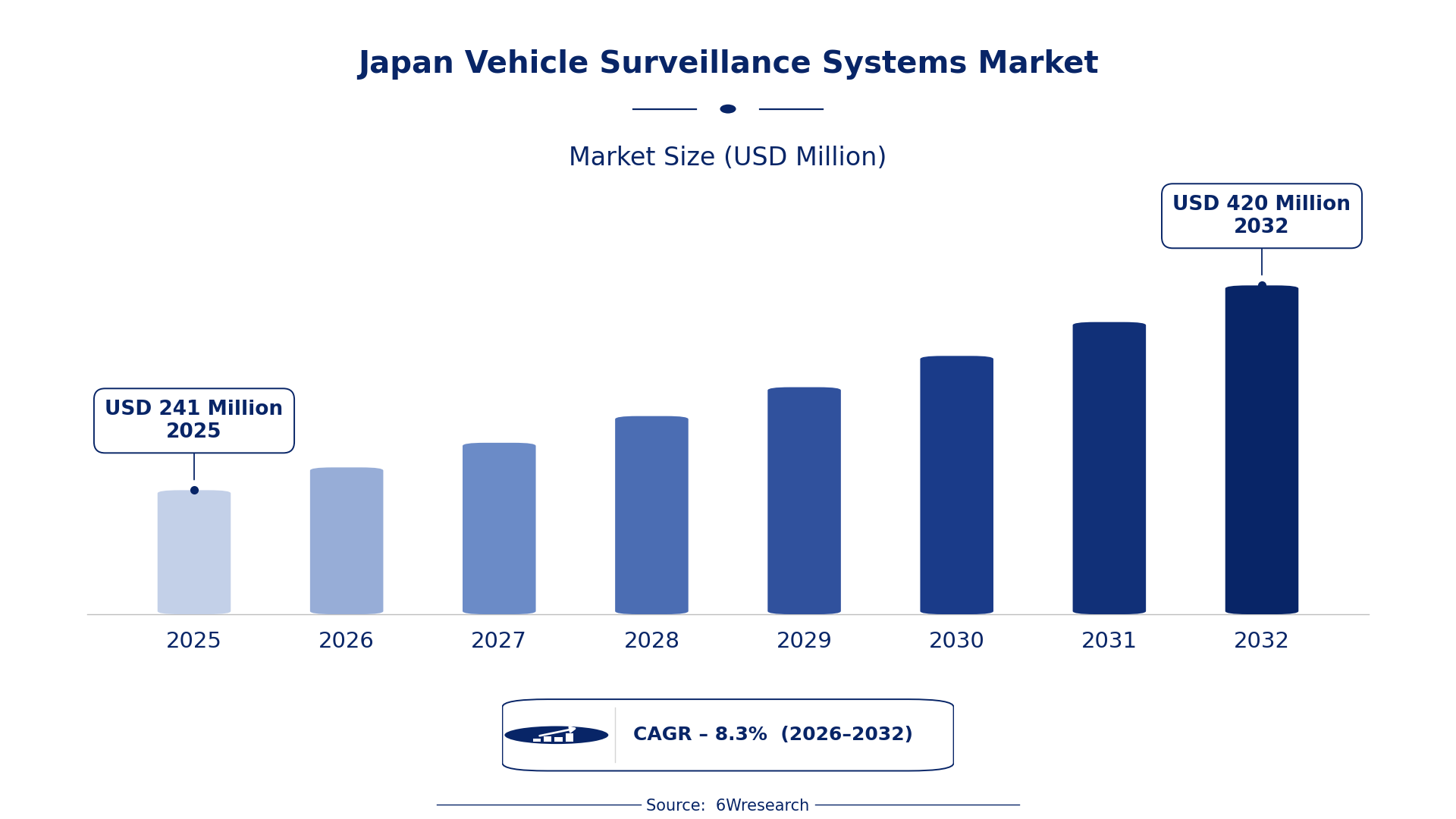
According to 6Wresearch internal database and industry insights, the Japan Vehicle Surveillance Systems Market was valued at USD 241 Million in 2025 and is projected to reach USD 420 Million by 2032, growing at a CAGR of approximately 8.3% during 2026–2032.
Japan Vehicle Surveillance Systems Market Highlights
| Report Metric | Details |
| Report Name | Japan Vehicle Surveillance Systems Market (2026-2032) |
| Market Size 2025 | USD 241 Million |
| Market Size 2032 | USD 420 Million |
| Absolute Growth 2025–2032 | USD 179 Million |
| CAGR 2026–2032 | 8.3% |
| Peak Annual Growth | 9.6% in 2032 |
| Forecast Period | 2026–2032 |
| Historical Data | 2022–2025 |
| Base Year | 2025 |
| Leading System Type, 2025 | Dash Cams (43% share) |
| Leading Technology Type, 2025 | AI Video Analytics (40% share) |
| Leading Vehicle Type, 2025 | Passenger Cars (38% share) |
| Leading Distribution Channel, 2025 | Direct Sales (42% share) |
| Fastest-Growing System Type | Rear Surveillance (11.7% CAGR) |
| Fastest-Growing Vehicle Type | Buses (12.1% CAGR) |
| Fastest-Growing Distribution Channel | Online Platforms (11.0% CAGR) |
| Growing Sector | Online Platforms |
| Key End Users | Direct Sales, Online Platforms, Specialty Stores, Industrial Suppliers |
Japan Vehicle Surveillance Systems Market Year-wise Growth Rate and Key Drivers (2022–2032)
This graph illustrates the annual growth rates of the market from 2022 to 2032, highlighting a steady upward trajectory and projected market expansion over the forecast period.
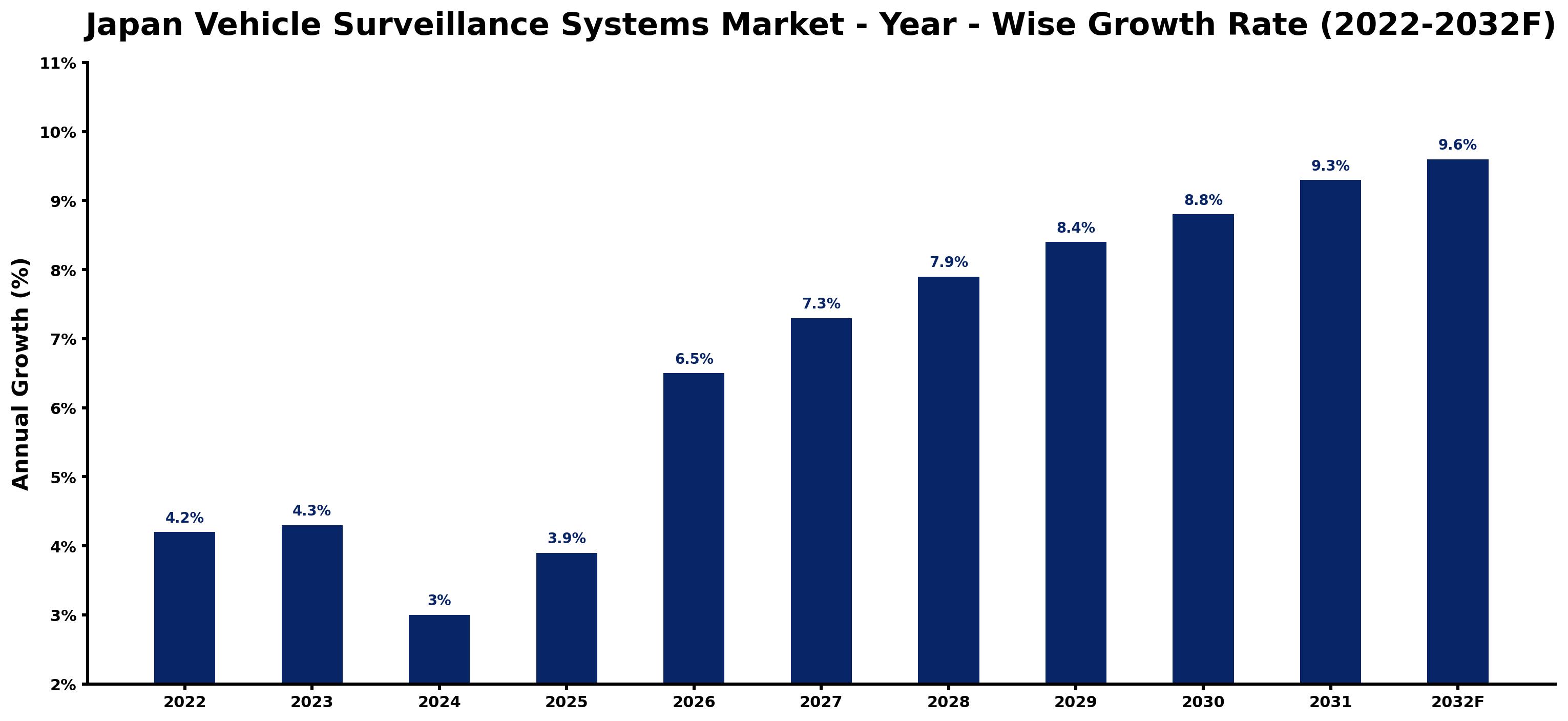
Year by year, the estimates below pair each growth rate with the development that shaped it.
| Year | Estimated Annual Growth (%) | Market Rationale |
| 2022 | 4.2 | The market showed steady growth, reflecting increasing awareness of vehicle safety technologies. |
| 2023 | 4.3 | Growth accelerated due to heightened demand for dash cams in urban areas. |
| 2024 | 3.0 | The growth rate slowed as market saturation began to affect new installations. |
| 2025 | 3.9 | Demand rose again with increased investments in commercial vehicle safety systems. |
| 2026 | 6.5 | The market is expected to grow faster as AI video analytics gain traction. |
| 2027 | 7.3 | Demand is projected to continue rising with advancements in surveillance technology. |
| 2028 | 7.9 | The growth rate is expected to increase as more vehicles adopt surveillance systems. |
| 2029 | 8.4 | Demand is projected to strengthen with the logistics sector's investment in safety. |
| 2030 | 8.8 | The market is expected to grow further as regulations mandate surveillance technology. |
| 2031 | 9.3 | Growth is projected to rise with the expansion of public transport safety measures. |
| 2032 | 9.6 | The market is expected to peak as consumer awareness and technology adoption increase. |
Note: Market size estimations and growth projections presented in this report are based on 6Wresearch's proprietary forecasting methodology, utilizing the latest available industry data, government publications, and primary research inputs.
Japan Vehicle Surveillance Systems Market Synopsis
Vehicle Surveillance Systems in Japan focus on safety and security through technologies like cameras and monitoring systems. The Japan Vehicle Surveillance Systems Market is growing due to rising demand from commercial applications in public transport and logistics. Notably, the logistics sector plans to invest ¥50 billion in vehicle surveillance systems by 2025, while a government initiative aims to increase AI video analytics in public transport by 20% in 2023.
Market Dynamics Impact Analysis (2026–2032)
| Factor | Type | Impact | Primary Segment Affected |
| Increased focus on vehicle safety regulations drives demand for surveillance systems in commercial vehicles. | Driver | High | Rear Surveillance |
| Growing adoption of AI video analytics enhances the effectiveness of vehicle surveillance systems. | Driver | High | AI Video Analytics |
| The logistics sector's investment in safety systems presents opportunities for suppliers of advanced surveillance technology. | Opportunity | High | Dash Cams |
| The rising number of passenger cars creates a demand for updated surveillance systems, especially dash cams. | Opportunity | Medium | Dash Cams |
| Market saturation in urban areas limits the growth potential for new installations of surveillance systems. | Restraint | High | Dash Cams |
| High costs associated with advanced surveillance technology can deter smaller operators from upgrading. | Restraint | Medium | AI Video Analytics |
| Compliance with evolving safety regulations can strain resources for manufacturers and suppliers. | Challenge | High | Dash Cams |
| Capacity constraints in production may delay the rollout of new surveillance technologies. | Challenge | Medium | Rear Surveillance |
Evaluation of Drivers in Japan Vehicle Surveillance Systems Market (2026–2032)
These are the developments adding the most demand over the forecast period.
| Drivers | Primary Segment Affected | Why It Matters (Evidence) |
| Increased vehicle safety regulations promote the adoption of rear surveillance systems. | Rear Surveillance | In 2022, 30% of commercial vehicles were equipped with rear surveillance systems, reflecting regulatory compliance. |
| The rise of AI video analytics enhances the functionality of vehicle surveillance systems. | AI Video Analytics | The Ministry of Land, Infrastructure, Transport and Tourism promotes AI integration, leading to a projected 20% increase in public transport by 2023. |
| The logistics sector's investment in safety systems drives demand for vehicle surveillance technologies. | Dash Cams | The logistics sector is expected to invest ¥50 billion in vehicle surveillance systems by 2025. |
| High adoption rates of dash cams in urban areas increase market demand. | Dash Cams | The Tokyo metropolitan area has over 1 million dash cams installed, reflecting consumer preference. |
| The average age of passenger cars in Japan creates a need for updated surveillance systems. | Passenger Cars | With an average age of 13 years, many vehicles require modern surveillance upgrades. |
The logistics sector is set to invest ¥50 billion in vehicle surveillance systems by 2025, further driving demand. In urban areas, over 1 million dash cams have been installed, reflecting consumer preference for improved safety. The average age of passenger cars in Japan is 13 years, necessitating upgrades to modern surveillance technologies.
Evaluation of Restraints in Japan Vehicle Surveillance Systems Market
The key brakes on demand, and where they bite hardest, are shown below.
| Market Restraint | Primary Segment Affected | Why It Matters (Evidence) |
| Market saturation in urban areas limits new installations of dash cams. | Dash Cams | The Tokyo region has over 1 million dash cams, resulting in reduced growth potential. |
| High costs of advanced surveillance technology deter smaller operators from upgrading. | AI Video Analytics | The investment required for AI integration can be prohibitive for many businesses. |
| Compliance with evolving safety regulations strains resources for manufacturers. | Rear Surveillance | Manufacturers must invest in compliance measures, which increases operational costs. |
| Limited availability of skilled technicians affects installation rates of surveillance systems. | Rear Surveillance | The shortage of qualified technicians can delay installation and maintenance. |
| Consumer awareness and education on surveillance benefits are still developing. | Dash Cams | Many potential buyers remain unaware of the advantages of vehicle surveillance. |
Japan Vehicle Surveillance Systems Market Challenges
Outdated surveillance systems burden buyers with high upgrade costs, as the average age of passenger cars in Japan is 13 years, forcing them to invest heavily in modern technology. Suppliers struggle with technology integration due to strict JIS standards, complicating compliance and extending product development timelines. Fleet managers in the logistics sector face pressure to adopt advanced solutions quickly, with 30% of commercial vehicles already equipped with rear surveillance systems, creating urgency for further upgrades. A limited supply of advanced components disrupts suppliers' production schedules, resulting in longer lead times that frustrate buyers seeking timely enhancements.
Trends in the Japan Vehicle Surveillance Systems Market
The trends below show where the Japan Vehicle Surveillance Systems Market is heading.
- Government Initiative Boosting AI Video Analytics: A government initiative in 2023 aims to increase AI video analytics in public transport by 20%. This shift will improve safety measures in public transport systems, encouraging suppliers to adapt and meet rising demands.
- Growing Adoption of Dash Cams in Urban Areas: Dash cams are gaining popularity in urban settings, especially in the Tokyo metropolitan area, where over 1 million units are installed. This trend reflects a shift towards prioritising vehicle safety and accountability.
- Shift Towards Enhanced Fleet Management: The logistics sector is concentrating on advanced surveillance technologies to improve fleet management. With an expected investment of ¥50 billion by 2025, this trend underscores the importance of safety in logistics operations.
- Passenger Cars Embracing Advanced Surveillance: Passenger cars are increasingly incorporating surveillance systems, driven by the average age of vehicles being 13 years. This trend indicates a growing market for updated safety technologies in personal vehicles.
Investment Opportunities in the Japan Vehicle Surveillance Systems Market
The openings below show where demand in the Japan Vehicle Surveillance Systems Market is visible and how suppliers can enter.
- Vehicle Surveillance Systems for Commercial Fleets: With the logistics sector projected to invest ¥50 billion by 2025, there is an opportunity to supply advanced surveillance systems. Partnering with logistics companies can facilitate market entry.
- AI Video Analytics Solutions for Public Transport: The government initiative aims for a 20% increase in AI video analytics adoption in public transport by 2023. Suppliers can enter this market by collaborating with public transport operators.
- Dash Cam Solutions for Urban Drivers: The high adoption rate of dash cams in urban areas, particularly in Tokyo, presents an opportunity for suppliers. Establishing direct sales channels can effectively reach urban consumers.
- Fleet Management Systems for Logistics Providers: The logistics sector's focus on advanced surveillance technologies creates a demand for comprehensive fleet management solutions. Collaborating with logistics hubs can enhance market penetration.
Government Initiatives in the Japan Vehicle Surveillance Systems Market
The Japan Vehicle Surveillance Systems Market is shaped by various regulations, including the JIS standards that govern the quality and safety of surveillance technologies. The GX Promotion Act, adopted in 2023, supports decarbonisation efforts and promotes advanced technologies, including those in vehicle surveillance systems.
The Ministry of Land, Infrastructure, Transport and Tourism actively promotes vehicle safety through surveillance technology. This includes funding initiatives to increase the adoption of AI video analytics in public transport, targeting a 20% increase by 2023, which directly benefits buyers seeking to improve operational safety.
Future Insight of the Japan Vehicle Surveillance Systems Market
Fleet managers will increasingly rely on real-time monitoring systems by 2032, as safety and efficiency become paramount. The logistics sector's investment in vehicle surveillance systems is projected to reach ¥50 billion, reflecting a strong commitment to modernisation. Regulations mandating cabin cameras in buses by 2024 will compel suppliers to innovate swiftly. The integration of AI video analytics in public transport is set to rise by 20%, improving operational capabilities for both buyers and suppliers.
Market Segmentation Analysis
Japan Vehicle Surveillance Systems Market report covers a detailed analysis of the following market segments:
By System Type – Dash Cams Lead, Rear Surveillance Expected to Grow Fastest
According to Saurav Kr Singh, Senior Research Analyst at 6Wresearch, in 2025, Dash Cams led the system type split with a 43% share. Dash cams hold the largest share due to their widespread use for accident recording and theft prevention, particularly in urban areas like Tokyo where over 1 million units are installed. Their effectiveness in providing crucial evidence during disputes makes them highly valued by vehicle owners. Rear Surveillance is projected to grow fastest, at a CAGR of 11.7% during 2026–2032. The rear surveillance segment is experiencing rapid growth as it is essential for preventing accidents during reversing, especially in commercial vehicles where safety regulations are stringent. With 30% of commercial vehicles already equipped with these systems, demand is projected to rise significantly. Suppliers should focus on enhancing rear surveillance features to meet increasing safety regulations.
By Technology Type – AI Video Analytics Leads and Records the Fastest Growth
AI Video Analytics held 40% of the Japan Vehicle Surveillance Systems Market by technology type in 2025. AI video analytics leads the market as it greatly improves surveillance capabilities, providing advanced features for real-time monitoring and data analysis. Government initiatives aimed at improving public transport safety and efficiency further encourage its adoption. AI Video Analytics is also forecast to expand faster than any other category, at a CAGR of 12.0% over 2026–2032. The growth of AI video analytics is propelled by its rising adoption across various sectors, particularly in public transport, where a government initiative aims to increase its usage by 20%. This technology's ability to deliver actionable insights ensures its sustained relevance. Suppliers must invest in the development of AI video analytics to remain competitive in the market.
By Vehicle Type – Passenger Cars Lead, Buses Expected to Grow Fastest
Passenger Cars took 38% of vehicle type revenue in 2025, more than any other category. Passenger cars represent the largest share as they are increasingly equipped with surveillance systems for personal safety, reflecting a growing consumer awareness of vehicle security. The average age of passenger cars in Japan is 13 years, driving demand for upgraded surveillance technologies. Over 2026–2032, Buses are expected to post the fastest growth, at a CAGR of 12.1%. Buses are witnessing rapid growth due to their critical role in ensuring passenger safety and compliance with upcoming regulations that mandate cabin camera installations. This trend is expected to accelerate as public transport systems modernise. Suppliers should concentrate on the bus segment to capitalise on regulatory changes and rising safety concerns.
By Distribution Channel – Direct Sales Leads, Online Platforms Expected to Grow Fastest
Direct Sales accounted for 42% of the market by distribution channel in 2025. Direct sales remain the primary channel for business customers, allowing suppliers to establish strong relationships and provide tailored solutions for commercial applications. This method is particularly effective in sectors like logistics, where vehicle surveillance systems are essential. Online Platforms are set to record the highest CAGR in this split, 11.0% over 2026–2032. Online platforms are gaining popularity as a sales channel, especially for consumer purchases, as many buyers prefer the convenience of e-commerce. This trend underscores the need for suppliers to enhance their online presence and marketing strategies. Suppliers must adapt their distribution strategies to include robust online platforms to reach a broader consumer audience.
Key Attractiveness of the Report
- 10 Years of Market Numbers
- Historical Data Starting from 2022 to 2025
- Base Year 2025
- Forecast Data until 2032
- Key Performance Indicators Impacting the Market
- Major Upcoming Developments and Projects
Key Highlights of the Report:
- Japan Vehicle Surveillance Systems Market Outlook
- Market Size of Japan Vehicle Surveillance Systems Market, 2025
- Forecast of Japan Vehicle Surveillance Systems Market, 2032
- Historical Data and Forecast of Japan Vehicle Surveillance Systems Revenues & Volume for the Period 2022-2032F
- Japan Vehicle Surveillance Systems Market Trend Evolution
- Japan Vehicle Surveillance Systems Market Drivers and Challenges
- Japan Vehicle Surveillance Systems Price Trends
- Japan Vehicle Surveillance Systems Porter's Five Forces
- Japan Vehicle Surveillance Systems Industry Life Cycle
- Historical Data and Forecast of Japan Vehicle Surveillance Systems Market Revenues & Volume By System Type for the Period 2022-2032F
- Historical Data and Forecast of Japan Vehicle Surveillance Systems Market Revenues & Volume By Cabin Cameras for the Period 2022-2032F
- Historical Data and Forecast of Japan Vehicle Surveillance Systems Market Revenues & Volume By Rear Surveillance for the Period 2022-2032F
- Historical Data and Forecast of Japan Vehicle Surveillance Systems Market Revenues & Volume By Dash Cams for the Period 2022-2032F
- Historical Data and Forecast of Japan Vehicle Surveillance Systems Market Revenues & Volume By Remote Monitoring for the Period 2022-2032F
- Historical Data and Forecast of Japan Vehicle Surveillance Systems Market Revenues & Volume By Technology Type for the Period 2022-2032F
- Historical Data and Forecast of Japan Vehicle Surveillance Systems Market Revenues & Volume By AI Video Analytics for the Period 2022-2032F
- Historical Data and Forecast of Japan Vehicle Surveillance Systems Market Revenues & Volume By IR Cameras for the Period 2022-2032F
- Historical Data and Forecast of Japan Vehicle Surveillance Systems Market Revenues & Volume By HD Cameras for the Period 2022-2032F
- Historical Data and Forecast of Japan Vehicle Surveillance Systems Market Revenues & Volume By GSM/4G Modules for the Period 2022-2032F
- Historical Data and Forecast of Japan Vehicle Surveillance Systems Market Revenues & Volume By Vehicle Type for the Period 2022-2032F
- Historical Data and Forecast of Japan Vehicle Surveillance Systems Market Revenues & Volume By Buses for the Period 2022-2032F
- Historical Data and Forecast of Japan Vehicle Surveillance Systems Market Revenues & Volume By Commercial Vans for the Period 2022-2032F
- Historical Data and Forecast of Japan Vehicle Surveillance Systems Market Revenues & Volume By Passenger Cars for the Period 2022-2032F
- Historical Data and Forecast of Japan Vehicle Surveillance Systems Market Revenues & Volume By Trucks for the Period 2022-2032F
- Historical Data and Forecast of Japan Vehicle Surveillance Systems Market Revenues & Volume By Distribution Channel for the Period 2022-2032F
- Historical Data and Forecast of Japan Vehicle Surveillance Systems Market Revenues & Volume By Direct Sales for the Period 2022-2032F
- Historical Data and Forecast of Japan Vehicle Surveillance Systems Market Revenues & Volume By Online Platforms for the Period 2022-2032F
- Historical Data and Forecast of Japan Vehicle Surveillance Systems Market Revenues & Volume By Specialty Stores for the Period 2022-2032F
- Historical Data and Forecast of Japan Vehicle Surveillance Systems Market Revenues & Volume By Industrial Suppliers for the Period 2022-2032F
- Japan Vehicle Surveillance Systems Import Export Trade Statistics
- Market Opportunity Assessment By System Type
- Market Opportunity Assessment By Technology Type
- Market Opportunity Assessment By Vehicle Type
- Market Opportunity Assessment By Distribution Channel
- Japan Vehicle Surveillance Systems Top Companies Market Share
- Japan Vehicle Surveillance Systems Competitive Benchmarking By Technical and Operational Parameters
- Japan Vehicle Surveillance Systems Company Profiles
- Japan Vehicle Surveillance Systems Key Strategic Recommendations
Market Covered
The following segment groups are covered in the report.
By System Type
- Cabin Cameras
- Rear Surveillance
- Dash Cams
- Remote Monitoring
By Technology Type
- AI Video Analytics
- IR Cameras
- HD Cameras
- GSM/4G Modules
By Vehicle Type
- Buses
- Commercial Vans
- Passenger Cars
- Trucks
By Distribution Channel
- Direct Sales
- Online Platforms
- Specialty Stores
- Industrial Suppliers































