Japan Vehicle-to-Vehicle Communication Market Size & Growth Rate
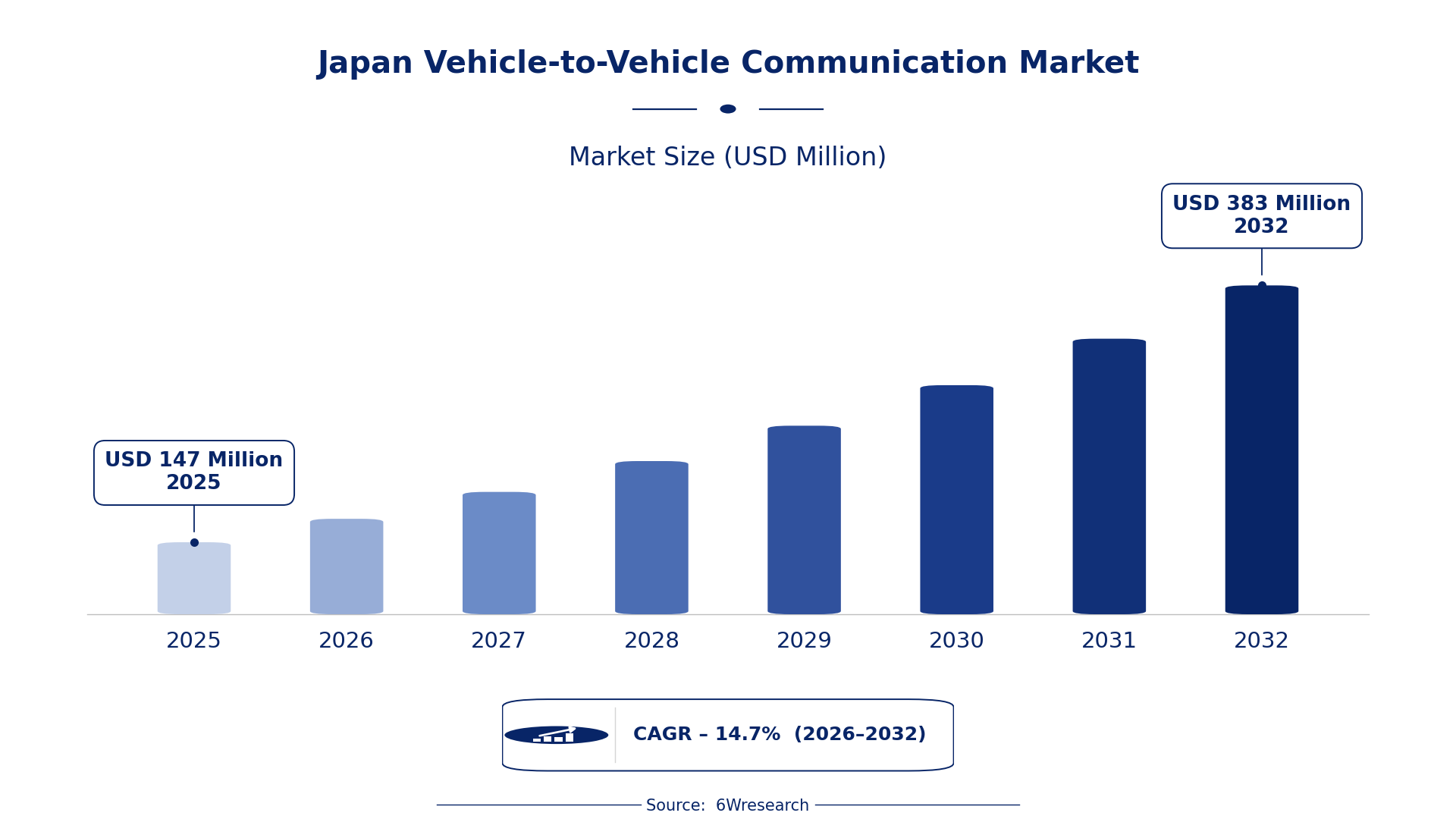
According to 6Wresearch internal database and industry insights, the Japan Vehicle-to-Vehicle Communication Market was valued at USD 147 Million in 2025 and is projected to reach USD 383 Million by 2032, growing at a CAGR of approximately 14.7% during 2026–2032.
Japan Vehicle-to-Vehicle Communication Market Highlights
| Report Metric | Details |
| Report Name | Japan Vehicle-to-Vehicle Communication Market (2026-2032) |
| Market Size 2025 | USD 147 Million |
| Market Size 2032 | USD 383 Million |
| Absolute Growth 2025–2032 | USD 236 Million |
| CAGR 2026–2032 | 14.7% |
| Peak Annual Growth | 17.1% in 2032 |
| Forecast Period | 2026–2032 |
| Historical Data | 2022–2025 |
| Base Year | 2025 |
| Leading Communication Type, 2025 | Short Range (DSRC) (46% share) |
| Leading Transmission Method, 2025 | Radio Frequency (42% share) |
| Leading Vehicle Type, 2025 | Passenger Cars (49% share) |
| Leading Distribution Channel, 2025 | Online Platforms (47% share) |
| Fastest-Growing Communication Type | Cellular V2V (20.6% CAGR) |
| Fastest-Growing Transmission Method | LTE/5G (16.4% CAGR) |
| Fastest-Growing Vehicle Type | Autonomous Vehicles (21.4% CAGR) |
| Fastest-Growing Distribution Channel | Direct Sales (19.6% CAGR) |
| Growing Sector | automotive technology |
| Key End Users | automotive manufacturers, technology developers, urban planners |
Japan Vehicle-to-Vehicle Communication Market Year-wise Growth Rate and Key Drivers (2022–2032)
This graph illustrates the annual growth rates of the market from 2022 to 2032, highlighting a steady upward trajectory and projected market expansion over the forecast period.
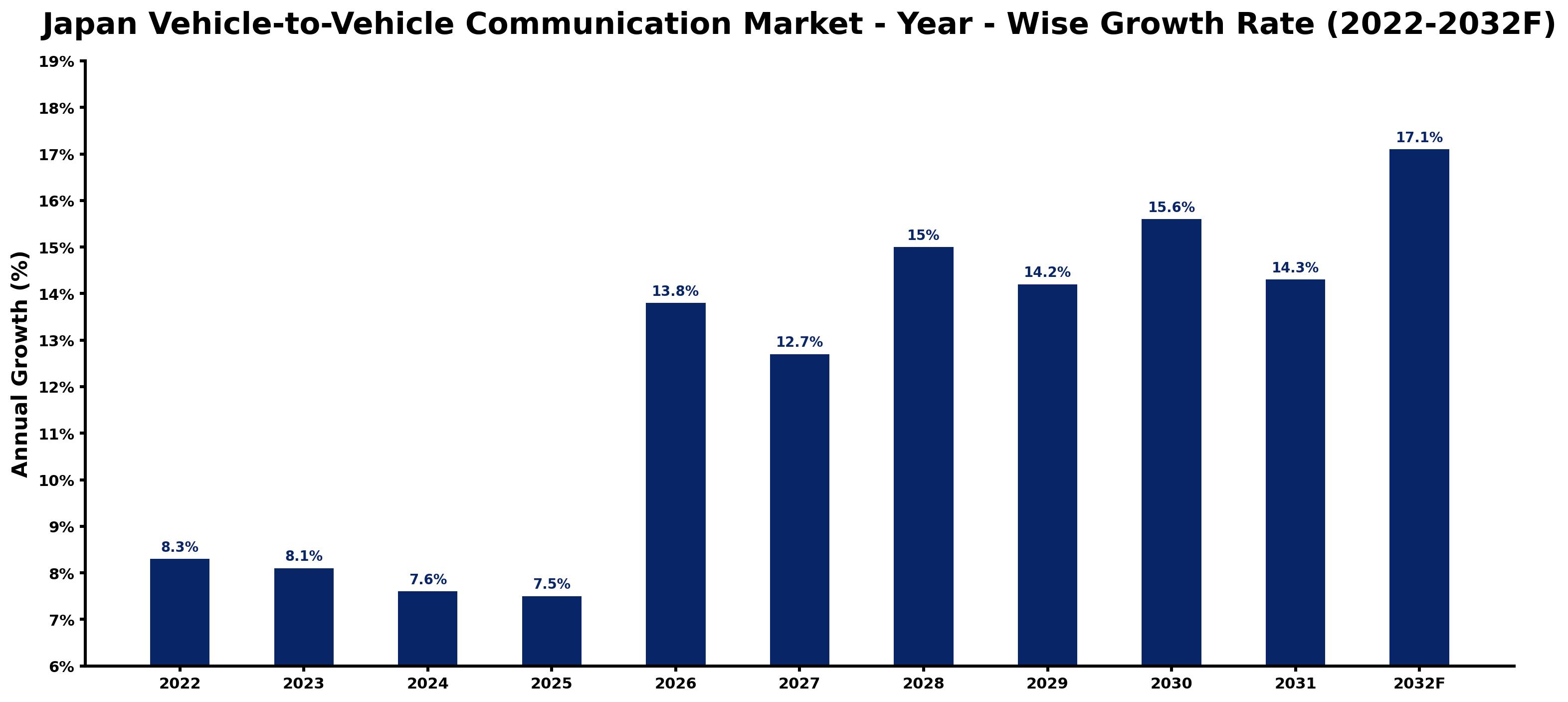
The table below sets out the estimated growth rate for each year and the main factor behind it.
| Year | Estimated Annual Growth (%) | Market Rationale |
| 2022 | 8.3 | The market experienced solid growth due to rising interest in vehicle connectivity. |
| 2023 | 8.1 | Growth slowed slightly as manufacturers adjusted to new technology integration timelines. |
| 2024 | 7.6 | Continued investment in smart transportation initiatives is expected to support market expansion. |
| 2025 | 7.5 | Market growth is projected to slow further as companies focus on refining existing technologies. |
| 2026 | 13.8 | Growth is expected to accelerate as new cellular technologies begin to gain traction among manufacturers. |
| 2027 | 12.7 | A slight slowdown is projected as the market adjusts to increased competition. |
| 2028 | 15.0 | Demand is expected to surge as autonomous vehicle development intensifies across the industry. |
| 2029 | 14.2 | Growth is projected to slow slightly as market saturation begins to impact new sales. |
| 2030 | 15.6 | A rebound in growth is expected as government initiatives further promote connectivity. |
| 2031 | 14.3 | The market is projected to experience a slowdown as companies consolidate their positions. |
| 2032 | 17.1 | Growth is expected to peak as the demand for connected vehicles reaches unprecedented levels. |
Note: Market size estimations and growth projections presented in this report are based on 6Wresearch's proprietary forecasting methodology, utilizing the latest available industry data, government publications, and primary research inputs.
Japan Vehicle-to-Vehicle Communication Market Synopsis
Vehicle-to-Vehicle Communication (V2V) is a technology enabling vehicles to communicate wirelessly, improving road safety and traffic efficiency. The ambition for 100% connected vehicles by 2030 and the increasing focus on autonomous driving features are key contributors to market growth. With a population of approximately 126 million, the demand for advanced automotive technologies continues to rise, creating opportunities for investment and development in this sector.
Market Dynamics Impact Analysis (2026–2032)
| Factor | Type | Impact | Primary Segment Affected |
| Rising demand for autonomous vehicles drives V2V technology adoption. | Driver | High | Autonomous Vehicles |
| Investment in smart transportation initiatives fosters V2V integration. | Driver | High | Cellular V2V |
| The government aims for 100% connected vehicles by 2030, creating a large market. | Opportunity | High | Passenger Cars |
| Growing urbanisation in the Tokyo metropolitan area increases demand for V2V systems. | Opportunity | High | Short Range (DSRC) |
| Limited awareness of V2V benefits restrains widespread adoption. | Restraint | Medium | Cellular V2V |
| High costs associated with V2V technology integration can deter manufacturers. | Restraint | Medium | Autonomous Vehicles |
| Competition from alternative communication technologies poses a challenge. | Challenge | High | Radio Frequency |
| Slow regulatory approvals for new V2V systems can delay market entry. | Challenge | Medium | LTE/5G |
Evaluation of Drivers in Japan Vehicle-to-Vehicle Communication Market (2026–2032)
Demand rests on the following drivers, each shown with the segment it touches most.
| Drivers | Primary Segment Affected | Why It Matters (Evidence) |
| Increased investment in autonomous vehicle technology drives demand for V2V systems. | Autonomous Vehicles | The push for self-driving capabilities leads manufacturers to adopt V2V technology. |
| Government initiatives promoting smart transportation increase V2V adoption. | Cellular V2V | The Smart Mobility Challenge encourages vehicle connectivity and communication. |
| Rising urbanisation in key regions boosts demand for V2V communication. | Short Range (DSRC) | Areas like Tokyo require advanced communication systems for traffic management. |
| The automotive industry's focus on safety drives V2V technology integration. | Passenger Cars | Safety features are increasingly prioritised in vehicle design and development. |
| Advancements in cellular technology improve V2V communication capabilities. | LTE/5G | Higher data transmission speeds enable more efficient vehicle communication. |
Several shifts outside the market lift sales. The push for 100% connected vehicles by 2030 drives automotive companies to invest in V2V systems, leading to increased purchases of related technologies. Approximately 126 million people in Japan create a strong demand for improved road safety and traffic efficiency. This growing demand prompts manufacturers to integrate advanced communication systems into their vehicles.
Evaluation of Restraints in Japan Vehicle-to-Vehicle Communication Market
Several factors work against faster growth; the main ones are summarised below.
| Market Restraint | Primary Segment Affected | Why It Matters (Evidence) |
| Limited awareness of V2V technology benefits restricts market growth. | Cellular V2V | Many consumers and manufacturers remain unaware of the advantages of V2V systems, hindering adoption. |
| High integration costs deter manufacturers from adopting V2V technology. | Autonomous Vehicles | The expense associated with implementing V2V systems can be a barrier for some automotive companies. |
| Lengthy approval processes can hinder the timely introduction of new technologies. | LTE/5G | Slow regulatory approvals for new V2V systems can delay market entry. |
| Insufficient infrastructure for V2V communication limits its effectiveness. | Short Range (DSRC) | The lack of supporting infrastructure can impede the full potential of V2V systems. |
| Competition from alternative communication technologies can limit V2V adoption. | Radio Frequency | Emerging technologies may offer similar benefits, drawing attention away from V2V systems. |
Japan Vehicle-to-Vehicle Communication Market Challenges
Consumer awareness about V2V benefits remains low, leading buyers to hesitate on adopting this technology and resulting in missed opportunities for improved road safety. Manufacturers encounter supply chain disruptions in sourcing components, causing production costs to rise by 15% and impacting pricing for buyers. A shortage of skilled workers in V2V technology development forces producers to allocate extra resources for training, delaying project timelines by six months and affecting market readiness. Compliance with safety standards like ISO 26262 presents regulatory hurdles that can postpone product launches for suppliers, limiting their competitive edge.
Trends in the Japan Vehicle-to-Vehicle Communication Market
The shifts below are changing how Japan Vehicle-to-Vehicle Communication Market products are bought and supplied.
- Shift from Traditional to Smart Mobility Solutions: The automotive industry is increasingly adopting smart mobility solutions, as seen in the 'Smart Mobility Challenge' launched in 2023, which aims to improve vehicle connectivity. This initiative is set to reshape the market, resulting in more integrated V2V systems.
- Transition from DSRC to Cellular V2V Technologies: As cellular technologies advance, the automotive sector is transitioning from Dedicated Short-Range Communications (DSRC) to Cellular V2V. The adoption of LTE/5G is expected to increase by 16.4% in the coming years, improving communication capabilities.
- Emergence of Autonomous Vehicles as Key Drivers: Autonomous vehicles are becoming a primary driver of V2V technology adoption, with a projected growth rate of 21.4% from 2026 to 2032. This shift is clear as manufacturers focus on integrating V2V systems to support self-driving functionalities.
- Prioritisation of Safety Features in Vehicle Design: The automotive industry is increasingly prioritising safety features, influenced by consumer demand for better safety. The implementation of ISO 26262 standards in Japan ensures that V2V systems meet safety requirements, affecting design decisions.
Investment Opportunities in the Japan Vehicle-to-Vehicle Communication Market
Several openings in the Japan Vehicle-to-Vehicle Communication Market merit attention from investors.
- Collaborations for V2V Technology Development: Partnering with local tech firms can accelerate V2V technology development, especially in urban areas like Tokyo, where demand is high. The government aims for 100% connected vehicles by 2030, creating a considerable opportunity for investment.
- Investment in Infrastructure for V2V Communication: With a target of 100% connected vehicles by 2030, there is a pressing need for infrastructure development. Urban planners in Tokyo are focusing on smart transportation systems, providing opportunities for investment in V2V-compatible infrastructure.
- Expansion of Direct Sales Channels for V2V Systems: The growth of the direct sales channel, projected to increase by 19.6%, presents an opportunity for suppliers to reach manufacturers more effectively. Targeting automotive manufacturers in Japan can facilitate market entry.
- Development of Cellular V2V Solutions: The demand for Cellular V2V solutions is rising, driven by the need for broader communication range. The government’s initiatives to promote smart mobility create opportunities for suppliers to develop and market these technologies.
Government Initiatives in the Japan Vehicle-to-Vehicle Communication Market
The GX Promotion Act, adopted in 2023, establishes a legal framework for promoting green technologies, including V2V systems. This act complements earlier measures like the Green Growth Strategy, which identifies key sectors for investment, ensuring that V2V technology development aligns with national goals for decarbonisation and sustainability.
In 2023, ¥10 billion was allocated for smart transportation initiatives, administered by the Ministry of Land, Infrastructure, Transport and Tourism. This funding supports projects aimed at improving vehicle connectivity and promotes the adoption of V2V technologies across the automotive sector.
Future Insight of the Japan Vehicle-to-Vehicle Communication Market
Investment in smart transportation initiatives will grow, generating demand for V2V technology. By 2032, the government aims for 100% connected vehicles, which will drive widespread V2V adoption across the automotive sector. The 'Smart Mobility Challenge' will enhance urban traffic efficiency, benefiting both buyers and suppliers. The 'Connected Vehicle Project' will facilitate real-world testing of V2V systems, paving the way for innovative solutions in urban environments.
Market Segmentation Analysis
Japan Vehicle-to-Vehicle Communication Market report covers a detailed analysis of the following market segments:
By Communication Type – Short Range (DSRC) Leads, Cellular V2V Expected to Grow Fastest
According to Saurav Kr Singh, Senior Research Analyst at 6Wresearch, Short Range (DSRC) accounted for 46% of the market by communication type in 2025. Short Range (DSRC) holds the largest share due to its direct application in real-time vehicle communication, crucial for enhancing safety on Japan's congested roads. Its extensive implementation in the Tokyo metropolitan area supports various traffic management initiatives, highlighting its importance in urban mobility. Cellular V2V is projected to grow fastest, at a CAGR of 20.6% during 2026–2032. Cellular V2V is rapidly expanding as it leverages LTE and 5G networks, offering broader communication capabilities vital for future mobility solutions. The government's 2023 'Smart Mobility Challenge' has accelerated the adoption of cellular technology in vehicles, driving this segment's growth. Suppliers should focus on developing cellular V2V solutions to meet the increasing demand for advanced vehicle connectivity.
By Transmission Method – Radio Frequency Leads, LTE/5G Expected to Grow Fastest
Radio Frequency held 42% of the Japan Vehicle-to-Vehicle Communication Market by transmission method in 2025. Radio Frequency is the leading transmission method, forming the foundation for reliable V2V communication systems that facilitate vital information exchange between vehicles. Its established market presence ensures widespread adoption across various vehicle types, enabling effective communication. The quickest growth will come from LTE/5G, forecast to expand at a CAGR of 16.4% between 2026 and 2032. LTE/5G is the fastest-growing transmission method, providing high-speed data transmission essential for real-time V2V applications. The aim for 100% connected vehicles by 2030 is driving significant investments in this technology, propelling its rapid growth. Buyers should prioritise solutions that utilise LTE/5G technology to remain competitive in an increasingly connected automotive market.
By Vehicle Type – Passenger Cars Lead, Autonomous Vehicles Expected to Grow Fastest
With 49% of vehicle type revenue in 2025, Passenger Cars was the largest category. Passenger Cars dominate the market as the primary vehicle type employing V2V technology, which is crucial for improving road safety and traffic efficiency. The substantial installed base of passenger cars in Japan reinforces this trend, making them the focal point for V2V applications. Autonomous Vehicles are set to record the highest CAGR in this split, 21.4% over 2026–2032. Autonomous Vehicles are the fastest-growing segment, as they rely heavily on V2V technology to enable self-driving capabilities. The ongoing 'Connected Vehicle Project' aims to integrate V2V systems into urban environments, further boosting this segment's growth. Suppliers must adjust their offerings to cater to the increasing demand for V2V solutions in the autonomous vehicle sector.
By Distribution Channel – Online Platforms Lead, Direct Sales Expected to Grow Fastest
In 2025, Online Platforms led the distribution channel split with a 47% share. Online Platforms lead the distribution channel segment, offering a convenient method for manufacturers to access V2V technology solutions. The growing digitalisation of the automotive sector has facilitated this trend, making online platforms a preferred choice for distribution. Over 2026–2032, Direct Sales is expected to post the fastest growth, at a CAGR of 19.6%. Direct Sales is the fastest-growing distribution channel, enabling manufacturers to build closer relationships with suppliers and ensuring tailored solutions for V2V technology. This approach aligns with the industry's shift towards customised offerings, improving customer satisfaction. Suppliers should enhance their direct sales strategies to effectively serve manufacturers seeking V2V solutions.
Key Attractiveness of the Report
- 10 Years of Market Numbers
- Historical Data Starting from 2022 to 2025
- Base Year 2025
- Forecast Data until 2032
- Key Performance Indicators Impacting the Market
- Major Upcoming Developments and Projects
Key Highlights of the Report:
- Japan Vehicle-to-Vehicle Communication Market Outlook
- Market Size of Japan Vehicle-to-Vehicle Communication Market, 2025
- Forecast of Japan Vehicle-to-Vehicle Communication Market, 2032
- Historical Data and Forecast of Japan Vehicle-to-Vehicle Communication Revenues & Volume for the Period 2022-2032F
- Japan Vehicle-to-Vehicle Communication Market Trend Evolution
- Japan Vehicle-to-Vehicle Communication Market Drivers and Challenges
- Japan Vehicle-to-Vehicle Communication Price Trends
- Japan Vehicle-to-Vehicle Communication Porter's Five Forces
- Japan Vehicle-to-Vehicle Communication Industry Life Cycle
- Historical Data and Forecast of Japan Vehicle-to-Vehicle Communication Market Revenues & Volume By Communication Type for the Period 2022-2032F
- Historical Data and Forecast of Japan Vehicle-to-Vehicle Communication Market Revenues & Volume By Short Range (DSRC) for the Period 2022-2032F
- Historical Data and Forecast of Japan Vehicle-to-Vehicle Communication Market Revenues & Volume By Cellular V2V for the Period 2022-2032F
- Historical Data and Forecast of Japan Vehicle-to-Vehicle Communication Market Revenues & Volume By Wi-Fi Direct V2V for the Period 2022-2032F
- Historical Data and Forecast of Japan Vehicle-to-Vehicle Communication Market Revenues & Volume By Satellite-Based V2V for the Period 2022-2032F
- Historical Data and Forecast of Japan Vehicle-to-Vehicle Communication Market Revenues & Volume By Transmission Method for the Period 2022-2032F
- Historical Data and Forecast of Japan Vehicle-to-Vehicle Communication Market Revenues & Volume By Radio Frequency for the Period 2022-2032F
- Historical Data and Forecast of Japan Vehicle-to-Vehicle Communication Market Revenues & Volume By LTE/5G for the Period 2022-2032F
- Historical Data and Forecast of Japan Vehicle-to-Vehicle Communication Market Revenues & Volume By IEEE 802.11p for the Period 2022-2032F
- Historical Data and Forecast of Japan Vehicle-to-Vehicle Communication Market Revenues & Volume By GNSS/RTK for the Period 2022-2032F
- Historical Data and Forecast of Japan Vehicle-to-Vehicle Communication Market Revenues & Volume By Vehicle Type for the Period 2022-2032F
- Historical Data and Forecast of Japan Vehicle-to-Vehicle Communication Market Revenues & Volume By Passenger Cars for the Period 2022-2032F
- Historical Data and Forecast of Japan Vehicle-to-Vehicle Communication Market Revenues & Volume By Autonomous Vehicles for the Period 2022-2032F
- Historical Data and Forecast of Japan Vehicle-to-Vehicle Communication Market Revenues & Volume By Electric Vehicles for the Period 2022-2032F
- Historical Data and Forecast of Japan Vehicle-to-Vehicle Communication Market Revenues & Volume By Trucks for the Period 2022-2032F
- Historical Data and Forecast of Japan Vehicle-to-Vehicle Communication Market Revenues & Volume By Distribution Channel for the Period 2022-2032F
- Historical Data and Forecast of Japan Vehicle-to-Vehicle Communication Market Revenues & Volume By Online Platforms for the Period 2022-2032F
- Historical Data and Forecast of Japan Vehicle-to-Vehicle Communication Market Revenues & Volume By Direct Sales for the Period 2022-2032F
- Historical Data and Forecast of Japan Vehicle-to-Vehicle Communication Market Revenues & Volume By Industrial Suppliers for the Period 2022-2032F
- Historical Data and Forecast of Japan Vehicle-to-Vehicle Communication Market Revenues & Volume By Specialty Stores for the Period 2022-2032F
- Japan Vehicle-to-Vehicle Communication Import Export Trade Statistics
- Market Opportunity Assessment By Communication Type
- Market Opportunity Assessment By Transmission Method
- Market Opportunity Assessment By Vehicle Type
- Market Opportunity Assessment By Distribution Channel
- Japan Vehicle-to-Vehicle Communication Top Companies Market Share
- Japan Vehicle-to-Vehicle Communication Competitive Benchmarking By Technical and Operational Parameters
- Japan Vehicle-to-Vehicle Communication Company Profiles
- Japan Vehicle-to-Vehicle Communication Key Strategic Recommendations
Market Covered
This report examines the market across the segments below.
By Communication Type
- Short Range (DSRC)
- Cellular V2V
- Wi-Fi Direct V2V
- Satellite-Based V2V
By Transmission Method
- Radio Frequency
- LTE/5G
- IEEE 802.11p
- GNSS/RTK
By Vehicle Type
- Passenger Cars
- Autonomous Vehicles
- Electric Vehicles
- Trucks
By Distribution Channel
- Online Platforms
- Direct Sales
- Industrial Suppliers
- Specialty Stores































