Japan Vehicle Virtualization Platform Market Size & Growth Rate
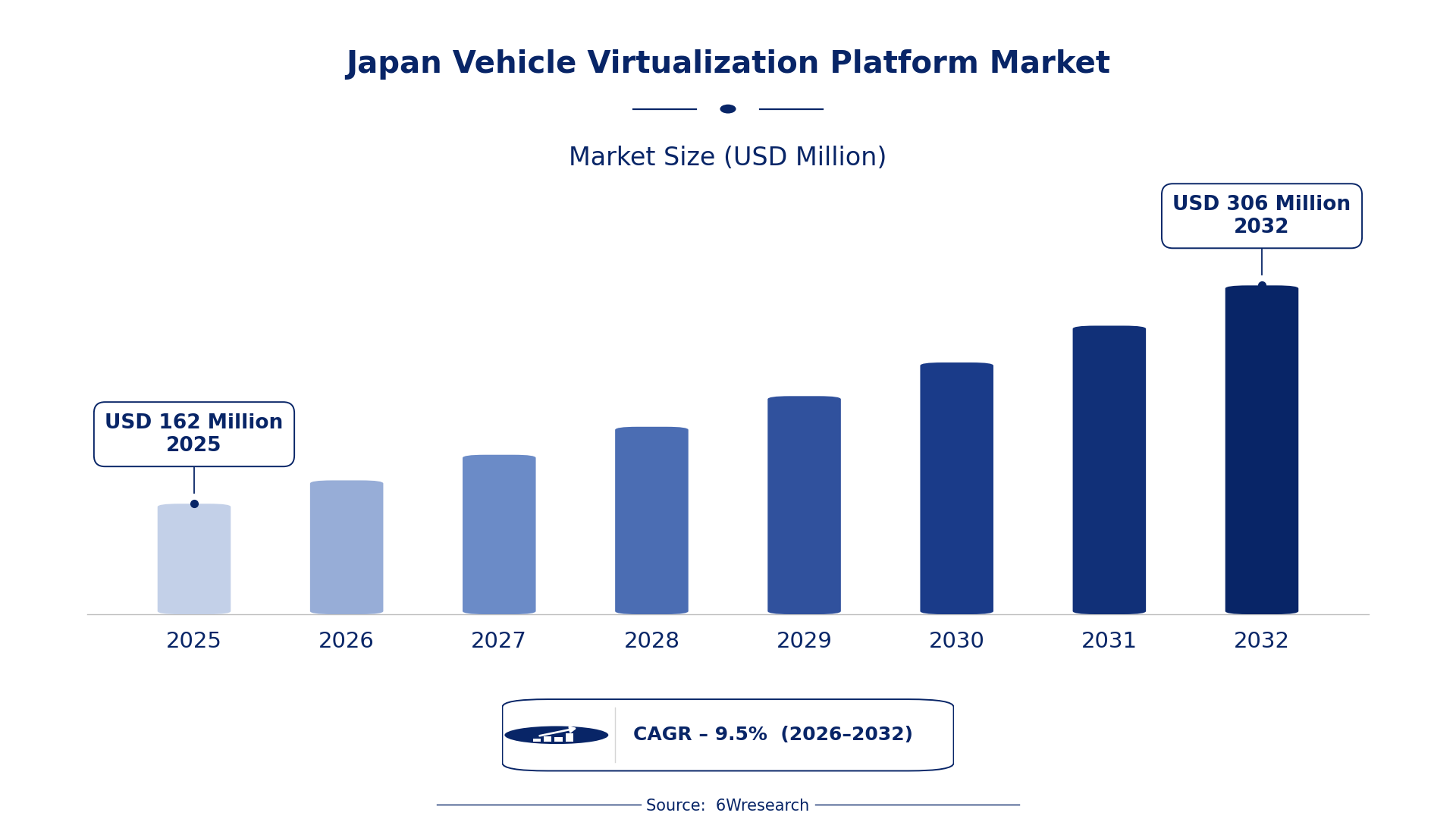
According to 6Wresearch internal database and industry insights, the Japan Vehicle Virtualization Platform Market was valued at USD 162 Million in 2025 and is projected to reach USD 306 Million by 2032, growing at a CAGR of approximately 9.5% during 2026–2032.
Japan Vehicle Virtualization Platform Market Highlights
| Report Metric | Details |
| Report Name | Japan Vehicle Virtualization Platform Market (2026-2032) |
| Market Size 2025 | USD 162 Million |
| Market Size 2032 | USD 306 Million |
| Absolute Growth 2025–2032 | USD 144 Million |
| CAGR 2026–2032 | 9.5% |
| Peak Annual Growth | 10.6% in 2028 |
| Forecast Period | 2026–2032 |
| Historical Data | 2022–2025 |
| Base Year | 2025 |
| Leading Platform Type, 2025 | Simulation Platforms (49% share) |
| Leading Application Area, 2025 | ADAS Development (50% share) |
| Leading Integration Level, 2025 | Cloud-Based (37% share) |
| Leading Distribution Channel, 2025 | Online Platforms (37% share) |
| Fastest-Growing Platform Type | Virtual ECUs (13.5% CAGR) |
| Fastest-Growing Integration Level | Local + Cloud (12.6% CAGR) |
| Fastest-Growing Distribution Channel | Direct Sales (12.2% CAGR) |
| Growing Sector | automotive technology |
| Key End Users | automotive manufacturers, R&D centres, technology developers |
Japan Vehicle Virtualization Platform Market Year-wise Growth Rate and Key Drivers (2022–2032)
This graph illustrates the annual growth rates of the market from 2022 to 2032, highlighting a steady upward trajectory and projected market expansion over the forecast period.
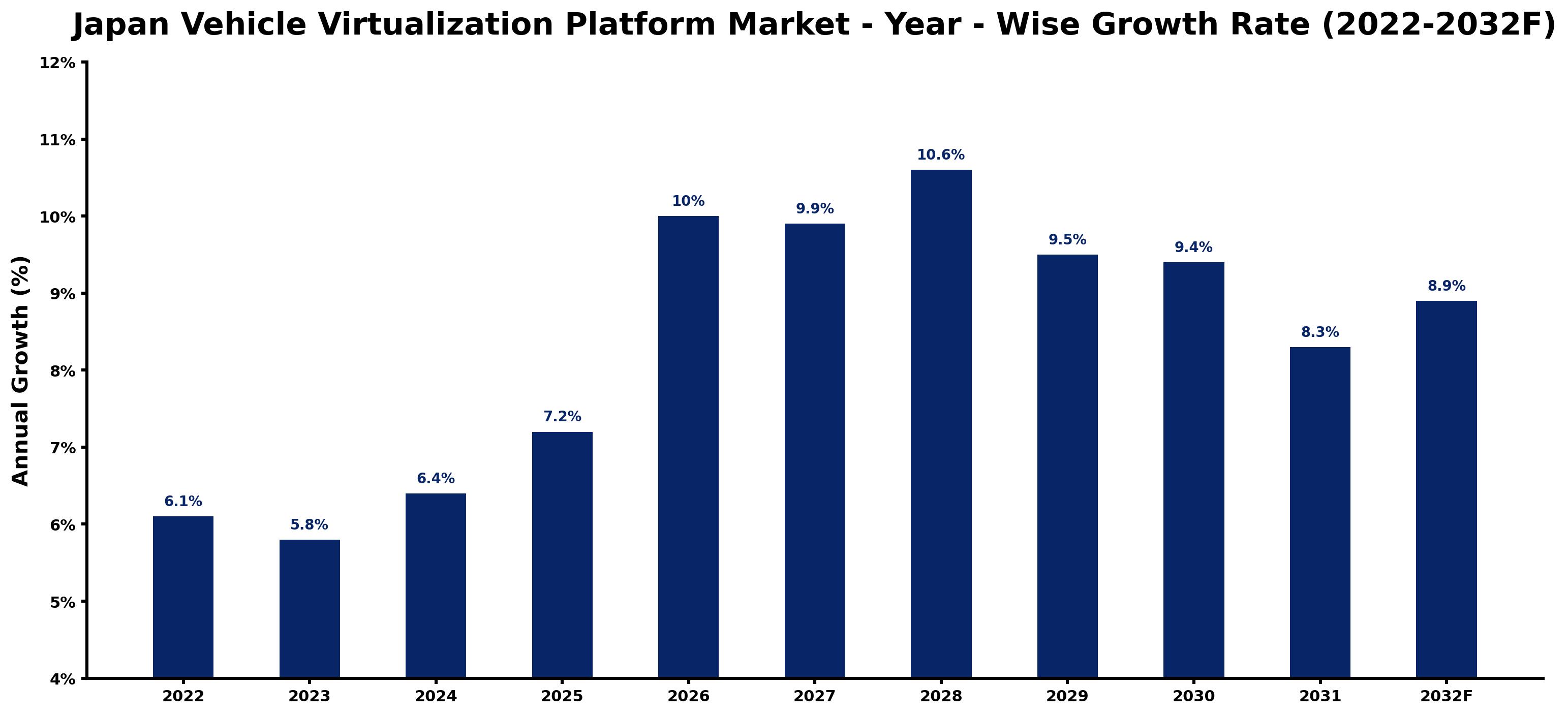
Below, each year's estimated growth is shown next to the factor that most influenced it.
| Year | Estimated Annual Growth (%) | Market Rationale |
| 2022 | 6.1 | The market experienced steady growth due to increased demand for vehicle testing solutions. |
| 2023 | 5.8 | Growth slowed slightly as manufacturers adjusted to evolving technological standards. |
| 2024 | 6.4 | Demand rose as manufacturers focused on enhancing vehicle performance and safety features. |
| 2025 | 7.2 | Growth accelerated with rising investments in advanced driver-assistance systems. |
| 2026 | 10.0 | The market is expected to expand rapidly as new technologies gain traction among manufacturers. |
| 2027 | 9.9 | Growth is projected to slow marginally as the market stabilises after a peak in demand. |
| 2028 | 10.6 | The market is anticipated to see a surge in demand driven by advancements in vehicle connectivity. |
| 2029 | 9.5 | Growth is expected to decelerate slightly as the market adjusts to saturation in some areas. |
| 2030 | 9.4 | Demand will continue to stabilise as manufacturers refine their product offerings. |
| 2031 | 8.3 | Growth is projected to slow as the market matures, with established technologies dominating. |
| 2032 | 8.9 | Demand will increase again as new innovations in vehicle systems emerge. |
Note: Market size estimations and growth projections presented in this report are based on 6Wresearch's proprietary forecasting methodology, utilizing the latest available industry data, government publications, and primary research inputs.
Japan Vehicle Virtualization Platform Market Synopsis
Vehicle Virtualization Platforms enable the simulation and testing of vehicle systems in a virtual environment, essential for the automotive industry's development and testing processes. The Japan Vehicle Virtualization Platform Market is expanding due to the increasing adoption of advanced driver-assistance systems and connectivity solutions, with domestic manufacturers and R&D centres as key buyers. The automotive sector's value exceeds 100 trillion yen, and with a strong focus on innovation, the market is set to thrive in the coming years.
Market Dynamics Impact Analysis (2026–2032)
| Factor | Type | Impact | Primary Segment Affected |
| Growing demand for advanced driver-assistance systems | Driver | High | ADAS Development |
| Increased investment in smart mobility initiatives | Driver | High | Powertrain Systems |
| Rising interest in vehicle cybersecurity solutions | Opportunity | High | Connectivity & Security |
| Expansion of testing facilities in the Tokyo region | Opportunity | Medium | Simulation Platforms |
| High development costs for new technologies | Restraint | High | Testing Frameworks |
| Limited availability of skilled workforce in advanced technologies | Restraint | Medium | Virtual ECUs |
| Competition from alternative vehicle testing methods | Challenge | High | Simulation Platforms |
| Rapid technological advancements leading to obsolescence | Challenge | Medium | ADAS Development |
Evaluation of Drivers in Japan Vehicle Virtualization Platform Market (2026–2032)
The table below links each growth driver to the segment it affects and the evidence for it.
| Drivers | Primary Segment Affected | Why It Matters (Evidence) |
| Increased adoption of advanced driver-assistance systems | ADAS Development | The adoption rate of ADAS in new vehicles exceeds 60% in urban areas, driving demand for simulation tools. |
| Investments in smart mobility initiatives | Powertrain Systems | Japan's investment of 200 billion yen in smart mobility initiatives boosts the need for advanced vehicle testing solutions. |
| Growth in connected vehicles | Connectivity & Security | The installed base of connected vehicles reached 15 million in 2023, increasing demand for cybersecurity solutions. |
| Focus on vehicle performance optimization | Simulation Platforms | The automotive sector, valued at over 100 trillion yen, drives demand for testing platforms. |
| Rising emphasis on vehicle safety standards | Testing Frameworks | The Ministry of Land, Infrastructure, Transport and Tourism's regulations ensure high safety standards, increasing demand for reliable testing solutions. |
Orders keep climbing as the automotive sector invests heavily in advanced technologies. The installed base of connected vehicles reached 15 million in 2023, prompting manufacturers to seek effective cybersecurity solutions. With over 60% of new vehicles adopting advanced driver-assistance systems, the need for simulation tools is increasing. R&D activities in the Tokyo region further stimulate the demand for reliable testing frameworks, as manufacturers concentrate on optimizing vehicle performance.
Evaluation of Restraints in Japan Vehicle Virtualization Platform Market
These restraints slow adoption and weigh on supplier margins.
| Market Restraint | Primary Segment Affected | Why It Matters (Evidence) |
| High development costs for new technologies | Testing Frameworks | The automotive sector's investment in advanced technologies can exceed 100 billion yen, limiting smaller players' entry. |
| Limited availability of skilled workforce in advanced technologies | Virtual ECUs | The automotive workforce in Japan is approximately 5.5 million, but skilled professionals in advanced technologies are scarce. |
| Competition from alternative vehicle testing methods | Simulation Platforms | Emerging technologies may offer lower-cost alternatives, challenging traditional simulation platforms. |
| Regulatory compliance costs | ADAS Development | Compliance with JIS standards for automotive software quality assurance raises development expenses for manufacturers. |
| Market saturation in certain segments | Connectivity & Security | As the market matures, growth rates may decline due to saturation in established segments. |
Japan Vehicle Virtualization Platform Market Challenges
The automotive sector in Japan faces increasing costs associated with stringent vehicle safety regulations from the Ministry of Land, Infrastructure, Transport and Tourism, delaying product launches for manufacturers by up to six months. Skills shortages in advanced vehicle technology hinder R&D centres from fully utilising their 5.5 million workforce, risking a loss of innovation. Integration of JIS standards for automotive software quality assurance complicates development processes, increasing time-to-market for new systems by an estimated 20%. Buyers experience pressure as the adoption rate of ADAS in urban areas exceeds 60%, compelling suppliers to deliver advanced solutions swiftly.
Trends in the Japan Vehicle Virtualization Platform Market
The trends below show where the Japan Vehicle Virtualization Platform Market is heading.
- Shift towards Vehicle Cybersecurity: Japan initiated a program in 2023 to improve vehicle cybersecurity measures, reflecting a growing focus on protecting connected vehicles. The installed base of connected vehicles reached 15 million, highlighting the urgency of this shift.
- Transition from Traditional Testing to Virtual Platforms: The automotive industry is increasingly adopting virtual testing platforms, with the Tokyo region leading in R&D facilities. This trend is driven by the need for efficient testing methods, supporting the sector's growth.
- Emergence of Cloud-Based Solutions: Cloud-Based integration is becoming more prevalent, with a 37% share in 2025, as manufacturers seek to improve collaboration and data accessibility in vehicle development. This shift enhances operational efficiency across the sector.
- Growing Demand for ADAS Development: ADAS Development is expected to maintain a 50% market share in 2025, driven by the increasing adoption of safety features in new vehicles. This trend reflects a broader commitment to enhancing vehicle safety.
Investment Opportunities in the Japan Vehicle Virtualization Platform Market
The opportunities below stand out in the Japan Vehicle Virtualization Platform Market for new entrants and existing suppliers.
- Collaborate with Local R&D Centres: With Japan's automotive sector valued at over 100 trillion yen, partnering with local R&D centres can facilitate entry into the market, particularly for companies focusing on ADAS Development.
- Invest in Testing Facilities: The Tokyo region is a hub for automotive R&D, making it an ideal location for investing in new testing facilities. This aligns with the demand for simulation platforms, which are critical for industry growth.
- Capitalize on Smart Mobility Investments: Japan's investment of 200 billion yen in smart mobility initiatives presents opportunities for suppliers of vehicle virtualization technologies, particularly in powertrain systems, enhancing their market presence.
- Develop Cybersecurity Solutions: The launch of the vehicle cybersecurity program in 2023 highlights the need for effective solutions in this area, creating opportunities for specialized providers to meet growing demands.
Government Initiatives in the Japan Vehicle Virtualization Platform Market
The Digital Agency oversees the government's digital transformation efforts, establishing common system standards that impact vehicle virtualization platforms. In 2023, Japan allocated substantial resources to enhance digital infrastructure, benefiting the automotive sector and ensuring that automotive software meets quality standards.
The Ministry of Land, Infrastructure, Transport and Tourism regulates vehicle safety, approving standards and funding projects that improve vehicle technology. Their focus on JIS standards for automotive software quality assurance ensures that manufacturers meet essential safety requirements while enhancing the overall quality of vehicle systems.
Future Insight of the Japan Vehicle Virtualization Platform Market
Japan's policy-driven shift towards net zero emissions will prompt suppliers to invest in advanced vehicle technologies by 2032. New cybersecurity measures will enhance vehicle safety, encouraging buyers to adopt connected vehicles, with the installed base expected to reach 20 million. Investment in smart mobility initiatives, totalling 200 billion yen, will spur innovation in vehicle virtualization platforms. R&D centres will concentrate on developing sophisticated simulation technologies, leveraging advancements highlighted at events like the Tokyo Motor Show.
Market Segmentation Analysis
Japan Vehicle Virtualization Platform Market report covers a detailed analysis of the following market segments:
By Platform Type – Simulation Platforms Lead, Virtual ECUs Expected to Grow Fastest
According to Saurav Kr Singh, Senior Research Analyst at 6Wresearch, Simulation Platforms accounted for 49% of the market by platform type in 2025. Simulation Platforms hold the largest share as they are essential for testing vehicle performance in a virtual environment. Their extensive use in R&D centres across the Tokyo region underscores their critical role in the automotive sector. Over 2026–2032, Virtual ECUs is expected to post the fastest growth, at a CAGR of 13.5%. Virtual ECUs are experiencing rapid growth due to their necessity in simulating electronic control units in vehicles. The increasing complexity of vehicle systems is propelling demand for these advanced simulation capabilities, ensuring their continued expansion. Suppliers should focus on enhancing simulation capabilities to cater to the growing needs of R&D centres.
By Application Area – ADAS Development Leads and Records the Fastest Growth
ADAS Development took 50% of application area revenue in 2025, more than any other category. ADAS Development commands the largest share as it is crucial for developing advanced safety features in vehicles. The notable adoption rate exceeding 60% in urban areas highlights its vital importance in the automotive market. Its lead should widen, with a projected CAGR of 11.2% during 2026–2032, the highest in this split. ADAS Development is also the fastest-growing segment, driven by the increasing emphasis on vehicle safety. The ongoing rise in adoption rates in urban settings indicates that this segment will continue to expand significantly. Buyers should prioritise investments in ADAS technologies to enhance vehicle safety and comply with evolving regulations.
By Integration Level – Cloud-Based Leads, Local + Cloud Expected to Grow Fastest
With 37% of integration level revenue in 2025, Cloud-Based was the largest category. Cloud-Based solutions lead the market as they facilitate remote access and collaboration among automotive developers. This feature is particularly advantageous for R&D centres that require the integration of various testing tools. The quickest growth will come from Local + Cloud, forecast to expand at a CAGR of 12.6% between 2026 and 2032. Local + Cloud integration is the fastest-growing segment, as it combines local processing with cloud capabilities. This integration enhances efficiency and flexibility in vehicle testing processes, aligning with industry demands. Suppliers should consider offering hybrid solutions to address the rising demand for integrated testing environments.
By Distribution Channel – Online Platforms Lead, Direct Sales Expected to Grow Fastest
The largest distribution channel category in 2025 was Online Platforms, at 37% of revenue. Online Platforms are the leading distribution channel due to their widespread use for accessing tools and resources in the automotive sector. Their convenience and accessibility are key factors contributing to their market dominance. Direct Sales is projected to grow fastest, at a CAGR of 12.2% during 2026–2032. Direct Sales is the fastest-growing channel, particularly for enterprise-level solutions that require tailored offerings. This trend reflects a shift towards personalised service and support during the purchasing process, enhancing customer satisfaction. Buyers may find more customised solutions through direct sales, improving their overall purchasing experience.
Key Attractiveness of the Report
- 10 Years of Market Numbers
- Historical Data Starting from 2022 to 2025
- Base Year 2025
- Forecast Data until 2032
- Key Performance Indicators Impacting the Market
- Major Upcoming Developments and Projects
Key Highlights of the Report:
- Japan Vehicle Virtualization Platform Market Outlook
- Market Size of Japan Vehicle Virtualization Platform Market, 2025
- Forecast of Japan Vehicle Virtualization Platform Market, 2032
- Historical Data and Forecast of Japan Vehicle Virtualization Platform Revenues & Volume for the Period 2022-2032F
- Japan Vehicle Virtualization Platform Market Trend Evolution
- Japan Vehicle Virtualization Platform Market Drivers and Challenges
- Japan Vehicle Virtualization Platform Price Trends
- Japan Vehicle Virtualization Platform Porter's Five Forces
- Japan Vehicle Virtualization Platform Industry Life Cycle
- Historical Data and Forecast of Japan Vehicle Virtualization Platform Market Revenues & Volume By Platform Type for the Period 2022-2032F
- Historical Data and Forecast of Japan Vehicle Virtualization Platform Market Revenues & Volume By Virtual ECUs for the Period 2022-2032F
- Historical Data and Forecast of Japan Vehicle Virtualization Platform Market Revenues & Volume By Simulation Platforms for the Period 2022-2032F
- Historical Data and Forecast of Japan Vehicle Virtualization Platform Market Revenues & Volume By Testing Frameworks for the Period 2022-2032F
- Historical Data and Forecast of Japan Vehicle Virtualization Platform Market Revenues & Volume By Virtual Sensors for the Period 2022-2032F
- Historical Data and Forecast of Japan Vehicle Virtualization Platform Market Revenues & Volume By Application Area for the Period 2022-2032F
- Historical Data and Forecast of Japan Vehicle Virtualization Platform Market Revenues & Volume By Powertrain Systems for the Period 2022-2032F
- Historical Data and Forecast of Japan Vehicle Virtualization Platform Market Revenues & Volume By ADAS Development for the Period 2022-2032F
- Historical Data and Forecast of Japan Vehicle Virtualization Platform Market Revenues & Volume By Connectivity & Security for the Period 2022-2032F
- Historical Data and Forecast of Japan Vehicle Virtualization Platform Market Revenues & Volume By Driver Assistance for the Period 2022-2032F
- Historical Data and Forecast of Japan Vehicle Virtualization Platform Market Revenues & Volume By Integration Level for the Period 2022-2032F
- Historical Data and Forecast of Japan Vehicle Virtualization Platform Market Revenues & Volume By Cloud-Based for the Period 2022-2032F
- Historical Data and Forecast of Japan Vehicle Virtualization Platform Market Revenues & Volume By Local + Cloud for the Period 2022-2032F
- Historical Data and Forecast of Japan Vehicle Virtualization Platform Market Revenues & Volume By Edge Deployment for the Period 2022-2032F
- Historical Data and Forecast of Japan Vehicle Virtualization Platform Market Revenues & Volume By SaaS for the Period 2022-2032F
- Historical Data and Forecast of Japan Vehicle Virtualization Platform Market Revenues & Volume By Distribution Channel for the Period 2022-2032F
- Historical Data and Forecast of Japan Vehicle Virtualization Platform Market Revenues & Volume By Online Platforms for the Period 2022-2032F
- Historical Data and Forecast of Japan Vehicle Virtualization Platform Market Revenues & Volume By Direct Sales for the Period 2022-2032F
- Historical Data and Forecast of Japan Vehicle Virtualization Platform Market Revenues & Volume By Industrial Suppliers for the Period 2022-2032F
- Historical Data and Forecast of Japan Vehicle Virtualization Platform Market Revenues & Volume By Specialty Stores for the Period 2022-2032F
- Japan Vehicle Virtualization Platform Import Export Trade Statistics
- Market Opportunity Assessment By Platform Type
- Market Opportunity Assessment By Application Area
- Market Opportunity Assessment By Integration Level
- Market Opportunity Assessment By Distribution Channel
- Japan Vehicle Virtualization Platform Top Companies Market Share
- Japan Vehicle Virtualization Platform Competitive Benchmarking By Technical and Operational Parameters
- Japan Vehicle Virtualization Platform Company Profiles
- Japan Vehicle Virtualization Platform Key Strategic Recommendations
Market Covered
Segments analysed in this report are listed below.
By Platform Type
- Virtual ECUs
- Simulation Platforms
- Testing Frameworks
- Virtual Sensors
By Application Area
- Powertrain Systems
- ADAS Development
- Connectivity & Security
- Driver Assistance
By Integration Level
- Cloud-Based
- Local + Cloud
- Edge Deployment
- SaaS
By Distribution Channel
- Online Platforms
- Direct Sales
- Industrial Suppliers
- Specialty Stores































