Japan Vibration Testing Equipment Market Size & Growth Rate
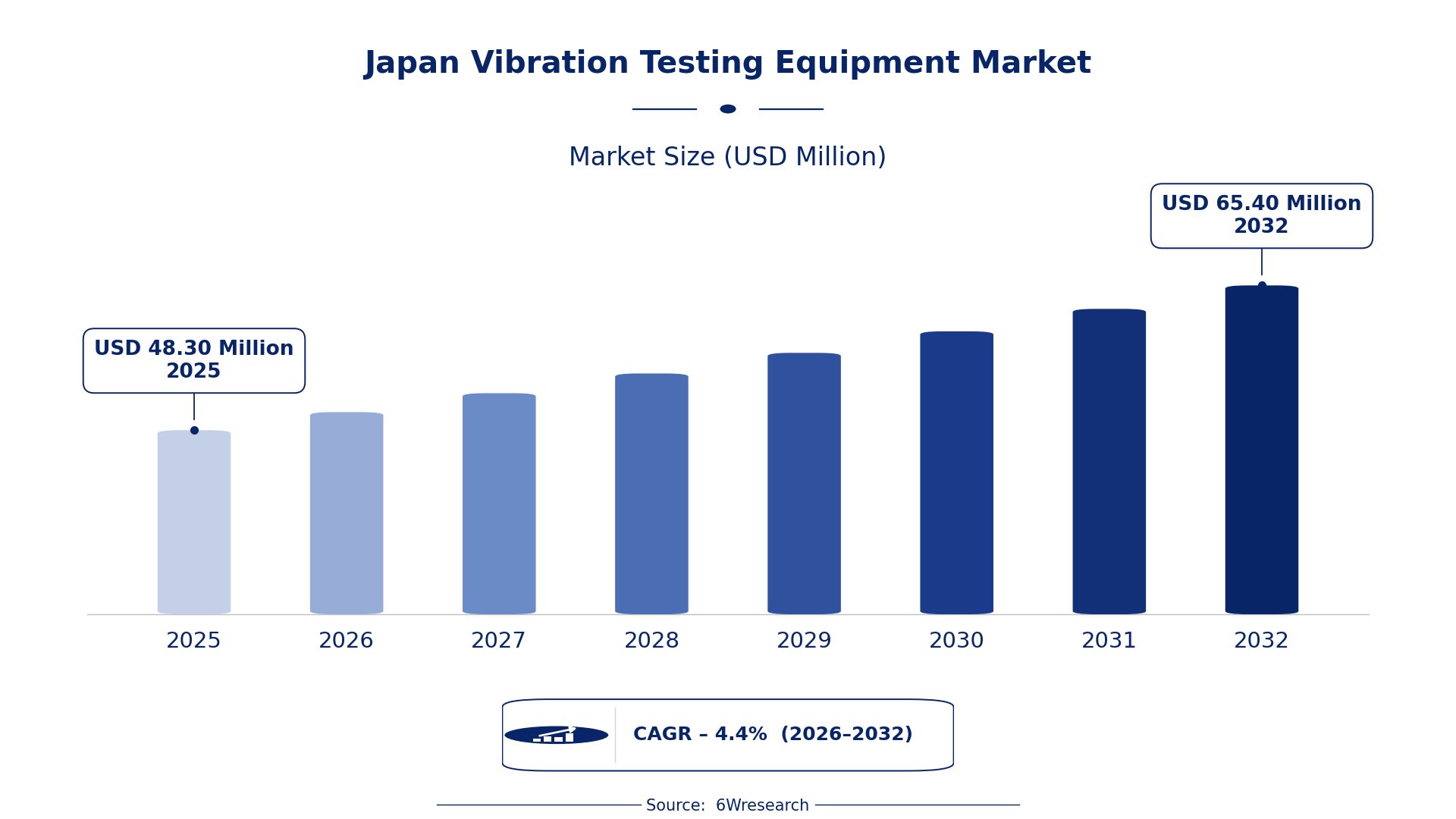
According to 6Wresearch internal database and industry insights, the Japan Vibration Testing Equipment Market was valued at USD 48.30 Million in 2025 and is projected to reach USD 65.40 Million by 2032, growing at a CAGR of approximately 4.4% during 2026–2032.
Japan Vibration Testing Equipment Market Highlights
| Report Metric | Details |
| Report Name | Japan Vibration Testing Equipment Market (2026-2032) |
| Market Size 2025 | USD 48.30 Million |
| Market Size 2032 | USD 65.40 Million |
| Absolute Growth 2025–2032 | USD 17.10 Million |
| CAGR 2026–2032 | 4.4% |
| Peak Annual Growth | 5.8% in 2032 |
| Forecast Period | 2026–2032 |
| Historical Data | 2022–2025 |
| Base Year | 2025 |
| Leading Equipment Type, 2025 | Shaker Tables (43% share) |
| Leading Test Type, 2025 | Sine Vibration (44% share) |
| Leading Distribution Channel, 2025 | Direct Sales (47% share) |
| Leading End User, 2025 | Electronics OEMs (44% share) |
| Fastest-Growing Equipment Type | Modal Exciters (6.5% CAGR) |
| Fastest-Growing Test Type | Random Vibration (6.2% CAGR) |
| Fastest-Growing Distribution Channel | Specialty Suppliers (5.8% CAGR) |
| Fastest-Growing End User | Aerospace R&D Centers (5.9% CAGR) |
| Growing Sector | Aerospace |
| Key End Users | Electronics OEMs, Aerospace R&D Centers, Product Testing Firms, Semiconductor Labs |
Japan Vibration Testing Equipment Market Year-wise Growth Rate and Key Drivers (2022–2032)
This graph illustrates the annual growth rates of the market from 2022 to 2032, highlighting a steady upward trajectory and projected market expansion over the forecast period.
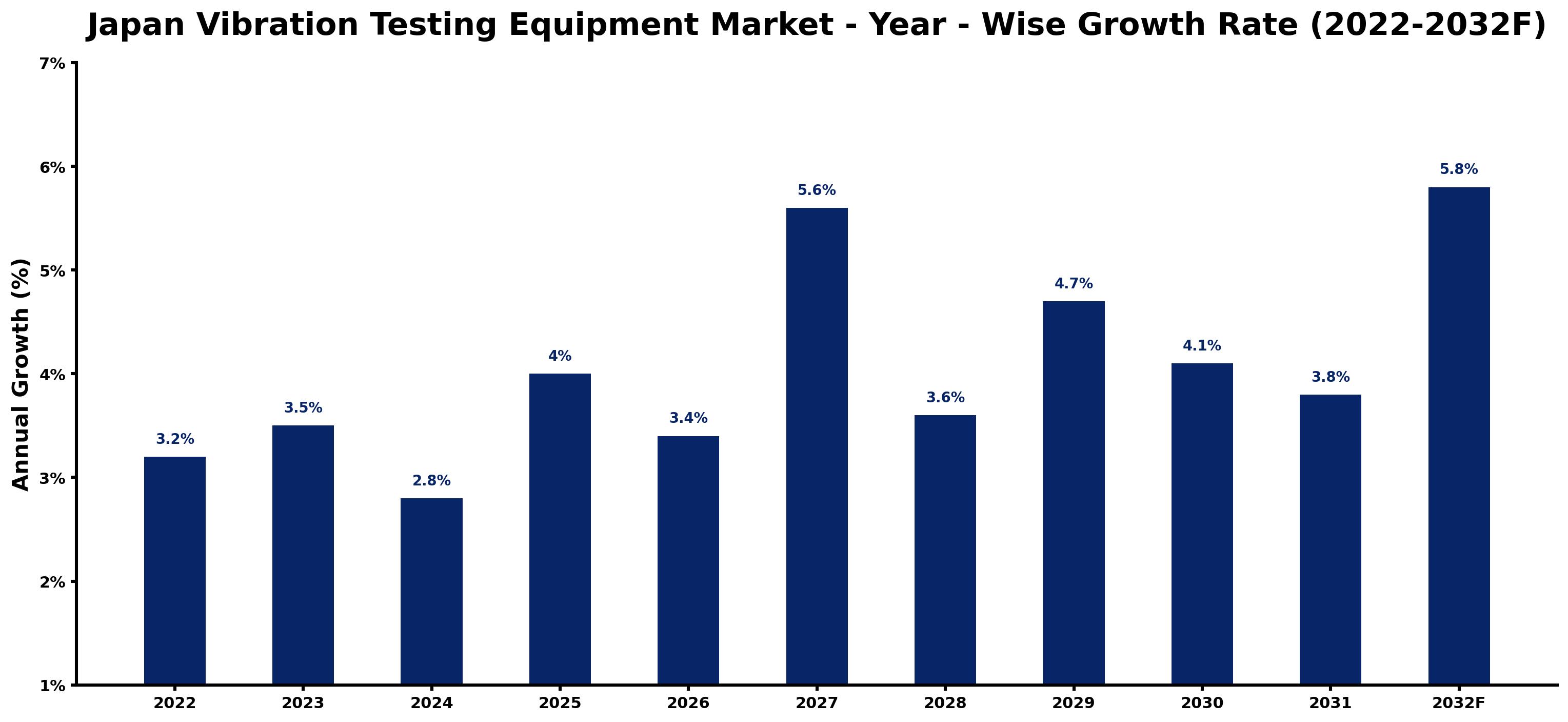
The following figures match every annual growth estimate with the main market development of that year, giving the reasoning behind each rise or slowdown.
| Year | Estimated Annual Growth (%) | Market Rationale |
| 2022 | 3.2 | The market experienced steady growth, reflecting ongoing investments in technology sectors. |
| 2023 | 3.5 | Growth accelerated as demand from electronics manufacturers increased significantly. |
| 2024 | 2.8 | Growth slowed slightly due to market adjustments and inventory management. |
| 2025 | 4.0 | The market rebounded with a surge in aerospace R&D investments. |
| 2026 | 3.4 | Growth moderated as companies adapted to changing testing requirements. |
| 2027 | 5.6 | Demand surged, driven by increased focus on automotive safety testing. |
| 2028 | 3.6 | Growth slowed as market saturation began to affect new purchases. |
| 2029 | 4.7 | Demand rose again, supported by expanding aerospace testing facilities. |
| 2030 | 4.1 | Growth slowed as manufacturers focused on optimising existing equipment. |
| 2031 | 3.8 | The market continued to grow, driven by ongoing technological advancements. |
| 2032 | 5.8 | Growth peaked as major investments in R&D reached fruition. |
Note: Market size estimations and growth projections presented in this report are based on 6Wresearch's proprietary forecasting methodology, utilizing the latest available industry data, government publications, and primary research inputs.
Japan Vibration Testing Equipment Market Synopsis
Vibration testing equipment assesses product durability under simulated vibrational conditions, critical for sectors like electronics and aerospace. The Japan Vibration Testing Equipment Market is growing due to substantial investments in R&D, especially in the aerospace sector, which is expected to invest ¥1 trillion by 2025. The electronics sector, comprising over 1,000 manufacturers, continues to fuel demand for dependable testing solutions. Improved testing capabilities are supported by standards such as ISO 17025, which ensures quality and compliance in testing practices.
Market Dynamics Impact Analysis (2026–2032)
| Factor | Type | Impact | Primary Segment Affected |
| Rising investments in aerospace R&D | Driver | High | Environmental Chambers |
| Increasing demand for product reliability in electronics | Driver | High | Sine Vibration |
| Growth in automotive safety testing | Opportunity | High | Modal Exciters |
| Expansion of aerospace testing facilities | Opportunity | Medium | Shaker Tables |
| High costs of advanced testing equipment | Restraint | High | Data Acquisition Units |
| Limited availability of skilled technicians | Restraint | Medium | Shock Testing |
| Compliance with stringent testing standards | Challenge | High | Random Vibration |
| Pressure to reduce testing times and costs | Challenge | Medium | Resonance Test |
Evaluation of Drivers in Japan Vibration Testing Equipment Market (2026–2032)
Demand rests on the following drivers, each shown with the segment it touches most.
| Drivers | Primary Segment Affected | Why It Matters (Evidence) |
| Increased R&D investments in aerospace | Environmental Chambers | The aerospace industry in Japan is projected to invest ¥1 trillion in R&D by 2025, driving demand for advanced testing solutions. |
| Demand for reliable electronics testing | Sine Vibration | With over 1,000 electronics manufacturers in Japan, the need for rigorous testing ensures product reliability and safety. |
| Rising focus on automotive safety standards | Modal Exciters | Increased R&D in automotive safety testing has led to a growing demand for modal exciters to assess product performance. |
| Expansion of aerospace R&D centers | Shaker Tables | The establishment of new aerospace R&D centers is increasing the need for precise vibration testing equipment. |
| Technological advancements in testing methods | Data Acquisition Units | Innovations in data acquisition technology are improving testing accuracy, prompting increased purchases from testing firms. |
Most of the extra volume comes from the aerospace sector, which is projected to invest ¥1 trillion in R&D by 2025, increasing demand for vibration testing equipment. The electronics sector drives a large portion of demand as companies seek reliable solutions, with over 1,000 manufacturers ensuring rigorous testing for product safety. The automotive industry is prioritising safety, leading to a rise in modal exciters for performance assessments. New aerospace R&D centres further boost the need for shaker tables, while advancements in data acquisition technology improve accuracy, prompting increased purchases from product testing firms.
Evaluation of Restraints in Japan Vibration Testing Equipment Market
The key brakes on demand, and where they bite hardest, are shown below.
| Market Restraint | Primary Segment Affected | Why It Matters (Evidence) |
| High costs of advanced testing equipment | Data Acquisition Units | The investment required for advanced vibration testing equipment limits accessibility for smaller firms. |
| Limited availability of skilled technicians | Shock Testing | A shortage of qualified technicians hinders the effective operation of vibration testing equipment in various sectors. |
| Compliance with stringent testing standards | Random Vibration | Adhering to rigorous standards like ISO 17025 increases operational costs and complexity for manufacturers. |
| Market saturation affecting new purchases | Resonance Test | As the market matures, many companies are optimising existing equipment rather than investing in new systems. |
| Pressure to reduce testing times and costs | Sine Vibration | The need for faster testing results can compromise the thoroughness of procedures, impacting reliability. |
Japan Vibration Testing Equipment Market Challenges
Rising operational costs for manufacturers stem from Japan's minimum wage reaching JPY 1,055 per hour in October 2024, forcing price increases that burden buyers. Local suppliers struggle against foreign competitors offering lower-priced vibration testing equipment, which pressures them to cut prices and reduces profit margins. A shortage of skilled technicians in the vibration testing sector causes project delays, impacting timelines for manufacturers and their clients. Many facilities still use outdated technology, complicating compliance with environmental testing standards, resulting in potential penalties for producers.
Trends in the Japan Vibration Testing Equipment Market
Below are the shifts with the largest effect on the Japan Vibration Testing Equipment Market.
- Electronics OEMs Prioritising Advanced Testing Methods: Electronics OEMs are increasingly adopting advanced vibration testing methods to ensure product reliability. In 2023, the Ministry of Economy, Trade and Industry launched a programme to improve testing capabilities, reflecting a shift towards higher standards.
- Transition from Traditional to Automated Testing: The industry is moving towards automated vibration testing solutions to increase efficiency. The rise in automation is visible in aerospace R&D centres, where testing processes are streamlined to meet growing demands.
- Increase in Environmental Testing Standards: Japan is seeing a rise in environmental testing standards, such as JIS Z 0200 for vibration testing. This shift is prompting manufacturers to invest in compliant testing equipment to meet regulatory requirements.
- Focus on Sustainability in Testing Practices: A growing emphasis on sustainability is influencing testing practices across industries. The Japanese government aims to reduce carbon emissions by 46% by 2030, impacting how testing methods are developed and implemented.
Investment Opportunities in the Japan Vibration Testing Equipment Market
The following areas offer the clearest openings for investors and suppliers in the Japan Vibration Testing Equipment Market.
- Aerospace R&D Centers Expanding: Aerospace R&D centres are expanding rapidly, creating a need for advanced vibration testing equipment. The projected ¥1 trillion investment in R&D by 2025 highlights this opportunity for suppliers.
- Electronics OEMs Seeking Reliability: Electronics OEMs are increasingly focused on product reliability, driving demand for high-quality vibration testing equipment. Suppliers can enter this market through partnerships with local manufacturers.
- Investment in Automotive Safety Testing: The automotive sector is investing heavily in safety testing, creating opportunities for suppliers of modal exciters. Collaborating with automotive testing firms can facilitate market entry.
- Growth of Specialty Suppliers: Specialty suppliers are gaining traction in the market, focusing on niche applications. This trend presents opportunities for new entrants to establish partnerships with these suppliers.
Government Initiatives in the Japan Vibration Testing Equipment Market
The Industrial Standardization Act, amended in 2019, strengthens the framework for product and test standards, ensuring compliance for vibration testing equipment manufacturers. This law complements earlier regulations by ensuring that all testing methods meet rigorous quality benchmarks.
In 2023, the Ministry of Economy, Trade and Industry allocated ¥5 billion to improve testing capabilities across various sectors, including aerospace. This funding supports initiatives to enhance compliance with international testing standards, benefiting manufacturers and buyers.
Future Insight of the Japan Vibration Testing Equipment Market
By 2032, Japan's aerospace sector will drive demand for vibration testing equipment due to an anticipated investment pipeline of ¥1 trillion in R&D by 2025. Government programmes will improve testing capabilities, resulting in higher quality standards for the industry. The adoption of ISO 17025 will standardise laboratory practices, ensuring consistent and reliable test outcomes. As automotive safety testing advances, suppliers must adapt their products to meet the rising expectations for more sophisticated testing methodologies.
Market Segmentation Analysis
Japan Vibration Testing Equipment Market report covers a detailed analysis of the following market segments:
By Equipment Type – Shaker Tables Lead, Modal Exciters Expected to Grow Fastest
According to Saurav Kr Singh, Senior Research Analyst at 6Wresearch, the largest equipment type category in 2025 was Shaker Tables, at 43% of revenue. Shaker tables hold the largest share due to their precision in testing products, especially in the electronics sector where over 1,000 manufacturers rely on them for thorough reliability assessments. Their compliance with critical standards such as ISO 17025 solidifies their dominant market position. Over 2026–2032, Modal Exciters are expected to post the fastest growth, at a CAGR of 6.5%. Modal exciters are experiencing rapid growth, primarily driven by increased R&D in automotive safety testing, as they provide essential controlled vibration analysis. Their ability to simulate real-world conditions effectively positions them for continued expansion across various sectors. Suppliers should focus on enhancing modal exciters to cater to the growing demand in automotive safety testing.
By Test Type – Sine Vibration Leads, Random Vibration Expected to Grow Fastest
Sine Vibration took 44% of test type revenue in 2025, more than any other category. Sine vibration testing commands the largest share as it is widely used for determining resonance frequencies, a crucial aspect for ensuring product reliability across industries. Its established methodology aligns with environmental testing standards, reinforcing its fundamental role in laboratories. Random Vibration is projected to grow fastest, at a CAGR of 6.2% during 2026–2032. Random vibration testing is gaining traction due to its effectiveness in evaluating product performance under unpredictable conditions, which is essential for industries facing dynamic operational challenges. Its significance in aerospace R&D is a key factor in its rapid adoption. Buyers may need to invest in random vibration testing capabilities to stay competitive in evolving markets.
By Distribution Channel – Direct Sales Leads, Specialty Suppliers Expected to Grow Fastest
With 47% of distribution channel revenue in 2025, Direct Sales was the largest category. Direct sales dominate the distribution channel, providing manufacturers with tailored solutions and direct access to technical support, which is vital for complex equipment like vibration testers. This channel's strength is evident in its widespread adoption among electronics OEMs. The quickest growth will come from Specialty Suppliers, forecast to expand at a CAGR of 5.8% between 2026 and 2032. Specialty suppliers are witnessing the fastest growth as they cater to niche markets, offering specialised products and expertise increasingly sought after by R&D centres. Their focus on technical support enhances customer satisfaction and loyalty, driving demand. Suppliers should consider partnerships with specialty suppliers to effectively reach targeted customer segments.
By End User – Electronics OEMs Lead, Aerospace R&D Centers Expected to Grow Fastest
Electronics OEMs held 44% of the Japan Vibration Testing Equipment Market by end user in 2025. Electronics OEMs represent the largest end user group, heavily relying on vibration testing to ensure product reliability in a competitive landscape. Their significant investment in quality assurance processes underscores the critical role of vibration testing within the electronics industry. Aerospace R&D Centers are set to record the highest CAGR in this split, 5.9% over 2026–2032. Aerospace R&D centres are experiencing the highest growth, necessitating advanced testing capabilities to meet stringent safety and performance standards. The projected ¥1 trillion investment in aerospace R&D by 2025 will further boost demand for sophisticated testing equipment. Suppliers should align product development strategies with the specific needs of aerospace R&D to capitalise on emerging opportunities.
Key Attractiveness of the Report
- 10 Years of Market Numbers
- Historical Data Starting from 2022 to 2025
- Base Year 2025
- Forecast Data until 2032
- Key Performance Indicators Impacting the Market
- Major Upcoming Developments and Projects
Key Highlights of the Report:
- Japan Vibration Testing Equipment Market Outlook
- Market Size of Japan Vibration Testing Equipment Market, 2025
- Forecast of Japan Vibration Testing Equipment Market, 2032
- Historical Data and Forecast of Japan Vibration Testing Equipment Revenues & Volume for the Period 2022-2032F
- Japan Vibration Testing Equipment Market Trend Evolution
- Japan Vibration Testing Equipment Market Drivers and Challenges
- Japan Vibration Testing Equipment Price Trends
- Japan Vibration Testing Equipment Porter's Five Forces
- Japan Vibration Testing Equipment Industry Life Cycle
- Historical Data and Forecast of Japan Vibration Testing Equipment Market Revenues & Volume By Equipment Type for the Period 2022-2032F
- Historical Data and Forecast of Japan Vibration Testing Equipment Market Revenues & Volume By Shaker Tables for the Period 2022-2032F
- Historical Data and Forecast of Japan Vibration Testing Equipment Market Revenues & Volume By Environmental Chambers for the Period 2022-2032F
- Historical Data and Forecast of Japan Vibration Testing Equipment Market Revenues & Volume By Modal Exciters for the Period 2022-2032F
- Historical Data and Forecast of Japan Vibration Testing Equipment Market Revenues & Volume By Data Acquisition Units for the Period 2022-2032F
- Historical Data and Forecast of Japan Vibration Testing Equipment Market Revenues & Volume By Test Type for the Period 2022-2032F
- Historical Data and Forecast of Japan Vibration Testing Equipment Market Revenues & Volume By Sine Vibration for the Period 2022-2032F
- Historical Data and Forecast of Japan Vibration Testing Equipment Market Revenues & Volume By Random Vibration for the Period 2022-2032F
- Historical Data and Forecast of Japan Vibration Testing Equipment Market Revenues & Volume By Resonance Test for the Period 2022-2032F
- Historical Data and Forecast of Japan Vibration Testing Equipment Market Revenues & Volume By Shock Testing for the Period 2022-2032F
- Historical Data and Forecast of Japan Vibration Testing Equipment Market Revenues & Volume By Distribution Channel for the Period 2022-2032F
- Historical Data and Forecast of Japan Vibration Testing Equipment Market Revenues & Volume By Direct Sales for the Period 2022-2032F
- Historical Data and Forecast of Japan Vibration Testing Equipment Market Revenues & Volume By Online Stores for the Period 2022-2032F
- Historical Data and Forecast of Japan Vibration Testing Equipment Market Revenues & Volume By Specialty Suppliers for the Period 2022-2032F
- Historical Data and Forecast of Japan Vibration Testing Equipment Market Revenues & Volume By Distributors for the Period 2022-2032F
- Historical Data and Forecast of Japan Vibration Testing Equipment Market Revenues & Volume By End User for the Period 2022-2032F
- Historical Data and Forecast of Japan Vibration Testing Equipment Market Revenues & Volume By Electronics OEMs for the Period 2022-2032F
- Historical Data and Forecast of Japan Vibration Testing Equipment Market Revenues & Volume By Semiconductor Labs for the Period 2022-2032F
- Historical Data and Forecast of Japan Vibration Testing Equipment Market Revenues & Volume By Aerospace R&D Centers for the Period 2022-2032F
- Historical Data and Forecast of Japan Vibration Testing Equipment Market Revenues & Volume By Product Testing Firms for the Period 2022-2032F
- Japan Vibration Testing Equipment Import Export Trade Statistics
- Market Opportunity Assessment By Equipment Type
- Market Opportunity Assessment By Test Type
- Market Opportunity Assessment By Distribution Channel
- Market Opportunity Assessment By End User
- Japan Vibration Testing Equipment Top Companies Market Share
- Japan Vibration Testing Equipment Competitive Benchmarking By Technical and Operational Parameters
- Japan Vibration Testing Equipment Company Profiles
- Japan Vibration Testing Equipment Key Strategic Recommendations
Market Covered
The following segment groups are covered in the report.
By Equipment Type
- Shaker Tables
- Environmental Chambers
- Modal Exciters
- Data Acquisition Units
By Test Type
- Sine Vibration
- Random Vibration
- Resonance Test
- Shock Testing
By Distribution Channel
- Direct Sales
- Online Stores
- Specialty Suppliers
- Distributors
By End User
- Electronics OEMs
- Semiconductor Labs
- Aerospace R&D Centers
- Product Testing Firms































