Japan Video Analytics Security Market Size & Growth Rate
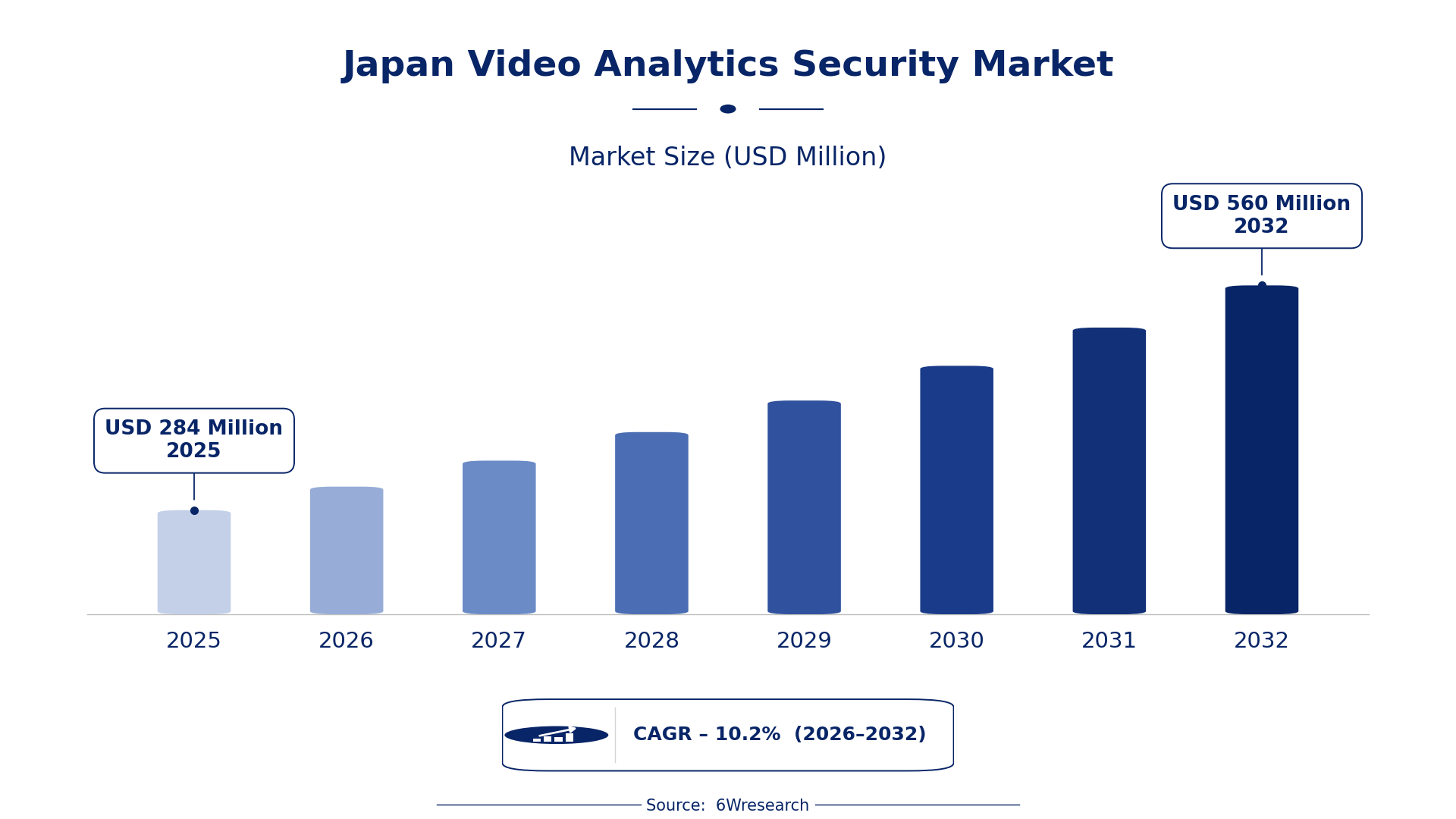
According to 6Wresearch internal database and industry insights, the Japan Video Analytics Security Market was valued at USD 284 Million in 2025 and is projected to reach USD 560 Million by 2032, growing at a CAGR of approximately 10.2% during 2026–2032.
Japan Video Analytics Security Market Highlights
| Report Metric | Details |
| Report Name | Japan Video Analytics Security Market (2026-2032) |
| Market Size 2025 | USD 284 Million |
| Market Size 2032 | USD 560 Million |
| Absolute Growth 2025–2032 | USD 276 Million |
| CAGR 2026–2032 | 10.2% |
| Peak Annual Growth | 12.0% in 2027 |
| Forecast Period | 2026–2032 |
| Historical Data | 2022–2025 |
| Base Year | 2025 |
| Leading Product Type, 2025 | Motion Detection Systems (38% share) |
| Leading Deployment Type, 2025 | On-Premise (36% share) |
| Leading Distribution Channel, 2025 | Direct Sales (47% share) |
| Leading End User, 2025 | Government Institutions (41% share) |
| Fastest-Growing Product Type | Facial Recognition (14.0% CAGR) |
| Fastest-Growing Deployment Type | Cloud-Based (14.6% CAGR) |
| Fastest-Growing Distribution Channel | Online Platforms (13.0% CAGR) |
| Fastest-Growing End User | Corporate Offices (13.5% CAGR) |
| Growing Sector | security technology |
| Key End Users | government institutions, corporate offices, transportation facilities, smart city projects |
Japan Video Analytics Security Market Year-wise Growth Rate and Key Drivers (2022–2032)
This graph illustrates the annual growth rates of the market from 2022 to 2032, highlighting a steady upward trajectory and projected market expansion over the forecast period.
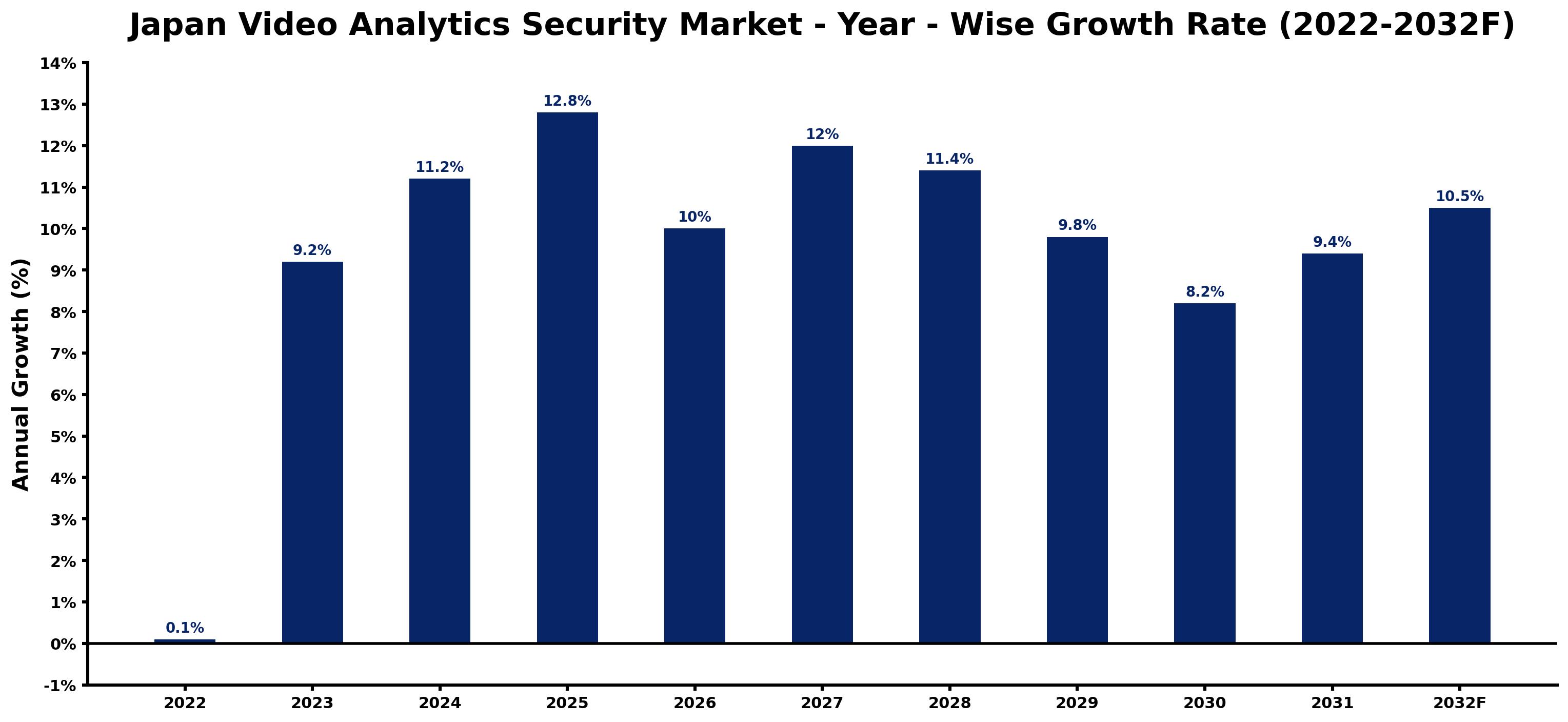
The yearly estimates that follow link every growth rate to its principal driver, so readers can see why the pace changed in each period.
| Year | Estimated Annual Growth (%) | Market Rationale |
| 2022 | 0.1 | The market showed minimal growth due to limited adoption of advanced technologies. |
| 2023 | 9.2 | Demand increased as corporate offices began investing in video analytics solutions. |
| 2024 | 11.2 | Growth accelerated with smart city projects gaining traction in urban areas. |
| 2025 | 12.8 | The peak growth year was driven by investments in public safety initiatives. |
| 2026 | 10.0 | Growth slowed as the market began to stabilise after rapid expansion. |
| 2027 | 12.0 | Demand rose again as facial recognition technology was increasingly adopted. |
| 2028 | 11.4 | Growth moderated as the market adjusted to technological advancements. |
| 2029 | 9.8 | A slight slowdown occurred as competition intensified among providers. |
| 2030 | 8.2 | The market continued to grow, albeit at a reduced rate, reflecting maturing demand. |
| 2031 | 9.4 | Growth picked up as new projects were launched in urban infrastructure. |
| 2032 | 10.5 | Demand is expected to rise as video analytics becomes standard in security systems. |
Note: Market size estimations and growth projections presented in this report are based on 6Wresearch's proprietary forecasting methodology, utilizing the latest available industry data, government publications, and primary research inputs.
Japan Video Analytics Security Market Synopsis
Video Analytics Security employs sophisticated software and algorithms to scrutinise video feeds for security applications. It improves monitoring in public spaces and accelerates emergency response times. In Japan, the primary demand comes from government institutions and corporate offices, with substantial investments in smart city projects propelling new growth. By 2032, the Japan Video Analytics Security Market will show increased adoption across various sectors, driven by ongoing urbanisation and technological progress.
Market Dynamics Impact Analysis (2026–2032)
| Factor | Type | Impact | Primary Segment Affected |
| Growing investments in smart city initiatives are increasing demand for video analytics solutions. | Driver | High | Smart City Projects |
| The rise in urban crime rates is prompting government institutions to enhance security measures. | Driver | High | Government Institutions |
| The integration of video analytics in urban infrastructure projects presents a significant opportunity. | Opportunity | High | Transportation Facilities |
| Corporate offices are increasingly seeking advanced security solutions for asset protection. | Opportunity | Medium | Corporate Offices |
| High costs associated with implementation can deter smaller institutions from adopting these technologies. | Restraint | High | Corporate Offices |
| Limited awareness of the benefits of video analytics among potential users restricts market growth. | Restraint | Medium | Smart City Projects |
| Competition among providers may lead to price wars, affecting profit margins. | Challenge | High | Motion Detection Systems |
| Rapid technological advancements require continuous investment, posing a challenge for suppliers. | Challenge | Medium | Motion Detection Systems |
Evaluation of Drivers in Japan Video Analytics Security Market (2026–2032)
The factors lifting demand, and the evidence behind each, are summarised below.
| Drivers | Primary Segment Affected | Why It Matters (Evidence) |
| Increased urbanisation is driving demand for security solutions. | Smart City Projects | Tokyo's smart city initiatives are integrating video analytics into 30% of new public infrastructure projects. |
| Government funding for public safety is boosting the adoption of video analytics. | Government Institutions | In 2023, the government allocated funds to enhance surveillance in transportation facilities. |
| Rising crime rates in urban areas prompt investments in security technologies. | Corporate Offices | Corporate offices in Osaka are increasing their investments in video analytics for asset protection. |
| Technological advancements in machine learning are improving video analytics capabilities. | Facial Recognition | The National Police Agency has implemented facial recognition technology in urban areas. |
| Growing public awareness of security threats is increasing demand for surveillance solutions. | Intrusion Detection | The Ministry of Internal Affairs and Communications promotes video analytics for public safety. |
Buyers are adding capacity as urbanisation intensifies, leading to increased demand for video analytics solutions. Rising crime rates in urban areas prompt corporate offices to invest more in video analytics for asset protection. Continuous advancements in technology are also improving the capabilities of security systems, particularly in urban settings.
Evaluation of Restraints in Japan Video Analytics Security Market
The table below lists the restraints and the evidence behind each.
| Market Restraint | Primary Segment Affected | Why It Matters (Evidence) |
| High implementation costs deter smaller institutions from adopting video analytics solutions. | Corporate Offices | The initial investment required for advanced systems can be prohibitive for smaller enterprises. |
| Limited awareness of video analytics benefits restricts market penetration. | Smart City Projects | Many potential users remain unaware of the advantages offered by these technologies. |
| Regulatory compliance requirements can slow down the adoption process. | Motion Detection Systems | Strict data protection laws necessitate thorough compliance checks before implementation. |
| Competition among providers may lead to price wars, impacting profitability. | Facial Recognition | As more players enter the market, pricing pressures can reduce margins for suppliers. |
| Technological advancements require continuous investment, which can strain budgets. | Motion Detection Systems | Suppliers must keep pace with rapid changes, necessitating ongoing financial commitment. |
Japan Video Analytics Security Market Challenges
Technological limitations in video analytics software impede the development of effective security solutions in Japan. This challenge arises from outdated programming methods, causing delays for producers who struggle to meet urgent security needs. Supply chain disruptions for essential hardware components, worsened by global shortages, result in postponed project timelines for buyers in urban areas where demand is high. A shortage of qualified personnel in machine learning hampers producers' recruitment efforts, raising operational costs and causing project delays for buyers reliant on timely implementations.
Trends in the Japan Video Analytics Security Market
Four trends stand out in the Japan Video Analytics Security Market.
- Shift towards Smart City Integration: Tokyo is increasingly integrating video analytics into urban infrastructure projects, improving public safety measures. In 2023, 30% of new public infrastructure projects incorporated these technologies, reflecting a shift in urban planning.
- Rise of Facial Recognition Technology: The National Police Agency has implemented facial recognition systems in urban areas since 2022, improving security measures. This technology is becoming standard in public safety strategies, with growing adoption rates across Japan.
- Increased Corporate Investment in Security: Corporate offices are prioritising video analytics for asset protection, particularly in Osaka. This trend is clear as investments in security solutions have risen, addressing concerns about workplace safety.
- Expansion of Cloud-Based Solutions: The adoption of cloud-based video analytics solutions is increasing, particularly among government institutions. This shift, driven by flexibility and scalability, is expected to grow by 14.6% from 2026 to 2032.
Investment Opportunities in the Japan Video Analytics Security Market
The opportunities below stand out in the Japan Video Analytics Security Market for new entrants and existing suppliers.
- Gap in Localised Security Solutions: With a projected market size of USD 560 million by 2032, there exists a gap in localised video analytics solutions. Government institutions in Japan are in search of tailored solutions to enhance public safety.
- Corporate Demand for Advanced Security: Corporate offices are increasingly investing in video analytics, particularly in urban settings. The escalating need for asset protection offers opportunities for suppliers to provide customised solutions.
- Investment in Transportation Facilities: The government is enhancing surveillance in transportation facilities, with allocated funds in 2023. Suppliers can penetrate this market by collaborating with local authorities for project execution.
- Entry through System Integrators: The demand for comprehensive security systems is growing, creating opportunities for partnerships with system integrators. This strategy can assist suppliers in reaching wider markets and improving service offerings.
Government Initiatives in the Japan Video Analytics Security Market
The PMD Act, established in 2014, regulates the approval and quality of security technologies, ensuring compliance with safety standards. The Digital Agency, established in September 2021, promotes digital transformation across sectors, including video analytics, by setting common system standards and guidelines.
Government institutions utilise funding from the Digital Agency to implement advanced security measures. In 2023, the agency allocated resources for improving surveillance in transportation facilities, ensuring compliance with the PMD Act and enhancing public safety.
Future Insight of the Japan Video Analytics Security Market
Smart city projects in Yokohama will increasingly incorporate advanced video analytics systems by 2032, enhancing public safety and operational efficiency. The adoption of ISO/IEC 27001 standards will fortify data security measures, building user confidence. Investment in cybersecurity initiatives will protect video analytics systems from evolving threats, ensuring dependable performance for stakeholders. By 2025, video analytics solutions are projected to be included in 30% of new public infrastructure projects, indicating a decisive shift towards improved urban security.
Market Segmentation Analysis
Japan Video Analytics Security Market report covers a detailed analysis of the following market segments:
By Product Type – Motion Detection Systems Lead, Facial Recognition Expected to Grow Fastest
According to Saurav Kr Singh, Senior Research Analyst at 6Wresearch, the largest product type category in 2025 was Motion Detection Systems, at 38% of revenue. Motion Detection Systems hold the largest share in the market due to their vital function in real-time monitoring within secured areas, especially in urban environments. Their integration into public safety strategies by the Tokyo Metropolitan Government illustrates their crucial role in enhancing security measures. Over 2026–2032, Facial Recognition is expected to post the fastest growth, at a CAGR of 14.0%. Facial Recognition is witnessing rapid growth as its application for identifying individuals in security systems becomes more widespread, with significant implementations by the National Police Agency in urban settings. This trend suggests a shift towards sophisticated identification methods, which will likely broaden the segment's lead. Suppliers must focus on advancing facial recognition technologies to meet the rising demand in the market.
By Deployment Type – On-Premise Leads, Cloud-Based Expected to Grow Fastest
On-Premise accounted for 36% of the market by deployment type in 2025. On-Premise solutions dominate the market as they are commonly used in facilities requiring local data processing, ensuring data security and compliance. This is particularly relevant for government institutions that prioritise control over their security systems. Cloud-Based is projected to grow fastest, at a CAGR of 14.6% during 2026–2032. Cloud-Based deployment is gaining traction due to its flexibility and scalability, appealing to organisations looking to adapt to changing security needs. The shift towards cloud solutions will likely accelerate as more businesses seek efficient data management. Buyers should consider cloud solutions for improved scalability and cost-effectiveness in their security operations.
By Distribution Channel – Direct Sales Leads, Online Platforms Expected to Grow Fastest
Direct Sales took 47% of distribution channel revenue in 2025, more than any other category. Direct Sales is the predominant distribution method for security solutions, offering tailored services that meet the unique needs of clients. This approach is particularly effective in government institutions, where complex security requirements necessitate personalised engagement. Online Platforms are set to record the highest CAGR in this split, 13.0% over 2026–2032. Online Platforms are swiftly becoming a preferred distribution channel, providing tech-savvy customers with convenient access to security solutions. This transition towards digital sales channels is expected to persist as consumer preferences shift in the security market. Suppliers should strengthen their online strategies to effectively connect with the evolving preferences of customers.
By End User – Government Institutions Lead, Corporate Offices Expected to Grow Fastest
Government Institutions held 41% of the Japan Video Analytics Security Market by end user in 2025. Government Institutions represent the largest end-user segment for security solutions, driven by their essential need for robust surveillance systems to ensure public safety. The advocacy of the Ministry of Internal Affairs and Communications for video analytics underscores the significance of this sector. The quickest growth will come from Corporate Offices, forecast to expand at a CAGR of 13.5% between 2026 and 2032. Corporate Offices are experiencing notable growth in demand for security solutions as they aim to safeguard their assets and employees from emerging threats. This segment's expansion is anticipated to continue as businesses increasingly prioritise security investments. Suppliers should tailor their offerings to meet the specific security requirements of corporate offices to capitalise on this growing market.
Key Attractiveness of the Report
- 10 Years of Market Numbers
- Historical Data Starting from 2022 to 2025
- Base Year 2025
- Forecast Data until 2032
- Key Performance Indicators Impacting the Market
- Major Upcoming Developments and Projects
Key Highlights of the Report:
- Japan Video Analytics Security Market Outlook
- Market Size of Japan Video Analytics Security Market, 2025
- Forecast of Japan Video Analytics Security Market, 2032
- Historical Data and Forecast of Japan Video Analytics Security Revenues & Volume for the Period 2022-2032F
- Japan Video Analytics Security Market Trend Evolution
- Japan Video Analytics Security Market Drivers and Challenges
- Japan Video Analytics Security Price Trends
- Japan Video Analytics Security Porter's Five Forces
- Japan Video Analytics Security Industry Life Cycle
- Historical Data and Forecast of Japan Video Analytics Security Market Revenues & Volume By Product Type for the Period 2022-2032F
- Historical Data and Forecast of Japan Video Analytics Security Market Revenues & Volume By Motion Detection Systems for the Period 2022-2032F
- Historical Data and Forecast of Japan Video Analytics Security Market Revenues & Volume By Facial Recognition for the Period 2022-2032F
- Historical Data and Forecast of Japan Video Analytics Security Market Revenues & Volume By Intrusion Detection for the Period 2022-2032F
- Historical Data and Forecast of Japan Video Analytics Security Market Revenues & Volume By License Plate Readers for the Period 2022-2032F
- Historical Data and Forecast of Japan Video Analytics Security Market Revenues & Volume By Deployment Type for the Period 2022-2032F
- Historical Data and Forecast of Japan Video Analytics Security Market Revenues & Volume By On-Premise for the Period 2022-2032F
- Historical Data and Forecast of Japan Video Analytics Security Market Revenues & Volume By Cloud-Based for the Period 2022-2032F
- Historical Data and Forecast of Japan Video Analytics Security Market Revenues & Volume By Hybrid for the Period 2022-2032F
- Historical Data and Forecast of Japan Video Analytics Security Market Revenues & Volume By Edge Devices for the Period 2022-2032F
- Historical Data and Forecast of Japan Video Analytics Security Market Revenues & Volume By Distribution Channel for the Period 2022-2032F
- Historical Data and Forecast of Japan Video Analytics Security Market Revenues & Volume By Direct Sales for the Period 2022-2032F
- Historical Data and Forecast of Japan Video Analytics Security Market Revenues & Volume By Online Platforms for the Period 2022-2032F
- Historical Data and Forecast of Japan Video Analytics Security Market Revenues & Volume By System Integrators for the Period 2022-2032F
- Historical Data and Forecast of Japan Video Analytics Security Market Revenues & Volume By Distributors for the Period 2022-2032F
- Historical Data and Forecast of Japan Video Analytics Security Market Revenues & Volume By End User for the Period 2022-2032F
- Historical Data and Forecast of Japan Video Analytics Security Market Revenues & Volume By Government Institutions for the Period 2022-2032F
- Historical Data and Forecast of Japan Video Analytics Security Market Revenues & Volume By Corporate Offices for the Period 2022-2032F
- Historical Data and Forecast of Japan Video Analytics Security Market Revenues & Volume By Smart City Projects for the Period 2022-2032F
- Historical Data and Forecast of Japan Video Analytics Security Market Revenues & Volume By Transportation Facilities for the Period 2022-2032F
- Japan Video Analytics Security Import Export Trade Statistics
- Market Opportunity Assessment By Product Type
- Market Opportunity Assessment By Deployment Type
- Market Opportunity Assessment By Distribution Channel
- Market Opportunity Assessment By End User
- Japan Video Analytics Security Top Companies Market Share
- Japan Video Analytics Security Competitive Benchmarking By Technical and Operational Parameters
- Japan Video Analytics Security Company Profiles
- Japan Video Analytics Security Key Strategic Recommendations
Market Covered
The report covers the following segments.
By Product Type
- Motion Detection Systems
- Facial Recognition
- Intrusion Detection
- License Plate Readers
By Deployment Type
- On-Premise
- Cloud-Based
- Hybrid
- Edge Devices
By Distribution Channel
- Direct Sales
- Online Platforms
- System Integrators
- Distributors
By End User
- Government Institutions
- Corporate Offices
- Smart City Projects
- Transportation Facilities































