Japan Virtual Assistant AI Market Size & Growth Rate
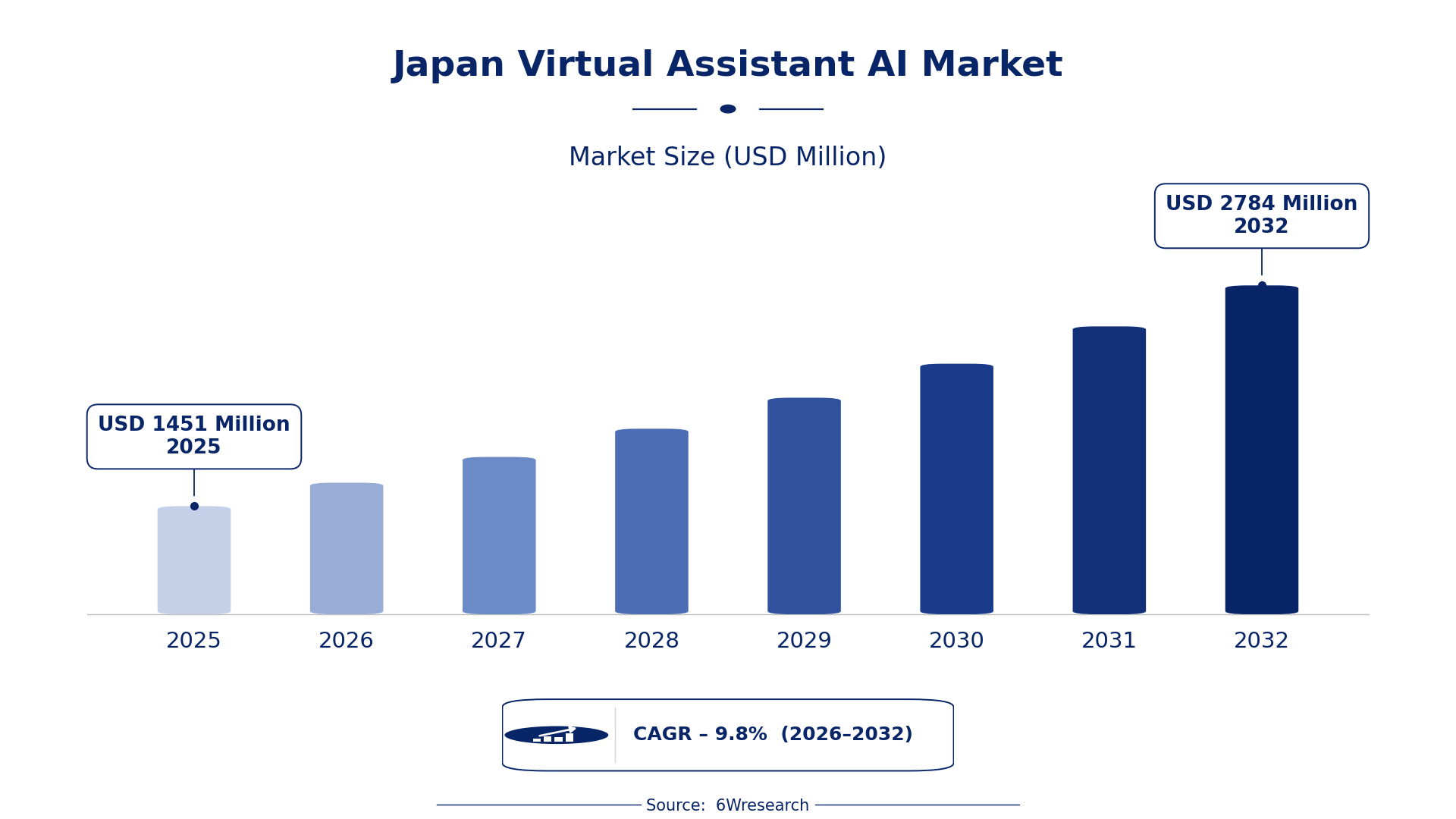
According to 6Wresearch internal database and industry insights, the Japan Virtual Assistant AI Market was valued at USD 1,451 Million in 2025 and is projected to reach USD 2,784 Million by 2032, growing at a CAGR of approximately 9.8% during 2026–2032.
Japan Virtual Assistant AI Market Highlights
| Report Metric | Details |
| Report Name | Japan Virtual Assistant AI Market (2026-2032) |
| Market Size 2025 | USD 1,451 Million |
| Market Size 2032 | USD 2,784 Million |
| Absolute Growth 2025–2032 | USD 1,333 Million |
| CAGR 2026–2032 | 9.8% |
| Peak Annual Growth | 10.5% in 2032 |
| Forecast Period | 2026–2032 |
| Historical Data | 2022–2025 |
| Base Year | 2025 |
| Leading Assistant Type, 2025 | Text-Based Assistants (48% share) |
| Leading Deployment Type, 2025 | Cloud-Based (36% share) |
| Leading Distribution Channel, 2025 | SaaS Providers (54% share) |
| Leading End User, 2025 | Customer Support Firms (38% share) |
| Fastest-Growing Assistant Type | Voice-Enabled Assistants (13.6% CAGR) |
| Fastest-Growing Deployment Type | On-Premise (14.2% CAGR) |
| Fastest-Growing Distribution Channel | Online Subscriptions (13.2% CAGR) |
| Fastest-Growing End User | Retail Businesses (13.0% CAGR) |
| Growing Sector | Customer Support |
| Key End Users | Customer Support Firms, E-commerce Companies, Retail Businesses, AI Solution Vendors |
Japan Virtual Assistant AI Market Year-wise Growth Rate and Key Drivers (2022–2032)
This graph illustrates the annual growth rates of the market from 2022 to 2032, highlighting a steady upward trajectory and projected market expansion over the forecast period.
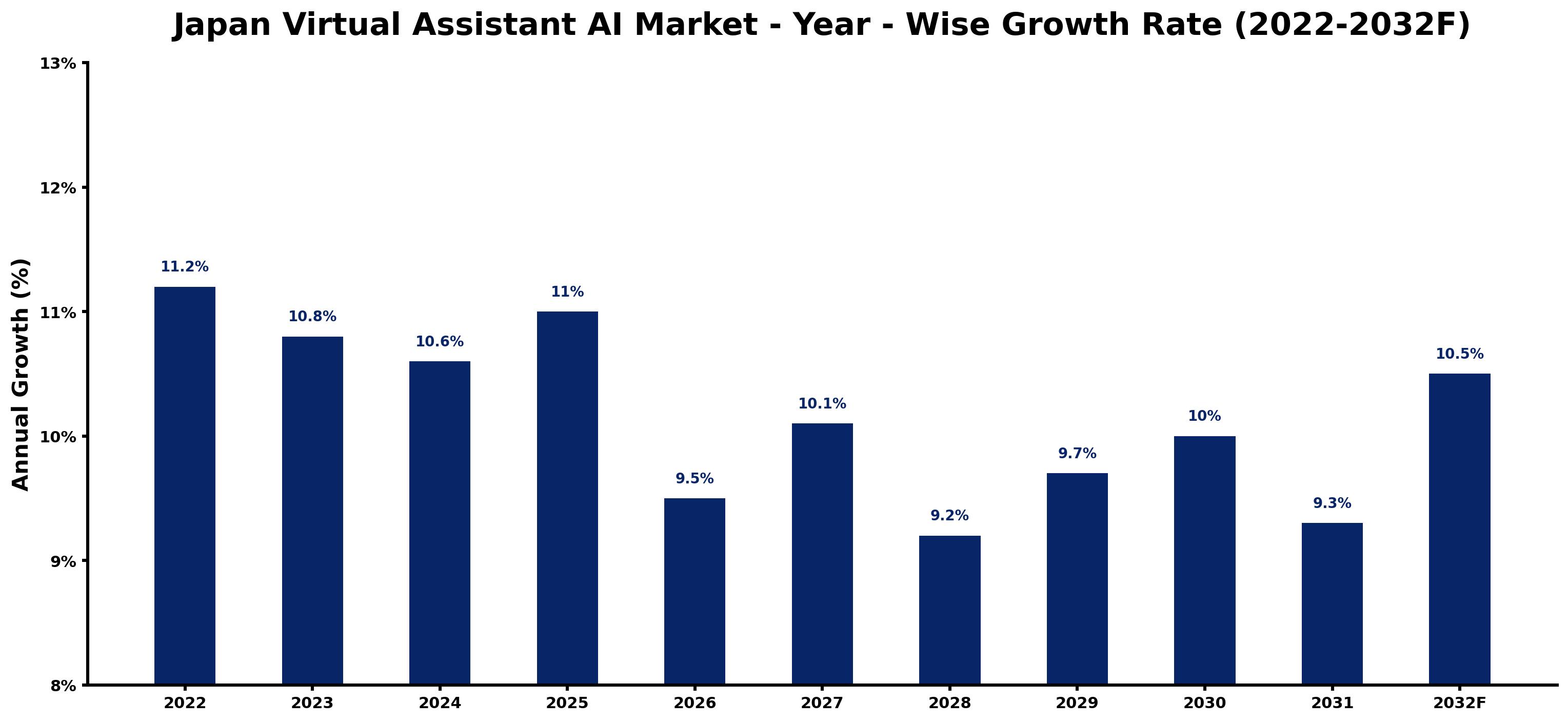
For each year, the table pairs the estimated growth rate with the leading influence on demand, showing how the drivers changed across the period.
| Year | Estimated Annual Growth (%) | Market Rationale |
| 2022 | 11.2 | The market experienced strong demand driven by advancements in AI technology. |
| 2023 | 10.8 | Growth slowed slightly due to market saturation in certain sectors. |
| 2024 | 10.6 | Demand continued to rise, supported by increased adoption in customer support. |
| 2025 | 11.0 | The market saw a resurgence as businesses invested more in AI solutions. |
| 2026 | 9.5 | Growth is expected to slow as firms face challenges in integrating new technologies. |
| 2027 | 10.1 | Demand is projected to pick up again with improved AI capabilities and applications. |
| 2028 | 9.2 | The market growth rate is expected to slow as competition intensifies among providers. |
| 2029 | 9.7 | A renewed interest in AI solutions is expected to lead to faster growth in various sectors. |
| 2030 | 10.0 | Investment in AI technologies will continue to rise, boosting market activity. |
| 2031 | 9.3 | Growth is projected to slow as the market matures and adoption levels stabilise. |
| 2032 | 10.5 | The market is expected to peak as new applications and technologies emerge. |
Note: Market size estimations and growth projections presented in this report are based on 6Wresearch's proprietary forecasting methodology, utilizing the latest available industry data, government publications, and primary research inputs.
Japan Virtual Assistant AI Market Synopsis
Virtual Assistant AI employs artificial intelligence to automate tasks and deliver services through natural language processing. Its main applications include improving customer support, automating repetitive tasks, and offering personalised user experiences. The Japan Virtual Assistant AI Market is growing due to increased demand from customer support firms and e-commerce companies, with the Tokyo region representing 45% of AI market activity. The introduction of the AI Strategy 2023 by the Ministry of Economy, Trade and Industry is further promoting adoption and innovation in this field.
Market Dynamics Impact Analysis (2026–2032)
| Factor | Type | Impact | Primary Segment Affected |
| Growing demand for customer support automation | Driver | High | Customer Support Firms |
| Increased investment in AI technologies | Driver | High | AI Solution Vendors |
| Expansion of e-commerce platforms | Opportunity | High | E-commerce Companies |
| Rising adoption of AI in retail | Opportunity | High | Retail Businesses |
| Challenges in integrating AI solutions | Restraint | Medium | Customer Support Firms |
| Concerns over data privacy and security | Restraint | High | AI Solution Vendors |
| Talent shortages in AI development | Challenge | High | AI Solution Vendors |
| High costs associated with AI implementation | Challenge | Medium | Customer Support Firms |
Evaluation of Drivers in Japan Virtual Assistant AI Market (2026–2032)
The table below links each growth driver to the segment it affects and the evidence for it.
| Drivers | Primary Segment Affected | Why It Matters (Evidence) |
| Increased digital service usage | Customer Support Firms | Approximately 40% of customer support interactions are handled by virtual assistants, driving demand for AI solutions. |
| Investment in AI research and development | AI Solution Vendors | The Japanese government allocated ¥10 billion for AI R&D in 2023, boosting innovation. |
| Growth of the e-commerce market | E-commerce Companies | The e-commerce market is projected to reach ¥20 trillion by 2025, increasing the need for virtual assistants. |
| Rising integration of voice-enabled assistants | Voice-Enabled Assistants | Voice-enabled assistants are integrated into 70% of smart home devices, enhancing user experience. |
| Demand for multilingual support | Multilingual Assistants | Over 500,000 active users of multilingual assistants in corporate settings indicate a growing need. |
Most of the extra volume comes from increased digital service usage, with approximately 40% of customer support interactions managed by virtual assistants. As the e-commerce market approaches ¥20 trillion by 2025, e-commerce companies are increasingly adopting virtual assistants to improve customer interactions. The integration of voice-enabled assistants into 70% of smart home devices is driving demand for user-friendly solutions. The presence of multilingual assistants in corporate settings highlights the growing need for diverse language support in AI applications.
Evaluation of Restraints in Japan Virtual Assistant AI Market
The table below lists the restraints and the evidence behind each.
| Market Restraint | Primary Segment Affected | Why It Matters (Evidence) |
| Integration challenges in existing systems | Customer Support Firms | Many customer support firms struggle with integrating AI solutions, leading to delays in deployment. |
| Data privacy concerns among users | AI Solution Vendors | Concerns over data security hinder the adoption of virtual assistants in sensitive applications. |
| Limited understanding of AI capabilities | Customer Support Firms | A lack of knowledge about AI technology restricts firms from fully utilising its benefits. |
| High costs of AI implementation | Customer Support Firms | The average investment of ¥100 million per project can deter smaller firms from adopting AI. |
| Shortage of skilled AI professionals | AI Solution Vendors | Talent shortages in AI development slow down the pace of innovation and deployment. |
Japan Virtual Assistant AI Market Challenges
In 2023, compliance with ISO/IEC 27001 for data security can delay project launches by up to six months for developers, impacting the timely delivery of virtual assistant solutions to buyers. Only 40% of companies can find qualified AI professionals, which raises hiring costs and extends project timelines for businesses. Fierce competition from over 1,000 AI startups drives up prices, limiting affordable options for buyers. Integration challenges arise as 60% of businesses struggle to adapt existing systems, resulting in lost efficiency and increased operational costs for firms trying to implement virtual assistants.
Trends in the Japan Virtual Assistant AI Market
The following changes are redrawing the Japan Virtual Assistant AI Market.
- Shift in Customer Support Strategies: Customer support firms are increasingly adopting virtual assistants to automate interactions, with chatbots expected to handle 85% of customer queries by 2025. This shift reflects a growing emphasis on efficiency and customer satisfaction.
- Rise of Voice-Enabled Assistants: Voice-enabled assistants are becoming standard in smart home devices, with 70% of devices sold in Japan incorporating this technology. This trend is reshaping user interactions and driving demand for voice recognition capabilities.
- Increased Focus on Multilingual Support: The number of active users of multilingual assistants in corporate settings reached over 500,000 in 2023. This trend is essential for global enterprises seeking to streamline operations across diverse markets.
- Growing Preference for Cloud-Based Solutions: Cloud-based virtual assistant solutions are preferred by 60% of businesses for their flexibility and cost-effectiveness. This trend is reshaping how companies deploy AI technologies across various sectors.
Investment Opportunities in the Japan Virtual Assistant AI Market
Where to invest in the Japan Virtual Assistant AI Market: the main openings are set out below.
- Investment in AI Startups: Tokyo is emerging as a hub for AI startups, with over 1,000 active companies in 2023. Investing in these startups can yield returns as they create novel solutions.
- Supply of AI Solutions for E-commerce: With the e-commerce market expected to reach ¥20 trillion by 2025, providing AI tools for automation presents a promising opportunity for technology providers.
- Partnerships with Customer Support Firms: Now is an opportune time to collaborate with customer support firms, which have increased AI tool usage by 30% since 2022, to deliver tailored virtual assistant solutions.
- Entry into Retail AI Solutions: Retail businesses are quickly adopting AI technologies, with a projected growth rate of 13.0% from 2026 to 2032. Suppliers can penetrate this market by offering specialised AI solutions.
Government Initiatives in the Japan Virtual Assistant AI Market
The regulatory framework for virtual assistant AI in Japan is shaped by several key laws. The Industrial Standardization Act governs product standards, while the Long-Term Care Insurance Act funds support services for older people. The Digital Agency, established in 2021, oversees the digital transformation and promotes AI adoption across sectors, including healthcare and customer service.
In 2023, the Japanese government allocated ¥10 billion for AI research and development, administered by the Ministry of Economy, Trade and Industry. This funding supports various initiatives aimed at improving AI capabilities, ensuring that producers and users can access advanced technologies and maintain compliance with evolving standards.
Future Insight of the Japan Virtual Assistant AI Market
A government allocation of ¥10 billion for AI research and development will stimulate demand for virtual assistants in various sectors. By 2032, public services will increasingly adopt AI technologies, improving user experiences and operational efficiency. The e-commerce market, projected to reach ¥20 trillion by 2025, will drive further demand for virtual assistants. As AI literacy programs expand, the workforce will become more proficient in utilising these technologies, benefiting both buyers and suppliers.
Market Segmentation Analysis
Japan Virtual Assistant AI Market report covers a detailed analysis of the following market segments:
By Assistant Type – Text-Based Assistants Lead, Voice-Enabled Assistants Expected to Grow Fastest
According to Saurav Kr Singh, Senior Research Analyst at 6Wresearch, Text-Based Assistants took 48% of assistant type revenue in 2025, more than any other category. Text-Based Assistants lead the market due to their widespread application in customer interactions and information retrieval, particularly in sectors like telecommunications. Their established integration into existing customer service frameworks solidifies their dominant position. Voice-Enabled Assistants are projected to grow fastest, at a CAGR of 13.6% during 2026–2032. Voice-Enabled Assistants are experiencing rapid growth as they become essential in smart home devices, with 70% of such devices sold in Japan incorporating this technology. The hands-free convenience they provide is attracting a growing number of users, ensuring sustained expansion in this segment. Suppliers should focus on enhancing voice functionalities to meet the increasing demand in smart home applications.
By Deployment Type – Cloud-Based Leads, On-Premise Expected to Grow Fastest
Cloud-Based held 36% of the Japan Virtual Assistant AI Market by deployment type in 2025. Cloud-Based solutions dominate the market because they provide scalability and accessibility, making them the preferred choice for various sectors including retail and finance. This deployment method enables businesses to adapt to changing demands without substantial upfront costs. On-Premise is set to record the highest CAGR in this split, 14.2% over 2026–2032. On-Premise deployment is growing quickly as firms with stringent data security needs seek greater control over their systems. This trend is particularly evident in sectors such as finance and healthcare, where data protection is paramount. Vendors must prioritise robust security features to cater to the rising interest in on-premise deployment options.
By Distribution Channel – SaaS Providers Lead, Online Subscriptions Expected to Grow Fastest
The largest distribution channel category in 2025 was SaaS Providers, at 54% of revenue. SaaS Providers hold the largest market share as they are pivotal in delivering virtual assistant solutions, allowing businesses to access advanced functionalities easily. This distribution model appeals to a diverse user base by enabling implementation without significant initial investments. Over 2026–2032, Online Subscriptions are expected to post the fastest growth, at a CAGR of 13.2%. Online Subscriptions are gaining popularity for accessing virtual assistant services, driven by their convenience and flexibility. This trend is particularly appealing to small and medium-sized enterprises seeking cost-effective solutions. Providers should refine their subscription offerings to attract a wider audience looking for flexible access to virtual assistant technologies.
By End User – Customer Support Firms Lead, Retail Businesses Expected to Grow Fastest
In 2025, Customer Support Firms led the end user split with a 38% share. Customer Support Firms are the primary users of virtual assistant technology, leveraging it to enhance service efficiency and customer satisfaction. The sector's adoption rate is estimated at 40%, highlighting a strong reliance on these tools for managing customer interactions. The quickest growth will come from Retail Businesses, forecast to expand at a CAGR of 13.0% between 2026 and 2032. Retail Businesses are rapidly adopting virtual assistants to improve customer experience, with forecasts indicating that chatbots will handle 85% of customer interactions by 2025. This swift uptake is driven by the need for streamlined operations and immediate consumer support. Suppliers should tailor their solutions to meet the specific needs of retail businesses focused on enhancing customer engagement.
Key Attractiveness of the Report
- 10 Years of Market Numbers
- Historical Data Starting from 2022 to 2025
- Base Year 2025
- Forecast Data until 2032
- Key Performance Indicators Impacting the Market
- Major Upcoming Developments and Projects
Key Highlights of the Report:
- Japan Virtual Assistant AI Market Outlook
- Market Size of Japan Virtual Assistant AI Market, 2025
- Forecast of Japan Virtual Assistant AI Market, 2032
- Historical Data and Forecast of Japan Virtual Assistant AI Revenues & Volume for the Period 2022-2032F
- Japan Virtual Assistant AI Market Trend Evolution
- Japan Virtual Assistant AI Market Drivers and Challenges
- Japan Virtual Assistant AI Price Trends
- Japan Virtual Assistant AI Porter's Five Forces
- Japan Virtual Assistant AI Industry Life Cycle
- Historical Data and Forecast of Japan Virtual Assistant AI Market Revenues & Volume By Assistant Type for the Period 2022-2032F
- Historical Data and Forecast of Japan Virtual Assistant AI Market Revenues & Volume By Text-Based Assistants for the Period 2022-2032F
- Historical Data and Forecast of Japan Virtual Assistant AI Market Revenues & Volume By Voice-Enabled Assistants for the Period 2022-2032F
- Historical Data and Forecast of Japan Virtual Assistant AI Market Revenues & Volume By Chatbots for Websites for the Period 2022-2032F
- Historical Data and Forecast of Japan Virtual Assistant AI Market Revenues & Volume By Multilingual Assistants for the Period 2022-2032F
- Historical Data and Forecast of Japan Virtual Assistant AI Market Revenues & Volume By Deployment Type for the Period 2022-2032F
- Historical Data and Forecast of Japan Virtual Assistant AI Market Revenues & Volume By Cloud-Based for the Period 2022-2032F
- Historical Data and Forecast of Japan Virtual Assistant AI Market Revenues & Volume By On-Premise for the Period 2022-2032F
- Historical Data and Forecast of Japan Virtual Assistant AI Market Revenues & Volume By Embedded for the Period 2022-2032F
- Historical Data and Forecast of Japan Virtual Assistant AI Market Revenues & Volume By Hybrid for the Period 2022-2032F
- Historical Data and Forecast of Japan Virtual Assistant AI Market Revenues & Volume By Distribution Channel for the Period 2022-2032F
- Historical Data and Forecast of Japan Virtual Assistant AI Market Revenues & Volume By SaaS Providers for the Period 2022-2032F
- Historical Data and Forecast of Japan Virtual Assistant AI Market Revenues & Volume By Online Subscriptions for the Period 2022-2032F
- Historical Data and Forecast of Japan Virtual Assistant AI Market Revenues & Volume By AI Solution Vendors for the Period 2022-2032F
- Historical Data and Forecast of Japan Virtual Assistant AI Market Revenues & Volume By System Integrators for the Period 2022-2032F
- Historical Data and Forecast of Japan Virtual Assistant AI Market Revenues & Volume By End User for the Period 2022-2032F
- Historical Data and Forecast of Japan Virtual Assistant AI Market Revenues & Volume By Customer Support Firms for the Period 2022-2032F
- Historical Data and Forecast of Japan Virtual Assistant AI Market Revenues & Volume By Retail Businesses for the Period 2022-2032F
- Historical Data and Forecast of Japan Virtual Assistant AI Market Revenues & Volume By E-commerce Companies for the Period 2022-2032F
- Historical Data and Forecast of Japan Virtual Assistant AI Market Revenues & Volume By Global Enterprises for the Period 2022-2032F
- Japan Virtual Assistant AI Import Export Trade Statistics
- Market Opportunity Assessment By Assistant Type
- Market Opportunity Assessment By Deployment Type
- Market Opportunity Assessment By Distribution Channel
- Market Opportunity Assessment By End User
- Japan Virtual Assistant AI Top Companies Market Share
- Japan Virtual Assistant AI Competitive Benchmarking By Technical and Operational Parameters
- Japan Virtual Assistant AI Company Profiles
- Japan Virtual Assistant AI Key Strategic Recommendations
Market Covered
The following segment groups are covered in the report.
By Assistant Type
- Text-Based Assistants
- Voice-Enabled Assistants
- Chatbots for Websites
- Multilingual Assistants
By Deployment Type
- Cloud-Based
- On-Premise
- Embedded
- Hybrid
By Distribution Channel
- SaaS Providers
- Online Subscriptions
- AI Solution Vendors
- System Integrators
By End User
- Customer Support Firms
- Retail Businesses
- E-commerce Companies
- Global Enterprises































