Japan Virtual Desktop Infrastructure Market Size & Growth Rate
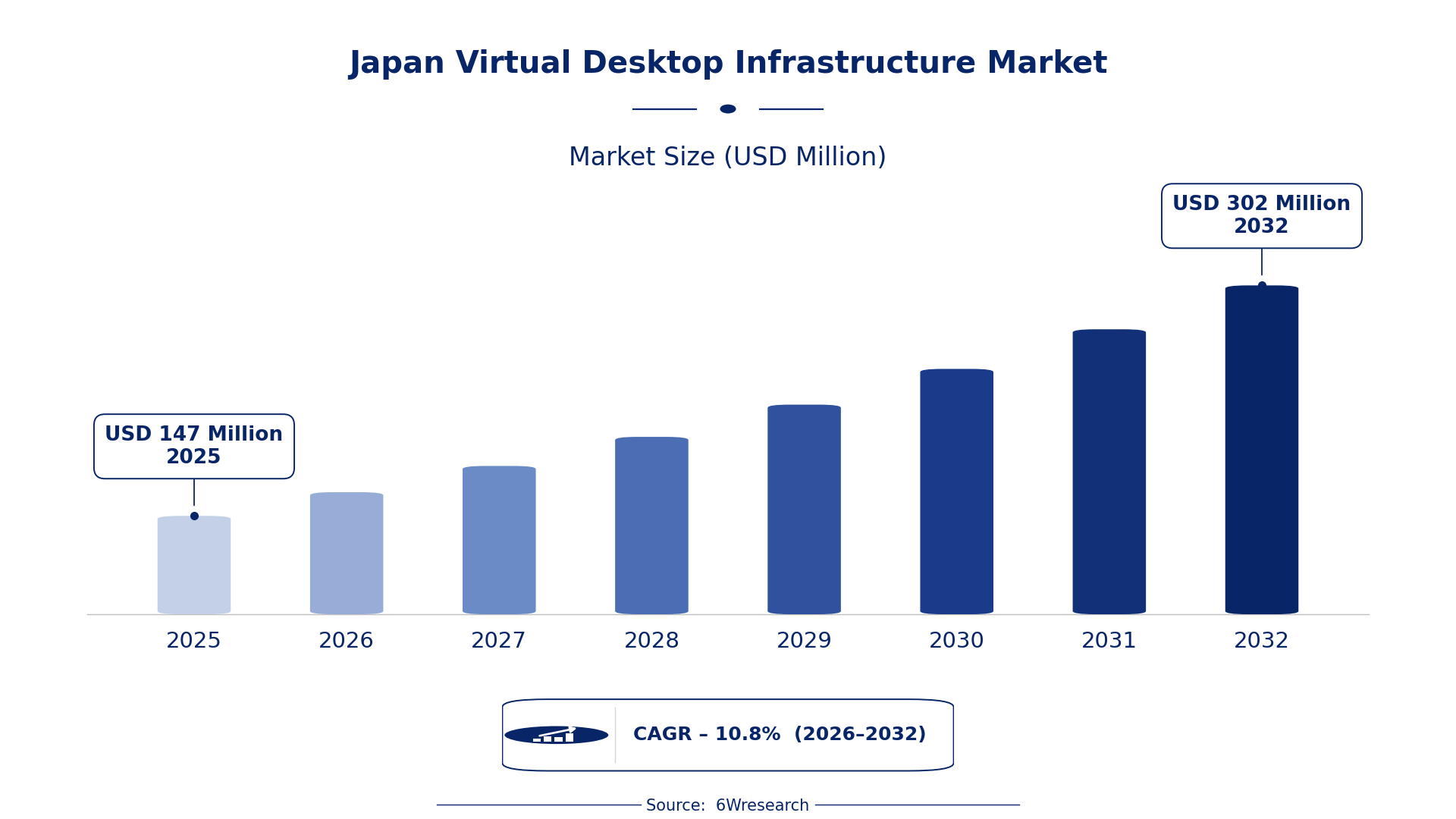
According to 6Wresearch internal database and industry insights, the Japan Virtual Desktop Infrastructure Market was valued at USD 147 Million in 2025 and is projected to reach USD 302 Million by 2032, growing at a CAGR of approximately 10.8% during 2026–2032.
Japan Virtual Desktop Infrastructure Market Highlights
| Report Metric | Details |
| Report Name | Japan Virtual Desktop Infrastructure Market (2026-2032) |
| Market Size 2025 | USD 147 Million |
| Market Size 2032 | USD 302 Million |
| Absolute Growth 2025–2032 | USD 155 Million |
| CAGR 2026–2032 | 10.8% |
| Peak Annual Growth | 13.2% in 2026 |
| Forecast Period | 2026–2032 |
| Historical Data | 2022–2025 |
| Base Year | 2025 |
| Leading Deployment Model, 2025 | Cloud-Based (42% share) |
| Leading Component, 2025 | Software (51% share) |
| Leading End User, 2025 | IT & Telecom (42% share) |
| Leading Device Type, 2025 | Thin Clients (53% share) |
| Leading Feature, 2025 | Secure Access (46% share) |
| Fastest-Growing Component | Services (14.6% CAGR) |
| Fastest-Growing End User | BFSI (13.3% CAGR) |
| Fastest-Growing Device Type | Zero Clients (14.2% CAGR) |
| Fastest-Growing Feature | High Availability (13.1% CAGR) |
| Growing Sector | IT & Telecom |
| Key End Users | IT companies, government agencies, healthcare providers, financial institutions |
Japan Virtual Desktop Infrastructure Market Year-wise Growth Rate and Key Drivers (2022–2032)
This graph illustrates the annual growth rates of the market from 2022 to 2032, highlighting a steady upward trajectory and projected market expansion over the forecast period.
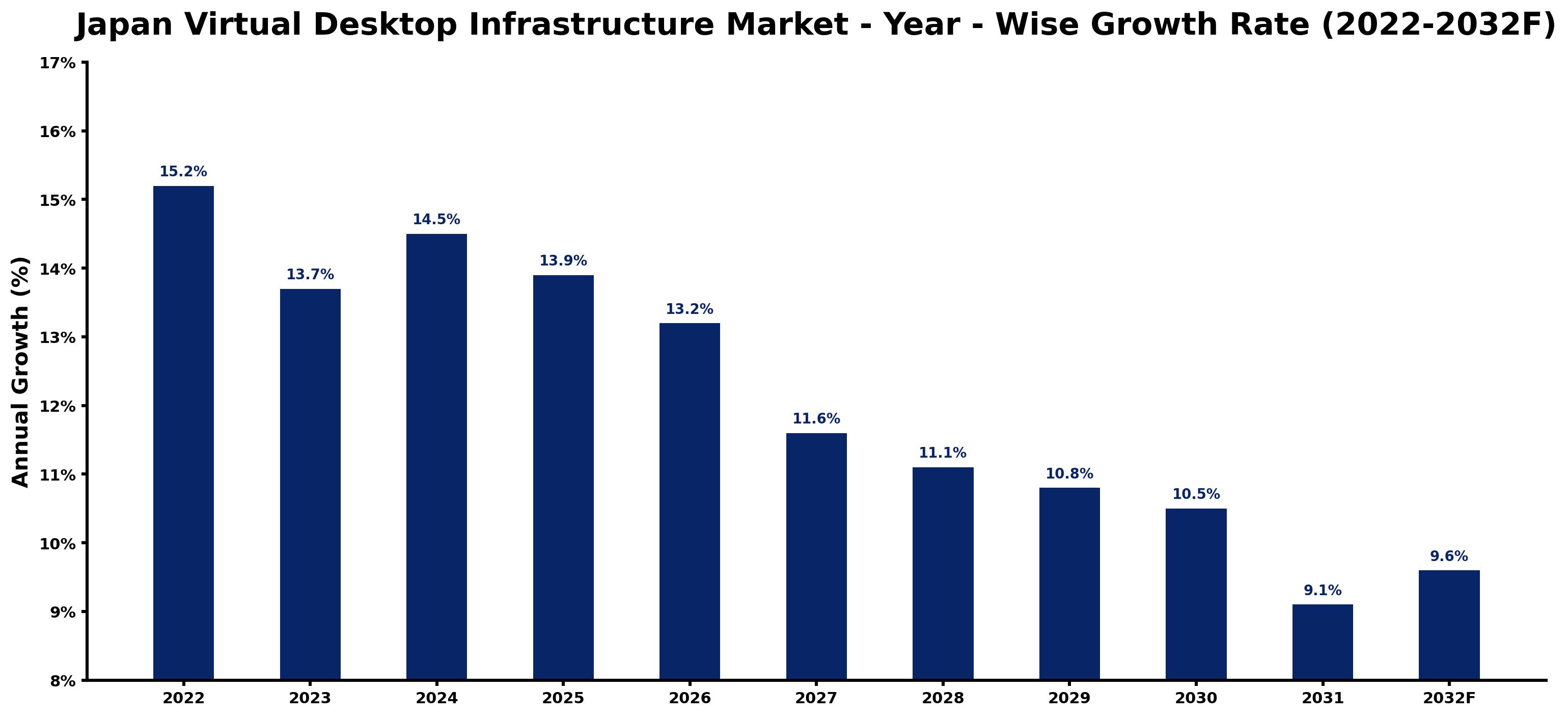
Annual growth estimates for each year appear below with the principal reason behind them, explaining the shifts that set the pace of the market.
| Year | Estimated Annual Growth (%) | Market Rationale |
| 2022 | 15.2 | The market experienced strong growth due to increased remote work adoption. |
| 2023 | 13.7 | Growth slowed as companies adjusted to the initial surge in demand. |
| 2024 | 14.5 | A rise in cloud-based solutions drove faster growth compared to 2023. |
| 2025 | 13.9 | Demand continued to grow, although at a slower pace than in 2024. |
| 2026 | 13.2 | The market is expected to slow further as it stabilises after rapid growth. |
| 2027 | 11.6 | Growth is expected to decelerate as the market matures and competition increases. |
| 2028 | 11.1 | The market is projected to stabilise with consistent demand patterns. |
| 2029 | 10.8 | A slight slowdown in growth is expected as market saturation occurs in key sectors. |
| 2030 | 10.5 | Demand is projected to remain steady, but growth rates will be lower as the market matures. |
| 2031 | 9.1 | The market growth rate is projected to decrease as adoption levels plateau. |
| 2032 | 9.6 | Growth is expected to pick up slightly as new technologies emerge. |
Note: Market size estimations and growth projections presented in this report are based on 6Wresearch's proprietary forecasting methodology, utilizing the latest available industry data, government publications, and primary research inputs.
Japan Virtual Desktop Infrastructure Market Synopsis
Virtual Desktop Infrastructure (VDI) allows users to access centralized desktop environments, improving security and resource management. The Japan Virtual Desktop Infrastructure Market is growing due to the increase in remote work, with over 70% of IT companies using VDI as of 2023. Demand is particularly robust in the Tokyo region, spurred by government initiatives and digital transformation efforts in sectors such as IT, telecom, and BFSI that require secure and efficient solutions.
Market Dynamics Impact Analysis (2026–2032)
| Factor | Type | Impact | Primary Segment Affected |
| Increasing remote work adoption drives demand for secure access solutions. | Driver | High | Cloud-Based |
| Government initiatives promote VDI adoption across public sector agencies. | Driver | High | IT & Telecom |
| The shift towards remote work creates a significant demand gap for VDI solutions. | Opportunity | High | Healthcare |
| Growing interest in digital transformation initiatives opens new markets for VDI. | Opportunity | Medium | BFSI |
| Limited awareness of VDI benefits restrains market growth in SMEs. | Restraint | Medium | On-Premises |
| Concerns over data security may hinder VDI adoption in sensitive sectors. | Restraint | High | Hybrid |
| Competition among VDI providers may lead to pricing pressures. | Challenge | Medium | Cloud-Based |
| Integration challenges with existing IT infrastructure can delay VDI deployment. | Challenge | High | Services |
Evaluation of Drivers in Japan Virtual Desktop Infrastructure Market (2026–2032)
Below are the drivers that matter most for revenue growth, with supporting evidence.
| Drivers | Primary Segment Affected | Why It Matters (Evidence) |
| Rising remote work adoption increases demand for VDI solutions. | Cloud-Based | As of 2023, over 70% of IT companies in Japan utilize VDI for remote work. |
| Government initiatives support VDI adoption in public agencies. | IT & Telecom | The Ministry of Internal Affairs and Communications promotes VDI adoption in government agencies. |
| Digital transformation efforts are boosting VDI demand across sectors. | Cloud-Based | The Japanese government allocated 5 billion yen for digital transformation initiatives including VDI. |
| Healthcare sector's need for secure data management drives VDI adoption. | Healthcare | The healthcare industry is expected to see a 20% increase in VDI adoption by 2025. |
| Increased focus on data security drives VDI market growth. | Secure Access | ISO/IEC 27001 is a key standard for data security in VDI implementations in Japan. |
A wider customer base explains much of the growth, as the rise in remote work has led to over 10 million remote workers in Japan. The healthcare sector's focus on secure patient data management is driving a projected 20% increase in VDI adoption by 2025. More than 70% of IT companies are now utilizing VDI, reflecting its growing importance in operations. The demand for secure transactions in various sectors is also pushing VDI adoption further, indicating a trend towards enhanced security measures.
Evaluation of Restraints in Japan Virtual Desktop Infrastructure Market
These restraints slow adoption and weigh on supplier margins.
| Market Restraint | Primary Segment Affected | Why It Matters (Evidence) |
| Limited awareness of VDI benefits among SMEs restricts market growth. | On-Premises | The adoption rate of VDI in Japanese SMEs is around 30% as of 2023. |
| Concerns over data security may hinder VDI adoption in sensitive sectors. | Hybrid | Many organizations face difficulties in ensuring data security, impacting adoption rates. |
| Integration challenges with existing IT infrastructure can delay VDI deployment. | Services | Many organizations face difficulties in integrating VDI with legacy systems, causing project delays. |
| High initial investment costs can deter smaller firms from adopting VDI. | Cloud-Based | The cost of implementing VDI solutions can be a barrier for smaller enterprises, limiting their participation. |
| Competition among VDI providers may lead to pricing pressures. | Cloud-Based | Increased competition can result in reduced profit margins for providers, affecting service quality. |
Japan Virtual Desktop Infrastructure Market Challenges
Strict regulations regarding data security present challenges for producers implementing VDI solutions. Compliance with ISO/IEC 27001 often extends deployment timelines by up to six months for IT companies, affecting their ability to meet rising demand. Buyers in the healthcare sector encounter difficulties in patient data management due to these compliance requirements, which can result in inefficiencies and potential data breaches. Skills shortages in VDI expertise complicate the situation, as firms struggle to recruit qualified personnel, leading to increased training costs that can reach 2 million yen per company annually. Technology integration issues arise, as outdated infrastructure can impede VDI adoption, resulting in lost productivity for organizations dependent on remote work solutions.
Trends in the Japan Virtual Desktop Infrastructure Market
Buyers and suppliers in the Japan Virtual Desktop Infrastructure Market are adjusting to the following trends.
- Shift from On-Premises to Cloud-Based Solutions: The movement towards cloud-based VDI solutions is gaining traction, especially in the Tokyo region, where over 42% of VDI deployments are now cloud-based. This change addresses the growing demand for flexible remote access.
- Transition to Data Security Standards: Since 2021, organizations have increasingly embraced ISO/IEC 27001 standards for VDI implementations, ensuring robust data security measures. This transition is crucial for sectors like BFSI, where secure transactions are critical.
- Emergence of Zero Clients in Corporate Environments: Zero clients are becoming the preferred device type for accessing VDI environments, with a projected CAGR of 14.2% through 2032. This shift is driven by the need for optimized performance and security in corporate settings.
- Prioritisation of High Availability Features: High availability features in VDI solutions are being emphasised, with a projected CAGR of 13.1% by 2032. This trend is important for organizations requiring continuous access to virtual desktops.
Investment Opportunities in the Japan Virtual Desktop Infrastructure Market
The following areas offer the clearest openings for investors and suppliers in the Japan Virtual Desktop Infrastructure Market.
- Gap in VDI Adoption Among SMEs: With only 30% of SMEs currently utilising VDI, there is a clear opportunity for growth. Targeting this segment can lead to increased sales and market penetration in the IT sector.
- Timing for Digital Transformation: The Japanese government's 5 billion yen allocation for digital transformation presents a ripe opportunity for VDI providers. Engaging with public sector agencies can facilitate entry into new markets.
- Entry into Healthcare Sector: As the healthcare industry anticipates a 20% increase in VDI adoption by 2025, suppliers should focus on tailored solutions for this sector. Collaborating with healthcare providers can strengthen market presence.
- Investment in Secure Access Solutions: The focus on data security creates an opportunity to invest in secure access solutions for VDI. Targeting BFSI and healthcare sectors can yield substantial returns.
Government Initiatives in the Japan Virtual Desktop Infrastructure Market
The AI Promotion Act (2025) establishes a framework for AI research and development, benefiting VDI producers by providing guidelines for secure and efficient implementations. This act complements existing laws, such as the Digital Agency's initiatives, which aim to standardise digital transformation efforts across sectors.
In 2023, the Japanese government allocated 5 billion yen for digital transformation initiatives, administered by the Digital Agency. This funding supports various projects, including VDI implementation in public sector agencies, promoting wider adoption and improving infrastructure.
Future Insight of the Japan Virtual Desktop Infrastructure Market
The Tokyo Metropolitan Government's initiative to enhance digital infrastructure will improve VDI capabilities for remote work. By 2032, the healthcare sector will experience a 25% increase in VDI adoption, improving patient data management and security. Government initiatives will propel VDI deployment in public agencies, ensuring that 50% of employees work remotely by 2025. With the average number of virtual desktops per organization at around 500, the demand for advanced VDI solutions will continue to rise, prompting suppliers to innovate and refine their offerings.
Market Segmentation Analysis
Japan Virtual Desktop Infrastructure Market report covers a detailed analysis of the following market segments:
By Deployment Model – Cloud-Based Leads and Records the Fastest Growth
According to Ravi Bhandari, Research Head at 6Wresearch, Cloud-Based took 42% of deployment model revenue in 2025, more than any other category. Cloud-based VDI holds the largest share as it enables flexible remote access for users, which is vital for organisations adapting to modern work practices. The Tokyo Metropolitan Government's initiative to enhance digital infrastructure has significantly accelerated its adoption across various sectors. Cloud-Based is also forecast to expand faster than any other category, at a CAGR of 12.5% over 2026–2032. The rapid growth of cloud-based VDI is propelled by the increasing demand for remote work solutions, with a projected 15% rise in usage in the IT sector by 2025. This trend indicates that cloud-based VDI will continue to expand as more organisations embrace remote operations. Suppliers should enhance their cloud-based offerings to meet the rising demand from enterprises.
By Component – Software Leads, Services Expected to Grow Fastest
Software accounted for 51% of the market by component in 2025. Software dominates the component segment of the VDI market due to its essential role in managing virtual environments, ensuring operational efficiency. Its critical importance in deployment makes it indispensable for both large enterprises and small to medium-sized enterprises. Over 2026–2032, Services are expected to post the fastest growth, at a CAGR of 14.6%. The services segment is experiencing rapid growth as organisations increasingly seek implementation and support for VDI solutions. This demand is expected to rise alongside the broader adoption of VDI across various sectors. Buyers will benefit from investing in comprehensive service packages that support their VDI implementations.
By End User – IT & Telecom Leads, BFSI Expected to Grow Fastest
IT & Telecom held 42% of the Japan Virtual Desktop Infrastructure Market by end user in 2025. The IT and telecom sector is the largest end user of VDI, primarily utilising it for operations that require secure and efficient remote access. With over 70% of IT companies in Japan employing VDI, this sector plays a crucial role in shaping market dynamics. BFSI is set to record the highest CAGR in this split, 13.3% over 2026–2032. The BFSI sector is witnessing the fastest growth in VDI adoption, largely due to its need for secure financial transactions and data access. This trend underscores the increasing importance of data security in financial operations. Suppliers should tailor their solutions to address the specific security needs of the BFSI sector.
By Device Type – Thin Clients Lead, Zero Clients Expected to Grow Fastest
With 53% of device type revenue in 2025, Thin Clients was the largest category. Thin clients dominate the device type segment as they are commonly used for accessing VDI environments, offering a cost-effective solution for organisations. Their efficiency in resource management makes them a preferred choice in corporate settings. Zero Clients are projected to grow fastest, at a CAGR of 14.2% during 2026–2032. Zero clients are experiencing the fastest growth due to their optimisation for VDI use with minimal local processing requirements. This trend aligns with the shift towards more streamlined and efficient access solutions. Suppliers should consider expanding their product lines to include zero clients to capture this growing market.
By Feature – Secure Access Leads, High Availability Expected to Grow Fastest
In 2025, Secure Access led the feature split with a 46% share. Secure access is the leading feature in the VDI market, as it is essential for maintaining data security in remote access scenarios. The emphasis on data protection drives its widespread adoption across various sectors. The quickest growth will come from High Availability, forecast to expand at a CAGR of 13.1% between 2026 and 2032. High availability is the fastest-growing feature, ensuring continuous access to virtual desktops, which is crucial for organisations reliant on uninterrupted operations. This focus on reliability is likely to improve the overall user experience. Buyers should prioritise solutions that offer robust high availability features to maintain seamless operations.
Key Attractiveness of the Report
- 10 Years of Market Numbers
- Historical Data Starting from 2022 to 2025
- Base Year 2025
- Forecast Data until 2032
- Key Performance Indicators Impacting the Market
- Major Upcoming Developments and Projects
Key Highlights of the Report:
- Japan Virtual Desktop Infrastructure Market Outlook
- Market Size of Japan Virtual Desktop Infrastructure Market,2025
- Forecast of Japan Virtual Desktop Infrastructure Market, 2032
- Historical Data and Forecast of Japan Virtual Desktop Infrastructure Revenues & Volume for the Period 2022-2032
- Japan Virtual Desktop Infrastructure Market Trend Evolution
- Japan Virtual Desktop Infrastructure Market Drivers and Challenges
- Japan Virtual Desktop Infrastructure Price Trends
- Japan Virtual Desktop Infrastructure Porter's Five Forces
- Japan Virtual Desktop Infrastructure Industry Life Cycle
- Historical Data and Forecast of Japan Virtual Desktop Infrastructure Market Revenues & Volume By Deployment Model for the Period 2022-2032
- Historical Data and Forecast of Japan Virtual Desktop Infrastructure Market Revenues & Volume By On-Premises for the Period 2022-2032
- Historical Data and Forecast of Japan Virtual Desktop Infrastructure Market Revenues & Volume By Cloud-Based for the Period 2022-2032
- Historical Data and Forecast of Japan Virtual Desktop Infrastructure Market Revenues & Volume By Hybrid for the Period 2022-2032
- Historical Data and Forecast of Japan Virtual Desktop Infrastructure Market Revenues & Volume By Component for the Period 2022-2032
- Historical Data and Forecast of Japan Virtual Desktop Infrastructure Market Revenues & Volume By Software for the Period 2022-2032
- Historical Data and Forecast of Japan Virtual Desktop Infrastructure Market Revenues & Volume By Hardware for the Period 2022-2032
- Historical Data and Forecast of Japan Virtual Desktop Infrastructure Market Revenues & Volume By Services for the Period 2022-2032
- Historical Data and Forecast of Japan Virtual Desktop Infrastructure Market Revenues & Volume By End User for the Period 2022-2032
- Historical Data and Forecast of Japan Virtual Desktop Infrastructure Market Revenues & Volume By IT & Telecom for the Period 2022-2032
- Historical Data and Forecast of Japan Virtual Desktop Infrastructure Market Revenues & Volume By Healthcare for the Period 2022-2032
- Historical Data and Forecast of Japan Virtual Desktop Infrastructure Market Revenues & Volume By BFSI for the Period 2022-2032
- Historical Data and Forecast of Japan Virtual Desktop Infrastructure Market Revenues & Volume By Device Type for the Period 2022-2032
- Historical Data and Forecast of Japan Virtual Desktop Infrastructure Market Revenues & Volume By Thin Clients for the Period 2022-2032
- Historical Data and Forecast of Japan Virtual Desktop Infrastructure Market Revenues & Volume By Zero Clients for the Period 2022-2032
- Historical Data and Forecast of Japan Virtual Desktop Infrastructure Market Revenues & Volume By Personal Computers for the Period 2022-2032
- Historical Data and Forecast of Japan Virtual Desktop Infrastructure Market Revenues & Volume By Feature for the Period 2022-2032
- Historical Data and Forecast of Japan Virtual Desktop Infrastructure Market Revenues & Volume By Multi-Session Support for the Period 2022-2032
- Historical Data and Forecast of Japan Virtual Desktop Infrastructure Market Revenues & Volume By Secure Access for the Period 2022-2032
- Historical Data and Forecast of Japan Virtual Desktop Infrastructure Market Revenues & Volume By High Availability for the Period 2022-2032
- Japan Virtual Desktop Infrastructure Import Export Trade Statistics
- Market Opportunity Assessment By Deployment Model
- Market Opportunity Assessment By Component
- Market Opportunity Assessment By End User
- Market Opportunity Assessment By Device Type
- Market Opportunity Assessment By Feature
- Japan Virtual Desktop Infrastructure Top Companies Market Share
- Japan Virtual Desktop Infrastructure Competitive Benchmarking By Technical and Operational Parameters
- Japan Virtual Desktop Infrastructure Company Profiles
- Japan Virtual Desktop Infrastructure Key Strategic Recommendations
Market Covered
The report covers the following segments.
By Deployment Model
- On-Premises
- Cloud-Based
- Hybrid
By Component
- Software
- Hardware
- Services
By End User
- IT & Telecom
- Healthcare
- BFSI
By Device Type
- Thin Clients
- Zero Clients
- Personal Computers
By Feature
- Multi-Session Support
- Secure Access
- High Availability































