Japan Virtual Modeling Market Size & Growth Rate
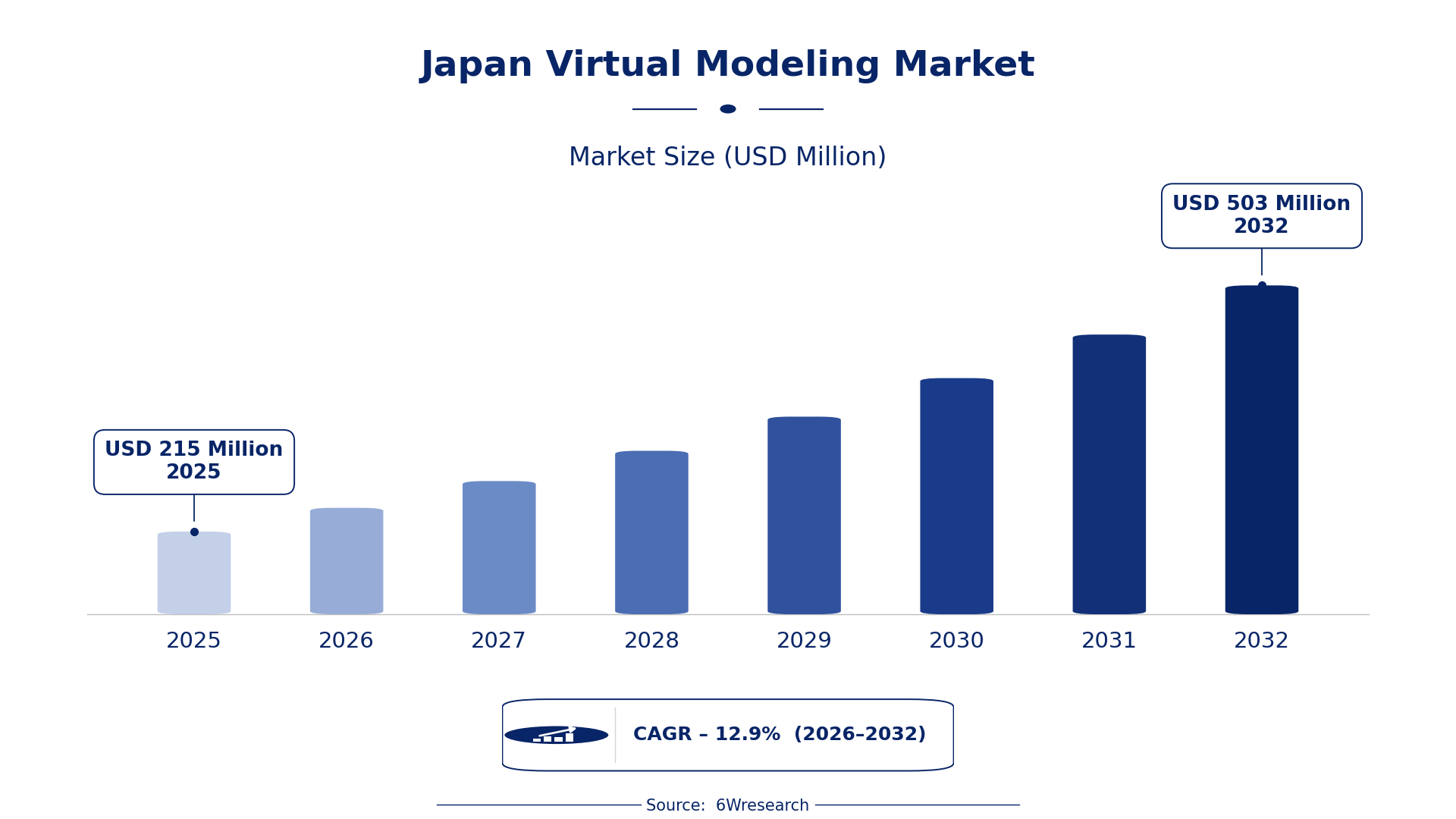
According to 6Wresearch internal database and industry insights, the Japan Virtual Modeling Market was valued at USD 215 Million in 2025 and is projected to reach USD 503 Million by 2032, growing at a CAGR of approximately 12.9% during 2026–2032.
Japan Virtual Modeling Market Highlights
| Report Metric | Details |
| Report Name | Japan Virtual Modeling Market (2026-2032) |
| Market Size 2025 | USD 215 Million |
| Market Size 2032 | USD 503 Million |
| Absolute Growth 2025–2032 | USD 288 Million |
| CAGR 2026–2032 | 12.9% |
| Peak Annual Growth | 13.6% in 2032 |
| Forecast Period | 2026–2032 |
| Historical Data | 2022–2025 |
| Base Year | 2025 |
| Leading Product Type, 2025 | 3D CAD Modeling (39% share) |
| Leading Application Area, 2025 | Product Design (39% share) |
| Leading Software Type, 2025 | Cloud-based CAD (35% share) |
| Leading Deployment Type, 2025 | SaaS (36% share) |
| Fastest-Growing Product Type | Simulation Modeling (19.1% CAGR) |
| Fastest-Growing Application Area | System Testing (15.6% CAGR) |
| Fastest-Growing Software Type | Simulation Software (19.7% CAGR) |
| Fastest-Growing Deployment Type | On-premise (15.4% CAGR) |
| Growing Sector | automotive |
| Key End Users | engineering firms, automotive manufacturers, aerospace companies, tech startups |
Japan Virtual Modeling Market Year-wise Growth Rate and Key Drivers (2022–2032)
This graph illustrates the annual growth rates of the market from 2022 to 2032, highlighting a steady upward trajectory and projected market expansion over the forecast period.
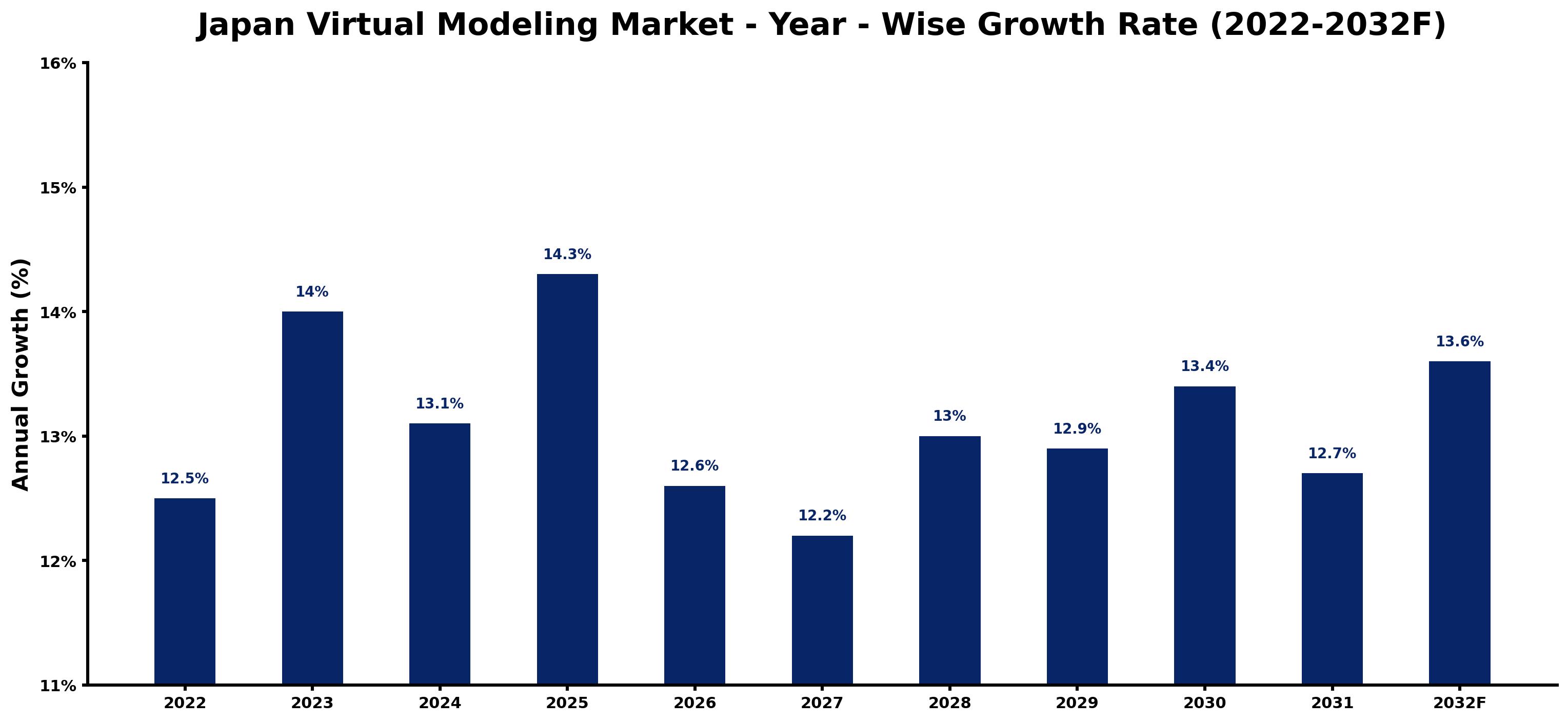
Annual growth estimates for each year appear below with the principal reason behind them, explaining the shifts that set the pace of the market.
| Year | Estimated Annual Growth (%) | Market Rationale |
| 2022 | 12.5 | The market experienced steady growth, driven by increased demand from engineering firms. |
| 2023 | 14.0 | Demand surged as more companies adopted advanced modeling technologies. |
| 2024 | 13.1 | Growth slowed slightly as firms adjusted to new software implementations. |
| 2025 | 14.3 | The market peaked, reflecting strong investment in product design and prototyping. |
| 2026 | 12.6 | A slight slowdown occurred as companies focused on optimizing existing technologies. |
| 2027 | 12.2 | Growth continued to slow as the market matured and competition intensified. |
| 2028 | 13.0 | Demand picked up again with renewed interest in advanced modeling solutions. |
| 2029 | 12.9 | The market saw another slowdown as firms consolidated their positions. |
| 2030 | 13.4 | Growth is expected to accelerate as new applications for AI-based modeling emerge. |
| 2031 | 12.7 | A slowdown is projected as market saturation begins to affect new investments. |
| 2032 | 13.6 | The market is expected to rebound with a strong focus on advanced simulation technologies. |
Note: Market size estimations and growth projections presented in this report are based on 6Wresearch's proprietary forecasting methodology, utilizing the latest available industry data, government publications, and primary research inputs.
Japan Virtual Modeling Market Synopsis
Virtual modeling encompasses various digital techniques for creating simulations of physical objects, primarily through advanced software. The Japan Virtual Modeling Market is growing rapidly, driven by over 1,000 engineering firms in Tokyo and strong demand from the automotive sector, which represents 40% of virtual modeling services. Key contributors to this growth include government initiatives promoting digital transformation and the increasing adoption of AI technologies in modeling applications.
Market Dynamics Impact Analysis (2026–2032)
| Factor | Type | Impact | Primary Segment Affected |
| Rising demand from the automotive sector | Driver | High | Product Design |
| Increased investment in AI-based modeling technologies | Driver | High | AI-Based Modeling |
| Growing interest in simulation software for engineering applications | Opportunity | Medium | Simulation Modeling |
| Expansion of cloud-based CAD solutions among startups | Opportunity | Medium | Cloud-based CAD |
| High costs associated with advanced modeling technologies | Restraint | High | 3D CAD Modeling |
| Limited availability of skilled professionals in the field | Restraint | Medium | System Testing |
| Compliance with evolving industry standards | Challenge | High | Simulation Software |
| Maintaining competitive pricing in a saturated market | Challenge | Medium | Cloud-based CAD |
Evaluation of Drivers in Japan Virtual Modeling Market (2026–2032)
These are the developments adding the most demand over the forecast period.
| Drivers | Primary Segment Affected | Why It Matters (Evidence) |
| Increased demand for product design services | Product Design | The automotive sector accounts for 40% of demand, driving purchases of virtual modeling services. |
| Growing investment in AI technologies | AI-Based Modeling | The government aims for a 30% increase in AI adoption by 2025, leading to more AI-based modeling projects. |
| Expansion of simulation software usage | Simulation Modeling | Japan ranks third globally in simulation software adoption, encouraging firms to invest in these technologies. |
| Preference for cloud-based CAD solutions | Cloud-based CAD | 70% of startups in the tech industry prefer cloud solutions for flexibility and collaboration. |
| Rising focus on digital transformation in manufacturing | System Testing | The Tokyo Metropolitan Government promotes digital transformation, increasing demand for system testing services. |
Several shifts outside the market lift sales. The automotive sector, accounting for 40% of demand, drives purchases for product design services. Investment in AI technologies is projected to increase by 30% by 2025, resulting in more AI-based modeling projects. Japan ranks third globally in simulation software adoption, which encourages firms to invest in these technologies. In addition, a significant push for digital transformation in manufacturing fuels demand for system testing services, creating a vibrant market environment.
Evaluation of Restraints in Japan Virtual Modeling Market
These restraints slow adoption and weigh on supplier margins.
| Market Restraint | Primary Segment Affected | Why It Matters (Evidence) |
| High costs associated with advanced modeling technologies | 3D CAD Modeling | The average annual investment in virtual modeling technologies is estimated at 500 million yen, limiting access for smaller firms. |
| Limited availability of skilled professionals in the field | System Testing | The average age of engineers in Japan is 45, creating a need for new talent in the industry. |
| Compliance with evolving industry standards | Simulation Software | ISO 9001 is widely adopted, requiring companies to invest in compliance measures. |
| Pressure to maintain competitive pricing | Cloud-based CAD | As competition increases, firms must balance quality and cost, affecting profit margins. |
| Challenges in integrating new technologies | AI-Based Modeling | Many firms struggle with the transition to AI-based solutions, delaying project timelines. |
Japan Virtual Modeling Market Challenges
In 2023, the cost of complying with ISO 9001 standards burdens engineering firms in Tokyo with an average expense of 100 million yen annually, delaying project timelines for producers needing quality assurance. Buyers in the automotive sector encounter sourcing difficulties, with 40% reporting challenges in obtaining virtual modeling services, disrupting their product development cycles. Operational costs are increasing, with annual technology investments estimated at 500 million yen, straining budgets for firms and limiting their ability to adopt new tools. An ageing workforce, with an average age of 45, creates a skills gap, complicating recruitment for startups seeking fresh talent.
Trends in the Japan Virtual Modeling Market
Several trends are reshaping the Japan Virtual Modeling Market; the most important are set out below.
- Shift towards AI-Based Modeling: The 2023 subsidy program for AI-based modeling technologies is driving firms to adopt these solutions, with a projected 30% increase in AI adoption by 2025.
- Transition to Cloud-Based Solutions: In 2023, 70% of startups in the tech industry preferred cloud-based CAD solutions, reflecting a shift towards flexible, collaborative environments.
- Emergence of Simulation Software: Japan ranks third globally in simulation software adoption, with over 300,000 licenses installed, indicating a growing reliance on these tools in engineering.
- Integration of AR/VR Tools in Education: AR/VR tools are increasingly integrated into engineering university programs, improving visualization skills among students and preparing them for industry demands.
Investment Opportunities in the Japan Virtual Modeling Market
The following opportunities in the Japan Virtual Modeling Market pair current demand with a clear way in.
- Partnerships for Digital Transformation: Now is the time to invest in partnerships with local firms focusing on digital transformation, particularly in the Kansai region, where manufacturing demand is high.
- Investment in AI-Based Solutions: With the government's target of 1,000 new AI startups by 2025, there is a strong opportunity to supply AI-based modeling technologies to emerging firms.
- Expansion of Simulation Software Offerings: The growing adoption of simulation software presents an opportunity to develop and supply tailored solutions for the automotive and aerospace industries.
- Focus on Educational Programs: Investing in educational programs that incorporate AR/VR tools can meet the rising demand for skilled professionals in the engineering sector.
Government Initiatives in the Japan Virtual Modeling Market
The Industrial Standardization Act, amended in 2019, governs JIS product and test standards, ensuring quality in virtual modeling practices. The AI Promotion Act, established in 2025, sets a national framework for AI research and development, encouraging innovation in modeling technologies.
The Digital Agency, established in September 2021, leads government initiatives for digital transformation, approving funding for projects that support digital skills in the workforce. In 2023, the Ministry of Economy, Trade and Industry launched a strategy to improve digital skills, benefiting virtual modeling producers and users.
Future Insight of the Japan Virtual Modeling Market
A policy-driven shift towards AI technologies will transform virtual modeling practices by 2032, compelling suppliers to diversify their offerings. The Tokyo Metropolitan Government's digital transformation initiative will boost demand for advanced modeling solutions. The government aims to increase AI adoption in modeling by 30% by 2025, enabling buyers to access a wider range of innovative products. The integration of AR/VR tools in engineering education will cultivate a new generation of skilled professionals, addressing the existing skills gap and supporting industry growth.
Market Segmentation Analysis
Japan Virtual Modeling Market report covers a detailed analysis of the following market segments:
By Product Type – 3D CAD Modeling Leads, Simulation Modeling Expected to Grow Fastest
According to Saurav Kr Singh, Senior Research Analyst at 6Wresearch, 3D CAD Modeling took 39% of product type revenue in 2025, more than any other category. 3D CAD modeling holds the largest share as it is essential for product design and engineering processes in sectors like automotive and aerospace. The strong demand from over 1,000 engineering firms in Tokyo highlights its critical role in efficient design workflows. The quickest growth will come from Simulation Modeling, forecast to expand at a CAGR of 19.1% between 2026 and 2032. Simulation modeling is witnessing rapid growth because it is critical for testing and validating designs before production. The government's subsidy program for advanced modeling technologies is expected to significantly accelerate this segment's expansion. Suppliers should focus on enhancing simulation capabilities to meet the increasing demand for effective validation processes.
By Application Area – Product Design Leads, System Testing Expected to Grow Fastest
Product Design held 39% of the Japan Virtual Modeling Market by application area in 2025. Product design is the leading application area, serving as a fundamental function across industries such as automotive and aerospace. The reliance on this application is evident from the extensive installed base of simulation software, exceeding 300,000 licenses. Over 2026–2032, System Testing is expected to post the fastest growth, at a CAGR of 15.6%. System testing is experiencing the fastest growth as it is necessary for ensuring product reliability and performance. The recent showcase of advancements in this area during Tokyo Design Week 2023 reflects its rising importance in the market. Buyers should prioritise investment in robust system testing solutions to improve product reliability.
By Software Type – Cloud-based CAD Leads, Simulation Software Expected to Grow Fastest
Cloud-based CAD accounted for 35% of the market by software type in 2025. Cloud-based CAD is the dominant software type, favoured for its flexibility and collaborative features that cater to modern engineering needs. Approximately 70% of startups in the tech industry prefer this solution, indicating its widespread acceptance. Simulation Software is set to record the highest CAGR in this split, 19.7% over 2026–2032. Simulation software is the fastest-growing type, widely used for various engineering applications that require accurate modelling. The increasing adoption of simulation software is likely to be supported by the government's push for digital transformation in manufacturing. Suppliers should prioritise developing advanced simulation software to capitalise on this growth trend.
By Deployment Type – SaaS Lead, On-premise Expected to Grow Fastest
With 36% of deployment type revenue in 2025, SaaS was the largest category. SaaS is the leading deployment type, preferred by many businesses for its scalability and ease of access. This model aligns well with the needs of over 1,000 engineering firms in Tokyo, who seek efficient solutions. On-premise is projected to grow fastest, at a CAGR of 15.4% during 2026–2032. On-premise deployment is growing rapidly as it caters to companies with specific data security needs. The average annual investment in virtual modeling technologies, estimated at 500 million yen, suggests a strong commitment to secure solutions. Buyers requiring stringent data security should consider on-premise solutions as a viable option.
Key Attractiveness of the Report
- 10 Years of Market Numbers
- Historical Data Starting from 2022 to 2025
- Base Year 2025
- Forecast Data until 2032
- Key Performance Indicators Impacting the Market
- Major Upcoming Developments and Projects
Key Highlights of the Report:
- Japan Virtual Modeling Market Outlook
- Market Size of Japan Virtual Modeling Market, 2025
- Forecast of Japan Virtual Modeling Market, 2032
- Historical Data and Forecast of Japan Virtual Modeling Revenues & Volume for the Period 2022-2032F
- Japan Virtual Modeling Market Trend Evolution
- Japan Virtual Modeling Market Drivers and Challenges
- Japan Virtual Modeling Price Trends
- Japan Virtual Modeling Porter's Five Forces
- Japan Virtual Modeling Industry Life Cycle
- Historical Data and Forecast of Japan Virtual Modeling Market Revenues & Volume By Product Type for the Period 2022-2032F
- Historical Data and Forecast of Japan Virtual Modeling Market Revenues & Volume By 3D CAD Modeling for the Period 2022-2032F
- Historical Data and Forecast of Japan Virtual Modeling Market Revenues & Volume By Simulation Modeling for the Period 2022-2032F
- Historical Data and Forecast of Japan Virtual Modeling Market Revenues & Volume By Visual Modeling for the Period 2022-2032F
- Historical Data and Forecast of Japan Virtual Modeling Market Revenues & Volume By Mathematical Modeling for the Period 2022-2032F
- Historical Data and Forecast of Japan Virtual Modeling Market Revenues & Volume By AI-Based Modeling for the Period 2022-2032F
- Historical Data and Forecast of Japan Virtual Modeling Market Revenues & Volume By Application Area for the Period 2022-2032F
- Historical Data and Forecast of Japan Virtual Modeling Market Revenues & Volume By Product Design for the Period 2022-2032F
- Historical Data and Forecast of Japan Virtual Modeling Market Revenues & Volume By System Testing for the Period 2022-2032F
- Historical Data and Forecast of Japan Virtual Modeling Market Revenues & Volume By Prototyping for the Period 2022-2032F
- Historical Data and Forecast of Japan Virtual Modeling Market Revenues & Volume By Computational Analysis for the Period 2022-2032F
- Historical Data and Forecast of Japan Virtual Modeling Market Revenues & Volume By Predictive Analysis for the Period 2022-2032F
- Historical Data and Forecast of Japan Virtual Modeling Market Revenues & Volume By Software Type for the Period 2022-2032F
- Historical Data and Forecast of Japan Virtual Modeling Market Revenues & Volume By Cloud-based CAD for the Period 2022-2032F
- Historical Data and Forecast of Japan Virtual Modeling Market Revenues & Volume By Simulation Software for the Period 2022-2032F
- Historical Data and Forecast of Japan Virtual Modeling Market Revenues & Volume By AR/VR Tools for the Period 2022-2032F
- Historical Data and Forecast of Japan Virtual Modeling Market Revenues & Volume By Modeling Platforms for the Period 2022-2032F
- Historical Data and Forecast of Japan Virtual Modeling Market Revenues & Volume By AI/ML Software for the Period 2022-2032F
- Historical Data and Forecast of Japan Virtual Modeling Market Revenues & Volume By Deployment Type for the Period 2022-2032F
- Historical Data and Forecast of Japan Virtual Modeling Market Revenues & Volume By SaaS for the Period 2022-2032F
- Historical Data and Forecast of Japan Virtual Modeling Market Revenues & Volume By On-premise for the Period 2022-2032F
- Historical Data and Forecast of Japan Virtual Modeling Market Revenues & Volume By Hybrid for the Period 2022-2032F
- Historical Data and Forecast of Japan Virtual Modeling Market Revenues & Volume By Cloud for the Period 2022-2032F
- Historical Data and Forecast of Japan Virtual Modeling Market Revenues & Volume By Cloud for the Period 2022-2032F
- Japan Virtual Modeling Import Export Trade Statistics
- Market Opportunity Assessment By Product Type
- Market Opportunity Assessment By Application Area
- Market Opportunity Assessment By Software Type
- Market Opportunity Assessment By Deployment Type
- Japan Virtual Modeling Top Companies Market Share
- Japan Virtual Modeling Competitive Benchmarking By Technical and Operational Parameters
- Japan Virtual Modeling Company Profiles
- Japan Virtual Modeling Key Strategic Recommendations
Market Covered
This report examines the market across the segments below.
By Product Type
- 3D CAD Modeling
- Simulation Modeling
- Visual Modeling
- Mathematical Modeling
- AI-Based Modeling
By Application Area
- Product Design
- System Testing
- Prototyping
- Computational Analysis
- Predictive Analysis
By Software Type
- Cloud-based CAD
- Simulation Software
- AR/VR Tools
- Modeling Platforms
- AI/ML Software
By Deployment Type
- SaaS
- On-premise
- Hybrid
- Cloud































