Japan Virtual Reality (VR) Content Market Size & Growth Rate
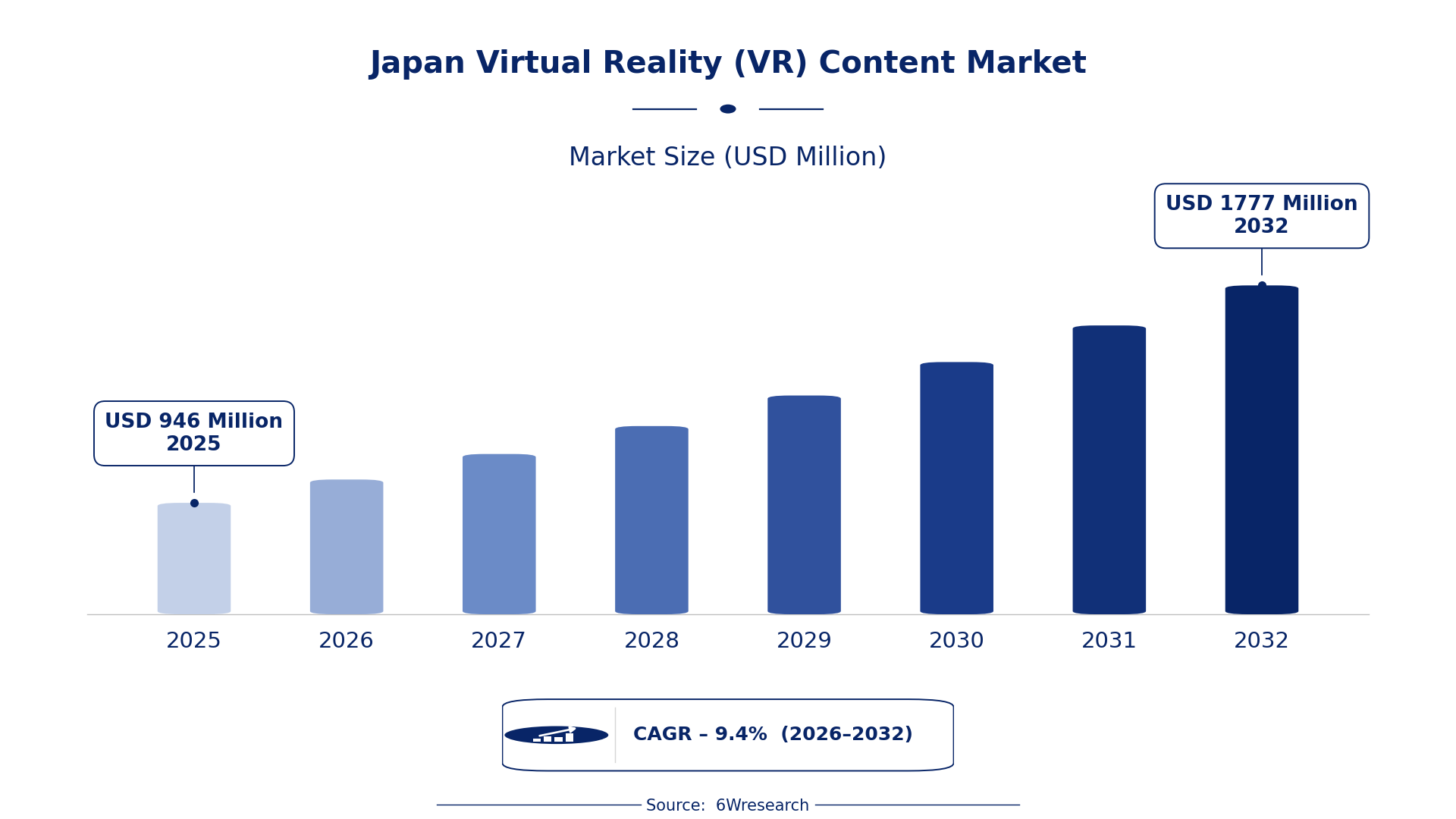
According to 6Wresearch internal database and industry insights, the Japan Virtual Reality (VR) Content Market was valued at USD 946 Million in 2025 and is projected to reach USD 1,777 Million by 2032, growing at a CAGR of approximately 9.4% during 2026–2032.
Japan Virtual Reality (VR) Content Market Highlights
| Report Metric | Details |
| Report Name | Japan Virtual Reality (VR) Content Market (2026-2032) |
| Market Size 2025 | USD 946 Million |
| Market Size 2032 | USD 1,777 Million |
| Absolute Growth 2025–2032 | USD 831 Million |
| CAGR 2026–2032 | 9.4% |
| Peak Annual Growth | 10.5% in 2029 |
| Forecast Period | 2026–2032 |
| Historical Data | 2022–2025 |
| Base Year | 2025 |
| Leading Content Type, 2025 | Interactive Games (34% share) |
| Leading Platform Type, 2025 | Mobile VR (42% share) |
| Leading Revenue Model, 2025 | Subscription-based (31% share) |
| Leading Distribution Mode, 2025 | Streaming Platforms (32% share) |
| Fastest-Growing Content Type | Educational Content (13.4% CAGR) |
| Fastest-Growing Platform Type | Enterprise VR (13.5% CAGR) |
| Fastest-Growing Revenue Model | B2B Subscription (13.1% CAGR) |
| Fastest-Growing Distribution Mode | eLearning Portals (12.1% CAGR) |
| Growing Sector | Educational VR |
| Key End Users | Educational institutions, corporate training departments, entertainment developers, technology startups |
Japan Virtual Reality (VR) Content Market Year-wise Growth Rate and Key Drivers (2022–2032)
This graph illustrates the annual growth rates of the market from 2022 to 2032, highlighting a steady upward trajectory and projected market expansion over the forecast period.
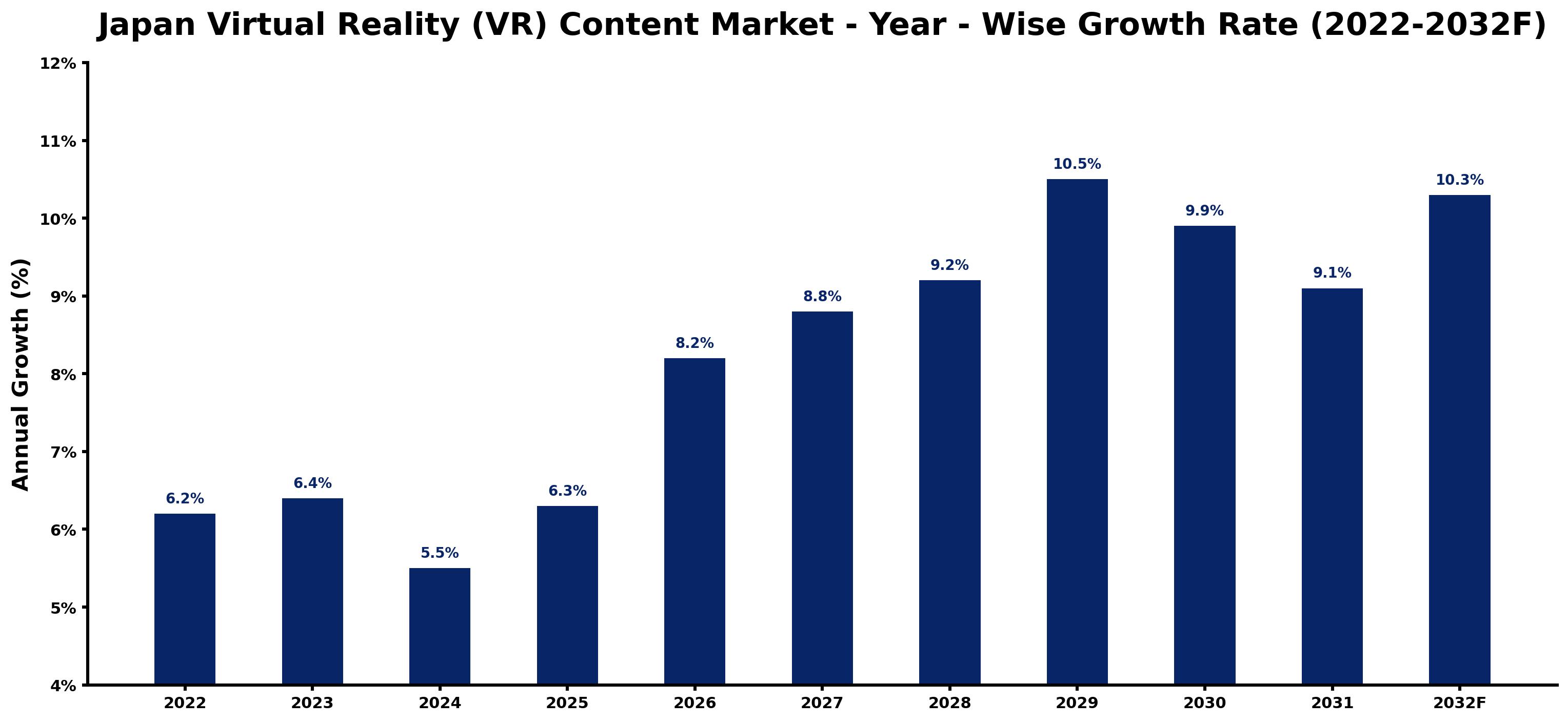
For each year, the table pairs the estimated growth rate with the leading influence on demand, showing how the drivers changed across the period.
| Year | Estimated Annual Growth (%) | Market Rationale |
| 2022 | 6.2 | The market experienced steady growth due to increasing user interest in VR technology. |
| 2023 | 6.4 | Demand rose as the number of VR users reached 10 million, boosting content consumption. |
| 2024 | 5.5 | Growth slowed slightly as competition intensified among content creators and platforms. |
| 2025 | 6.3 | A resurgence in corporate training initiatives led to faster growth in VR content adoption. |
| 2026 | 8.2 | Technological advancements in mobile VR are expected to benefit the market. |
| 2027 | 8.8 | Interest in educational VR content is projected to drive demand further. |
| 2028 | 9.2 | A rise in VR applications available in app stores is anticipated to increase user engagement. |
| 2029 | 10.5 | Peak growth is expected as immersive experiences gain traction in entertainment and education. |
| 2030 | 9.9 | The market will see a slight slowdown as saturation in some segments begins to occur. |
| 2031 | 9.1 | Growth will continue to decelerate as the market matures and competition increases. |
| 2032 | 10.3 | Demand for VR content is projected to rise as new technologies and applications emerge. |
Note: Market size estimations and growth projections presented in this report are based on 6Wresearch's proprietary forecasting methodology, utilizing the latest available industry data, government publications, and primary research inputs.
Japan Virtual Reality (VR) Content Market Synopsis
Virtual Reality (VR) Content in Japan encompasses immersive experiences created through advanced digital technology for entertainment, education, and training. The Japan Virtual Reality (VR) Content Market is expanding due to rising adoption among younger users, with 60% of users under 35. Key drivers include the growing popularity of mobile VR, which represents 40% of content consumption, and the integration of VR in educational settings, with over 500 schools utilizing VR for interactive learning experiences. The market is set to grow as corporate training and gaming sectors continue to embrace VR technology.
Market Dynamics Impact Analysis (2026–2032)
| Factor | Type | Impact | Primary Segment Affected |
| Increasing adoption of mobile VR technology | Driver | High | Mobile VR |
| Growing corporate training initiatives using VR | Driver | High | Training Modules |
| Expansion of VR content in educational institutions | Opportunity | High | Educational Content |
| Rising interest in VR for entertainment among younger demographics | Opportunity | Medium | Interactive Games |
| Competition among content creators leading to market fragmentation | Restraint | High | Interactive Games |
| Limited access to high-quality VR hardware for some users | Restraint | Medium | Head-mounted Devices |
| High production costs for developing immersive VR content | Challenge | High | Cinematic VR |
| Technological barriers in integrating VR into existing systems | Challenge | Medium | Enterprise VR |
Evaluation of Drivers in Japan Virtual Reality (VR) Content Market (2026–2032)
These are the developments adding the most demand over the forecast period.
| Drivers | Primary Segment Affected | Why It Matters (Evidence) |
| Rising number of VR users in Japan | Mobile VR | The number of VR users is estimated at 10 million, increasing demand for mobile VR content. |
| Corporate training adoption | Training Modules | Corporate training using VR has increased by 30% in the last year, prompting companies to invest in training solutions. |
| Integration of VR in STEM education | Educational Content | Support for VR integration in STEM has led to over 500 schools adopting educational VR resources. |
| Technological advancements in VR hardware | Head-mounted Devices | The adoption rate of VR in corporate training is expected to reach 25% by 2025, boosting hardware sales. |
| Popularity of VR gaming | Interactive Games | Japan's VR gaming sector is one of the largest globally, driving content creation. |
Purchasing is picking up as the number of VR users in Japan reached 10 million, boosting demand for immersive experiences. Corporate training using VR has surged, prompting companies to invest in advanced training solutions. The integration of VR in educational settings has led to over 500 schools adopting educational resources. Technological advancements in VR hardware are expected to improve user experiences, with the corporate training adoption rate projected to reach 25% by 2025. Japan's VR gaming sector, one of the largest globally, continues to drive content creation and consumer interest.
Evaluation of Restraints in Japan Virtual Reality (VR) Content Market
The table below lists the restraints and the evidence behind each.
| Market Restraint | Primary Segment Affected | Why It Matters (Evidence) |
| High production costs for immersive VR content | Cinematic VR | Developing quality VR content requires substantial investment, limiting production capabilities. |
| Limited access to high-quality VR hardware | Head-mounted Devices | Some users face barriers in acquiring advanced VR hardware, restricting market growth. |
| Market fragmentation due to competition | Interactive Games | Intense competition among content creators results in a fragmented market, complicating user choices. |
| Technological barriers in VR integration | Enterprise VR | Challenges in integrating VR into existing training systems hinder adoption in businesses. |
| Inconsistent quality of VR content | Educational Content | Variability in content quality affects user satisfaction and limits widespread adoption. |
Japan Virtual Reality (VR) Content Market Challenges
High production costs arise for buyers because developing immersive VR content demands advanced software and skilled personnel, which can push project budgets beyond 1 million yen. A shortage of skilled developers limits suppliers, as only 20% of tech graduates specialise in VR, causing delays in project timelines and reducing the talent pool for content creation. Local producers face intense competition from international markets, forcing them to lower prices and potentially reducing profit margins by up to 15%. Rapid technological advancements challenge suppliers, as keeping pace with evolving standards like ISO/IEC 30170 demands continuous investment, straining resources and impacting product quality.
Trends in the Japan Virtual Reality (VR) Content Market
Below are the shifts with the largest effect on the Japan Virtual Reality (VR) Content Market.
- Shift from Traditional to Interactive VR Content: The trend towards interactive VR content began in 2023, with educational institutions increasingly adopting immersive experiences. Over 500 schools are now utilizing VR for interactive learning, indicating a shift in educational methods.
- Increase in Mobile VR Adoption: Since 2022, mobile VR has gained traction, accounting for 40% of total VR content consumption. This shift is evident in the rise of accessible VR applications in app stores, catering to a broader audience.
- Growth of VR in Corporate Training: Starting in 2023, corporate training using VR has surged, with a 30% increase in adoption. This trend reflects the growing recognition of VR's effectiveness in skill development and employee training.
- Emergence of Educational VR Content: The launch of the government program to enhance VR technology in education in 2023 has spurred growth in educational VR content. Approximately 70% of schools are now exploring VR solutions for interactive learning.
Investment Opportunities in the Japan Virtual Reality (VR) Content Market
The following opportunities in the Japan Virtual Reality (VR) Content Market pair current demand with a clear way in.
- Educational Institutions Seeking VR Solutions: Schools across Japan are increasingly looking for VR content to improve learning experiences, with over 500 already utilizing it. This presents an opportunity for content developers to invest in educational VR.
- Corporate Training Facilities Adopting VR: With corporate training using VR increasing by 30% in the last year, companies are actively seeking innovative training solutions. Collaborating with local training providers can facilitate market entry.
- Growing Demand for Mobile VR Content: The rising number of mobile VR users, estimated at 10 million, creates a strong market for mobile content development. Engaging with app stores can provide a pathway for new developers.
- Investment in VR Startups: The Tokyo Metropolitan Government supports initiatives for VR startups, creating opportunities for investment. Establishing partnerships with local firms can strengthen market presence and innovation.
Government Initiatives in the Japan Virtual Reality (VR) Content Market
The PMD Act, established in 2014, regulates the approval and quality of pharmaceuticals and medical devices, impacting VR content development for healthcare training. This law ensures that VR applications meet safety and efficacy standards, benefiting producers and users alike. The Digital Agency, founded in September 2021, leads the government's digital transformation efforts, establishing common system standards that support the VR industry.
The Digital Agency funds programs that integrate VR technology into educational settings, improving learning experiences. This agency approves initiatives aimed at promoting VR content in schools, ensuring that educational institutions can access high-quality resources and training.
Future Insight of the Japan Virtual Reality (VR) Content Market
Educational institutions will increasingly integrate VR into their curriculums, with 70% exploring VR solutions by 2032, transforming learning experiences for students. Corporate training will evolve, with the adoption rate of VR in training expected to reach 25% by 2025, creating more engaging learning environments. The government’s ongoing programme to advance VR technology in education will stimulate innovation, benefiting both buyers and suppliers. Healthcare training will expand further, as 200 hospitals are already utilising VR, improving training outcomes and operational efficiency.
Market Segmentation Analysis
Japan Virtual Reality (VR) Content Market report covers a detailed analysis of the following market segments:
By Content Type – Interactive Games Lead, Educational Content Expected to Grow Fastest
According to Saurav Kr Singh, Senior Research Analyst at 6Wresearch, the largest content type category in 2025 was Interactive Games, at 34% of revenue. Interactive Games dominate the market as they are highly appealing to consumers, especially in the entertainment sector. The large number of VR users engaged in gaming creates a strong foundation for ongoing content development. Educational Content is set to record the highest CAGR in this split, 13.4% over 2026–2032. Educational Content is experiencing rapid growth, with over 500 schools in Japan incorporating VR to improve learning outcomes. This trend is further propelled by government initiatives aimed at enhancing VR technology in education. Suppliers should focus on developing engaging educational VR content to cater to the increasing demand from educational institutions.
By Platform Type – Mobile VR Leads, Enterprise VR Expected to Grow Fastest
Mobile VR took 42% of platform type revenue in 2025, more than any other category. Mobile VR holds the largest share due to its accessibility for a wide audience through smartphones, facilitating extensive engagement with VR content. The doubling of available VR applications in app stores reinforces this sub-segment's strength. The quickest growth will come from Enterprise VR, forecast to expand at a CAGR of 13.5% between 2026 and 2032. Enterprise VR is witnessing swift growth, highlighted by a 30% increase in corporate training using VR over the past year. This shift signifies a move towards more immersive training approaches that improve employee engagement and retention. Corporate buyers should consider investing in Enterprise VR solutions to maximise the effectiveness of their training initiatives.
By Revenue Model – Subscription-based Leads, B2B Subscription Expected to Grow Fastest
With 31% of revenue model revenue in 2025, Subscription-based was the largest category. Subscription-based models are prevalent as they offer users ongoing access to a diverse range of VR content, ensuring steady revenue streams for providers. This model aligns well with consumer preferences for continuous engagement in gaming and educational experiences. Over 2026–2032, B2B Subscription is expected to post the fastest growth, at a CAGR of 13.1%. B2B Subscription is rapidly gaining traction, particularly in corporate training sectors where companies seek reliable access to VR content for employee development. This growth is indicative of a broader trend towards subscription services in professional environments. Suppliers should explore B2B subscription offerings to meet the rising demand from corporate clients.
By Distribution Mode – Streaming Platforms Lead, eLearning Portals Expected to Grow Fastest
In 2025, Streaming Platforms led the distribution mode split with a 32% share. Streaming Platforms are the primary distribution method for VR content, allowing users to easily access a variety of experiences without the need for extensive downloads. This convenience has made streaming a preferred choice among consumers. eLearning Portals are projected to grow fastest, at a CAGR of 12.1% during 2026–2032. eLearning Portals are emerging as the fastest-growing distribution mode, as they integrate VR content into online education platforms, meeting the increasing demand for digital learning solutions. This shift highlights the importance of accessible educational resources. Suppliers must prioritise partnerships with eLearning platforms to effectively reach educational institutions.
Key Attractiveness of the Report
- 10 Years of Market Numbers
- Historical Data Starting from 2022 to 2025
- Base Year 2025
- Forecast Data until 2032
- Key Performance Indicators Impacting the Market
- Major Upcoming Developments and Projects
Key Highlights of the Report:
- Japan Virtual Reality (VR) Content Market Outlook
- Market Size of Japan Virtual Reality (VR) Content Market, 2025
- Forecast of Japan Virtual Reality (VR) Content Market, 2032
- Historical Data and Forecast of Japan Virtual Reality (VR) Content Revenues & Volume for the Period 2022-2032F
- Japan Virtual Reality (VR) Content Market Trend Evolution
- Japan Virtual Reality (VR) Content Market Drivers and Challenges
- Japan Virtual Reality (VR) Content Price Trends
- Japan Virtual Reality (VR) Content Porter's Five Forces
- Japan Virtual Reality (VR) Content Industry Life Cycle
- Historical Data and Forecast of Japan Virtual Reality (VR) Content Market Revenues & Volume By Content Type for the Period 2022-2032F
- Historical Data and Forecast of Japan Virtual Reality (VR) Content Market Revenues & Volume By 360-Degree Videos for the Period 2022-2032F
- Historical Data and Forecast of Japan Virtual Reality (VR) Content Market Revenues & Volume By Interactive Games for the Period 2022-2032F
- Historical Data and Forecast of Japan Virtual Reality (VR) Content Market Revenues & Volume By Cinematic VR for the Period 2022-2032F
- Historical Data and Forecast of Japan Virtual Reality (VR) Content Market Revenues & Volume By Educational Content for the Period 2022-2032F
- Historical Data and Forecast of Japan Virtual Reality (VR) Content Market Revenues & Volume By Training Modules for the Period 2022-2032F
- Historical Data and Forecast of Japan Virtual Reality (VR) Content Market Revenues & Volume By Platform Type for the Period 2022-2032F
- Historical Data and Forecast of Japan Virtual Reality (VR) Content Market Revenues & Volume By Mobile VR for the Period 2022-2032F
- Historical Data and Forecast of Japan Virtual Reality (VR) Content Market Revenues & Volume By Console VR for the Period 2022-2032F
- Historical Data and Forecast of Japan Virtual Reality (VR) Content Market Revenues & Volume By Head-mounted Devices for the Period 2022-2032F
- Historical Data and Forecast of Japan Virtual Reality (VR) Content Market Revenues & Volume By Educational VR for the Period 2022-2032F
- Historical Data and Forecast of Japan Virtual Reality (VR) Content Market Revenues & Volume By Enterprise VR for the Period 2022-2032F
- Historical Data and Forecast of Japan Virtual Reality (VR) Content Market Revenues & Volume By Revenue Model for the Period 2022-2032F
- Historical Data and Forecast of Japan Virtual Reality (VR) Content Market Revenues & Volume By Subscription-based for the Period 2022-2032F
- Historical Data and Forecast of Japan Virtual Reality (VR) Content Market Revenues & Volume By Pay-per-use for the Period 2022-2032F
- Historical Data and Forecast of Japan Virtual Reality (VR) Content Market Revenues & Volume By Ad-based for the Period 2022-2032F
- Historical Data and Forecast of Japan Virtual Reality (VR) Content Market Revenues & Volume By Licensing for the Period 2022-2032F
- Historical Data and Forecast of Japan Virtual Reality (VR) Content Market Revenues & Volume By B2B Subscription for the Period 2022-2032F
- Historical Data and Forecast of Japan Virtual Reality (VR) Content Market Revenues & Volume By Distribution Mode for the Period 2022-2032F
- Historical Data and Forecast of Japan Virtual Reality (VR) Content Market Revenues & Volume By Streaming Platforms for the Period 2022-2032F
- Historical Data and Forecast of Japan Virtual Reality (VR) Content Market Revenues & Volume By App Stores for the Period 2022-2032F
- Historical Data and Forecast of Japan Virtual Reality (VR) Content Market Revenues & Volume By VR Theaters for the Period 2022-2032F
- Historical Data and Forecast of Japan Virtual Reality (VR) Content Market Revenues & Volume By eLearning Portals for the Period 2022-2032F
- Historical Data and Forecast of Japan Virtual Reality (VR) Content Market Revenues & Volume By Corporate Portals for the Period 2022-2032F
- Japan Virtual Reality (VR) Content Import Export Trade Statistics
- Market Opportunity Assessment By Content Type
- Market Opportunity Assessment By Platform Type
- Market Opportunity Assessment By Revenue Model
- Market Opportunity Assessment By Distribution Mode
- Japan Virtual Reality (VR) Content Top Companies Market Share
- Japan Virtual Reality (VR) Content Competitive Benchmarking By Technical and Operational Parameters
- Japan Virtual Reality (VR) Content Company Profiles
- Japan Virtual Reality (VR) Content Key Strategic Recommendations
Market Covered
This report examines the market across the segments below.
By Content Type
- 360-Degree Videos
- Interactive Games
- Cinematic VR
- Educational Content
- Training Modules
By Platform Type
- Mobile VR
- Console VR
- Head-mounted Devices
- Educational VR
- Enterprise VR
By Revenue Model
- Subscription-based
- Pay-per-use
- Ad-based
- Licensing
- B2B Subscription
By Distribution Mode
- Streaming Platforms
- App Stores
- VR Theaters
- eLearning Portals
- Corporate Portals































