Japan Virtual Shopping Experience Market Size & Growth Rate
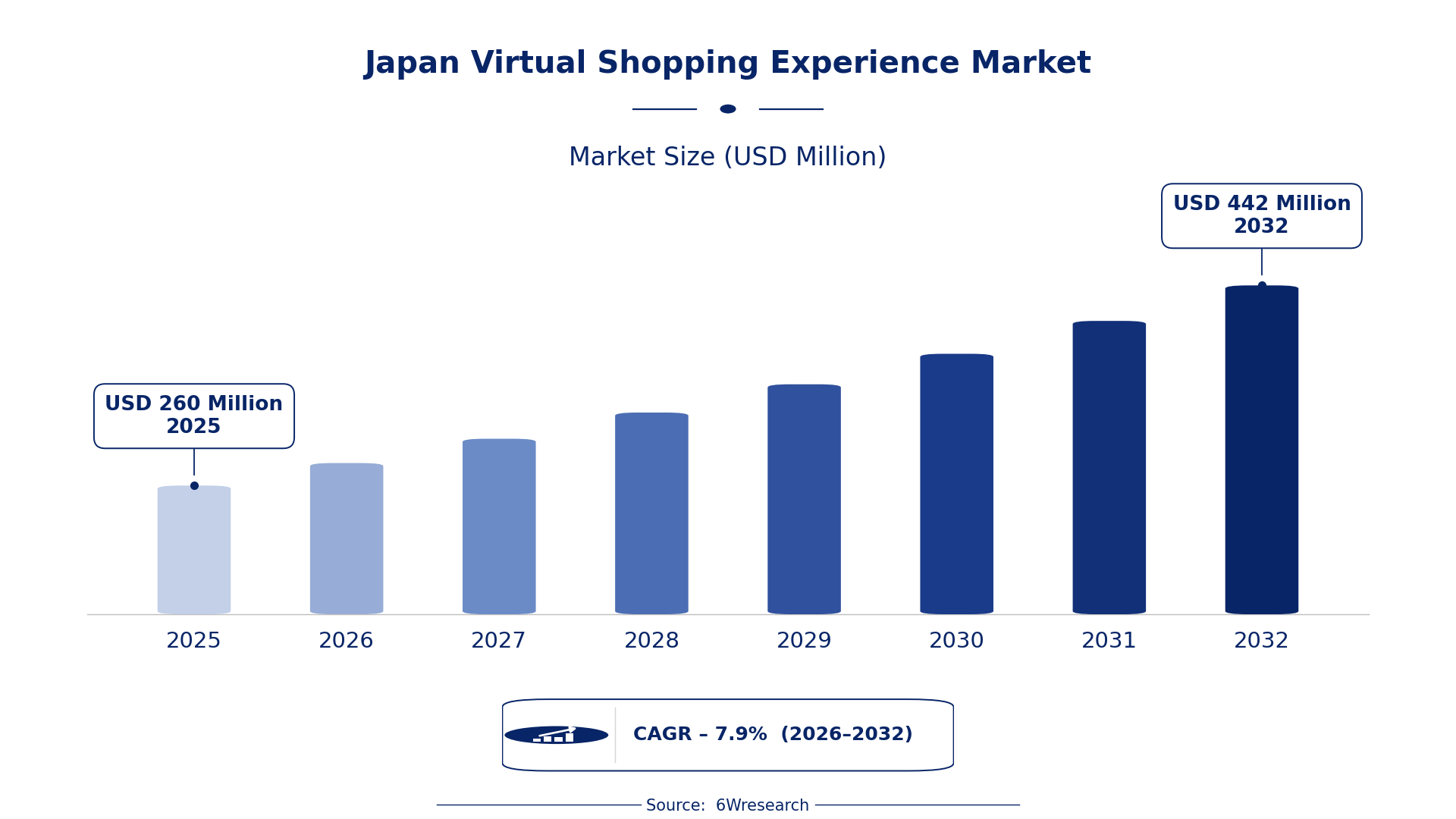
According to 6Wresearch internal database and industry insights, the Japan Virtual Shopping Experience Market was valued at USD 260 Million in 2025 and is projected to reach USD 442 Million by 2032, growing at a CAGR of approximately 7.9% during 2026–2032.
Japan Virtual Shopping Experience Market Highlights
| Report Metric | Details |
| Report Name | Japan Virtual Shopping Experience Market (2026-2032) |
| Market Size 2025 | USD 260 Million |
| Market Size 2032 | USD 442 Million |
| Absolute Growth 2025–2032 | USD 182 Million |
| CAGR 2026–2032 | 7.9% |
| Peak Annual Growth | 11.5% in 2026 |
| Forecast Period | 2026–2032 |
| Historical Data | 2022–2025 |
| Base Year | 2025 |
| Leading Experience Type, 2025 | Virtual Storefront (52% share) |
| Leading Technology Used, 2025 | AR + AI (44% share) |
| Leading Platform Type, 2025 | Mobile App (29% share) |
| Leading Distribution Channel, 2025 | E-commerce Platforms (32% share) |
| Fastest-Growing Experience Type | AR Shopping App (10.7% CAGR) |
| Fastest-Growing Platform Type | Web-based (11.5% CAGR) |
| Fastest-Growing Distribution Channel | Brand Websites (10.1% CAGR) |
| Growing Sector | E-commerce |
| Key End Users | retailers, e-commerce platforms, tech startups, consumers |
Japan Virtual Shopping Experience Market Year-wise Growth Rate and Key Drivers (2022–2032)
This graph illustrates the annual growth rates of the market from 2022 to 2032, highlighting a steady upward trajectory and projected market expansion over the forecast period.
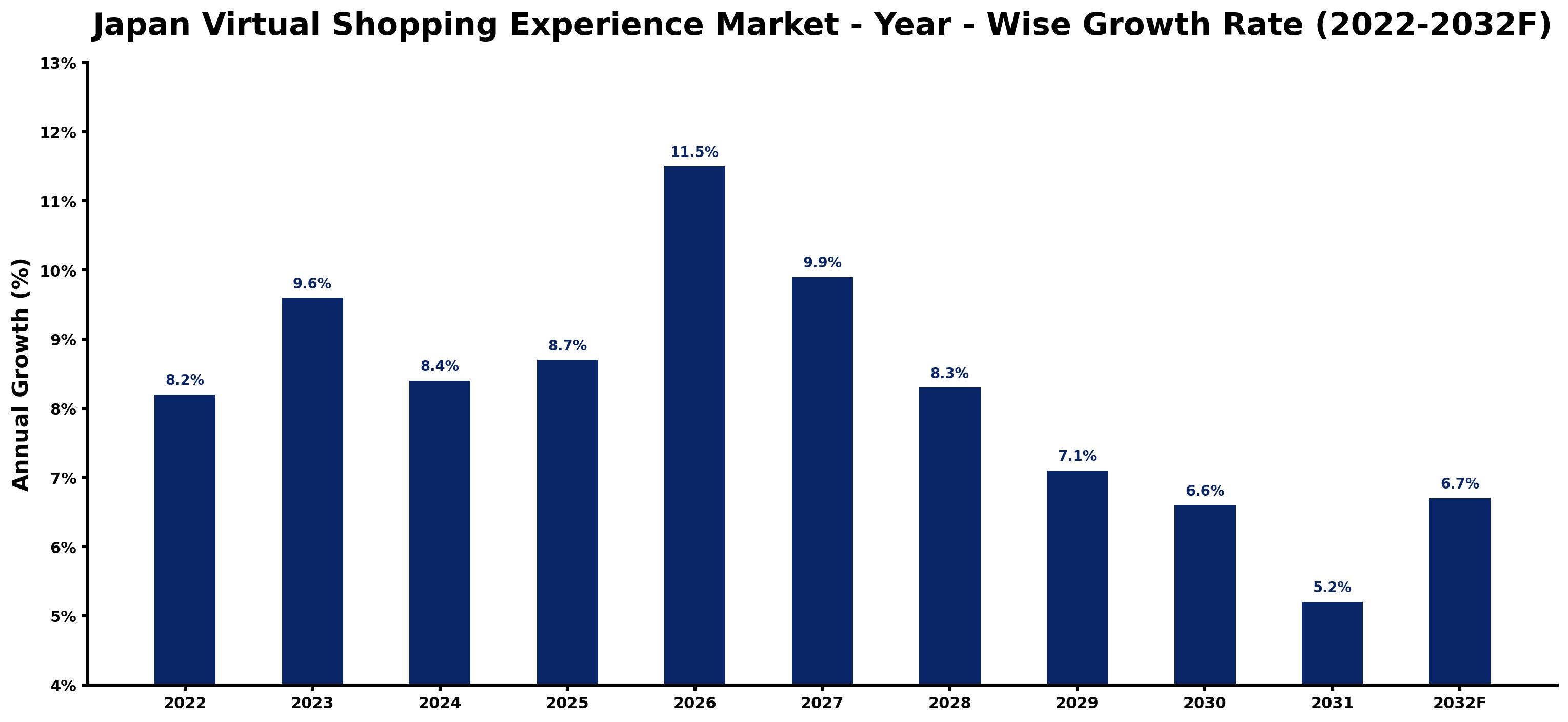
Below, each year's estimated growth is shown next to the factor that most influenced it.
| Year | Estimated Annual Growth (%) | Market Rationale |
| 2022 | 8.2 | The market experienced steady growth, driven by increasing interest in immersive shopping solutions. |
| 2023 | 9.6 | Growth accelerated as consumer interest in AR shopping experiences rose. |
| 2024 | 8.4 | Growth slowed slightly as the market adjusted to new technology adoption rates. |
| 2025 | 8.7 | The market saw renewed growth as retailers began implementing virtual shopping technologies. |
| 2026 | 11.5 | Demand surged as innovations in AR and AI technologies unlocked new shopping experiences. |
| 2027 | 9.9 | Growth slowed as the market began to stabilise after rapid adoption phases. |
| 2028 | 8.3 | A continued slowdown marked the market as saturation in early adopters occurred. |
| 2029 | 7.1 | The market maintained growth, albeit at a slower rate due to maturing technology. |
| 2030 | 6.6 | Demand continued to slow as the market reached a more stable phase of development. |
| 2031 | 5.2 | The market further stabilised, reflecting a mature phase in virtual shopping experiences. |
| 2032 | 6.7 | Growth picked up again as new innovations and consumer interest reignited demand. |
Note: Market size estimations and growth projections presented in this report are based on 6Wresearch's proprietary forecasting methodology, utilizing the latest available industry data, government publications, and primary research inputs.
Japan Virtual Shopping Experience Market Synopsis
The Virtual Shopping Experience combines augmented reality and virtual reality to create immersive environments for consumers. This market is expanding rapidly, with strong interest from both e-commerce platforms and retail sectors. Over 70% of consumers express interest in AR shopping experiences, and by 2025, half of all retailers are expected to adopt these technologies, improving customer engagement and satisfaction.
Market Dynamics Impact Analysis (2026–2032)
| Factor | Type | Impact | Primary Segment Affected |
| Increased consumer interest in immersive shopping experiences | Driver | High | AR Shopping App |
| Growing adoption of mobile shopping technologies | Driver | High | Mobile App |
| Expansion of e-commerce platforms integrating AR features | Opportunity | High | E-commerce Platforms |
| Rising demand for engaging brand experiences through virtual interfaces | Opportunity | High | Virtual Storefront |
| High development costs associated with AR and VR technologies | Restraint | Medium | AR + AI |
| Limited awareness among traditional retailers of virtual shopping benefits | Restraint | Medium | Interactive Product Preview |
| Challenges in integrating new technologies into existing retail systems | Challenge | High | Avatar Try-On |
| Consumer hesitation towards adopting new shopping experiences | Challenge | Medium | Live VR Shopping |
Evaluation of Drivers in Japan Virtual Shopping Experience Market (2026–2032)
These are the developments adding the most demand over the forecast period.
| Drivers | Primary Segment Affected | Why It Matters (Evidence) |
| Investment in AR and VR technologies by retailers | Virtual Storefront | This investment increases customer engagement, leading to higher sales, as evidenced by the 30% rise in AR shopping app downloads in 2023. |
| Consumer demand for personalised shopping experiences | AR + AI | This demand compels retailers to implement AI simulations, resulting in improved customer satisfaction and repeat purchases. |
| Growth of the e-commerce sector in Japan | E-commerce Platforms | With the e-commerce market reaching ¥19 trillion in 2023, retailers are motivated to adopt virtual shopping solutions to stay competitive. |
| Technological advancements in mobile devices | Mobile App | As 80% of the Japanese population uses smartphones, retailers are increasingly focusing on mobile shopping applications to meet consumer expectations. |
| Support from industry associations for AR technology | AR Shopping App | The Japan Virtual and Augmented Reality Association promotes industry growth, encouraging more retailers to adopt AR shopping technologies. |
What keeps demand rising is substantial investment in AR and VR technologies by retailers, which increases customer engagement. In 2023, AR shopping apps experienced a 30% increase in downloads, reflecting consumer interest in personalised experiences. The e-commerce market reached ¥19 trillion, prompting retailers to adopt virtual shopping solutions. With 80% of the population using smartphones, mobile shopping applications are becoming increasingly important. Support from industry associations is driving the adoption of AR technologies, resulting in more immersive experiences for consumers.
Evaluation of Restraints in Japan Virtual Shopping Experience Market
These are the pressures that could keep growth below its potential.
| Market Restraint | Primary Segment Affected | Why It Matters (Evidence) |
| High costs associated with developing AR and VR technologies | AR + AI | These costs can deter smaller retailers from adopting new technologies, limiting market growth opportunities. |
| Limited understanding of virtual shopping benefits among traditional retailers | Interactive Product Preview | This lack of awareness can slow the adoption of new shopping solutions, affecting overall market expansion. |
| Challenges in integrating new technologies into existing retail systems | Avatar Try-On | Retailers face difficulties in merging these technologies, which can delay implementation and reduce competitiveness. |
| Consumer hesitation towards new shopping experiences | Live VR Shopping | This hesitation can limit the uptake of virtual shopping solutions, impacting overall market growth. |
| Regulatory challenges in implementing new technologies | Virtual Storefront | Compliance with standards can complicate the integration of AR and VR solutions, hindering market progress. |
Japan Virtual Shopping Experience Market Challenges
High development costs for advanced software can reach ¥500 million per project, delaying virtual shopping experiences for producers. Many retailers face challenges with technology integration, leading to a 20% slowdown in adoption rates and limiting options for buyers. Regulatory compliance with the JIS X 0133 standard imposes additional burdens that can extend project timelines by up to six months for retailers. Local tech talent shortages create supply chain issues, causing project delays of 30% for producers during peak demand periods, ultimately affecting the availability of immersive shopping solutions for consumers.
Trends in the Japan Virtual Shopping Experience Market
These developments are changing demand patterns in the Japan Virtual Shopping Experience Market.
- Shift towards Mobile Shopping Solutions: Tokyo is experiencing a notable shift towards mobile shopping solutions, with 80% of the population using smartphones. This trend is prompting retailers to develop mobile applications that improve user experience, resulting in increased sales.
- Transition to AR Shopping Experiences: Consumer preferences are transitioning towards AR shopping experiences, as over 70% express interest. The Tokyo Game Show 2023 showcased several innovations in this area, indicating a growing market for immersive shopping.
- AR + AI Integration Gaining Momentum: The integration of AR and AI technologies is gaining traction, with AR + AI applications expected to dominate the market. By 2025, 50% of retailers are projected to adopt these technologies, improving customer engagement.
- Emergence of Smart Mirrors in Retail: Smart mirrors are being tested in over 100 retail locations across Japan, providing interactive experiences for consumers. This innovation is expected to improve customer engagement and drive sales in physical stores.
Investment Opportunities in the Japan Virtual Shopping Experience Market
Investors looking at the Japan Virtual Shopping Experience Market should consider the following areas.
- Partnerships with Tech Startups: Retailers can collaborate with tech startups to develop effective AR solutions, addressing the growing demand for immersive shopping experiences. The government's 2023 program supports tech startups in the retail sector, providing funding opportunities.
- Integrating AR Features into E-commerce Platforms: E-commerce platforms need to integrate more AR features to meet rising consumer expectations. With the e-commerce market reaching ¥19 trillion in 2023, this presents a substantial growth opportunity for retailers.
- Investment in Mobile Shopping Applications: Investing in mobile shopping applications is essential as 80% of the population uses smartphones. Retailers can improve user experience by developing dedicated apps that cater to this demand.
- Utilising Industry Support for AR Technologies: Retailers should take advantage of the support from industry associations to adopt AR technologies. The Japan Virtual and Augmented Reality Association is promoting growth in this sector, encouraging more retailers to innovate.
Government Initiatives in the Japan Virtual Shopping Experience Market
The Act against Unjustifiable Premiums and Misleading Representations, established in 1962, prohibits misleading labelling and advertising of goods. This law ensures that virtual shopping experiences in Japan maintain transparency and trust, benefiting both consumers and retailers.
In 2023, the government launched a program to support tech startups in the retail sector, with a budget of JPY 150 billion. The Digital Agency oversees this initiative, aiming to stimulate innovation and improve the retail sector.
Future Insight of the Japan Virtual Shopping Experience Market
The introduction of interactive kiosks in retail locations will enhance customer experiences and streamline purchasing processes. By 2025, half of all retailers will adopt virtual shopping technologies, driven by the growing consumer interest in immersive environments. Government initiatives to support tech startups will spur innovation, allowing suppliers to develop more engaging shopping experiences. As e-commerce in Japan continues to expand, buyers will benefit from a wider range of virtual shopping options.
Market Segmentation Analysis
Japan Virtual Shopping Experience Market report covers a detailed analysis of the following market segments:
By Experience Type – Virtual Storefront Leads, AR Shopping App Expected to Grow Fastest
According to Saurav Kr Singh, Senior Research Analyst at 6Wresearch, Virtual Storefront took 52% of experience type revenue in 2025, more than any other category. The Virtual Storefront holds the largest share as it provides a direct shopping interface that appeals to a diverse consumer base. This segment is particularly favoured in urban areas like Tokyo, where interest in immersive shopping experiences is high. AR Shopping App is set to record the highest CAGR in this split, 10.7% over 2026–2032. The AR Shopping App is rapidly growing due to its ability to allow users to visualise products in their own environments, making shopping more engaging. With a 30% increase in downloads in 2023, this segment is attracting a younger, tech-savvy demographic. Suppliers should prioritise the development of intuitive AR shopping applications to capture the growing interest in this segment.
By Technology Used – AR + AI Leads and Records the Fastest Growth
The largest technology used category in 2025 was AR + AI, at 44% of revenue. The AR + AI segment leads the market due to its ability to create immersive shopping experiences that resonate with consumers. This technology is particularly effective in enhancing online shopping, as evidenced by over 70% of consumers expressing interest in AR shopping experiences. AR + AI is also forecast to expand faster than any other category, at a CAGR of 9.1% over 2026–2032. The AR + AI segment will continue to grow rapidly, driven by increasing consumer demand for personalised shopping experiences. As more retailers adopt these technologies, the segment's lead will expand further, reinforcing its market position. Suppliers should prioritise advancements in AR and AI to align with consumer preferences and enhance their market presence.
By Platform Type – Mobile App Leads, Web-based Expected to Grow Fastest
In 2025, Mobile App led the platform type split with a 29% share. Mobile Apps hold the largest share as they provide convenient shopping access on mobile devices, aligning with the trend of increasing mobile shopping adoption in Japan. This segment caters to the preferences of the 80% of the population using smartphones. The quickest growth will come from Web-based, forecast to expand at a CAGR of 11.5% between 2026 and 2032. Web-based platforms are growing rapidly as they offer accessible shopping options for all users, appealing to a broader audience. As more consumers engage with online shopping, this segment is expected to flourish. Suppliers should ensure their platforms are optimised for both mobile and web to capture diverse consumer preferences.
By Distribution Channel – E-commerce Platforms Lead, Brand Websites Expected to Grow Fastest
E-commerce Platforms accounted for 32% of the market by distribution channel in 2025. E-commerce Platforms dominate as the primary distribution channel for virtual shopping experiences in Japan. This channel's significance is underscored by the overall growth of the e-commerce market, which reached ¥19 trillion in 2023. Brand Websites are projected to grow fastest, at a CAGR of 10.1% during 2026–2032. Brand Websites are experiencing the fastest growth as retailers focus on enhancing their online presence and direct consumer engagement. This trend indicates a shift towards more personalised shopping experiences through brand-specific platforms. Suppliers need to strengthen their presence on brand websites to leverage this growing distribution channel effectively.
Key Attractiveness of the Report
- 10 Years of Market Numbers
- Historical Data Starting from 2022 to 2025
- Base Year 2025
- Forecast Data until 2032
- Key Performance Indicators Impacting the Market
- Major Upcoming Developments and Projects
Key Highlights of the Report:
- Japan Virtual Shopping Experience Market Outlook
- Market Size of Japan Virtual Shopping Experience Market, 2025
- Forecast of Japan Virtual Shopping Experience Market, 2032
- Historical Data and Forecast of Japan Virtual Shopping Experience Revenues & Volume for the Period 2022-2032F
- Japan Virtual Shopping Experience Market Trend Evolution
- Japan Virtual Shopping Experience Market Drivers and Challenges
- Japan Virtual Shopping Experience Price Trends
- Japan Virtual Shopping Experience Porter's Five Forces
- Japan Virtual Shopping Experience Industry Life Cycle
- Historical Data and Forecast of Japan Virtual Shopping Experience Market Revenues & Volume By Experience Type for the Period 2022-2032F
- Historical Data and Forecast of Japan Virtual Shopping Experience Market Revenues & Volume By Virtual Storefront for the Period 2022-2032F
- Historical Data and Forecast of Japan Virtual Shopping Experience Market Revenues & Volume By AR Shopping App for the Period 2022-2032F
- Historical Data and Forecast of Japan Virtual Shopping Experience Market Revenues & Volume By Avatar Try-On for the Period 2022-2032F
- Historical Data and Forecast of Japan Virtual Shopping Experience Market Revenues & Volume By Live VR Shopping for the Period 2022-2032F
- Historical Data and Forecast of Japan Virtual Shopping Experience Market Revenues & Volume By Interactive Product Preview for the Period 2022-2032F
- Historical Data and Forecast of Japan Virtual Shopping Experience Market Revenues & Volume By Technology Used for the Period 2022-2032F
- Historical Data and Forecast of Japan Virtual Shopping Experience Market Revenues & Volume By 3D Web VR for the Period 2022-2032F
- Historical Data and Forecast of Japan Virtual Shopping Experience Market Revenues & Volume By AR + AI for the Period 2022-2032F
- Historical Data and Forecast of Japan Virtual Shopping Experience Market Revenues & Volume By AI-based Simulation for the Period 2022-2032F
- Historical Data and Forecast of Japan Virtual Shopping Experience Market Revenues & Volume By VR Livestreaming for the Period 2022-2032F
- Historical Data and Forecast of Japan Virtual Shopping Experience Market Revenues & Volume By 3D Modeling for the Period 2022-2032F
- Historical Data and Forecast of Japan Virtual Shopping Experience Market Revenues & Volume By Platform Type for the Period 2022-2032F
- Historical Data and Forecast of Japan Virtual Shopping Experience Market Revenues & Volume By Web-based for the Period 2022-2032F
- Historical Data and Forecast of Japan Virtual Shopping Experience Market Revenues & Volume By Mobile App for the Period 2022-2032F
- Historical Data and Forecast of Japan Virtual Shopping Experience Market Revenues & Volume By In-App for the Period 2022-2032F
- Historical Data and Forecast of Japan Virtual Shopping Experience Market Revenues & Volume By Headset + Web for the Period 2022-2032F
- Historical Data and Forecast of Japan Virtual Shopping Experience Market Revenues & Volume By Smart Mirrors for the Period 2022-2032F
- Historical Data and Forecast of Japan Virtual Shopping Experience Market Revenues & Volume By Distribution Channel for the Period 2022-2032F
- Historical Data and Forecast of Japan Virtual Shopping Experience Market Revenues & Volume By Brand Websites for the Period 2022-2032F
- Historical Data and Forecast of Japan Virtual Shopping Experience Market Revenues & Volume By App Stores for the Period 2022-2032F
- Historical Data and Forecast of Japan Virtual Shopping Experience Market Revenues & Volume By Brand Apps for the Period 2022-2032F
- Historical Data and Forecast of Japan Virtual Shopping Experience Market Revenues & Volume By E-commerce Platforms for the Period 2022-2032F
- Historical Data and Forecast of Japan Virtual Shopping Experience Market Revenues & Volume By In-store Kiosks for the Period 2022-2032F
- Japan Virtual Shopping Experience Import Export Trade Statistics
- Market Opportunity Assessment By Experience Type
- Market Opportunity Assessment By Technology Used
- Market Opportunity Assessment By Platform Type
- Market Opportunity Assessment By Distribution Channel
- Japan Virtual Shopping Experience Top Companies Market Share
- Japan Virtual Shopping Experience Competitive Benchmarking By Technical and Operational Parameters
- Japan Virtual Shopping Experience Company Profiles
- Japan Virtual Shopping Experience Key Strategic Recommendations
Market Covered
This report examines the market across the segments below.
By Experience Type
- Virtual Storefront
- AR Shopping App
- Avatar Try-On
- Live VR Shopping
- Interactive Product Preview
By Technology Used
- 3D Web VR
- AR + AI
- AI-based Simulation
- VR Livestreaming
- 3D Modeling
By Platform Type
- Web-based
- Mobile App
- In-App
- Headset + Web
- Smart Mirrors
By Distribution Channel
- Brand Websites
- App Stores
- Brand Apps
- E-commerce Platforms
- In-store Kiosks































