Japan Virtual Testing Solutions Market Size & Growth Rate
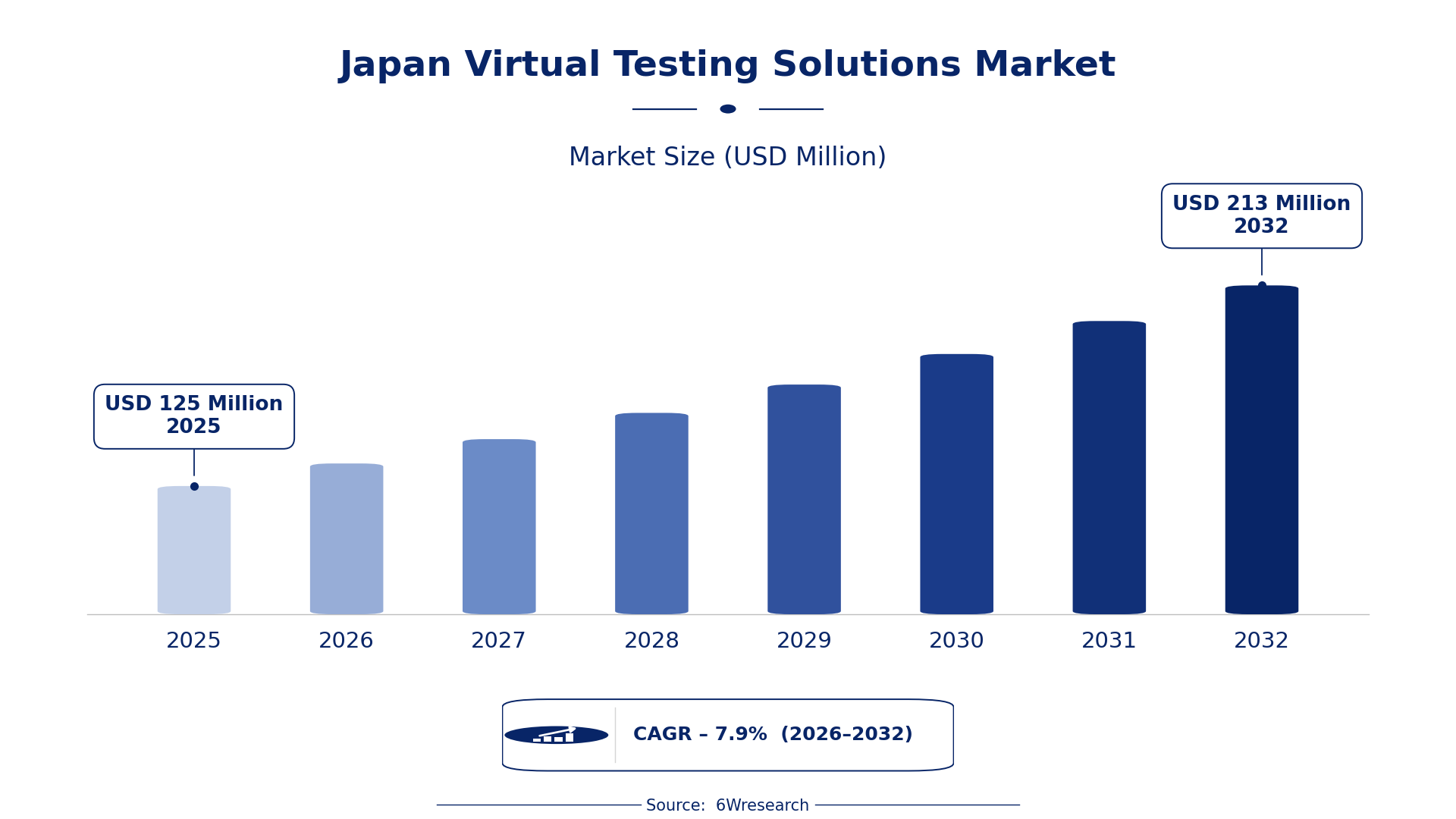
According to 6Wresearch internal database and industry insights, the Japan Virtual Testing Solutions Market was valued at USD 125 Million in 2025 and is projected to reach USD 213 Million by 2032, growing at a CAGR of approximately 7.9% during 2026–2032.
Japan Virtual Testing Solutions Market Highlights
| Report Metric | Details |
| Report Name | Japan Virtual Testing Solutions Market (2026-2032) |
| Market Size 2025 | USD 125 Million |
| Market Size 2032 | USD 213 Million |
| Absolute Growth 2025–2032 | USD 88 Million |
| CAGR 2026–2032 | 7.9% |
| Peak Annual Growth | 10.3% in 2026 |
| Forecast Period | 2026–2032 |
| Historical Data | 2022–2025 |
| Base Year | 2025 |
| Leading Testing Type, 2025 | Software Testing (43% share) |
| Leading Technology Used, 2025 | AI Automation (29% share) |
| Leading Testing Environment, 2025 | Cloud (41% share) |
| Leading Deployment Mode, 2025 | SaaS (49% share) |
| Fastest-Growing Testing Type | Hardware Simulation (11.0% CAGR) |
| Fastest-Growing Technology Used | Digital Twin Tech (11.5% CAGR) |
| Fastest-Growing Testing Environment | Virtual Lab (10.3% CAGR) |
| Fastest-Growing Deployment Mode | On-premise (11.4% CAGR) |
| Growing Sector | automotive and electronics industries |
| Key End Users | automotive manufacturers, electronics producers, educational institutions, software companies |
Japan Virtual Testing Solutions Market Year-wise Growth Rate and Key Drivers (2022–2032)
This graph illustrates the annual growth rates of the market from 2022 to 2032, highlighting a steady upward trajectory and projected market expansion over the forecast period.
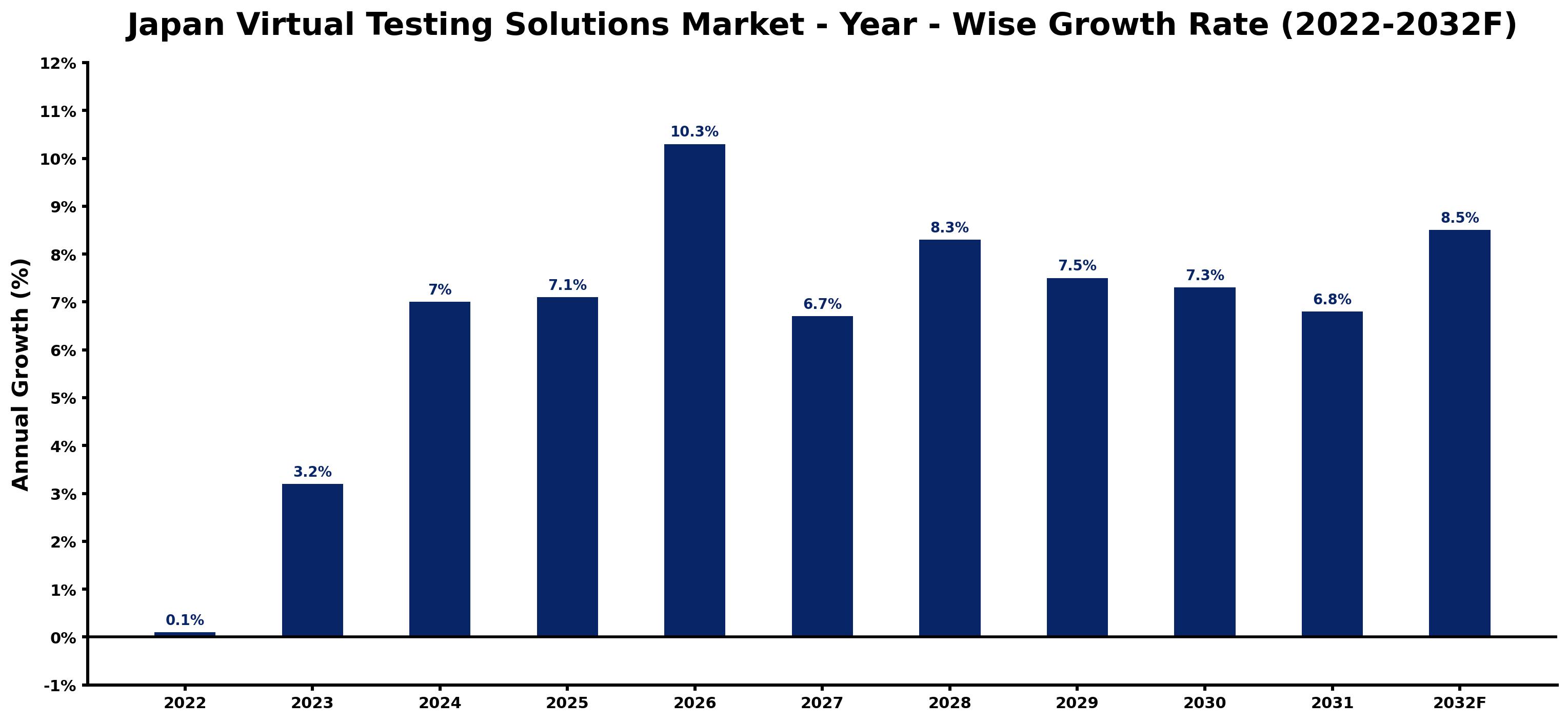
Each row of the following table gives one year's estimated growth and the event or demand shift that explains it.
| Year | Estimated Annual Growth (%) | Market Rationale |
| 2022 | 0.1 | The market showed minimal growth as initial adoption of virtual testing solutions began. |
| 2023 | 3.2 | Growth accelerated as more companies recognised the value of virtual testing in product development. |
| 2024 | 7.0 | Demand continued to rise, driven by increasing automation in testing processes across industries. |
| 2025 | 7.1 | The market peaked with investments in automotive safety testing technologies. |
| 2026 | 10.3 | Growth surged as the integration of AI technologies became more prevalent in testing solutions. |
| 2027 | 6.7 | Growth slowed slightly as market saturation began to affect new customer acquisition. |
| 2028 | 8.3 | Demand increased again as companies sought to improve testing capabilities with cloud solutions. |
| 2029 | 7.5 | Growth decelerated as competition intensified among existing providers in the market. |
| 2030 | 7.3 | The market continued to expand as more sectors adopted virtual testing for compliance. |
| 2031 | 6.8 | Growth slowed further as technological advancements reached maturity in existing applications. |
| 2032 | 8.5 | Demand picked up again as new applications for digital twin technologies emerged. |
Note: Market size estimations and growth projections presented in this report are based on 6Wresearch's proprietary forecasting methodology, utilizing the latest available industry data, government publications, and primary research inputs.
Japan Virtual Testing Solutions Market Synopsis
Virtual Testing Solutions are advanced software and hardware tools that simulate real-world conditions for product testing. The Japan Virtual Testing Solutions Market is driven by the automotive sector, which produces over 5 million vehicles annually, and the electronics industry, which is projected to invest ¥200 billion in virtual testing technologies by 2025. The integration of AI and cloud-based solutions is propelling market growth, as companies seek to improve their testing capabilities and ensure compliance with industry standards.
Market Dynamics Impact Analysis (2026–2032)
| Factor | Type | Impact | Primary Segment Affected |
| Increased automotive production drives demand for rigorous safety testing. | Driver | High | Automotive Testing |
| Growing reliance on cloud-based solutions enhances testing efficiency and accessibility. | Driver | High | Cloud |
| The shift towards AI integration in testing processes opens new market opportunities. | Opportunity | High | AI Automation |
| Rising investments in electronics testing create demand for advanced solutions. | Opportunity | High | Device Performance Test |
| Limited awareness of virtual testing benefits restrains wider adoption. | Restraint | Medium | Software Testing |
| High initial costs associated with implementing advanced testing solutions can deter investment. | Restraint | Medium | Hardware Simulation |
| Competition among providers may lead to price wars, affecting profitability. | Challenge | High | Network Testing |
| Technological advancements require continuous investment to stay relevant. | Challenge | Medium | Virtual Lab |
Evaluation of Drivers in Japan Virtual Testing Solutions Market (2026–2032)
The factors lifting demand, and the evidence behind each, are summarised below.
| Drivers | Primary Segment Affected | Why It Matters (Evidence) |
| Increased vehicle production necessitates rigorous testing for safety compliance. | Automotive Testing | Japan's automotive sector produces over 5 million vehicles annually, driving demand for virtual testing solutions. |
| Cloud adoption streamlines testing processes, making them more efficient. | Cloud | Approximately 70% of software companies in Japan are adopting cloud-based testing solutions. |
| AI integration improves testing accuracy and efficiency, attracting investments. | AI Automation | The Ministry of Economy, Trade and Industry launched a program supporting AI integration in 2023. |
| Growing electronics investments drive demand for performance testing solutions. | Device Performance Test | The electronics industry is projected to invest ¥200 billion in virtual testing technologies by 2025. |
| Educational institutions are increasingly utilising virtual labs for training purposes. | Virtual Lab | Over 300 educational institutions in Japan are using virtual labs for training in various fields. |
Volumes increase due to heightened vehicle production, with over 5 million vehicles manufactured annually in Japan, necessitating rigorous automotive testing. Cloud-based solutions are utilised by 70% of software companies, streamlining testing processes and boosting efficiency. The electronics sector is set to invest ¥200 billion in virtual testing technologies by 2025, fuelling demand for performance testing solutions. Educational institutions, with over 300 employing virtual labs, are also contributing to the rising demand as they prepare future engineers in advanced testing methodologies. The push for AI integration in testing solutions is further driving market growth.
Evaluation of Restraints in Japan Virtual Testing Solutions Market
The table below lists the restraints and the evidence behind each.
| Market Restraint | Primary Segment Affected | Why It Matters (Evidence) |
| Limited awareness of the benefits of virtual testing solutions restricts market growth. | Software Testing | Many companies remain unaware of how virtual testing can improve product development and safety. |
| High initial costs can deter companies from investing in advanced testing technologies. | Hardware Simulation | The upfront investment required for implementing virtual testing solutions can be substantial. |
| Regulatory compliance requirements may slow down the adoption of new technologies. | Network Testing | Companies must navigate complex regulations that can delay the implementation of virtual testing. |
| Market saturation leads to intense competition, affecting pricing strategies. | Automotive Testing | As more providers enter the market, pricing pressures may arise, impacting profitability. |
| Technological advancements require continuous investment to remain competitive. | Virtual Lab | Providers must invest regularly in updates and new features to meet evolving customer needs. |
Japan Virtual Testing Solutions Market Challenges
Producers face challenges with outdated technology, as many still depend on legacy systems that impede efficiency in virtual testing solutions. Compliance with ISO 26262 standards introduces regulatory hurdles, complicating automotive testing and delaying product launches for manufacturers. Increasing costs of advanced solutions put pressure on budgets, with the electronics sector projected to invest ¥200 billion by 2025, affecting financial planning for producers. Skills shortages remain a concern, as only 50,000 engineers are currently trained in AR/VR setups, limiting the workforce available for implementing modern testing methodologies.
Trends in the Japan Virtual Testing Solutions Market
The trends below show where the Japan Virtual Testing Solutions Market is heading.
- Shift towards Cloud-Based Solutions: In 2023, 70% of software companies in Japan adopted cloud-based testing solutions, improving accessibility and efficiency. This trend reflects a broader move towards remote testing environments, allowing for greater flexibility in product development.
- Growing Integration of AI in Testing: The integration of AI technologies in testing processes began gaining traction in 2023, with government support for AI initiatives. This shift is expected to improve testing accuracy and speed, benefiting various industries.
- Increased Use of Virtual Labs in Education: Over 300 educational institutions are now using virtual labs for training purposes, reflecting a growing emphasis on practical skills in engineering education. This trend supports the development of a skilled workforce in advanced testing methodologies.
- Expansion of Digital Twin Technologies: The Digital Twin Consortium Japan Chapter focuses on advancing digital twin technologies, with a government allocation of ¥10 billion for research in 2023. This initiative aims to improve testing accuracy and efficiency across various sectors.
Investment Opportunities in the Japan Virtual Testing Solutions Market
The openings below show where demand in the Japan Virtual Testing Solutions Market is visible and how suppliers can enter.
- Automotive Manufacturers Seeking Advanced Testing: Automotive manufacturers require advanced virtual testing solutions to ensure safety compliance, with over 5 million vehicles produced annually. Collaborating with local technology providers can facilitate market entry.
- Electronics Sector Investment Gap: The electronics industry plans to invest ¥200 billion in virtual testing technologies by 2025, presenting a strong opportunity for suppliers of advanced testing solutions. Engaging with industry associations can aid in establishing connections.
- Educational Institutions Expanding Training Programs: Educational institutions are increasingly adopting virtual labs for training, with over 300 currently using them. Investing in partnerships with these institutions can provide access to a growing market.
- Growing Demand for AI Integration: The recent government programme supporting AI integration in testing solutions creates a timely opportunity for investment in AI-driven technologies. Collaborating with tech firms can improve product offerings.
Government Initiatives in the Japan Virtual Testing Solutions Market
The Semiconductor and Digital Industry Strategy, established by METI in June 2021, outlines measures to secure domestic semiconductor manufacturing, which indirectly supports the virtual testing solutions market by promoting technological advancements. The Next-Generation Medical Infrastructure Act, enacted in 2017, allows certified bodies to anonymise medical data for research, promoting innovation in testing methodologies.
The automotive sector benefits from the PMDA's oversight of pharmaceutical and medical device testing, ensuring compliance with safety standards. The PMDA reviews testing protocols and monitors post-market safety, which is vital for manufacturers seeking to validate their products effectively. This regulatory framework supports the adoption of virtual testing solutions in ensuring compliance.
Future Insight of the Japan Virtual Testing Solutions Market
New digital twin facilities will transform testing practices by 2032, enabling real-time simulations for improved accuracy. Government investment of ¥10 billion in digital twin technologies will drive innovation and enhance capabilities for suppliers. As 60% of tech firms adopt AI-driven analytics, buyers will benefit from streamlined operations and quicker product development cycles. The trend of virtual labs in educational institutions will cultivate a skilled workforce, ensuring a steady supply of talent for the evolving market.
Market Segmentation Analysis
Japan Virtual Testing Solutions Market report covers a detailed analysis of the following market segments:
By Testing Type – Software Testing Leads, Hardware Simulation Expected to Grow Fastest
According to Saurav Kr Singh, Senior Research Analyst at 6Wresearch, in 2025, Software Testing led the testing type split with a 43% share. Software Testing holds the largest share as it is essential for validating software functionality and performance, particularly in the automotive and electronics sectors. The issuance of over 150,000 virtual testing software licenses in Japan highlights its critical role in ensuring product reliability. The quickest growth will come from Hardware Simulation, forecast to expand at a CAGR of 11.0% between 2026 and 2032. Hardware Simulation is experiencing rapid growth due to its importance in assessing hardware under various conditions, which is crucial for manufacturers focused on product safety. The increasing investment in hardware testing solutions reflects a heightened prioritisation of performance and safety standards. Suppliers should focus on enhancing software testing capabilities to meet the growing demand across various industries.
By Technology Used – AI Automation Leads, Digital Twin Tech Expected to Grow Fastest
With 29% of technology used revenue in 2025, AI Automation was the largest category. AI Automation leads the market as it significantly improves the efficiency of testing processes, making it a preferred choice among technology firms. Its integration has become a standard practice, ensuring reliable outcomes in testing methodologies. Digital Twin Tech is set to record the highest CAGR in this split, 11.5% over 2026–2032. Digital Twin Tech is the fastest-growing segment because it enhances testing accuracy by creating virtual replicas of physical systems, which is increasingly sought after. The government's allocation of ¥10 billion for research in this technology is a key factor driving its rapid adoption. Buyers should consider investing in digital twin technologies to improve testing accuracy and operational efficiency.
By Testing Environment – Cloud Leads, Virtual Lab Expected to Grow Fastest
Cloud took 41% of testing environment revenue in 2025, more than any other category. Cloud solutions dominate the market because they facilitate remote testing environments, allowing for greater flexibility and scalability. The adoption of cloud-based testing solutions by 70% of software companies in Japan underscores its importance. Virtual Lab is projected to grow fastest, at a CAGR of 10.3% during 2026–2032. Virtual Lab environments are growing rapidly as they provide a controlled setting for testing, essential for educational institutions and training programs. Their use in over 300 educational institutions highlights their increasing relevance. Suppliers must prioritise cloud and virtual lab solutions to cater to the evolving needs of their clients.
By Deployment Mode – SaaS Lead, On-premise Expected to Grow Fastest
SaaS held 49% of the Japan Virtual Testing Solutions Market by deployment mode in 2025. SaaS is the dominant deployment model for testing solutions, mainly due to its accessibility and user-friendliness for various organisations. The trend among software companies to adopt SaaS-based solutions indicates its widespread acceptance and effectiveness. Over 2026–2032, On-premise is expected to post the fastest growth, at a CAGR of 11.4%. On-premise deployment is gaining popularity as some firms prefer to maintain control over their testing environments, particularly in light of data security concerns. This shift may reflect a cautious approach to adopting newer technologies and platforms. Buyers should evaluate their deployment preferences to ensure they align with operational strategies and security considerations.
Key Attractiveness of the Report
- 10 Years of Market Numbers
- Historical Data Starting from 2022 to 2025
- Base Year 2025
- Forecast Data until 2032
- Key Performance Indicators Impacting the Market
- Major Upcoming Developments and Projects
Key Highlights of the Report:
- Japan Virtual Testing Solutions Market Outlook
- Market Size of Japan Virtual Testing Solutions Market, 2025
- Forecast of Japan Virtual Testing Solutions Market, 2032
- Historical Data and Forecast of Japan Virtual Testing Solutions Revenues & Volume for the Period 2022-2032F
- Japan Virtual Testing Solutions Market Trend Evolution
- Japan Virtual Testing Solutions Market Drivers and Challenges
- Japan Virtual Testing Solutions Price Trends
- Japan Virtual Testing Solutions Porter's Five Forces
- Japan Virtual Testing Solutions Industry Life Cycle
- Historical Data and Forecast of Japan Virtual Testing Solutions Market Revenues & Volume By Testing Type for the Period 2022-2032F
- Historical Data and Forecast of Japan Virtual Testing Solutions Market Revenues & Volume By Software Testing for the Period 2022-2032F
- Historical Data and Forecast of Japan Virtual Testing Solutions Market Revenues & Volume By Hardware Simulation for the Period 2022-2032F
- Historical Data and Forecast of Japan Virtual Testing Solutions Market Revenues & Volume By Automotive Testing for the Period 2022-2032F
- Historical Data and Forecast of Japan Virtual Testing Solutions Market Revenues & Volume By Device Performance Test for the Period 2022-2032F
- Historical Data and Forecast of Japan Virtual Testing Solutions Market Revenues & Volume By Network Testing for the Period 2022-2032F
- Historical Data and Forecast of Japan Virtual Testing Solutions Market Revenues & Volume By Technology Used for the Period 2022-2032F
- Historical Data and Forecast of Japan Virtual Testing Solutions Market Revenues & Volume By AI Automation for the Period 2022-2032F
- Historical Data and Forecast of Japan Virtual Testing Solutions Market Revenues & Volume By Digital Twin Tech for the Period 2022-2032F
- Historical Data and Forecast of Japan Virtual Testing Solutions Market Revenues & Volume By VR Simulation for the Period 2022-2032F
- Historical Data and Forecast of Japan Virtual Testing Solutions Market Revenues & Volume By AI-Driven Analytics for the Period 2022-2032F
- Historical Data and Forecast of Japan Virtual Testing Solutions Market Revenues & Volume By Virtual Emulators for the Period 2022-2032F
- Historical Data and Forecast of Japan Virtual Testing Solutions Market Revenues & Volume By Testing Environment for the Period 2022-2032F
- Historical Data and Forecast of Japan Virtual Testing Solutions Market Revenues & Volume By Cloud for the Period 2022-2032F
- Historical Data and Forecast of Japan Virtual Testing Solutions Market Revenues & Volume By Virtual Lab for the Period 2022-2032F
- Historical Data and Forecast of Japan Virtual Testing Solutions Market Revenues & Volume By AR/VR Setup for the Period 2022-2032F
- Historical Data and Forecast of Japan Virtual Testing Solutions Market Revenues & Volume By Simulated Hardware for the Period 2022-2032F
- Historical Data and Forecast of Japan Virtual Testing Solutions Market Revenues & Volume By Virtual Network for the Period 2022-2032F
- Historical Data and Forecast of Japan Virtual Testing Solutions Market Revenues & Volume By Deployment Mode for the Period 2022-2032F
- Historical Data and Forecast of Japan Virtual Testing Solutions Market Revenues & Volume By SaaS for the Period 2022-2032F
- Historical Data and Forecast of Japan Virtual Testing Solutions Market Revenues & Volume By On-premise for the Period 2022-2032F
- Historical Data and Forecast of Japan Virtual Testing Solutions Market Revenues & Volume By Hybrid for the Period 2022-2032F
- Historical Data and Forecast of Japan Virtual Testing Solutions Market Revenues & Volume By Cloud for the Period 2022-2032F
- Historical Data and Forecast of Japan Virtual Testing Solutions Market Revenues & Volume By Subscription Model for the Period 2022-2032F
- Japan Virtual Testing Solutions Import Export Trade Statistics
- Market Opportunity Assessment By Testing Type
- Market Opportunity Assessment By Technology Used
- Market Opportunity Assessment By Testing Environment
- Market Opportunity Assessment By Deployment Mode
- Japan Virtual Testing Solutions Top Companies Market Share
- Japan Virtual Testing Solutions Competitive Benchmarking By Technical and Operational Parameters
- Japan Virtual Testing Solutions Company Profiles
- Japan Virtual Testing Solutions Key Strategic Recommendations
Market Covered
The study includes the following segmentation.
By Testing Type
- Software Testing
- Hardware Simulation
- Automotive Testing
- Device Performance Test
- Network Testing
By Technology Used
- AI Automation
- Digital Twin Tech
- VR Simulation
- AI-Driven Analytics
- Virtual Emulators
By Testing Environment
- Cloud
- Virtual Lab
- AR/VR Setup
- Simulated Hardware
- Virtual Network
By Deployment Mode
- SaaS
- On-premise
- Hybrid
- Cloud
- Subscription Model































