Japan Virtual Try-On AI Market Size & Growth Rate
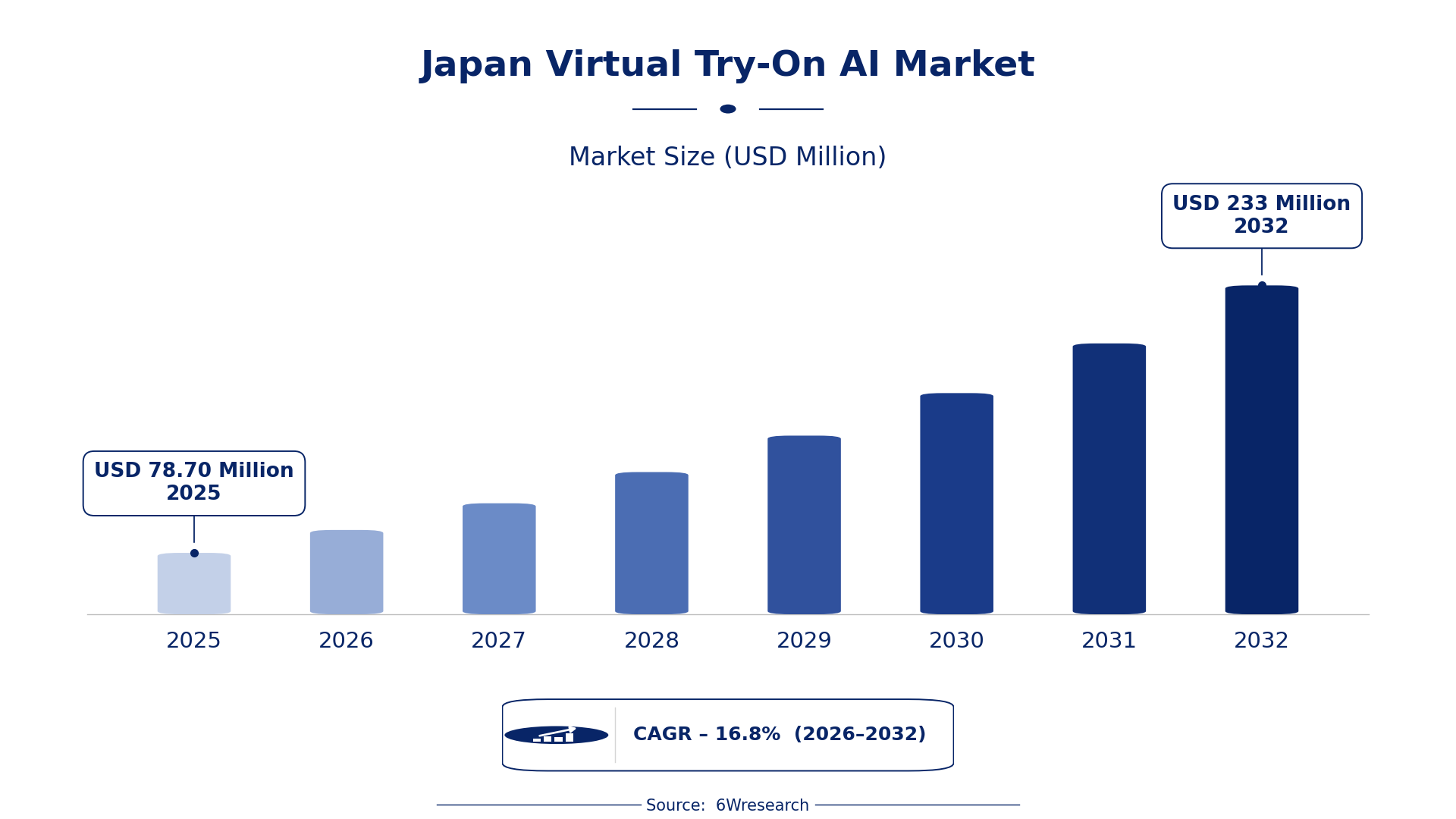
According to 6Wresearch internal database and industry insights, the Japan Virtual Try-On AI Market was valued at USD 78.70 Million in 2025 and is projected to reach USD 233 Million by 2032, growing at a CAGR of approximately 16.8% during 2026–2032.
Japan Virtual Try-On AI Market Highlights
| Report Metric | Details |
| Report Name | Japan Virtual Try-On AI Market (2026-2032) |
| Market Size 2025 | USD 78.70 Million |
| Market Size 2032 | USD 233 Million |
| Absolute Growth 2025–2032 | USD 154.30 Million |
| CAGR 2026–2032 | 16.8% |
| Peak Annual Growth | 18.1% in 2032 |
| Forecast Period | 2026–2032 |
| Historical Data | 2022–2025 |
| Base Year | 2025 |
| Leading Product Type, 2025 | Apparel Try-On (30% share) |
| Leading Technology Used, 2025 | AR + AI Vision (41% share) |
| Leading Application Area, 2025 | Fashion Retail (46% share) |
| Leading Deployment Type, 2025 | Web & Mobile (37% share) |
| Fastest-Growing Product Type | Eyewear Try-On (23.5% CAGR) |
| Fastest-Growing Technology Used | Facial Mapping AI (18.5% CAGR) |
| Fastest-Growing Application Area | Optical Stores (20.1% CAGR) |
| Fastest-Growing Deployment Type | Mobile App (18.1% CAGR) |
| Growing Sector | beauty and fashion retail |
| Key End Users | retailers, beauty brands, fashion brands, optical stores |
Japan Virtual Try-On AI Market Year-wise Growth Rate and Key Drivers (2022–2032)
This graph illustrates the annual growth rates of the market from 2022 to 2032, highlighting a steady upward trajectory and projected market expansion over the forecast period.
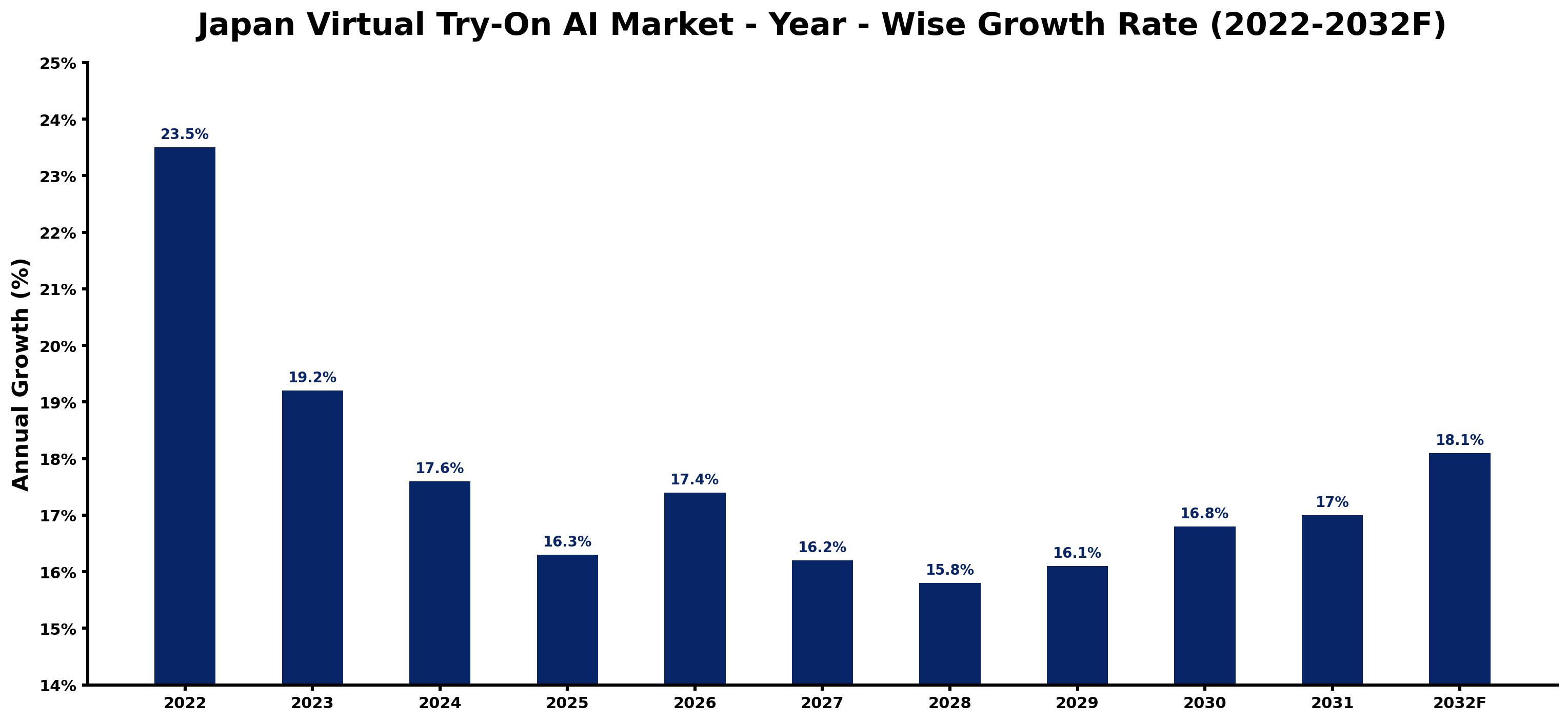
Annual growth estimates for each year appear below with the principal reason behind them, explaining the shifts that set the pace of the market.
| Year | Estimated Annual Growth (%) | Market Rationale |
| 2022 | 23.5 | The market experienced strong consumer interest in virtual try-on solutions. |
| 2023 | 19.2 | Growth slowed due to market maturation and increased competition among technologies. |
| 2024 | 17.6 | The demand remained steady as retailers continued to adopt digital solutions. |
| 2025 | 16.3 | Growth slowed as the market approached saturation in key segments. |
| 2026 | 17.4 | Demand is expected to rise as fashion retailers invest in new technologies. |
| 2027 | 16.2 | Growth is projected to slow as competition intensifies and innovation stabilises. |
| 2028 | 15.8 | The market is anticipated to grow at a slower pace as adoption levels off. |
| 2029 | 16.1 | Demand is likely to increase as new applications in optical stores emerge. |
| 2030 | 16.8 | Growth is expected to rise with further technological advancements in AI. |
| 2031 | 17.0 | The market is projected to grow as consumer engagement with virtual solutions deepens. |
| 2032 | 18.1 | Demand is expected to peak as the market reaches maturity and innovation continues. |
Note: Market size estimations and growth projections presented in this report are based on 6Wresearch's proprietary forecasting methodology, utilizing the latest available industry data, government publications, and primary research inputs.
Japan Virtual Try-On AI Market Synopsis
Virtual Try-On AI utilises augmented reality and artificial intelligence to enable users to visualise products such as clothing and makeup virtually. In Japan, the beauty industry, valued at over 3 trillion JPY, is increasingly adopting these technologies to improve shopping experiences. Market growth is driven by substantial investments in digital solutions from the fashion retail sector and a high consumer interest, with over 70% of Japanese consumers expressing a desire to use virtual try-on technologies. Key regions like Tokyo and Osaka are at the forefront of deploying these solutions.
Market Dynamics Impact Analysis (2026–2032)
| Factor | Type | Impact | Primary Segment Affected |
| Growing consumer interest in virtual try-on solutions | Driver | High | Eyewear Try-On |
| Increased investment in digital retail solutions | Driver | High | Fashion Retail |
| High consumer engagement in beauty retail | Opportunity | Medium | Beauty Industry |
| Expansion of optical stores adopting digital technologies | Opportunity | Medium | Optical Stores |
| Regulatory constraints on AR technology usage | Restraint | High | AR + AI Vision |
| Market saturation in key segments limiting growth | Restraint | Medium | Apparel Try-On |
| High initial investment costs for retailers | Challenge | High | Fashion Retail |
| Intense competition among technology providers | Challenge | Medium | Eyewear Try-On |
Evaluation of Drivers in Japan Virtual Try-On AI Market (2026–2032)
Below are the drivers that matter most for revenue growth, with supporting evidence.
| Drivers | Primary Segment Affected | Why It Matters (Evidence) |
| Increased consumer engagement with virtual try-on solutions | Makeup Try-On | Over 70% of Japanese consumers express interest in using virtual try-on technologies, driving demand for makeup applications. |
| Investment in digital solutions by retailers | Fashion Retail | The Japanese fashion retail sector is projected to invest over 3 trillion JPY in digital solutions, improving customer experiences. |
| Technological advancements in AR and AI | Eyewear Try-On | The integration of advanced AR technologies is boosting adoption rates in eyewear sales, projected to grow by 20%. |
| Growing online shopping trends | Apparel Try-On | Japan's population of approximately 125 million provides a substantial market for virtual try-on technologies. |
| Support from industry associations for technology adoption | Beauty Industry | The Japan Cosmetic Industry Association promotes the integration of AR, boosting demand for virtual makeup applications. |
Several shifts outside the market lift sales. Consumer engagement with virtual try-on solutions is rising, with over 70% of Japanese consumers expressing interest in these technologies. Retailers are investing in digital solutions to improve customer experiences, driven by growing online shopping trends in Japan's large population. The integration of advanced AR technologies is boosting adoption rates in eyewear sales, while support from industry associations is further promoting the use of virtual try-on applications in beauty retail, leading to increased consumer interaction and satisfaction.
Evaluation of Restraints in Japan Virtual Try-On AI Market
These restraints slow adoption and weigh on supplier margins.
| Market Restraint | Primary Segment Affected | Why It Matters (Evidence) |
| Regulatory constraints on AR technology usage | AR + AI Vision | AR technology is regulated under the Ministry of Internal Affairs and Communications, which can restrict deployment. |
| Market saturation in key segments limiting growth | Apparel Try-On | As the market matures, growth decelerates due to saturation in popular segments. |
| High initial investment costs for retailers | Fashion Retail | Retailers face costs of up to 15% in implementing virtual try-on technologies, which can slow adoption rates. |
| Consumer resistance to new technologies | Eyewear Try-On | Some consumers remain hesitant to adopt virtual try-on solutions, which limits market expansion. |
| Limited understanding of technology benefits among retailers | Beauty Industry | Many retailers lack awareness of the advantages of virtual try-on, which hinders widespread adoption. |
Japan Virtual Try-On AI Market Challenges
Buyers in the retail sector struggle with limited access to advanced virtual try-on technologies, hampering their ability to engage customers effectively. This issue arises from stringent regulations imposed by the Ministry of Internal Affairs and Communications, resulting in deployment delays that can lead to potential sales losses of up to 20% for retailers. Technology providers face high development costs associated with compliance to Japan Industrial Standards, inflating solution prices by 15%, making these technologies less affordable for buyers. Competition intensifies as over 70% of consumers express interest in virtual try-on, pressuring retailers to invest quickly or risk losing market share.
Trends in the Japan Virtual Try-On AI Market
Below are the shifts with the largest effect on the Japan Virtual Try-On AI Market.
- Shift from Physical to Virtual Shopping Experiences: Since 2023, retailers have increasingly adopted virtual try-on technologies to improve online shopping. The Tokyo Metropolitan Government has launched programs to support tech innovation in retail, resulting in a growing preference for digital solutions.
- Emergence of AI-Driven Personalisation: In 2023, the integration of AI in virtual try-on applications has gained traction. The Japan Fashion Association is actively promoting AI use in fashion retail, resulting in more tailored shopping experiences for consumers.
- Increase in Mobile App Deployments: By 2025, mobile apps have become the primary platform for virtual try-on solutions. With a projected CAGR of 18.1%, mobile app deployment is transforming how consumers engage with products.
- Growth of Optical Stores Adopting Digital Solutions: Since 2026, optical stores have increasingly integrated virtual try-on technologies. The Optical Industry Association of Japan reports a 20.1% CAGR in this segment, enhancing customer interaction.
Investment Opportunities in the Japan Virtual Try-On AI Market
The following opportunities in the Japan Virtual Try-On AI Market pair current demand with a clear way in.
- High Consumer Interest in Virtual Try-On: With over 70% of Japanese consumers expressing interest, there is a strong opportunity to supply virtual try-on solutions. Fashion retailers in Tokyo are ideal partners for collaboration.
- Expansion of Digital Solutions in Beauty Retail: The beauty industry, valued at over 3 trillion JPY, presents a gap for virtual try-on technologies. Collaborating with beauty retailers in Osaka can enhance market penetration.
- Growing Demand for Eyewear Try-On Solutions: The eyewear market is experiencing a surge in demand, with a projected increase in adoption. Partnering with optical stores can facilitate entry into this growing segment.
- Investment in AR Technology Development: The market is witnessing increased investment in AR technology, with a focus on improving user experiences. Collaborating with tech firms in Tokyo can accelerate development.
Government Initiatives in the Japan Virtual Try-On AI Market
The GX Basic Policy, adopted in 2023, aims for about JPY 150 trillion of public-private decarbonisation investment over 10 years, which includes support for digital transformation in retail. This policy complements existing laws like the Industrial Standardization Act, which governs product standards and testing in AR applications, directly impacting Virtual Try-On AI producers and buyers by ensuring compliance with industry standards.
The Ministry of Internal Affairs and Communications oversees the regulation of AR technology, approving standards for applications. This agency ensures compliance, which affects how producers develop and implement virtual try-on solutions. In 2023, the agency approved several new guidelines to streamline the integration of AR technologies in retail, enhancing operational efficiency for producers.
Future Insight of the Japan Virtual Try-On AI Market
Investment in digital solutions will surge by 2032, driven by government initiatives and increasing consumer demand for virtual try-on technologies. The fashion retail sector will undergo a transformation as AR applications achieve standardisation under Japan Industrial Standards, facilitating smoother integration for retailers. Regions like Tokyo and Osaka will lead the way, leveraging advanced algorithms to enhance user experiences. With the beauty industry valued at over 3 trillion JPY, the rising adoption of virtual try-on will streamline sales processes and reduce return rates, benefiting both buyers and suppliers.
Market Segmentation Analysis
Japan Virtual Try-On AI Market report covers a detailed analysis of the following market segments:
By Product Type – Apparel Try-On Leads, Eyewear Try-On Expected to Grow Fastest
According to Saurav Kr Singh, Senior Research Analyst at 6Wresearch, Apparel Try-On held 30% of the Japan Virtual Try-On AI Market by product type in 2025. Apparel Try-On holds the largest share as it is extensively utilised by consumers seeking to visualise clothing fit and style prior to purchase. This sub-segment aligns with the significant interest shown by over 70% of Japanese consumers in virtual try-on technologies. Over 2026–2032, Eyewear Try-On is expected to post the fastest growth, at a CAGR of 23.5%. Eyewear Try-On is rapidly growing as optical stores increasingly adopt virtual try-on solutions to effectively engage customers. The Optical Industry Association's active promotion of digital solutions in eyewear sales is a key factor driving this trend. Suppliers should focus on enhancing features for eyewear to capitalise on this increasing demand.
By Technology Used – AR + AI Vision Leads, Facial Mapping AI Expected to Grow Fastest
With 41% of technology used revenue in 2025, AR + AI Vision was the largest category. AR + AI Vision is the leading technology because it is essential for creating immersive virtual try-on experiences that attract consumers. Its integration is crucial for retailers aiming to improve online shopping experiences in Japan's competitive market. Facial Mapping AI is projected to grow fastest, at a CAGR of 18.5% during 2026–2032. Facial Mapping AI is experiencing swift growth due to its importance in accurately overlaying products on users' faces, which enhances user satisfaction. The rising emphasis on precision in virtual try-on experiences is driving its adoption among retailers. Buyers should seek solutions that incorporate advanced facial mapping to improve user experience.
By Application Area – Fashion Retail Leads, Optical Stores Expected to Grow Fastest
The largest application area category in 2025 was Fashion Retail, at 46% of revenue. Fashion Retail dominates the market as it significantly enhances both online and in-store shopping experiences, appealing to a broad consumer base. The sector's anticipated investment in digital solutions by 2025 indicates a strong commitment to integrating virtual try-on technologies. Optical Stores are set to record the highest CAGR in this split, 20.1% over 2026–2032. Optical Stores are quickly adopting virtual try-on technologies to boost customer engagement, spurred by initiatives from the Optical Industry Association. This focus on improving the shopping experience is leading to rapid growth in this application area. Suppliers must tailor their offerings to meet the specific needs of optical retailers.
By Deployment Type – Web & Mobile Leads, Mobile App Expected to Grow Fastest
In 2025, Web & Mobile led the deployment type split with a 37% share. Web & Mobile is the leading deployment type as these platforms are the primary means for consumers to access virtual try-on solutions. The high penetration of smartphones in Japan supports the effectiveness of this approach. The quickest growth will come from Mobile App, forecast to expand at a CAGR of 18.1% between 2026 and 2032. Mobile App is the fastest-growing deployment type, serving as a key medium for user engagement and convenience. The increasing reliance on mobile devices for shopping is propelling this segment's growth. Suppliers should prioritise mobile app development to capture the growing user base.
Key Attractiveness of the Report
- 10 Years of Market Numbers
- Historical Data Starting from 2022 to 2025
- Base Year 2025
- Forecast Data until 2032
- Key Performance Indicators Impacting the Market
- Major Upcoming Developments and Projects
Key Highlights of the Report:
- Japan Virtual Try-On AI Market Outlook
- Market Size of Japan Virtual Try-On AI Market, 2025
- Forecast of Japan Virtual Try-On AI Market, 2032
- Historical Data and Forecast of Japan Virtual Try-On AI Revenues & Volume for the Period 2022-2032F
- Japan Virtual Try-On AI Market Trend Evolution
- Japan Virtual Try-On AI Market Drivers and Challenges
- Japan Virtual Try-On AI Price Trends
- Japan Virtual Try-On AI Porter's Five Forces
- Japan Virtual Try-On AI Industry Life Cycle
- Historical Data and Forecast of Japan Virtual Try-On AI Market Revenues & Volume By Product Type for the Period 2022-2032F
- Historical Data and Forecast of Japan Virtual Try-On AI Market Revenues & Volume By Eyewear Try-On for the Period 2022-2032F
- Historical Data and Forecast of Japan Virtual Try-On AI Market Revenues & Volume By Makeup Try-On for the Period 2022-2032F
- Historical Data and Forecast of Japan Virtual Try-On AI Market Revenues & Volume By Jewelry Try-On for the Period 2022-2032F
- Historical Data and Forecast of Japan Virtual Try-On AI Market Revenues & Volume By Apparel Try-On for the Period 2022-2032F
- Historical Data and Forecast of Japan Virtual Try-On AI Market Revenues & Volume By Footwear Try-On for the Period 2022-2032F
- Historical Data and Forecast of Japan Virtual Try-On AI Market Revenues & Volume By Technology Used for the Period 2022-2032F
- Historical Data and Forecast of Japan Virtual Try-On AI Market Revenues & Volume By AR + AI Vision for the Period 2022-2032F
- Historical Data and Forecast of Japan Virtual Try-On AI Market Revenues & Volume By Facial Mapping AI for the Period 2022-2032F
- Historical Data and Forecast of Japan Virtual Try-On AI Market Revenues & Volume By 3D Modeling AI for the Period 2022-2032F
- Historical Data and Forecast of Japan Virtual Try-On AI Market Revenues & Volume By Virtual Mirror AI for the Period 2022-2032F
- Historical Data and Forecast of Japan Virtual Try-On AI Market Revenues & Volume By Gesture AI for the Period 2022-2032F
- Historical Data and Forecast of Japan Virtual Try-On AI Market Revenues & Volume By Application Area for the Period 2022-2032F
- Historical Data and Forecast of Japan Virtual Try-On AI Market Revenues & Volume By Optical Stores for the Period 2022-2032F
- Historical Data and Forecast of Japan Virtual Try-On AI Market Revenues & Volume By Beauty Industry for the Period 2022-2032F
- Historical Data and Forecast of Japan Virtual Try-On AI Market Revenues & Volume By Jewelry Stores for the Period 2022-2032F
- Historical Data and Forecast of Japan Virtual Try-On AI Market Revenues & Volume By Fashion Retail for the Period 2022-2032F
- Historical Data and Forecast of Japan Virtual Try-On AI Market Revenues & Volume By Footwear Retail for the Period 2022-2032F
- Historical Data and Forecast of Japan Virtual Try-On AI Market Revenues & Volume By Deployment Type for the Period 2022-2032F
- Historical Data and Forecast of Japan Virtual Try-On AI Market Revenues & Volume By Web & Mobile for the Period 2022-2032F
- Historical Data and Forecast of Japan Virtual Try-On AI Market Revenues & Volume By Mobile App for the Period 2022-2032F
- Historical Data and Forecast of Japan Virtual Try-On AI Market Revenues & Volume By AR Kiosk for the Period 2022-2032F
- Historical Data and Forecast of Japan Virtual Try-On AI Market Revenues & Volume By Hybrid for the Period 2022-2032F
- Historical Data and Forecast of Japan Virtual Try-On AI Market Revenues & Volume By App Integration for the Period 2022-2032F
- Japan Virtual Try-On AI Import Export Trade Statistics
- Market Opportunity Assessment By Product Type
- Market Opportunity Assessment By Technology Used
- Market Opportunity Assessment By Application Area
- Market Opportunity Assessment By Deployment Type
- Japan Virtual Try-On AI Top Companies Market Share
- Japan Virtual Try-On AI Competitive Benchmarking By Technical and Operational Parameters
- Japan Virtual Try-On AI Company Profiles
- Japan Virtual Try-On AI Key Strategic Recommendations
Market Covered
The following segment groups are covered in the report.
By Product Type
- Eyewear Try-On
- Makeup Try-On
- Jewelry Try-On
- Apparel Try-On
- Footwear Try-On
By Technology Used
- AR + AI Vision
- Facial Mapping AI
- 3D Modeling AI
- Virtual Mirror AI
- Gesture AI
By Application Area
- Optical Stores
- Beauty Industry
- Jewelry Stores
- Fashion Retail
- Footwear Retail
By Deployment Type
- Web & Mobile
- Mobile App
- AR Kiosk
- Hybrid
- App Integration































