Japan Vision Enhancement Glass Market Size & Growth Rate
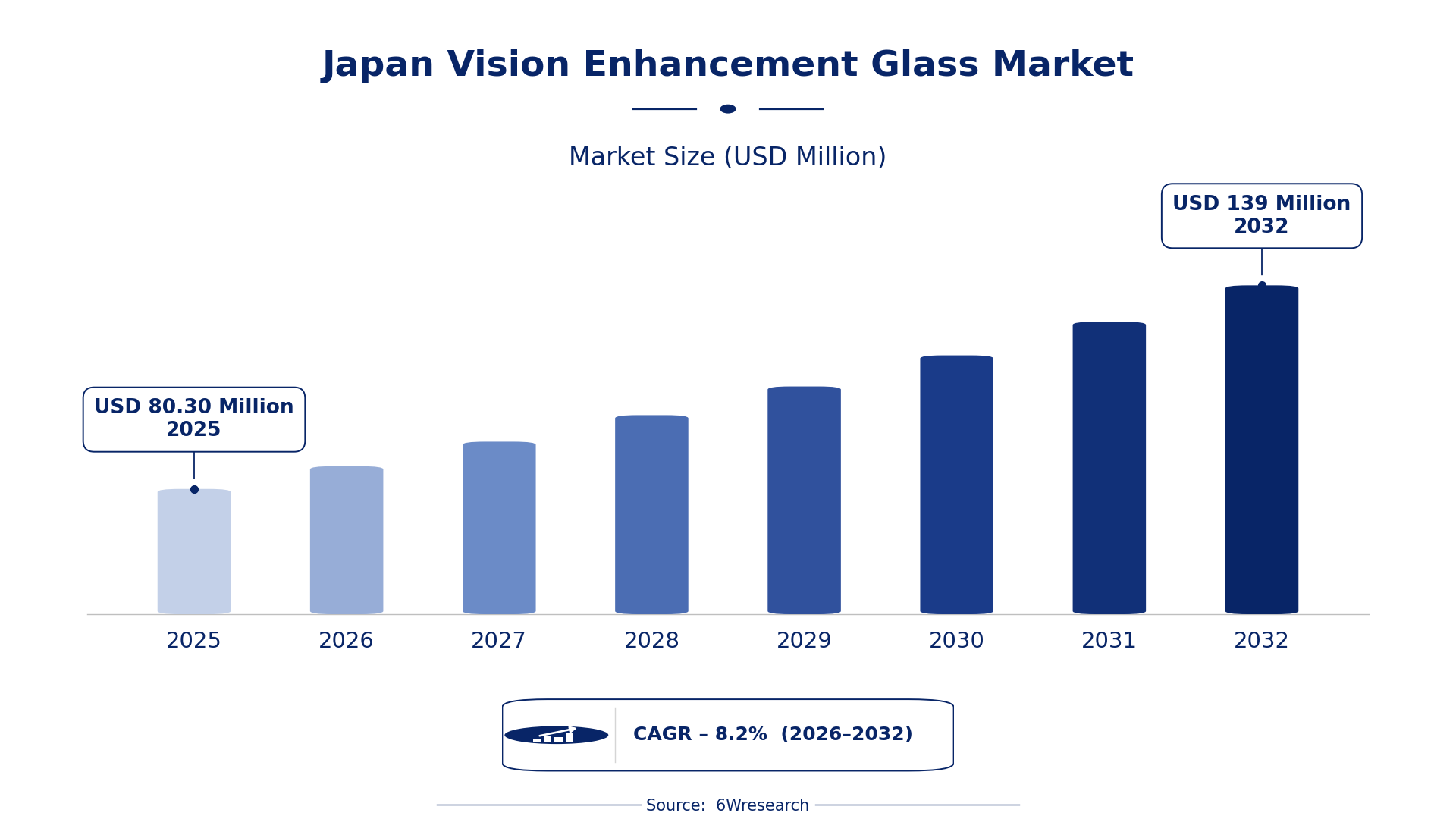
According to 6Wresearch internal database and industry insights, the Japan Vision Enhancement Glass Market was valued at USD 80.30 Million in 2025 and is projected to reach USD 139 Million by 2032, growing at a CAGR of approximately 8.2% during 2026–2032.
Japan Vision Enhancement Glass Market Highlights
| Report Metric | Details |
| Report Name | Japan Vision Enhancement Glass Market (2026-2032) |
| Market Size 2025 | USD 80.30 Million |
| Market Size 2032 | USD 139 Million |
| Absolute Growth 2025–2032 | USD 58.70 Million |
| CAGR 2026–2032 | 8.2% |
| Peak Annual Growth | 9.1% in 2027 |
| Forecast Period | 2026–2032 |
| Historical Data | 2022–2025 |
| Base Year | 2025 |
| Leading Glass Type, 2025 | Prescription Smart (41% share) |
| Leading Technology Integrated, 2025 | Display Overlay (47% share) |
| Leading Usage Type, 2025 | Visual Aid (48% share) |
| Leading Distribution Channel, 2025 | Optical Stores (50% share) |
| Fastest-Growing Glass Type | Smart Glass (11.8% CAGR) |
| Fastest-Growing Usage Type | AR/VR (11.2% CAGR) |
| Fastest-Growing Distribution Channel | Medical Suppliers (10.8% CAGR) |
| Growing Sector | healthcare |
| Key End Users | hospitals, rehabilitation centres, optical stores, educational institutions |
Japan Vision Enhancement Glass Market Year-wise Growth Rate and Key Drivers (2022–2032)
This graph illustrates the annual growth rates of the market from 2022 to 2032, highlighting a steady upward trajectory and projected market expansion over the forecast period.
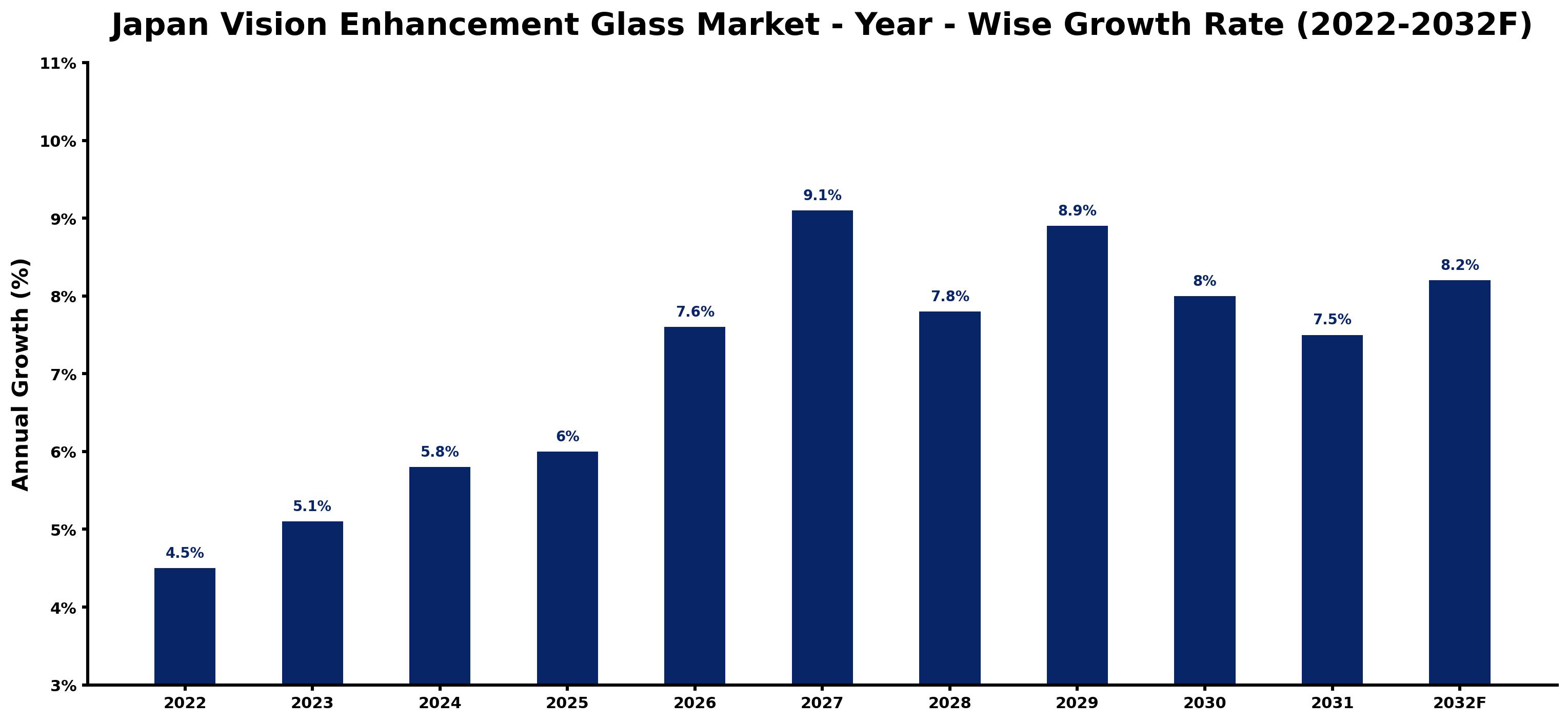
The table below sets out the estimated growth rate for each year and the main factor behind it.
| Year | Estimated Annual Growth (%) | Market Rationale |
| 2022 | 4.5 | The market experienced steady growth driven by increased awareness of vision health. |
| 2023 | 5.1 | Demand rose as more individuals sought solutions for visual impairments. |
| 2024 | 5.8 | Technological advancements in vision products contributed to growth. |
| 2025 | 6.0 | The introduction of new products boosted consumer interest and purchases. |
| 2026 | 7.6 | Investment in healthcare facilities is expected to expand the market for vision glass. |
| 2027 | 9.1 | A surge in demand for prescription smart glasses will propel market growth. |
| 2028 | 7.8 | Growth will slow slightly as market saturation begins to affect new sales. |
| 2029 | 8.9 | Innovations in augmented reality applications will revitalise consumer interest. |
| 2030 | 8.0 | A focus on outdoor activities will increase the demand for transition glasses. |
| 2031 | 7.5 | The growing elderly population will continue to drive demand for visual aids. |
| 2032 | 8.2 | Rising health awareness and technological advancements will support market expansion. |
Note: Market size estimations and growth projections presented in this report are based on 6Wresearch's proprietary forecasting methodology, utilizing the latest available industry data, government publications, and primary research inputs.
Japan Vision Enhancement Glass Market Synopsis
Vision enhancement glass improves visual clarity for individuals with visual impairments, utilising advanced materials for better light transmission. The Japan Vision Enhancement Glass Market is expanding due to rising demand from domestic users, particularly hospitals and optical stores. Technological advancements, such as augmented reality applications and government initiatives aimed at improving accessibility, are stimulating market growth. In 2023, a government programme was launched to improve accessibility for the visually impaired, further supporting this trend.
Market Dynamics Impact Analysis (2026–2032)
| Factor | Type | Impact | Primary Segment Affected |
| Increasing adoption of prescription smart glasses among rehabilitation facilities. | Driver | High | Prescription Smart |
| Growth in the elderly population requiring visual aids. | Driver | High | Visual Aid |
| Expansion of online retail channels for easier consumer access. | Opportunity | High | Online Retailers |
| Investment in AR technology by educational institutions enhancing visual aids. | Opportunity | Medium | AR/VR |
| High costs associated with advanced vision enhancement technologies. | Restraint | High | Smart Glass |
| Limited awareness of available vision enhancement solutions among consumers. | Restraint | Medium | Video Magnifier |
| Competition from alternative visual aid technologies may hinder growth. | Challenge | High | Transition Glass |
| Supply chain disruptions affecting product availability and pricing. | Challenge | Medium | Prescription Smart |
Evaluation of Drivers in Japan Vision Enhancement Glass Market (2026–2032)
These are the developments adding the most demand over the forecast period.
| Drivers | Primary Segment Affected | Why It Matters (Evidence) |
| Growing demand for prescription smart glasses in rehabilitation centres. | Prescription Smart | Over 10 million people in Japan have some form of visual impairment, increasing the need for tailored solutions. |
| Aging population requiring visual aids. | Visual Aid | Approximately 125 million people in Japan experience vision impairment, driving demand for solutions. |
| Technological advancements in AR applications for educational institutions. | AR/VR | AR technology adoption in schools improves learning experiences, leading to increased purchases. |
| Expansion of online retail channels for consumer access. | Online Retailers | The convenience of online shopping has led to a surge in consumer purchases of vision products. |
| Investment in healthcare facilities to improve vision health. | Medical Suppliers | Government initiatives promoting vision health have led to increased funding for healthcare upgrades. |
Orders keep climbing as the elderly population in Japan continues to grow, with over 10 million individuals experiencing visual impairment. This demographic shift drives demand for visual aids, particularly prescription smart glasses in rehabilitation centres. The integration of AR technology in educational institutions is creating new opportunities for product adoption. The expansion of online retail channels has made it easier for consumers to access vision products, further boosting sales. Investment in healthcare facilities to improve vision health is also contributing to demand for medical suppliers.
Evaluation of Restraints in Japan Vision Enhancement Glass Market
The table below lists the restraints and the evidence behind each.
| Market Restraint | Primary Segment Affected | Why It Matters (Evidence) |
| High costs associated with advanced vision technologies. | Smart Glass | The financial burden of acquiring advanced vision products limits accessibility for many consumers. |
| Limited awareness of available vision solutions among consumers. | Video Magnifier | Many potential users are unaware of the options available, hindering market growth. |
| Competition from alternative visual aid technologies may hinder growth. | Transition Glass | Emerging technologies can divert attention and resources away from traditional vision products. |
| Supply chain disruptions affecting product availability and pricing. | Prescription Smart | Global supply chain issues can lead to delays and increased costs for buyers. |
| Regulatory compliance costs for manufacturers of vision products. | Visual Aid | Compliance with standards such as ISO 13485 can increase production costs. |
Japan Vision Enhancement Glass Market Challenges
Stringent regulations under ISO 13485 impose high quality standards on manufacturers, increasing compliance costs and potentially delaying product launches for producers. Intense competition among local firms drives down prices, which can compromise product quality and reliability for hospitals. Rapid technological advancements require continuous innovation, leading to R&D expenditures that strain budgets for smaller manufacturers. Buyers face challenges due to fluctuating prices and limited availability of advanced vision products, disrupting procurement processes and raising operational costs for clinics.
Trends in the Japan Vision Enhancement Glass Market
The shifts below are changing how Japan Vision Enhancement Glass Market products are bought and supplied.
- Shift towards Smart Vision Solutions: Healthcare facilities are increasingly adopting prescription smart glasses, projected to capture a 41% market share in 2025. This shift reflects the growing need for tailored visual aids among the elderly population.
- Transition towards Augmented Reality in Education: The integration of AR technology in educational institutions is on the rise, with substantial investment in visual aids. This trend is expected to improve learning experiences and drive demand for AR products.
- Popularity of Online Retail Channels: Online retailers are becoming the primary distribution channel for vision products, capturing a significant share of the market. This shift is driven by consumer preference for convenience and accessibility.
- Increase in Government Initiatives for Vision Health: In 2023, a government programme was launched to improve accessibility for the visually impaired. This initiative aims to increase the availability of vision products across Japan.
Investment Opportunities in the Japan Vision Enhancement Glass Market
The following opportunities in the Japan Vision Enhancement Glass Market pair current demand with a clear way in.
- Expansion of Optical Stores in Urban Areas: The Tokyo region is a major hub for optical technology innovation, with a growing number of optical stores. This presents an opportunity for suppliers to increase their presence in urban markets.
- Investment in Joint Ventures for Product Development: With a projected market size of USD 139 million by 2032, there is a gap in product offerings. Collaborating with local partners can facilitate entry into the Japanese market.
- Focus on Rehabilitation Centres for Product Supply: The increasing adoption of prescription smart glasses in rehabilitation centres presents a lucrative opportunity. Suppliers can target this segment to meet the growing demand for tailored solutions.
- Timing for Transition Glasses in Outdoor Activities: As outdoor activities gain popularity, the demand for transition glasses is likely to rise. Suppliers should focus on marketing these products to outdoor enthusiasts.
Government Initiatives in the Japan Vision Enhancement Glass Market
The Building Energy Efficiency Act, amended in 2022, mandates that all new buildings comply with energy standards starting April 2025, which indirectly influences vision enhancement glass producers by promoting energy-efficient designs. This law complements the Industrial Standardization Act, ensuring that products meet quality and safety standards, thereby enhancing consumer trust in vision enhancement glass products.
The Consumer Affairs Agency administers the Act against Unjustifiable Premiums and Misleading Representations, which prohibits misleading advertising of vision enhancement products. This regulation protects buyers by ensuring they receive accurate information about product capabilities, fostering a more transparent market environment for optical devices.
Future Insight of the Japan Vision Enhancement Glass Market
A government initiative aimed at improving accessibility for the visually impaired will drive demand for vision improvement glass by 2032. The Tokyo region's focus on optical technology innovation will facilitate the creation of advanced products that enhance user experience. As AR technology becomes more prevalent in educational settings, suppliers will need to tailor their offerings to specific requirements. By 2030, an estimated 10 million individuals in Japan will need improved vision solutions, creating significant opportunities for producers to broaden their market reach.
Market Segmentation Analysis
Japan Vision Enhancement Glass Market report covers a detailed analysis of the following market segments:
By Glass Type – Prescription Smart Leads, Smart Glass Expected to Grow Fastest
According to Saurav Kr Singh, Senior Research Analyst at 6Wresearch, with 41% of glass type revenue in 2025, Prescription Smart was the largest category. Prescription smart glasses hold the largest share due to their tailored design for individual visual impairments, making them essential for users needing specific assistance. Their widespread use in rehabilitation centres highlights their importance in improving the quality of life for individuals with vision challenges. Smart Glass is set to record the highest CAGR in this split, 11.8% over 2026–2032. Smart glasses are experiencing rapid growth because of their integration with augmented reality applications, which significantly enhance user interaction and experience. This trend is further driven by increasing demand for advanced solutions in educational institutions. Suppliers should focus on developing advanced smart glasses to meet the growing demand in rehabilitation and educational sectors.
By Technology Integrated – Display Overlay Leads and Records the Fastest Growth
The largest technology integrated category in 2025 was Display Overlay, at 47% of revenue. Display overlay technology leads the market as it effectively enhances visual information within existing optical devices, making it highly sought after across various applications. Its broad adoption ensures extensive usage, particularly in sectors focused on vision enhancement. Its lead should widen, with a projected CAGR of 10.4% during 2026–2032, the highest in this split. Display overlay technology is also the fastest growing segment, propelled by its expanding applications in augmented reality, which attract a diverse audience. The synergy between AR and display overlay solutions is expected to further accelerate its growth. Suppliers must invest in display overlay advancements to capitalise on the increasing demand for integrated optical solutions.
By Usage Type – Visual Aid Leads, AR/VR Expected to Grow Fastest
Visual Aid took 48% of usage type revenue in 2025, more than any other category. Visual aid products are the most utilised as they directly assist individuals with vision loss, addressing a fundamental need in the market. Their essential role in enhancing daily activities for over 10 million people with visual impairments in Japan reinforces their leading position. AR/VR is projected to grow fastest, at a CAGR of 11.2% during 2026–2032. AR/VR technology is witnessing rapid growth, driven by its role in immersive experiences that significantly enhance vision for users. The rising interest in AR solutions for educational applications is a key factor contributing to this growth. Buyers should explore investments in AR/VR technologies to improve accessibility and interaction for visually impaired individuals.
By Distribution Channel – Optical Stores Lead, Medical Suppliers Expected to Grow Fastest
Optical Stores accounted for 50% of the market by distribution channel in 2025. Optical stores serve as the primary retail outlets for vision products, providing direct access to consumers seeking tailored solutions for their visual needs. Their established presence, particularly in urban areas like Tokyo, supports their leading market share. Over 2026–2032, Medical Suppliers are expected to post the fastest growth, at a CAGR of 10.8%. Medical suppliers represent the fastest growing distribution channel, as they increasingly provide vision enhancement products to healthcare facilities, reflecting a shift towards professional healthcare environments. The heightened focus on vision health initiatives further propels this trend. Suppliers should strengthen collaborations with medical suppliers to enhance distribution and reach more users in healthcare settings.
Key Attractiveness of the Report
- 10 Years of Market Numbers
- Historical Data Starting from 2022 to 2025
- Base Year 2025
- Forecast Data until 2032
- Key Performance Indicators Impacting the Market
- Major Upcoming Developments and Projects
Key Highlights of the Report:
- Japan Vision Enhancement Glass Market Outlook
- Market Size of Japan Vision Enhancement Glass Market, 2025
- Forecast of Japan Vision Enhancement Glass Market, 2032
- Historical Data and Forecast of Japan Vision Enhancement Glass Revenues & Volume for the Period 2022-2032F
- Japan Vision Enhancement Glass Market Trend Evolution
- Japan Vision Enhancement Glass Market Drivers and Challenges
- Japan Vision Enhancement Glass Price Trends
- Japan Vision Enhancement Glass Porter's Five Forces
- Japan Vision Enhancement Glass Industry Life Cycle
- Historical Data and Forecast of Japan Vision Enhancement Glass Market Revenues & Volume By Glass Type for the Period 2022-2032F
- Historical Data and Forecast of Japan Vision Enhancement Glass Market Revenues & Volume By Smart Glass for the Period 2022-2032F
- Historical Data and Forecast of Japan Vision Enhancement Glass Market Revenues & Volume By Prescription Smart for the Period 2022-2032F
- Historical Data and Forecast of Japan Vision Enhancement Glass Market Revenues & Volume By Transition Glass for the Period 2022-2032F
- Historical Data and Forecast of Japan Vision Enhancement Glass Market Revenues & Volume By Video Magnifier for the Period 2022-2032F
- Historical Data and Forecast of Japan Vision Enhancement Glass Market Revenues & Volume By Technology Integrated for the Period 2022-2032F
- Historical Data and Forecast of Japan Vision Enhancement Glass Market Revenues & Volume By Display Overlay for the Period 2022-2032F
- Historical Data and Forecast of Japan Vision Enhancement Glass Market Revenues & Volume By Eye Tracking Sensors for the Period 2022-2032F
- Historical Data and Forecast of Japan Vision Enhancement Glass Market Revenues & Volume By UV Sensing for the Period 2022-2032F
- Historical Data and Forecast of Japan Vision Enhancement Glass Market Revenues & Volume By Zoom Lenses + Display for the Period 2022-2032F
- Historical Data and Forecast of Japan Vision Enhancement Glass Market Revenues & Volume By Usage Type for the Period 2022-2032F
- Historical Data and Forecast of Japan Vision Enhancement Glass Market Revenues & Volume By AR/VR for the Period 2022-2032F
- Historical Data and Forecast of Japan Vision Enhancement Glass Market Revenues & Volume By Mixed Reality for the Period 2022-2032F
- Historical Data and Forecast of Japan Vision Enhancement Glass Market Revenues & Volume By Outdoor for the Period 2022-2032F
- Historical Data and Forecast of Japan Vision Enhancement Glass Market Revenues & Volume By Visual Aid for the Period 2022-2032F
- Historical Data and Forecast of Japan Vision Enhancement Glass Market Revenues & Volume By Distribution Channel for the Period 2022-2032F
- Historical Data and Forecast of Japan Vision Enhancement Glass Market Revenues & Volume By Online Retailers for the Period 2022-2032F
- Historical Data and Forecast of Japan Vision Enhancement Glass Market Revenues & Volume By Optical Stores for the Period 2022-2032F
- Historical Data and Forecast of Japan Vision Enhancement Glass Market Revenues & Volume By Specialty Stores for the Period 2022-2032F
- Historical Data and Forecast of Japan Vision Enhancement Glass Market Revenues & Volume By Medical Suppliers for the Period 2022-2032F
- Japan Vision Enhancement Glass Import Export Trade Statistics
- Market Opportunity Assessment By Glass Type
- Market Opportunity Assessment By Technology Integrated
- Market Opportunity Assessment By Usage Type
- Market Opportunity Assessment By Distribution Channel
- Japan Vision Enhancement Glass Top Companies Market Share
- Japan Vision Enhancement Glass Competitive Benchmarking By Technical and Operational Parameters
- Japan Vision Enhancement Glass Company Profiles
- Japan Vision Enhancement Glass Key Strategic Recommendations
Market Covered
The study includes the following segmentation.
By Glass Type
- Smart Glass
- Prescription Smart
- Transition Glass
- Video Magnifier
By Technology Integrated
- Display Overlay
- Eye Tracking Sensors
- UV Sensing
- Zoom Lenses + Display
By Usage Type
- AR/VR
- Mixed Reality
- Outdoor
- Visual Aid
By Distribution Channel
- Online Retailers
- Optical Stores
- Specialty Stores
- Medical Suppliers































