Japan Visual Merchandising AI Market Size & Growth Rate
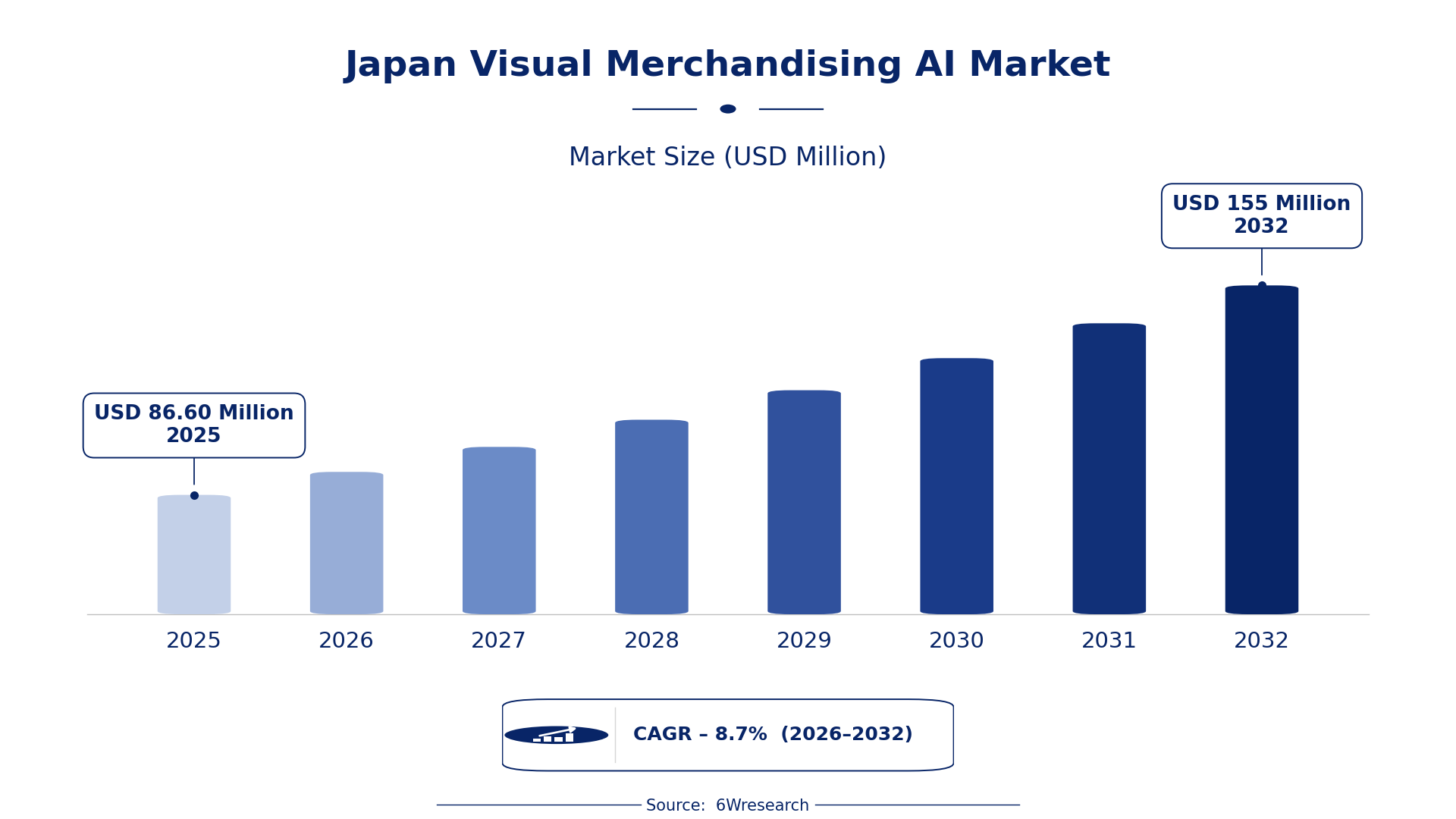
According to 6Wresearch internal database and industry insights, the Japan Visual Merchandising AI Market was valued at USD 86.60 Million in 2025 and is projected to reach USD 155 Million by 2032, growing at a CAGR of approximately 8.7% during 2026–2032.
Japan Visual Merchandising AI Market Highlights
| Report Metric | Details |
| Report Name | Japan Visual Merchandising AI Market (2026-2032) |
| Market Size 2025 | USD 86.60 Million |
| Market Size 2032 | USD 155 Million |
| Absolute Growth 2025–2032 | USD 68.40 Million |
| CAGR 2026–2032 | 8.7% |
| Peak Annual Growth | 9.5% in 2027 |
| Forecast Period | 2026–2032 |
| Historical Data | 2022–2025 |
| Base Year | 2025 |
| Leading Application Type, 2025 | Shelf Layout AI (41% share) |
| Leading AI Technology Used, 2025 | Computer Vision (49% share) |
| Leading Retail Format, 2025 | Supermarkets (39% share) |
| Leading Deployment Mode, 2025 | SaaS (34% share) |
| Fastest-Growing Application Type | Product Placement AI (12.5% CAGR) |
| Fastest-Growing AI Technology Used | Predictive Models (11.9% CAGR) |
| Fastest-Growing Retail Format | Fashion Retail (12.2% CAGR) |
| Fastest-Growing Deployment Mode | Cloud-based (12.8% CAGR) |
| Growing Sector | Retail technology |
| Key End Users | Supermarkets, Fashion Retailers, Department Stores, Electronic Stores |
Japan Visual Merchandising AI Market Year-wise Growth Rate and Key Drivers (2022–2032)
This graph illustrates the annual growth rates of the market from 2022 to 2032, highlighting a steady upward trajectory and projected market expansion over the forecast period.
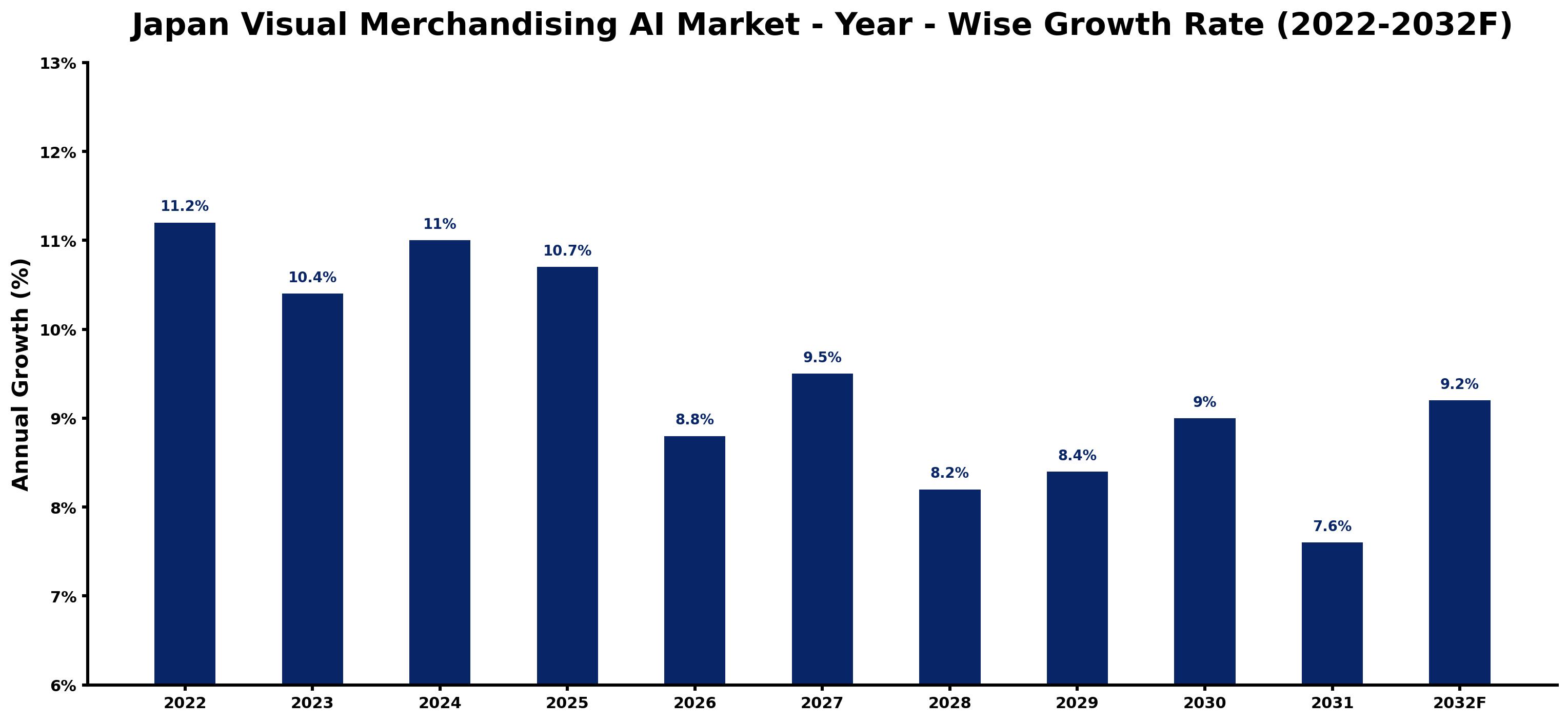
Below, each year's estimated growth is shown next to the factor that most influenced it.
| Year | Estimated Annual Growth (%) | Market Rationale |
| 2022 | 11.2 | The market experienced strong engagement from retailers leveraging advanced AI technologies. |
| 2023 | 10.4 | Demand growth slowed as retailers adjusted to new AI implementations and consumer preferences. |
| 2024 | 11.0 | Increased interest in data-driven merchandising strategies led to a rise in AI adoption. |
| 2025 | 10.7 | Retailers continued to invest in AI solutions for enhanced customer experiences. |
| 2026 | 8.8 | The market growth slowed as competition intensified among AI providers. |
| 2027 | 9.5 | New AI technologies are expected to drive significant demand from the retail sector. |
| 2028 | 8.2 | Market growth slowed as retailers focused on optimising existing AI systems. |
| 2029 | 8.4 | Increased investments in AI for merchandising are anticipated to boost growth. |
| 2030 | 9.0 | Retailers will adopt more advanced AI solutions to improve operational efficiency. |
| 2031 | 7.6 | The market is expected to grow more slowly as saturation occurs in urban areas. |
| 2032 | 9.2 | Demand for innovative AI applications is projected to rise as retailers seek differentiation. |
Note: Market size estimations and growth projections presented in this report are based on 6Wresearch's proprietary forecasting methodology, utilizing the latest available industry data, government publications, and primary research inputs.
Japan Visual Merchandising AI Market Synopsis
Visual Merchandising AI improves retail display strategies through artificial intelligence technologies that analyse consumer behaviour and optimise product placement. The Japanese retail market, valued at approximately 150 trillion yen, is growing due to urban demand and substantial investments in AI technology. The AI Strategy 2023 aims to increase AI usage in retail by 20%, while the Ministry of Economy, Trade and Industry supports AI adoption, especially in supermarkets and fashion retail, where advanced merchandising techniques are crucial for maintaining competitive edge.
Market Dynamics Impact Analysis (2026–2032)
| Factor | Type | Impact | Primary Segment Affected |
| Growing adoption of AI technologies in retail to enhance customer engagement and sales performance. | Driver | High | Digital Display AI |
| Increased investment in AI-driven merchandising solutions by major retail formats. | Driver | High | Supermarkets |
| Rising demand for advanced merchandising solutions in urban areas creates new market opportunities. | Opportunity | High | Product Placement AI |
| The expansion of AI applications in fashion retail presents a significant growth avenue. | Opportunity | High | Fashion Retail |
| High initial investment costs for AI systems may deter smaller retailers from adoption. | Restraint | Medium | Shelf Layout AI |
| Limited understanding of AI technologies among traditional retailers can hinder market growth. | Restraint | Medium | Heatmap AI |
| Compliance with evolving AI regulations can increase operational costs for retailers. | Challenge | High | Digital Display AI |
| Capacity constraints in integrating AI solutions with existing retail systems may limit growth. | Challenge | Medium | Product Placement AI |
Evaluation of Drivers in Japan Visual Merchandising AI Market (2026–2032)
These are the developments adding the most demand over the forecast period.
| Drivers | Primary Segment Affected | Why It Matters (Evidence) |
| Increased consumer engagement through dynamic digital displays. | Digital Display AI | Retailers in Tokyo are adopting digital displays to improve customer interaction, leading to a 30% increase in engagement. |
| Investment in AI for product placement optimisation. | Product Placement AI | Supermarkets are using AI to strategically position products, resulting in a 25% boost in sales. |
| Growing trend of data-driven decision-making in retail. | Shelf Layout AI | The installed base of AI systems in urban retail is expanding, with a 40% increase in AI adoption reported. |
| Demand for predictive analytics to forecast consumer trends. | Predictive Models | Fashion retail accounts for over 30% of Japan's retail sales, driving investments in predictive analytics. |
| Government initiatives promoting AI integration in retail. | Heatmap AI | The AI Strategy 2023 aims for a 20% increase in AI usage, encouraging retailers to adopt heatmap technologies. |
Several shifts outside the market lift sales. The installed base of AI systems in urban areas is growing rapidly, with a 40% increase in adoption reported. Retailers are investing in digital displays to improve customer interaction, resulting in a 30% rise in engagement. The AI Strategy 2023 aims to boost AI usage in retail by 20%, encouraging investments in predictive analytics. The growing trend of data-driven decision-making is driving demand for AI technologies across various retail formats.
Evaluation of Restraints in Japan Visual Merchandising AI Market
These are the pressures that could keep growth below its potential.
| Market Restraint | Primary Segment Affected | Why It Matters (Evidence) |
| High initial investment costs for AI systems deter smaller retailers from adoption. | Shelf Layout AI | Smaller retailers face challenges with upfront costs, limiting their ability to implement AI technologies. |
| Limited understanding of AI technologies among traditional retailers hinders market growth. | Heatmap AI | Many traditional retailers lack the expertise to effectively utilise AI, resulting in underinvestment. |
| Compliance with evolving AI regulations increases operational costs for retailers. | Digital Display AI | Adhering to new standards requires additional resources, impacting profitability for retailers. |
| Capacity constraints in integrating AI solutions with existing retail systems limit growth. | Product Placement AI | Retailers struggle to merge new AI technologies with legacy systems, delaying implementation. |
| Concerns over data privacy and security may restrict AI adoption in retail. | Predictive Models | Retailers are cautious about data handling, which can slow down the integration of AI solutions. |
Japan Visual Merchandising AI Market Challenges
Buyers encounter high costs due to the slow adoption of AI technologies, which hinders the implementation of effective merchandising strategies and limits sales potential. Competition intensifies as traditional retailers fall behind in AI integration, risking a 15% loss in market share to more agile competitors. Compliance with the JIS Z 8803 standard incurs additional expenses for smaller retailers, restricting their ability to invest in necessary upgrades. Regulatory delays from the Ministry of Economy, Trade and Industry can postpone AI deployment, resulting in missed opportunities for improved customer engagement and a 10% decline in sales growth.
Trends in the Japan Visual Merchandising AI Market
Four trends stand out in the Japan Visual Merchandising AI Market.
- Shift from Static Displays to Interactive Digital Merchandising: Since 2022, retailers have increasingly embraced interactive digital displays to engage customers. For instance, Tokyo's department stores reported a 30% rise in customer interaction through these technologies.
- Transition from Traditional to AI-Driven Product Placement: In 2023, supermarkets began utilising AI for product placement, resulting in a 25% increase in sales. This shift underscores the growing dependence on technology for merchandising strategies.
- Fashion Retail Prioritising Predictive Analytics: Fashion retailers are increasingly incorporating predictive analytics, with a 30% rise in usage since 2022. This trend is driven by the necessity to accurately forecast consumer preferences.
- Emergence of Cloud-based AI Solutions in Retail: The adoption of cloud-based AI solutions has surged since 2023, with a 20% increase in usage among retailers. This trend enables scalable and flexible merchandising strategies.
Investment Opportunities in the Japan Visual Merchandising AI Market
The openings below show where demand in the Japan Visual Merchandising AI Market is visible and how suppliers can enter.
- Growing Demand for AI in Supermarkets: With Japan's retail market valued at approximately 150 trillion yen, supermarkets are increasingly implementing AI for shelf management, creating a notable opportunity for suppliers.
- Investment in AI for Fashion Retail: Fashion retail, accounting for over 30% of Japan's retail sales, presents a prime opportunity for investment in AI technologies to refine merchandising strategies.
- Expansion of Digital Displays in Department Stores: The increasing trend of digital displays in department stores offers suppliers a chance to deliver effective AI solutions, with a projected 10 billion yen allocated for AI technology development.
- Partnerships for AI Implementation in Retail: Retailers are seeking partnerships to implement AI solutions effectively, creating opportunities for local firms to collaborate and provide tailored AI technologies.
Government Initiatives in the Japan Visual Merchandising AI Market
The AI Promotion Act, established in 2025, creates a national framework for AI research and development, improving the regulatory environment for Visual Merchandising AI. This act complements the Building Energy Efficiency Act, which mandates energy standards for new buildings, promoting sustainable practices in retail environments.
The Digital Agency oversees government digital transformation efforts and approves funding for AI projects. In 2023, the agency allocated 10 billion yen specifically for AI technology development, supporting retailers in adopting advanced merchandising solutions.
Future Insight of the Japan Visual Merchandising AI Market
New digital display systems will emerge, transforming customer interactions in stores by 2032. The installed base of AI systems in urban retail is projected to increase by 20%, improving operational efficiencies for buyers and suppliers. Predictive analytics will become standard, enabling retailers to tailor their offerings more effectively. The Ministry of Economy, Trade and Industry's initiatives will further promote AI adoption, creating a more dynamic retail environment.
Market Segmentation Analysis
Japan Visual Merchandising AI Market report covers a detailed analysis of the following market segments:
By Application Type – Shelf Layout AI Leads, Product Placement AI Expected to Grow Fastest
According to Saurav Kr Singh, Senior Research Analyst at 6Wresearch, the largest application type category in 2025 was Shelf Layout AI, at 41% of revenue. Shelf Layout AI holds the largest share due to its effectiveness in optimising product arrangement for better visibility in retail spaces. This technology is particularly prevalent in supermarkets across urban areas, where enhancing customer engagement is a priority. Product Placement AI is set to record the highest CAGR in this split, 12.5% over 2026–2032. Product Placement AI is experiencing rapid growth as it enhances sales through strategic product positioning based on consumer behaviour. The increasing emphasis on data-driven merchandising strategies is significantly boosting its adoption among retailers. Suppliers should focus on developing advanced product placement solutions to meet the rising demand in the market.
By AI Technology Used – Computer Vision Leads, Predictive Models Expected to Grow Fastest
In 2025, Computer Vision led the ai technology used split with a 49% share. Computer Vision leads the market as it supports various applications in visual merchandising, enabling retailers to analyse customer interactions with displays effectively. Its extensive use in urban retail environments underscores its critical role in enhancing merchandising strategies. The quickest growth will come from Predictive Models, forecast to expand at a CAGR of 11.9% between 2026 and 2032. Predictive Models are expanding quickly as they offer valuable forecasting capabilities that assist retailers in anticipating trends and consumer preferences. The growing focus on data analytics within retail operations is propelling this segment's growth. Buyers should seek solutions that incorporate predictive capabilities to maintain a competitive edge in the market.
By Retail Format – Supermarkets Lead, Fashion Retail Expected to Grow Fastest
Supermarkets held 39% of the Japan Visual Merchandising AI Market by retail format in 2025. Supermarkets dominate the market due to their extensive use of visual merchandising techniques to maximise product visibility and sales. This format is particularly prominent in urban areas where competition is fierce and customer engagement is vital. Fashion Retail is projected to grow fastest, at a CAGR of 12.2% during 2026–2032. Fashion Retail is the fastest-growing segment as it employs advanced merchandising techniques to remain competitive in a dynamic market. The sector's focus on customer experience and visual appeal is fuelling its rapid adoption of AI technologies. Suppliers must tailor their offerings to meet the specific needs of the fashion retail sector to capture growth opportunities.
By Deployment Mode – SaaS Lead, Cloud-based Expected to Grow Fastest
With 34% of deployment mode revenue in 2025, SaaS was the largest category. SaaS is the leading deployment mode because it provides retailers with cloud-based solutions that ensure easy access and scalability for visual merchandising applications. This model is particularly preferred in urban retail settings where agility and responsiveness are essential. Over 2026–2032, Cloud-based is expected to post the fastest growth, at a CAGR of 12.8%. Cloud-based solutions are rapidly gaining traction as they enable remote access and efficient data management for retailers. The increasing reliance on digital tools in retail operations is driving this segment's growth. Buyers should evaluate cloud-based solutions for their flexibility and efficiency in managing visual merchandising strategies.
Key Attractiveness of the Report
- 10 Years of Market Numbers
- Historical Data Starting from 2022 to 2025
- Base Year 2025
- Forecast Data until 2032
- Key Performance Indicators Impacting the Market
- Major Upcoming Developments and Projects
Key Highlights of the Report:
- Japan Visual Merchandising AI Market Outlook
- Market Size of Japan Visual Merchandising AI Market, 2025
- Forecast of Japan Visual Merchandising AI Market, 2032
- Historical Data and Forecast of Japan Visual Merchandising AI Revenues & Volume for the Period 2022-2032F
- Japan Visual Merchandising AI Market Trend Evolution
- Japan Visual Merchandising AI Market Drivers and Challenges
- Japan Visual Merchandising AI Price Trends
- Japan Visual Merchandising AI Porter's Five Forces
- Japan Visual Merchandising AI Industry Life Cycle
- Historical Data and Forecast of Japan Visual Merchandising AI Market Revenues & Volume By Application Type for the Period 2022-2032F
- Historical Data and Forecast of Japan Visual Merchandising AI Market Revenues & Volume By Shelf Layout AI for the Period 2022-2032F
- Historical Data and Forecast of Japan Visual Merchandising AI Market Revenues & Volume By Product Placement AI for the Period 2022-2032F
- Historical Data and Forecast of Japan Visual Merchandising AI Market Revenues & Volume By Digital Display AI for the Period 2022-2032F
- Historical Data and Forecast of Japan Visual Merchandising AI Market Revenues & Volume By Heatmap AI for the Period 2022-2032F
- Historical Data and Forecast of Japan Visual Merchandising AI Market Revenues & Volume By AI Technology Used for the Period 2022-2032F
- Historical Data and Forecast of Japan Visual Merchandising AI Market Revenues & Volume By Computer Vision for the Period 2022-2032F
- Historical Data and Forecast of Japan Visual Merchandising AI Market Revenues & Volume By Predictive Models for the Period 2022-2032F
- Historical Data and Forecast of Japan Visual Merchandising AI Market Revenues & Volume By Image Processing for the Period 2022-2032F
- Historical Data and Forecast of Japan Visual Merchandising AI Market Revenues & Volume By Behavior Tracking for the Period 2022-2032F
- Historical Data and Forecast of Japan Visual Merchandising AI Market Revenues & Volume By Retail Format for the Period 2022-2032F
- Historical Data and Forecast of Japan Visual Merchandising AI Market Revenues & Volume By Supermarkets for the Period 2022-2032F
- Historical Data and Forecast of Japan Visual Merchandising AI Market Revenues & Volume By Fashion Retail for the Period 2022-2032F
- Historical Data and Forecast of Japan Visual Merchandising AI Market Revenues & Volume By Electronic Stores for the Period 2022-2032F
- Historical Data and Forecast of Japan Visual Merchandising AI Market Revenues & Volume By Department Stores for the Period 2022-2032F
- Historical Data and Forecast of Japan Visual Merchandising AI Market Revenues & Volume By Deployment Mode for the Period 2022-2032F
- Historical Data and Forecast of Japan Visual Merchandising AI Market Revenues & Volume By SaaS for the Period 2022-2032F
- Historical Data and Forecast of Japan Visual Merchandising AI Market Revenues & Volume By Cloud-based for the Period 2022-2032F
- Historical Data and Forecast of Japan Visual Merchandising AI Market Revenues & Volume By Integrated for the Period 2022-2032F
- Historical Data and Forecast of Japan Visual Merchandising AI Market Revenues & Volume By On-premise for the Period 2022-2032F
- Japan Visual Merchandising AI Import Export Trade Statistics
- Market Opportunity Assessment By Application Type
- Market Opportunity Assessment By AI Technology Used
- Market Opportunity Assessment By Retail Format
- Market Opportunity Assessment By Deployment Mode
- Japan Visual Merchandising AI Top Companies Market Share
- Japan Visual Merchandising AI Competitive Benchmarking By Technical and Operational Parameters
- Japan Visual Merchandising AI Company Profiles
- Japan Visual Merchandising AI Key Strategic Recommendations
Market Covered
Coverage by segment is as follows.
By Application Type
- Shelf Layout AI
- Product Placement AI
- Digital Display AI
- Heatmap AI
By AI Technology Used
- Computer Vision
- Predictive Models
- Image Processing
- Behavior Tracking
By Retail Format
- Supermarkets
- Fashion Retail
- Electronic Stores
- Department Stores
By Deployment Mode
- SaaS
- Cloud-based
- Integrated
- On-premise































