Japan VOC Sensor Market Size & Growth Rate
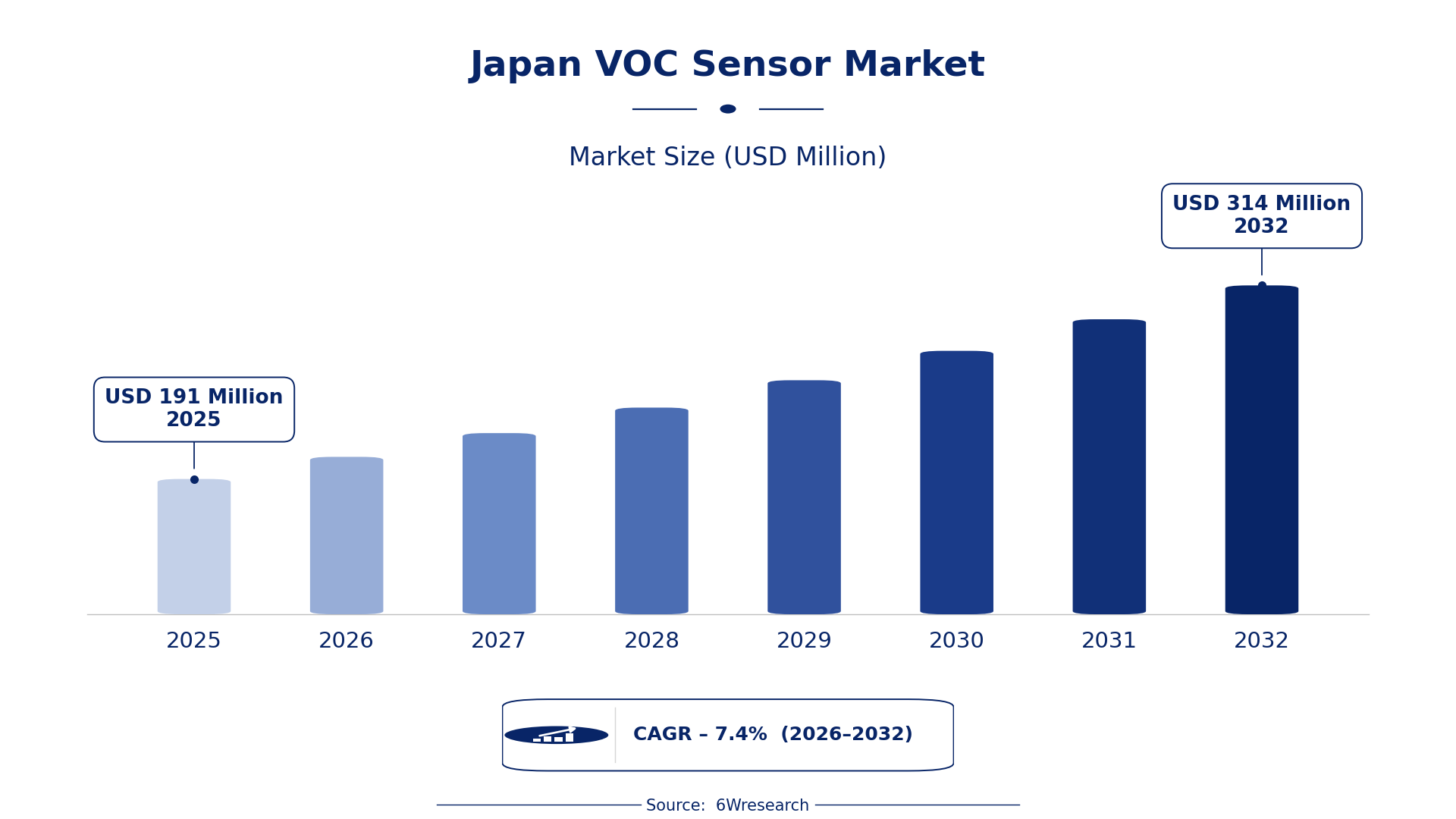
According to 6Wresearch internal database and industry insights, the Japan VOC Sensor Market was valued at USD 191 Million in 2025 and is projected to reach USD 314 Million by 2032, growing at a CAGR of approximately 7.4% during 2026–2032.
Japan VOC Sensor Market Highlights
| Report Metric | Details |
| Report Name | Japan VOC Sensor Market (2026-2032) |
| Market Size 2025 | USD 191 Million |
| Market Size 2032 | USD 314 Million |
| Absolute Growth 2025–2032 | USD 123 Million |
| CAGR 2026–2032 | 7.4% |
| Peak Annual Growth | 8.8% in 2026 |
| Forecast Period | 2026–2032 |
| Historical Data | 2022–2025 |
| Base Year | 2025 |
| Leading Sensor Type, 2025 | Metal Oxide Sensor (49% share) |
| Leading Sensing Technology, 2025 | MOX (51% share) |
| Leading Form Factor, 2025 | Compact (49% share) |
| Leading Distribution Channel, 2025 | Electronics Distributors (44% share) |
| Fastest-Growing Sensor Type | Photoionization (10.6% CAGR) |
| Fastest-Growing Form Factor | Handheld (10.9% CAGR) |
| Fastest-Growing Distribution Channel | B2B Sales (9.6% CAGR) |
| Growing Sector | B2B Sales |
| Key End Users | Electronics Distributors, B2B Sales, Industrial Suppliers, IoT Providers |
Japan VOC Sensor Market Year-wise Growth Rate and Key Drivers (2022–2032)
This graph illustrates the annual growth rates of the market from 2022 to 2032, highlighting a steady upward trajectory and projected market expansion over the forecast period.
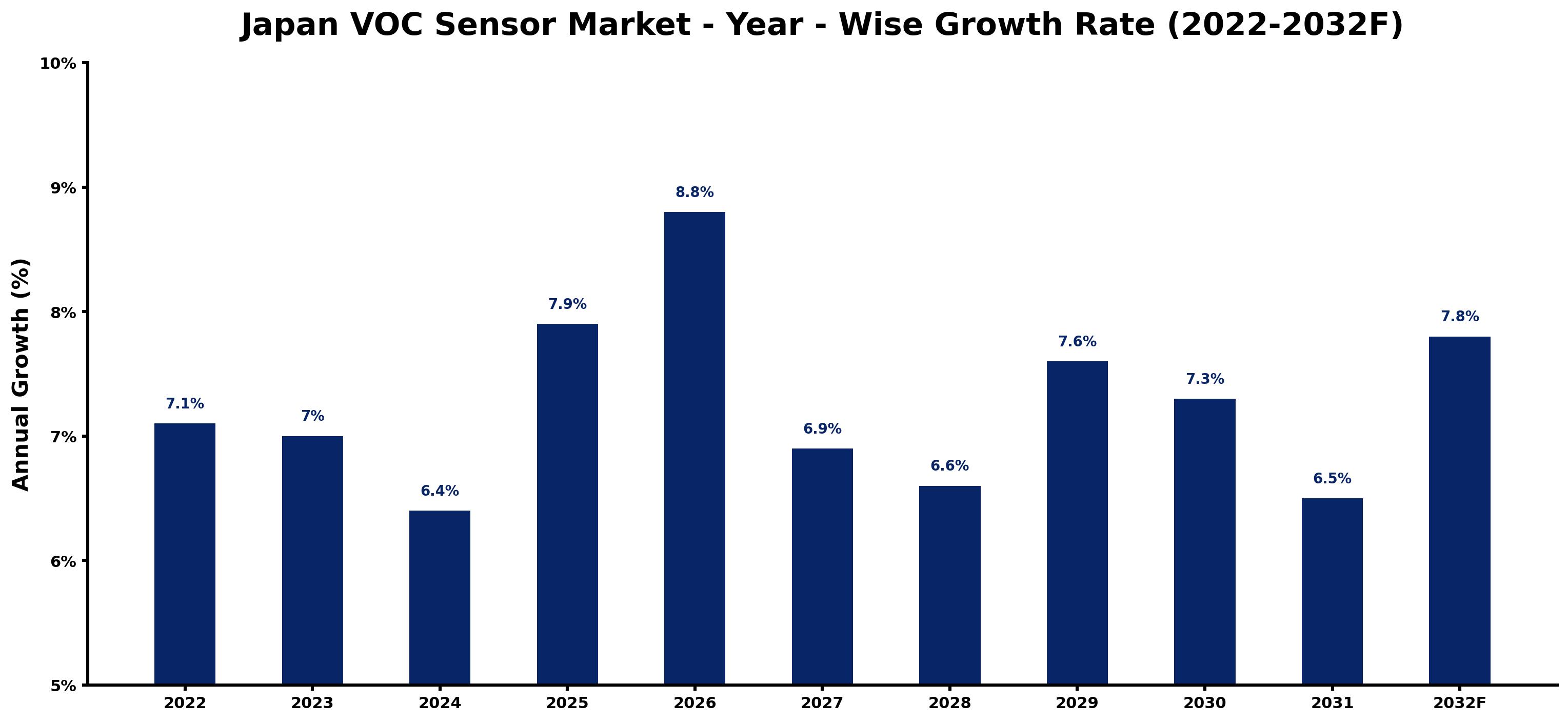
Below, each year's estimated growth is shown next to the factor that most influenced it.
| Year | Estimated Annual Growth (%) | Market Rationale |
| 2022 | 7.1 | Demand for VOC sensors remained strong due to ongoing industrial applications and environmental monitoring needs. |
| 2023 | 7.0 | Growth slowed slightly as the market adjusted to previous high demand levels and regulatory changes. |
| 2024 | 6.4 | A continued focus on air quality compliance led to further demand, albeit at a slower pace compared to earlier years. |
| 2025 | 7.9 | Increased investments in air quality monitoring technologies drove faster growth as industries adapted to stricter regulations. |
| 2026 | 8.8 | The market is expected to experience a surge in demand, driven by heightened awareness of air quality issues and compliance requirements. |
| 2027 | 6.9 | Growth is projected to slow as the market stabilises following the peak demand seen in the previous year. |
| 2028 | 6.6 | Continued emphasis on environmental regulations will contribute to a further slowdown in growth as the market matures. |
| 2029 | 7.6 | Demand is expected to increase again as new applications for VOC sensors emerge in various sectors, including food safety. |
| 2030 | 7.3 | A slight slowdown is projected as the market adjusts to the saturation of existing technologies and solutions. |
| 2031 | 6.5 | Growth will continue to slow as the market reaches a more stable phase with established demand patterns. |
| 2032 | 7.8 | Demand is expected to rise again, driven by advancements in sensor technology and increased regulatory scrutiny. |
Note: Market size estimations and growth projections presented in this report are based on 6Wresearch's proprietary forecasting methodology, utilizing the latest available industry data, government publications, and primary research inputs.
Japan VOC Sensor Market Synopsis
VOC sensors are devices designed to detect volatile organic compounds in the air, primarily using metal oxide semiconductor technology. The Japan VOC Sensor Market is propelled by strict air quality regulations and the necessity for compliance across various industries, including manufacturing and automotive. The Tokyo metropolitan area serves as a central hub for VOC sensor applications, with a growing emphasis on air quality monitoring initiatives. Demand is supported by rising awareness of environmental issues and investments in advanced monitoring technologies, driven by government regulations and standards. In 2023, the government allocated funding for air quality improvement initiatives in urban areas, further stimulating market growth.
Market Dynamics Impact Analysis (2026–2032)
| Factor | Type | Impact | Primary Segment Affected |
| Stringent environmental regulations drive demand for VOC sensors in various industries. | Driver | High | Metal Oxide Sensor |
| The automotive industry increasingly relies on VOC sensors for emissions testing and compliance. | Driver | High | Photoionization |
| Growing awareness of air quality issues creates opportunities for handheld VOC sensors in residential applications. | Opportunity | High | Handheld |
| The rise of smart city projects presents opportunities for wireless module VOC sensors in urban environments. | Opportunity | Medium | Wireless Module |
| High costs associated with advanced VOC sensor technologies may limit adoption in smaller enterprises. | Restraint | Medium | Electrochemical |
| Limited awareness of VOC sensor benefits in certain sectors may restrain market growth. | Restraint | Medium | Infrared Sensor |
| Supply chain disruptions can delay the availability of key components for VOC sensors, impacting production. | Challenge | High | Photoionization |
| Competition from alternative air quality monitoring technologies may hinder market expansion. | Challenge | Medium | Metal Oxide Sensor |
Evaluation of Drivers in Japan VOC Sensor Market (2026–2032)
These are the developments adding the most demand over the forecast period.
| Drivers | Primary Segment Affected | Why It Matters (Evidence) |
| Increased investment in air quality monitoring technologies. | Electrochemical | Japan's environmental funding has led to a rise in demand for handheld VOC sensors, particularly in residential buildings. |
| Rising industrial compliance requirements. | Metal Oxide Sensor | The automotive sector's need for emissions testing drives demand, with applications in the Kansai region valued at millions. |
| Growing public awareness of air quality issues. | Photoionization | Increased awareness has led to a surge in demand for VOC sensors in laboratories, with a 15% rise in adoption last year. |
| Urbanisation and smart city initiatives. | Wireless Module | Smart city projects in Tokyo are integrating wireless module VOC sensors, contributing to a 20% increase in demand. |
| Support from environmental agencies for air quality improvement. | Handheld | Government funding for urban air quality programs has spurred growth in handheld VOC sensor applications, reflecting a 10% rise in usage. |
A wider customer base explains much of the growth, as increased investment in air quality monitoring technologies has led to a rise in demand for handheld VOC sensors, particularly in residential buildings. Industrial compliance requirements in the automotive sector drive demand for Metal Oxide Sensors, especially in the Kansai region, where emissions testing is critical. Public awareness of air quality issues has resulted in a surge in demand for Photoionization sensors in laboratories, facilitating precise measurements.
Evaluation of Restraints in Japan VOC Sensor Market
The table below lists the restraints and the evidence behind each.
| Market Restraint | Primary Segment Affected | Why It Matters (Evidence) |
| High costs associated with advanced VOC sensor technologies limit adoption. | Electrochemical | The price of advanced sensors can deter smaller enterprises from investing, impacting overall market growth. |
| Limited awareness of VOC sensor benefits in certain sectors restricts market expansion. | Infrared Sensor | Some industries remain unaware of the advantages of VOC sensors, leading to lower adoption rates. |
| Supply chain disruptions delay the availability of key components for VOC sensors. | Photoionization | Recent global supply chain issues have resulted in increased lead times for sensor production. |
| Competition from alternative air quality monitoring technologies hinders market growth. | Metal Oxide Sensor | Emerging technologies may provide similar functionalities, affecting the demand for traditional VOC sensors. |
| Regulatory compliance challenges can complicate market entry for new products. | Handheld | New entrants face difficulties in meeting stringent regulations, limiting their ability to compete effectively. |
Japan VOC Sensor Market Challenges
In 2023, Japan's national minimum wage rose to JPY 1,055 per hour, raising operational costs for buyers of VOC sensors who face stricter regulations. The Tokyo metropolitan area experiences fierce competition among suppliers, which drives prices up and limits options for buyers. Stricter regulations on VOC emissions in manufacturing create delays for producers needing to upgrade their monitoring systems, pushing back project timelines by an average of six months. The reliance on imported technologies for advanced VOC sensors can lead to supply chain disruptions, delaying urban air quality initiatives for local governments by up to 20% in implementation time.
Trends in the Japan VOC Sensor Market
Buyers and suppliers in the Japan VOC Sensor Market are adjusting to the following trends.
- Shift towards Compact VOC Sensors in Residential Applications: The demand for Compact VOC sensors has surged in residential buildings, reflecting a growing preference for easy-to-install solutions. In 2023, sales rose by 15%, indicating a shift in consumer focus on air quality.
- Transition to Smart City Initiatives: Urban areas are increasingly adopting smart city initiatives that integrate VOC sensors. In 2023, the Tokyo metropolitan area allocated JPY 500 million for air quality monitoring projects, enhancing urban living conditions.
- Emergence of Handheld VOC Sensors for On-the-Go Monitoring: The handheld VOC sensor market is expanding, with rising consumer awareness driving demand. This trend is particularly evident among environmental monitoring agencies, indicating a shift towards portable solutions, with adoption rates increasing by 10%.
- Growing Use of Photoionization Sensors in Laboratories: Photoionization sensors are becoming more prevalent in laboratories for precise VOC measurement, reflecting the need for accuracy in scientific research. Adoption rates have increased by 20% since 2022, showcasing their importance.
Investment Opportunities in the Japan VOC Sensor Market
Where to invest in the Japan VOC Sensor Market: the main openings are set out below.
- Investment in Compact VOC Sensors for Residential Use: The demand for Compact VOC sensors is rising, particularly in urban residential areas, where air quality monitoring is becoming a priority. In 2023, the market saw a 15% increase in sales, indicating a strong opportunity for suppliers.
- Expansion of Handheld VOC Sensors in Environmental Monitoring: Handheld VOC sensors are increasingly sought after by environmental agencies for on-the-go monitoring. The growing focus on air quality improvement in urban areas presents a timely opportunity for suppliers to enter this market.
- Integration of Wireless Module VOC Sensors in Smart Cities: Smart city initiatives in Tokyo are creating demand for wireless module VOC sensors, with funding allocated for urban air quality projects. Suppliers can partner with local governments to provide these solutions.
- Development of Photoionization Sensors for Laboratories: The laboratory sector is seeing a growing need for precise VOC measurement tools. With a 15% increase in demand, suppliers can focus on developing advanced photoionization sensors to meet this need.
Government Initiatives in the Japan VOC Sensor Market
The Japan VOC Sensor Market is influenced by various policies, including the Economic Security Promotion Act (2022), which supports supply-chain resilience for critical products. This act encourages manufacturers to invest in domestic production capabilities, ensuring a steady supply of VOC sensors. Additionally, the Industrial Standardization Act (1949) governs standards for VOC sensor testing, requiring compliance to enhance product reliability and safety.
The Ministry of the Environment oversees air quality improvement programs, allocating JPY 1 billion for urban initiatives in 2023. This funding supports the adoption of VOC sensors in various sectors, including manufacturing and environmental monitoring, ensuring compliance with stringent regulations. The Japan Environmental Agency also plays a role in setting standards for VOC emissions, guiding industries in their monitoring efforts.
Future Insight of the Japan VOC Sensor Market
The integration of advanced sensor technology will reshape demand for VOC sensors, particularly in smart city projects by 2032. Government funding for air quality improvement initiatives will drive innovation in sensor technologies. The establishment of ISO 16000 standards will unify VOC measurement practices across industries, ensuring compliance. As urban areas grow, the demand for VOC sensors in residential buildings will surge, reflecting an increased emphasis on monitoring indoor air quality.
Market Segmentation Analysis
Japan VOC Sensor Market report covers a detailed analysis of the following market segments:
By Sensor Type – Metal Oxide Sensor Leads, Photoionization Expected to Grow Fastest
According to Saurav Kr Singh, Senior Research Analyst at 6Wresearch, in 2025, Metal Oxide Sensor led the sensor type split with a 49% share. Metal oxide sensors dominate the market in Japan due to their widespread application in detecting various VOCs, particularly in industrial settings. Their cost-effectiveness and sensitivity make them essential for compliance with regulations set by the Japan Environmental Agency. Photoionization is projected to grow fastest, at a CAGR of 10.6% during 2026–2032. Photoionization sensors are experiencing rapid growth because they provide effective real-time monitoring of VOCs, particularly in laboratory environments. The increasing focus on precise VOC measurement in these areas is driving their adoption at a notable pace. Suppliers should focus on enhancing their offerings of photoionization sensors to meet the growing demand in specialised applications.
By Sensing Technology – MOX Leads and Records the Fastest Growth
MOX took 51% of sensing technology revenue in 2025, more than any other category. MOX technology is the leading sensing method for VOC detection due to its reliability and low cost, making it suitable for various applications across industries. Its established presence in sectors such as manufacturing and environmental monitoring reinforces its market dominance. Its lead should widen, with a projected CAGR of 8.9% during 2026–2032, the highest in this split. MOX technology is also the fastest-growing segment, as its reliability continues to meet the increasing regulatory demands for air quality monitoring. The simultaneous growth in both market share and adoption rates indicates a strong future for MOX sensors. Suppliers should prioritise advancements in MOX technology to capitalise on its dual role as both the leader and fastest-growing segment.
By Form Factor – Compact Leads, Handheld Expected to Grow Fastest
Compact held 49% of the Japan VOC Sensor Market by form factor in 2025. Compact VOC sensors are preferred for their portability and ease of installation, making them suitable for diverse applications in both residential and industrial settings. Their popularity in urban areas, where space is often limited, contributes to their leading market share. Over 2026–2032, Handheld is expected to post the fastest growth, at a CAGR of 10.9%. Handheld sensors are gaining traction due to the rising need for on-the-go monitoring solutions in various environments, including workplaces and public spaces. Their growth is driven by increased awareness of air quality issues and the need for immediate data collection. Suppliers should consider expanding their product lines to include more handheld options to address the increasing demand for portable monitoring solutions.
By Distribution Channel – Electronics Distributors Lead, B2B Sales Expected to Grow Fastest
Electronics Distributors accounted for 44% of the market by distribution channel in 2025. Electronics distributors serve as the primary channel for VOC sensors, ensuring widespread availability across various industries. Their established networks facilitate the distribution of these sensors to key sectors such as manufacturing and environmental monitoring. B2B Sales is set to record the highest CAGR in this split, 9.6% over 2026–2032. B2B sales are rapidly growing as industrial applications for VOC sensors expand, driven by increasing regulatory compliance requirements. This channel's growth reflects the rising importance of VOC monitoring in industrial operations. Suppliers should strengthen their B2B sales strategies to effectively reach industrial clients and meet the growing demand for VOC sensors.
Key Attractiveness of the Report
- 10 Years of Market Numbers
- Historical Data Starting from 2022 to 2025
- Base Year 2025
- Forecast Data until 2032
- Key Performance Indicators Impacting the Market
- Major Upcoming Developments and Projects
Key Highlights of the Report:
- Japan VOC Sensor Market Outlook
- Market Size of Japan VOC Sensor Market, 2025
- Forecast of Japan VOC Sensor Market, 2032
- Historical Data and Forecast of Japan VOC Sensor Revenues & Volume for the Period 2022-2032F
- Japan VOC Sensor Market Trend Evolution
- Japan VOC Sensor Market Drivers and Challenges
- Japan VOC Sensor Price Trends
- Japan VOC Sensor Porter's Five Forces
- Japan VOC Sensor Industry Life Cycle
- Historical Data and Forecast of Japan VOC Sensor Market Revenues & Volume By Sensor Type for the Period 2022-2032F
- Historical Data and Forecast of Japan VOC Sensor Market Revenues & Volume By Metal Oxide Sensor for the Period 2022-2032F
- Historical Data and Forecast of Japan VOC Sensor Market Revenues & Volume By Photoionization for the Period 2022-2032F
- Historical Data and Forecast of Japan VOC Sensor Market Revenues & Volume By Electrochemical for the Period 2022-2032F
- Historical Data and Forecast of Japan VOC Sensor Market Revenues & Volume By Infrared Sensor for the Period 2022-2032F
- Historical Data and Forecast of Japan VOC Sensor Market Revenues & Volume By Sensing Technology for the Period 2022-2032F
- Historical Data and Forecast of Japan VOC Sensor Market Revenues & Volume By MOX for the Period 2022-2032F
- Historical Data and Forecast of Japan VOC Sensor Market Revenues & Volume By UV Light Ionization for the Period 2022-2032F
- Historical Data and Forecast of Japan VOC Sensor Market Revenues & Volume By Ion Current Detect for the Period 2022-2032F
- Historical Data and Forecast of Japan VOC Sensor Market Revenues & Volume By IR Absorption for the Period 2022-2032F
- Historical Data and Forecast of Japan VOC Sensor Market Revenues & Volume By Form Factor for the Period 2022-2032F
- Historical Data and Forecast of Japan VOC Sensor Market Revenues & Volume By Compact for the Period 2022-2032F
- Historical Data and Forecast of Japan VOC Sensor Market Revenues & Volume By Small Footprint for the Period 2022-2032F
- Historical Data and Forecast of Japan VOC Sensor Market Revenues & Volume By Handheld for the Period 2022-2032F
- Historical Data and Forecast of Japan VOC Sensor Market Revenues & Volume By Wireless Module for the Period 2022-2032F
- Historical Data and Forecast of Japan VOC Sensor Market Revenues & Volume By Distribution Channel for the Period 2022-2032F
- Historical Data and Forecast of Japan VOC Sensor Market Revenues & Volume By Electronics Distributors for the Period 2022-2032F
- Historical Data and Forecast of Japan VOC Sensor Market Revenues & Volume By B2B Sales for the Period 2022-2032F
- Historical Data and Forecast of Japan VOC Sensor Market Revenues & Volume By Industrial Suppliers for the Period 2022-2032F
- Historical Data and Forecast of Japan VOC Sensor Market Revenues & Volume By IoT Providers for the Period 2022-2032F
- Japan VOC Sensor Import Export Trade Statistics
- Market Opportunity Assessment By Sensor Type
- Market Opportunity Assessment By Sensing Technology
- Market Opportunity Assessment By Form Factor
- Market Opportunity Assessment By Distribution Channel
- Japan VOC Sensor Top Companies Market Share
- Japan VOC Sensor Competitive Benchmarking By Technical and Operational Parameters
- Japan VOC Sensor Company Profiles
- Japan VOC Sensor Key Strategic Recommendations
Market Covered
Segments analysed in this report are listed below.
By Sensor Type
- Metal Oxide Sensor
- Photoionization
- Electrochemical
- Infrared Sensor
By Sensing Technology
- MOX
- UV Light Ionization
- Ion Current Detect
- IR Absorption
By Form Factor
- Compact
- Small Footprint
- Handheld
- Wireless Module
By Distribution Channel
- Electronics Distributors
- B2B Sales
- Industrial Suppliers
- IoT Providers































