Japan Voice-Activated Technology Market Size & Growth Rate
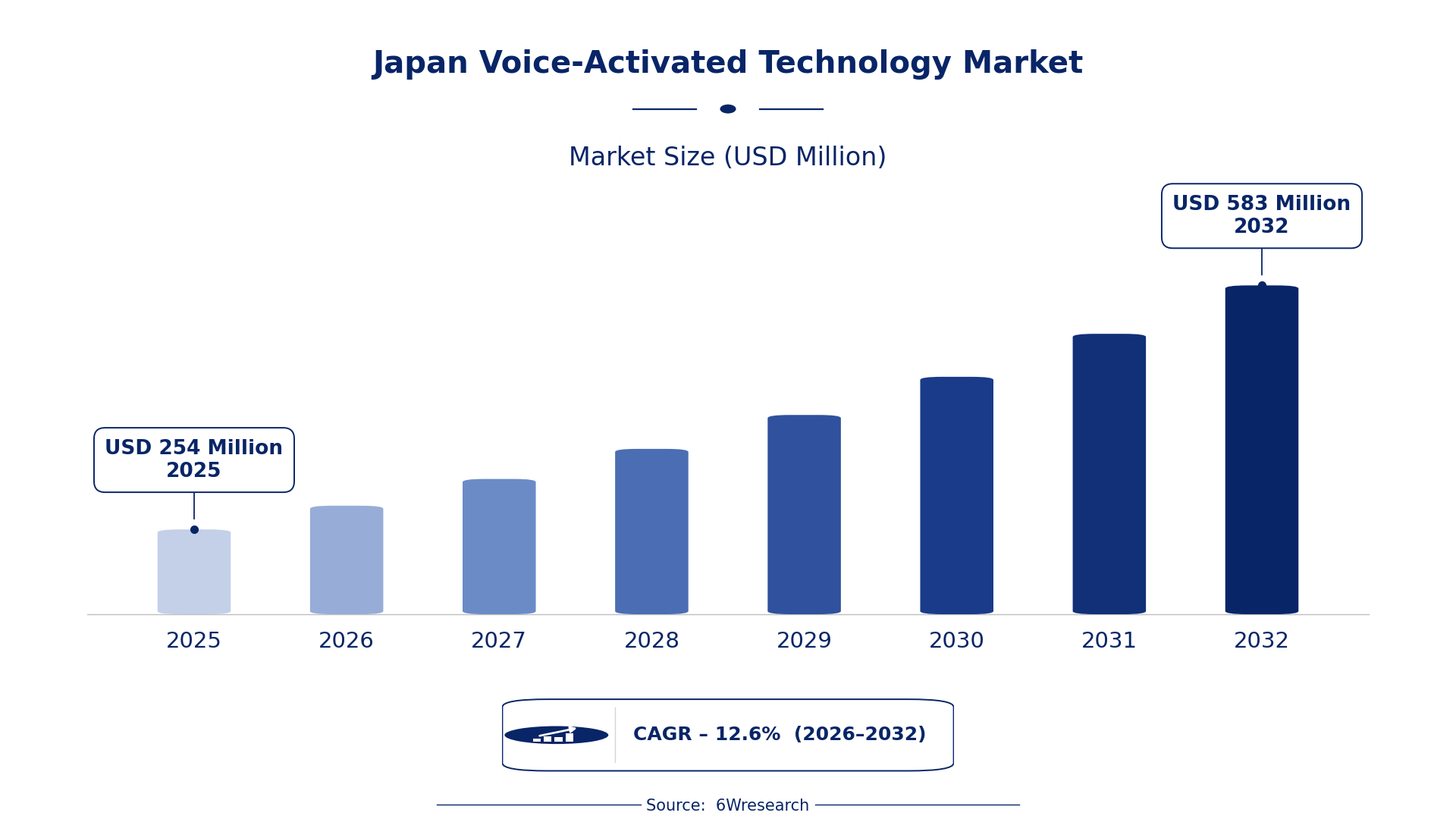
According to 6Wresearch internal database and industry insights, the Japan Voice-Activated Technology Market was valued at USD 254 Million in 2025 and is projected to reach USD 583 Million by 2032, growing at a CAGR of approximately 12.6% during 2026–2032.
Japan Voice-Activated Technology Market Highlights
| Report Metric | Details |
| Report Name | Japan Voice-Activated Technology Market (2026-2032) |
| Market Size 2025 | USD 254 Million |
| Market Size 2032 | USD 583 Million |
| Absolute Growth 2025–2032 | USD 329 Million |
| CAGR 2026–2032 | 12.6% |
| Peak Annual Growth | 14.0% in 2026 |
| Forecast Period | 2026–2032 |
| Historical Data | 2022–2025 |
| Base Year | 2025 |
| Leading Product Type, 2025 | Smart Thermostat (36% share) |
| Leading AI Integration, 2025 | Voice Assistant (44% share) |
| Leading Application Area, 2025 | Smart Home (45% share) |
| Leading Distribution Mode, 2025 | Online Retailers (52% share) |
| Fastest-Growing Product Type | Voice-Controlled TV (17.2% CAGR) |
| Fastest-Growing AI Integration | Embedded NLP (17.4% CAGR) |
| Fastest-Growing Application Area | Living Room Devices (14.8% CAGR) |
| Fastest-Growing Distribution Mode | Electronics Stores (16.0% CAGR) |
| Growing Sector | Smart Home |
| Key End Users | Urban households, electronics retailers, smart home solution providers |
Japan Voice-Activated Technology Market Year-wise Growth Rate and Key Drivers (2022–2032)
This graph illustrates the annual growth rates of the market from 2022 to 2032, highlighting a steady upward trajectory and projected market expansion over the forecast period.
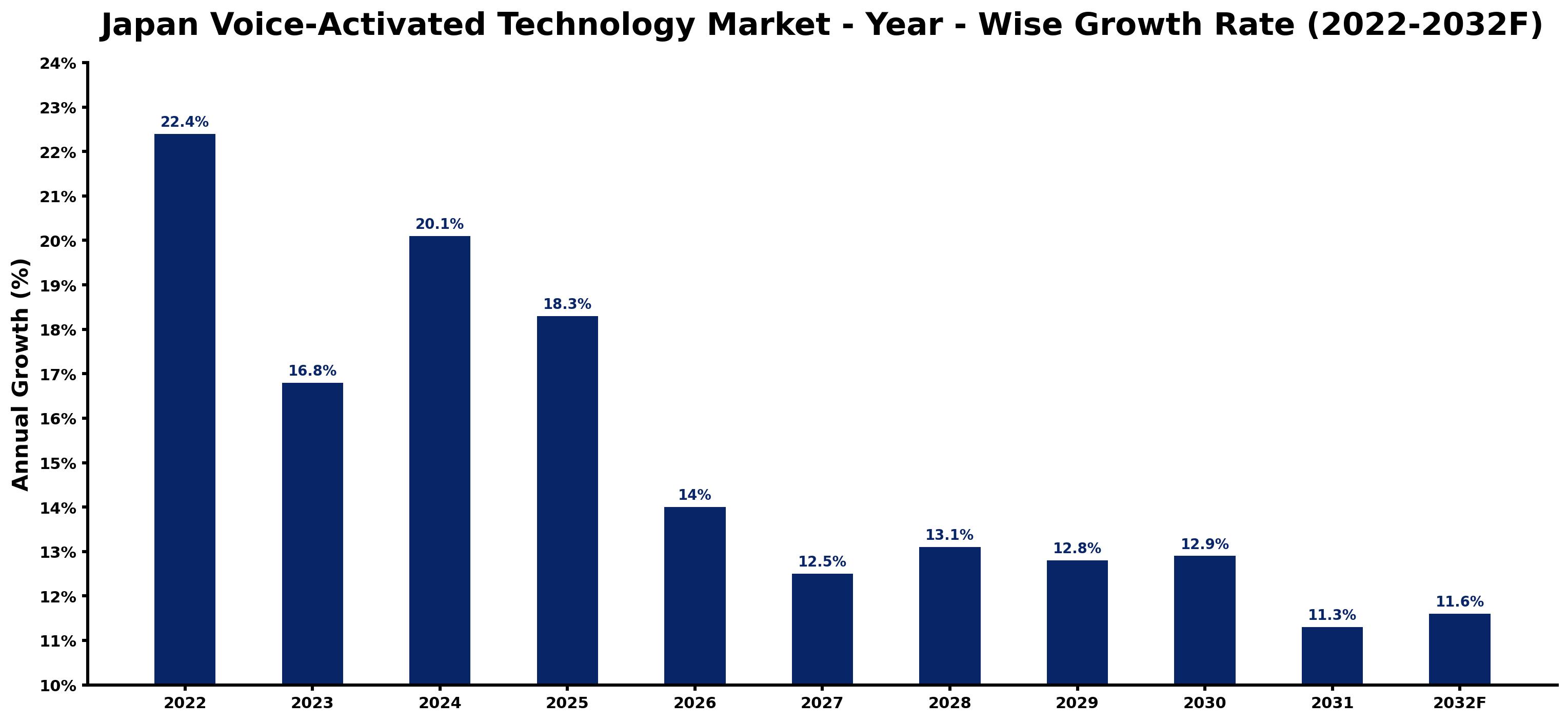
Year by year, the estimates below pair each growth rate with the development that shaped it.
| Year | Estimated Annual Growth (%) | Market Rationale |
| 2022 | 22.4 | The market experienced growth due to rising consumer interest in smart home technologies. |
| 2023 | 16.8 | Growth slowed as market saturation began to impact new device sales and adoption rates. |
| 2024 | 20.1 | Demand surged again as new features in voice-activated devices attracted more users. |
| 2025 | 18.3 | Market growth slowed again as competition intensified among existing products. |
| 2026 | 14.0 | Growth is expected to slow as the market matures, leading to a stabilisation phase. |
| 2027 | 12.5 | The market will see further deceleration as consumers become more selective in their purchases. |
| 2028 | 13.1 | Demand is projected to pick up as new applications for voice technology emerge. |
| 2029 | 12.8 | Growth is expected to slow slightly as consumers begin to focus on device interoperability. |
| 2030 | 12.9 | Demand will increase again as advancements in AI improve user experiences. |
| 2031 | 11.3 | Growth is projected to slow as the market approaches saturation, with fewer new users entering the segment. |
| 2032 | 11.6 | Demand is expected to rise as emerging technologies create new applications for voice-activated devices. |
Note: Market size estimations and growth projections presented in this report are based on 6Wresearch's proprietary forecasting methodology, utilizing the latest available industry data, government publications, and primary research inputs.
Japan Voice-Activated Technology Market Synopsis
Voice-Activated Technology encompasses devices that respond to voice commands, integrating AI and IoT for user interaction. The smart home industry is thriving, projected to reach 1.5 million units by 2025. Key buyer groups include urban households, where 60% use voice assistants. Market growth is driven by increased adoption of smart home technologies, supported by government initiatives and rising consumer interest in energy management and automation.
Market Dynamics Impact Analysis (2026–2032)
| Factor | Type | Impact | Primary Segment Affected |
| Growing adoption of smart home devices | Driver | High | Smart Home |
| Increased integration of AI in voice technology | Driver | High | Smart Thermostat |
| Expansion of IoT-connected devices in urban areas | Opportunity | High | IoT-Connected |
| Rising demand for energy-efficient solutions in households | Opportunity | High | Smart Thermostat |
| Market saturation limiting new user growth | Restraint | Medium | Voice Assistant |
| Intense competition among manufacturers affecting pricing | Restraint | Medium | Voice-Controlled TV |
| Supply chain disruptions impacting product availability | Challenge | High | Kitchen Appliances |
| Rapid technological advancements requiring constant innovation | Challenge | High | Lighting Systems |
Evaluation of Drivers in Japan Voice-Activated Technology Market (2026–2032)
The following drivers explain most of the expected growth.
| Drivers | Primary Segment Affected | Why It Matters (Evidence) |
| Increased consumer interest in smart home automation | Smart Home | Japan's smart home market is projected to reach 1.5 million units by 2025, driving demand for voice-activated devices. |
| Rising penetration of voice assistants in households | Voice Assistant | As of 2023, 60% of urban households use voice assistants, increasing demand for compatible devices. |
| Integration of voice technology in energy management systems | Smart Thermostat | 20% penetration of smart thermostats in urban households reflects growing interest in energy efficiency. |
| Adoption of IoT-connected devices for improved operation | IoT-Connected | The segment saw a 15% increase in adoption rates in 2023, indicating rising consumer demand. |
| Technological advancements improving user experience | Voice-Controlled TV | Voice-Controlled TVs are expected to dominate the living room device segment by 2025, enhancing user interaction. |
Orders keep climbing as the average household in Japan owns 2.3 voice-activated devices, leading to increased purchases of smart home technologies. The Tokyo metropolitan area accounts for 40% of sales, driving demand for voice assistants and IoT-connected devices. With 60% of urban households using voice assistants, there is a clear shift towards automation and convenience. The integration of voice technology in energy management, particularly with smart thermostats, reflects a growing focus on efficiency in homes. As the market matures, advancements continue to improve user experience, further boosting demand for voice-controlled TVs and other products.
Evaluation of Restraints in Japan Voice-Activated Technology Market
These are the pressures that could keep growth below its potential.
| Market Restraint | Primary Segment Affected | Why It Matters (Evidence) |
| Market saturation limiting new user growth | Voice Assistant | As more households adopt voice assistants, the market faces challenges in attracting new users, slowing growth rates. |
| Intense competition affecting pricing strategies | Voice-Controlled TV | With numerous brands vying for market share, pricing pressures are impacting profitability for manufacturers. |
| Supply chain disruptions impacting product availability | Kitchen Appliances | Ongoing supply chain issues have led to delays in product launches, affecting availability for consumers. |
| Consumer preference for established brands over new entrants | Lighting Systems | Brand loyalty among consumers makes it difficult for new entrants to gain market traction, limiting growth. |
| Technological complexity deterring some buyers | Smart Thermostat | Some consumers find the technology behind smart thermostats intimidating, which can hinder adoption rates. |
Japan Voice-Activated Technology Market Challenges
Strict regulations surrounding smart device standards create hurdles for producers, delaying product launches and increasing compliance costs. In Japan, ongoing updates to JIS standards for smart devices require manufacturers to allocate additional resources, potentially raising prices for buyers. A lack of skilled workers in the workforce hampers the development of advanced voice technology, making it challenging for producers to innovate and meet market demands. This skills gap can lead to a 10% delay in product availability, impacting distributors' ability to stock new items. High technology costs burden importers, as integrating AI and IoT components raises expenses, resulting in higher prices for consumers.
Trends in the Japan Voice-Activated Technology Market
The trends below show where the Japan Voice-Activated Technology Market is heading.
- Shift from Basic to Advanced Voice Features: Since 2023, the integration of advanced AI capabilities in voice-activated devices has transformed user experiences. For instance, the introduction of advanced voice recognition features has led to a 15% increase in device sales in urban areas.
- Transition from Standalone Devices to Integrated Solutions: In 2023, the trend towards integrating voice technology with other smart devices gained momentum. The smart home initiative launched by the Ministry of Internal Affairs and Communications has encouraged a 10% rise in IoT-connected device adoption.
- Smart Home Prioritised over Traditional Automation: Urban households are increasingly favouring smart home solutions, with 45% of the market share in 2025. This shift is evidenced by the growing popularity of smart home products in the Tokyo metropolitan area.
- Voice Assistants Emerging as Central Control Interfaces: As of 2023, voice assistants have become the primary interface for managing smart home devices. This trend is reflected in the 60% usage rate among urban households, indicating a strong preference for voice control.
Investment Opportunities in the Japan Voice-Activated Technology Market
The following areas offer the clearest openings for investors and suppliers in the Japan Voice-Activated Technology Market.
- Collaborate with Local Manufacturers for Smart Home Solutions: With the smart home market projected to reach 1.5 million units by 2025, local partnerships can facilitate market entry. Collaborating with regional manufacturers can improve product distribution and brand recognition.
- Invest in Energy Management Technologies: The growing demand for energy-efficient solutions presents an opportunity, particularly in urban households. Targeting smart thermostat adoption can yield substantial returns, given the 20% penetration rate.
- Focus on IoT-Connected Device Development: The rise in IoT-connected devices, with a 15% increase in adoption rates, creates a lucrative investment opportunity. Engaging with tech-savvy urban households will be key to capturing this market.
- Expand Distribution through Electronics Stores: As Electronics Stores are projected to grow at a 16.0% rate, investing in this distribution channel can improve market reach. Targeting urban centres will be essential for maximizing sales.
Government Initiatives in the Japan Voice-Activated Technology Market
The Electrical Appliance and Material Safety Act, enacted in 1961, regulates safety standards for electrical appliances, including voice-activated devices. This law ensures that manufacturers adhere to strict safety protocols, boosting consumer confidence. Additionally, the Semiconductor and Digital Industry Strategy launched in June 2021 aims to strengthen domestic semiconductor manufacturing, which is important for the production of advanced voice-activated technologies.
The smart home initiative launched in 2023 promotes the integration of voice technology into everyday life. This initiative allocates ¥10 billion for smart city projects, benefiting urban households by improving their access to innovative voice-activated solutions. Furthermore, the Japan Electronics and Information Technology Industries Association supports the development of voice technology, facilitating industry collaboration.
Future Insight of the Japan Voice-Activated Technology Market
Investment in smart city projects will stimulate demand for voice-activated technology, driven by the government's allocation of ¥10 billion for initiatives by 2032. As the average household owns 2.3 voice-activated devices, suppliers must scale production to meet this increased need. The anticipated rise in smart home market units to 1.5 million by 2025 will drive further innovation in the sector. Voice-Controlled TVs are expected to dominate the living room device segment, shaping consumer preferences and influencing future product development.
Market Segmentation Analysis
Japan Voice-Activated Technology Market report covers a detailed analysis of the following market segments:
By Product Type – Smart Thermostat Leads, Voice-Controlled TV Expected to Grow Fastest
According to Saurav Kr Singh, Senior Research Analyst at 6Wresearch, with 36% of product type revenue in 2025, Smart Thermostat was the largest category. Smart Thermostats hold the largest share as they provide essential energy management and comfort control in homes, appealing to environmentally conscious consumers. With the average household in Japan owning 2.3 voice-activated devices, the demand for smart thermostats remains robust. Voice-Controlled TV is set to record the highest CAGR in this split, 17.2% over 2026–2032. Voice-Controlled TVs are rapidly gaining traction as they enhance user experience through hands-free operation, making them increasingly sought after in urban households. Their anticipated dominance in living room devices by 2025 indicates a clear shift in consumer preferences towards integrated entertainment solutions. Suppliers should focus on expanding their product lines to include more voice-controlled entertainment options to meet growing consumer demand.
By AI Integration – Voice Assistant Leads, Embedded NLP Expected to Grow Fastest
In 2025, Voice Assistant led the ai integration split with a 44% share. Voice Assistants lead the market as they serve as the core interface for voice-activated devices, enabling seamless user interaction. Their integration into 60% of households in urban areas underscores their widespread acceptance and reliance among consumers. Over 2026–2032, Embedded NLP is expected to post the fastest growth, at a CAGR of 17.4%. Embedded NLP is experiencing rapid growth as it supports voice recognition in various applications, particularly in customer service where efficiency is vital. The 15% increase in adoption rates for this technology highlights the rising importance of advanced functionalities in everyday devices. Buyers will benefit from enhanced functionalities and improved user experiences as AI integration continues to advance across voice-activated technologies.
By Application Area – Smart Home Leads, Living Room Devices Expected to Grow Fastest
The largest application area category in 2025 was Smart Home, at 45% of revenue. The Smart Home segment leads the market as it encompasses all voice-activated technologies in home automation, appealing to tech-savvy consumers seeking convenience. The government's smart home initiative launched in 2023 further supports the growth of this segment. The quickest growth will come from Living Room Devices, forecast to expand at a CAGR of 14.8% between 2026 and 2032. Living Room Devices, including TVs and speakers that utilize voice control, are rapidly growing as they cater to the entertainment needs of consumers. The anticipated increase in voice-controlled TVs indicates a shift towards more interactive and user-friendly home entertainment systems. Suppliers should prioritise the development of voice-activated products tailored for living room environments to capitalise on this growing trend.
By Distribution Mode – Online Retailers Lead, Electronics Stores Expected to Grow Fastest
Online Retailers took 52% of distribution mode revenue in 2025, more than any other category. Online Retailers dominate as the primary sales channel for voice-activated products, offering consumers convenience and a broad selection. The substantial share of online sales reflects the changing shopping habits of tech-savvy consumers in Japan. Electronics Stores are projected to grow fastest, at a CAGR of 16.0% during 2026–2032. Electronics Stores are seeing rapid growth as physical retail outlets for consumer electronics, providing hands-on experiences that online platforms cannot match. The increasing foot traffic in these stores indicates a resurgence in consumer interest in in-person shopping experiences. Suppliers must ensure a strong presence in both online and physical retail channels to effectively reach diverse consumer preferences.
Key Attractiveness of the Report
- 10 Years of Market Numbers
- Historical Data Starting from 2022 to 2025
- Base Year 2025
- Forecast Data until 2032
- Key Performance Indicators Impacting the Market
- Major Upcoming Developments and Projects
Key Highlights of the Report:
- Japan Voice-Activated Technology Market Outlook
- Market Size of Japan Voice-Activated Technology Market, 2025
- Forecast of Japan Voice-Activated Technology Market, 2032
- Historical Data and Forecast of Japan Voice-Activated Technology Revenues & Volume for the Period 2022-2032F
- Japan Voice-Activated Technology Market Trend Evolution
- Japan Voice-Activated Technology Market Drivers and Challenges
- Japan Voice-Activated Technology Price Trends
- Japan Voice-Activated Technology Porter's Five Forces
- Japan Voice-Activated Technology Industry Life Cycle
- Historical Data and Forecast of Japan Voice-Activated Technology Market Revenues & Volume By Product Type for the Period 2022-2032F
- Historical Data and Forecast of Japan Voice-Activated Technology Market Revenues & Volume By Smart Thermostat for the Period 2022-2032F
- Historical Data and Forecast of Japan Voice-Activated Technology Market Revenues & Volume By Voice-Controlled TV for the Period 2022-2032F
- Historical Data and Forecast of Japan Voice-Activated Technology Market Revenues & Volume By Kitchen Appliances for the Period 2022-2032F
- Historical Data and Forecast of Japan Voice-Activated Technology Market Revenues & Volume By Lighting Systems for the Period 2022-2032F
- Historical Data and Forecast of Japan Voice-Activated Technology Market Revenues & Volume By AI Integration for the Period 2022-2032F
- Historical Data and Forecast of Japan Voice-Activated Technology Market Revenues & Volume By Voice Assistant for the Period 2022-2032F
- Historical Data and Forecast of Japan Voice-Activated Technology Market Revenues & Volume By Embedded NLP for the Period 2022-2032F
- Historical Data and Forecast of Japan Voice-Activated Technology Market Revenues & Volume By Voice Enabled for the Period 2022-2032F
- Historical Data and Forecast of Japan Voice-Activated Technology Market Revenues & Volume By IoT-Connected for the Period 2022-2032F
- Historical Data and Forecast of Japan Voice-Activated Technology Market Revenues & Volume By Application Area for the Period 2022-2032F
- Historical Data and Forecast of Japan Voice-Activated Technology Market Revenues & Volume By Smart Home for the Period 2022-2032F
- Historical Data and Forecast of Japan Voice-Activated Technology Market Revenues & Volume By Living Room Devices for the Period 2022-2032F
- Historical Data and Forecast of Japan Voice-Activated Technology Market Revenues & Volume By Cooking Environment for the Period 2022-2032F
- Historical Data and Forecast of Japan Voice-Activated Technology Market Revenues & Volume By Home/Office for the Period 2022-2032F
- Historical Data and Forecast of Japan Voice-Activated Technology Market Revenues & Volume By Distribution Mode for the Period 2022-2032F
- Historical Data and Forecast of Japan Voice-Activated Technology Market Revenues & Volume By Online Retailers for the Period 2022-2032F
- Historical Data and Forecast of Japan Voice-Activated Technology Market Revenues & Volume By Electronics Stores for the Period 2022-2032F
- Historical Data and Forecast of Japan Voice-Activated Technology Market Revenues & Volume By OEM Supplies for the Period 2022-2032F
- Historical Data and Forecast of Japan Voice-Activated Technology Market Revenues & Volume By Smart Home Shops for the Period 2022-2032F
- Japan Voice-Activated Technology Import Export Trade Statistics
- Market Opportunity Assessment By Product Type
- Market Opportunity Assessment By AI Integration
- Market Opportunity Assessment By Application Area
- Market Opportunity Assessment By Distribution Mode
- Japan Voice-Activated Technology Top Companies Market Share
- Japan Voice-Activated Technology Competitive Benchmarking By Technical and Operational Parameters
- Japan Voice-Activated Technology Company Profiles
- Japan Voice-Activated Technology Key Strategic Recommendations
Market Covered
The report covers the following segments.
By Product Type
- Smart Thermostat
- Voice-Controlled TV
- Kitchen Appliances
- Lighting Systems
By AI Integration
- Voice Assistant
- Embedded NLP
- Voice Enabled
- IoT-Connected
By Application Area
- Smart Home
- Living Room Devices
- Cooking Environment
- Home/Office
By Distribution Mode
- Online Retailers
- Electronics Stores
- OEM Supplies
- Smart Home Shops































