Japan Voice Codec Market Size & Growth Rate
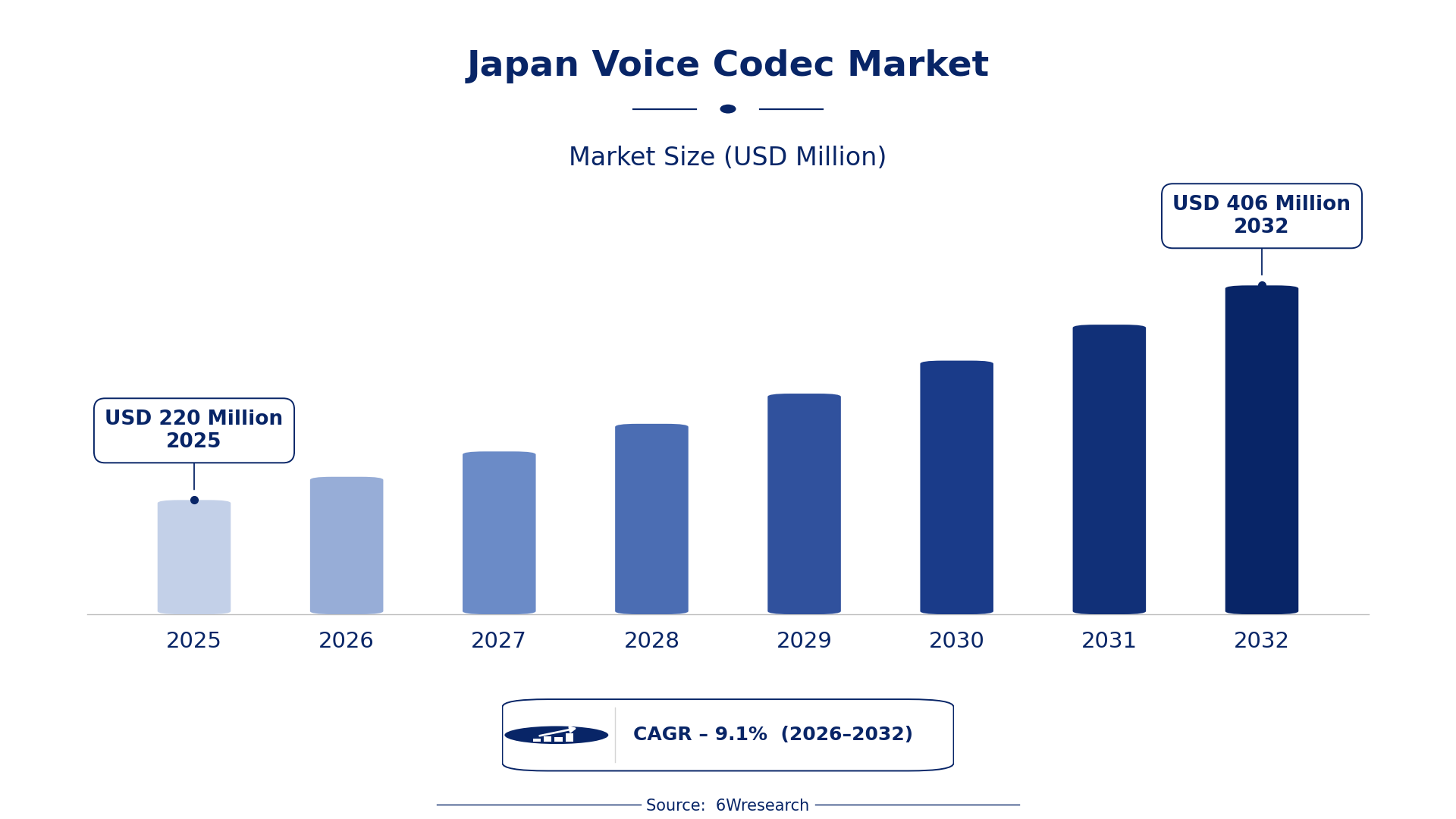
According to 6Wresearch internal database and industry insights, the Japan Voice Codec Market was valued at USD 220 Million in 2025 and is projected to reach USD 406 Million by 2032, growing at a CAGR of approximately 9.1% during 2026–2032.
Japan Voice Codec Market Highlights
| Report Metric | Details |
| Report Name | Japan Voice Codec Market (2026-2032) |
| Market Size 2025 | USD 220 Million |
| Market Size 2032 | USD 406 Million |
| Absolute Growth 2025–2032 | USD 186 Million |
| CAGR 2026–2032 | 9.1% |
| Peak Annual Growth | 9.8% in 2030 |
| Forecast Period | 2026–2032 |
| Historical Data | 2022–2025 |
| Base Year | 2025 |
| Leading Codec Type, 2025 | Wideband Codec (38% share) |
| Leading Compression Level, 2025 | High (53% share) |
| Leading Bandwidth Support, 2025 | 16 kHz (53% share) |
| Leading Distribution Mode, 2025 | Licensing (40% share) |
| Fastest-Growing Codec Type | Fullband Codec (12.7% CAGR) |
| Fastest-Growing Compression Level | Efficient (11.8% CAGR) |
| Fastest-Growing Bandwidth Support | >20 kHz (12.2% CAGR) |
| Growing Sector | Telecommunications |
| Key End Users | Telecom operators, VoIP service providers, multimedia application developers |
Japan Voice Codec Market Year-wise Growth Rate and Key Drivers (2022–2032)
This graph illustrates the annual growth rates of the market from 2022 to 2032, highlighting a steady upward trajectory and projected market expansion over the forecast period.
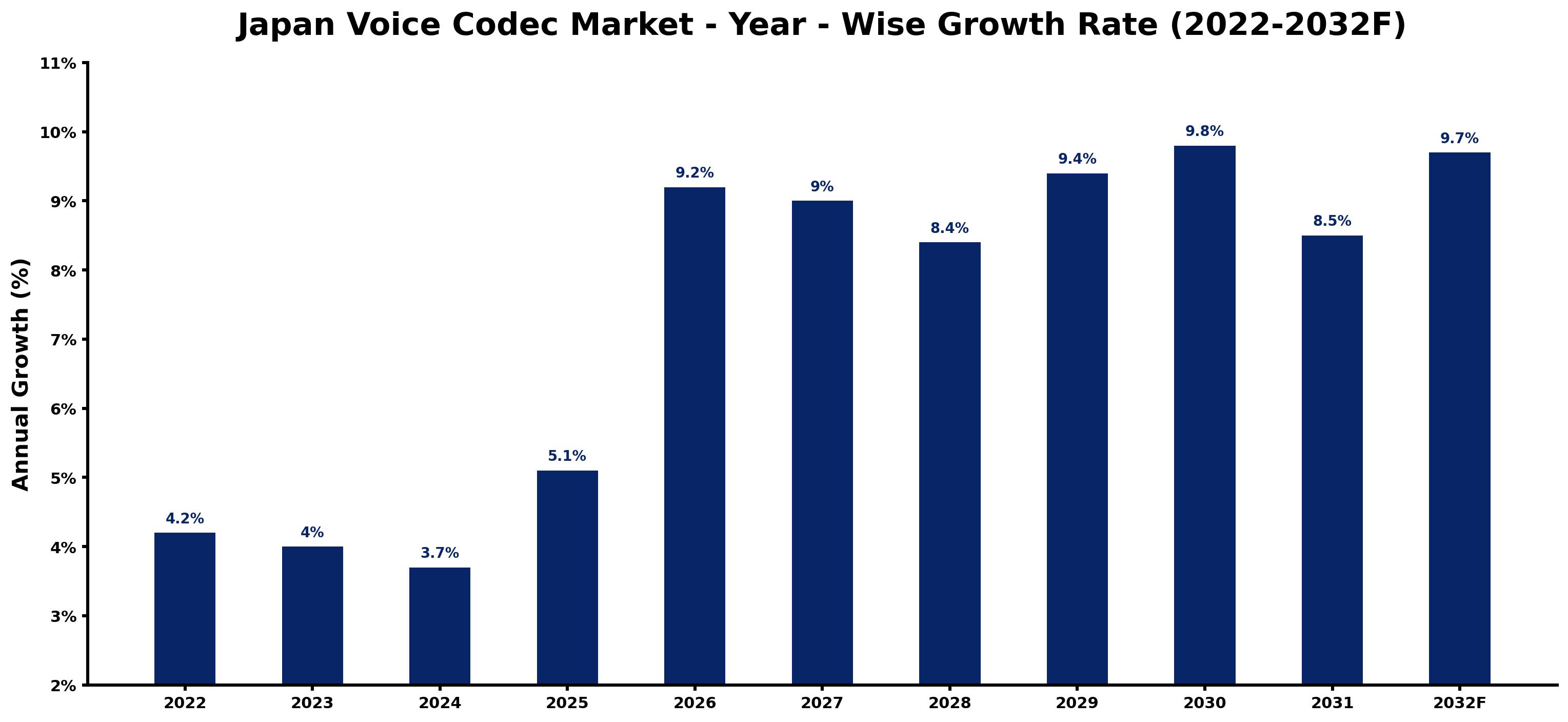
The table below sets out the estimated growth rate for each year and the main factor behind it.
| Year | Estimated Annual Growth (%) | Market Rationale |
| 2022 | 4.2 | The market experienced steady growth due to strong demand from telecommunications. |
| 2023 | 4.0 | Growth slowed as the market adjusted to previous high levels of investment. |
| 2024 | 3.7 | Continued demand for VoIP services contributed to a further slowdown in growth. |
| 2025 | 5.1 | Investment in next-generation voice codecs accelerated growth as telecoms modernised. |
| 2026 | 9.2 | Demand surged as telecom operators adopted advanced voice codec technologies. |
| 2027 | 9.0 | A slight slowdown occurred as the market stabilised after rapid growth. |
| 2028 | 8.4 | Growth continued but at a slower pace as market saturation began to set in. |
| 2029 | 9.4 | Increased adoption of video conferencing applications drove faster growth again. |
| 2030 | 9.8 | Demand peaked as telecom operators heavily invested in voice codec innovations. |
| 2031 | 8.5 | The market saw a slowdown as growth stabilised after reaching high levels. |
| 2032 | 9.7 | Continued investment in telecommunications infrastructure will sustain growth. |
Note: Market size estimations and growth projections presented in this report are based on 6Wresearch's proprietary forecasting methodology, utilizing the latest available industry data, government publications, and primary research inputs.
Japan Voice Codec Market Synopsis
Voice codecs are essential technologies that compress and decompress voice signals for effective transmission over various channels. Their primary applications include telecommunications, VoIP services, and multimedia. The Japan Voice Codec Market is expanding due to the telecommunications sector, which is increasingly adopting advanced voice codec technologies. With over 30 million VoIP users and a strong focus on digital transformation, demand is expected to rise, particularly for wideband codecs as video conferencing becomes more prevalent.
Market Dynamics Impact Analysis (2026–2032)
| Factor | Type | Impact | Primary Segment Affected |
| Rising VoIP user base drives demand for efficient voice codecs. | Driver | High | Narrowband Codec |
| Investment in next-generation voice codec technologies enhances audio quality. | Driver | High | Wideband Codec |
| Growing demand for high-quality audio in communication systems presents opportunities. | Opportunity | High | Fullband Codec |
| Telecom operators' digital transformation initiatives create demand for innovative codecs. | Opportunity | High | Low Bitrate Codec |
| Market saturation in traditional telephony limits growth potential. | Restraint | Medium | Narrowband Codec |
| High competition among codec providers may pressure pricing strategies. | Restraint | Medium | Wideband Codec |
| Rapid technological advancements require constant updates to codec technology. | Challenge | High | Fullband Codec |
| Integration challenges with existing communication systems can delay adoption. | Challenge | Medium | Low Bitrate Codec |
Evaluation of Drivers in Japan Voice Codec Market (2026–2032)
The following drivers explain most of the expected growth.
| Drivers | Primary Segment Affected | Why It Matters (Evidence) |
| Increase in VoIP users boosts demand for voice codecs. | Narrowband Codec | The number of VoIP users in Japan reached over 30 million, driving codec adoption. |
| Investment in next-gen voice codecs improves user experience. | Wideband Codec | Telecom operators are investing heavily in advanced voice codec technologies, improving audio quality. |
| Rising demand for video conferencing increases codec usage. | Fullband Codec | The adoption of wideband codecs has surged due to the rise in video conferencing applications. |
| High penetration of mobile devices supports codec demand. | Low Bitrate Codec | Japan's mobile device penetration rate exceeds 90%, driving demand for efficient codecs. |
| Digital transformation initiatives promote advanced communication technologies. | Narrowband Codec | The Japanese government launched a digital transformation initiative in 2023, enhancing codec demand. |
Several shifts outside the market lift sales. The number of VoIP users in Japan reached over 30 million, increasing demand for voice codecs. Telecom operators are investing heavily in next-generation voice codec technologies, improving audio quality and user experience. The adoption of wideband codecs has surged due to the rise in video conferencing applications, with many businesses upgrading their communication systems. Japan's mobile device penetration rate exceeds 90%, which supports the demand for efficient codecs.
Evaluation of Restraints in Japan Voice Codec Market
These restraints slow adoption and weigh on supplier margins.
| Market Restraint | Primary Segment Affected | Why It Matters (Evidence) |
| Market saturation in traditional telephony limits growth potential. | Narrowband Codec | The traditional telephony market is reaching saturation, constraining codec adoption. |
| High competition among codec providers may pressure pricing strategies. | Wideband Codec | Intense competition in the codec market can lead to reduced profit margins. |
| Rapid technological advancements require constant updates to codec technology. | Fullband Codec | The need for continuous innovation can strain resources for codec developers. |
| Integration challenges with existing communication systems can delay adoption. | Low Bitrate Codec | Compatibility issues with legacy systems may hinder the adoption of new codecs. |
| Limited awareness of advanced codecs among smaller telecom operators. | Narrowband Codec | Smaller operators may lack knowledge of the benefits of upgrading codecs. |
Japan Voice Codec Market Challenges
In Japan, over 30 million VoIP users face delays due to stringent regulations imposed by the Ministry of Internal Affairs and Communications, complicating the approval process for new voice codec technologies. A shortage of skilled professionals in the telecommunications sector hinders the development of advanced codecs, resulting in project delays for telecom operators and rising operational costs. Buyers encounter inflated prices when procuring new codecs, as limited access to cutting-edge technology increases expenses, impacting their budgets. Supply chain disruptions also affect the availability of essential components, forcing producers to extend lead times, which delays service delivery for telecom companies.
Trends in the Japan Voice Codec Market
Below are the shifts with the largest effect on the Japan Voice Codec Market.
- Shift towards Wideband Codecs in Telecommunications: The Kanto region is experiencing a shift towards wideband codecs as telecom operators upgrade their systems. With over 30 million VoIP users, demand for high-quality audio is rising, driving the adoption of these codecs.
- Emergence of Fullband Codecs for Specialized Applications: Specialized applications are increasingly adopting fullband codecs, which are projected to grow at a CAGR of 12.7%. This trend is evident in sectors requiring high-fidelity audio, improving communication quality.
- Increase in Licensing Distribution Mode: Licensing has captured the largest share of distribution modes, accounting for 40% in 2025. This trend reflects the growing preference for flexible business models among codec providers.
- Growth of Low Bitrate Codecs in Constrained Environments: Low bitrate codecs are gaining traction in low-bandwidth environments, driven by the need for efficient communication solutions. This trend is particularly relevant in rural areas with limited connectivity.
Investment Opportunities in the Japan Voice Codec Market
The following opportunities in the Japan Voice Codec Market pair current demand with a clear way in.
- Investment Gap in High-Quality Audio Solutions: With the demand for high-quality audio solutions on the rise, there is an investment gap in fullband codecs. Telecom operators in urban areas are seeking to upgrade their offerings.
- Supply of Advanced Codec Technologies: The demand for advanced codec technologies is increasing, particularly in the Kanto region. Companies can enter this market through partnerships with local telecom operators to provide innovative solutions.
- Entry into Licensing Models for Codec Distribution: The licensing distribution model is expanding, presenting opportunities for suppliers to offer their codecs. Companies can establish joint ventures with local firms to access this growing market.
- Timing for Investment in Digital Transformation: The recent digital transformation initiative launched in 2023 creates a timely opportunity for investment in voice codecs. Suppliers can collaborate with telecom operators to address the rising demand.
Government Initiatives in the Japan Voice Codec Market
The GX Basic Policy, adopted in 2023, aims to promote communication technologies through public-private investment. This policy builds on the Industrial Standardization Act, which governs product standards, ensuring that voice codecs meet quality requirements for telecommunications and enhancing compliance.
The Ministry of Internal Affairs and Communications oversees the implementation of telecommunications regulations, including standards that prohibit misleading advertising. This agency ensures that voice codec products adhere to strict advertising standards, protecting consumers and promoting fair competition.
Future Insight of the Japan Voice Codec Market
Investment in next-generation voice codec technologies will exceed 500 billion yen by 2032, driven by the government's digital transformation initiative launched in 2023. This will create robust demand for advanced communication solutions, especially in the Kanto region, a key technology development hub. The adoption of JIS X 5070 standards will facilitate better codec integration and interoperability across various platforms. As broadband subscriptions surpass 40 million, the market will increasingly focus on codecs that improve video conferencing and multimedia applications.
Market Segmentation Analysis
Japan Voice Codec Market report covers a detailed analysis of the following market segments:
By Codec Type – Wideband Codec Leads, Fullband Codec Expected to Grow Fastest
According to Saurav Kr Singh, Senior Research Analyst at 6Wresearch, Wideband Codec took 38% of codec type revenue in 2025, more than any other category. Wideband codecs dominate the market due to their essential role in providing high-quality audio for modern communication systems. With over 30 million VoIP users in Japan, the need for superior audio clarity drives the demand for these codecs. Over 2026–2032, Fullband Codec is expected to post the fastest growth, at a CAGR of 12.7%. Fullband codecs are experiencing rapid growth as they cater to specialised applications that demand high fidelity. The surge in video conferencing applications has notably increased the interest in these codecs, indicating a growing niche market. Suppliers should focus on developing fullband codecs to capitalise on the increasing demand for high-fidelity audio solutions.
By Compression Level – High Leads, Efficient Expected to Grow Fastest
With 53% of compression level revenue in 2025, High was the largest category. High compression levels are prevalent in the market, primarily due to their indirect support for high-quality audio despite higher bandwidth requirements. This is particularly relevant in telecommunications, where audio clarity is paramount. The quickest growth will come from Efficient, forecast to expand at a CAGR of 11.8% between 2026 and 2032. Efficient compression levels are gaining traction as they optimize performance in constrained environments, aligning with the digital transformation initiative launched in 2023. This focus on efficiency reflects the industry's shift towards advanced communication technologies. Buyers may benefit from exploring efficient compression options to improve performance while managing bandwidth costs.
By Bandwidth Support – 16 kHz Leads, >20 kHz Expected to Grow Fastest
16 kHz accounted for 53% of the market by bandwidth support in 2025. The 16 kHz bandwidth support is the benchmark for wideband applications, making it a preferred option among telecommunications providers in Japan. This standard ensures compatibility across various communication systems, enhancing overall user experience. >20 kHz is projected to grow fastest, at a CAGR of 12.2% during 2026–2032. There is a swift rise in demand for bandwidth support exceeding 20 kHz as users pursue higher audio fidelity, particularly in video conferencing. This trend highlights the growing expectations for superior audio quality in communication technologies. Suppliers must prioritise advancements in bandwidth technologies to satisfy the increasing demand for enhanced audio quality.
By Distribution Mode – Licensing Leads and Records the Fastest Growth
Licensing held 40% of the Japan Voice Codec Market by distribution mode in 2025. Licensing is the dominant distribution mode for voice codecs, as it serves as a common business model that enables widespread adoption across various sectors. This model allows for efficient scaling and access to advanced codec technologies, benefiting both suppliers and users. Licensing is also forecast to expand faster than any other category, at a CAGR of 11.9% over 2026–2032. Licensing continues to be the fastest distribution mode, as it remains the preferred method for codec distribution, allowing suppliers to quickly adapt to market demands. This consistency highlights the importance of licensing in the voice codec market. Buyers should utilise licensing agreements to efficiently access the latest codec technologies.
Key Attractiveness of the Report
- 10 Years of Market Numbers
- Historical Data Starting from 2022 to 2025
- Base Year 2025
- Forecast Data until 2032
- Key Performance Indicators Impacting the Market
- Major Upcoming Developments and Projects
Key Highlights of the Report:
- Japan Voice Codec Market Outlook
- Market Size of Japan Voice Codec Market, 2025
- Forecast of Japan Voice Codec Market, 2032
- Historical Data and Forecast of Japan Voice Codec Revenues & Volume for the Period 2022-2032F
- Japan Voice Codec Market Trend Evolution
- Japan Voice Codec Market Drivers and Challenges
- Japan Voice Codec Price Trends
- Japan Voice Codec Porter's Five Forces
- Japan Voice Codec Industry Life Cycle
- Historical Data and Forecast of Japan Voice Codec Market Revenues & Volume By Codec Type for the Period 2022-2032F
- Historical Data and Forecast of Japan Voice Codec Market Revenues & Volume By Narrowband Codec for the Period 2022-2032F
- Historical Data and Forecast of Japan Voice Codec Market Revenues & Volume By Wideband Codec for the Period 2022-2032F
- Historical Data and Forecast of Japan Voice Codec Market Revenues & Volume By Fullband Codec for the Period 2022-2032F
- Historical Data and Forecast of Japan Voice Codec Market Revenues & Volume By Low Bitrate Codec for the Period 2022-2032F
- Historical Data and Forecast of Japan Voice Codec Market Revenues & Volume By Compression Level for the Period 2022-2032F
- Historical Data and Forecast of Japan Voice Codec Market Revenues & Volume By Low for the Period 2022-2032F
- Historical Data and Forecast of Japan Voice Codec Market Revenues & Volume By Medium for the Period 2022-2032F
- Historical Data and Forecast of Japan Voice Codec Market Revenues & Volume By High for the Period 2022-2032F
- Historical Data and Forecast of Japan Voice Codec Market Revenues & Volume By Efficient for the Period 2022-2032F
- Historical Data and Forecast of Japan Voice Codec Market Revenues & Volume By Bandwidth Support for the Period 2022-2032F
- Historical Data and Forecast of Japan Voice Codec Market Revenues & Volume By 8 kHz for the Period 2022-2032F
- Historical Data and Forecast of Japan Voice Codec Market Revenues & Volume By 16 kHz for the Period 2022-2032F
- Historical Data and Forecast of Japan Voice Codec Market Revenues & Volume By >20 kHz for the Period 2022-2032F
- Historical Data and Forecast of Japan Voice Codec Market Revenues & Volume By Variable for the Period 2022-2032F
- Historical Data and Forecast of Japan Voice Codec Market Revenues & Volume By Distribution Mode for the Period 2022-2032F
- Historical Data and Forecast of Japan Voice Codec Market Revenues & Volume By Licensing for the Period 2022-2032F
- Historical Data and Forecast of Japan Voice Codec Market Revenues & Volume By OEM Integrations for the Period 2022-2032F
- Historical Data and Forecast of Japan Voice Codec Market Revenues & Volume By Subscription-Based for the Period 2022-2032F
- Historical Data and Forecast of Japan Voice Codec Market Revenues & Volume By Open Source for the Period 2022-2032F
- Japan Voice Codec Import Export Trade Statistics
- Market Opportunity Assessment By Codec Type
- Market Opportunity Assessment By Compression Level
- Market Opportunity Assessment By Bandwidth Support
- Market Opportunity Assessment By Distribution Mode
- Japan Voice Codec Top Companies Market Share
- Japan Voice Codec Competitive Benchmarking By Technical and Operational Parameters
- Japan Voice Codec Company Profiles
- Japan Voice Codec Key Strategic Recommendations
Market Covered
The following segment groups are covered in the report.
By Codec Type
- Narrowband Codec
- Wideband Codec
- Fullband Codec
- Low Bitrate Codec
By Compression Level
- Low
- Medium
- High
- Efficient
By Bandwidth Support
- 8 kHz
- 16 kHz
- >20 kHz
- Variable
By Distribution Mode
- Licensing
- OEM Integrations
- Subscription-Based
- Open Source































