Japan Voicebot Market Size & Growth Rate
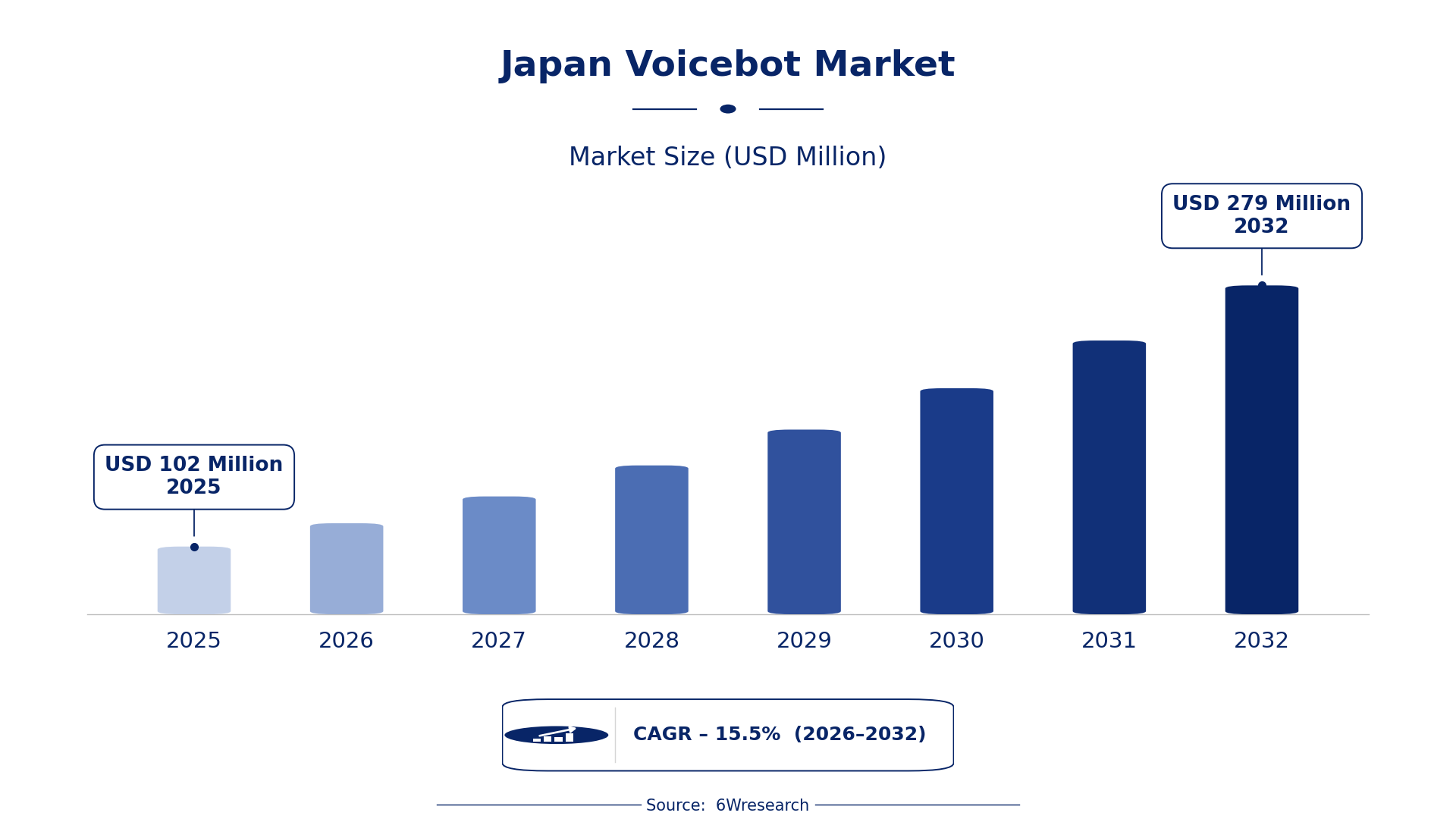
According to 6Wresearch internal database and industry insights, the Japan Voicebot Market was valued at USD 102 Million in 2025 and is projected to reach USD 279 Million by 2032, growing at a CAGR of approximately 15.5% during 2026–2032.
Japan Voicebot Market Highlights
| Report Metric | Details |
| Report Name | Japan Voicebot Market (2026-2032) |
| Market Size 2025 | USD 102 Million |
| Market Size 2032 | USD 279 Million |
| Absolute Growth 2025–2032 | USD 177 Million |
| CAGR 2026–2032 | 15.5% |
| Peak Annual Growth | 22.8% in 2032 |
| Forecast Period | 2026–2032 |
| Historical Data | 2022–2025 |
| Base Year | 2025 |
| Leading Bot Type, 2025 | Customer Support Bot (40% share) |
| Leading AI Platform, 2025 | AI NLP (44% share) |
| Leading Deployment Type, 2025 | Cloud (36% share) |
| Leading Language Support, 2025 | Multi-lingual (38% share) |
| Fastest-Growing Bot Type | IVR Voicebot (17.5% CAGR) |
| Fastest-Growing AI Platform | Rule-based AI (18.1% CAGR) |
| Fastest-Growing Deployment Type | On-premise (17.4% CAGR) |
| Fastest-Growing Language Support | English & Regional (20.7% CAGR) |
| Growing Sector | Customer support |
| Key End Users | Retailers, healthcare providers, customer service departments, e-commerce platforms |
Japan Voicebot Market Year-wise Growth Rate and Key Drivers (2022–2032)
This graph illustrates the annual growth rates of the market from 2022 to 2032, highlighting a steady upward trajectory and projected market expansion over the forecast period.
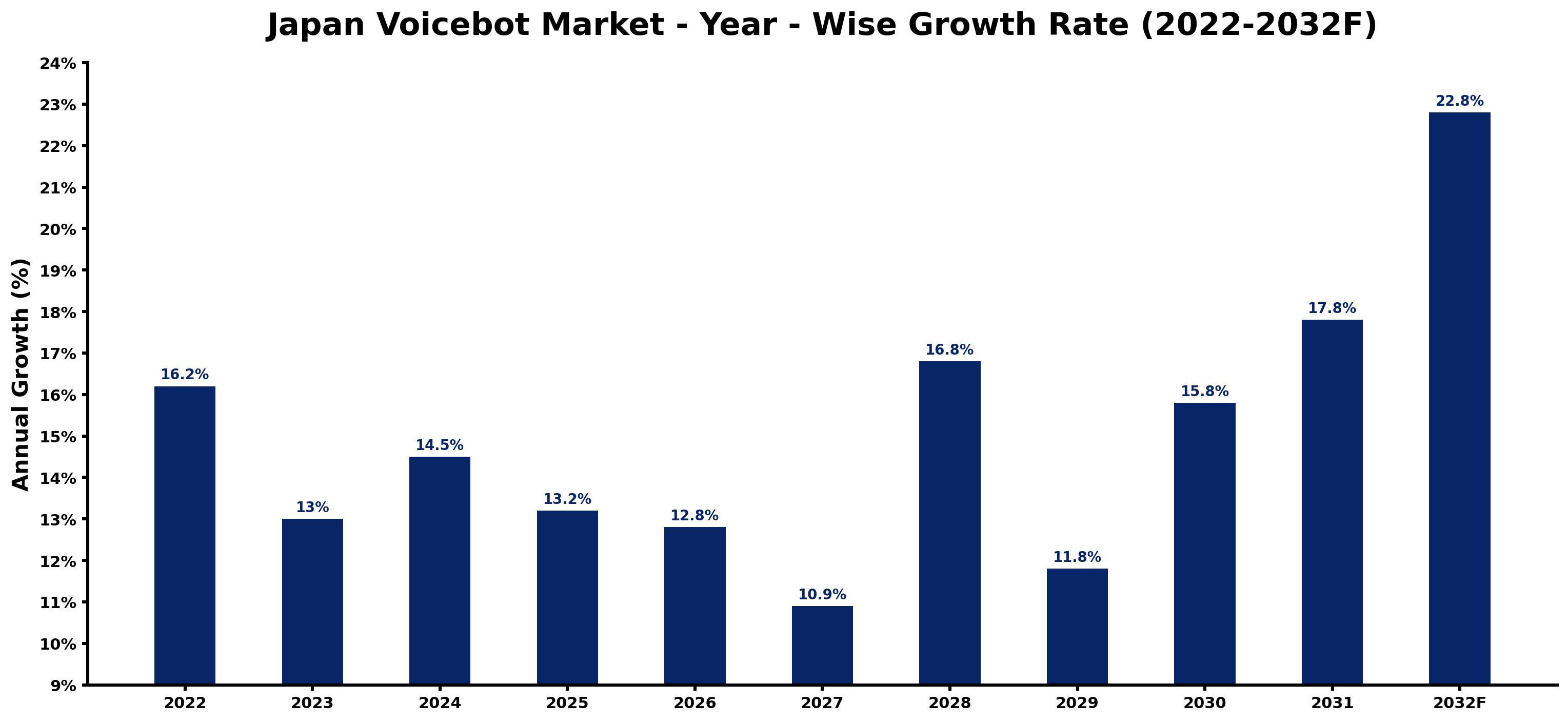
Below, each year's estimated growth is shown next to the factor that most influenced it.
| Year | Estimated Annual Growth (%) | Market Rationale |
| 2022 | 16.2 | The market experienced strong growth due to increased adoption of voicebot technology. |
| 2023 | 13.0 | Growth slowed as companies adjusted to the previous year's rapid expansion. |
| 2024 | 14.5 | Demand picked up as more sectors began integrating voicebots into their operations. |
| 2025 | 13.2 | Growth slowed again as market saturation began to affect new adoption rates. |
| 2026 | 12.8 | A further slowdown is expected as companies focus on optimising existing systems. |
| 2027 | 10.9 | Growth will continue to decelerate as competition increases among service providers. |
| 2028 | 16.8 | A resurgence in demand is projected as new applications for voicebots emerge. |
| 2029 | 11.8 | Growth will slow again as the market stabilises after the previous surge. |
| 2030 | 15.8 | Demand is expected to pick up as businesses seek to improve customer engagement through voicebots. |
| 2031 | 17.8 | Growth will accelerate as voicebot technology becomes more sophisticated and widely accepted. |
| 2032 | 22.8 | The market will peak as voice commerce expands, driving further adoption. |
Note: Market size estimations and growth projections presented in this report are based on 6Wresearch's proprietary forecasting methodology, utilizing the latest available industry data, government publications, and primary research inputs.
Japan Voicebot Market Synopsis
Voicebots are AI-driven software applications that simulate human conversation through natural language processing and machine learning. They find extensive use in customer support, interactive voice response systems, and voice commerce. The Japan Voicebot Market is growing due to rising demand from sectors like retail and customer service, particularly among tech-savvy consumers in regions such as Tokyo. Voice commerce is projected to increase by 20% annually through 2025, further propelling market expansion.
Market Dynamics Impact Analysis (2026–2032)
| Factor | Type | Impact | Primary Segment Affected |
| Rising demand for customer support automation | Driver | High | Customer Support Bot |
| Growth in voice commerce applications | Driver | High | Voice Commerce Bot |
| Increasing adoption of voicebots in healthcare | Opportunity | Medium | Customer Support Bot |
| Expansion of AI NLP capabilities in voicebots | Opportunity | Medium | AI NLP |
| Market saturation affecting new adoption rates | Restraint | High | IVR Voicebot |
| Limited awareness of voicebot benefits among smaller businesses | Restraint | Medium | Customer Support Bot |
| High initial investment costs for advanced voicebot systems | Challenge | High | Conversational AI |
| Competition among service providers leading to price wars | Challenge | Medium | AI NLP |
Evaluation of Drivers in Japan Voicebot Market (2026–2032)
These are the developments adding the most demand over the forecast period.
| Drivers | Primary Segment Affected | Why It Matters (Evidence) |
| Increased automation in customer service | Customer Support Bot | Over 30% of customer service interactions in Japan are handled by voicebots, driving demand for automation. |
| Growth of e-commerce | Voice Commerce Bot | Voice commerce is expected to grow by 20% annually, leading retailers to adopt voicebot solutions. |
| Healthcare sector's digital transformation | Customer Support Bot | The healthcare sector is increasingly adopting voicebots for patient interaction, improving service delivery. |
| Technological advancements in AI NLP | AI NLP | AI NLP technology is essential for enhancing user experience, prompting companies to invest in voicebots. |
| Preference for cloud deployment | Cloud | Cloud deployment is favoured by 70% of companies, enabling scalable and accessible voicebot solutions. |
Purchasing is picking up as the healthcare sector increasingly adopts voicebots for patient interaction, improving service delivery. Approximately 30% of interactions in customer service are now handled by voicebots, leading to greater automation. The e-commerce sector will see voice commerce grow by 20% annually, prompting retailers to integrate voicebot solutions. Technological advancements in AI NLP are essential for enhancing user experience, driving companies to invest in advanced voicebots. Moreover, cloud deployment is preferred by 70% of companies, facilitating scalable and accessible solutions in customer service.
Evaluation of Restraints in Japan Voicebot Market
The table below lists the restraints and the evidence behind each.
| Market Restraint | Primary Segment Affected | Why It Matters (Evidence) |
| Market saturation affecting new adoption rates | IVR Voicebot | As more companies adopt IVR systems, the market is becoming saturated, limiting growth opportunities. |
| Limited awareness of voicebot benefits among smaller businesses | Customer Support Bot | Many smaller businesses lack knowledge about the advantages of voicebots, hindering broader adoption. |
| High initial investment costs for advanced voicebot systems | Conversational AI | The high costs associated with implementing advanced voicebot systems deter potential buyers. |
| Integration challenges with existing IT systems | AI NLP | Many companies face difficulties integrating voicebots with their current IT infrastructure, slowing adoption. |
| Regulatory compliance issues in data handling | Customer Support Bot | Companies must navigate complex regulations regarding data privacy, complicating voicebot implementation. |
Japan Voicebot Market Challenges
Producers in the voicebot market contend with fierce competition from emerging technologies, which pressures pricing and diminishes profitability. This competition stems from a rapid influx of new entrants, causing a 15% drop in average selling prices over two years. Regulatory challenges complicate deployment, as compliance with standards like ISO/IEC 30170:2012 can delay product launches by six months for developers. Buyers face difficulties in integrating voicebot solutions, with 30% reporting issues aligning these technologies with existing systems, leading to increased operational costs.
Trends in the Japan Voicebot Market
The shifts below are changing how Japan Voicebot Market products are bought and supplied.
- Shift towards AI NLP in Voicebots: As of 2023, AI NLP technology is increasingly important for improving user experience in voicebots. This shift is particularly evident in the healthcare sector, where voicebots handle over 30% of patient inquiries.
- Rise of Cloud Deployment for Voicebots: Since 2023, cloud deployment has emerged as the preferred method for 70% of companies using voicebots. This trend is particularly pronounced in Tokyo, where tech-savvy consumers seek scalable and accessible customer service solutions.
- Growth of Voice Commerce Applications: Voice commerce is anticipated to rise by 20% annually through 2025, driven by growing consumer adoption in retail. This trend underscores the necessity for businesses to incorporate voicebots into their e-commerce strategies.
- Expansion of Voicebot Use in Healthcare: The healthcare sector is increasingly integrating voicebots for patient interaction, reflecting a broader trend towards digital transformation. By 2025, voicebot usage in healthcare is expected to rise considerably, enhancing service delivery.
Investment Opportunities in the Japan Voicebot Market
The following areas offer the clearest openings for investors and suppliers in the Japan Voicebot Market.
- Investment in AI NLP Capabilities: With voice commerce projected to grow by 20% annually, investing in AI NLP capabilities offers a compelling opportunity for developers. Retailers in Tokyo are particularly eager to boost customer engagement through advanced voicebot solutions.
- Expansion into Healthcare Sector: As voicebot usage in healthcare is expected to rise significantly by 2025, companies should concentrate on providing tailored solutions for patient interaction. Collaborating with healthcare providers can facilitate market entry.
- Development of Multi-lingual Voicebots: The demand for multi-lingual voicebots is increasing, with a considerable portion of the population using various languages. Companies can capitalise on this market by developing solutions that address diverse linguistic needs.
- Partnerships with E-commerce Platforms: With voice commerce anticipated to grow by 20% annually, forming partnerships with e-commerce platforms can create new opportunities for voicebot integration. This strategy enables streamlined entry into the expanding retail market.
Government Initiatives in the Japan Voicebot Market
The Act on Japanese Industrial Standards, established in 1949 and amended in 2019, governs product standards, including those for voicebot technology, promoting quality and safety in the market. Additionally, the Act against Unjustifiable Premiums and Misleading Representations, instituted in 1962, prohibits misleading advertising of goods, ensuring that voicebot providers accurately represent their services.
In 2023, a program with a budget of 5 billion yen was launched to support AI startups, administered by the Digital Agency. This initiative aims to stimulate innovation in AI technologies, including voicebots, promoting their adoption across various sectors.
Future Insight of the Japan Voicebot Market
The Tokyo Metropolitan Government's smart city project will drive advancements in voicebot technology by 2032. This initiative will create new opportunities for voicebot applications across various sectors, benefiting both buyers and suppliers. The target of 50% AI integration in public services by 2030 will promote collaboration and innovation in the market. Voice commerce will grow by 20% annually through 2025, enhancing customer engagement and encouraging wider adoption of voicebots.
Market Segmentation Analysis
Japan Voicebot Market report covers a detailed analysis of the following market segments:
By Bot Type – Customer Support Bot Leads, IVR Voicebot Expected to Grow Fastest
According to Saurav Kr Singh, Senior Research Analyst at 6Wresearch, Customer Support Bot accounted for 40% of the market by bot type in 2025. The Customer Support Bot holds the largest share as it is extensively utilised for addressing customer inquiries across various sectors. This is evidenced by the fact that over 30% of customer service interactions in Japan are managed by these bots, underscoring their importance in operational processes. IVR Voicebot is set to record the highest CAGR in this split, 17.5% over 2026–2032. The IVR Voicebot is experiencing rapid growth as businesses increasingly adopt automated telephony systems for efficient customer interactions. This trend is highlighted by the expected rise in voicebot usage within retail, projected to significantly increase by 2025. Suppliers should prioritise the development of customer support bots to meet the rising demand in the market.
By AI Platform – AI NLP Leads, Rule-based AI Expected to Grow Fastest
The largest ai platform category in 2025 was AI NLP, at 44% of revenue. AI NLP is the leading segment as it is critical for enabling voicebots to accurately process and understand human language. This technology is essential for enhancing user experience, making it the preferred choice among developers and businesses. Rule-based AI is projected to grow fastest, at a CAGR of 18.1% during 2026–2032. Rule-based AI is witnessing the fastest growth as it caters to simpler applications, appealing to businesses with basic operational needs. The demand for cost-effective solutions is propelling this segment's rapid expansion, despite its limitations compared to AI NLP. Buyers may benefit from considering rule-based AI for straightforward applications while also recognising the advantages of AI NLP for more complex requirements.
By Deployment Type – Cloud Leads, On-premise Expected to Grow Fastest
Cloud held 36% of the Japan Voicebot Market by deployment type in 2025. Cloud deployment is the dominant choice, favoured for its scalability and accessibility among companies using voicebots. Approximately 70% of businesses in Japan select cloud solutions, reflecting a strong preference for flexible operational frameworks. Over 2026–2032, On-premise is expected to post the fastest growth, at a CAGR of 17.4%. On-premise deployment is growing quickly as organisations with specific data security needs opt for this method. This trend is driven by increasing concerns about data privacy and the desire for customisation in sensitive environments. Suppliers should explore opportunities to create customised on-premise solutions to cater to the rising demand for enhanced data security.
By Language Support – Multi-lingual Leads, English & Regional Expected to Grow Fastest
Multi-lingual took 38% of language support revenue in 2025, more than any other category. Multi-lingual support is crucial for addressing Japan's varied customer demographics, facilitating effective communication across diverse groups. This capability is vital in a market where customer satisfaction and loyalty are heavily influenced by communication quality. The quickest growth will come from English & Regional, forecast to expand at a CAGR of 20.7% between 2026 and 2032. The English & Regional support segment is rapidly expanding as businesses aim to meet local market needs while also serving international clients. This trend reflects Japan's increasing integration into the global market, where English proficiency is often essential. Providers should enhance multi-lingual capabilities to attract a broader audience and improve user engagement.
Key Attractiveness of the Report
- 10 Years of Market Numbers
- Historical Data Starting from 2022 to 2025
- Base Year 2025
- Forecast Data until 2032
- Key Performance Indicators Impacting the Market
- Major Upcoming Developments and Projects
Key Highlights of the Report:
- Japan Voicebot Market Outlook
- Market Size of Japan Voicebot Market, 2025
- Forecast of Japan Voicebot Market, 2032
- Historical Data and Forecast of Japan Voicebot Revenues & Volume for the Period 2022-2032F
- Japan Voicebot Market Trend Evolution
- Japan Voicebot Market Drivers and Challenges
- Japan Voicebot Price Trends
- Japan Voicebot Porter's Five Forces
- Japan Voicebot Industry Life Cycle
- Historical Data and Forecast of Japan Voicebot Market Revenues & Volume By Bot Type for the Period 2022-2032F
- Historical Data and Forecast of Japan Voicebot Market Revenues & Volume By Customer Support Bot for the Period 2022-2032F
- Historical Data and Forecast of Japan Voicebot Market Revenues & Volume By IVR Voicebot for the Period 2022-2032F
- Historical Data and Forecast of Japan Voicebot Market Revenues & Volume By Voice Commerce Bot for the Period 2022-2032F
- Historical Data and Forecast of Japan Voicebot Market Revenues & Volume By HR Helpdesk Bot for the Period 2022-2032F
- Historical Data and Forecast of Japan Voicebot Market Revenues & Volume By AI Platform for the Period 2022-2032F
- Historical Data and Forecast of Japan Voicebot Market Revenues & Volume By AI NLP for the Period 2022-2032F
- Historical Data and Forecast of Japan Voicebot Market Revenues & Volume By Rule-based AI for the Period 2022-2032F
- Historical Data and Forecast of Japan Voicebot Market Revenues & Volume By Transactional AI for the Period 2022-2032F
- Historical Data and Forecast of Japan Voicebot Market Revenues & Volume By Conversational AI for the Period 2022-2032F
- Historical Data and Forecast of Japan Voicebot Market Revenues & Volume By Deployment Type for the Period 2022-2032F
- Historical Data and Forecast of Japan Voicebot Market Revenues & Volume By Cloud for the Period 2022-2032F
- Historical Data and Forecast of Japan Voicebot Market Revenues & Volume By On-premise for the Period 2022-2032F
- Historical Data and Forecast of Japan Voicebot Market Revenues & Volume By SaaS for the Period 2022-2032F
- Historical Data and Forecast of Japan Voicebot Market Revenues & Volume By Web-based for the Period 2022-2032F
- Historical Data and Forecast of Japan Voicebot Market Revenues & Volume By Language Support for the Period 2022-2032F
- Historical Data and Forecast of Japan Voicebot Market Revenues & Volume By Multi-lingual for the Period 2022-2032F
- Historical Data and Forecast of Japan Voicebot Market Revenues & Volume By English & Regional for the Period 2022-2032F
- Historical Data and Forecast of Japan Voicebot Market Revenues & Volume By Multilingual for the Period 2022-2032F
- Historical Data and Forecast of Japan Voicebot Market Revenues & Volume By English for the Period 2022-2032F
- Japan Voicebot Import Export Trade Statistics
- Market Opportunity Assessment By Bot Type
- Market Opportunity Assessment By AI Platform
- Market Opportunity Assessment By Deployment Type
- Market Opportunity Assessment By Language Support
- Japan Voicebot Top Companies Market Share
- Japan Voicebot Competitive Benchmarking By Technical and Operational Parameters
- Japan Voicebot Company Profiles
- Japan Voicebot Key Strategic Recommendations
Market Covered
Coverage by segment is as follows.
By Bot Type
- Customer Support Bot
- IVR Voicebot
- Voice Commerce Bot
- HR Helpdesk Bot
By AI Platform
- AI NLP
- Rule-based AI
- Transactional AI
- Conversational AI
By Deployment Type
- Cloud
- On-premise
- SaaS
- Web-based
By Language Support
- Multi-lingual
- English & Regional
- Multilingual
- English































