Japan VR Classroom Market Size & Growth Rate
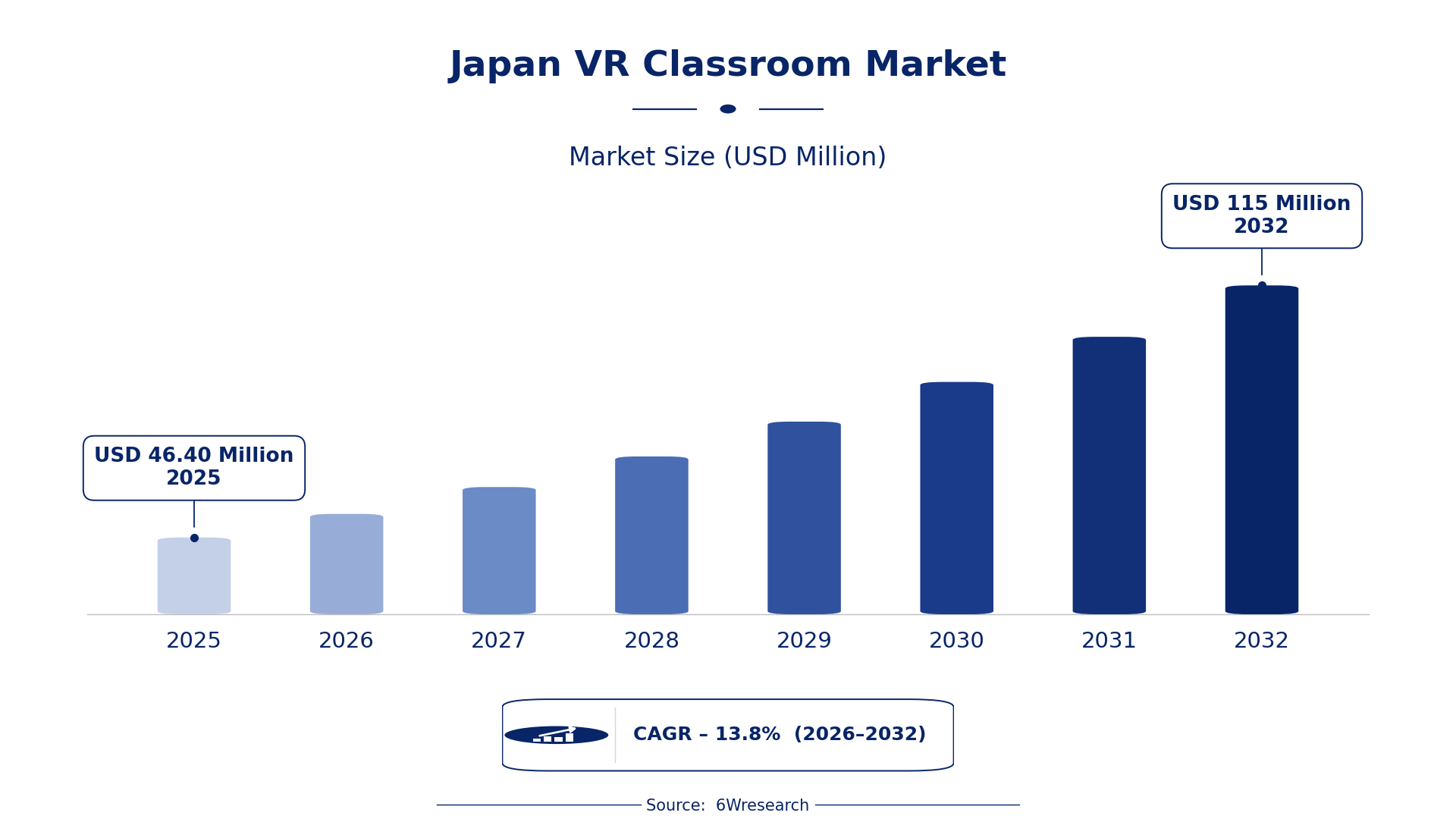
According to 6Wresearch internal database and industry insights, the Japan VR Classroom Market was valued at USD 46.40 Million in 2025 and is projected to reach USD 115 Million by 2032, growing at a CAGR of approximately 13.8% during 2026–2032.
Japan VR Classroom Market Highlights
| Report Metric | Details |
| Report Name | Japan VR Classroom Market (2026-2032) |
| Market Size 2025 | USD 46.40 Million |
| Market Size 2032 | USD 115 Million |
| Absolute Growth 2025–2032 | USD 68.60 Million |
| CAGR 2026–2032 | 13.8% |
| Peak Annual Growth | 16.4% in 2026 |
| Forecast Period | 2026–2032 |
| Historical Data | 2022–2025 |
| Base Year | 2025 |
| Leading VR Type, 2025 | Interactive Lecture (53% share) |
| Leading Curriculum Format, 2025 | STEM & Science (44% share) |
| Leading Hardware Used, 2025 | VR Headset (41% share) |
| Leading Deployment Mode, 2025 | Cloud-based (41% share) |
| Fastest-Growing VR Type | Language Learning VR (18.5% CAGR) |
| Fastest-Growing Curriculum Format | Vocational Courses (19.1% CAGR) |
| Fastest-Growing Deployment Mode | App-Based (19.2% CAGR) |
| Growing Sector | education |
| Key End Users | educational institutions, universities, vocational training centres, language schools |
Japan VR Classroom Market Year-wise Growth Rate and Key Drivers (2022–2032)
This graph illustrates the annual growth rates of the market from 2022 to 2032, highlighting a steady upward trajectory and projected market expansion over the forecast period.
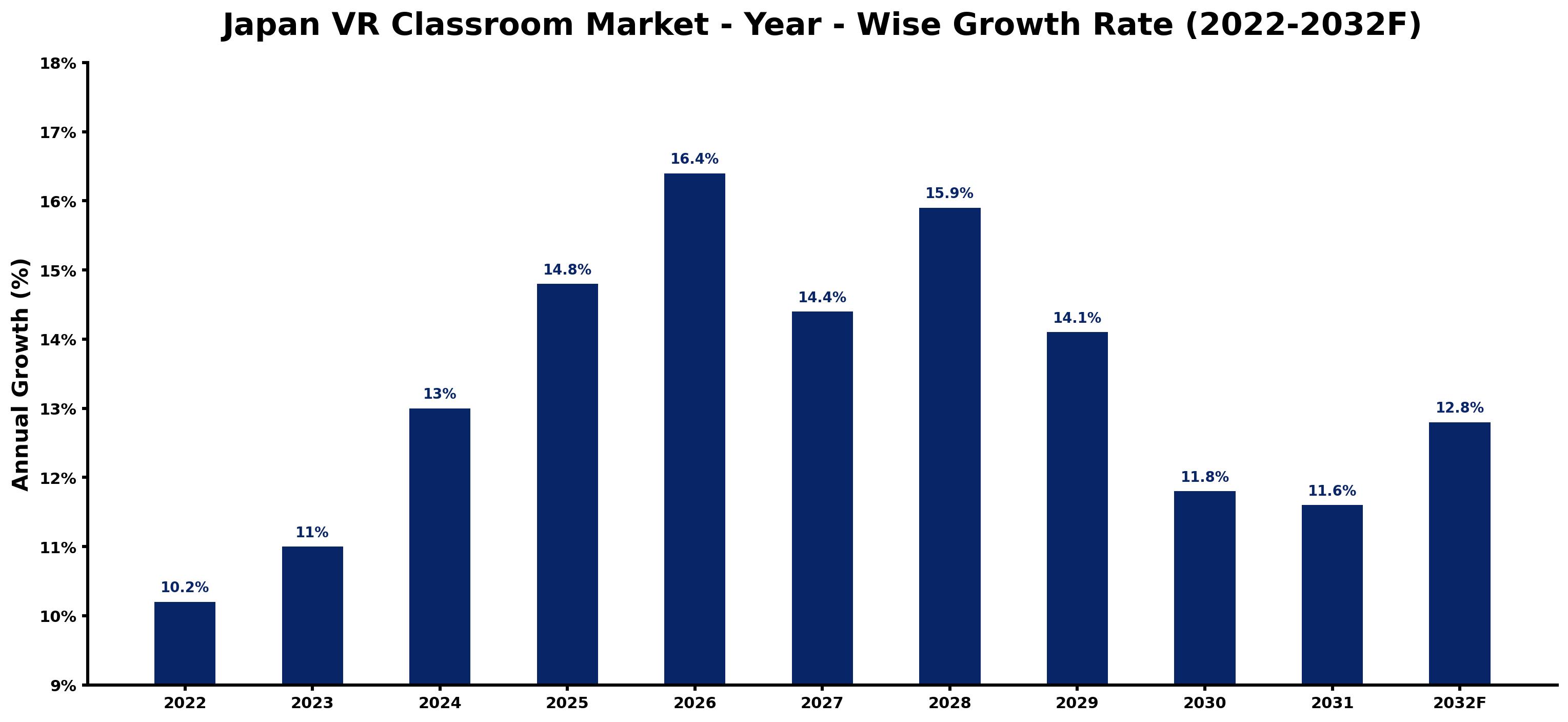
Each row of the following table gives one year's estimated growth and the event or demand shift that explains it.
| Year | Estimated Annual Growth (%) | Market Rationale |
| 2022 | 10.2 | The market saw initial adoption of VR technology in classrooms across Japan. |
| 2023 | 11.0 | Increased interest from educational institutions led to faster growth compared to 2022. |
| 2024 | 13.0 | The integration of VR into curricula drove further demand for immersive learning tools. |
| 2025 | 14.8 | Growth accelerated as more schools implemented VR for interactive learning experiences. |
| 2026 | 16.4 | The introduction of new digital education programmes significantly boosted market activity. |
| 2027 | 14.4 | Growth slowed slightly as the market began to stabilise after rapid expansion. |
| 2028 | 15.9 | Renewed investments in educational technology sparked a resurgence in VR adoption. |
| 2029 | 14.1 | The market experienced a slight slowdown as growth rates normalised after peak levels. |
| 2030 | 11.8 | Continued emphasis on digital literacy maintained steady growth in VR classroom usage. |
| 2031 | 11.6 | The market growth rate continued to slow as it approached a more stable phase. |
| 2032 | 12.8 | Increased focus on vocational training with VR tools drove renewed interest in the market. |
Note: Market size estimations and growth projections presented in this report are based on 6Wresearch's proprietary forecasting methodology, utilizing the latest available industry data, government publications, and primary research inputs.
Japan VR Classroom Market Synopsis
VR Classrooms utilise immersive technology to enhance educational experiences through interactive simulations. They are designed to engage students and provide practical learning opportunities across various subjects. The Japan VR Classroom Market is expanding due to rising investments in digital education, with over 1,200 institutions adopting VR technology. The Ministry of Education's initiatives and funding from local governments are further driving this growth, particularly in regions like Tokyo and Osaka, where demand for innovative learning tools is high.
Market Dynamics Impact Analysis (2026–2032)
| Factor | Type | Impact | Primary Segment Affected |
| Growing emphasis on digital literacy in education | Driver | High | STEM & Science |
| Increased funding for educational technology initiatives | Driver | High | Vocational Courses |
| High demand for immersive learning experiences | Opportunity | High | Language Learning VR |
| Rising interest in remote learning solutions | Opportunity | High | Virtual Training Sim |
| Limited awareness of VR benefits among educators | Restraint | Medium | Interactive Lecture |
| High initial costs of VR implementation | Restraint | Medium | Immersive VR Labs |
| Competition from alternative educational technologies | Challenge | High | Cloud-based |
| Need for continuous content updates and maintenance | Challenge | Medium | App-Based |
Evaluation of Drivers in Japan VR Classroom Market (2026–2032)
Key forces behind demand, with the segment each one moves most, are listed below.
| Drivers | Primary Segment Affected | Why It Matters (Evidence) |
| Increased investment in digital education tools | STEM & Science | In 2023, the Japanese government allocated ¥10 billion for educational technology advancements, encouraging schools to adopt VR. |
| Growing adoption of VR for remote learning | Language Learning VR | More than half of universities are exploring VR for remote education, driving demand for immersive language experiences. |
| Support from educational authorities for VR integration | Vocational Courses | The Ministry of Education promotes VR in vocational training, facilitating practical skills development. |
| Rising student engagement through immersive learning | Interactive Lecture | VR classrooms have been shown to increase student participation and motivation in learning. |
| Technological advancements in VR hardware | VR Headset | The availability of affordable VR headsets has made it easier for schools to implement VR solutions. |
Many universities are exploring VR for remote learning, improving language acquisition through immersive experiences. Educational authorities actively promote VR in vocational training, leading to practical skills development. Increased student engagement in immersive learning environments drives demand for interactive lectures, while affordable VR headsets facilitate widespread adoption in classrooms. These factors boost the market for VR classrooms across Japan.
Evaluation of Restraints in Japan VR Classroom Market
These are the pressures that could keep growth below its potential.
| Market Restraint | Primary Segment Affected | Why It Matters (Evidence) |
| Limited awareness of VR benefits among educators | Interactive Lecture | Many educators lack knowledge of how VR can improve traditional teaching methods, limiting adoption. |
| High initial costs of VR implementation | Immersive VR Labs | The investment required for VR infrastructure can deter educational institutions from adopting the technology. |
| Competition from alternative educational technologies | Cloud-based | Other digital learning tools may be seen as more cost-effective, impacting VR adoption rates. |
| Need for continuous content updates and maintenance | App-Based | Educational institutions face challenges in keeping VR content current, affecting user engagement. |
| Insufficient training for educators on VR use | Virtual Training Sim | A lack of training programs for teachers hinders effective integration of VR into curricula. |
Japan VR Classroom Market Challenges
In 2022, over 1,200 educational institutions in Japan faced regulatory hurdles due to strict JIS standards, causing implementation delays that cost producers time and resources. Budget constraints have intensified as institutions compete for limited funding, restricting buyers' capacity to invest in advanced VR systems, with many reporting a 30% decrease in project budgets. Producers struggle to keep pace with rapid technological advancements, resulting in outdated offerings that fail to meet buyers' expectations for immersive learning experiences. A shortage of skilled VR content developers hampers training programs, limiting the effectiveness of VR tools for educators aiming to enhance student engagement.
Trends in the Japan VR Classroom Market
The trends below show where the Japan VR Classroom Market is heading.
- Shift from Traditional to Immersive Learning: Educational institutions are increasingly adopting immersive learning experiences, with over 1,200 schools implementing VR technology in 2022. This shift improves engagement and practical learning opportunities for students.
- Transition from On-Premise to Cloud-Based Solutions: In 2023, cloud-based VR solutions gained traction as schools sought flexible access to educational content. This shift allows for easier updates and broader access to immersive learning tools.
- Emergence of Language Learning VR: Language Learning VR has become a prominent focus, with a projected CAGR of 18.5% from 2026 to 2032. This trend reflects the growing need for real-life language practice in educational settings.
- Prioritisation of Vocational Training with VR: Vocational Courses are increasingly utilising VR simulations, with a CAGR of 19.1% projected from 2026 to 2032. This trend addresses the demand for practical skills in various industries.
Investment Opportunities in the Japan VR Classroom Market
Several openings in the Japan VR Classroom Market merit attention from investors.
- VR Classroom Solutions: With a growing emphasis on digital literacy, there is an opportunity to supply VR classroom solutions to educational institutions. The demand for immersive learning tools is increasing as schools adopt VR technology.
- Investment in Vocational Training Programs: The demand for VR in vocational training is high, with a projected increase in adoption. Investing in VR solutions for skill development can cater to this growing market.
- Cloud-Based VR Solutions: As schools transition to cloud-based systems, the need for VR content delivery increases. This presents an opportunity to supply cloud-based VR solutions to educational institutions.
- Language Learning Tools: The rise of Language Learning VR indicates a need for immersive language tools. Suppliers can focus on developing VR content tailored for language education.
Government Initiatives in the Japan VR Classroom Market
The Digital Agency, established in September 2021, leads efforts to promote VR technology in education and ensure that educational institutions adhere to common system standards. This agency facilitates the integration of VR into curricula, enhancing the quality of educational experiences. The Industrial Standardization Act governs JIS product standards for educational technology, ensuring quality and safety in VR classroom applications.
The Ministry of Education, Culture, Sports, Science and Technology (MEXT) actively supports educational institutions in implementing VR technology. In 2023, MEXT launched a program to integrate VR into STEM education, providing funding and resources to schools. This initiative aims to improve student engagement and learning outcomes through immersive experiences.
Future Insight of the Japan VR Classroom Market
A shift in policy will drive increased investment in digital education initiatives, propelling VR classroom adoption across institutions. The integration of VR into STEM education will create opportunities for suppliers to develop tailored solutions that cater to diverse learning environments. With over 50% of universities exploring VR for remote learning, buyers will benefit from enhanced access to innovative educational tools. As vocational training programs adopt VR simulations, the demand for skilled content developers will rise, contributing to a more robust educational technology ecosystem.
Market Segmentation Analysis
Japan VR Classroom Market report covers a detailed analysis of the following market segments:
By VR Type – Interactive Lecture Leads, Language Learning VR Expected to Grow Fastest
According to Saurav Kr Singh, Senior Research Analyst at 6Wresearch, Interactive Lecture took 53% of vr type revenue in 2025, more than any other category. Interactive Lecture holds the largest share due to its widespread implementation in educational institutions throughout Japan, enhancing traditional teaching methods with engaging content. This format is particularly prevalent in major cities like Tokyo and Osaka, where VR classroom adoption is notable. Language Learning VR is set to record the highest CAGR in this split, 18.5% over 2026–2032. Language Learning VR is experiencing rapid growth as it immerses students in real-life language use scenarios, aligning with the government's commitment to improving digital literacy. The recent MEXT initiative to integrate VR into STEM education further increases its appeal and adoption. This trend indicates that suppliers should prioritise the development of interactive content to meet the rising demand in educational environments.
By Curriculum Format – STEM & Science Leads, Vocational Courses Expected to Grow Fastest
STEM & Science accounted for 44% of the market by curriculum format in 2025. STEM & Science dominates the market as it emphasises practical applications in science education, supported by government initiatives that promote digital learning. This format is widely embraced in universities, with a notable portion exploring VR for remote education. The quickest growth will come from Vocational Courses, forecast to expand at a CAGR of 19.1% between 2026 and 2032. Vocational Courses are expanding quickly as they offer specialised training for career skills, addressing the rising need for skilled professionals in Japan. The government's substantial investment in educational technology advancements also propels this segment's growth. Buyers should invest in vocational training VR solutions to improve skill development and job readiness.
By Hardware Used – VR Headset Leads and Records the Fastest Growth
In 2025, VR Headset led the hardware used split with a 41% share. VR Headset dominates the market as the primary device for accessing VR content, essential for creating immersive learning experiences in classrooms. The widespread availability and affordability of headsets have contributed to their extensive use in educational settings. The same category is also set to grow fastest, at a CAGR of 17.8% during 2026–2032. VR Headset is also the fastest-growing segment, as its continued integration into various educational applications ensures its relevance and demand. As more institutions adopt VR technology, the reliance on headsets will only increase, solidifying their market position. Suppliers must ensure the availability of high-quality VR headsets to meet the surging demand from educational institutions.
By Deployment Mode – Cloud-based Leads, App-Based Expected to Grow Fastest
The largest deployment mode category in 2025 was Cloud-based, at 41% of revenue. Cloud-based deployment dominates the market as it allows access to VR content from various devices, simplifying implementation for educational institutions. This mode is particularly beneficial in urban centres like Tokyo, where the digital infrastructure is robust. Over 2026–2032, App-Based is expected to post the fastest growth, at a CAGR of 19.2%. App-Based deployment is quickly gaining momentum due to its provision for mobile access to VR educational tools, catering to students who prefer flexible learning options. The increasing smartphone usage in Japan further supports this trend, enhancing accessibility. Suppliers should concentrate on creating app-based solutions to capitalise on the growing mobile learning market.
Key Attractiveness of the Report
- 10 Years of Market Numbers
- Historical Data Starting from 2022 to 2025
- Base Year 2025
- Forecast Data until 2032
- Key Performance Indicators Impacting the Market
- Major Upcoming Developments and Projects
Key Highlights of the Report:
- Japan VR Classroom Market Outlook
- Market Size of Japan VR Classroom Market, 2025
- Forecast of Japan VR Classroom Market, 2032
- Historical Data and Forecast of Japan VR Classroom Revenues & Volume for the Period 2022-2032F
- Japan VR Classroom Market Trend Evolution
- Japan VR Classroom Market Drivers and Challenges
- Japan VR Classroom Price Trends
- Japan VR Classroom Porter's Five Forces
- Japan VR Classroom Industry Life Cycle
- Historical Data and Forecast of Japan VR Classroom Market Revenues & Volume By VR Type for the Period 2022-2032F
- Historical Data and Forecast of Japan VR Classroom Market Revenues & Volume By Immersive VR Labs for the Period 2022-2032F
- Historical Data and Forecast of Japan VR Classroom Market Revenues & Volume By Interactive Lecture for the Period 2022-2032F
- Historical Data and Forecast of Japan VR Classroom Market Revenues & Volume By Language Learning VR for the Period 2022-2032F
- Historical Data and Forecast of Japan VR Classroom Market Revenues & Volume By Virtual Training Sim for the Period 2022-2032F
- Historical Data and Forecast of Japan VR Classroom Market Revenues & Volume By Curriculum Format for the Period 2022-2032F
- Historical Data and Forecast of Japan VR Classroom Market Revenues & Volume By STEM & Science for the Period 2022-2032F
- Historical Data and Forecast of Japan VR Classroom Market Revenues & Volume By History & Culture for the Period 2022-2032F
- Historical Data and Forecast of Japan VR Classroom Market Revenues & Volume By Real-Time Conversation for the Period 2022-2032F
- Historical Data and Forecast of Japan VR Classroom Market Revenues & Volume By Vocational Courses for the Period 2022-2032F
- Historical Data and Forecast of Japan VR Classroom Market Revenues & Volume By Hardware Used for the Period 2022-2032F
- Historical Data and Forecast of Japan VR Classroom Market Revenues & Volume By Head-Mounted Display for the Period 2022-2032F
- Historical Data and Forecast of Japan VR Classroom Market Revenues & Volume By VR Headset for the Period 2022-2032F
- Historical Data and Forecast of Japan VR Classroom Market Revenues & Volume By Smartboards for the Period 2022-2032F
- Historical Data and Forecast of Japan VR Classroom Market Revenues & Volume By Desktop VR Setup for the Period 2022-2032F
- Historical Data and Forecast of Japan VR Classroom Market Revenues & Volume By Deployment Mode for the Period 2022-2032F
- Historical Data and Forecast of Japan VR Classroom Market Revenues & Volume By Cloud-based for the Period 2022-2032F
- Historical Data and Forecast of Japan VR Classroom Market Revenues & Volume By App-Based for the Period 2022-2032F
- Historical Data and Forecast of Japan VR Classroom Market Revenues & Volume By Hybrid for the Period 2022-2032F
- Historical Data and Forecast of Japan VR Classroom Market Revenues & Volume By On-premise for the Period 2022-2032F
- Japan VR Classroom Import Export Trade Statistics
- Market Opportunity Assessment By VR Type
- Market Opportunity Assessment By Curriculum Format
- Market Opportunity Assessment By Hardware Used
- Market Opportunity Assessment By Deployment Mode
- Japan VR Classroom Top Companies Market Share
- Japan VR Classroom Competitive Benchmarking By Technical and Operational Parameters
- Japan VR Classroom Company Profiles
- Japan VR Classroom Key Strategic Recommendations
Market Covered
Coverage by segment is as follows.
By VR Type
- Immersive VR Labs
- Interactive Lecture
- Language Learning VR
- Virtual Training Sim
By Curriculum Format
- STEM & Science
- History & Culture
- Real-Time Conversation
- Vocational Courses
By Hardware Used
- Head-Mounted Display
- VR Headset
- Smartboards
- Desktop VR Setup
By Deployment Mode
- Cloud-based
- App-Based
- Hybrid
- On-premise































