Japan VR Game Content Market Size & Growth Rate
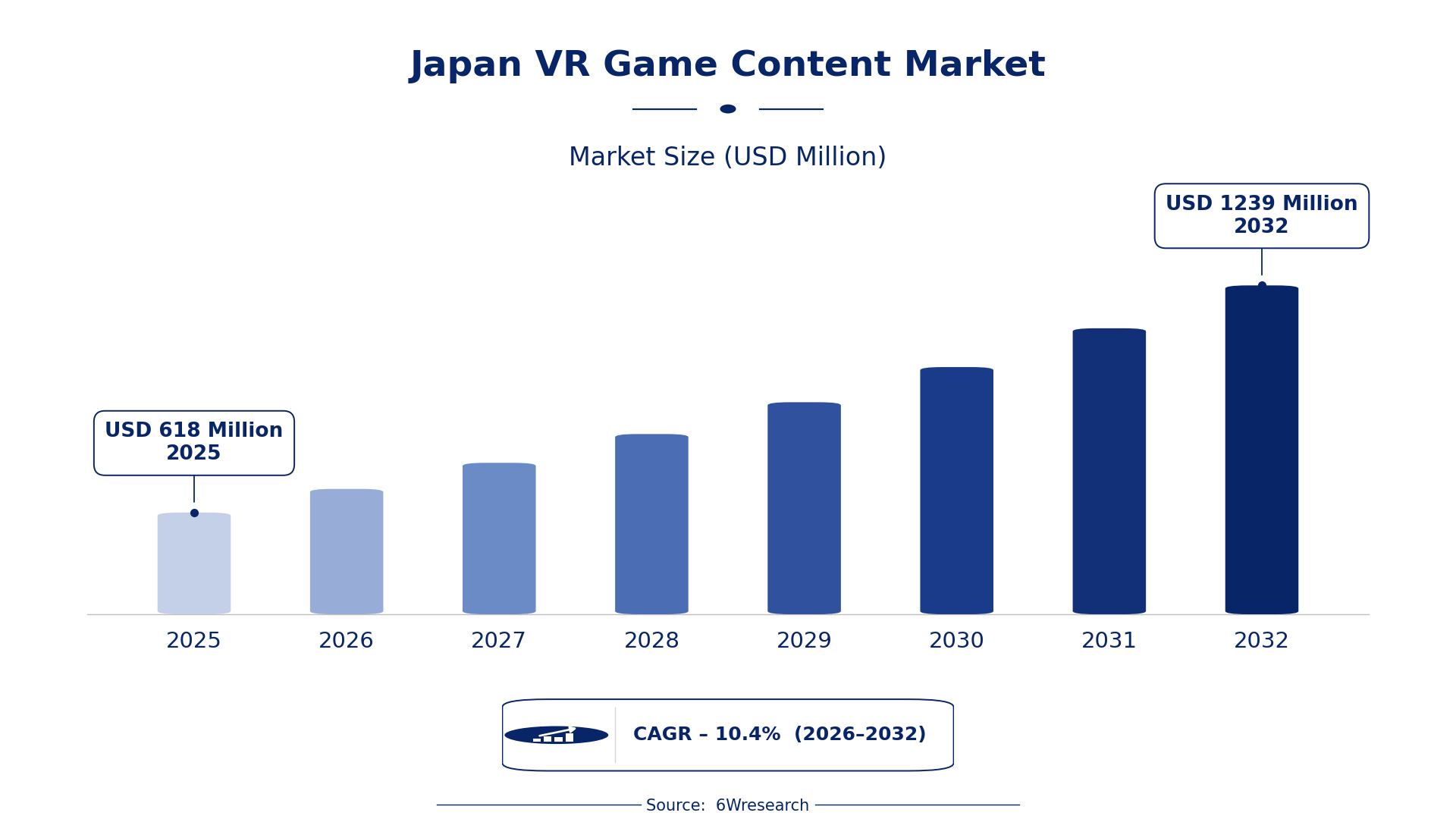
According to 6Wresearch internal database and industry insights, the Japan VR Game Content Market was valued at USD 618 Million in 2025 and is projected to reach USD 1,239 Million by 2032, growing at a CAGR of approximately 10.4% during 2026–2032.
Japan VR Game Content Market Highlights
| Report Metric | Details |
| Report Name | Japan VR Game Content Market (2026-2032) |
| Market Size 2025 | USD 618 Million |
| Market Size 2032 | USD 1,239 Million |
| Absolute Growth 2025–2032 | USD 621 Million |
| CAGR 2026–2032 | 10.4% |
| Peak Annual Growth | 13.0% in 2032 |
| Forecast Period | 2026–2032 |
| Historical Data | 2022–2025 |
| Base Year | 2025 |
| Leading Game Genre, 2025 | Multiplayer VR (43% share) |
| Leading Distribution Platform, 2025 | Steam (43% share) |
| Leading Graphic Quality, 2025 | HD (46% share) |
| Leading Monetization Model, 2025 | One-time Purchase (46% share) |
| Fastest-Growing Game Genre | Adventure VR Titles (13.7% CAGR) |
| Fastest-Growing Distribution Platform | Cross-platform (13.2% CAGR) |
| Fastest-Growing Graphic Quality | 4K (14.1% CAGR) |
| Fastest-Growing Monetization Model | Freemium + DLC (13.9% CAGR) |
| Growing Sector | entertainment |
| Key End Users | gamers, educational institutions, training providers, content developers |
Japan VR Game Content Market Year-wise Growth Rate and Key Drivers (2022–2032)
This graph illustrates the annual growth rates of the market from 2022 to 2032, highlighting a steady upward trajectory and projected market expansion over the forecast period.
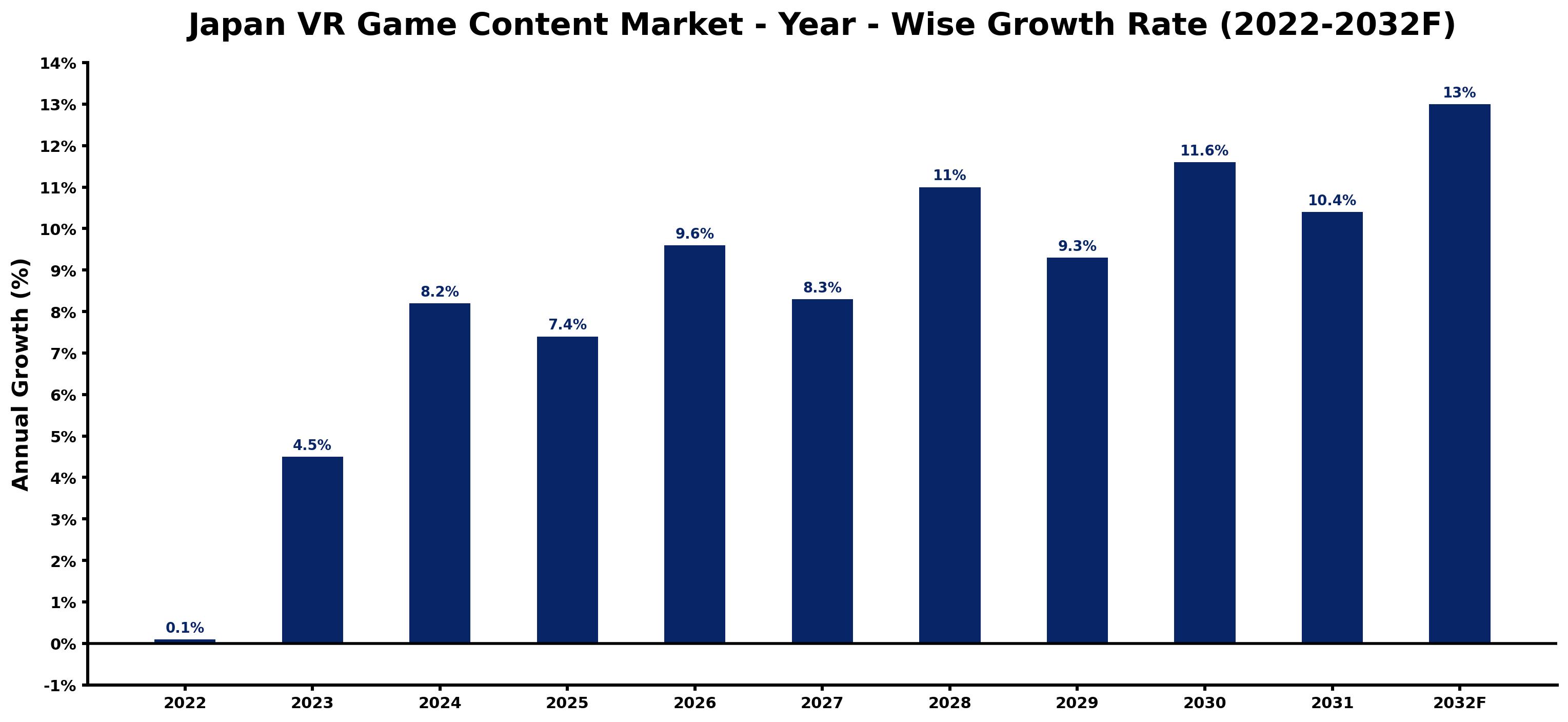
Year by year, the estimates below pair each growth rate with the development that shaped it.
| Year | Estimated Annual Growth (%) | Market Rationale |
| 2022 | 0.1 | The market experienced minimal growth due to initial adoption phases and limited content availability. |
| 2023 | 4.5 | Increased interest in VR technology led to faster growth as more titles were released. |
| 2024 | 8.2 | The launch of several popular VR games contributed to a rise in user engagement. |
| 2025 | 7.4 | Growth slowed as the market adjusted to previous peaks and faced competition from other entertainment forms. |
| 2026 | 9.6 | New technological advancements in VR hardware will spur increased consumer interest and purchases. |
| 2027 | 8.3 | Market growth is projected to slow again as saturation begins to affect new game releases and user acquisition. |
| 2028 | 11.0 | The introduction of immersive educational content is expected to attract a wider audience, boosting growth. |
| 2029 | 9.3 | Growth is projected to slow slightly as the market matures and competition intensifies among platforms. |
| 2030 | 11.6 | The rise of 4K graphics in VR games is expected to renew user interest, leading to increased purchases. |
| 2031 | 10.4 | Growth is projected to slow as the market stabilises, reflecting a more mature consumer base and offerings. |
| 2032 | 13.0 | The peak growth rate is expected to be achieved as innovative titles and cross-platform capabilities attract new users. |
Note: Market size estimations and growth projections presented in this report are based on 6Wresearch's proprietary forecasting methodology, utilizing the latest available industry data, government publications, and primary research inputs.
Japan VR Game Content Market Synopsis
VR game content in Japan consists of immersive experiences designed for virtual reality systems, created through advanced graphics and interactive technologies. The Japan VR Game Content Market is expanding due to a gaming population of approximately 67 million and increasing demand for engaging experiences. Investment in VR technology development, particularly in Tokyo, is driving new game releases and expanding the consumer base. The PlayStation VR has sold over 5 million units, demonstrating strong hardware support for market growth, while the Japan VR Association promotes industry standards and innovation.
Market Dynamics Impact Analysis (2026–2032)
| Factor | Type | Impact | Primary Segment Affected |
| Growing gaming population driving demand for immersive experiences | Driver | High | Horror VR Games |
| Technological advancements in VR hardware enhancing user experience | Driver | High | Adventure VR Titles |
| Expansion of cross-platform capabilities attracting diverse user groups | Opportunity | Medium | Cross-platform |
| Increased interest in educational VR content opening new markets | Opportunity | Medium | Puzzle VR Games |
| High development costs limiting smaller studios' market entry | Restraint | High | Multiplayer VR |
| Competition from mobile and traditional gaming platforms affecting growth | Restraint | Medium | Steam |
| High costs of VR hardware limiting consumer adoption | Challenge | High | PlayStation VR |
| Rapid technological changes creating uncertainty for developers | Challenge | Medium | 4K |
Evaluation of Drivers in Japan VR Game Content Market (2026–2032)
Key forces behind demand, with the segment each one moves most, are listed below.
| Drivers | Primary Segment Affected | Why It Matters (Evidence) |
| Large gaming population | Horror VR Games | Japan's gaming population of approximately 67 million drives demand for immersive horror experiences. |
| Technological advancements | Adventure VR Titles | New developments in VR technology are attracting more players to narrative-driven titles. |
| Increased investment in VR development | Multiplayer VR | Investment in VR studios in Tokyo supports the growth of social interaction games. |
| Popularity of VR events | Puzzle VR Games | Quarterly VR gaming events in cities like Osaka encourage community engagement and interest. |
| Sales of VR hardware | Steam | The PlayStation VR's sales of over 5 million units indicate strong hardware support for VR content. |
What keeps demand rising is the substantial gaming population in Japan, estimated at around 67 million, which fuels interest in immersive experiences. The popularity of VR events held quarterly in cities like Osaka encourages community engagement, leading to higher game purchases. Recent technological advancements, particularly in 4K graphics, are attracting more players to narrative-driven adventure titles. Investment in VR development in Tokyo further supports the growth of social interaction games, creating a vibrant gaming environment.
Evaluation of Restraints in Japan VR Game Content Market
The main factors holding the market back are set out below.
| Market Restraint | Primary Segment Affected | Why It Matters (Evidence) |
| High development costs for VR content limiting market entry | Multiplayer VR | High development costs restrict smaller studios' ability to compete effectively in the market. |
| Intense competition from mobile gaming platforms | Steam | Mobile games provide cheaper alternatives, affecting the growth of VR game sales. |
| Consumer reluctance to invest in expensive VR hardware | PlayStation VR | High costs deter potential users, limiting the market's growth potential. |
| Rapid technological changes creating uncertainty for developers | 4K | Frequent updates in VR technology can lead to costly adaptations for game developers. |
| Limited content availability for certain genres | Horror VR Games | A lack of diverse horror titles restricts market expansion and user engagement. |
Japan VR Game Content Market Challenges
High transportation costs burden producers, as rising fuel prices have escalated logistics expenses, resulting in a 15% increase in production costs for VR game developers. Limited technological infrastructure hampers innovation, with many studios lacking access to advanced tools, causing project timelines to extend by an average of six months. Intense competition among developers pressures pricing strategies, compelling many to reduce prices by up to 20%, which diminishes profitability for smaller studios. A skills gap in the workforce is evident, as only 30% of graduates possess the necessary expertise in VR development, leading to project delays for companies seeking qualified talent.
Trends in the Japan VR Game Content Market
The following changes are redrawing the Japan VR Game Content Market.
- Shift to Cross-Platform Gaming: Tokyo is experiencing a shift towards cross-platform gaming, allowing users from different systems to play together. This trend is illustrated by the growing popularity of cross-platform titles, which have increased user engagement significantly.
- Increased Adoption of 4K Graphics: The gaming community is embracing 4K graphics, particularly in high-end VR titles. This trend is evident as over 30% of new releases now feature 4K technology, enhancing visual experiences.
- Expansion of VR in Education: Educational institutions are integrating VR into their curricula, enhancing learning experiences. The trend is highlighted by the introduction of VR training simulations in schools, attracting significant interest from educators.
- Rise of VR Gaming Events: Major cities like Osaka are hosting quarterly VR gaming events, drawing thousands of participants. These events have seen attendance grow by over 25%, reflecting the increasing popularity of VR gaming.
Investment Opportunities in the Japan VR Game Content Market
The following areas offer the clearest openings for investors and suppliers in the Japan VR Game Content Market.
- Collaborate with Local Studios: Now is an ideal time to partner with local studios in Tokyo, which are actively developing new VR content. The growing interest in immersive experiences presents a significant market opportunity for developers.
- Invest in Educational VR Content: With educational institutions increasingly adopting VR, there is a significant opportunity to create tailored content. The demand for immersive learning experiences presents a notable market for developers.
- Expand Cross-Platform Capabilities: Cross-platform gaming is gaining traction, with a projected growth rate of 13.2%. Focusing on this area can attract diverse user groups and increase market share.
- Develop High-Quality 4K Titles: The demand for 4K graphics in VR games is on the rise, presenting an opportunity for developers to create visually stunning content. This trend is supported by the increasing sales of high-end VR headsets.
Government Initiatives in the Japan VR Game Content Market
The Digital Agency, established in September 2021, leads the government's digital transformation efforts, promoting common system standards that benefit VR game developers and users. This initiative aims to improve the overall quality and accessibility of VR content in Japan, ensuring compliance with industry standards and encouraging innovation.
The Consumer Affairs Agency oversees regulations that prohibit misleading advertising of VR games. This regulation protects consumers by ensuring that marketing claims are accurate, thereby building trust in the VR gaming market.
Future Insight of the Japan VR Game Content Market
New VR development facilities will emerge by 2032, driven by government support for technology projects and industry standards like ISO/IEC 30170:2018. The number of VR gamers is expected to grow, reaching approximately 75 million, which will increase demand for diverse content. Graphics capabilities will evolve, allowing developers to create more immersive experiences. Regular VR gaming events will encourage collaboration and innovation among studios, strengthening industry connections.
Market Segmentation Analysis
Japan VR Game Content Market report covers a detailed analysis of the following market segments:
By Game Genre – Multiplayer VR Leads, Adventure VR Titles Expected to Grow Fastest
According to Saurav Kr Singh, Senior Research Analyst at 6Wresearch, Multiplayer VR held 43% of the Japan VR Game Content Market by game genre in 2025. Multiplayer VR captures the largest share as it enables social interactions, appealing to Japan's extensive gaming population. This genre thrives in environments like Tokyo, where numerous studios focus on creating engaging multiplayer experiences. Over 2026–2032, Adventure VR Titles are expected to post the fastest growth, at a CAGR of 13.7%. Adventure VR Titles are rapidly growing due to their focus on narrative-driven experiences, attracting players who seek immersive storytelling. Their popularity is highlighted by their strong presence at events such as the Tokyo Game Show 2023. Suppliers should prioritise the development of multiplayer features to maximise market share.
By Distribution Platform – Steam Leads, Cross-platform Expected to Grow Fastest
The largest distribution platform category in 2025 was Steam, at 43% of revenue. Steam leads the distribution platform segment, serving as a primary channel for VR game delivery to consumers. Its over 30% market share allows it to effectively reach a broad audience of gamers in Japan. The quickest growth will come from Cross-platform, forecast to expand at a CAGR of 13.2% between 2026 and 2032. Cross-platform distribution is expanding quickly as it enables users across different systems to engage together, thus widening the potential player base. This growth aligns with the increasing demand for collaborative gaming experiences. Buyers will gain access to a more diverse range of games across various platforms.
By Graphic Quality – HD Leads, 4K Expected to Grow Fastest
With 46% of graphic quality revenue in 2025, HD was the largest category. HD graphic quality serves as the foundation for most VR games, appealing to a broad audience of developers and gamers alike. This format aligns with the expectations of Japan's gaming population, which numbers approximately 67 million, ensuring widespread adoption. 4K is projected to grow fastest, at a CAGR of 14.1% during 2026–2032. The shift towards 4K graphics is gaining momentum as it captivates enthusiasts who desire enhanced visual experiences in their gaming. This trend is likely to persist, especially with the introduction of new high-end VR titles that leverage 4K technology. Suppliers must prioritise the development of high-resolution content to meet the growing appetite for superior graphic quality in VR games.
By Monetization Model – One-time Purchase Leads, Freemium + DLC Expected to Grow Fastest
In 2025, One-time Purchase led the monetization model split with a 46% share. The One-time Purchase model remains the most prevalent way for consumers to acquire VR games, reflecting traditional buying habits in the gaming industry. This model provides a straightforward transaction process that resonates with many players. Freemium + DLC is set to record the highest CAGR in this split, 13.9% over 2026–2032. The Freemium + DLC model is becoming more popular as it allows for additional content to be offered, catering to players who seek more value. This approach is gaining traction as it provides flexibility in monetisation strategies. Suppliers may need to diversify their monetisation strategies to capture different segments of the market.
Key Attractiveness of the Report
- 10 Years of Market Numbers
- Historical Data Starting from 2022 to 2025
- Base Year 2025
- Forecast Data until 2032
- Key Performance Indicators Impacting the Market
- Major Upcoming Developments and Projects
Key Highlights of the Report:
- Japan VR Game Content Market Outlook
- Market Size of Japan VR Game Content Market, 2025
- Forecast of Japan VR Game Content Market, 2032
- Historical Data and Forecast of Japan VR Game Content Revenues & Volume for the Period 2022-2032F
- Japan VR Game Content Market Trend Evolution
- Japan VR Game Content Market Drivers and Challenges
- Japan VR Game Content Price Trends
- Japan VR Game Content Porter's Five Forces
- Japan VR Game Content Industry Life Cycle
- Historical Data and Forecast of Japan VR Game Content Market Revenues & Volume By Game Genre for the Period 2022-2032F
- Historical Data and Forecast of Japan VR Game Content Market Revenues & Volume By Horror VR Games for the Period 2022-2032F
- Historical Data and Forecast of Japan VR Game Content Market Revenues & Volume By Puzzle VR Games for the Period 2022-2032F
- Historical Data and Forecast of Japan VR Game Content Market Revenues & Volume By Adventure VR Titles for the Period 2022-2032F
- Historical Data and Forecast of Japan VR Game Content Market Revenues & Volume By Multiplayer VR for the Period 2022-2032F
- Historical Data and Forecast of Japan VR Game Content Market Revenues & Volume By Distribution Platform for the Period 2022-2032F
- Historical Data and Forecast of Japan VR Game Content Market Revenues & Volume By Steam for the Period 2022-2032F
- Historical Data and Forecast of Japan VR Game Content Market Revenues & Volume By Oculus Store for the Period 2022-2032F
- Historical Data and Forecast of Japan VR Game Content Market Revenues & Volume By PlayStation VR for the Period 2022-2032F
- Historical Data and Forecast of Japan VR Game Content Market Revenues & Volume By Cross-platform for the Period 2022-2032F
- Historical Data and Forecast of Japan VR Game Content Market Revenues & Volume By Graphic Quality for the Period 2022-2032F
- Historical Data and Forecast of Japan VR Game Content Market Revenues & Volume By HD for the Period 2022-2032F
- Historical Data and Forecast of Japan VR Game Content Market Revenues & Volume By 4K for the Period 2022-2032F
- Historical Data and Forecast of Japan VR Game Content Market Revenues & Volume By 8K for the Period 2022-2032F
- Historical Data and Forecast of Japan VR Game Content Market Revenues & Volume By UHD for the Period 2022-2032F
- Historical Data and Forecast of Japan VR Game Content Market Revenues & Volume By Monetization Model for the Period 2022-2032F
- Historical Data and Forecast of Japan VR Game Content Market Revenues & Volume By Subscription for the Period 2022-2032F
- Historical Data and Forecast of Japan VR Game Content Market Revenues & Volume By One-time Purchase for the Period 2022-2032F
- Historical Data and Forecast of Japan VR Game Content Market Revenues & Volume By Freemium + DLC for the Period 2022-2032F
- Historical Data and Forecast of Japan VR Game Content Market Revenues & Volume By In-game Purchases for the Period 2022-2032F
- Japan VR Game Content Import Export Trade Statistics
- Market Opportunity Assessment By Game Genre
- Market Opportunity Assessment By Distribution Platform
- Market Opportunity Assessment By Graphic Quality
- Market Opportunity Assessment By Monetization Model
- Japan VR Game Content Top Companies Market Share
- Japan VR Game Content Competitive Benchmarking By Technical and Operational Parameters
- Japan VR Game Content Company Profiles
- Japan VR Game Content Key Strategic Recommendations
Market Covered
This report examines the market across the segments below.
By Game Genre
- Horror VR Games
- Puzzle VR Games
- Adventure VR Titles
- Multiplayer VR
By Distribution Platform
- Steam
- Oculus Store
- PlayStation VR
- Cross-platform
By Graphic Quality
- HD
- 4K
- 8K
- UHD
By Monetization Model
- Subscription
- One-time Purchase
- Freemium + DLC
- In-game Purchases































