Japan Vulnerability Assessment Tools Market Size & Growth Rate
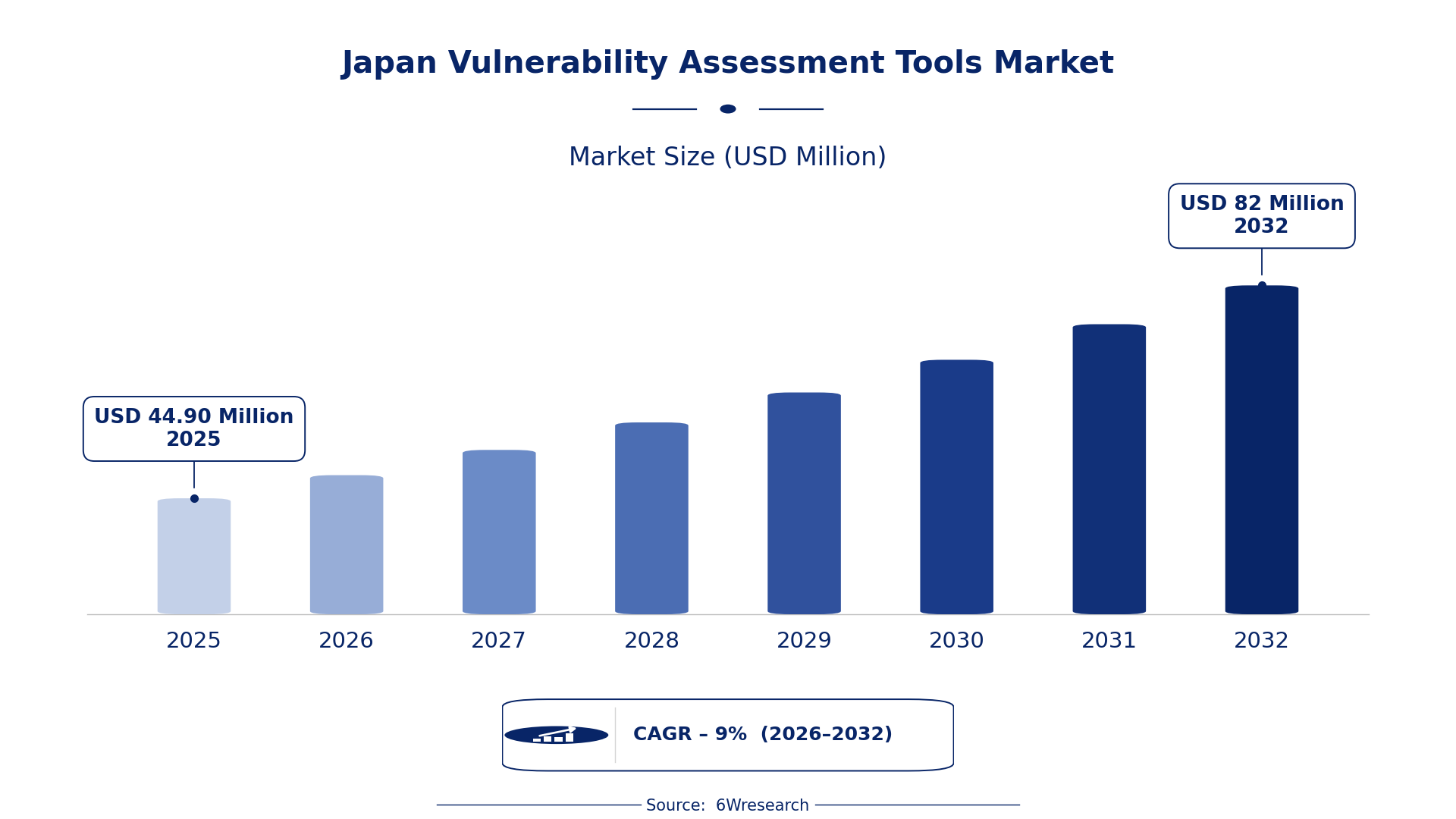
According to 6Wresearch internal database and industry insights, the Japan Vulnerability Assessment Tools Market was valued at USD 44.90 Million in 2025 and is projected to reach USD 82 Million by 2032, growing at a CAGR of approximately 9% during 2026–2032.
Japan Vulnerability Assessment Tools Market Highlights
| Report Metric | Details |
| Report Name | Japan Vulnerability Assessment Tools Market (2026-2032) |
| Market Size 2025 | USD 44.90 Million |
| Market Size 2032 | USD 82 Million |
| Absolute Growth 2025–2032 | USD 37.10 Million |
| CAGR 2026–2032 | 9% |
| Peak Annual Growth | 10.8% in 2030 |
| Forecast Period | 2026–2032 |
| Historical Data | 2022–2025 |
| Base Year | 2025 |
| Leading Tool Type, 2025 | Static Analysis (39% share) |
| Leading Analysis Method, 2025 | Code Analysis (38% share) |
| Leading Integration Mode, 2025 | CI/CD Pipeline (46% share) |
| Leading Use Case, 2025 | Secure Coding Review (44% share) |
| Fastest-Growing Tool Type | Dynamic Analysis (13.1% CAGR) |
| Fastest-Growing Analysis Method | Behavior Testing (12.5% CAGR) |
| Fastest-Growing Integration Mode | Standalone (12.4% CAGR) |
| Fastest-Growing Use Case | Runtime Assessment (12.6% CAGR) |
| Growing Sector | Runtime Assessment |
| Key End Users | Secure Coding Review, Runtime Assessment, Intrusion Detection, Cloud Security Audit |
Japan Vulnerability Assessment Tools Market Year-wise Growth Rate and Key Drivers (2022–2032)
This graph illustrates the annual growth rates of the market from 2022 to 2032, highlighting a steady upward trajectory and projected market expansion over the forecast period.
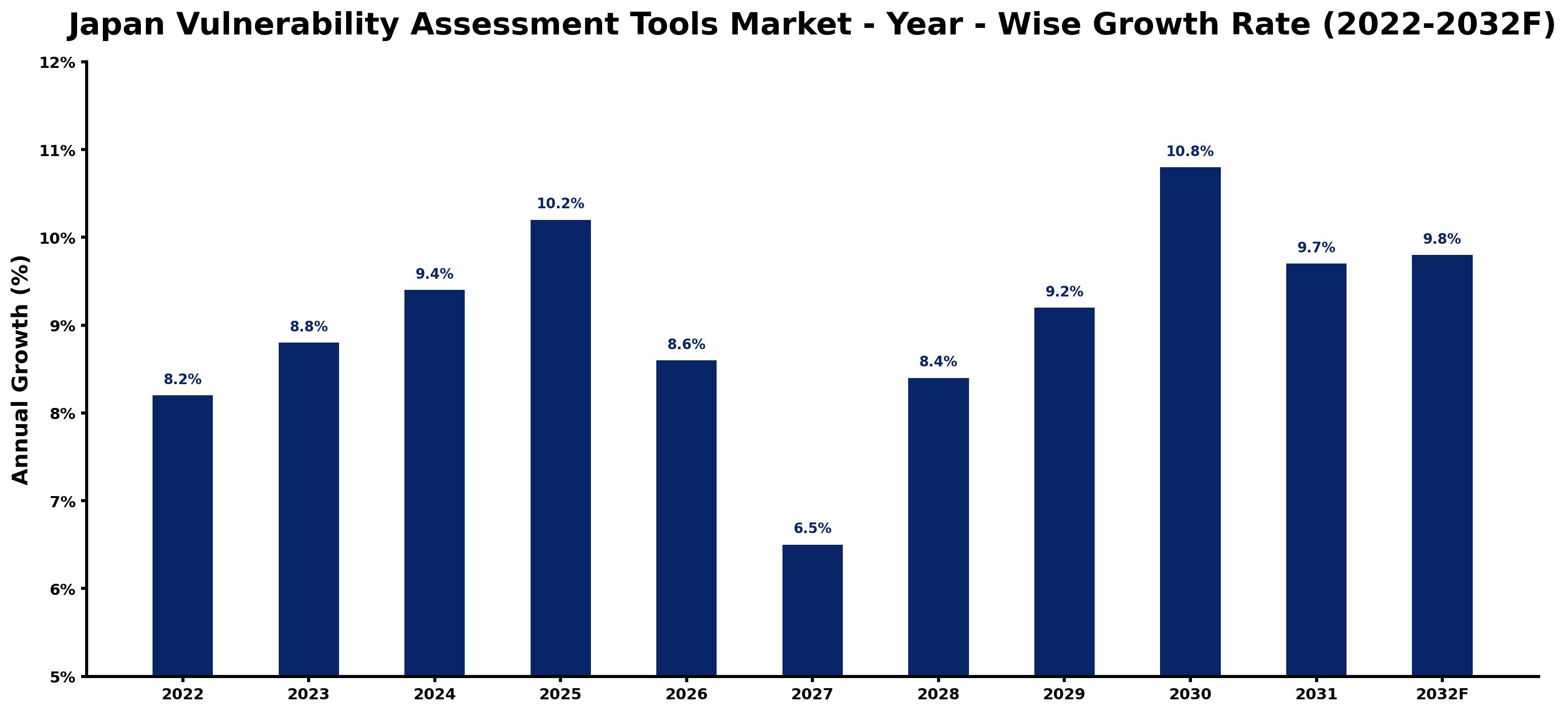
The table below sets out the estimated growth rate for each year and the main factor behind it.
| Year | Estimated Annual Growth (%) | Market Rationale |
| 2022 | 8.2 | The market showed steady growth with increasing cybersecurity awareness among businesses. |
| 2023 | 8.8 | Demand for tools rose as reported cyber incidents increased. |
| 2024 | 9.4 | Investment in cybersecurity initiatives expanded, driving further tool adoption. |
| 2025 | 10.2 | The peak growth was supported by heightened regulatory compliance requirements. |
| 2026 | 8.6 | Growth slowed as the market adjusted to previous high demand levels. |
| 2027 | 6.5 | Continued investment in cybersecurity infrastructure led to further market expansion. |
| 2028 | 8.4 | Growth accelerated again as new technologies emerged in vulnerability assessment. |
| 2029 | 9.2 | Increased focus on cloud security drove demand for specialized assessment tools. |
| 2030 | 10.8 | The market peaked again as businesses sought advanced security solutions. |
| 2031 | 9.7 | Growth slowed slightly as the market matured and competition intensified. |
| 2032 | 9.8 | Demand is expected to rise again as new regulations come into effect. |
Note: Market size estimations and growth projections presented in this report are based on 6Wresearch's proprietary forecasting methodology, utilizing the latest available industry data, government publications, and primary research inputs.
Japan Vulnerability Assessment Tools Market Synopsis
Vulnerability Assessment Tools are software solutions that identify and mitigate security vulnerabilities in systems and applications. The Japan Vulnerability Assessment Tools Market is growing due to an increase in cyber incidents, with a reported 30% rise in 2022. The IT and finance sectors are key demand sources, actively investing in cybersecurity measures. Heightened regulatory compliance requirements and government initiatives are driving market expansion, leading to increased tool adoption across various sectors.
Market Dynamics Impact Analysis (2026–2032)
| Factor | Type | Impact | Primary Segment Affected |
| Increasing cyber incidents drive demand for security solutions. | Driver | High | Static Analysis |
| Growing regulatory compliance requirements create a need for assessments. | Driver | High | Static Analysis |
| Rising investment in cybersecurity initiatives presents opportunities. | Opportunity | High | Static Analysis |
| Emerging technologies in cybersecurity create new market segments. | Opportunity | Medium | Static Analysis |
| High costs of implementing security measures can deter small firms. | Restraint | High | Static Analysis |
| Limited awareness among smaller businesses restricts market growth. | Restraint | Medium | Static Analysis |
| Shortage of skilled cybersecurity professionals hampers growth. | Challenge | High | Static Analysis |
| Rapid technological changes require constant updates to tools. | Challenge | Medium | Static Analysis |
Evaluation of Drivers in Japan Vulnerability Assessment Tools Market (2026–2032)
Key forces behind demand, with the segment each one moves most, are listed below.
| Drivers | Primary Segment Affected | Why It Matters (Evidence) |
| Increase in reported cyber incidents | Static Analysis | The number of reported cyber incidents in Japan increased by 30% in 2022, prompting businesses to invest in assessment tools to mitigate risks. |
| Mandatory security audits for financial institutions | Static Analysis | Security audits are mandatory for financial institutions under the Financial Services Agency regulations, driving tool adoption to meet compliance requirements. |
| Investment in cybersecurity initiatives | Static Analysis | The government allocated 5 billion JPY for cybersecurity initiatives in 2023, stimulating market demand for assessment tools and solutions. |
| Focus on cloud security | Static Analysis | The demand for cloud security assessments has surged, particularly in Tokyo, as businesses migrate to cloud solutions, increasing the need for specialized tools. |
| Emerging technologies in cybersecurity | Static Analysis | The updated Cybersecurity Strategy of Japan promotes advanced security technologies, increasing demand for vulnerability assessment tools. |
The primary driver of demand is the rise in reported cyber incidents, which increased by 30% in 2022, prompting businesses to invest in vulnerability assessment tools to improve security. Mandatory security audits for financial institutions drive adoption, as compliance processes often necessitate these tools. The growing emphasis on cloud security assessments is clear as businesses migrate to cloud solutions, increasing the need for specialized tools to protect data and ensure compliance. New technologies in cybersecurity are also pushing demand for advanced assessment solutions, aligning with ongoing industry needs.
Evaluation of Restraints in Japan Vulnerability Assessment Tools Market
The table below lists the restraints and the evidence behind each.
| Market Restraint | Primary Segment Affected | Why It Matters (Evidence) |
| High costs of implementing security measures | Static Analysis | The costs associated with implementing security measures can deter small firms from investing in assessment tools, which can reach millions of yen. |
| Limited awareness among smaller businesses | Static Analysis | Many smaller businesses lack awareness of the importance of vulnerability assessments, restricting market growth and adoption of tools. |
| Shortage of skilled cybersecurity professionals | Static Analysis | The shortage of qualified cybersecurity professionals in Japan hampers the effective implementation of assessment tools, delaying projects. |
| Rapid technological changes require constant updates | Static Analysis | The fast pace of technological advancements necessitates frequent updates to vulnerability assessment tools, increasing operational costs for users. |
| Complexity of compliance regulations | Static Analysis | Navigating complex compliance regulations can be challenging for businesses, slowing down tool adoption and increasing the time to compliance. |
Japan Vulnerability Assessment Tools Market Challenges
In 2022, Japan saw a 30% rise in cyber incidents, compelling buyers in the IT and finance sectors to invest millions in incident response and recovery efforts. Financial institutions face delays due to mandatory security audits imposed by the Financial Services Agency, extending compliance timelines by up to three months and disrupting operations. Suppliers encounter fierce competition in major regions like Tokyo and Osaka, which can erode profit margins and limit their ability to invest in new technologies. Rapid advancements in vulnerability assessment tools require frequent upgrades for buyers, leading to costs that can reach hundreds of thousands of yen every few years.
Trends in the Japan Vulnerability Assessment Tools Market
The shifts below are changing how Japan Vulnerability Assessment Tools Market products are bought and supplied.
- Shift from Manual to Automated Assessments: Since 2023, many organizations have moved to automated vulnerability assessments to improve efficiency. The Tokyo Metropolitan Government's cybersecurity awareness campaign has highlighted the benefits of automation, resulting in a 25% increase in tool adoption.
- Increased Focus on Cloud Security: The demand for cloud security assessments has surged, particularly in Tokyo, as businesses migrate to cloud solutions. This shift has resulted in a 40% rise in cloud assessment tool usage since 2022.
- Emergence of Integrated Security Solutions: In 2023, businesses are increasingly adopting integrated security solutions that combine multiple assessment tools. This trend is evident in Osaka, where demand for such solutions has grown by 30%.
- Growing Demand for Continuous Monitoring: Since 2023, there has been a notable shift towards continuous monitoring of vulnerabilities. Financial institutions are leading this trend, with a marked increase in demand for continuous assessment tools by 35%.
Investment Opportunities in the Japan Vulnerability Assessment Tools Market
The following areas offer the clearest openings for investors and suppliers in the Japan Vulnerability Assessment Tools Market.
- Growing Investment in Cybersecurity: With the government allocating 5 billion JPY for cybersecurity initiatives in 2023, there is a strong opportunity for suppliers of vulnerability assessment tools to meet rising demand from financial institutions and other sectors.
- Expansion of Cloud Security Solutions: The surge in cloud adoption has created a need for specialized assessment tools. IT firms in Tokyo are actively seeking solutions to ensure compliance and security in cloud environments, leading to a 20% increase in tool demand.
- Increased Demand for Training Programs: As the cybersecurity sector evolves, there is a growing need for training programs. Educational institutions in Japan are looking to partner with providers of cybersecurity training solutions to enhance workforce skills, with a projected 15% growth in training initiatives.
- Focus on Compliance Solutions: With complex compliance regulations in place, businesses require tools that simplify adherence. Financial institutions are particularly interested in solutions that streamline compliance processes, leading to a 25% increase in demand for compliance-focused tools.
Government Initiatives in the Japan Vulnerability Assessment Tools Market
The Cybersecurity Basic Act, enacted in 2014, established a framework for cybersecurity measures in Japan. This law mandates that businesses implement security measures to protect sensitive data, driving demand for vulnerability assessment tools. The updated Cybersecurity Strategy of Japan in 2023 further reinforces these requirements, ensuring that organizations maintain their cybersecurity posture and comply with regulations.
In 2023, the government allocated 5 billion JPY for cybersecurity initiatives, administered by the Digital Agency. This funding supports various programs aimed at improving cybersecurity infrastructure, which directly benefits producers and users of vulnerability assessment tools.
Future Insight of the Japan Vulnerability Assessment Tools Market
The investment pipeline for cybersecurity will expand significantly, creating a robust demand for vulnerability assessment tools. Government funding of 5 billion JPY in 2023 will support initiatives that drive the need for regular updates and replacements of existing tools. Enhanced training programs will improve the capabilities of cybersecurity professionals, equipping them to tackle increasingly complex threats. The establishment of the National Cyber Security Center will facilitate better coordination among stakeholders, allowing suppliers to meet the evolving needs of buyers across various sectors.
Market Segmentation Analysis
Japan Vulnerability Assessment Tools Market report covers a detailed analysis of the following market segments:
By Tool Type – Static Analysis Leads, Dynamic Analysis Expected to Grow Fastest
According to Saurav Kr Singh, Senior Research Analyst at 6Wresearch, Static Analysis took 39% of tool type revenue in 2025, more than any other category. Static Analysis holds the largest share as it is vital for identifying vulnerabilities in source code before deployment, particularly in the IT sector where code security is paramount. This method is widely adopted by developers to comply with standards like ISO/IEC 27001, ensuring robust security practices. Dynamic Analysis is projected to grow fastest, at a CAGR of 13.1% during 2026–2032. Dynamic Analysis is witnessing rapid growth because it assesses running applications to detect security flaws during execution, a necessity given the 30% rise in reported cyber incidents in 2022. This increasing urgency for real-time vulnerability detection will likely widen the lead of Static Analysis. Suppliers should enhance Dynamic Analysis capabilities to align with the rising demand for real-time security solutions.
By Analysis Method – Code Analysis Leads, Behavior Testing Expected to Grow Fastest
Code Analysis held 38% of the Japan Vulnerability Assessment Tools Market by analysis method in 2025. Code Analysis leads the market as it effectively identifies vulnerabilities and ensures adherence to security standards, making it essential for compliance in critical sectors like finance. Its importance is reinforced by the rigorous standards established by ISO/IEC 27001 in Japan's cybersecurity framework. The quickest growth will come from Behavior Testing, forecast to expand at a CAGR of 12.5% between 2026 and 2032. Behavior Testing is experiencing rapid growth as it evaluates user behaviour patterns, which are becoming increasingly relevant in identifying security vulnerabilities. The rise in cyber incidents has prompted organisations to adopt more comprehensive assessment methods that include user behaviour analysis, further solidifying Code Analysis's lead. Buyers may benefit from integrating Behaviour Testing alongside traditional methods to strengthen their overall security posture.
By Integration Mode – CI/CD Pipeline Leads, Standalone Expected to Grow Fastest
The largest integration mode category in 2025 was CI/CD Pipeline, at 46% of revenue. CI/CD Pipeline dominates the market by integrating security assessments into continuous integration and deployment processes, which is essential for modern software development. This integration is particularly vital for organisations aiming to maintain agility while ensuring robust security measures throughout their development cycles. Standalone is set to record the highest CAGR in this split, 12.4% over 2026–2032. Standalone solutions are experiencing the fastest growth as they operate independently for vulnerability assessments, appealing to organisations that prefer quick and straightforward evaluations. The urgency for immediate vulnerability detection is driving this trend, which may further solidify the position of CI/CD Pipeline. Suppliers should consider offering more standalone solutions to meet the needs of organisations prioritising speed and simplicity.
By Use Case – Secure Coding Review Leads, Runtime Assessment Expected to Grow Fastest
With 44% of use case revenue in 2025, Secure Coding Review was the largest category. Secure Coding Review is the leading use case as it focuses on enhancing code security practices during development, which is crucial for preventing vulnerabilities before they occur. This proactive approach is highly valued in sectors with stringent compliance requirements, particularly in finance and IT. Over 2026–2032, Runtime Assessment is expected to post the fastest growth, at a CAGR of 12.6%. Runtime Assessment is growing quickly as it evaluates security during application runtime for immediate threats, addressing the urgent need for real-time security measures. The heightened awareness of cybersecurity risks has made this approach increasingly attractive to organisations seeking effective risk mitigation strategies. Buyers should prioritise Runtime Assessment tools to ensure ongoing protection against emerging security threats.
Key Attractiveness of the Report
- 10 Years of Market Numbers
- Historical Data Starting from 2022 to 2025
- Base Year 2025
- Forecast Data until 2032
- Key Performance Indicators Impacting the Market
- Major Upcoming Developments and Projects
Key Highlights of the Report:
- Japan Vulnerability Assessment Tools Market Outlook
- Market Size of Japan Vulnerability Assessment Tools Market, 2025
- Forecast of Japan Vulnerability Assessment Tools Market, 2032
- Historical Data and Forecast of Japan Vulnerability Assessment Tools Revenues & Volume for the Period 2022-2032F
- Japan Vulnerability Assessment Tools Market Trend Evolution
- Japan Vulnerability Assessment Tools Market Drivers and Challenges
- Japan Vulnerability Assessment Tools Price Trends
- Japan Vulnerability Assessment Tools Porter's Five Forces
- Japan Vulnerability Assessment Tools Industry Life Cycle
- Historical Data and Forecast of Japan Vulnerability Assessment Tools Market Revenues & Volume By Tool Type for the Period 2022-2032F
- Historical Data and Forecast of Japan Vulnerability Assessment Tools Market Revenues & Volume By Static Analysis for the Period 2022-2032F
- Historical Data and Forecast of Japan Vulnerability Assessment Tools Market Revenues & Volume By Dynamic Analysis for the Period 2022-2032F
- Historical Data and Forecast of Japan Vulnerability Assessment Tools Market Revenues & Volume By Penetration Testing for the Period 2022-2032F
- Historical Data and Forecast of Japan Vulnerability Assessment Tools Market Revenues & Volume By Cloud Assessment for the Period 2022-2032F
- Historical Data and Forecast of Japan Vulnerability Assessment Tools Market Revenues & Volume By Analysis Method for the Period 2022-2032F
- Historical Data and Forecast of Japan Vulnerability Assessment Tools Market Revenues & Volume By Code Analysis for the Period 2022-2032F
- Historical Data and Forecast of Japan Vulnerability Assessment Tools Market Revenues & Volume By Behavior Testing for the Period 2022-2032F
- Historical Data and Forecast of Japan Vulnerability Assessment Tools Market Revenues & Volume By Ethical Hacking for the Period 2022-2032F
- Historical Data and Forecast of Japan Vulnerability Assessment Tools Market Revenues & Volume By Risk Modeling for the Period 2022-2032F
- Historical Data and Forecast of Japan Vulnerability Assessment Tools Market Revenues & Volume By Integration Mode for the Period 2022-2032F
- Historical Data and Forecast of Japan Vulnerability Assessment Tools Market Revenues & Volume By CI/CD Pipeline for the Period 2022-2032F
- Historical Data and Forecast of Japan Vulnerability Assessment Tools Market Revenues & Volume By Standalone for the Period 2022-2032F
- Historical Data and Forecast of Japan Vulnerability Assessment Tools Market Revenues & Volume By Manual + AI for the Period 2022-2032F
- Historical Data and Forecast of Japan Vulnerability Assessment Tools Market Revenues & Volume By SaaS for the Period 2022-2032F
- Historical Data and Forecast of Japan Vulnerability Assessment Tools Market Revenues & Volume By Use Case for the Period 2022-2032F
- Historical Data and Forecast of Japan Vulnerability Assessment Tools Market Revenues & Volume By Secure Coding Review for the Period 2022-2032F
- Historical Data and Forecast of Japan Vulnerability Assessment Tools Market Revenues & Volume By Runtime Assessment for the Period 2022-2032F
- Historical Data and Forecast of Japan Vulnerability Assessment Tools Market Revenues & Volume By Intrusion Detection for the Period 2022-2032F
- Historical Data and Forecast of Japan Vulnerability Assessment Tools Market Revenues & Volume By Cloud Security Audit for the Period 2022-2032F
- Japan Vulnerability Assessment Tools Import Export Trade Statistics
- Market Opportunity Assessment By Tool Type
- Market Opportunity Assessment By Analysis Method
- Market Opportunity Assessment By Integration Mode
- Market Opportunity Assessment By Use Case
- Japan Vulnerability Assessment Tools Top Companies Market Share
- Japan Vulnerability Assessment Tools Competitive Benchmarking By Technical and Operational Parameters
- Japan Vulnerability Assessment Tools Company Profiles
- Japan Vulnerability Assessment Tools Key Strategic Recommendations
Market Covered
The study includes the following segmentation.
By Tool Type
- Static Analysis
- Dynamic Analysis
- Penetration Testing
- Cloud Assessment
By Analysis Method
- Code Analysis
- Behavior Testing
- Ethical Hacking
- Risk Modeling
By Integration Mode
- CI/CD Pipeline
- Standalone
- Manual + AI
- SaaS
By Use Case
- Secure Coding Review
- Runtime Assessment
- Intrusion Detection
- Cloud Security Audit































