Japan Wafer Handling Systems Market Size & Growth Rate
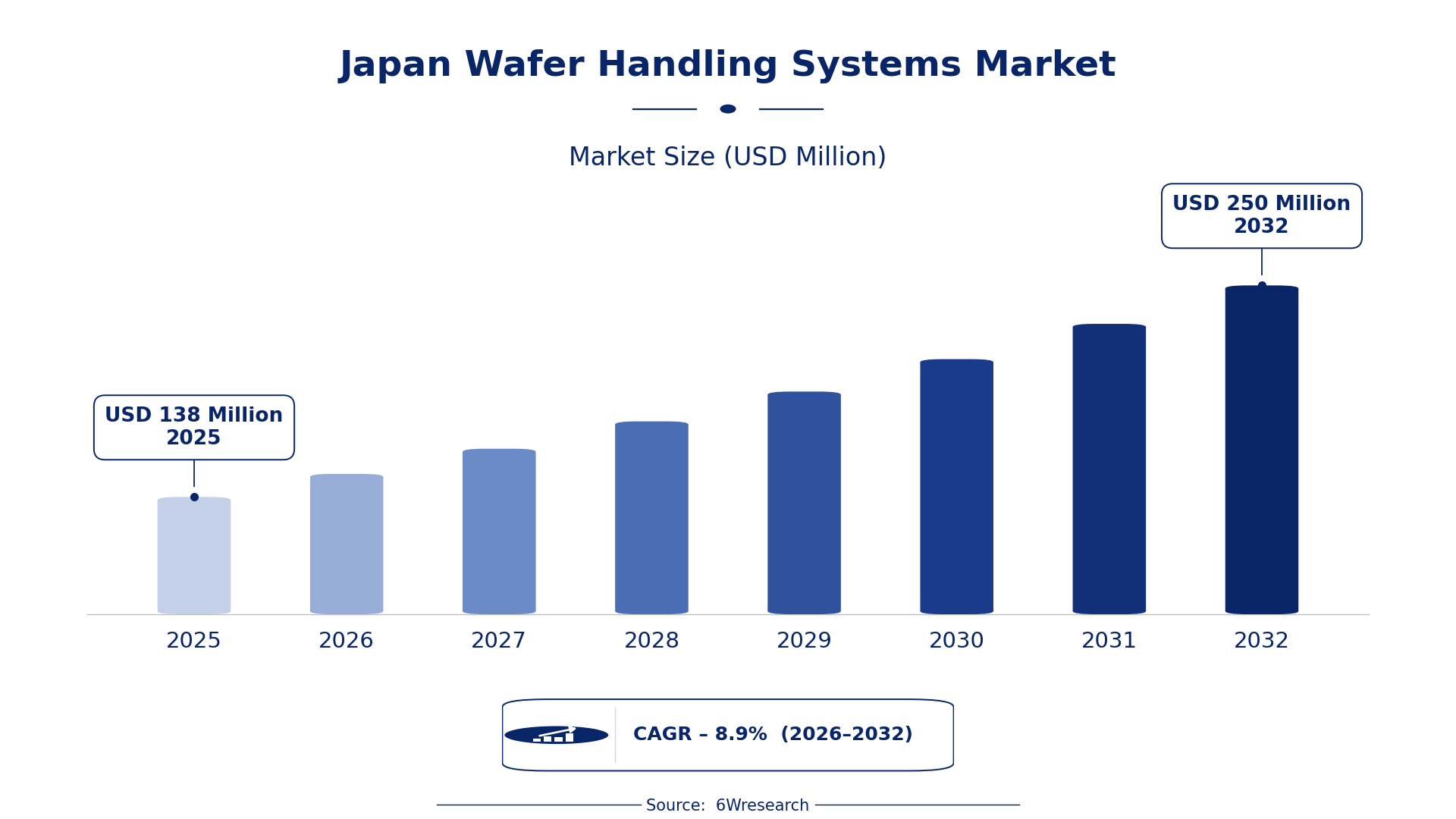
According to 6Wresearch internal database and industry insights, the Japan Wafer Handling Systems Market was valued at USD 138 Million in 2025 and is projected to reach USD 250 Million by 2032, growing at a CAGR of approximately 8.9% during 2026–2032.
Japan Wafer Handling Systems Market Highlights
| Report Metric | Details |
| Report Name | Japan Wafer Handling Systems Market (2026-2032) |
| Market Size 2025 | USD 138 Million |
| Market Size 2032 | USD 250 Million |
| Absolute Growth 2025–2032 | USD 112 Million |
| CAGR 2026–2032 | 8.9% |
| Peak Annual Growth | 9.7% in 2030 |
| Forecast Period | 2026–2032 |
| Historical Data | 2022–2025 |
| Base Year | 2025 |
| Leading System Type, 2025 | Cassette-to-Cassette (47% share) |
| Leading Component Type, 2025 | Load Port Units (40% share) |
| Leading Use Case, 2025 | Front-End Processing (38% share) |
| Leading Distribution Channel, 2025 | Direct Supply (38% share) |
| Fastest-Growing System Type | Cluster Tools (12.3% CAGR) |
| Fastest-Growing Component Type | Multi-Arm Robots (13.0% CAGR) |
| Fastest-Growing Use Case | Tool Integration (11.8% CAGR) |
| Fastest-Growing Distribution Channel | OEM Channels (11.1% CAGR) |
| Growing Sector | semiconductor manufacturing |
| Key End Users | semiconductor manufacturers, cleanroom operators, equipment suppliers, technology developers |
Japan Wafer Handling Systems Market Year-wise Growth Rate and Key Drivers (2022–2032)
This graph illustrates the annual growth rates of the market from 2022 to 2032, highlighting a steady upward trajectory and projected market expansion over the forecast period.
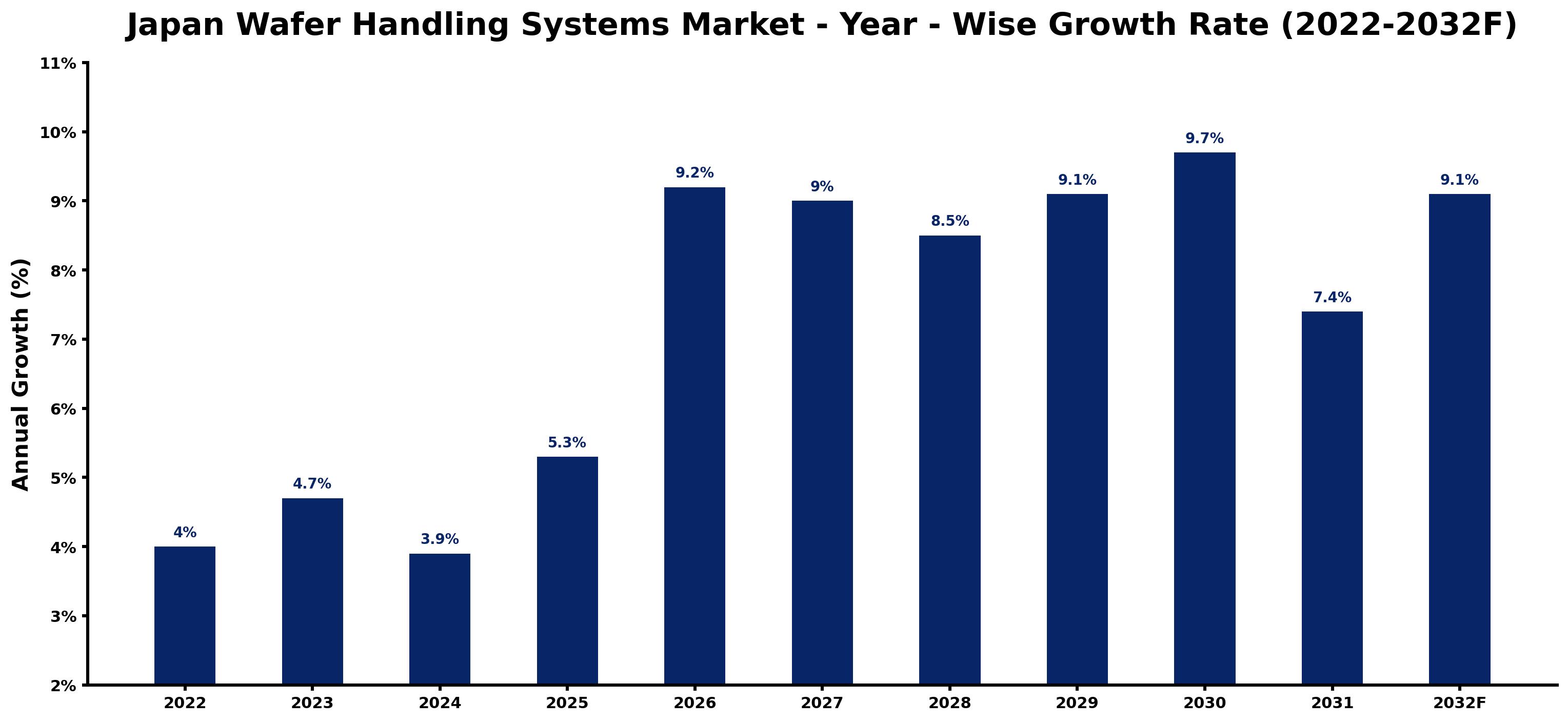
Each row of the following table gives one year's estimated growth and the event or demand shift that explains it.
| Year | Estimated Annual Growth (%) | Market Rationale |
| 2022 | 4.0 | The semiconductor market showed steady performance with established demand from local manufacturers. |
| 2023 | 4.7 | Growth accelerated due to increased investments in semiconductor technologies and production capacity. |
| 2024 | 3.9 | The market experienced a slowdown as growth rates moderated after a strong previous year. |
| 2025 | 5.3 | Demand rose as manufacturers expanded operations and upgraded their equipment. |
| 2026 | 9.2 | A surge in the market is anticipated as new technologies and production methods are adopted. |
| 2027 | 9.0 | Growth is projected to slow slightly as the market stabilises after rapid expansion. |
| 2028 | 8.5 | Continued investments in automation are expected to sustain growth despite a slight slowdown. |
| 2029 | 9.1 | The market is expected to rebound with renewed interest in advanced manufacturing techniques. |
| 2030 | 9.7 | A peak in growth is anticipated as major investments in semiconductor infrastructure materialise. |
| 2031 | 7.4 | Growth rates are expected to normalise as the market adjusts to new production capacities. |
| 2032 | 9.1 | The market is projected to grow steadily as demand from manufacturers remains strong. |
Note: Market size estimations and growth projections presented in this report are based on 6Wresearch's proprietary forecasting methodology, utilizing the latest available industry data, government publications, and primary research inputs.
Japan Wafer Handling Systems Market Synopsis
Wafer Handling Systems are vital for semiconductor manufacturing, utilising automated equipment to transport and process silicon wafers. The Japan Wafer Handling Systems Market is expanding, driven by a strong domestic semiconductor industry valued at approximately 3 trillion yen in 2022. Factors such as the Kanto region's dominance in production and substantial government investments, including 500 billion yen allocated for semiconductor support in 2023, are propelling this growth.
Market Dynamics Impact Analysis (2026–2032)
| Factor | Type | Impact | Primary Segment Affected |
| Rising investments in semiconductor manufacturing capacity | Driver | High | Cassette-to-Cassette |
| Increased demand for automation in wafer processing | Driver | High | Cluster Tools |
| Growing need for advanced wafer handling solutions | Opportunity | High | Multi-Arm Robots |
| Expansion of cleanroom environments in semiconductor facilities | Opportunity | High | FOUP Loaders |
| High initial investment costs for advanced systems | Restraint | Medium | Conveyor Systems |
| Limited availability of skilled workforce for system integration | Restraint | Medium | Tool Integration |
| Challenges in meeting stringent cleanroom standards | Challenge | High | FOUP Transfer |
| Compliance with evolving industry regulations | Challenge | Medium | Load Port Units |
Evaluation of Drivers in Japan Wafer Handling Systems Market (2026–2032)
The following drivers explain most of the expected growth.
| Drivers | Primary Segment Affected | Why It Matters (Evidence) |
| Rising domestic semiconductor production | Cassette-to-Cassette | This segment sees increased demand due to its essential role in transporting wafers between processes, with Japan's semiconductor market valued at approximately 3 trillion yen in 2022. |
| Growing investment in automation technologies | Cluster Tools | Investment in advanced automation is driving demand for integrated tools, as these systems enhance efficiency in wafer processing, aligning with Japan's semiconductor strategy. |
| High adoption of ISO 9001 standards | FOUP Loaders | The implementation of ISO 9001 standards promotes the use of FOUP Loaders to minimise contamination, leading to increased purchases in cleanroom environments where over 80% of systems are used. |
| Expansion of cleanroom facilities | Load Port Units | The growth of cleanroom facilities necessitates Load Port Units for interfacing with various equipment, supporting the semiconductor industry's operational needs. |
| Increased focus on contamination control | Multi-Arm Robots | Enhanced research on contamination control methods drives demand for Multi-Arm Robots, as these systems provide flexibility and precision in wafer handling. |
Volumes grow on the back of Japan's semiconductor market, valued at approximately 3 trillion yen in 2022, which drives demand for efficient wafer handling solutions. The allocation of 500 billion yen for semiconductor support in 2023 boosts production capabilities significantly. Enhanced automation technologies are leading to increased purchases of integrated tools, while stringent ISO 9001 standards promote advanced handling systems to minimise contamination. As a result, buyers are increasingly investing in modernised solutions to meet industry standards.
Evaluation of Restraints in Japan Wafer Handling Systems Market
The following restraints limit how fast demand can grow.
| Market Restraint | Primary Segment Affected | Why It Matters (Evidence) |
| High initial investment costs for advanced systems | Conveyor Systems | The average installed base of wafer handling systems is estimated at 10,000 units, resulting in substantial upfront costs. |
| Limited availability of skilled workforce for system integration | Tool Integration | With over 300 semiconductor manufacturing companies, competition for skilled workers is intense, impacting project timelines. |
| Challenges in meeting stringent cleanroom standards | FOUP Transfer | The Cleanroom Technology Association of Japan establishes strict guidelines, complicating compliance for manufacturers. |
| Compliance with evolving industry regulations | Load Port Units | The Semiconductor Industry Association of Japan promotes standards that necessitate constant updates to handling systems. |
| Dependence on specific technology suppliers | Cluster Tools | Reliance on a few suppliers for critical components can create vulnerabilities in the supply chain. |
Japan Wafer Handling Systems Market Challenges
Japan's strict regulatory environment complicates semiconductor manufacturing, resulting in production delays for producers. These regulations can extend lead times by 20%, making it challenging for buyers to maintain timely supply chains. Compliance costs have surged, raising operational expenses for producers by approximately 15%, which pressures profit margins. A shortage of skilled workers in robotics and precision engineering hampers production efficiency, compelling manufacturers to invest in training programmes lasting up to two years, ultimately delaying their ability to meet market demand.
Trends in the Japan Wafer Handling Systems Market
The shifts below are changing how Japan Wafer Handling Systems Market products are bought and supplied.
- Shift Towards Automation in Wafer Handling: The New Robot Strategy launched in 2015 has accelerated the adoption of robotics in wafer handling, resulting in a 15% increase in automated systems in use.
- Transition to Improved Cleanroom Standards: Since 2021, the Semiconductor and Digital Industry Strategy has driven improvements in cleanroom operations, with 80% of facilities now adhering to updated ISO standards.
- Emergence of Integrated Handling Solutions: The trend towards integrated tools has been marked by a 12% increase in Cluster Tools adoption, reflecting the industry's push for efficiency.
- Growing Demand for Multi-Arm Robots: The average installed base of Multi-Arm Robots is projected to rise by 20% by 2025, reflecting their flexibility in wafer handling.
Investment Opportunities in the Japan Wafer Handling Systems Market
Several openings in the Japan Wafer Handling Systems Market merit attention from investors.
- Timing for Investment in Automation: With Japan's semiconductor market valued at 3 trillion yen, investing in automation solutions is timely for manufacturers aiming to enhance efficiency.
- Need for Cleanroom-Compatible Systems: The expansion of cleanroom environments presents an opportunity for suppliers of FOUP Loaders, particularly in the Kanto region, which leads in production.
- Focus on Advanced Robotics: The rising demand for Multi-Arm Robots in semiconductor facilities offers a notable opportunity for suppliers, especially in urban industrial hubs.
- Entry into the Direct Supply Channel: Direct Supply remains the primary distribution method, allowing new entrants to collaborate with local manufacturers for effective market access.
Government Initiatives in the Japan Wafer Handling Systems Market
The Semiconductor and Digital Industry Strategy, launched in June 2021, aims to secure domestic semiconductor manufacturing by boosting production capabilities and integrating advanced technologies. This strategy complements existing laws by increasing investments in the semiconductor sector and promoting innovation.
The Ministry of Economy, Trade and Industry (METI) oversees various support programs, including the allocation of 500 billion yen for semiconductor industry initiatives. This funding enhances production capacity and supports research and development in semiconductor technologies.
Future Insight of the Japan Wafer Handling Systems Market
The semiconductor market will undergo substantial changes by 2032, driven by advancements in automation and robotics that will improve efficiency for buyers. The semiconductor strategy from the Ministry of Economy, Trade and Industry aims to elevate domestic production, with an investment of 500 billion yen supporting innovation initiatives. Research from the National Institute of Advanced Industrial Science and Technology will enhance contamination control methods. Suppliers will experience increased demand for advanced systems, while buyers will benefit from faster delivery and improved product quality.
Market Segmentation Analysis
Japan Wafer Handling Systems Market report covers a detailed analysis of the following market segments:
By System Type – Cassette-to-Cassette Leads, Cluster Tools Expected to Grow Fastest
According to Saurav Kr Singh, Senior Research Analyst at 6Wresearch, Cassette-to-Cassette took 47% of system type revenue in 2025, more than any other category. Cassette-to-Cassette systems hold the largest share as they are essential for transporting wafers between processes, ensuring efficiency in semiconductor manufacturing. This method is widely adopted in the Kanto region, which accounts for over 70% of Japan's semiconductor production. The quickest growth will come from Cluster Tools, forecast to expand at a CAGR of 12.3% between 2026 and 2032. Cluster Tools are growing rapidly due to their ability to integrate multiple processes into a single tool, streamlining operations. The demand for enhanced efficiency in wafer processing is particularly strong in advanced manufacturing environments, indicating a trend towards more integrated solutions. Suppliers should focus on developing Cluster Tools to meet the rising demand for integrated manufacturing solutions.
By Component Type – Load Port Units Lead, Multi-Arm Robots Expected to Grow Fastest
In 2025, Load Port Units led the component type split with a 40% share. Load Port Units dominate the market as they are necessary for interfacing with various equipment in semiconductor manufacturing. Their critical role in ensuring smooth operations makes them indispensable for Japan's extensive semiconductor manufacturing sector. Multi-Arm Robots are projected to grow fastest, at a CAGR of 13.0% during 2026–2032. Multi-Arm Robots are witnessing rapid growth due to their flexibility in wafer handling, which enhances efficiency and reduces cycle times. The ongoing push for automation in semiconductor facilities is a key factor contributing to this trend. Buyers should consider investing in Multi-Arm Robots to improve operational efficiency and flexibility in their processes.
By Use Case – Front-End Processing Leads, Tool Integration Expected to Grow Fastest
Front-End Processing accounted for 38% of the market by use case in 2025. Front-End Processing is the leading use case as it is vital to the initial stages of wafer fabrication, essential for semiconductor production. This segment plays a critical role in maintaining the quality and precision required throughout the manufacturing process. Over 2026–2032, Tool Integration is expected to post the fastest growth, at a CAGR of 11.8%. Tool Integration is the fastest-growing use case, as it facilitates seamless operation of multiple tools during fabrication. The increasing complexity of semiconductor manufacturing processes is fuelling the demand for integrated solutions. Suppliers should focus on developing tools that enhance integration capabilities to meet the rising demand in this sector.
By Distribution Channel – Direct Supply Leads, OEM Channels Expected to Grow Fastest
With 38% of distribution channel revenue in 2025, Direct Supply was the largest category. Direct Supply is the primary distribution method for manufacturers, ensuring they receive necessary equipment directly from producers. This channel is crucial for maintaining strong relationships with Japan's numerous semiconductor companies. OEM Channels are set to record the highest CAGR in this split, 11.1% over 2026–2032. OEM Channels are rapidly growing as they provide systems through original equipment manufacturers, allowing for a broader market reach. The collaboration between manufacturers and OEMs is improving distribution efficiency across the sector. Suppliers should strengthen their partnerships with OEMs to enhance market presence and distribution effectiveness.
Key Attractiveness of the Report
- 10 Years of Market Numbers
- Historical Data Starting from 2022 to 2025
- Base Year 2025
- Forecast Data until 2032
- Key Performance Indicators Impacting the Market
- Major Upcoming Developments and Projects
Key Highlights of the Report:
- Japan Wafer Handling Systems Market Outlook
- Market Size of Japan Wafer Handling Systems Market, 2025
- Forecast of Japan Wafer Handling Systems Market, 2032
- Historical Data and Forecast of Japan Wafer Handling Systems Revenues & Volume for the Period 2022-2032F
- Japan Wafer Handling Systems Market Trend Evolution
- Japan Wafer Handling Systems Market Drivers and Challenges
- Japan Wafer Handling Systems Price Trends
- Japan Wafer Handling Systems Porter's Five Forces
- Japan Wafer Handling Systems Industry Life Cycle
- Historical Data and Forecast of Japan Wafer Handling Systems Market Revenues & Volume By System Type for the Period 2022-2032F
- Historical Data and Forecast of Japan Wafer Handling Systems Market Revenues & Volume By Cassette-to-Cassette for the Period 2022-2032F
- Historical Data and Forecast of Japan Wafer Handling Systems Market Revenues & Volume By Cluster Tools for the Period 2022-2032F
- Historical Data and Forecast of Japan Wafer Handling Systems Market Revenues & Volume By Conveyor Systems for the Period 2022-2032F
- Historical Data and Forecast of Japan Wafer Handling Systems Market Revenues & Volume By FOUP Loaders for the Period 2022-2032F
- Historical Data and Forecast of Japan Wafer Handling Systems Market Revenues & Volume By Component Type for the Period 2022-2032F
- Historical Data and Forecast of Japan Wafer Handling Systems Market Revenues & Volume By Load Port Units for the Period 2022-2032F
- Historical Data and Forecast of Japan Wafer Handling Systems Market Revenues & Volume By Multi-Arm Robots for the Period 2022-2032F
- Historical Data and Forecast of Japan Wafer Handling Systems Market Revenues & Volume By Motor Driven for the Period 2022-2032F
- Historical Data and Forecast of Japan Wafer Handling Systems Market Revenues & Volume By Sensor Based for the Period 2022-2032F
- Historical Data and Forecast of Japan Wafer Handling Systems Market Revenues & Volume By Use Case for the Period 2022-2032F
- Historical Data and Forecast of Japan Wafer Handling Systems Market Revenues & Volume By Front-End Processing for the Period 2022-2032F
- Historical Data and Forecast of Japan Wafer Handling Systems Market Revenues & Volume By Tool Integration for the Period 2022-2032F
- Historical Data and Forecast of Japan Wafer Handling Systems Market Revenues & Volume By Backend Process for the Period 2022-2032F
- Historical Data and Forecast of Japan Wafer Handling Systems Market Revenues & Volume By FOUP Transfer for the Period 2022-2032F
- Historical Data and Forecast of Japan Wafer Handling Systems Market Revenues & Volume By Distribution Channel for the Period 2022-2032F
- Historical Data and Forecast of Japan Wafer Handling Systems Market Revenues & Volume By Direct Supply for the Period 2022-2032F
- Historical Data and Forecast of Japan Wafer Handling Systems Market Revenues & Volume By OEM Channels for the Period 2022-2032F
- Historical Data and Forecast of Japan Wafer Handling Systems Market Revenues & Volume By System Integrators for the Period 2022-2032F
- Historical Data and Forecast of Japan Wafer Handling Systems Market Revenues & Volume By Equipment Suppliers for the Period 2022-2032F
- Japan Wafer Handling Systems Import Export Trade Statistics
- Market Opportunity Assessment By System Type
- Market Opportunity Assessment By Component Type
- Market Opportunity Assessment By Use Case
- Market Opportunity Assessment By Distribution Channel
- Japan Wafer Handling Systems Top Companies Market Share
- Japan Wafer Handling Systems Competitive Benchmarking By Technical and Operational Parameters
- Japan Wafer Handling Systems Company Profiles
- Japan Wafer Handling Systems Key Strategic Recommendations
Market Covered
Coverage by segment is as follows.
By System Type
- Cassette-to-Cassette
- Cluster Tools
- Conveyor Systems
- FOUP Loaders
By Component Type
- Load Port Units
- Multi-Arm Robots
- Motor Driven
- Sensor Based
By Use Case
- Front-End Processing
- Tool Integration
- Backend Process
- FOUP Transfer
By Distribution Channel
- Direct Supply
- OEM Channels
- System Integrators
- Equipment Suppliers































