Japan Warehouse Optimization AI Market Size & Growth Rate
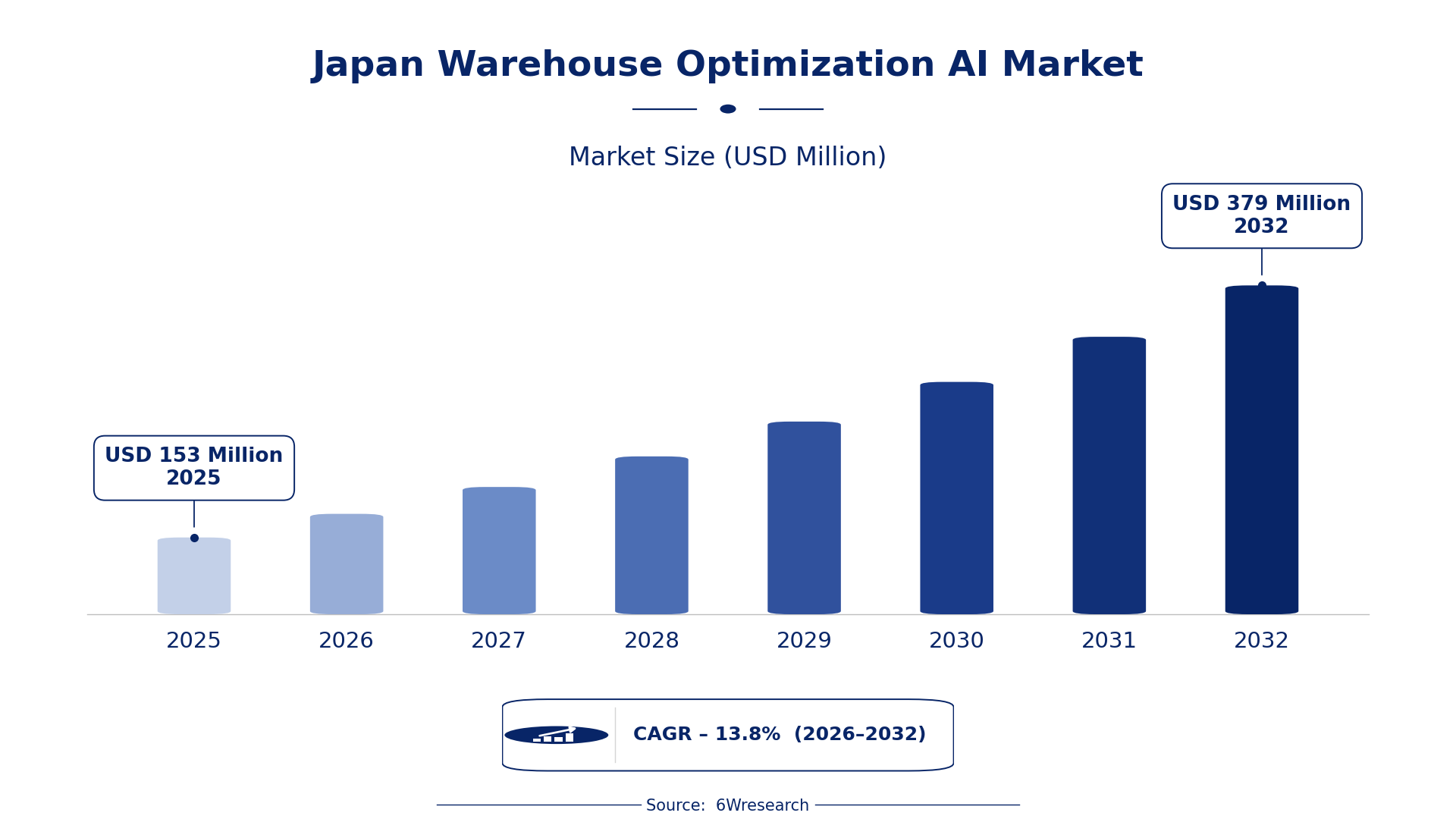
According to 6Wresearch internal database and industry insights, the Japan Warehouse Optimization AI Market was valued at USD 153 Million in 2025 and is projected to reach USD 379 Million by 2032, growing at a CAGR of approximately 13.8% during 2026–2032.
Japan Warehouse Optimization AI Market Highlights
| Report Metric | Details |
| Report Name | Japan Warehouse Optimization AI Market (2026-2032) |
| Market Size 2025 | USD 153 Million |
| Market Size 2032 | USD 379 Million |
| Absolute Growth 2025–2032 | USD 226 Million |
| CAGR 2026–2032 | 13.8% |
| Peak Annual Growth | 19.8% in 2026 |
| Forecast Period | 2026–2032 |
| Historical Data | 2022–2025 |
| Base Year | 2025 |
| Leading Optimization Type, 2025 | Inventory Forecasting (36% share) |
| Leading AI Model Used, 2025 | Machine Learning (48% share) |
| Leading Deployment Format, 2025 | Cloud-based (47% share) |
| Leading Operational Benefit, 2025 | Demand Prediction (40% share) |
| Fastest-Growing Optimization Type | Labor Scheduling (18.7% CAGR) |
| Fastest-Growing Deployment Format | SaaS (19.6% CAGR) |
| Fastest-Growing Operational Benefit | Workforce Efficiency (17.3% CAGR) |
| Growing Sector | logistics |
| Key End Users | logistics companies, e-commerce firms, warehouse operators, supply chain managers |
Japan Warehouse Optimization AI Market Year-wise Growth Rate and Key Drivers (2022–2032)
This graph illustrates the annual growth rates of the market from 2022 to 2032, highlighting a steady upward trajectory and projected market expansion over the forecast period.
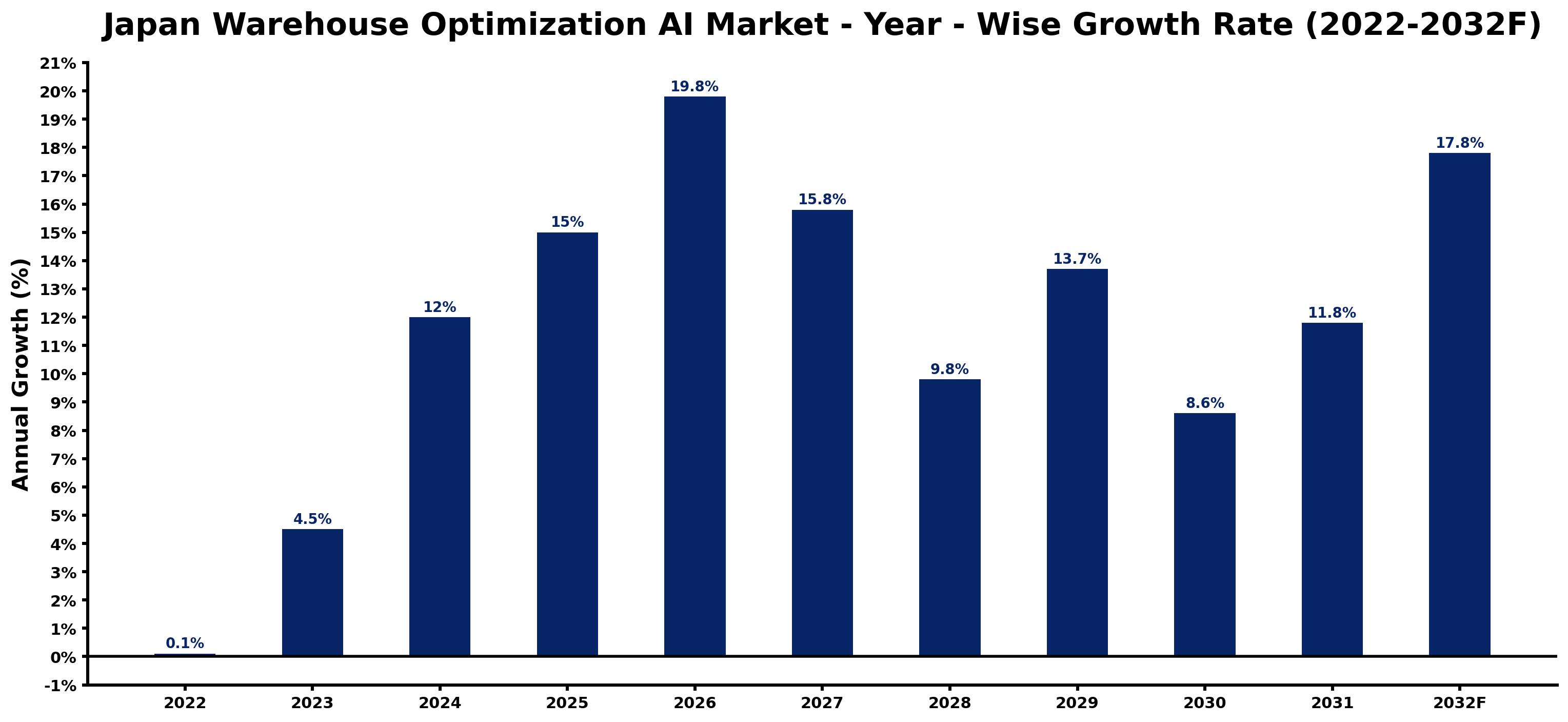
Below, each year's estimated growth is shown next to the factor that most influenced it.
| Year | Estimated Annual Growth (%) | Market Rationale |
| 2022 | 0.1 | The market showed minimal growth due to initial adoption phases of AI technologies. |
| 2023 | 4.5 | Demand increased as logistics companies began integrating AI solutions into their operations. |
| 2024 | 12.0 | Growth accelerated as e-commerce expanded, driving the need for better warehouse management. |
| 2025 | 15.0 | The market peaked historically as companies heavily invested in optimization technologies. |
| 2026 | 19.8 | Demand surged due to the introduction of advanced AI models and increased efficiency needs. |
| 2027 | 15.8 | Growth slowed as the market stabilised after the peak, yet remained positive. |
| 2028 | 9.8 | The market continued to grow, although at a reduced rate compared to previous years. |
| 2029 | 13.7 | Demand picked up again as companies sought to improve operational efficiencies. |
| 2030 | 8.6 | Growth slowed again, reflecting a maturing market with established players. |
| 2031 | 11.8 | Demand increased as new technologies emerged, stimulating further investment. |
| 2032 | 17.8 | The market is projected to grow robustly as AI adoption becomes mainstream. |
Note: Market size estimations and growth projections presented in this report are based on 6Wresearch's proprietary forecasting methodology, utilizing the latest available industry data, government publications, and primary research inputs.
Japan Warehouse Optimization AI Market Synopsis
Warehouse Optimization AI improves efficiency in logistics through advanced algorithms and machine learning techniques, enhancing inventory management and labour allocation. The Japan Warehouse Optimization AI Market is growing, driven by a booming e-commerce sector valued at 19 trillion yen in 2022. Government initiatives, including a 10 billion yen allocation for technology upgrades, are further increasing demand for these optimisation technologies.
Market Dynamics Impact Analysis (2026–2032)
| Factor | Type | Impact | Primary Segment Affected |
| Increasing investment in AI technologies | Driver | High | Inventory Forecasting |
| Growth of e-commerce driving operational efficiency needs | Driver | High | Space Optimization |
| Expansion of AI applications in logistics | Opportunity | High | Labor Scheduling |
| Need for improved delivery efficiency | Opportunity | Medium | Route Optimization |
| High initial costs of AI implementation | Restraint | High | Machine Learning |
| Limited understanding of AI capabilities among smaller firms | Restraint | Medium | Predictive Algorithms |
| Competition from traditional methods | Challenge | High | Cloud-based |
| Regulatory compliance costs | Challenge | Medium | SaaS |
Evaluation of Drivers in Japan Warehouse Optimization AI Market (2026–2032)
Below are the drivers that matter most for revenue growth, with supporting evidence.
| Drivers | Primary Segment Affected | Why It Matters (Evidence) |
| Growing e-commerce sector | Inventory Forecasting | The Japanese e-commerce market reached 19 trillion yen in 2022, driving the need for inventory management solutions. |
| Technological advancements in AI | Space Optimization | Over 5,000 AI systems are installed in logistics, enhancing space utilization strategies. |
| Government support for AI integration | Labor Scheduling | The Ministry of Economy, Trade and Industry promotes AI adoption, leading to improved workforce efficiency. |
| Rising operational costs | Route Optimization | Companies are investing in AI to streamline delivery processes and reduce expenses. |
| Demand for real-time data analysis | Predictive Algorithms | AI models are essential for accurate forecasting and decision-making in logistics. |
Purchasing is picking up as the logistics sector embraces AI technologies to enhance operational efficiency. The Japanese e-commerce market, valued at 19 trillion yen in 2022, drives demand for inventory forecasting solutions. With over 5,000 AI systems installed, companies are increasingly investing in space optimization to maximize warehouse efficiency.
Evaluation of Restraints in Japan Warehouse Optimization AI Market
These restraints slow adoption and weigh on supplier margins.
| Market Restraint | Primary Segment Affected | Why It Matters (Evidence) |
| High implementation costs of AI technologies | Machine Learning | The average investment for AI integration can exceed millions, limiting adoption among smaller firms. |
| Insufficient knowledge of AI capabilities | Predictive Algorithms | Many logistics companies lack expertise, hindering effective AI utilization for forecasting. |
| Resistance to change from traditional practices | Cloud-based | Established firms often prefer conventional methods, delaying AI integration. |
| Regulatory compliance burdens | SaaS | Companies face costs related to meeting compliance standards, impacting AI investments. |
| Limited scalability for small operations | Labor Scheduling | Smaller firms struggle to scale AI solutions due to resource constraints. |
Japan Warehouse Optimization AI Market Challenges
In 2023, Japan's logistics sector faces intense competition, prompting suppliers to invest heavily in AI technologies, which can increase operational costs by 20%. Regulatory requirements from the Ministry of Economy, Trade and Industry demand compliance with ISO 9001 standards, delaying warehouse implementation by up to six months. Buyers face rising expenses as the e-commerce market reached 19 trillion yen in 2022, driving them to seek more efficient solutions. Technological integration remains inadequate, with over 5,000 AI systems installed, yet many warehouses experience inefficiencies that can reduce productivity by 15%.
Trends in the Japan Warehouse Optimization AI Market
These developments are changing demand patterns in the Japan Warehouse Optimization AI Market.
- Shift from Traditional to AI-Driven Logistics: Tokyo is increasingly embracing AI-driven solutions in logistics, with over 25,000 warehouses integrating new technologies to boost efficiency.
- Rise of Cloud-based Solutions in Warehousing: The Cloud-based deployment format accounted for 47% of the market in 2025, reflecting a move towards flexible and scalable solutions.
- E-commerce Driving Demand for Optimization: The growth of the Japanese e-commerce sector is pushing logistics companies to invest in AI, with a projected market value of 19 trillion yen in 2022.
- Increased Focus on Workforce Efficiency: The Logistics Innovation Conference aims to enhance workforce allocation through AI technologies, targeting improved productivity by 2025.
Investment Opportunities in the Japan Warehouse Optimization AI Market
Where to invest in the Japan Warehouse Optimization AI Market: the main openings are set out below.
- Partnerships for AI Implementation: Local partnerships are essential for entering the Japanese market, with a projected investment gap of 10 billion yen for technology upgrades.
- Investment in AI Training Programs: With the logistics sector projected to grow significantly, training programs for AI applications can improve workforce capabilities, especially in urban areas like Tokyo.
- Supply of Predictive Algorithms: The demand for predictive algorithms is rising, particularly among e-commerce logistics firms seeking to optimize inventory management and forecasting.
- Expansion of Cloud-based Services: Cloud-based solutions are in high demand, particularly in Osaka, where flexibility and scalability are important for logistics operations.
Government Initiatives in the Japan Warehouse Optimization AI Market
The New Robot Strategy, initiated in 2015, seeks to expand the use of robotics and AI across various sectors, including logistics. This strategy complements existing laws like the Industrial Safety and Health Act, which ensures safe working conditions while integrating new technologies into warehouse operations.
Funding from the Digital Agency, established in 2021, supports digital transformation initiatives. In 2023, the agency allocated 10 billion yen to aid technology adoption in logistics, enabling firms to implement AI solutions effectively.
Future Insight of the Japan Warehouse Optimization AI Market
The Smart Logistics Initiative will introduce new technology upgrades to enhance warehouse operations. By 2032, government support for AI research will lead to advancements in logistics, benefiting buyers through improved inventory management and streamlined processes. Suppliers will adopt standardised AI solutions to remain competitive. Major industrial regions like Tokyo and Osaka will spearhead technology adoption, shaping practices across the country.
Market Segmentation Analysis
Japan Warehouse Optimization AI Market report covers a detailed analysis of the following market segments:
By Optimization Type – Inventory Forecasting Leads, Labor Scheduling Expected to Grow Fastest
According to Saurav Kr Singh, Senior Research Analyst at 6Wresearch, Inventory Forecasting held 36% of the Japan Warehouse Optimization AI Market by optimization type in 2025. Inventory Forecasting holds the largest share due to its crucial role in predicting stock levels and managing supply chains effectively. The extensive installed base of over 5,000 systems in Japan's logistics sector underscores the demand for robust inventory management solutions. Labor Scheduling is set to record the highest CAGR in this split, 18.7% over 2026–2032. Labor Scheduling is experiencing rapid growth as businesses increasingly prioritise optimising workforce allocation to boost productivity. The rise of the Japanese e-commerce market, valued at 19 trillion yen in 2022, significantly fuels the need for effective labour management strategies. Suppliers should focus on enhancing inventory forecasting capabilities to capture a larger share of the market.
By AI Model Used – Machine Learning Leads and Records the Fastest Growth
Machine Learning accounted for 48% of the market by ai model used in 2025. Machine Learning is the leading model due to its fundamental role in analysing data and improving predictions in warehouse operations. Its widespread adoption is reflected in the estimated 5,000 AI systems currently operational in Japan's logistics sector. The same category is also set to grow fastest, at a CAGR of 15.5% during 2026–2032. Machine Learning also ranks as the fastest-growing model because of continuous advancements and its applications across various solutions. As the logistics sector expands, reliance on this model will likely increase, further solidifying its market dominance. Buyers should invest in Machine Learning-based solutions to remain competitive in warehouse optimisation.
By Deployment Format – Cloud-based Leads, SaaS Expected to Grow Fastest
With 47% of deployment format revenue in 2025, Cloud-based was the largest category. Cloud-based deployment is the preferred choice for its flexibility and scalability, catering to the diverse requirements of warehouse operations. The presence of approximately 25,000 warehouses in Japan reflects a strong trend towards cloud solutions for operational optimisation. Over 2026–2032, SaaS are expected to post the fastest growth, at a CAGR of 19.6%. SaaS is the fastest-growing deployment format, driven by its ease of access and maintenance, which appeals to businesses looking for quick implementation. As logistics companies strive to streamline their operations, the demand for SaaS solutions is anticipated to increase significantly. Suppliers must include both cloud-based and SaaS options in their offerings to cater to varying customer preferences.
By Operational Benefit – Demand Prediction Leads, Workforce Efficiency Expected to Grow Fastest
Demand Prediction took 40% of operational benefit revenue in 2025, more than any other category. Demand Prediction is the leading operational benefit as it is vital for aligning inventory with market needs, ensuring efficiency in warehouse operations. The Japanese government's initiatives to promote technology adoption highlight the significance of accurate demand forecasting in the logistics sector. The quickest growth will come from Workforce Efficiency, forecast to expand at a CAGR of 17.3% between 2026 and 2032. Workforce Efficiency is rapidly gaining importance as organisations seek to lower labour costs and enhance productivity. With the continuous growth of the logistics sector, the emphasis on improving workforce efficiency is expected to accelerate, driving overall operational advancements. Buyers should prioritise solutions that improve demand prediction capabilities to optimise their inventory management.
Key Attractiveness of the Report
- 10 Years of Market Numbers
- Historical Data Starting from 2022 to 2025
- Base Year 2025
- Forecast Data until 2032
- Key Performance Indicators Impacting the Market
- Major Upcoming Developments and Projects
Key Highlights of the Report:
- Japan Warehouse Optimization AI Market Outlook
- Market Size of Japan Warehouse Optimization AI Market, 2025
- Forecast of Japan Warehouse Optimization AI Market, 2032
- Historical Data and Forecast of Japan Warehouse Optimization AI Revenues & Volume for the Period 2022-2032F
- Japan Warehouse Optimization AI Market Trend Evolution
- Japan Warehouse Optimization AI Market Drivers and Challenges
- Japan Warehouse Optimization AI Price Trends
- Japan Warehouse Optimization AI Porter's Five Forces
- Japan Warehouse Optimization AI Industry Life Cycle
- Historical Data and Forecast of Japan Warehouse Optimization AI Market Revenues & Volume By Optimization Type for the Period 2022-2032F
- Historical Data and Forecast of Japan Warehouse Optimization AI Market Revenues & Volume By Inventory Forecasting for the Period 2022-2032F
- Historical Data and Forecast of Japan Warehouse Optimization AI Market Revenues & Volume By Space Optimization for the Period 2022-2032F
- Historical Data and Forecast of Japan Warehouse Optimization AI Market Revenues & Volume By Labor Scheduling for the Period 2022-2032F
- Historical Data and Forecast of Japan Warehouse Optimization AI Market Revenues & Volume By Route Optimization for the Period 2022-2032F
- Historical Data and Forecast of Japan Warehouse Optimization AI Market Revenues & Volume By AI Model Used for the Period 2022-2032F
- Historical Data and Forecast of Japan Warehouse Optimization AI Market Revenues & Volume By Machine Learning for the Period 2022-2032F
- Historical Data and Forecast of Japan Warehouse Optimization AI Market Revenues & Volume By Spatial AI for the Period 2022-2032F
- Historical Data and Forecast of Japan Warehouse Optimization AI Market Revenues & Volume By Predictive Algorithms for the Period 2022-2032F
- Historical Data and Forecast of Japan Warehouse Optimization AI Market Revenues & Volume By Deep Learning Models for the Period 2022-2032F
- Historical Data and Forecast of Japan Warehouse Optimization AI Market Revenues & Volume By Deployment Format for the Period 2022-2032F
- Historical Data and Forecast of Japan Warehouse Optimization AI Market Revenues & Volume By Cloud-based for the Period 2022-2032F
- Historical Data and Forecast of Japan Warehouse Optimization AI Market Revenues & Volume By On-premise for the Period 2022-2032F
- Historical Data and Forecast of Japan Warehouse Optimization AI Market Revenues & Volume By SaaS for the Period 2022-2032F
- Historical Data and Forecast of Japan Warehouse Optimization AI Market Revenues & Volume By Mobile App for the Period 2022-2032F
- Historical Data and Forecast of Japan Warehouse Optimization AI Market Revenues & Volume By Operational Benefit for the Period 2022-2032F
- Historical Data and Forecast of Japan Warehouse Optimization AI Market Revenues & Volume By Demand Prediction for the Period 2022-2032F
- Historical Data and Forecast of Japan Warehouse Optimization AI Market Revenues & Volume By Efficient Storage Layout for the Period 2022-2032F
- Historical Data and Forecast of Japan Warehouse Optimization AI Market Revenues & Volume By Workforce Efficiency for the Period 2022-2032F
- Historical Data and Forecast of Japan Warehouse Optimization AI Market Revenues & Volume By Time Reduction for the Period 2022-2032F
- Japan Warehouse Optimization AI Import Export Trade Statistics
- Market Opportunity Assessment By Optimization Type
- Market Opportunity Assessment By AI Model Used
- Market Opportunity Assessment By Deployment Format
- Market Opportunity Assessment By Operational Benefit
- Japan Warehouse Optimization AI Top Companies Market Share
- Japan Warehouse Optimization AI Competitive Benchmarking By Technical and Operational Parameters
- Japan Warehouse Optimization AI Company Profiles
- Japan Warehouse Optimization AI Key Strategic Recommendations
Market Covered
The following segment groups are covered in the report.
By Optimization Type
- Inventory Forecasting
- Space Optimization
- Labor Scheduling
- Route Optimization
By AI Model Used
- Machine Learning
- Spatial AI
- Predictive Algorithms
- Deep Learning Models
By Deployment Format
- Cloud-based
- On-premise
- SaaS
- Mobile App
By Operational Benefit
- Demand Prediction
- Efficient Storage Layout
- Workforce Efficiency
- Time Reduction































