Japan Warm Air Heating Equipment Market Size & Growth Rate
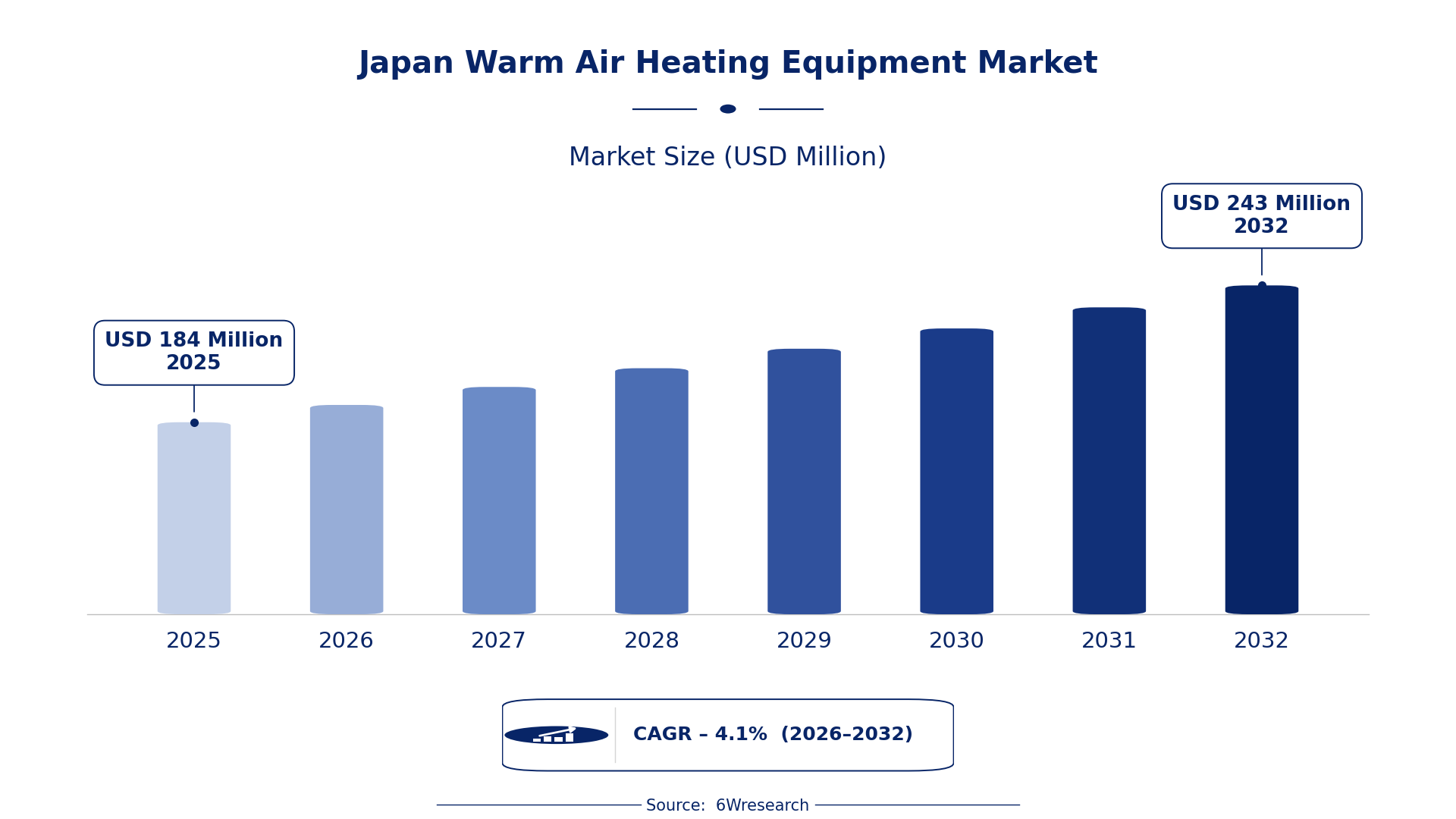
According to 6Wresearch internal database and industry insights, the Japan Warm Air Heating Equipment Market was valued at USD 184 Million in 2025 and is projected to reach USD 243 Million by 2032, growing at a CAGR of approximately 4.1% during 2026–2032.
Japan Warm Air Heating Equipment Market Highlights
| Report Metric | Details |
| Report Name | Japan Warm Air Heating Equipment Market (2026-2032) |
| Market Size 2025 | USD 184 Million |
| Market Size 2032 | USD 243 Million |
| Absolute Growth 2025–2032 | USD 59 Million |
| CAGR 2026–2032 | 4.1% |
| Peak Annual Growth | 5.1% in 2026 |
| Forecast Period | 2026–2032 |
| Historical Data | 2022–2025 |
| Base Year | 2025 |
| Leading Product Type, 2025 | Heat Pumps (54% share) |
| Leading Fuel Type, 2025 | Electric Powered (47% share) |
| Leading Application, 2025 | Air to Air (58% share) |
| Leading Implementation, 2025 | New Construction (61% share) |
| Leading End User Industry, 2025 | Residential (52% share) |
| Fastest-Growing Fuel Type | Solar Powered (5.9% CAGR) |
| Fastest-Growing Application | Air to Water (5.2% CAGR) |
| Fastest-Growing Implementation | Maintenance (5.1% CAGR) |
| Fastest-Growing End User Industry | Commercial (6.3% CAGR) |
| Growing Sector | Air to Water |
| Key End Users | Air to Air, Air to Water |
Japan Warm Air Heating Equipment Market Year-wise Growth Rate and Key Drivers (2022–2032)
This graph illustrates the annual growth rates of the market from 2022 to 2032, highlighting a steady upward trajectory and projected market expansion over the forecast period.
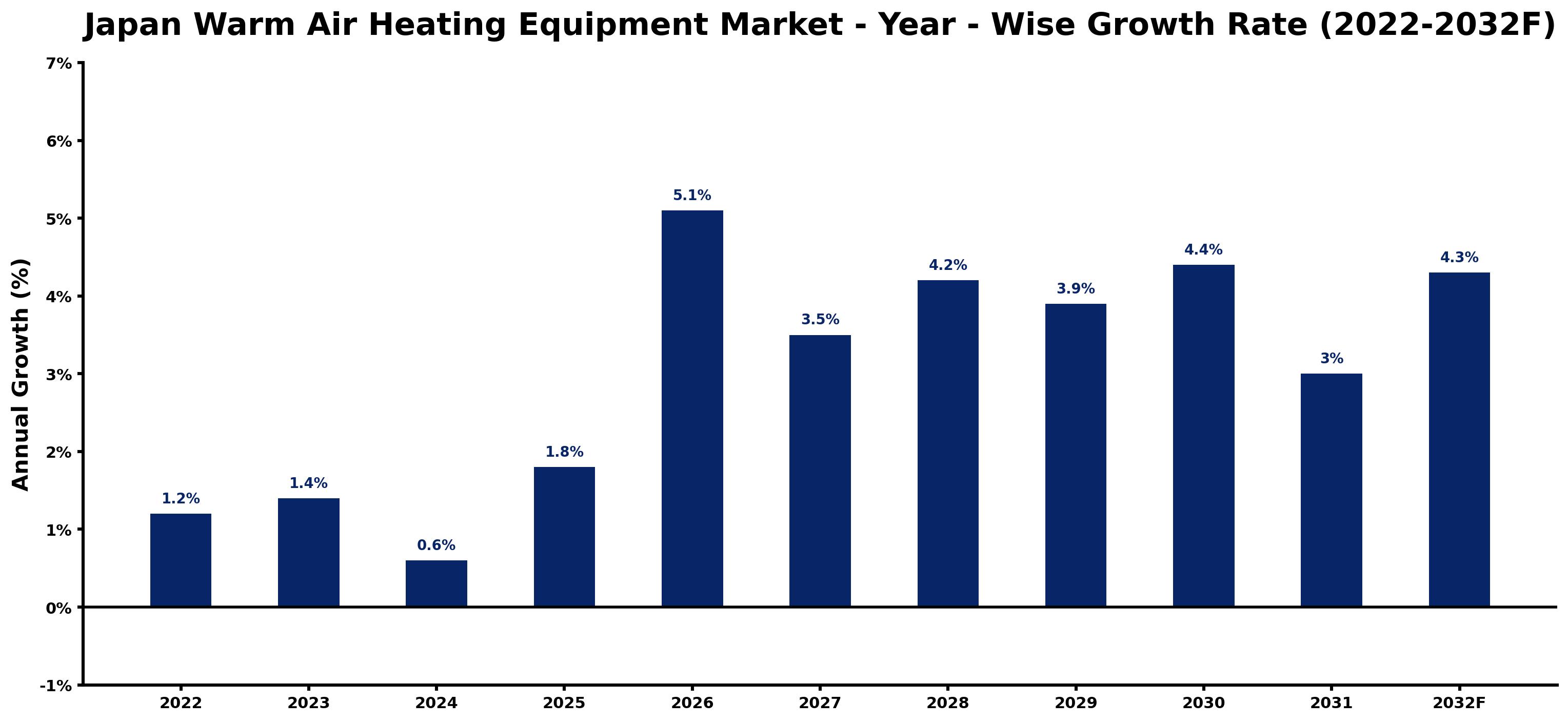
Annual growth estimates for each year appear below with the principal reason behind them, explaining the shifts that set the pace of the market.
| Year | Estimated Annual Growth (%) | Market Rationale |
| 2022 | 1.2 | The market showed moderate growth as demand stabilised following economic recovery. |
| 2023 | 1.4 | Demand increased due to a rise in residential construction projects across the country. |
| 2024 | 0.6 | Growth slowed as energy prices fluctuated, affecting purchasing decisions for consumers. |
| 2025 | 1.8 | Market expansion accelerated with heightened investments in energy-efficient technologies. |
| 2026 | 5.1 | A surge in demand for warm air heating equipment is expected to be driven by new construction projects. |
| 2027 | 3.5 | Growth is projected to decelerate as market saturation begins to influence purchasing patterns. |
| 2028 | 4.2 | Increased focus on energy efficiency will lead to renewed interest in heating solutions. |
| 2029 | 3.9 | Market growth is anticipated to slow as competition intensifies among various heating technologies. |
| 2030 | 4.4 | Demand is expected to rise again as consumers seek to upgrade older heating systems. |
| 2031 | 3.0 | Growth will moderate as the market adjusts to previous peaks in demand. |
| 2032 | 4.3 | The market is projected to grow steadily with ongoing energy efficiency initiatives. |
Note: Market size estimations and growth projections presented in this report are based on 6Wresearch's proprietary forecasting methodology, utilizing the latest available industry data, government publications, and primary research inputs.
Japan Warm Air Heating Equipment Market Synopsis
Warm Air Heating Equipment encompasses systems that deliver effective heating solutions for various applications, primarily within residential and commercial environments. The Japan Warm Air Heating Equipment Market is growing due to increased demand from the residential sector, spurred by heightened construction activity and energy efficiency regulations. The market is set to expand as consumers and businesses aim to modernise heating systems, particularly focusing on electric-powered solutions, which represented 47% of the market in 2025. This growth is underpinned by technological advancements and regulatory measures that advocate for energy-efficient solutions throughout the sector.
Market Dynamics Impact Analysis (2026–2032)
| Factor | Type | Impact | Primary Segment Affected |
| Growing residential construction activity drives demand for efficient heating solutions. | Driver | High | Residential |
| Regulatory measures promote energy-efficient heating solutions in new buildings. | Driver | High | New Construction |
| Rising energy costs may limit the affordability of heating equipment for some consumers. | Restraint | Medium | Residential |
| Competition from alternative heating technologies may hinder market growth. | Challenge | Medium | Electric Powered |
| Increased focus on energy efficiency creates opportunities for innovative heating technologies. | Opportunity | High | Electric Powered |
| Growing awareness of environmental impacts encourages investment in sustainable heating options. | Opportunity | High | Solar Powered |
| Rising labour costs can affect production expenses for manufacturers. | Restraint | Medium | Electric Powered |
| Technological advancements in heating systems create pressure to innovate. | Challenge | Medium | Heat Pumps |
Evaluation of Drivers in Japan Warm Air Heating Equipment Market (2026–2032)
The table below links each growth driver to the segment it affects and the evidence for it.
| Drivers | Primary Segment Affected | Why It Matters (Evidence) |
| Increased residential construction activity leads to higher demand for warm air heating systems. | Residential | In 2025, residential construction accounted for 52% of the end-user industry, driving purchases of heating equipment. |
| Regulatory measures promote energy-efficient heating solutions, boosting market demand. | New Construction | The Act on the Rational Use of Energy encourages builders to implement energy-efficient systems, improving overall market standards. |
| Rising energy costs prompt consumers to invest in more efficient heating solutions. | Electric Powered | As energy prices rise, buyers seek to reduce long-term operational costs through efficient heating systems that lower bills. |
| Growing awareness of environmental impacts drives demand for sustainable heating technologies. | Solar Powered | Consumer interest in eco-friendly solutions is pushing the adoption of solar-powered heating, with significant growth expected. |
| Technological advancements in heating systems attract buyers looking for efficiency. | Heat Pumps | Innovations in heat pump technology improve efficiency, appealing to environmentally conscious consumers seeking modern solutions. |
Much of the new demand stems from rising residential construction activity, which constituted 52% of the end-user industry in 2025. As energy prices rise, consumers are inclined to invest in electric-powered solutions that offer reduced operational costs. Furthermore, increasing awareness of environmental impacts is driving demand for sustainable technologies, especially solar-powered heating systems. Technological advancements are improving product offerings, appealing to buyers who prioritise efficiency and sustainability in their purchasing choices.
Evaluation of Restraints in Japan Warm Air Heating Equipment Market
These are the pressures that could keep growth below its potential.
| Market Restraint | Primary Segment Affected | Why It Matters (Evidence) |
| High production costs due to rising labour expenses impact pricing strategies. | Heat Pumps | Producers face increased labour expenses, as Japan's national minimum wage rose to JPY 1,055 per hour, leading to higher production costs. |
| Complex regulatory frameworks can prolong customs processes for importers. | Electric Powered | Importers encounter intricate regulations that can delay customs clearance, resulting in potential stock shortages for distributors. |
| A shortage of skilled technicians trained in modern heating technologies affects installation times. | Heat Pumps | Buyers experience delays in installation due to a lack of qualified technicians, which can inflate service charges. |
| Intense competition from alternative heating solutions pressures traditional equipment buyers. | Solar Powered | Competition from various heating technologies compels buyers to reassess their choices, potentially incurring additional costs during the transition. |
| Fluctuating energy prices create uncertainty in purchasing decisions for consumers. | Electric Powered | Buyers hesitate to invest in new systems when energy costs are unpredictable, impacting market stability. |
Japan Warm Air Heating Equipment Market Challenges
Producers are contending with rising labour costs due to Japan's national minimum wage increase to JPY 1,055 per hour, which escalates production expenses and compresses profit margins. Importers face stringent regulatory requirements that may delay customs clearance, potentially leading to stock shortages for distributors. Buyers are encountering a shortage of skilled technicians experienced in modern heating technologies, resulting in prolonged installation times and elevated service fees. Competition from alternative heating solutions is intensifying, compelling traditional equipment buyers to reassess their options and possibly incur additional costs during the transition.
Trends in the Japan Warm Air Heating Equipment Market
The following changes are redrawing the Japan Warm Air Heating Equipment Market.
- Shift Towards Electric-Powered Solutions: In 2025, electric-powered heating systems captured 47% of the market share, indicating a growing preference for energy-efficient options. This trend is driven by increasing energy costs and consumer awareness of sustainability, encouraging more buyers to opt for electric solutions.
- Transition from Conventional to Sustainable Heating: A clear shift is taking place from conventional heating methods to sustainable alternatives, particularly solar-powered systems. Solar-powered heating solutions are anticipated to grow substantially, with an emphasis on minimising carbon footprints in both residential and commercial applications.
- Emergence of Smart Heating Technologies: Smart heating technologies are gaining popularity, with consumers increasingly seeking systems that provide improved control and efficiency. This trend is bolstered by technological advancements that enhance user experience and energy management, making smart systems more attractive.
- Prioritisation of Energy Efficiency in New Builds: New construction projects are increasingly emphasising energy efficiency, with regulations promoting the adoption of modern heating solutions. This shift is reflected in the rising number of energy-efficient buildings being developed, designed to comply with strict energy standards.
Investment Opportunities in the Japan Warm Air Heating Equipment Market
The following areas offer the clearest openings for investors and suppliers in the Japan Warm Air Heating Equipment Market.
- Investment in Solar-Powered Heating: The demand for solar-powered heating solutions is on the rise, especially in regions with high solar potential. Suppliers can focus on the residential sector by establishing local partnerships to improve market penetration and address growing consumer needs.
- Focus on Energy-Efficient Technologies: There exists a strong opportunity to provide energy-efficient heating systems, particularly electric-powered solutions. Targeting new construction projects will be advantageous, especially in urban areas with strict energy regulations that favour modern technologies.
- Expansion into Commercial Heating Solutions: The commercial sector is increasingly investing in efficient heating solutions, driven by sustainability objectives. Suppliers can penetrate this market by collaborating with construction firms dedicated to energy-efficient designs, thereby enhancing their product offerings.
- Development of Smart Heating Systems: The rise of smart home technology offers an opportunity to create integrated heating solutions. Suppliers can partner with technology firms to develop systems that improve user control and efficiency, aligning with modern consumer preferences.
Government Initiatives in the Japan Warm Air Heating Equipment Market
The Act on the Rational Use of Energy, established in 1979, requires large energy users to improve energy efficiency and monitor their consumption levels. This legislation complements the Industrial Standardization Act, which ensures that heating equipment meets energy efficiency standards, promoting sustainable practices within the industry.
The Consumer Affairs Agency supervises regulations that prevent misleading advertising of heating products. This ensures that buyers receive accurate information regarding energy efficiency and performance, building trust in the market and encouraging informed purchasing decisions.
Future Insight of the Japan Warm Air Heating Equipment Market
Suppliers will adjust to changing buyer preferences by 2032, influenced by new environmental standards that prioritise energy efficiency. Technological advancements in smart heating systems will transform market offerings, improving efficiency and user control. Government initiatives that promote renewable energy will motivate suppliers to innovate and diversify their product lines. By 2032, approximately 30% of new installations are expected to incorporate smart technology capabilities, reflecting a notable shift in market dynamics.
Market Segmentation Analysis
Japan Warm Air Heating Equipment Market report covers a detailed analysis of the following market segments:
By Product Type – Heat Pumps Lead and Record the Fastest Growth
According to Ravi Bhandari, Research Head at 6Wresearch, in 2025, Heat Pumps led the product type split with a 54% share. Heat pumps are prevalent in Japan due to their efficiency and adaptability, making them the preferred choice for residential heating applications. Their extensive use in new residential developments has established them as the dominant product type in the market. Its lead should widen, with a projected CAGR of 5.5% during 2026–2032, the highest in this split. The emphasis on energy efficiency and environmental responsibility will ensure that heat pumps continue to expand, with increasing installations in urban residential areas. This ongoing trend will likely strengthen their market position as consumers increasingly choose sustainable heating options. Suppliers should focus on heat pump solutions to align with the growing consumer demand.
By Fuel Type – Electric Powered Leads, Solar Powered Expected to Grow Fastest
With 47% of fuel type revenue in 2025, Electric Powered was the largest category. Electric powered heating systems dominate the market in Japan due to the country's reliable electrical infrastructure and a strong preference for environmentally friendly energy options. Their widespread application in both residential and commercial sectors reinforces their leading position in this segment. The quickest growth will come from Solar Powered, forecast to expand at a CAGR of 5.9% between 2026 and 2032. Solar powered heating systems are rapidly gaining traction as consumers increasingly seek renewable energy solutions, encouraged by government incentives and a growing environmental consciousness. This trend indicates a robust shift towards sustainable energy sources within the heating market. Suppliers must consider expanding their solar heating offerings to align with the increasing demand for renewable energy solutions.
By Application – Air to Air Leads, Air to Water Expected to Grow Fastest
Air to Air accounted for 58% of the market by application in 2025. Air to air heating systems are prevalent due to their effectiveness in providing comfortable indoor climates, particularly in urban residential settings. Their adaptability to various building types has established them as the leading application in the market. Over 2026–2032, Air to Water is expected to post the fastest growth, at a CAGR of 5.2%. The demand for air to water systems is rising as they offer efficient heating solutions for both residential and commercial applications, particularly in new builds. This growth reflects a broader trend towards integrated heating systems that provide higher efficiency. Suppliers should explore opportunities in air to water systems to capture emerging market segments.
By Implementation – New Construction Leads, Maintenance Expected to Grow Fastest
New Construction took 61% of implementation revenue in 2025, more than any other category. New construction is the primary factor driving the demand for warm air heating equipment, as builders are incorporating advanced heating technologies into their projects. This trend is particularly evident in metropolitan areas where new residential developments are on the rise. Maintenance is set to record the highest CAGR in this split, 5.1% over 2026–2032. Maintenance services are becoming increasingly vital as older heating systems necessitate upgrades and repairs, resulting in a burgeoning market segment focused on these services. This shift highlights the importance of establishing long-term service agreements to enhance customer retention. Suppliers should enhance their service offerings to capitalise on the growing maintenance segment.
By End User Industry – Residential Leads, Commercial Expected to Grow Fastest
Residential held 52% of the Japan Warm Air Heating Equipment Market by end user industry in 2025. The residential sector leads the market for warm air heating equipment, as homeowners prioritise comfort and energy efficiency in their heating solutions. This segment's growth is supported by increasing disposable income and investment in home improvements. Commercial is projected to grow fastest, at a CAGR of 6.3% during 2026–2032. The commercial sector is experiencing rapid growth due to the expansion of businesses and the need for efficient heating solutions in office and retail spaces. This trend highlights the increasing importance of energy-efficient systems in commercial applications. Suppliers should tailor their offerings to meet the specific needs of the commercial sector.
Key Attractiveness of the Report
- 10 Years of Market Numbers
- Historical Data Starting from 2022 to 2025
- Base Year 2025
- Forecast Data until 2032
- Key Performance Indicators Impacting the Market
- Major Upcoming Developments and Projects
Key Highlights of the Report:
- Japan Warm Air Heating Equipment Market Outlook
- Market Size of Japan Warm Air Heating Equipment Market, 2025
- Forecast of Japan Warm Air Heating Equipment Market, 2032
- Historical Data and Forecast of Japan Warm Air Heating Equipment Revenues & Volume for the Period 2022-2032
- Japan Warm Air Heating Equipment Market Trend Evolution
- Japan Warm Air Heating Equipment Market Drivers and Challenges
- Japan Warm Air Heating Equipment Price Trends
- Japan Warm Air Heating Equipment Porter's Five Forces
- Japan Warm Air Heating Equipment Industry Life Cycle
- Historical Data and Forecast of Japan Warm Air Heating Equipment Market Revenues & Volume By Product Type for the Period 2022-2032
- Historical Data and Forecast of Japan Warm Air Heating Equipment Market Revenues & Volume By Heat Pumps for the Period 2022-2032
- Historical Data and Forecast of Japan Warm Air Heating Equipment Market Revenues & Volume By Humidifying Equipment for the Period 2022-2032
- Historical Data and Forecast of Japan Warm Air Heating Equipment Market Revenues & Volume By Fuel Type for the Period 2022-2032
- Historical Data and Forecast of Japan Warm Air Heating Equipment Market Revenues & Volume By Electric Powered for the Period 2022-2032
- Historical Data and Forecast of Japan Warm Air Heating Equipment Market Revenues & Volume By Gas-Powered for the Period 2022-2032
- Historical Data and Forecast of Japan Warm Air Heating Equipment Market Revenues & Volume By Hybrid for the Period 2022-2032
- Historical Data and Forecast of Japan Warm Air Heating Equipment Market Revenues & Volume By Solar Powered for the Period 2022-2032
- Historical Data and Forecast of Japan Warm Air Heating Equipment Market Revenues & Volume By Application for the Period 2022-2032
- Historical Data and Forecast of Japan Warm Air Heating Equipment Market Revenues & Volume By Air to Air for the Period 2022-2032
- Historical Data and Forecast of Japan Warm Air Heating Equipment Market Revenues & Volume By Air to Water for the Period 2022-2032
- Historical Data and Forecast of Japan Warm Air Heating Equipment Market Revenues & Volume By Implementation for the Period 2022-2032
- Historical Data and Forecast of Japan Warm Air Heating Equipment Market Revenues & Volume By New Construction for the Period 2022-2032
- Historical Data and Forecast of Japan Warm Air Heating Equipment Market Revenues & Volume By Maintenance for the Period 2022-2032
- Historical Data and Forecast of Japan Warm Air Heating Equipment Market Revenues & Volume By End User Industry for the Period 2022-2032
- Historical Data and Forecast of Japan Warm Air Heating Equipment Market Revenues & Volume By Residential for the Period 2022-2032
- Historical Data and Forecast of Japan Warm Air Heating Equipment Market Revenues & Volume By Commercial for the Period 2022-2032
- Historical Data and Forecast of Japan Warm Air Heating Equipment Market Revenues & Volume By Industrial for the Period 2022-2032
- Historical Data and Forecast of Japan Warm Air Heating Equipment Market Revenues & Volume By Business Type for the Period 2022-2032
- Historical Data and Forecast of Japan Warm Air Heating Equipment Market Revenues & Volume By Original Equipment Manufacturer (OEM) for the Period 2022-2032
- Historical Data and Forecast of Japan Warm Air Heating Equipment Market Revenues & Volume By Aftermarket for the Period 2022-2032
- Japan Warm Air Heating Equipment Import Export Trade Statistics
- Market Opportunity Assessment By Product Type
- Market Opportunity Assessment By Fuel Type
- Market Opportunity Assessment By Application
- Market Opportunity Assessment By Implementation
- Market Opportunity Assessment By End User Industry
- Market Opportunity Assessment By Business Type
- Japan Warm Air Heating Equipment Top Companies Market Share
- Japan Warm Air Heating Equipment Competitive Benchmarking By Technical and Operational Parameters
- Japan Warm Air Heating Equipment Company Profiles
- Japan Warm Air Heating Equipment Key Strategic Recommendations
Market Covered
Coverage by segment is as follows.
By Product Type
- Heat Pumps
- Humidifying Equipment
By Fuel Type
- Electric Powered
- Gas-Powered
- Hybrid
- Solar Powered
By Application
- Air to Air
- Air to Water
By Implementation
- New Construction
- Maintenance
By End User Industry
- Residential
- Commercial
- Industrial































