Japan Water-Efficient Farm Tools Market Size & Growth Rate
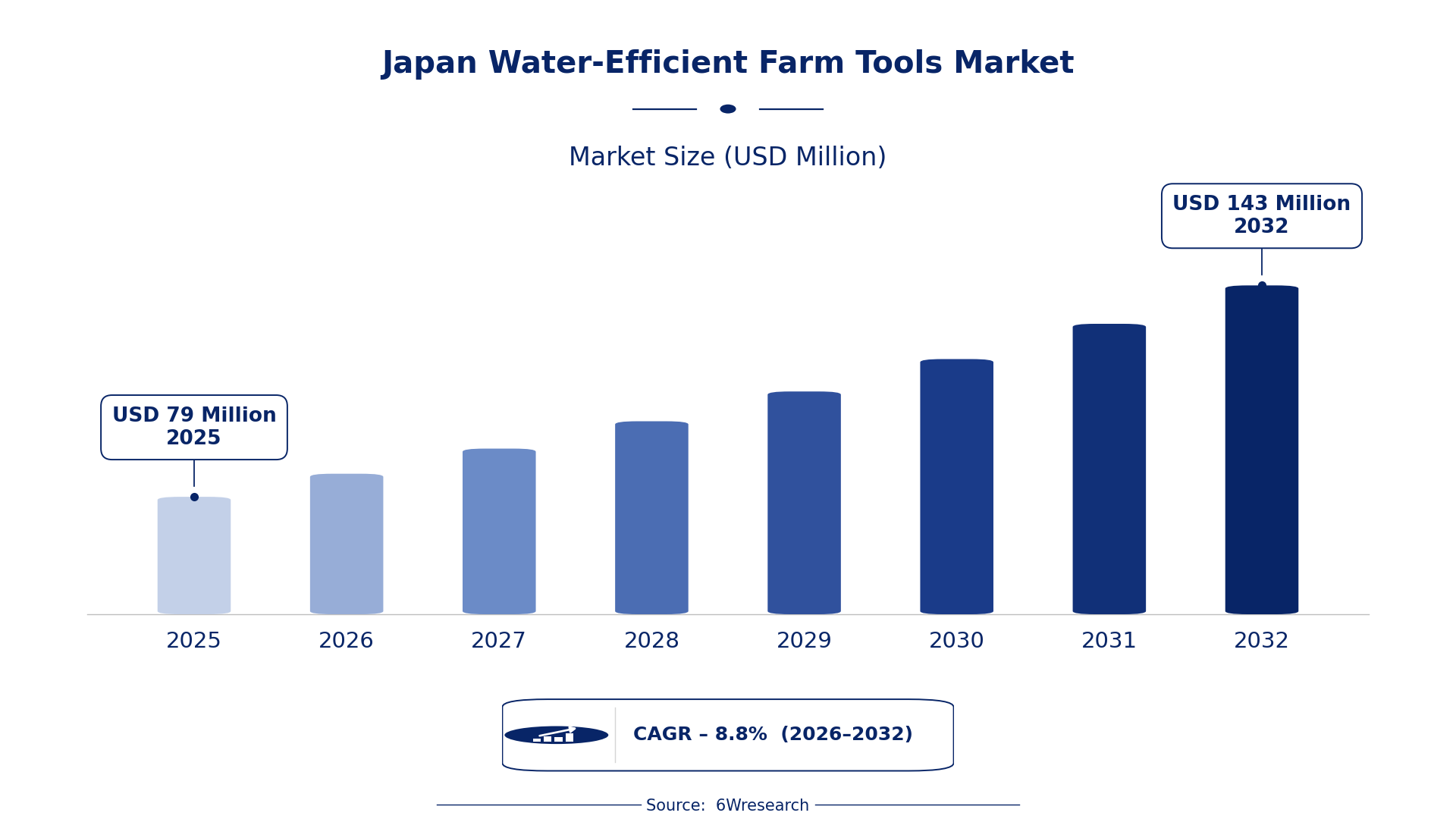
According to 6Wresearch internal database and industry insights, the Japan Water-Efficient Farm Tools Market was valued at USD 79 Million in 2025 and is projected to reach USD 143 Million by 2032, growing at a CAGR of approximately 8.8% during 2026–2032.
Japan Water-Efficient Farm Tools Market Highlights
| Report Metric | Details |
| Report Name | Japan Water-Efficient Farm Tools Market (2026-2032) |
| Market Size 2025 | USD 79 Million |
| Market Size 2032 | USD 143 Million |
| Absolute Growth 2025–2032 | USD 64 Million |
| CAGR 2026–2032 | 8.8% |
| Peak Annual Growth | 12.1% in 2028 |
| Forecast Period | 2026–2032 |
| Historical Data | 2022–2025 |
| Base Year | 2025 |
| Leading Product Type, 2025 | Drip Irrigation Kits (40% share) |
| Leading Tool Category, 2025 | Irrigation Tools (53% share) |
| Leading Distribution Channel, 2025 | Agricultural Suppliers (40% share) |
| Leading End User, 2025 | Farmers (43% share) |
| Fastest-Growing Product Type | Smart Sprinklers (12.7% CAGR) |
| Fastest-Growing Tool Category | Automation Tools (11.7% CAGR) |
| Fastest-Growing Distribution Channel | Online Platforms (11.4% CAGR) |
| Fastest-Growing End User | Agro-tech Companies (11.3% CAGR) |
| Growing Sector | Agriculture |
| Key End Users | Farmers, Agro-tech Companies, Horticulturists |
Japan Water-Efficient Farm Tools Market Year-wise Growth Rate and Key Drivers (2022–2032)
This graph illustrates the annual growth rates of the market from 2022 to 2032, highlighting a steady upward trajectory and projected market expansion over the forecast period.
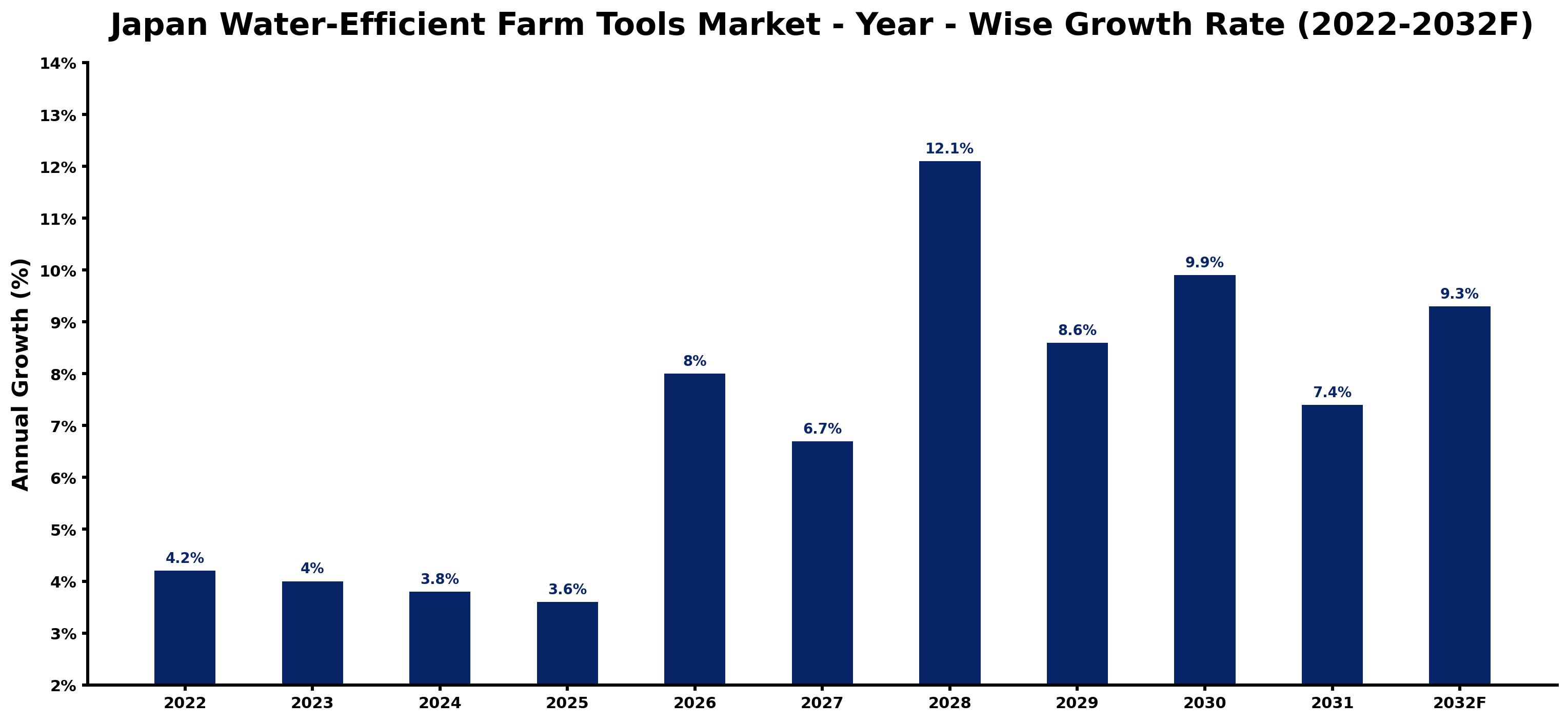
Annual growth estimates for each year appear below with the principal reason behind them, explaining the shifts that set the pace of the market.
| Year | Estimated Annual Growth (%) | Market Rationale |
| 2022 | 4.2 | The market experienced steady growth due to increased awareness of water conservation practices. |
| 2023 | 4.0 | Demand for water-efficient tools continued, but growth slowed slightly as market saturation began. |
| 2024 | 3.8 | The market maintained positive growth, supported by ongoing farmer interest in sustainable practices. |
| 2025 | 3.6 | Growth slowed further as farmers began to adopt existing technologies more widely. |
| 2026 | 8.0 | A surge in demand is anticipated as new smart irrigation technologies are introduced to the market. |
| 2027 | 6.7 | The market is projected to grow at a slower pace, as the initial excitement around new products stabilises. |
| 2028 | 12.1 | A peak in growth is anticipated, driven by heightened adoption of advanced irrigation systems. |
| 2029 | 8.6 | Growth is expected to slow as the market adjusts to the saturation of smart irrigation tools. |
| 2030 | 9.9 | Demand is projected to increase again as farmers seek to upgrade existing systems for better efficiency. |
| 2031 | 7.4 | The market will continue to grow, albeit at a slower rate as competition intensifies. |
| 2032 | 9.3 | Growth is expected to accelerate again as new technologies emerge, improving water management capabilities. |
Note: Market size estimations and growth projections presented in this report are based on 6Wresearch's proprietary forecasting methodology, utilizing the latest available industry data, government publications, and primary research inputs.
Japan Water-Efficient Farm Tools Market Synopsis
Water-efficient farm tools optimise agricultural water use through technologies like drip irrigation and smart sprinklers. The Japan Water-Efficient Farm Tools Market is driven by over 1 million farmers and agro-tech companies focused on efficient farming solutions. Market growth is supported by government initiatives promoting water conservation technologies, including a target to increase adoption by 30% by 2025, alongside a 20% rise in online sales of farm tools last year.
Market Dynamics Impact Analysis (2026–2032)
| Factor | Type | Impact | Primary Segment Affected |
| Increasing adoption of smart irrigation systems | Driver | High | Smart Sprinklers |
| Growing focus on sustainable farming practices | Driver | High | Irrigation Tools |
| Expansion of online sales channels | Opportunity | Medium | Online Platforms |
| Government subsidies for water-efficient technologies | Opportunity | High | Drip Irrigation Kits |
| High initial investment costs for advanced tools | Restraint | High | Soil Moisture Sensors |
| Limited awareness among small landowners | Restraint | Medium | Water Timers |
| Compliance with stringent environmental regulations | Challenge | High | Automation Tools |
| Capacity constraints in rural supply chains | Challenge | Medium | Monitoring Devices |
Evaluation of Drivers in Japan Water-Efficient Farm Tools Market (2026–2032)
These are the developments adding the most demand over the forecast period.
| Drivers | Primary Segment Affected | Why It Matters (Evidence) |
| Increased crop yields through efficient water usage | Drip Irrigation Kits | Drip irrigation systems can reduce water usage by up to 50%, encouraging farmers to invest more in these technologies. |
| Automation of irrigation practices | Smart Sprinklers | Smart sprinklers automate watering based on weather conditions, appealing to tech-savvy farmers looking for efficiency. |
| Rising demand for precision farming | Soil Moisture Sensors | Soil moisture sensors provide real-time data, enabling farmers to optimise irrigation schedules and reduce water waste. |
| Government initiatives promoting water conservation | Irrigation Tools | Government efforts to promote water conservation technologies increase the adoption of irrigation tools among farmers. |
| Growth of agro-tech companies integrating advanced tools | Automation Tools | Agro-tech companies are increasingly adopting automation tools, driving demand for advanced farming solutions. |
Volumes grow on the back of the increasing adoption of precision farming techniques, with soil moisture sensors providing real-time data for irrigation management, leading to more efficient water usage. In Japan, the average farm size is approximately 1.5 hectares, prompting farmers to seek tools that maximise yields while conserving resources. As a result, online sales of farm tools increased by 20% last year, reflecting a shift towards digital purchasing channels. The Tohoku region is a key area for irrigation tool usage, further driving demand for these solutions.
Evaluation of Restraints in Japan Water-Efficient Farm Tools Market
Below are the constraints most often cited by buyers and suppliers, with the segment each affects.
| Market Restraint | Primary Segment Affected | Why It Matters (Evidence) |
| High initial investment costs for advanced irrigation tools | Drip Irrigation Kits | The upfront costs associated with installing advanced irrigation systems can deter farmers from making purchases. |
| Limited awareness of water-efficient tools among small landowners | Water Timers | Small landowners may not fully understand the benefits of water-efficient technologies, resulting in lower adoption rates. |
| Compliance with environmental regulations | Automation Tools | Producers must navigate stringent regulations, which can delay product launches and increase costs. |
| Supply chain constraints in rural areas | Monitoring Devices | Limited infrastructure in rural prefectures like Hokkaido can hinder the availability of essential farming tools. |
| Market saturation of existing irrigation technologies | Smart Sprinklers | As more farmers adopt current technologies, the growth rate may slow due to market saturation. |
Japan Water-Efficient Farm Tools Market Challenges
Producers in Japan face high costs due to limited access to advanced irrigation technologies, which leads to inefficient water use and potential crop losses. A lack of skilled workers in rural areas slows the adoption of effective farming practices, delaying the transition to water-efficient tools for farmers. Supply chain disruptions in sourcing durable materials for these tools create delays, impacting farmers' ability to implement timely irrigation solutions. Low technology adoption persists, with only a small percentage of farmers using soil moisture sensors, which can reduce water usage by up to 50%, costing producers in terms of reduced yields and increased resource waste.
Trends in the Japan Water-Efficient Farm Tools Market
Buyers and suppliers in the Japan Water-Efficient Farm Tools Market are adjusting to the following trends.
- Shift towards Smart Irrigation Systems: In 2023, Japan launched a program to subsidise smart irrigation systems, aiming to improve water efficiency in agriculture. This initiative is expected to increase adoption rates, with a target of 30% by 2025.
- Increase in Online Sales Channels: Online platforms for purchasing farm tools have gained popularity, with a 20% increase in sales last year. This shift is changing how farmers access water-efficient tools, making them more readily available.
- Farmers Prioritising Sustainable Practices: Farmers are increasingly adopting sustainable farming practices, supported by government initiatives and consumer demand for environmentally friendly products. This trend aligns with the Ministry of the Environment's encouragement of sustainable practices.
- Emergence of Precision Farming Technologies: Soil moisture sensors are becoming essential for precision farming, particularly in rice farming. Their adoption is increasing as farmers seek to optimise irrigation management.
Investment Opportunities in the Japan Water-Efficient Farm Tools Market
Several openings in the Japan Water-Efficient Farm Tools Market merit attention from investors.
- Timing for Investment in Smart Irrigation: With the government's target to increase water-efficient tool adoption by 30% by 2025, now is an opportune time to invest in smart irrigation systems, particularly in the Tohoku region, where demand is high.
- Supply of Soil Moisture Sensors: The growing need for real-time data in irrigation management presents an opportunity to supply soil moisture sensors, especially to farmers in the Chubu region, who are adopting advanced techniques.
- Gap in Automation Tools: The market shows a gap in automation tools, with a projected growth rate of 11.7% for the fastest-growing segment. Partnering with agricultural suppliers can facilitate entry into this segment.
- Entry through Online Platforms: As online sales of farm tools increased by 20% last year, entering the market through online platforms can effectively reach tech-savvy farmers looking for efficient solutions.
Government Initiatives in the Japan Water-Efficient Farm Tools Market
The Water Supply Act of 1957 establishes standards for drinking-water quality and supply, ensuring that agricultural practices align with water conservation efforts. The Sewerage Act of 1958 governs wastewater treatment, promoting sustainable farming practices. These laws have laid the foundation for modern agricultural water management in Japan, directly impacting the adoption of water-efficient farm tools.
The Japan Agricultural Cooperatives (JA) funds initiatives that support the adoption of water-efficient technologies, such as subsidies for smart irrigation systems launched in 2023. This program aims to help farmers transition to more efficient practices, improving the overall market for water-efficient farm tools.
Future Insight of the Japan Water-Efficient Farm Tools Market
By 2032, government initiatives will drive a significant shift towards water-efficient tools, increasing demand among buyers. The Smart Agriculture Promotion Program will support suppliers through enhanced access to funding and resources. Adoption of ISO 14001 standards will improve quality and environmental management in agricultural tools, benefiting both buyers and producers. With a projected 30% increase in tool adoption by 2025, the market will evolve, resulting in improved crop yields and reduced water waste.
Market Segmentation Analysis
Japan Water-Efficient Farm Tools Market report covers a detailed analysis of the following market segments:
By Product Type – Drip Irrigation Kits Lead, Smart Sprinklers Expected to Grow Fastest
According to Saurav Kr Singh, Senior Research Analyst at 6Wresearch, with 40% of product type revenue in 2025, Drip Irrigation Kits was the largest category. Drip irrigation kits hold the largest share due to their critical role in delivering water efficiently to crops, especially in regions like Tohoku where irrigation is essential. Their ability to reduce water usage by up to 50% resonates with the extensive base of over 1 million farmers in Japan. Smart Sprinklers are set to record the highest CAGR in this split, 12.7% over 2026–2032. Smart sprinklers are rapidly gaining traction as they automate watering based on weather conditions, appealing to farmers focused on precision in water management. The recent launch of a government subsidy programme for smart irrigation systems in 2023 is expected to further boost this segment's growth. Suppliers should focus on enhancing the availability of smart sprinklers to meet the increasing demand for automated irrigation solutions.
By Tool Category – Irrigation Tools Lead, Automation Tools Expected to Grow Fastest
Irrigation Tools took 53% of tool category revenue in 2025, more than any other category. Irrigation tools dominate the market as they are vital for effective water management in agriculture, particularly in regions like Chubu known for advanced irrigation techniques. Their widespread use among farmers underscores their importance in optimising agricultural practices. Automation Tools are projected to grow fastest, at a CAGR of 11.7% during 2026–2032. Automation tools are witnessing significant growth as they greatly improve efficiency in farming, particularly with the rise of precision agriculture techniques. The growing emphasis on sustainable farming practices is also driving demand for these tools. Buyers are likely to seek more automation tools to enhance efficiency and sustainability in their agricultural operations.
By Distribution Channel – Agricultural Suppliers Lead, Online Platforms Expected to Grow Fastest
In 2025, Agricultural Suppliers led the distribution channel split with a 40% share. Agricultural suppliers are the primary source for farmers to purchase tools, particularly in rural prefectures where access to these resources is vital. Their established networks and relationships with local farmers ensure a steady market share. Over 2026–2032, Online Platforms are expected to post the fastest growth, at a CAGR of 11.4%. Online platforms are rapidly gaining traction as a distribution channel, with a 20% increase in online sales of farm tools over the last year. This shift reflects changing purchasing behaviours among farmers who value convenience and accessibility. Suppliers should invest in online sales strategies to capture the growing segment of tech-savvy farmers.
By End User – Farmers Lead, Agro-tech Companies Expected to Grow Fastest
Farmers held 43% of the Japan Water-Efficient Farm Tools Market by end user in 2025. Farmers represent the largest user group for water-efficient farm tools, employing these products to optimise their agricultural practices. Their substantial numbers and dependence on effective water management solidify their position as the primary market segment. The quickest growth will come from Agro-tech Companies, forecast to expand at a CAGR of 11.3% between 2026 and 2032. Agro-tech companies are the fastest-growing segment as they incorporate water-efficient tools into advanced farming solutions, reflecting a trend towards modernisation in agriculture. Their focus on innovative farming practices is driving the rising demand for these tools. Suppliers should tailor their products to meet the specific needs of agro-tech companies as they become increasingly influential in the market.
Key Attractiveness of the Report
- 10 Years of Market Numbers
- Historical Data Starting from 2022 to 2025
- Base Year 2025
- Forecast Data until 2032
- Key Performance Indicators Impacting the Market
- Major Upcoming Developments and Projects
Key Highlights of the Report:
- Japan Water-Efficient Farm Tools Market Outlook
- Market Size of Japan Water-Efficient Farm Tools Market, 2025
- Forecast of Japan Water-Efficient Farm Tools Market, 2032
- Historical Data and Forecast of Japan Water-Efficient Farm Tools Revenues & Volume for the Period 2022-2032F
- Japan Water-Efficient Farm Tools Market Trend Evolution
- Japan Water-Efficient Farm Tools Market Drivers and Challenges
- Japan Water-Efficient Farm Tools Price Trends
- Japan Water-Efficient Farm Tools Porter's Five Forces
- Japan Water-Efficient Farm Tools Industry Life Cycle
- Historical Data and Forecast of Japan Water-Efficient Farm Tools Market Revenues & Volume By Product Type for the Period 2022-2032F
- Historical Data and Forecast of Japan Water-Efficient Farm Tools Market Revenues & Volume By Drip Irrigation Kits for the Period 2022-2032F
- Historical Data and Forecast of Japan Water-Efficient Farm Tools Market Revenues & Volume By Smart Sprinklers for the Period 2022-2032F
- Historical Data and Forecast of Japan Water-Efficient Farm Tools Market Revenues & Volume By Soil Moisture Sensors for the Period 2022-2032F
- Historical Data and Forecast of Japan Water-Efficient Farm Tools Market Revenues & Volume By Water Timers for the Period 2022-2032F
- Historical Data and Forecast of Japan Water-Efficient Farm Tools Market Revenues & Volume By Tool Category for the Period 2022-2032F
- Historical Data and Forecast of Japan Water-Efficient Farm Tools Market Revenues & Volume By Irrigation Tools for the Period 2022-2032F
- Historical Data and Forecast of Japan Water-Efficient Farm Tools Market Revenues & Volume By Automation Tools for the Period 2022-2032F
- Historical Data and Forecast of Japan Water-Efficient Farm Tools Market Revenues & Volume By Monitoring Devices for the Period 2022-2032F
- Historical Data and Forecast of Japan Water-Efficient Farm Tools Market Revenues & Volume By Scheduling Tools for the Period 2022-2032F
- Historical Data and Forecast of Japan Water-Efficient Farm Tools Market Revenues & Volume By Distribution Channel for the Period 2022-2032F
- Historical Data and Forecast of Japan Water-Efficient Farm Tools Market Revenues & Volume By Agricultural Suppliers for the Period 2022-2032F
- Historical Data and Forecast of Japan Water-Efficient Farm Tools Market Revenues & Volume By Online Platforms for the Period 2022-2032F
- Historical Data and Forecast of Japan Water-Efficient Farm Tools Market Revenues & Volume By Direct Sales for the Period 2022-2032F
- Historical Data and Forecast of Japan Water-Efficient Farm Tools Market Revenues & Volume By Hardware Stores for the Period 2022-2032F
- Historical Data and Forecast of Japan Water-Efficient Farm Tools Market Revenues & Volume By End User for the Period 2022-2032F
- Historical Data and Forecast of Japan Water-Efficient Farm Tools Market Revenues & Volume By Farmers for the Period 2022-2032F
- Historical Data and Forecast of Japan Water-Efficient Farm Tools Market Revenues & Volume By Agro-tech Companies for the Period 2022-2032F
- Historical Data and Forecast of Japan Water-Efficient Farm Tools Market Revenues & Volume By Horticulturists for the Period 2022-2032F
- Historical Data and Forecast of Japan Water-Efficient Farm Tools Market Revenues & Volume By Small Landowners for the Period 2022-2032F
- Japan Water-Efficient Farm Tools Import Export Trade Statistics
- Market Opportunity Assessment By Product Type
- Market Opportunity Assessment By Tool Category
- Market Opportunity Assessment By Distribution Channel
- Market Opportunity Assessment By End User
- Japan Water-Efficient Farm Tools Top Companies Market Share
- Japan Water-Efficient Farm Tools Competitive Benchmarking By Technical and Operational Parameters
- Japan Water-Efficient Farm Tools Company Profiles
- Japan Water-Efficient Farm Tools Key Strategic Recommendations
Market Covered
The report covers the following segments.
By Product Type
- Drip Irrigation Kits
- Smart Sprinklers
- Soil Moisture Sensors
- Water Timers
By Tool Category
- Irrigation Tools
- Automation Tools
- Monitoring Devices
- Scheduling Tools
By Distribution Channel
- Agricultural Suppliers
- Online Platforms
- Direct Sales
- Hardware Stores
By End User
- Farmers
- Agro-tech Companies
- Horticulturists
- Small Landowners































