Japan Water Filtration Automation Market Size & Growth Rate
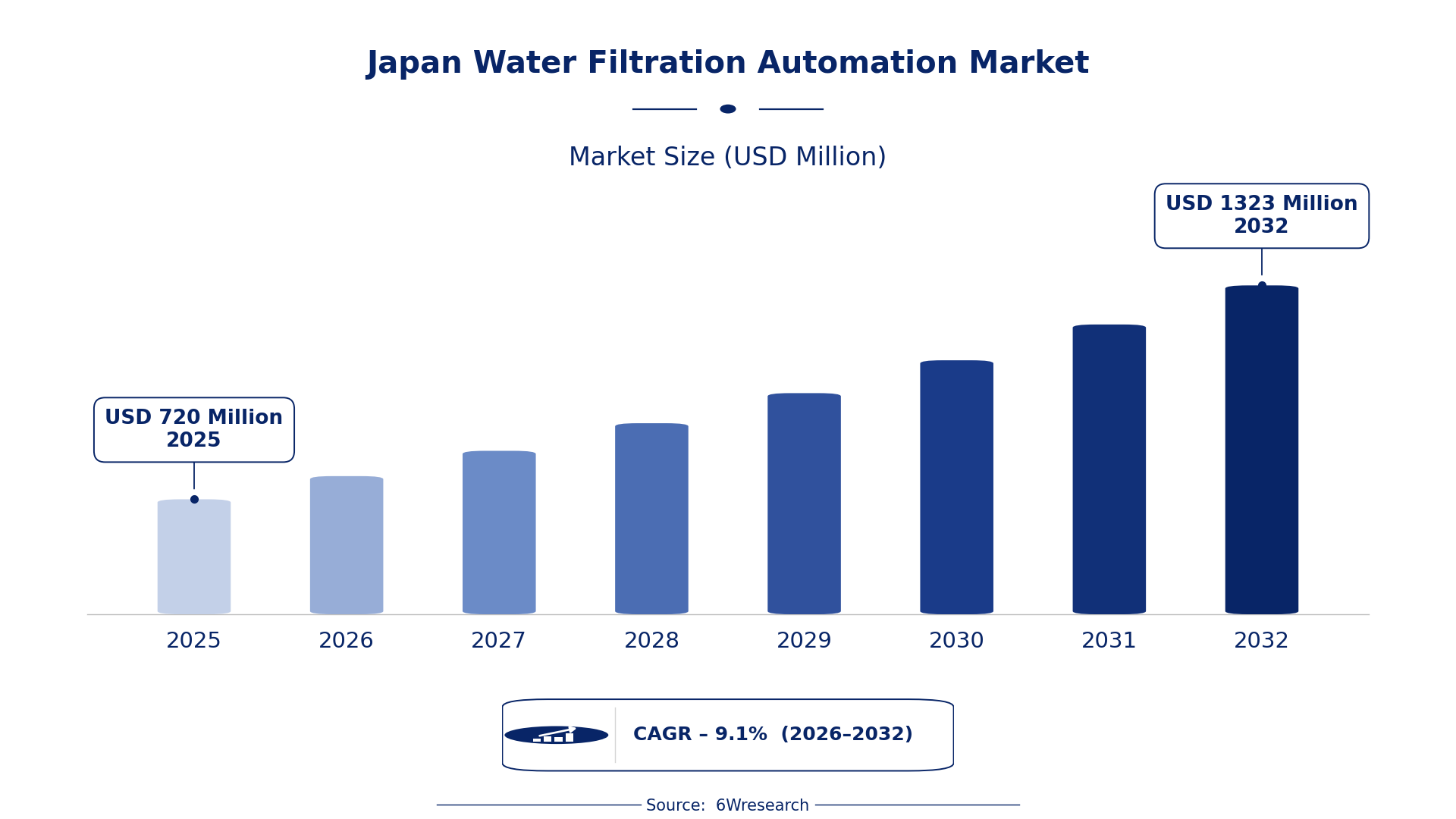
According to 6Wresearch internal database and industry insights, the Japan Water Filtration Automation Market was valued at USD 720 Million in 2025 and is projected to reach USD 1,323 Million by 2032, growing at a CAGR of approximately 9.1% during 2026–2032.
Japan Water Filtration Automation Market Highlights
| Report Metric | Details |
| Report Name | Japan Water Filtration Automation Market (2026-2032) |
| Market Size 2025 | USD 720 Million |
| Market Size 2032 | USD 1,323 Million |
| Absolute Growth 2025–2032 | USD 603 Million |
| CAGR 2026–2032 | 9.1% |
| Peak Annual Growth | 10.6% in 2030 |
| Forecast Period | 2026–2032 |
| Historical Data | 2022–2025 |
| Base Year | 2025 |
| Leading System Type, 2025 | Smart Water Filters (49% share) |
| Leading Automation Technology, 2025 | IoT-Based (55% share) |
| Leading Filter Type, 2025 | Carbon/RO (36% share) |
| Leading Application Area, 2025 | Residential Buildings (40% share) |
| Fastest-Growing System Type | Remote Monitoring (12.8% CAGR) |
| Fastest-Growing Automation Technology | AI Predictive Control (13.1% CAGR) |
| Fastest-Growing Filter Type | Multi-stage Filters (13.0% CAGR) |
| Fastest-Growing Application Area | Municipal Water Plants (10.8% CAGR) |
| Growing Sector | residential water filtration |
| Key End Users | municipal water plants, industrial facilities, residential buildings, commercial buildings |
Japan Water Filtration Automation Market Year-wise Growth Rate and Key Drivers (2022–2032)
This graph illustrates the annual growth rates of the market from 2022 to 2032, highlighting a steady upward trajectory and projected market expansion over the forecast period.
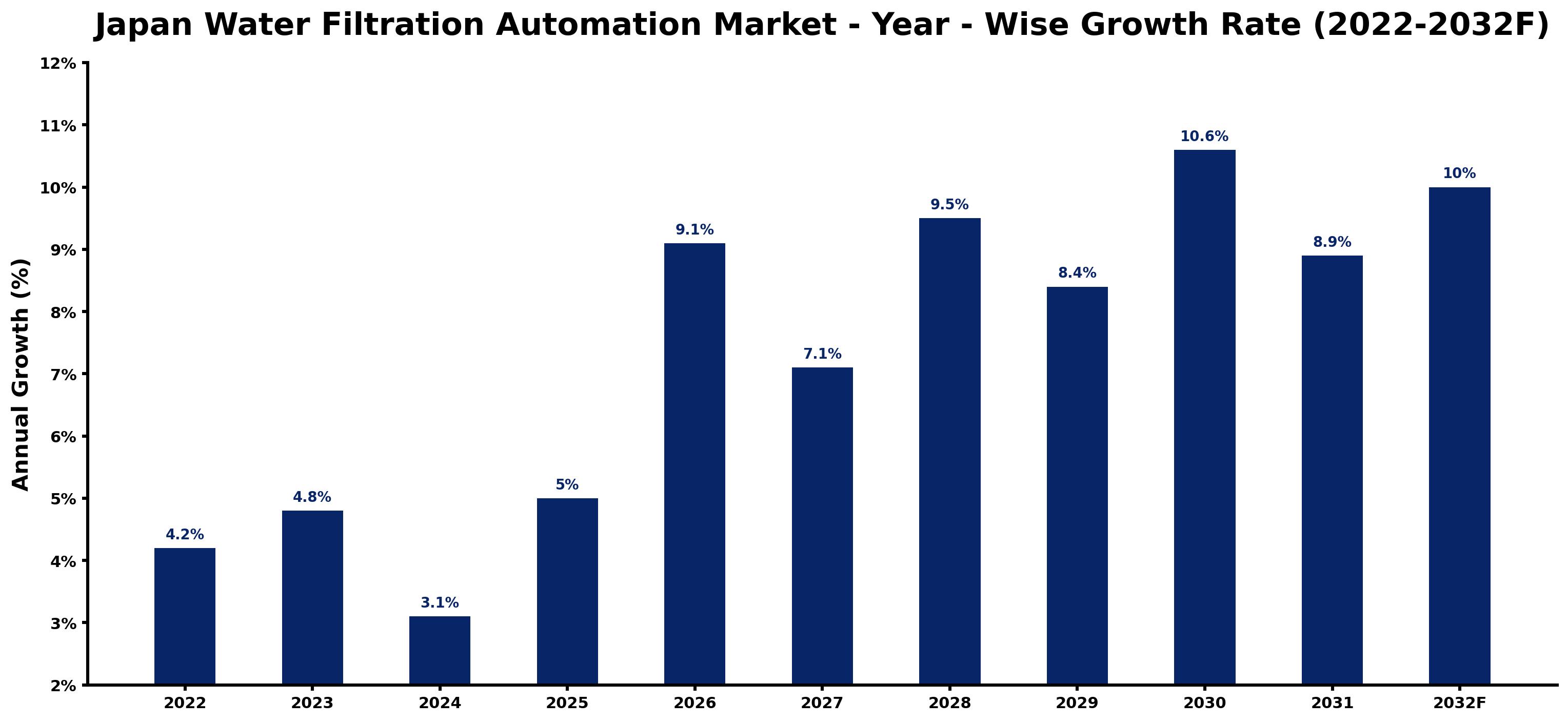
For each year, the table pairs the estimated growth rate with the leading influence on demand, showing how the drivers changed across the period.
| Year | Estimated Annual Growth (%) | Market Rationale |
| 2022 | 4.2 | The market experienced steady growth due to ongoing investments in water infrastructure. |
| 2023 | 4.8 | Demand for water filtration automation increased with rising awareness of water quality. |
| 2024 | 3.1 | Growth slowed slightly as some projects faced delays in implementation. |
| 2025 | 5.0 | The market rebounded with significant upgrades in municipal water plants. |
| 2026 | 9.1 | Investment in IoT-based solutions accelerated demand for smart filtration systems. |
| 2027 | 7.1 | Growth moderated as market saturation began in urban areas. |
| 2028 | 9.5 | Demand surged again with advancements in AI predictive control technologies. |
| 2029 | 8.4 | Growth slowed as competition intensified among filtration solution providers. |
| 2030 | 10.6 | The market peaked with a major push for decarbonisation and efficiency improvements. |
| 2031 | 8.9 | Growth slowed as the market stabilised after reaching peak demand. |
| 2032 | 10.0 | Continued focus on sustainability drives further investments in automation. |
Note: Market size estimations and growth projections presented in this report are based on 6Wresearch's proprietary forecasting methodology, utilizing the latest available industry data, government publications, and primary research inputs.
Japan Water Filtration Automation Market Synopsis
Water Filtration Automation enhances the efficiency of purification processes through smart devices and automation systems. This technology significantly improves water quality for residential, municipal, and industrial applications. The Japan Water Filtration Automation Market is expanding due to rising demand from over 127 million residents and ongoing investments in infrastructure, with the Tokyo metropolitan area leading adoption. The government's focus on decarbonisation and water quality improvement programs is further driving growth in this sector.
Market Dynamics Impact Analysis (2026–2032)
| Factor | Type | Impact | Primary Segment Affected |
| Increasing investment in water infrastructure upgrades | Driver | High | IoT-Based |
| Growing awareness of water quality among consumers | Driver | High | Smart Water Filters |
| Rising demand for efficient water management solutions | Opportunity | High | Remote Monitoring |
| Expansion of municipal water plants adopting advanced technologies | Opportunity | High | SCADA-Controlled |
| High initial costs of advanced filtration systems | Restraint | Medium | AI Predictive Control |
| Limited awareness of automation benefits among small-scale users | Restraint | Medium | Auto Backwash Filters |
| Competition from traditional filtration methods | Challenge | High | Carbon/RO |
| Technological integration challenges in existing systems | Challenge | Medium | Multi-stage Filters |
Evaluation of Drivers in Japan Water Filtration Automation Market (2026–2032)
These are the developments adding the most demand over the forecast period.
| Drivers | Primary Segment Affected | Why It Matters (Evidence) |
| Investment in smart water filtration systems | IoT-Based | This investment is driven by the need for real-time monitoring and efficiency, with municipal plants adopting IoT solutions to improve water quality management. |
| Rising consumer demand for clean drinking water | Smart Water Filters | In urban areas, the average water consumption per person is approximately 280 liters per day, leading to increased purchases of smart filtration devices. |
| Government initiatives promoting water quality improvement | Remote Monitoring | The Ministry of the Environment's programs support real-time tracking systems, encouraging municipalities to invest in advanced monitoring technologies. |
| Technological advancements in filtration automation | AI Predictive Control | AI technologies are being adopted in major industrial facilities, improving operational efficiency and reducing maintenance costs. |
| Growing urbanisation and population density | SCADA-Controlled | With over 127 million residents, urban areas are modernising water systems, increasing demand for centralized control solutions. |
Buyers are increasing capacity as investments in smart water filtration systems rise, driven by the need for real-time monitoring and efficiency. Urban areas are seeing high water consumption, with the average per person at approximately 280 litres daily, leading to greater purchases of smart filtration devices. AI technologies are being implemented in major industrial facilities, boosting operational efficiency and lowering maintenance costs. Urbanisation continues to modernise water systems, heightening demand for centralised control solutions.
Evaluation of Restraints in Japan Water Filtration Automation Market
These restraints slow adoption and weigh on supplier margins.
| Market Restraint | Primary Segment Affected | Why It Matters (Evidence) |
| High initial costs of advanced filtration systems | AI Predictive Control | Many facilities find the upfront investment prohibitive, delaying adoption of advanced filtration technologies. |
| Limited awareness of automation benefits among small-scale users | Auto Backwash Filters | Small businesses often lack knowledge about automation advantages, resulting in slower uptake of these systems. |
| Competition from traditional filtration methods | Carbon/RO | Established methods dominate due to lower costs, which hinders the growth of newer technologies. |
| Technological integration challenges in existing systems | Multi-stage Filters | Many facilities struggle to integrate new filtration technologies with outdated infrastructure, slowing market growth. |
| Regulatory compliance costs for advanced systems | Remote Monitoring | The need to meet stringent regulations increases operational costs, discouraging some buyers from upgrading. |
Japan Water Filtration Automation Market Challenges
Japan's strict environmental policies create a high demand for advanced filtration systems, raising procurement costs for buyers who must comply with JIS standards. Municipal plants are modernising with IoT solutions, resulting in delays for producers who find it challenging to adopt these technologies swiftly. A shortage of skilled technicians in water treatment hampers suppliers, increasing training periods and operational expenses by up to 20%. Natural disasters disrupt supply chains, compelling clinics to maintain larger inventories to ensure continuous access to clean water for patients, which raises their operational costs by approximately 15%.
Trends in the Japan Water Filtration Automation Market
These developments are changing demand patterns in the Japan Water Filtration Automation Market.
- Shift towards Smart Water Management: Municipal water plants are increasingly adopting IoT-based solutions for real-time monitoring, with JPY 150 trillion targeted for decarbonisation investment over the next decade.
- Transition from Manual to Automated Systems: The adoption of AI predictive control technologies is transforming water filtration processes, improving operational efficiency in major industrial facilities across Japan.
- Emergence of Remote Monitoring Solutions: Remote monitoring systems are becoming essential for disaster recovery in water supply, with municipalities investing heavily in these technologies to ensure resilience.
- Prioritisation of Sustainability in Water Filtration: Government programs focusing on improving water quality in rural areas are driving demand for sustainable filtration solutions, aligning with Japan's target for net zero emissions by 2050.
Investment Opportunities in the Japan Water Filtration Automation Market
Where to invest in the Japan Water Filtration Automation Market: the main openings are set out below.
- Timing for Infrastructure Upgrades: Japan's target of a 46% reduction in greenhouse gas emissions by 2030 creates an opportunity to invest in advanced water filtration systems in urban areas, particularly in the Tokyo metropolitan region.
- Focus on Municipal Water Plants: Municipal water plants are modernising with IoT-based solutions, presenting a prime opportunity for suppliers to offer advanced filtration technologies and systems.
- Entry through Partnerships: Local partnerships with municipalities can facilitate entry into the market, especially for companies offering filtration solutions that meet JIS standards.
- Growing Demand from Residential Buildings: The residential sector is increasingly seeking high-quality water filtration solutions, creating opportunities for suppliers to introduce smart water filters in urban residential areas.
Government Initiatives in the Japan Water Filtration Automation Market
The Water Supply Act (1957) establishes standards for drinking-water quality and supply, ensuring that filtration systems meet safety requirements. The Sewerage Act (1958) governs wastewater treatment, promoting the need for advanced filtration technologies in municipal plants. These measures directly impact Water Filtration Automation by ensuring that systems comply with safety and efficiency standards.
Japan's GX Basic Policy (2023) aims for about JPY 150 trillion in public and private decarbonisation investment over the next decade. The Ministry of the Environment oversees these initiatives, funding projects that improve water quality and infrastructure, which benefits buyers and producers in the water filtration sector.
Future Insight of the Japan Water Filtration Automation Market
Japan's policy-driven shift towards decarbonisation will accelerate the adoption of smart filtration technologies, prompting suppliers to innovate in response to evolving regulatory standards. Investment in water infrastructure is expected to surpass JPY 150 trillion over the next decade, enhancing municipal plant capabilities. The integration of advanced monitoring systems will empower buyers to improve water quality management. Government initiatives will focus on technological advancements, particularly in rural areas, ensuring reliable access to clean water for all communities.
Market Segmentation Analysis
Japan Water Filtration Automation Market report covers a detailed analysis of the following market segments:
By System Type – Smart Water Filters Lead, Remote Monitoring Expected to Grow Fastest
According to Saurav Kr Singh, Senior Research Analyst at 6Wresearch, Smart Water Filters accounted for 49% of the market by system type in 2025. Smart water filters dominate the market as they play a vital role in improving household water quality for Japan's 127 million residents. Their adoption is further encouraged by government initiatives focused on enhancing water safety and adherence to JIS standards. Over 2026–2032, Remote Monitoring is expected to post the fastest growth, at a CAGR of 12.8%. Remote monitoring is experiencing rapid growth because it facilitates real-time tracking of water quality, which is crucial for effective management of municipal water systems. The ongoing push for modernised infrastructure significantly boosts the demand for these advanced systems. Suppliers should focus on developing sophisticated remote monitoring capabilities to meet the increasing demands of the market.
By Automation Technology – IoT-Based Leads, AI Predictive Control Expected to Grow Fastest
With 55% of automation technology revenue in 2025, IoT-Based was the largest category. IoT-based solutions lead the market by enabling efficient management of water filtration systems, essential for the modernisation of municipal water facilities. Their widespread use reflects substantial investments aimed at improving water quality and operational effectiveness. AI Predictive Control is projected to grow fastest, at a CAGR of 13.1% during 2026–2032. AI predictive control is growing quickly as it optimises maintenance and enhances operational efficiency, which is critical for managing complex filtration processes. This trend is further accelerated by the increasing sophistication of water treatment facilities across the country. Buyers ought to invest in advanced technologies to improve maintenance practices and overall operational efficiency.
By Filter Type – Carbon/RO Leads, Multi-stage Filters Expected to Grow Fastest
The largest filter type category in 2025 was Carbon/RO, at 36% of revenue. Carbon/RO filters are widely used for effective water purification in urban residential areas, meeting the high demand for clean drinking water. Their established presence in households makes them the preferred choice among consumers. The quickest growth will come from Multi-stage Filters, forecast to expand at a CAGR of 13.0% between 2026 and 2032. Multi-stage filters are gaining traction as they are essential for achieving high water quality standards in critical applications like hospitals. The focus on health and safety in water supply further accelerates their adoption. Suppliers need to ensure that multi-stage filters meet stringent quality requirements to capture this growing market.
By Application Area – Residential Buildings Lead, Municipal Water Plants Expected to Grow Fastest
In 2025, Residential Buildings led the application area split with a 40% share. Residential buildings represent the largest segment for water filtration solutions, driven by the rising demand for clean water among Japan's population. This trend is bolstered by government initiatives aimed at enhancing household water quality and safety standards. Municipal Water Plants are set to record the highest CAGR in this split, 10.8% over 2026–2032. Municipal water plants are swiftly adopting advanced filtration automation to modernise their operations and comply with safety regulations. Continuous investments in infrastructure upgrades serve as a key driver for this segment's growth. Suppliers must tailor their offerings to meet the specific needs of municipal water plants to capitalise on emerging opportunities.
Key Attractiveness of the Report
- 10 Years of Market Numbers
- Historical Data Starting from 2022 to 2025
- Base Year 2025
- Forecast Data until 2032
- Key Performance Indicators Impacting the Market
- Major Upcoming Developments and Projects
Key Highlights of the Report:
- Japan Water Filtration Automation Market Outlook
- Market Size of Japan Water Filtration Automation Market, 2025
- Forecast of Japan Water Filtration Automation Market, 2032
- Historical Data and Forecast of Japan Water Filtration Automation Revenues & Volume for the Period 2022-2032F
- Japan Water Filtration Automation Market Trend Evolution
- Japan Water Filtration Automation Market Drivers and Challenges
- Japan Water Filtration Automation Price Trends
- Japan Water Filtration Automation Porter's Five Forces
- Japan Water Filtration Automation Industry Life Cycle
- Historical Data and Forecast of Japan Water Filtration Automation Market Revenues & Volume By System Type for the Period 2022-2032F
- Historical Data and Forecast of Japan Water Filtration Automation Market Revenues & Volume By Smart Water Filters for the Period 2022-2032F
- Historical Data and Forecast of Japan Water Filtration Automation Market Revenues & Volume By Remote Monitoring for the Period 2022-2032F
- Historical Data and Forecast of Japan Water Filtration Automation Market Revenues & Volume By SCADA-Controlled for the Period 2022-2032F
- Historical Data and Forecast of Japan Water Filtration Automation Market Revenues & Volume By Auto Backwash Filters for the Period 2022-2032F
- Historical Data and Forecast of Japan Water Filtration Automation Market Revenues & Volume By Automation Technology for the Period 2022-2032F
- Historical Data and Forecast of Japan Water Filtration Automation Market Revenues & Volume By IoT-Based for the Period 2022-2032F
- Historical Data and Forecast of Japan Water Filtration Automation Market Revenues & Volume By AI Predictive Control for the Period 2022-2032F
- Historical Data and Forecast of Japan Water Filtration Automation Market Revenues & Volume By Real-time Data Logging for the Period 2022-2032F
- Historical Data and Forecast of Japan Water Filtration Automation Market Revenues & Volume By PLC Controlled for the Period 2022-2032F
- Historical Data and Forecast of Japan Water Filtration Automation Market Revenues & Volume By Filter Type for the Period 2022-2032F
- Historical Data and Forecast of Japan Water Filtration Automation Market Revenues & Volume By Carbon/RO for the Period 2022-2032F
- Historical Data and Forecast of Japan Water Filtration Automation Market Revenues & Volume By Multi-stage Filters for the Period 2022-2032F
- Historical Data and Forecast of Japan Water Filtration Automation Market Revenues & Volume By UV/RO for the Period 2022-2032F
- Historical Data and Forecast of Japan Water Filtration Automation Market Revenues & Volume By Sand Media for the Period 2022-2032F
- Historical Data and Forecast of Japan Water Filtration Automation Market Revenues & Volume By Application Area for the Period 2022-2032F
- Historical Data and Forecast of Japan Water Filtration Automation Market Revenues & Volume By Residential Buildings for the Period 2022-2032F
- Historical Data and Forecast of Japan Water Filtration Automation Market Revenues & Volume By Municipal Water Plants for the Period 2022-2032F
- Historical Data and Forecast of Japan Water Filtration Automation Market Revenues & Volume By Industrial Water Supply for the Period 2022-2032F
- Historical Data and Forecast of Japan Water Filtration Automation Market Revenues & Volume By Commercial Buildings for the Period 2022-2032F
- Japan Water Filtration Automation Import Export Trade Statistics
- Market Opportunity Assessment By System Type
- Market Opportunity Assessment By Automation Technology
- Market Opportunity Assessment By Filter Type
- Market Opportunity Assessment By Application Area
- Japan Water Filtration Automation Top Companies Market Share
- Japan Water Filtration Automation Competitive Benchmarking By Technical and Operational Parameters
- Japan Water Filtration Automation Company Profiles
- Japan Water Filtration Automation Key Strategic Recommendations
Market Covered
Coverage by segment is as follows.
By System Type
- Smart Water Filters
- Remote Monitoring
- SCADA-Controlled
- Auto Backwash Filters
By Automation Technology
- IoT-Based
- AI Predictive Control
- Real-time Data Logging
- PLC Controlled
By Filter Type
- Carbon/RO
- Multi-stage Filters
- UV/RO
- Sand Media
By Application Area
- Residential Buildings
- Municipal Water Plants
- Industrial Water Supply
- Commercial Buildings































