Japan Water Quality Monitoring Equipment Market Size & Growth Rate
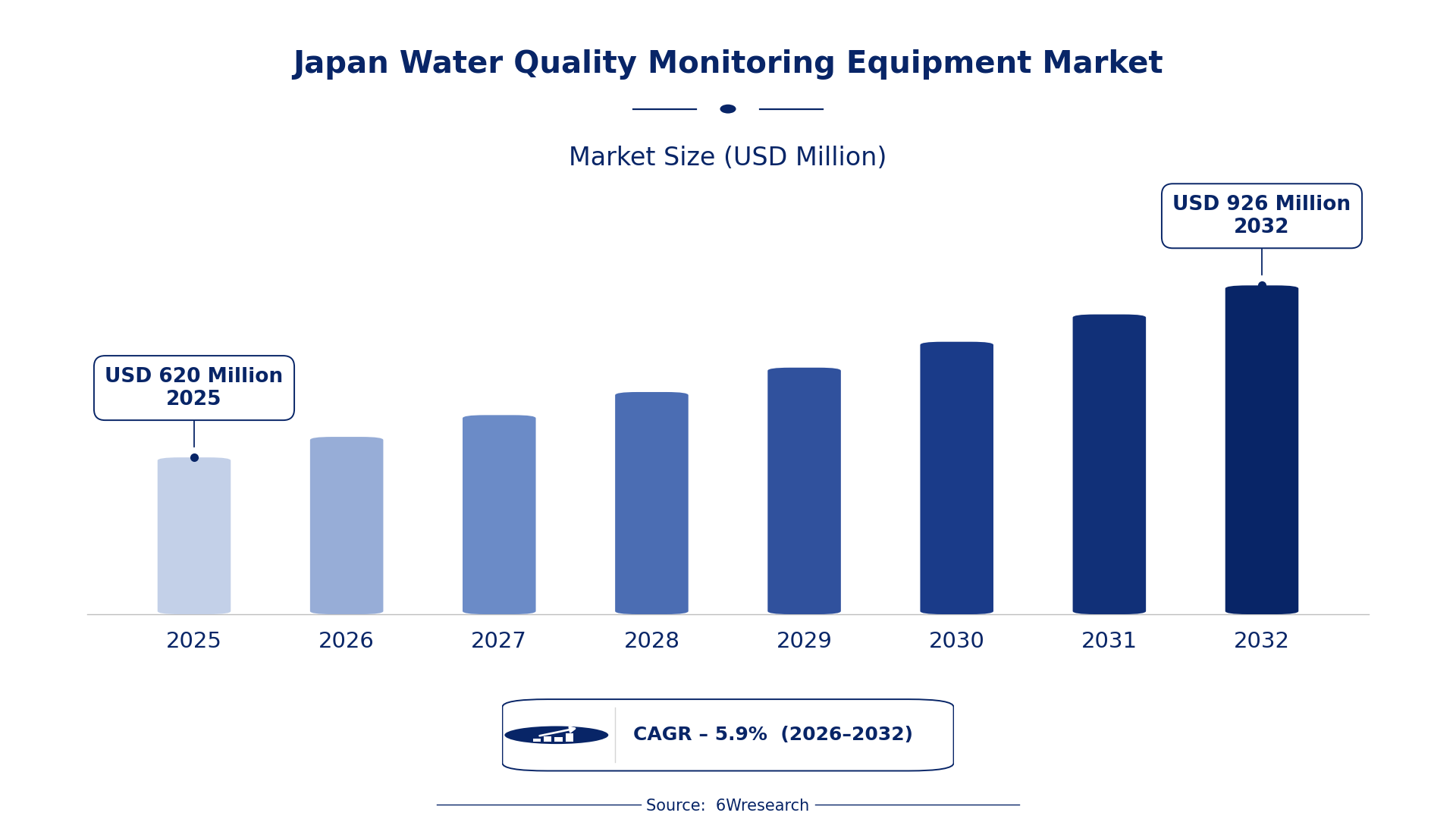
According to 6Wresearch internal database and industry insights, the Japan Water Quality Monitoring Equipment Market was valued at USD 620 Million in 2025 and is projected to reach USD 926 Million by 2032, growing at a CAGR of approximately 5.9% during 2026–2032.
Japan Water Quality Monitoring Equipment Market Highlights
| Report Metric | Details |
| Report Name | Japan Water Quality Monitoring Equipment Market (2026-2032) |
| Market Size 2025 | USD 620 Million |
| Market Size 2032 | USD 926 Million |
| Absolute Growth 2025–2032 | USD 306 Million |
| CAGR 2026–2032 | 5.9% |
| Peak Annual Growth | 6.6% in 2032 |
| Forecast Period | 2026–2032 |
| Historical Data | 2022–2025 |
| Base Year | 2025 |
| Leading Equipment Type, 2025 | Digital TDS Meters (33% share) |
| Leading Parameter Measured, 2025 | Total Dissolved Solids (34% share) |
| Leading Technology Used, 2025 | Electronic Sensor (53% share) |
| Leading Application Area, 2025 | Drinking Water Systems (38% share) |
| Fastest-Growing Equipment Type | Multi-Parameter Probes (9.4% CAGR) |
| Fastest-Growing Parameter Measured | pH (7.8% CAGR) |
| Fastest-Growing Technology Used | Optical & Electrochemical (9.1% CAGR) |
| Fastest-Growing Application Area | Industrial Water Plants (7.0% CAGR) |
| Growing Sector | water quality monitoring |
| Key End Users | municipalities, environmental agencies, industrial water plants, research institutions |
Japan Water Quality Monitoring Equipment Market Year-wise Growth Rate and Key Drivers (2022–2032)
This graph illustrates the annual growth rates of the market from 2022 to 2032, highlighting a steady upward trajectory and projected market expansion over the forecast period.
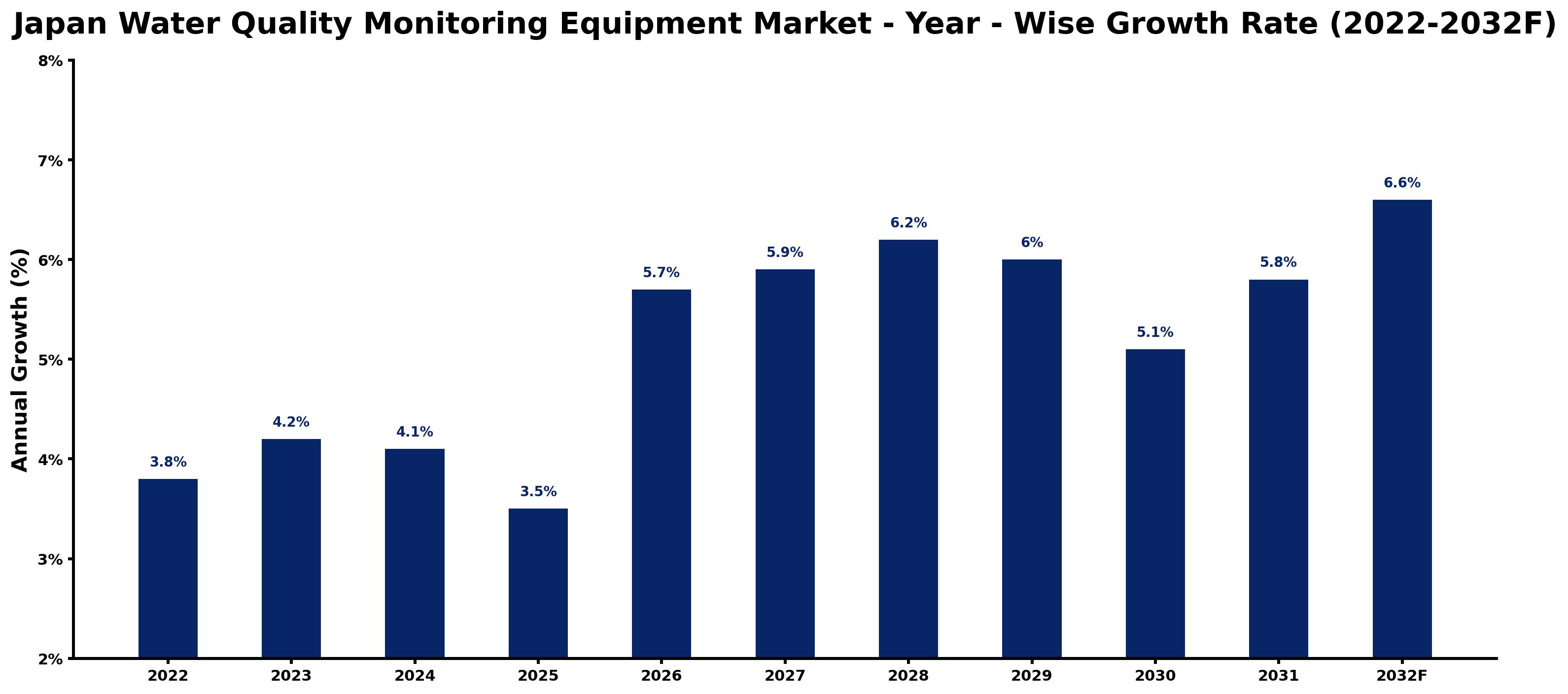
Year by year, the estimates below pair each growth rate with the development that shaped it.
| Year | Estimated Annual Growth (%) | Market Rationale |
| 2022 | 3.8 | The market experienced steady growth due to increasing awareness of water quality issues. |
| 2023 | 4.2 | Demand rose as urban areas tightened water quality regulations and standards. |
| 2024 | 4.1 | Growth slowed slightly as market adjustments occurred after the previous year's surge. |
| 2025 | 3.5 | The market maintained growth despite a further slowdown as investments in monitoring systems continued. |
| 2026 | 5.7 | Growth is expected to accelerate as technological advancements in monitoring equipment gain traction. |
| 2027 | 5.9 | Demand will increase with the rising adoption of smart IoT sensors in urban management. |
| 2028 | 6.2 | The market is projected to continue expanding as multi-parameter probes become more popular among users. |
| 2029 | 6.0 | Growth will slow as the market begins to stabilise after several years of rapid expansion. |
| 2030 | 5.1 | A further slowdown is expected as the market adjusts to new standards and regulations. |
| 2031 | 5.8 | Demand will pick up again with renewed investments in water quality monitoring technologies. |
| 2032 | 6.6 | The market is projected to peak as urban infrastructure projects drive substantial equipment purchases. |
Note: Market size estimations and growth projections presented in this report are based on 6Wresearch's proprietary forecasting methodology, utilizing the latest available industry data, government publications, and primary research inputs.
Japan Water Quality Monitoring Equipment Market Synopsis
Japan Water Quality Monitoring Equipment is essential for assessing water quality in applications such as drinking water and industrial processes. The market is expanding due to stringent regulations in urban areas, with over 100 million people relying on safe drinking water. The adoption of smart IoT sensors and real-time monitoring technologies is increasing, driven by the need for compliance with health standards and efficient management systems. This growth is supported by investments in upgrading monitoring systems across the country, particularly in regions with high population density.
Market Dynamics Impact Analysis (2026–2032)
| Factor | Type | Impact | Primary Segment Affected |
| Rising urbanisation increases the need for effective water quality monitoring solutions. | Driver | High | Smart IoT Sensors |
| Growing environmental awareness among consumers drives demand for better water quality assessments. | Driver | High | Multi-Parameter Probes |
| Investment in rural water monitoring systems presents a significant opportunity for suppliers. | Opportunity | High | Portable Test Kits |
| The increasing adoption of cloud-connected devices opens new avenues for data management. | Opportunity | Medium | Electronic Sensor |
| High initial costs of advanced monitoring equipment can deter smaller buyers. | Restraint | High | Digital TDS Meters |
| Limited awareness of advanced technologies among some user groups restricts market growth. | Restraint | Medium | Basic Chemistry Tests |
| Competition from low-cost imports may pressure local manufacturers' pricing strategies. | Challenge | High | All-in-One Parameters |
| Technological advancements require continuous investment in R&D, impacting profit margins. | Challenge | Medium | Optical & Electrochemical |
Evaluation of Drivers in Japan Water Quality Monitoring Equipment Market (2026–2032)
Below are the drivers that matter most for revenue growth, with supporting evidence.
| Drivers | Primary Segment Affected | Why It Matters (Evidence) |
| Urbanisation drives demand for real-time water quality monitoring. | Smart IoT Sensors | With over 100 million people relying on safe drinking water, urban areas need advanced monitoring solutions. |
| Environmental concerns lead to higher demand for multi-parameter analysis. | Multi-Parameter Probes | Research institutions are increasingly using these probes for water quality studies, improving data accuracy. |
| Investment in rural water monitoring systems is expanding market opportunities. | Portable Test Kits | In 2023, the government allocated funds to upgrade monitoring systems in rural areas, boosting demand. |
| Technological advancements in cloud-connected devices improve data management capabilities. | Electronic Sensor | These devices are becoming standard in modern water quality monitoring solutions, improving efficiency. |
| Rising health standards increase the need for accurate water quality assessments. | Digital TDS Meters | The Tokyo metropolitan area has stringent water quality standards regulated by local authorities. |
Several shifts outside the market lift sales. Urbanisation is driving demand for smart IoT sensors, as over 100 million people rely on safe drinking water. Environmental concerns lead to higher demand for multi-parameter probes, with research institutions increasingly utilising these for precise water quality studies. Technological advancements in cloud-connected devices improve data management capabilities, becoming standard in modern monitoring solutions.
Evaluation of Restraints in Japan Water Quality Monitoring Equipment Market
Several factors work against faster growth; the main ones are summarised below.
| Market Restraint | Primary Segment Affected | Why It Matters (Evidence) |
| High initial costs of advanced monitoring equipment deter smaller buyers. | Digital TDS Meters | The average cost of sophisticated monitoring devices can exceed budgets of smaller municipalities. |
| Limited awareness of advanced technologies restricts market growth. | Basic Chemistry Tests | Some user groups lack knowledge of the benefits of modern monitoring solutions. |
| Competition from low-cost imports pressures local manufacturers' pricing strategies. | All-in-One Parameters | Imported products often offer lower prices, impacting local sales. |
| Technological advancements require continuous investment in R&D, affecting profit margins. | Optical & Electrochemical | Manufacturers must invest heavily to keep pace with evolving technologies. |
| Regulatory changes can impose additional compliance costs on manufacturers. | Multi-Parameter Probes | New standards may require upgrades to existing equipment, increasing operational costs. |
Japan Water Quality Monitoring Equipment Market Challenges
Intense competition among manufacturers leads to price reductions, which squeeze profit margins and deter investment in new technologies. Supply chain challenges arise from dependence on imported components, resulting in delays in equipment availability that hinder producers' ability to fulfil orders, potentially costing them up to 15% in sales. Rapid technological advancements create a knowledge gap, leaving some manufacturers unable to keep pace, resulting in outdated products that fail to meet buyer expectations and risking a loss of 10% in market share. Workforce shortages in skilled labour restrict the effective operation of advanced systems, raising operational costs for hospitals and clinics that depend on accurate water quality assessments.
Trends in the Japan Water Quality Monitoring Equipment Market
Several trends are reshaping the Japan Water Quality Monitoring Equipment Market; the most important are set out below.
- Shift towards Smart IoT Sensors: In 2023, the adoption of smart IoT sensors surged, with urban water management systems increasingly integrating these technologies. This shift allows for real-time monitoring and data collection, improving compliance with health standards.
- Transition from Manual to Automated Testing: The trend towards automated testing began in 2022, as portable test kits became more popular among environmental agencies. This shift reduces human error and improves the efficiency of water quality assessments.
- Emergence of Cloud-Connected Devices: Since 2023, cloud-connected devices have gained traction, enabling data sharing and analysis in real-time. This trend is reshaping water quality monitoring practices across urban areas in Japan.
- Increased Focus on Multi-Parameter Analysis: The emphasis on multi-parameter analysis has grown since 2022, with research institutions increasingly utilising multi-parameter probes for detailed assessments. This approach improves the understanding of water quality conditions.
Investment Opportunities in the Japan Water Quality Monitoring Equipment Market
The following opportunities in the Japan Water Quality Monitoring Equipment Market pair current demand with a clear way in.
- Investment in Rural Monitoring Systems: With government funding designated for upgrading rural water monitoring systems, there is a promising opportunity for suppliers of portable test kits. This investment aims to improve water quality assessments in underserved regions.
- Expansion of Cloud-Connected Solutions: As urban areas embrace cloud-connected devices, suppliers can concentrate on providing electronic sensors that streamline data management. This trend is particularly pertinent in metropolitan regions with strict water quality regulations.
- Growth in Industrial Water Plants: The industrial sector is increasingly investing in advanced monitoring solutions, offering opportunities for suppliers of multi-parameter probes. This expansion is driven by the need for compliance with environmental standards.
- Rising Demand for Real-Time Monitoring: The growing requirement for real-time monitoring solutions presents a gap for suppliers of smart IoT sensors. Urban water management systems are actively pursuing advanced technologies to enhance their capabilities.
Government Initiatives in the Japan Water Quality Monitoring Equipment Market
The Water Supply Act (1957) establishes standards for drinking-water quality and supply, ensuring that producers adhere to strict guidelines. This law mandates regular testing and reporting of water quality parameters, which directly impacts the quality of water supplied to consumers. The Ministry of Health, Labour and Welfare oversees compliance, ensuring that water meets health standards for over 100 million residents.
The Sewerage Act (1958) governs wastewater treatment and sewerage systems, ensuring compliance with regulations. The Environmental Protection Agency monitors these systems, influencing how water quality monitoring equipment is utilised in both urban and rural settings. This oversight is vital for maintaining water safety and compliance with health standards.
Future Insight of the Japan Water Quality Monitoring Equipment Market
By 2032, urban buyers will experience improved water quality assessments due to advancements in smart IoT sensors and cloud-connected devices. New regulations for wastewater treatment facilities will compel suppliers to innovate their products, ensuring compliance with changing standards. Government funding aimed at upgrading rural water monitoring systems will improve access to safe drinking water for over 100 million individuals. Training initiatives will equip the workforce to effectively utilise advanced technologies, ensuring reliable water quality management across diverse applications.
Market Segmentation Analysis
Japan Water Quality Monitoring Equipment Market report covers a detailed analysis of the following market segments:
By Equipment Type – Digital TDS Meters Lead, Multi-Parameter Probes Expected to Grow Fastest
According to Saurav Kr Singh, Senior Research Analyst at 6Wresearch, Digital TDS Meters held 33% of the Japan Water Quality Monitoring Equipment Market by equipment type in 2025. Digital TDS Meters hold the largest share as they are crucial for measuring total dissolved solids, which directly impacts water safety. Their prevalent use in urban areas with stringent water quality regulations highlights their significance in the market. Over 2026–2032, Multi-Parameter Probes are expected to post the fastest growth, at a CAGR of 9.4%. The rapid growth of Multi-Parameter Probes is driven by their capability to measure multiple water quality parameters simultaneously, a necessity for comprehensive monitoring. As the demand for detailed assessments increases, this technology will likely see broader adoption. Suppliers should focus on developing Multi-Parameter Probes to meet the rising demand for thorough water quality evaluations.
By Parameter Measured – Total Dissolved Solids Lead, pH Expected to Grow Fastest
Total Dissolved Solids took 34% of parameter measured revenue in 2025, more than any other category. Total Dissolved Solids is the leading parameter measured because it is essential for assessing water purity and safety, particularly in urban drinking water systems. This emphasis on TDS is vital for complying with Japan's stringent health standards for safe drinking water. pH is projected to grow fastest, at a CAGR of 7.8% during 2026–2032. The pH measurement segment is experiencing rapid growth due to its critical role in determining the acidity or alkalinity of water, necessary for both drinking and industrial purposes. As regulations tighten, the need for accurate pH monitoring will continue to escalate. Buyers must ensure their monitoring solutions include reliable pH measurement capabilities to comply with increasingly strict regulations.
By Technology Used – Electronic Sensor Leads, Optical & Electrochemical Expected to Grow Fastest
With 53% of technology used revenue in 2025, Electronic Sensor was the largest category. Electronic Sensors dominate the market as they are widely used for precise measurements in water quality monitoring, ensuring compliance with health regulations. Their reliability is particularly important in urban water systems where adherence to standards is critical. Optical & Electrochemical is set to record the highest CAGR in this split, 9.1% over 2026–2032. Optical & Electrochemical technologies are witnessing rapid growth due to their advanced capabilities for accurate water analysis, which are increasingly required in municipal and industrial settings. Their integration into modern monitoring systems is essential for effective water quality management. Suppliers should prioritise advancements in Optical & Electrochemical technologies to capitalise on expanding market opportunities.
By Application Area – Drinking Water Systems Lead, Industrial Water Plants Expected to Grow Fastest
In 2025, Drinking Water Systems led the application area split with a 38% share. Drinking Water Systems represent the largest application area, as they are critical for ensuring a safe supply of drinking water to over 100 million people in Japan. The stringent regulations in urban areas further reinforce the demand for monitoring equipment in this sector. The quickest growth will come from Industrial Water Plants, forecast to expand at a CAGR of 7.0% between 2026 and 2032. Industrial Water Plants are the fastest-growing application area, driven by the need to maintain water quality in industrial processes amidst increasing regulatory scrutiny. As industries expand, the demand for reliable monitoring solutions will continue to rise. Suppliers need to tailor their products to meet the specific requirements of industrial water plants to capitalise on this growth.
Key Attractiveness of the Report
- 10 Years of Market Numbers
- Historical Data Starting from 2022 to 2025
- Base Year 2025
- Forecast Data until 2032
- Key Performance Indicators Impacting the Market
- Major Upcoming Developments and Projects
Key Highlights of the Report:
- Japan Water Quality Monitoring Equipment Market Outlook
- Market Size of Japan Water Quality Monitoring Equipment Market, 2025
- Forecast of Japan Water Quality Monitoring Equipment Market, 2032
- Historical Data and Forecast of Japan Water Quality Monitoring Equipment Revenues & Volume for the Period 2022-2032F
- Japan Water Quality Monitoring Equipment Market Trend Evolution
- Japan Water Quality Monitoring Equipment Market Drivers and Challenges
- Japan Water Quality Monitoring Equipment Price Trends
- Japan Water Quality Monitoring Equipment Porter's Five Forces
- Japan Water Quality Monitoring Equipment Industry Life Cycle
- Historical Data and Forecast of Japan Water Quality Monitoring Equipment Market Revenues & Volume By Equipment Type for the Period 2022-2032F
- Historical Data and Forecast of Japan Water Quality Monitoring Equipment Market Revenues & Volume By Digital TDS Meters for the Period 2022-2032F
- Historical Data and Forecast of Japan Water Quality Monitoring Equipment Market Revenues & Volume By Multi-Parameter Probes for the Period 2022-2032F
- Historical Data and Forecast of Japan Water Quality Monitoring Equipment Market Revenues & Volume By Smart IoT Sensors for the Period 2022-2032F
- Historical Data and Forecast of Japan Water Quality Monitoring Equipment Market Revenues & Volume By Portable Test Kits for the Period 2022-2032F
- Historical Data and Forecast of Japan Water Quality Monitoring Equipment Market Revenues & Volume By Parameter Measured for the Period 2022-2032F
- Historical Data and Forecast of Japan Water Quality Monitoring Equipment Market Revenues & Volume By Total Dissolved Solids for the Period 2022-2032F
- Historical Data and Forecast of Japan Water Quality Monitoring Equipment Market Revenues & Volume By pH, DO, Turbidity for the Period 2022-2032F
- Historical Data and Forecast of Japan Water Quality Monitoring Equipment Market Revenues & Volume By All-in-One Parameters for the Period 2022-2032F
- Historical Data and Forecast of Japan Water Quality Monitoring Equipment Market Revenues & Volume By Basic Chemistry Tests for the Period 2022-2032F
- Historical Data and Forecast of Japan Water Quality Monitoring Equipment Market Revenues & Volume By Technology Used for the Period 2022-2032F
- Historical Data and Forecast of Japan Water Quality Monitoring Equipment Market Revenues & Volume By Electronic Sensor for the Period 2022-2032F
- Historical Data and Forecast of Japan Water Quality Monitoring Equipment Market Revenues & Volume By Optical & Electrochemical for the Period 2022-2032F
- Historical Data and Forecast of Japan Water Quality Monitoring Equipment Market Revenues & Volume By Cloud-Connected for the Period 2022-2032F
- Historical Data and Forecast of Japan Water Quality Monitoring Equipment Market Revenues & Volume By Manual for the Period 2022-2032F
- Historical Data and Forecast of Japan Water Quality Monitoring Equipment Market Revenues & Volume By Application Area for the Period 2022-2032F
- Historical Data and Forecast of Japan Water Quality Monitoring Equipment Market Revenues & Volume By Drinking Water Systems for the Period 2022-2032F
- Historical Data and Forecast of Japan Water Quality Monitoring Equipment Market Revenues & Volume By Industrial Water Plants for the Period 2022-2032F
- Historical Data and Forecast of Japan Water Quality Monitoring Equipment Market Revenues & Volume By Real-Time Monitoring for the Period 2022-2032F
- Historical Data and Forecast of Japan Water Quality Monitoring Equipment Market Revenues & Volume By Field Water Testing for the Period 2022-2032F
- Japan Water Quality Monitoring Equipment Import Export Trade Statistics
- Market Opportunity Assessment By Equipment Type
- Market Opportunity Assessment By Parameter Measured
- Market Opportunity Assessment By Technology Used
- Market Opportunity Assessment By Application Area
- Japan Water Quality Monitoring Equipment Top Companies Market Share
- Japan Water Quality Monitoring Equipment Competitive Benchmarking By Technical and Operational Parameters
- Japan Water Quality Monitoring Equipment Company Profiles
- Japan Water Quality Monitoring Equipment Key Strategic Recommendations
Market Covered
Segments analysed in this report are listed below.
By Equipment Type
- Digital TDS Meters
- Multi-Parameter Probes
- Smart IoT Sensors
- Portable Test Kits
By Parameter Measured
- Total Dissolved Solids
- pH
- DO
- Turbidity
- All-in-One Parameters
- Basic Chemistry Tests
By Technology Used
- Electronic Sensor
- Optical & Electrochemical
- Cloud-Connected
- Manual
By Application Area
- Drinking Water Systems
- Industrial Water Plants
- Real-Time Monitoring
- Field Water Testing































