Japan Water Treatment Sensor Market Size & Growth Rate
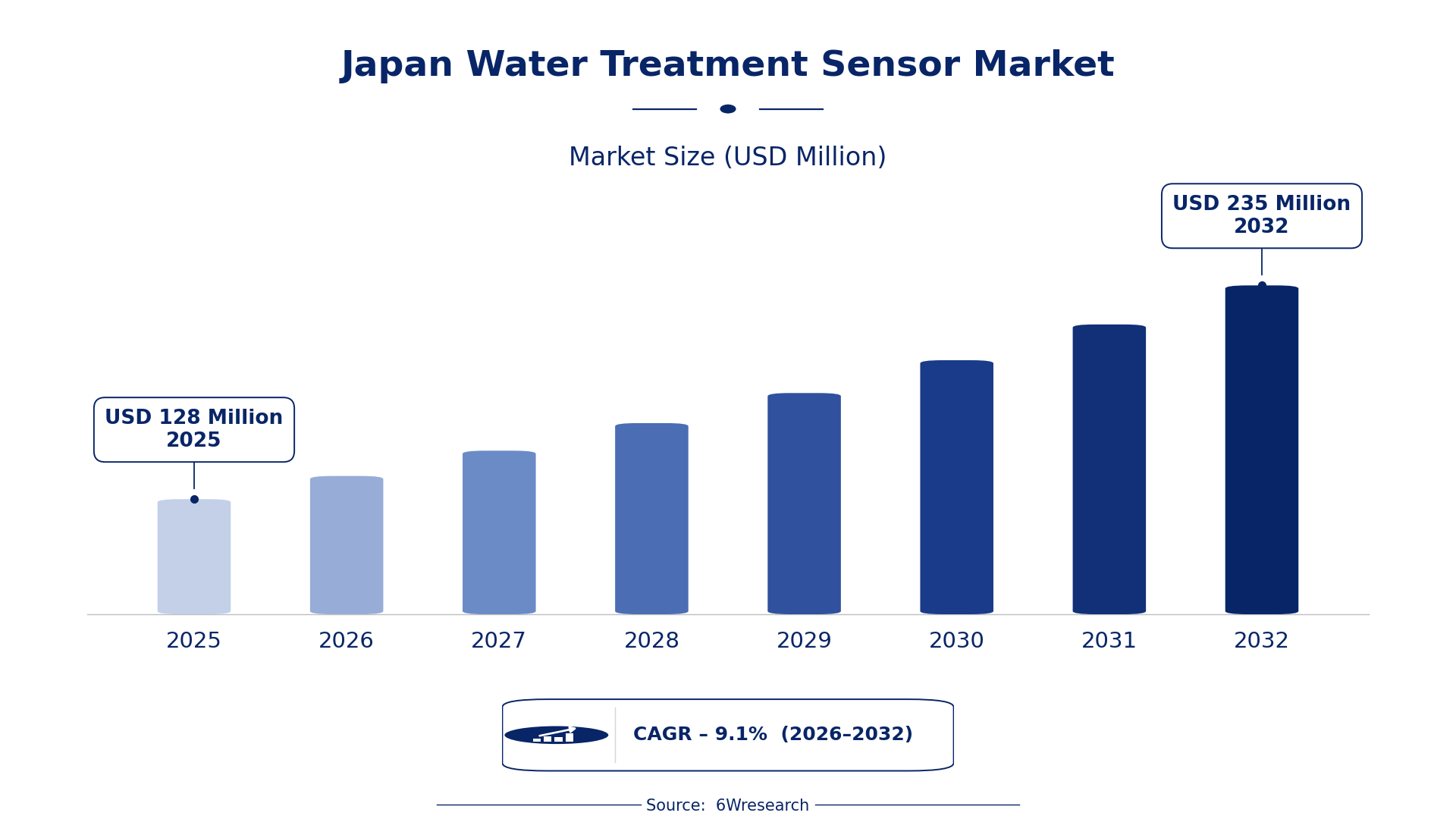
According to 6Wresearch internal database and industry insights, the Japan Water Treatment Sensor Market was valued at USD 128 Million in 2025 and is projected to reach USD 235 Million by 2032, growing at a CAGR of approximately 9.1% during 2026–2032.
Japan Water Treatment Sensor Market Highlights
| Report Metric | Details |
| Report Name | Japan Water Treatment Sensor Market (2026-2032) |
| Market Size 2025 | USD 128 Million |
| Market Size 2032 | USD 235 Million |
| Absolute Growth 2025–2032 | USD 107 Million |
| CAGR 2026–2032 | 9.1% |
| Peak Annual Growth | 10.2% in 2032 |
| Forecast Period | 2026–2032 |
| Historical Data | 2022–2025 |
| Base Year | 2025 |
| Leading Product Type, 2025 | pH Sensor (40% share) |
| Leading Sensing Parameter, 2025 | pH Level (38% share) |
| Leading Distribution Channel, 2025 | Direct Sales (46% share) |
| Leading End User, 2025 | Wastewater Treatment (45% share) |
| Fastest-Growing Product Type | Conductivity Sensor (13.5% CAGR) |
| Fastest-Growing Sensing Parameter | Clarity/Turbidity (12.1% CAGR) |
| Fastest-Growing Distribution Channel | Industrial Suppliers (11.9% CAGR) |
| Fastest-Growing End User | Aquaculture (12.0% CAGR) |
| Growing Sector | Wastewater Treatment |
| Key End Users | Industrial Water Plants, Aquaculture, Research Institutions |
Japan Water Treatment Sensor Market Year-wise Growth Rate and Key Drivers (2022–2032)
This graph illustrates the annual growth rates of the market from 2022 to 2032, highlighting a steady upward trajectory and projected market expansion over the forecast period.
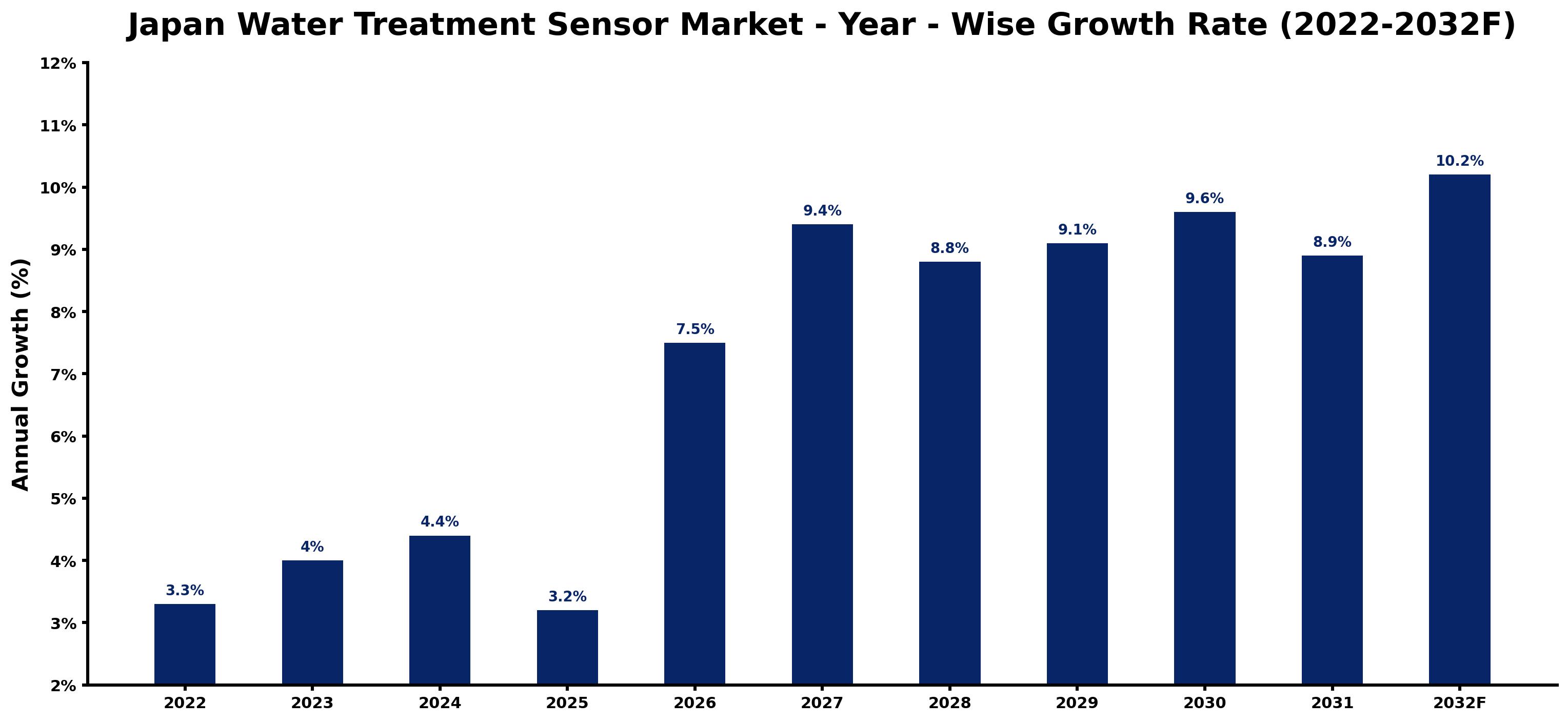
Annual growth estimates for each year appear below with the principal reason behind them, explaining the shifts that set the pace of the market.
| Year | Estimated Annual Growth (%) | Market Rationale |
| 2022 | 3.3 | The market showed steady growth, reflecting ongoing investments in water quality management. |
| 2023 | 4.0 | Demand increased as industries focused on compliance with environmental standards. |
| 2024 | 4.4 | Growth accelerated due to rising awareness of water quality issues among consumers. |
| 2025 | 3.2 | The market experienced a slowdown as some sectors adjusted to previous investments. |
| 2026 | 7.5 | Demand surged as new technologies significantly improved water treatment processes. |
| 2027 | 9.4 | Growth continued with increased investments in wastewater treatment facilities nationwide. |
| 2028 | 8.8 | The market saw a slowdown as growth stabilised after rapid technological adoption. |
| 2029 | 9.1 | Demand rose again as aquaculture expanded, requiring better monitoring solutions. |
| 2030 | 9.6 | Growth remained strong due to heightened scrutiny on water quality. |
| 2031 | 8.9 | The market experienced a slowdown as competition intensified among suppliers. |
| 2032 | 10.2 | Demand peaked as major infrastructure projects focused on advanced treatment technologies. |
Note: Market size estimations and growth projections presented in this report are based on 6Wresearch's proprietary forecasting methodology, utilizing the latest available industry data, government publications, and primary research inputs.
Japan Water Treatment Sensor Market Synopsis
Water treatment sensors monitor and analyse parameters such as pH, conductivity, and turbidity, ensuring compliance with environmental regulations. The Japan Water Treatment Sensor Market is expanding due to rising demand from the wastewater treatment sector and advancements in monitoring technologies. With over 1,200 registered facilities and support from the Ministry of the Environment's programmes, the market is set for considerable growth, underscoring the need to maintain water quality standards.
Market Dynamics Impact Analysis (2026–2032)
| Factor | Type | Impact | Primary Segment Affected |
| Rising regulatory requirements for water quality monitoring | Driver | High | pH Sensor |
| Technological advancements in sensor capabilities | Driver | High | Conductivity Sensor |
| Growing investments in wastewater treatment infrastructure | Opportunity | High | Wastewater Treatment |
| Expansion of aquaculture requiring enhanced water quality management | Opportunity | High | Aquaculture |
| High initial costs of advanced sensor technologies | Restraint | Medium | Turbidity Sensor |
| Limited awareness among smaller industrial users | Restraint | Medium | Conductivity Sensor |
| Intense competition among sensor manufacturers | Challenge | High | pH Sensor |
| Dependence on regulatory compliance for market growth | Challenge | High | Wastewater Treatment |
Evaluation of Drivers in Japan Water Treatment Sensor Market (2026–2032)
The following drivers explain most of the expected growth.
| Drivers | Primary Segment Affected | Why It Matters (Evidence) |
| Increasing environmental regulations | pH Sensor | The Ministry of the Environment mandates stringent water quality standards, driving demand for pH sensors in treatment facilities. |
| Technological improvements in sensor accuracy | Conductivity Sensor | Advanced sensor technology allows for precise ion concentration measurements, prompting higher purchases by industrial users. |
| Expansion of wastewater treatment facilities | Turbidity Sensor | With over 1,200 registered facilities, the need for turbidity sensors to ensure compliance is rising. |
| Growth in aquaculture production | ORP Sensor | Japan's aquaculture sector, producing around 600,000 tons of seafood, increasingly relies on ORP sensors for monitoring. |
| Investment in research and development | Clarity/Turbidity | Research institutions conduct numerous studies annually, boosting demand for clarity sensors in experimental applications. |
Spending rises because Japan's aquaculture sector produced approximately 600,000 tons of seafood in 2023, increasing the need for effective monitoring. The demand for turbidity sensors is rising to maintain clarity, supported by the presence of over 1,200 registered water treatment facilities. Technological advancements improve sensor accuracy, prompting more purchases by wastewater treatment plants. Research institutions conducting numerous studies annually further boost the demand for clarity sensors, reflecting a commitment to management.
Evaluation of Restraints in Japan Water Treatment Sensor Market
These are the pressures that could keep growth below its potential.
| Market Restraint | Primary Segment Affected | Why It Matters (Evidence) |
| High initial costs of advanced sensor technologies | Turbidity Sensor | The upfront investment for advanced turbidity sensors can deter smaller facilities from upgrading their systems. |
| Limited awareness among smaller industrial users | Conductivity Sensor | Many smaller users are unaware of the benefits of conductivity sensors, resulting in lower adoption rates. |
| Dependence on regulatory compliance for market growth | Wastewater Treatment | Market growth relies on strict adherence to regulations, which can fluctuate based on policy changes. |
| Challenges in integrating new technologies | pH Sensor | Existing facilities may struggle to integrate new pH sensor technologies into their operations, delaying upgrades. |
| Intense competition among sensor manufacturers | ORP Sensor | Increased competition can lead to price wars, affecting profit margins for manufacturers. |
Japan Water Treatment Sensor Market Challenges
Regulatory hurdles from the Water Quality Assurance Agency create obstacles for buyers, as compliance with national water standards can delay project approvals by up to six months. Rising operational costs affect suppliers, with Japan's national minimum wage reaching JPY 1,055 per hour, increasing production expenses. Buyers encounter difficulties in sourcing advanced water treatment sensors, as local supply struggles to meet the growing demand, extending project timelines by an average of three months. Skills shortages among technicians limit suppliers' capacity to install and maintain these sensors, resulting in increased downtime for facilities reliant on effective water treatment processes.
Trends in the Japan Water Treatment Sensor Market
Buyers and suppliers in the Japan Water Treatment Sensor Market are adjusting to the following trends.
- Shift towards Real-Time Water Quality Monitoring: In Japan, the trend is moving towards real-time monitoring systems, with over 300 wastewater treatment plants adopting advanced sensors. This shift improves compliance and operational efficiency.
- Adoption of ISO 9001 Standards: ISO 9001 is increasingly adopted by water treatment sensor manufacturers in Japan, ensuring quality management systems are in place. This trend is critical for maintaining competitive advantage.
- Focus on Environmental Sustainability: The Tokyo metropolitan area is prioritising sustainable water management practices, leading to increased investments in treatment technologies. This focus aligns with national environmental goals.
- Integration of IoT in Water Treatment: The integration of IoT technologies in treatment processes is gaining traction, with facilities using smart sensors for improved monitoring and data analysis.
Investment Opportunities in the Japan Water Treatment Sensor Market
The following areas offer the clearest openings for investors and suppliers in the Japan Water Treatment Sensor Market.
- Supply of Advanced pH Sensors: With Japan's focus on stringent water quality regulations, supplying advanced pH sensors is timely. The Ministry of the Environment's initiatives create a strong demand for compliance solutions.
- Investment in Wastewater Treatment Facilities: The Shiga Prefecture is expanding its wastewater treatment capabilities, presenting opportunities for suppliers of advanced monitoring technologies. This growth is driven by environmental compliance needs.
- Partnerships for Sensor Development: Forming joint ventures with local manufacturers can facilitate entry into the Japanese market, especially for advanced sensor technologies. This approach aligns with regional growth strategies.
- Timing for Aquaculture Expansion: As Japan's aquaculture sector grows, there is a pressing need for effective water quality management solutions. Suppliers can capitalise on this demand by offering tailored sensor technologies.
Government Initiatives in the Japan Water Treatment Sensor Market
The Water Supply Act (1957) sets strict standards for drinking-water quality and supply, impacting manufacturers by requiring compliance with these regulations. This law ensures that producers maintain high-quality standards in their products, which is essential for market acceptance. Additionally, the annual budget for water quality monitoring programmes is around 10 billion yen, supporting advancements in technology and compliance efforts.
The Water Quality Assurance Agency oversees compliance with national standards, approving technologies that meet regulatory requirements. This agency's funding for water quality monitoring programmes supports the development of advanced sensor technologies, benefiting producers and users alike.
Future Insight of the Japan Water Treatment Sensor Market
New automated monitoring systems will enhance water treatment facilities by 2032. The integration of advanced sensor technologies in various facilities will streamline operations and reduce costs. The Tokyo metropolitan area will implement real-time data analysis, improving decision-making capabilities. Nationwide water quality monitoring programs will continue to receive substantial funding, driving compliance and operational efficiency.
Market Segmentation Analysis
Japan Water Treatment Sensor Market report covers a detailed analysis of the following market segments:
By Product Type – pH Sensor Leads, Conductivity Sensor Expected to Grow Fastest
According to Saurav Kr Singh, Senior Research Analyst at 6Wresearch, in 2025, pH Sensor led the product type split with a 40% share. The pH sensor holds the largest share as it is essential for monitoring water acidity, crucial for compliance with environmental regulations. Its widespread use across Japan's numerous registered water treatment facilities underscores its importance in ensuring water quality. Conductivity Sensor is set to record the highest CAGR in this split, 13.5% over 2026–2032. The conductivity sensor is experiencing the fastest growth due to its critical role in assessing ion concentration, particularly in wastewater treatment plants. With over 300 facilities utilising these sensors, demand is expected to rise as regulatory standards tighten. This indicates that suppliers should focus on enhancing their pH and conductivity sensor offerings to meet the growing regulatory demands.
By Sensing Parameter – pH Level Leads, Clarity/Turbidity Expected to Grow Fastest
pH Level held 38% of the Japan Water Treatment Sensor Market by sensing parameter in 2025. The pH level is the leading parameter due to its key role in water quality assessment, ensuring compliance with national standards. The average pH level for treated water in Japan is maintained between 6.5 and 8.5, reflecting its importance in treatment processes. The quickest growth will come from Clarity/Turbidity, forecast to expand at a CAGR of 12.1% between 2026 and 2032. Clarity/turbidity is the fastest-growing parameter as it is essential for water quality monitoring, particularly in aquaculture. The increasing seafood production of approximately 600,000 tons in 2023 highlights the need for improved clarity measurements. Suppliers should prioritise advancements in clarity and turbidity monitoring technologies to cater to the growing aquaculture sector.
By Distribution Channel – Direct Sales Leads, Industrial Suppliers Expected to Grow Fastest
With 46% of distribution channel revenue in 2025, Direct Sales was the largest category. Direct sales dominate the distribution channel as they serve as the primary channel for industrial users, ensuring tailored solutions for specific needs. This method allows for direct engagement with clients, facilitating better service and support. Industrial Suppliers are projected to grow fastest, at a CAGR of 11.9% during 2026–2032. Industrial suppliers are the fastest-growing channel, acting as a key source for large-scale users who require bulk purchasing options. The increasing number of industrial water plants in the Tokyo metropolitan area drives this growth. Suppliers must strengthen relationships with industrial suppliers to capture the expanding market share effectively.
By End User – Wastewater Treatment Leads, Aquaculture Expected to Grow Fastest
Wastewater Treatment accounted for 45% of the market by end user in 2025. Wastewater treatment is the leading end user as it is critical for environmental compliance, with numerous facilities mandated to monitor water quality. The oversight by the Water Quality Assurance Agency ensures stringent adherence to standards. Over 2026–2032, Aquaculture is expected to post the fastest growth, at a CAGR of 12.0%. Aquaculture is the fastest-growing end user due to its importance in maintaining water quality for seafood production. The sector's output of approximately 600,000 tons in 2023 underscores the increasing demand for effective monitoring solutions. This growth suggests that suppliers should tailor their products to meet the specific needs of the aquaculture industry.
Key Attractiveness of the Report
- 10 Years of Market Numbers
- Historical Data Starting from 2022 to 2025
- Base Year 2025
- Forecast Data until 2032
- Key Performance Indicators Impacting the Market
- Major Upcoming Developments and Projects
Key Highlights of the Report:
- Japan Water Treatment Sensor Market Outlook
- Market Size of Japan Water Treatment Sensor Market, 2025
- Forecast of Japan Water Treatment Sensor Market, 2032
- Historical Data and Forecast of Japan Water Treatment Sensor Revenues & Volume for the Period 2022-2032F
- Japan Water Treatment Sensor Market Trend Evolution
- Japan Water Treatment Sensor Market Drivers and Challenges
- Japan Water Treatment Sensor Price Trends
- Japan Water Treatment Sensor Porter's Five Forces
- Japan Water Treatment Sensor Industry Life Cycle
- Historical Data and Forecast of Japan Water Treatment Sensor Market Revenues & Volume By Product Type for the Period 2022-2032F
- Historical Data and Forecast of Japan Water Treatment Sensor Market Revenues & Volume By pH Sensor for the Period 2022-2032F
- Historical Data and Forecast of Japan Water Treatment Sensor Market Revenues & Volume By Conductivity Sensor for the Period 2022-2032F
- Historical Data and Forecast of Japan Water Treatment Sensor Market Revenues & Volume By ORP Sensor for the Period 2022-2032F
- Historical Data and Forecast of Japan Water Treatment Sensor Market Revenues & Volume By Turbidity Sensor for the Period 2022-2032F
- Historical Data and Forecast of Japan Water Treatment Sensor Market Revenues & Volume By Sensing Parameter for the Period 2022-2032F
- Historical Data and Forecast of Japan Water Treatment Sensor Market Revenues & Volume By pH Level for the Period 2022-2032F
- Historical Data and Forecast of Japan Water Treatment Sensor Market Revenues & Volume By Salinity for the Period 2022-2032F
- Historical Data and Forecast of Japan Water Treatment Sensor Market Revenues & Volume By Oxidation-Reduction for the Period 2022-2032F
- Historical Data and Forecast of Japan Water Treatment Sensor Market Revenues & Volume By Clarity/Turbidity for the Period 2022-2032F
- Historical Data and Forecast of Japan Water Treatment Sensor Market Revenues & Volume By Distribution Channel for the Period 2022-2032F
- Historical Data and Forecast of Japan Water Treatment Sensor Market Revenues & Volume By Direct Sales for the Period 2022-2032F
- Historical Data and Forecast of Japan Water Treatment Sensor Market Revenues & Volume By Online Platforms for the Period 2022-2032F
- Historical Data and Forecast of Japan Water Treatment Sensor Market Revenues & Volume By Industrial Suppliers for the Period 2022-2032F
- Historical Data and Forecast of Japan Water Treatment Sensor Market Revenues & Volume By Distributors for the Period 2022-2032F
- Historical Data and Forecast of Japan Water Treatment Sensor Market Revenues & Volume By End User for the Period 2022-2032F
- Historical Data and Forecast of Japan Water Treatment Sensor Market Revenues & Volume By Industrial Water Plants for the Period 2022-2032F
- Historical Data and Forecast of Japan Water Treatment Sensor Market Revenues & Volume By Wastewater Treatment for the Period 2022-2032F
- Historical Data and Forecast of Japan Water Treatment Sensor Market Revenues & Volume By Aquaculture for the Period 2022-2032F
- Historical Data and Forecast of Japan Water Treatment Sensor Market Revenues & Volume By Research Institutions for the Period 2022-2032F
- Japan Water Treatment Sensor Import Export Trade Statistics
- Market Opportunity Assessment By Product Type
- Market Opportunity Assessment By Sensing Parameter
- Market Opportunity Assessment By Distribution Channel
- Market Opportunity Assessment By End User
- Japan Water Treatment Sensor Top Companies Market Share
- Japan Water Treatment Sensor Competitive Benchmarking By Technical and Operational Parameters
- Japan Water Treatment Sensor Company Profiles
- Japan Water Treatment Sensor Key Strategic Recommendations
Market Covered
The report covers the following segments.
By Product Type
- pH Sensor
- Conductivity Sensor
- ORP Sensor
- Turbidity Sensor
By Sensing Parameter
- pH Level
- Salinity
- Oxidation-Reduction
- Clarity/Turbidity
By Distribution Channel
- Direct Sales
- Online Platforms
- Industrial Suppliers
- Distributors
By End User
- Industrial Water Plants
- Wastewater Treatment
- Aquaculture
- Research Institutions































