Japan Wavefront Technology Market Size & Growth Rate
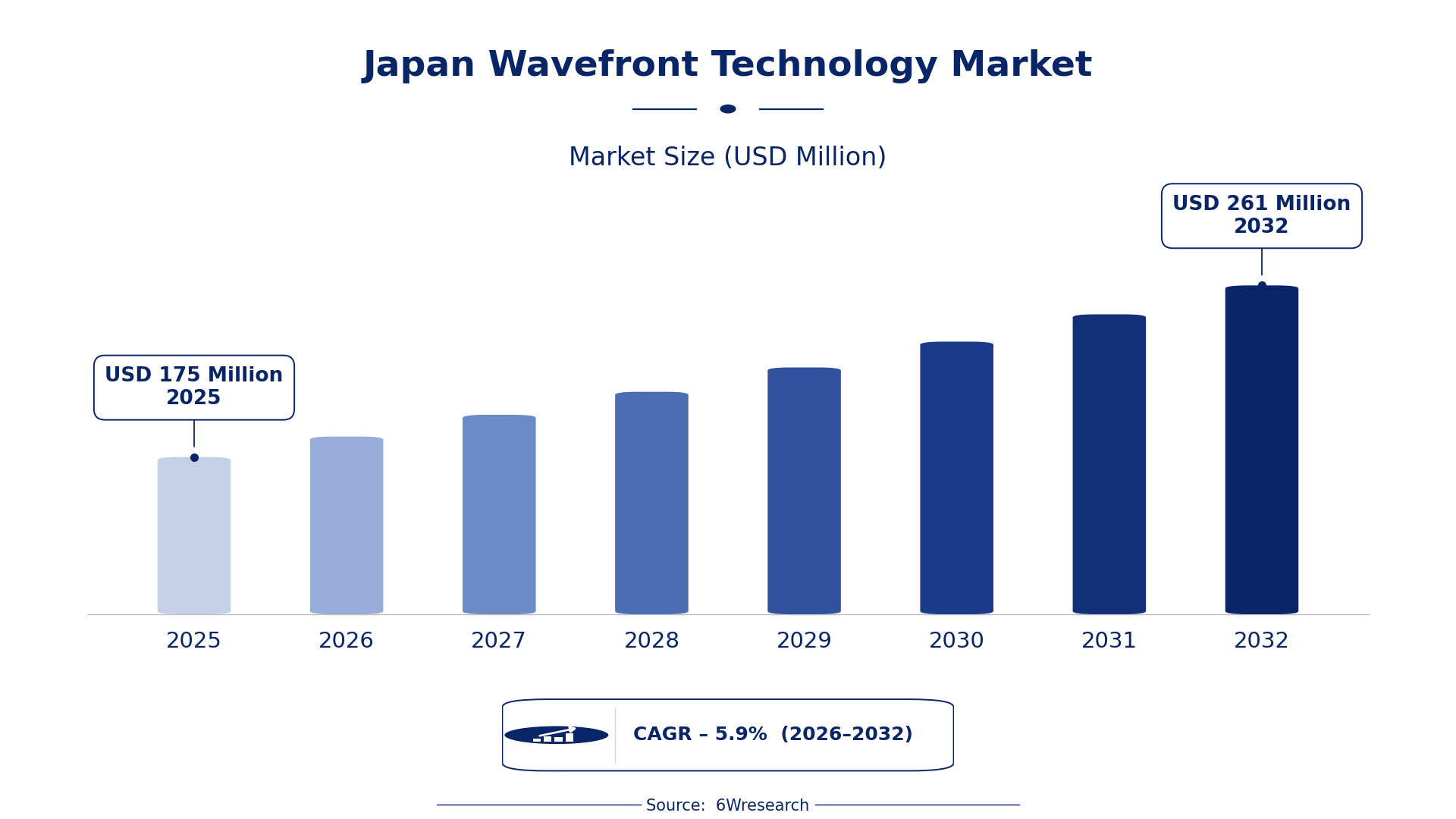
According to 6Wresearch internal database and industry insights, the Japan Wavefront Technology Market was valued at USD 175 Million in 2025 and is projected to reach USD 261 Million by 2032, growing at a CAGR of approximately 5.9% during 2026–2032.
Japan Wavefront Technology Market Highlights
| Report Metric | Details |
| Report Name | Japan Wavefront Technology Market (2026-2032) |
| Market Size 2025 | USD 175 Million |
| Market Size 2032 | USD 261 Million |
| Absolute Growth 2025–2032 | USD 86 Million |
| CAGR 2026–2032 | 5.9% |
| Peak Annual Growth | 7.4% in 2026 |
| Forecast Period | 2026–2032 |
| Historical Data | 2022–2025 |
| Base Year | 2025 |
| Leading Product Type, 2025 | Adaptive Optics (46% share) |
| Leading Application Area, 2025 | Vision Testing (52% share) |
| Leading Distribution Channel, 2025 | Direct Sales (50% share) |
| Leading End User, 2025 | Ophthalmology Clinics (38% share) |
| Fastest-Growing Product Type | Wavefront Sensors (8.1% CAGR) |
| Fastest-Growing Application Area | Refractive Analysis (6.9% CAGR) |
| Fastest-Growing Distribution Channel | Medical Distributors (7.3% CAGR) |
| Fastest-Growing End User | LASIK Centers (7.4% CAGR) |
| Growing Sector | Healthcare |
| Key End Users | Ophthalmology Clinics, LASIK Centers, Research Institutions, Space Observatories |
Japan Wavefront Technology Market Year-wise Growth Rate and Key Drivers (2022–2032)
This graph illustrates the annual growth rates of the market from 2022 to 2032, highlighting a steady upward trajectory and projected market expansion over the forecast period.
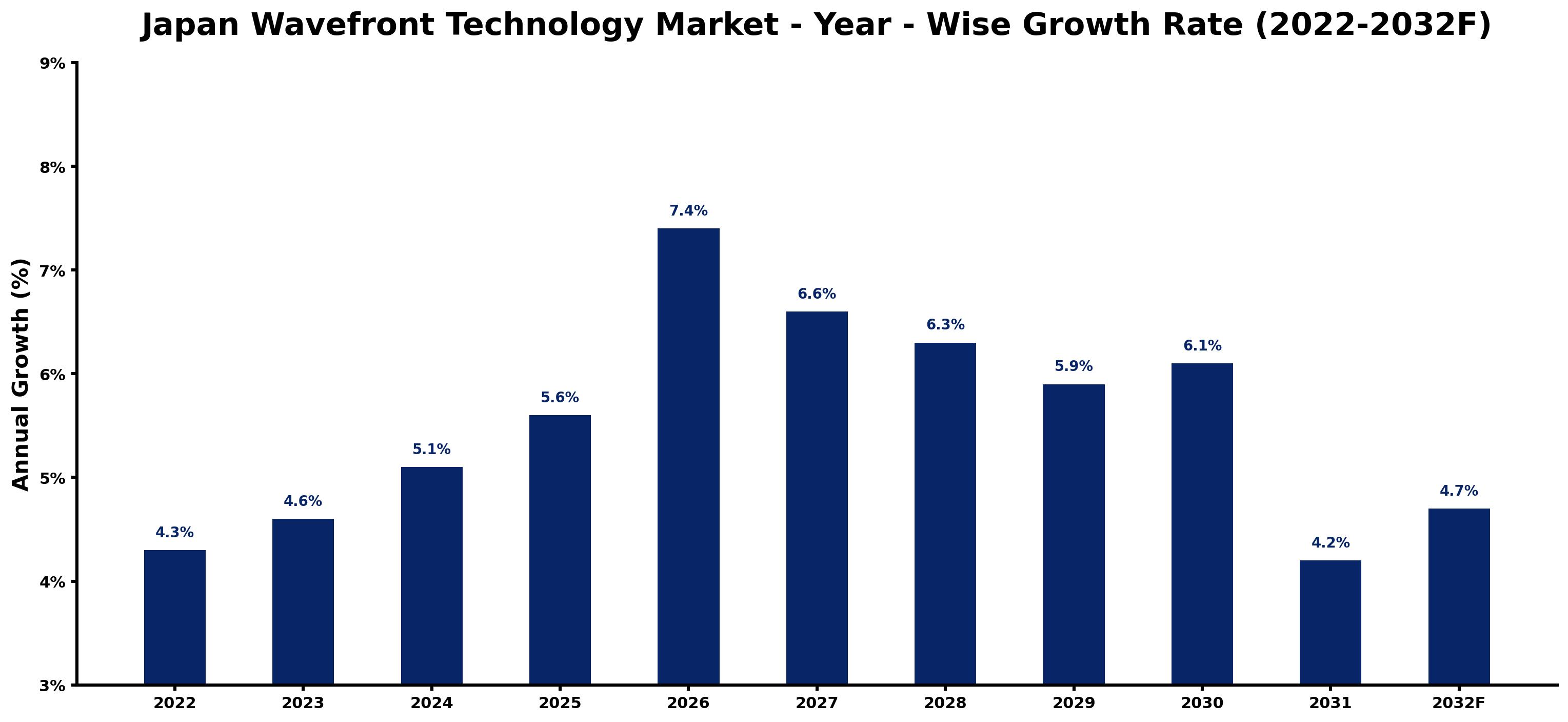
Each row of the following table gives one year's estimated growth and the event or demand shift that explains it.
| Year | Estimated Annual Growth (%) | Market Rationale |
| 2022 | 4.3 | The market experienced stable demand from medical facilities and research institutions. |
| 2023 | 4.6 | Growth was driven by increased investments in optical technology research. |
| 2024 | 5.1 | Rising adoption of wavefront technology in LASIK procedures boosted market performance. |
| 2025 | 5.6 | The market reached a historical peak due to heightened demand in vision correction. |
| 2026 | 7.4 | Demand surged as wavefront sensors became integral in LASIK procedures. |
| 2027 | 6.6 | Growth slowed as the market adjusted to previous high levels of demand. |
| 2028 | 6.3 | Continued investments in adaptive optics research are expected to moderate growth rates. |
| 2029 | 5.9 | A slight slowdown is projected as the market stabilises after peak growth. |
| 2030 | 6.1 | The market is expected to rebound with renewed interest in advanced imaging systems. |
| 2031 | 4.2 | Growth will decelerate as competition intensifies among medical distributors. |
| 2032 | 4.7 | A slight increase in growth is anticipated due to ongoing technological advancements. |
Note: Market size estimations and growth projections presented in this report are based on 6Wresearch's proprietary forecasting methodology, utilizing the latest available industry data, government publications, and primary research inputs.
Japan Wavefront Technology Market Synopsis
Wavefront technology involves measuring and manipulating light wavefronts to improve imaging systems, primarily used in ophthalmology and aerospace applications. The Japan Wavefront Technology Market is expanding due to rising demand from over 1,200 ophthalmology clinics and substantial investments in optical technology research, particularly in the Tokyo region. Government support for innovation in optical systems and the increasing need for vision correction are driving purchases, indicating a positive market outlook.
Market Dynamics Impact Analysis (2026–2032)
| Factor | Type | Impact | Primary Segment Affected |
| Growing demand for vision correction procedures | Driver | High | Vision Testing |
| Increased investment in adaptive optics research | Driver | High | Adaptive Optics |
| Expansion of LASIK centers in urban areas | Opportunity | High | LASIK Centers |
| Rising need for advanced imaging devices | Opportunity | Medium | Imaging Devices |
| High competition among medical distributors | Restraint | High | Medical Distributors |
| Limited awareness of wavefront technology benefits | Restraint | Medium | Ophthalmology Clinics |
| Supply chain disruptions affecting component availability | Challenge | High | Wavefront Sensors |
| Technological advancements outpacing market adaptation | Challenge | Medium | Adaptive Optics |
Evaluation of Drivers in Japan Wavefront Technology Market (2026–2032)
Below are the drivers that matter most for revenue growth, with supporting evidence.
| Drivers | Primary Segment Affected | Why It Matters (Evidence) |
| Increased LASIK procedures | Wavefront Sensors | Wavefront sensors are critical in over 80% of LASIK procedures, driving demand for accurate measurement systems. |
| Rising investments in optical technology | Adaptive Optics | The Tokyo region attracts substantial funding for research, boosting technology adoption. |
| Growing patient population needing vision correction | Vision Testing | Approximately 126 million people in Japan require vision correction, increasing demand for testing technologies. |
| Technological advancements in imaging devices | Imaging Devices | Wavefront technology enhances image clarity, increasing demand for advanced imaging systems in various applications. |
| Support from the Japan Society of Applied Optics | Aberrometers | The society promotes advancements in wavefront technology, encouraging the adoption of aberrometers in clinical settings. |
The strongest pull on demand comes from the increasing number of LASIK procedures, where wavefront sensors are critical, being used in over 80% of such surgeries. Japan's population includes a substantial segment requiring vision correction, driving demand for vision testing technologies. Investments in optical technology, particularly in the Tokyo region, have led to advancements in adaptive optics, improving imaging systems. The Japan Society of Applied Optics promotes innovation in aberrometers, vital for precise optical measurements. These factors stimulate purchasing across healthcare and aerospace sectors.
Evaluation of Restraints in Japan Wavefront Technology Market
These are the pressures that could keep growth below its potential.
| Market Restraint | Primary Segment Affected | Why It Matters (Evidence) |
| Intense competition among medical distributors | Medical Distributors | High competition limits profit margins, affecting the ability to invest in new technologies and services. |
| Lack of awareness regarding technology benefits | Ophthalmology Clinics | Limited understanding of wavefront technology's advantages hinders adoption rates among clinics. |
| Supply chain issues impacting component availability | Wavefront Sensors | Disruptions in the supply chain delay production and delivery of essential components. |
| Regulatory hurdles for new product approvals | Adaptive Optics | Stringent regulations slow down the introduction of new products to the market. |
| High costs associated with advanced imaging systems | Imaging Devices | The expense of implementing new technologies can deter clinics from upgrading their systems. |
Japan Wavefront Technology Market Challenges
Producers in ophthalmology clinics face high costs due to outdated wavefront technology, resulting in patient wait times extending by 30%. This problem exists because many clinics rely on legacy systems that require costly upgrades, delaying service delivery. Regulatory challenges hinder the introduction of new technologies; compliance with the JIS Z 8401 standard can prolong the certification process for new devices by six months, restricting clinics' ability to offer the latest treatments. Skills shortages in advanced optics limit the workforce available for developing these systems, causing underutilised equipment and lost revenue for producers.
Trends in the Japan Wavefront Technology Market
The shifts below are changing how Japan Wavefront Technology Market products are bought and supplied.
- Increased Investment in Wavefront Sensors: In 2023, Japan's space observatories reported increased investments in wavefront sensors, improving their imaging capabilities. This trend reflects a growing focus on precision in astronomical research, indicating a shift in demand for advanced imaging technologies.
- Transition to Wavefront-guided LASIK: The adoption of wavefront-guided LASIK procedures began to rise in 2023, with over 80% of procedures utilizing this technology. This shift improves surgical outcomes, prompting more clinics to invest in wavefront technology.
- Adoption of Adaptive Optics in Telescopes: Adaptive optics technology has been employed in over 200 telescopes nationwide since 2022, allowing for clearer astronomical observations. This trend underscores the increasing reliance on advanced optical systems for research.
- Increased Research Funding for Optical Technologies: The government allocated funds for optical technology innovation projects in 2023, supporting advancements in wavefront technology. This prioritisation encourages further development and application across various sectors.
Investment Opportunities in the Japan Wavefront Technology Market
The openings below show where demand in the Japan Wavefront Technology Market is visible and how suppliers can enter.
- Gap in Advanced Imaging Device Supply: With Japan's imaging devices market projected to grow, there is a gap for suppliers of advanced wavefront correctors. Medical distributors in urban areas can capitalise on this opportunity by partnering with local clinics.
- Expansion of LASIK Centers: The increasing number of LASIK centers presents an opportunity for suppliers of wavefront sensors. Investing in partnerships with clinics can meet the growing need for vision correction.
- Surge in Vision Testing Equipment Demand: As Japan's population ages, the demand for vision testing equipment is surging. Suppliers can target ophthalmology clinics in metropolitan regions to effectively meet this growing need.
- Focus on Research Facility Expansion: The Tokyo region's focus on adaptive optics research creates an opportunity for suppliers of wavefront technology. Collaborating with research institutions can facilitate entry into this expanding market.
Government Initiatives in the Japan Wavefront Technology Market
The Economic Security Promotion Act, enacted in 2022, supports supply-chain resilience for critical products, impacting wavefront technology producers by ensuring a stable supply of essential components. This measure encourages investments in local manufacturing capabilities, supporting the growth of the wavefront technology market.
The PMDA reviews and approves medical devices, including wavefront technology products. This agency ensures that ophthalmology clinics can trust the safety and efficacy of the technologies they implement, directly benefiting buyers in the healthcare sector.
Future Insight of the Japan Wavefront Technology Market
New optical technology innovation projects will emerge by 2032, driven by government funding and research initiatives. Investments in wavefront sensors will increase, with over 500 imaging devices expected to incorporate advanced technology, enhancing imaging quality. The Tokyo region will solidify its position as a research hub, enabling collaborations between medical facilities and research institutions. As adaptive optics technology expands into new sectors, suppliers will find opportunities in aerospace and healthcare applications.
Market Segmentation Analysis
Japan Wavefront Technology Market report covers a detailed analysis of the following market segments:
By Product Type – Adaptive Optics Lead, Wavefront Sensors Expected to Grow Fastest
According to Saurav Kr Singh, Senior Research Analyst at 6Wresearch, Adaptive Optics held 46% of the Japan Wavefront Technology Market by product type in 2025. Adaptive optics holds the largest share due to its essential role in correcting distortions in imaging systems, particularly in healthcare settings. Its application in over 80% of LASIK procedures in Japan showcases its critical importance in vision correction. Wavefront Sensors are projected to grow fastest, at a CAGR of 8.1% during 2026–2032. Wavefront sensors are experiencing rapid growth as they are vital for accurately measuring wavefront aberrations, which enhance optical performance. The increased investments in wavefront sensors reported by space observatories in 2023 highlight their growing relevance in advanced imaging applications. Suppliers should focus on advancing wavefront sensor technologies to meet the rising demand in both medical and aerospace sectors.
By Application Area – Vision Testing Leads, Refractive Analysis Expected to Grow Fastest
The largest application area category in 2025 was Vision Testing, at 52% of revenue. Vision testing leads the market because it is crucial for assessing and correcting vision impairments, with a significant portion of Japan's population in need of vision correction. The extensive use of vision testing across more than 1,200 ophthalmology clinics underscores its central role in the industry. Over 2026–2032, Refractive Analysis is expected to post the fastest growth, at a CAGR of 6.9%. Refractive analysis is the fastest-growing segment as it is key for evaluating and treating refractive errors in patients. The increasing number of individuals seeking corrective procedures is driving this segment's rapid expansion. Suppliers should enhance refractive analysis technologies to capitalise on the growing demand for vision correction solutions.
By Distribution Channel – Direct Sales Leads, Medical Distributors Expected to Grow Fastest
Direct Sales accounted for 50% of the market by distribution channel in 2025. Direct sales is the leading distribution channel as it serves as the primary method for delivering wavefront technology products directly to end-users. This approach ensures that medical facilities have timely access to the latest technological advancements. The quickest growth will come from Medical Distributors, forecast to expand at a CAGR of 7.3% between 2026 and 2032. Medical distributors are the fastest-growing channel, playing a crucial role in distributing medical wavefront technology to clinics. The rising reliance on specialised distributors to reach healthcare providers is propelling this segment's growth. Suppliers should strengthen partnerships with medical distributors to enhance their market presence and accessibility.
By End User – Ophthalmology Clinics Lead, LASIK Centers Expected to Grow Fastest
In 2025, Ophthalmology Clinics led the end user split with a 38% share. Ophthalmology clinics represent the largest end-user group, serving as the primary users of wavefront technology for vision correction procedures. The substantial number of clinics across Japan indicates a strong and consistent demand for these technologies. LASIK Centers are set to record the highest CAGR in this split, 7.4% over 2026–2032. LASIK centers are the fastest-growing end-user segment, directly utilising wavefront technology for laser eye surgeries. The increasing popularity of LASIK procedures among patients is significantly driving this rapid growth. This indicates that suppliers should tailor their offerings specifically for LASIK centers to effectively capture this expanding market.
Key Attractiveness of the Report
- 10 Years of Market Numbers
- Historical Data Starting from 2022 to 2025
- Base Year 2025
- Forecast Data until 2032
- Key Performance Indicators Impacting the Market
- Major Upcoming Developments and Projects
Key Highlights of the Report:
- Japan Wavefront Technology Market Outlook
- Market Size of Japan Wavefront Technology Market, 2025
- Forecast of Japan Wavefront Technology Market, 2032
- Historical Data and Forecast of Japan Wavefront Technology Revenues & Volume for the Period 2022-2032F
- Japan Wavefront Technology Market Trend Evolution
- Japan Wavefront Technology Market Drivers and Challenges
- Japan Wavefront Technology Price Trends
- Japan Wavefront Technology Porter's Five Forces
- Japan Wavefront Technology Industry Life Cycle
- Historical Data and Forecast of Japan Wavefront Technology Market Revenues & Volume By Product Type for the Period 2022-2032F
- Historical Data and Forecast of Japan Wavefront Technology Market Revenues & Volume By Adaptive Optics for the Period 2022-2032F
- Historical Data and Forecast of Japan Wavefront Technology Market Revenues & Volume By Wavefront Sensors for the Period 2022-2032F
- Historical Data and Forecast of Japan Wavefront Technology Market Revenues & Volume By Aberrometers for the Period 2022-2032F
- Historical Data and Forecast of Japan Wavefront Technology Market Revenues & Volume By Wavefront Correctors for the Period 2022-2032F
- Historical Data and Forecast of Japan Wavefront Technology Market Revenues & Volume By Application Area for the Period 2022-2032F
- Historical Data and Forecast of Japan Wavefront Technology Market Revenues & Volume By Telescopes for the Period 2022-2032F
- Historical Data and Forecast of Japan Wavefront Technology Market Revenues & Volume By Vision Testing for the Period 2022-2032F
- Historical Data and Forecast of Japan Wavefront Technology Market Revenues & Volume By Refractive Analysis for the Period 2022-2032F
- Historical Data and Forecast of Japan Wavefront Technology Market Revenues & Volume By Imaging Devices for the Period 2022-2032F
- Historical Data and Forecast of Japan Wavefront Technology Market Revenues & Volume By Distribution Channel for the Period 2022-2032F
- Historical Data and Forecast of Japan Wavefront Technology Market Revenues & Volume By Direct Sales for the Period 2022-2032F
- Historical Data and Forecast of Japan Wavefront Technology Market Revenues & Volume By Online Platforms for the Period 2022-2032F
- Historical Data and Forecast of Japan Wavefront Technology Market Revenues & Volume By Medical Distributors for the Period 2022-2032F
- Historical Data and Forecast of Japan Wavefront Technology Market Revenues & Volume By Industrial Suppliers for the Period 2022-2032F
- Historical Data and Forecast of Japan Wavefront Technology Market Revenues & Volume By End User for the Period 2022-2032F
- Historical Data and Forecast of Japan Wavefront Technology Market Revenues & Volume By Space Observatories for the Period 2022-2032F
- Historical Data and Forecast of Japan Wavefront Technology Market Revenues & Volume By Ophthalmology Clinics for the Period 2022-2032F
- Historical Data and Forecast of Japan Wavefront Technology Market Revenues & Volume By LASIK Centers for the Period 2022-2032F
- Historical Data and Forecast of Japan Wavefront Technology Market Revenues & Volume By Defense R&D Labs for the Period 2022-2032F
- Japan Wavefront Technology Import Export Trade Statistics
- Market Opportunity Assessment By Product Type
- Market Opportunity Assessment By Application Area
- Market Opportunity Assessment By Distribution Channel
- Market Opportunity Assessment By End User
- Japan Wavefront Technology Top Companies Market Share
- Japan Wavefront Technology Competitive Benchmarking By Technical and Operational Parameters
- Japan Wavefront Technology Company Profiles
- Japan Wavefront Technology Key Strategic Recommendations
Market Covered
Coverage by segment is as follows.
By Product Type
- Adaptive Optics
- Wavefront Sensors
- Aberrometers
- Wavefront Correctors
By Application Area
- Telescopes
- Vision Testing
- Refractive Analysis
- Imaging Devices
By Distribution Channel
- Direct Sales
- Online Platforms
- Medical Distributors
- Industrial Suppliers
By End User
- Space Observatories
- Ophthalmology Clinics
- LASIK Centers
- Defense R&D Labs































