Japan Wearable Computing Devices Market Size & Growth Rate
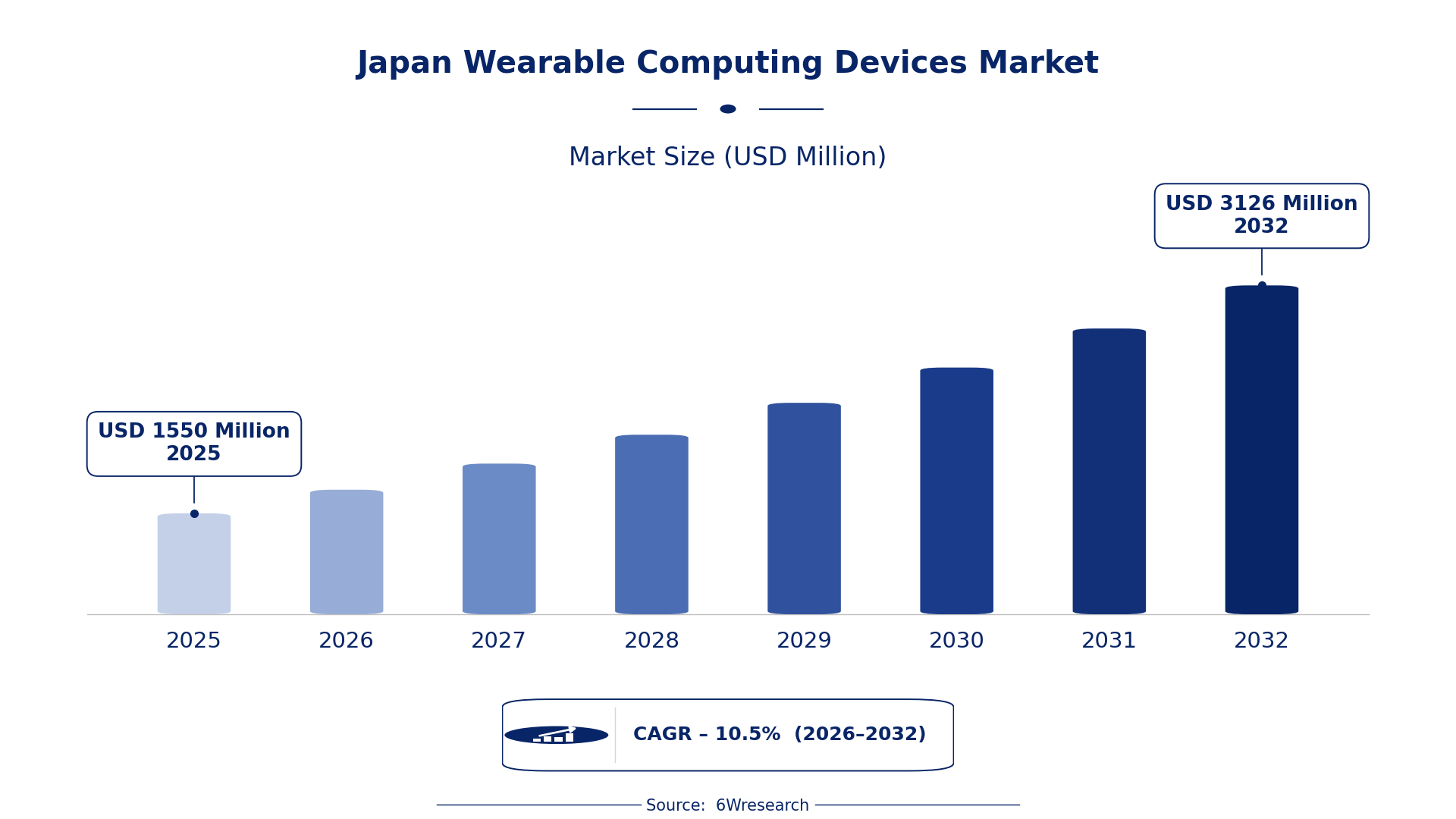
According to 6Wresearch internal database and industry insights, the Japan Wearable Computing Devices Market was valued at USD 1,550 Million in 2025 and is projected to reach USD 3,126 Million by 2032, growing at a CAGR of approximately 10.5% during 2026–2032.
Japan Wearable Computing Devices Market Highlights
| Report Metric | Details |
| Report Name | Japan Wearable Computing Devices Market (2026-2032) |
| Market Size 2025 | USD 1,550 Million |
| Market Size 2032 | USD 3,126 Million |
| Absolute Growth 2025–2032 | USD 1,576 Million |
| CAGR 2026–2032 | 10.5% |
| Peak Annual Growth | 11.1% in 2032 |
| Forecast Period | 2026–2032 |
| Historical Data | 2022–2025 |
| Base Year | 2025 |
| Leading Product Type, 2025 | Smart Watches (40% share) |
| Leading Connectivity Type, 2025 | Bluetooth (40% share) |
| Leading Application, 2025 | Fitness and Wellness (32% share) |
| Fastest-Growing Product Type | Head Mounted Displays (15.7% CAGR) |
| Fastest-Growing Connectivity Type | Wi-Fi (15.6% CAGR) |
| Fastest-Growing Application | Medical and Healthcare (14.9% CAGR) |
| Growing Sector | Medical and Healthcare |
| Key End Users | Fitness and Wellness, Medical and Healthcare, Infotainment, Industrial and Defense |
Japan Wearable Computing Devices Market Year-wise Growth Rate and Key Drivers (2022–2032)
This graph illustrates the annual growth rates of the market from 2022 to 2032, highlighting a steady upward trajectory and projected market expansion over the forecast period.
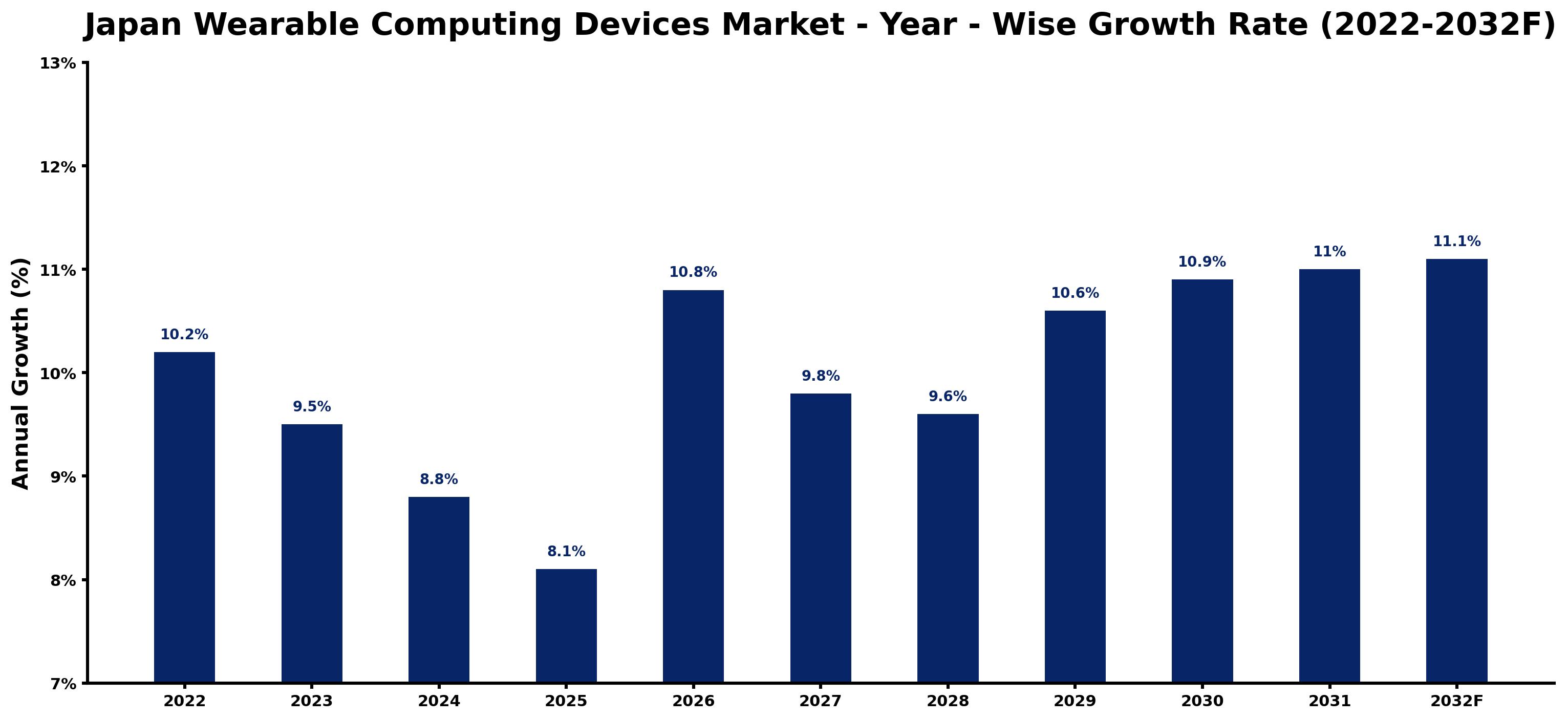
For each year, the table pairs the estimated growth rate with the leading influence on demand, showing how the drivers changed across the period.
| Year | Estimated Annual Growth (%) | Market Rationale |
| 2022 | 10.2 | The market was characterised by strong consumer interest in health monitoring devices. |
| 2023 | 9.5 | Growth slowed due to market saturation and increased competition among device manufacturers. |
| 2024 | 8.8 | The trend of health awareness continued to support steady demand for wearable devices. |
| 2025 | 8.1 | Consumer adoption of fitness trackers among the elderly increased, contributing to market growth. |
| 2026 | 10.8 | A resurgence in demand for health technologies is expected to drive growth. |
| 2027 | 9.8 | The market continues to expand as health-conscious consumers seek advanced wearable solutions. |
| 2028 | 9.6 | Technological advancements are anticipated to improve the appeal of wearable devices. |
| 2029 | 10.6 | Growing interest in telehealth services is expected to boost the wearable medical segment. |
| 2030 | 10.9 | Increased investment in health tech initiatives will further stimulate market growth. |
| 2031 | 11.0 | The market is projected to benefit from rising health awareness and technological integration. |
| 2032 | 11.1 | A surge in demand for connected health devices is likely to peak this year. |
Note: Market size estimations and growth projections presented in this report are based on 6Wresearch's proprietary forecasting methodology, utilizing the latest available industry data, government publications, and primary research inputs.
Japan Wearable Computing Devices Market Synopsis
Wearable computing devices are electronic gadgets worn on the body, equipped with sensors to monitor health metrics and fitness. They utilise advanced materials and technology, serving applications in health monitoring and fitness tracking. The Japan Wearable Computing Devices Market is expanding due to rising health consciousness among consumers and continuous technological advancements. The 'Health Japan 21' initiative promotes health management through technology, while the increasing elderly population drives demand for monitoring solutions, contributing to a growing market.
Market Dynamics Impact Analysis (2026–2032)
| Factor | Type | Impact | Primary Segment Affected |
| Growing health awareness among consumers drives demand for fitness trackers and smart watches. | Driver | High | Fitness Trackers |
| The increasing elderly population creates a need for health monitoring solutions. | Driver | High | Smart Watches |
| The rise in telehealth services presents opportunities for wearable medical devices. | Opportunity | High | Medical and Healthcare |
| Investment in health tech initiatives opens new avenues for wearable technology. | Opportunity | High | Fitness and Wellness |
| Market saturation limits growth potential for new entrants in the wearable sector. | Restraint | Medium | Smart Watches |
| High competition among manufacturers can lead to price wars, affecting profitability. | Restraint | Medium | Fitness Trackers |
| Technological integration challenges can delay product development timelines. | Challenge | High | Head Mounted Displays |
| Regulatory hurdles can slow the approval process for new wearable medical devices. | Challenge | Medium | Medical and Healthcare |
Evaluation of Drivers in Japan Wearable Computing Devices Market (2026–2032)
The following drivers explain most of the expected growth.
| Drivers | Primary Segment Affected | Why It Matters (Evidence) |
| Health-conscious consumers are increasingly adopting fitness trackers for personal health management. | Fitness Trackers | In 2023, a campaign was launched to encourage fitness tracker use among the elderly, driving demand. |
| Smart watches are gaining popularity for their health monitoring capabilities and connectivity features. | Smart Watches | Over 40% of the wearable market share in Japan in 2022 was attributed to smart watches, reflecting consumer preference. |
| The rise of telehealth services is increasing the demand for wearable medical devices. | Medical and Healthcare | Japan's national medical care expenditure reached about JPY 46.7 trillion in fiscal 2022, highlighting the healthcare sector's growth. |
| Bluetooth connectivity is essential for the functionality of wearable devices, enhancing user experience. | Bluetooth | Bluetooth is standard in 90% of wearable devices sold in Japan, ensuring connectivity. |
| The increasing elderly population is driving demand for wearable health monitoring solutions. | Smart Watches | 29.3% of Japan's population was aged 65 or older in September 2024, creating a significant market for health-focused wearables. |
Volumes grow on the back of the increasing elderly population, which drives demand for health monitoring solutions. In 2023, a campaign was launched to encourage the use of fitness trackers among older adults, boosting sales. Smart watches accounted for over 40% of the wearable market share in Japan in 2022, reflecting consumer preference for health-oriented devices. Japan's national medical care expenditure reached about JPY 46.7 trillion in fiscal 2022, further supporting the growth of wearable medical devices as telehealth services expand. The increasing elderly population, with 29.3% aged 65 or older, creates a substantial market for health-focused wearables.
Evaluation of Restraints in Japan Wearable Computing Devices Market
The key brakes on demand, and where they bite hardest, are shown below.
| Market Restraint | Primary Segment Affected | Why It Matters (Evidence) |
| Producers face high costs due to strict regulations under the Pharmaceuticals and Medical Devices Act, delaying product launches by up to six months. | Smart Watches | These regulations require extensive testing and compliance, impacting the speed of market entry. |
| Buyers encounter challenges accessing affordable wearable devices, as the average price point remains elevated, limiting adoption among health-conscious consumers. | Fitness Trackers | High prices deter potential users, particularly among the elderly population. |
| Supply chain disruptions arise from reliance on imported components, leading to delays in delivery times of up to eight weeks for hospitals needing timely access to health monitoring tools. | Smart Watches | This reliance complicates logistics and affects the availability of devices. |
| Increased competition from emerging startups pressures established suppliers to lower prices, impacting profit margins by an estimated 15%. | Smart Watches | Established brands must adapt to maintain market share against new entrants. |
| Limited consumer awareness of the full capabilities of wearable devices restricts market growth potential. | Fitness Trackers | Many consumers remain unaware of features that could improve their health management. |
Japan Wearable Computing Devices Market Challenges
High costs for buyers arise from stringent regulations under the Pharmaceuticals and Medical Devices Act, which can delay product launches by up to six months. Buyers face elevated prices for wearable computing devices, with the average cost around JPY 20,000, restricting access for health-conscious consumers. Supply chain disruptions occur due to reliance on imported components, leading to delivery delays of up to eight weeks for hospitals needing timely health monitoring tools. Increased competition from new startups forces established suppliers to lower prices, which can reduce profit margins by about 15%.
Trends in the Japan Wearable Computing Devices Market
Below are the shifts with the largest effect on the Japan Wearable Computing Devices Market.
- Shift Towards Health Monitoring: Japan is experiencing a shift towards health monitoring solutions as consumers increasingly adopt wearable devices. In 2023, the Ministry of Health, Labour and Welfare launched a campaign to promote fitness trackers, encouraging usage among older adults.
- Rise of Telehealth Integration: The integration of telehealth services is transforming the wearable market. In 2022, Japan's national medical care expenditure reached approximately JPY 46.7 trillion, driving demand for wearable medical devices.
- Increased Adoption of Smart Watches: The popularity of smart watches is growing as consumers seek multifunctional health monitoring tools. In 2022, smart watches accounted for over 40% of the wearable market share in Japan.
- Expansion of Bluetooth Connectivity: Bluetooth connectivity is becoming standard in wearable devices, improving user experience. In 2022, Bluetooth was standard in 90% of wearable devices sold in Japan.
Investment Opportunities in the Japan Wearable Computing Devices Market
Investors looking at the Japan Wearable Computing Devices Market should consider the following areas.
- Growing Demand for Fitness Trackers: With a large elderly population, there is an increasing demand for fitness trackers in Japan. In 2023, campaigns promoting health management through technology are expected to drive sales among older consumers.
- Investment in Health Tech Initiatives: Local governments are investing in health tech initiatives, creating opportunities for suppliers. The Tokyo Metropolitan Government has funded health tech projects since 2021, enhancing the market for wearable devices.
- Expansion of Medical Wearables: The medical wearable segment is set for growth as telehealth services expand. The increasing focus on patient monitoring and remote health solutions presents opportunities for suppliers.
- Partnerships in Wearable Technology: Now is an opportune time for partnerships in wearable technology development. Collaborating with local startups in regions like Tokyo can facilitate market entry and innovation.
Government Initiatives in the Japan Wearable Computing Devices Market
The Pharmaceuticals and Medical Devices Act regulates the approval and quality of wearable medical devices, ensuring safety and efficacy. This law mandates rigorous testing and compliance, which affects producers by increasing development timelines and costs.
The Pharmaceuticals and Medical Devices Agency (PMDA) reviews and monitors the safety of medical devices. It plays a crucial role in ensuring that wearable devices meet regulatory standards, impacting the speed at which products can enter the market.
Future Insight of the Japan Wearable Computing Devices Market
Elderly consumers will increasingly adopt wearable computing devices by 2032, driven by government initiatives like 'Health Japan 21' and campaigns promoting fitness tracker usage. The market for wearable medical devices is expected to grow, with projections indicating that the elderly population, which comprises 29.3% of Japan's total, will drive this demand. Advancements in data security standards, such as ISO/IEC 27001, will enhance consumer trust in wearable technology. Local government investments in health tech initiatives will further spur innovation and accessibility in wearable computing.
Market Segmentation Analysis
Japan Wearable Computing Devices Market report covers a detailed analysis of the following market segments:
By Product Type – Smart Watches Lead, Head Mounted Displays Expected to Grow Fastest
According to Sumit Sagar, AM at 6Wresearch, with 40% of product type revenue in 2025, Smart Watches was the largest category. Smart watches dominate the market due to their widespread use for health monitoring and notifications, appealing to a diverse group of health-conscious consumers. Their significant presence is highlighted by accounting for over 40% of the wearable market share in Japan in 2022. Over 2026–2032, Head Mounted Displays are expected to post the fastest growth, at a CAGR of 15.7%. The head mounted displays segment is experiencing rapid growth as they find increasing applications in specialised areas like training and simulation, which are becoming more prevalent across various sectors. This trend is further supported by initiatives such as the 'Smart Wearable Device Promotion Project' launched in 2023. Suppliers should focus on smart watch advancements while also exploring the growing opportunities within head mounted displays.
By Connectivity Type – Bluetooth Leads, Wi-Fi Expected to Grow Fastest
The largest connectivity type category in 2025 was Bluetooth, at 40% of revenue. Bluetooth is the leading connectivity type, essential for enabling seamless communication in wearable devices, which greatly improves user experience. With 90% of wearable devices sold in Japan utilising Bluetooth, it has firmly established itself as the standard among consumers. The quickest growth will come from Wi-Fi, forecast to expand at a CAGR of 15.6% between 2026 and 2032. Wi-Fi is the fastest-growing connectivity type, driven by the increasing demand for internet access in specific applications, especially in health monitoring devices. This trend is further encouraged by campaigns promoting fitness trackers among the elderly, which often depend on internet connectivity for data sharing. Buyers and suppliers should prioritise Bluetooth compatibility while also investing in Wi-Fi capabilities to adapt to evolving market needs.
By Application – Fitness and Wellness Leads, Medical and Healthcare Expected to Grow Fastest
Fitness and Wellness accounted for 32% of the market by application in 2025. Fitness and wellness applications lead the market as they represent a primary focus for consumer devices, attracting a large audience interested in health tracking. The rise in health awareness campaigns has significantly influenced the growth and acceptance of this segment. Medical and Healthcare is projected to grow fastest, at a CAGR of 14.9% during 2026–2032. Medical and healthcare applications are expanding rapidly, propelled by the growing use of wearable devices for patient monitoring and telehealth services. This growth is further underscored by Japan's national medical care expenditure, which reached approximately JPY 46.7 trillion in fiscal 2022, highlighting the sector's importance. Suppliers should enhance their fitness and wellness offerings while also considering the medical sector to align with market trends.
Key Attractiveness of the Report
- 10 Years of Market Numbers
- Historical Data Starting from 2022 to 2025
- Base Year 2025
- Forecast Data until 2032
- Key Performance Indicators Impacting the Market
- Major Upcoming Developments and Projects
Key Highlights of the Report:
- Japan Wearable Computing Devices Market Outlook
- Market Size of Japan Wearable Computing Devices Market, 2025
- Forecast of Japan Wearable Computing Devices Market, 2032
- Historical Data and Forecast of Japan Wearable Computing Devices Revenues & Volume for the Period 2022-2032
- Japan Wearable Computing Devices Market Trend Evolution
- Japan Wearable Computing Devices Market Drivers and Challenges
- Japan Wearable Computing Devices Price Trends
- Japan Wearable Computing Devices Porter's Five Forces
- Japan Wearable Computing Devices Industry Life Cycle
- Historical Data and Forecast of Japan Wearable Computing Devices Market Revenues & Volume By Product Type for the Period 2022-2032
- Historical Data and Forecast of Japan Wearable Computing Devices Market Revenues & Volume By Smart Watches for the Period 2022-2032
- Historical Data and Forecast of Japan Wearable Computing Devices Market Revenues & Volume By Head Mounted Displays for the Period 2022-2032
- Historical Data and Forecast of Japan Wearable Computing Devices Market Revenues & Volume By Smart Clothing for the Period 2022-2032
- Historical Data and Forecast of Japan Wearable Computing Devices Market Revenues & Volume By Ear Worn for the Period 2022-2032
- Historical Data and Forecast of Japan Wearable Computing Devices Market Revenues & Volume By Fitness Trackers for the Period 2022-2032
- Historical Data and Forecast of Japan Wearable Computing Devices Market Revenues & Volume By Body Worn Camera for the Period 2022-2032
- Historical Data and Forecast of Japan Wearable Computing Devices Market Revenues & Volume By Exoskeleton for the Period 2022-2032
- Historical Data and Forecast of Japan Smart Watches Wearable Computing Devices Market Revenues & Volume By Others for the Period 2022-2032
- Historical Data and Forecast of Japan Wearable Computing Devices Market Revenues & Volume By Connectivity Type for the Period 2022-2032
- Historical Data and Forecast of Japan Wearable Computing Devices Market Revenues & Volume By Bluetooth for the Period 2022-2032
- Historical Data and Forecast of Japan Wearable Computing Devices Market Revenues & Volume By Wi-Fi for the Period 2022-2032
- Historical Data and Forecast of Japan Wearable Computing Devices Market Revenues & Volume By 4G/5G for the Period 2022-2032
- Historical Data and Forecast of Japan Wearable Computing Devices Market Revenues & Volume By Others for the Period 2022-2032
- Historical Data and Forecast of Japan Wearable Computing Devices Market Revenues & Volume By Application for the Period 2022-2032
- Historical Data and Forecast of Japan Wearable Computing Devices Market Revenues & Volume By Fitness and Wellness for the Period 2022-2032
- Historical Data and Forecast of Japan Wearable Computing Devices Market Revenues & Volume By Medical and Healthcare for the Period 2022-2032
- Historical Data and Forecast of Japan Wearable Computing Devices Market Revenues & Volume By Infotainment for the Period 2022-2032
- Historical Data and Forecast of Japan Wearable Computing Devices Market Revenues & Volume By Industrial and Defense for the Period 2022-2032
- Historical Data and Forecast of Japan Wearable Computing Devices Market Revenues & Volume By Others for the Period 2022-2032
- Japan Wearable Computing Devices Import Export Trade Statistics
- Market Opportunity Assessment By Product Type
- Market Opportunity Assessment By Connectivity Type
- Market Opportunity Assessment By Application
- Japan Wearable Computing Devices Top Companies Market Share
- Japan Wearable Computing Devices Competitive Benchmarking By Technical and Operational Parameters
- Japan Wearable Computing Devices Company Profiles
- Japan Wearable Computing Devices Key Strategic Recommendations
Market Covered
The study includes the following segmentation.
By Product Type
- Smart Watches
- Head Mounted Displays
- Smart Clothing
- Ear Worn
- Fitness Trackers
- Body Worn Camera
- Exoskeleton
- Others
By Connectivity Type
- Bluetooth
- Wi-Fi
- 4G/5G
- Others
By Application
- Fitness and Wellness
- Medical and Healthcare
- Infotainment
- Industrial and Defense
- Others






































