Japan Wearable Technology for Enterprises Market Size & Growth Rate
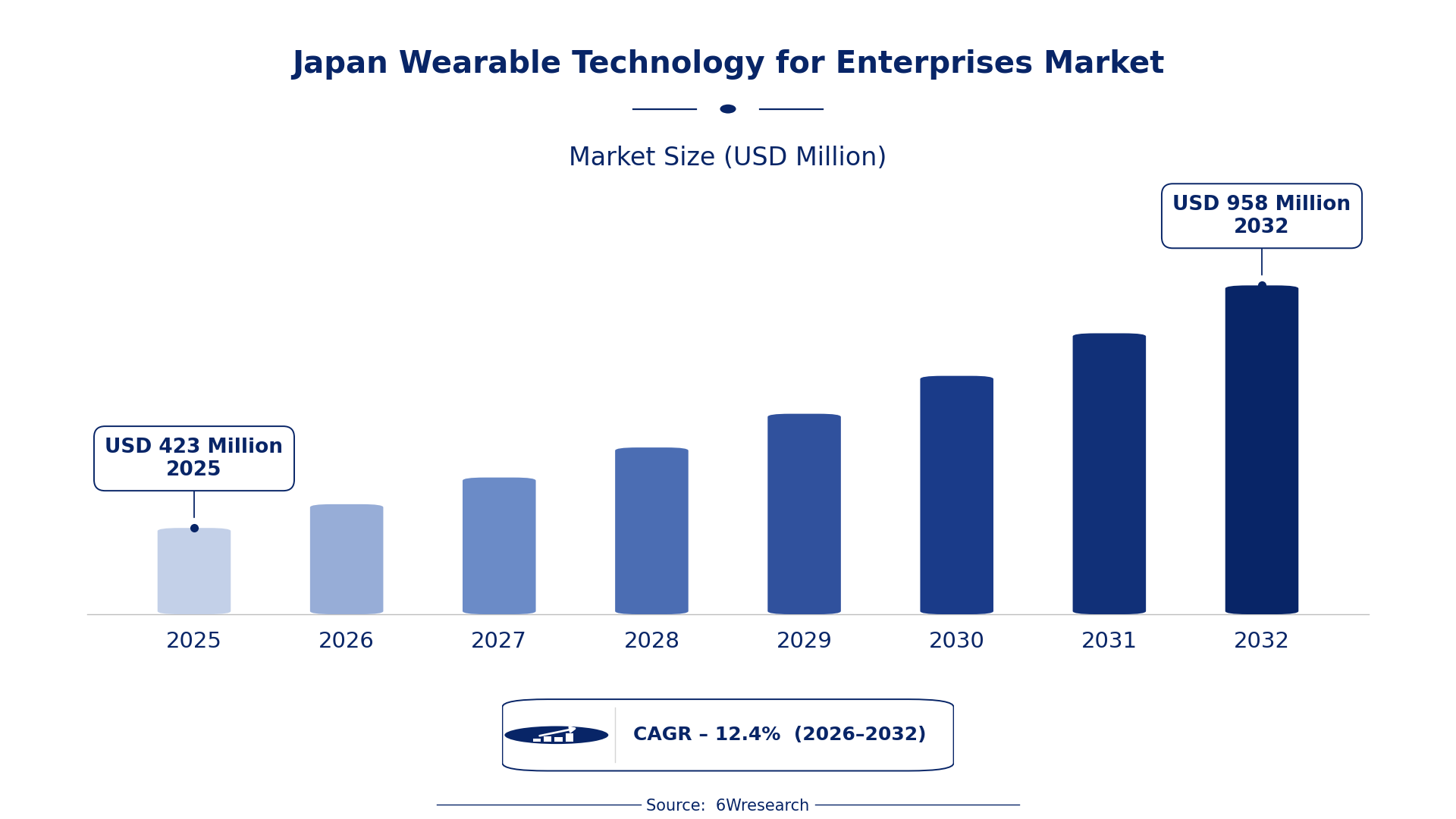
According to 6Wresearch internal database and industry insights, the Japan Wearable Technology for Enterprises Market was valued at USD 423 Million in 2025 and is projected to reach USD 958 Million by 2032, growing at a CAGR of approximately 12.4% during 2026–2032.
Japan Wearable Technology for Enterprises Market Highlights
| Report Metric | Details |
| Report Name | Japan Wearable Technology for Enterprises Market (2026-2032) |
| Market Size 2025 | USD 423 Million |
| Market Size 2032 | USD 958 Million |
| Absolute Growth 2025–2032 | USD 535 Million |
| CAGR 2026–2032 | 12.4% |
| Peak Annual Growth | 13.6% in 2031 |
| Forecast Period | 2026–2032 |
| Historical Data | 2022–2025 |
| Base Year | 2025 |
| Leading Product Type, 2025 | Smart Badges (45% share) |
| Leading Enterprise Use Case, 2025 | Employee Tracking (41% share) |
| Leading Distribution Channel, 2025 | B2B Sales (49% share) |
| Leading End User, 2025 | Construction Companies (48% share) |
| Fastest-Growing Product Type | Wearable Scanners (18.2% CAGR) |
| Fastest-Growing Enterprise Use Case | On-Site Data Access (17.1% CAGR) |
| Fastest-Growing Distribution Channel | Tech Integrators (15.6% CAGR) |
| Fastest-Growing End User | Warehouses (16.9% CAGR) |
| Growing Sector | Warehouses |
| Key End Users | Construction Companies, Warehouses, Corporate Offices, Robotics Assembly |
Japan Wearable Technology for Enterprises Market Year-wise Growth Rate and Key Drivers (2022–2032)
This graph illustrates the annual growth rates of the market from 2022 to 2032, highlighting a steady upward trajectory and projected market expansion over the forecast period.
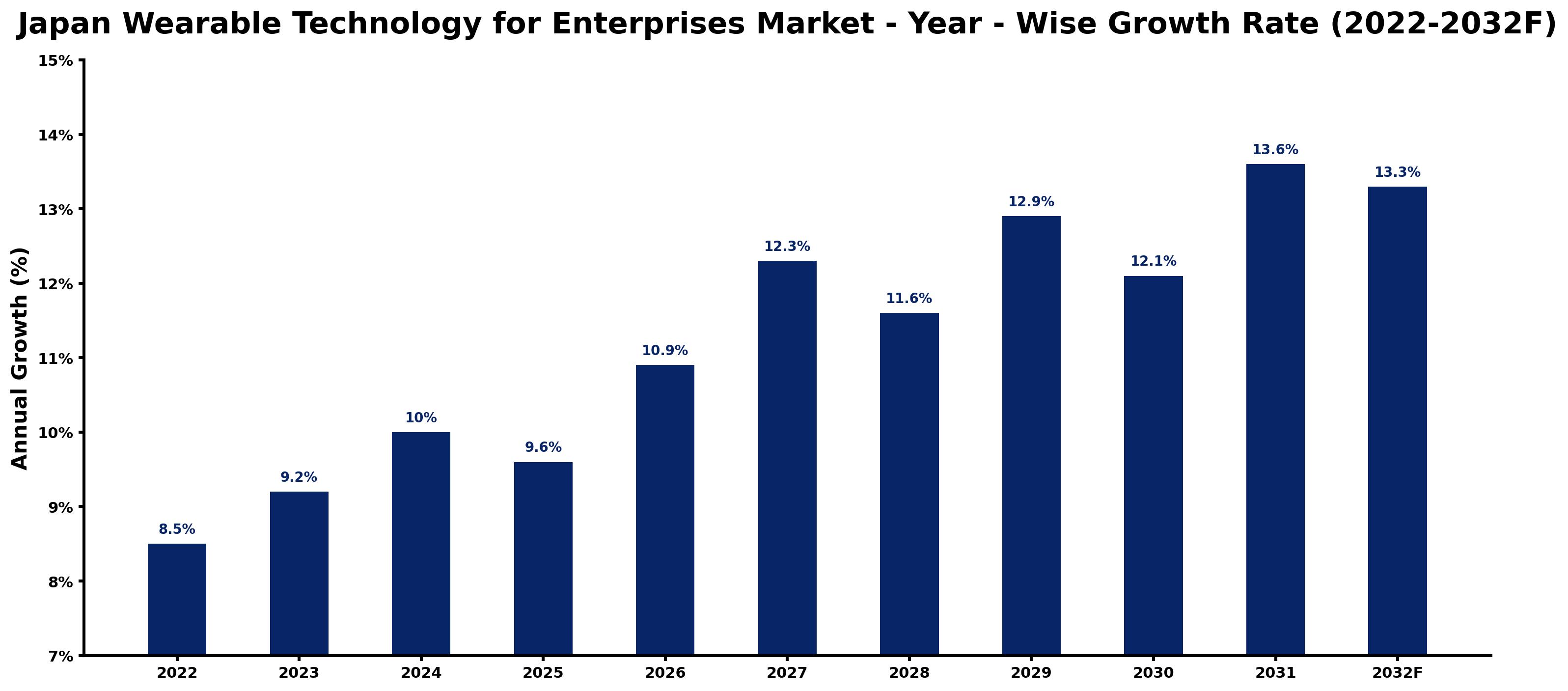
Below, each year's estimated growth is shown next to the factor that most influenced it.
| Year | Estimated Annual Growth (%) | Market Rationale |
| 2022 | 8.5 | The market exhibited steady growth, reflecting increasing interest in workplace safety technology. |
| 2023 | 9.2 | Demand accelerated as more sectors recognised the benefits of wearable technology for safety improvements. |
| 2024 | 10.0 | Growth continued as construction sites adopted AR safety helmets for improved worker protection. |
| 2025 | 9.6 | The market experienced a slowdown, influenced by fluctuating investments in technology upgrades. |
| 2026 | 10.9 | Growth is expected to resume as companies expand their focus on employee tracking solutions for operational efficiency. |
| 2027 | 12.3 | Demand is projected to strengthen with rising investments in on-site data access technologies across industries. |
| 2028 | 11.6 | A slight slowdown is anticipated as the market stabilises after rapid growth in previous years. |
| 2029 | 12.9 | Growth is expected to pick up again, driven by increased adoption of wearable scanners in logistics. |
| 2030 | 12.1 | The market is projected to slow slightly, reflecting a maturation phase in technology integration. |
| 2031 | 13.6 | Demand is expected to surge as companies invest heavily in smart badges for enhanced security measures. |
| 2032 | 13.3 | The market will experience a minor slowdown, yet growth will remain strong due to ongoing technological advancements. |
Note: Market size estimations and growth projections presented in this report are based on 6Wresearch's proprietary forecasting methodology, utilizing the latest available industry data, government publications, and primary research inputs.
Japan Wearable Technology for Enterprises Market Synopsis
Wearable Technology for Enterprises includes devices such as smart badges, AR safety helmets, and wearable scanners designed to improve workplace efficiency and safety. The Japan Wearable Technology for Enterprises Market is growing due to increased awareness of workplace safety, particularly in the construction sector, which is projected to invest substantially in wearable technology for compliance by 2025. Technological advancements and integration into training programs are driving new demand, creating opportunities for suppliers.
Market Dynamics Impact Analysis (2026–2032)
| Factor | Type | Impact | Primary Segment Affected |
| Increased focus on workplace safety regulations | Driver | High | AR Safety Helmets |
| Growing adoption of data management solutions | Driver | High | Wearable Scanners |
| High investment in safety compliance by construction companies | Opportunity | High | Construction Companies |
| Expansion of logistics hubs requiring inventory management solutions | Opportunity | Medium | Warehouses |
| High costs associated with technology upgrades | Restraint | High | Smart Badges |
| Limited awareness among smaller enterprises regarding benefits | Restraint | Medium | Employee Tracking |
| Challenges in integrating new technologies into existing systems | Challenge | High | Tech Integrators |
| Competition from alternative safety solutions | Challenge | Medium | AR Safety Helmets |
Evaluation of Drivers in Japan Wearable Technology for Enterprises Market (2026–2032)
Key forces behind demand, with the segment each one moves most, are listed below.
| Drivers | Primary Segment Affected | Why It Matters (Evidence) |
| Growing emphasis on operational efficiency | On-Site Data Access | On-site data access solutions are critical for operational efficiency in various industries, prompting more investments in technologies that enhance workplace processes. |
| Increased focus on workplace safety | AR Safety Helmets | The construction sector's commitment to safety compliance drives demand for AR safety helmets, with adoption rates rising significantly in urban areas. |
| Rising investments in employee tracking | Employee Tracking | Companies are increasingly investing in employee tracking solutions to enhance workforce management, improving operational efficiency across sectors. |
| Expansion of logistics capabilities | Wearable Scanners | The logistics industry is adopting wearable scanners to streamline inventory management, particularly in high-demand regions like Kanagawa Prefecture. |
| Technological advancements in wearable devices | Smart Badges | Advancements in smart badge technology are leading to increased adoption in corporate offices, enhancing security and employee tracking. |
Buyers are adding capacity as the construction sector invests heavily in wearable technology for safety compliance. In 2023, smart badges gained traction in corporate offices, improving security and employee tracking. The logistics industry utilises wearable scanners for efficient inventory management, particularly in Kanagawa Prefecture, which drives demand among logistics providers. The emphasis on operational efficiency drives demand for on-site data access solutions, prompting more investments across multiple sectors.
Evaluation of Restraints in Japan Wearable Technology for Enterprises Market
Several factors work against faster growth; the main ones are summarised below.
| Market Restraint | Primary Segment Affected | Why It Matters (Evidence) |
| High costs associated with technology upgrades | Smart Badges | The implementation of smart badges requires substantial investments, which can deter smaller enterprises from adoption, with costs reaching up to 30% more than traditional methods. |
| Limited awareness among smaller enterprises regarding benefits | Employee Tracking | Many smaller enterprises lack knowledge about the advantages of employee tracking technology, resulting in lower adoption rates, impacting overall market growth. |
| Integration challenges with existing systems | Wearable Scanners | Integrating wearable scanners into current logistics systems can be complex, which hinders widespread adoption and complicates operational processes for users. |
| Regulatory compliance costs | AR Safety Helmets | Compliance with safety regulations can incur additional costs, impacting the adoption of AR safety helmets, particularly among smaller firms. |
| Competition from alternative safety solutions | Tech Integrators | Tech integrators face competition from other safety solutions, which may limit their market share and affect their growth potential. |
Japan Wearable Technology for Enterprises Market Challenges
AR safety helmets on construction sites often exceed budgets due to high initial costs, which can reach up to 30% more than traditional safety gear, delaying adoption among contractors. Competition from lower-cost alternatives restricts market growth, as firms may opt for cheaper options, risking compliance with safety standards and facing fines that can total millions. Technology integration presents challenges; many enterprises lack the necessary infrastructure, prolonging implementation timelines by six months or more, frustrating buyers seeking efficiency. Supply chain disruptions affect the availability of wearable scanners, causing delays in logistics operations that can raise operational costs for warehouses by up to 15%.
Trends in the Japan Wearable Technology for Enterprises Market
The trends below show where the Japan Wearable Technology for Enterprises Market is heading.
- Shift from Traditional Safety Equipment to Wearable Technology: Since 2022, the construction sector has increasingly adopted wearable technology, such as AR safety helmets, to improve worker safety. This shift is reflected in a notable rise in adoption rates in Tokyo, demonstrating a growing commitment to workplace safety.
- Integration of AR Technology in Training Programs: In 2023, AR technology began being integrated into training programs for construction workers, enhancing safety awareness and operational efficiency. This trend is supported by the Tokyo Metropolitan Government's initiatives to improve workplace safety through technology.
- Increased Use of Wearable Scanners in Logistics: Starting in 2024, logistics hubs have increasingly utilised wearable scanners for inventory management. In Kanagawa Prefecture, the adoption of these devices has improved operational efficiency, leading to better inventory tracking.
- Expansion of Employee Tracking Solutions in Corporate Offices: From 2025, corporate offices have begun prioritising employee tracking solutions, with smart badges gaining popularity. This trend reflects a broader focus on security and efficiency in workplace management.
Investment Opportunities in the Japan Wearable Technology for Enterprises Market
The following areas offer the clearest openings for investors and suppliers in the Japan Wearable Technology for Enterprises Market.
- Investment in Construction Sites: With the construction sector projected to invest USD 423 million in wearable technology by 2025, suppliers can focus on AR safety helmets and smart badges. Partnering with construction firms can facilitate entry into this growing market.
- Supply of Smart Badges: The increasing demand for smart badges in corporate offices presents an opportunity for suppliers. With a projected market size of USD 958 million by 2032, entering through local partnerships can enhance market penetration.
- Logistics Hubs Expansion: As logistics hubs in Kanagawa Prefecture expand, the demand for wearable scanners is expected to rise. Suppliers can target this opportunity by establishing joint ventures with local logistics providers.
- Enhancing Safety Compliance: With the focus on safety compliance in construction, suppliers can offer AR safety helmets to meet regulatory requirements. Collaborating with industry associations can streamline market entry.
Government Initiatives in the Japan Wearable Technology for Enterprises Market
The Building Energy Efficiency Act (2015, amended 2022) mandates that all new buildings meet energy standards from April 2025, impacting producers of wearable technology by requiring compliance with safety standards. This measure encourages investment in advanced safety solutions, particularly in the construction sector, where wearable technology is essential for meeting these regulations.
In 2023, the government allocated USD 10 million for technology upgrades in small and medium enterprises, administered by the Digital Agency. This funding supports the adoption of wearable technology, enabling businesses to improve workplace safety and operational efficiency.
Future Insight of the Japan Wearable Technology for Enterprises Market
Investment in wearable technology for enterprises will surge as government initiatives and industry standards create demand for improved safety solutions. By 2032, the construction sector will see a substantial rise in AR technology integration, with training programs for workers expanding to include virtual simulations. Smart badges will become commonplace in corporate offices, enhancing security and tracking efficiency across various sectors. The Tokyo Metropolitan Government's focus on safety measures will lead to upgraded systems in small and medium enterprises, creating a more competitive environment.
Market Segmentation Analysis
Japan Wearable Technology for Enterprises Market report covers a detailed analysis of the following market segments:
By Product Type – Smart Badges Lead, Wearable Scanners Expected to Grow Fastest
According to Saurav Kr Singh, Senior Research Analyst at 6Wresearch, in 2025, Smart Badges led the product type split with a 45% share. Smart badges are essential for employee identification and tracking, particularly in corporate offices that prioritise security and efficiency. Their widespread adoption reflects a growing trend towards enhancing workplace safety through technology. Wearable Scanners are projected to grow fastest, at a CAGR of 18.2% during 2026–2032. Wearable scanners are rapidly gaining traction as they are crucial for inventory management in logistics hubs, particularly in Kanagawa Prefecture. The increasing demand for operational optimisation in warehouses is propelling the growth of these devices. Suppliers should focus on enhancing the functionality of wearable scanners to meet the rising demand in logistics.
By Enterprise Use Case – Employee Tracking Leads, On-Site Data Access Expected to Grow Fastest
With 41% of enterprise use case revenue in 2025, Employee Tracking was the largest category. Employee tracking is the leading use case, crucial for workforce management and safety, especially in sectors like construction where monitoring is vital. The emphasis on safety compliance drives the adoption of technologies that ensure workers are accounted for at all times. Over 2026–2032, On-Site Data Access is expected to post the fastest growth, at a CAGR of 17.1%. On-site data access is witnessing rapid growth due to its critical role in improving operational efficiency across various industries. The need for immediate data access to streamline processes is becoming increasingly recognised by companies. Investing in technologies that enhance on-site data access will significantly benefit buyers by improving operational workflows.
By Distribution Channel – B2B Sales Leads, Tech Integrators Expected to Grow Fastest
B2B Sales took 49% of distribution channel revenue in 2025, more than any other category. B2B sales are the dominant distribution channel, serving as the primary avenue for enterprise technology distribution. This channel effectively meets the specific needs of businesses seeking wearable solutions tailored to their requirements. Tech Integrators are set to record the highest CAGR in this split, 15.6% over 2026–2032. Tech integrators are expanding swiftly as they facilitate the integration of wearable technology into existing systems, ensuring smoother transitions for enterprises. Their expertise in custom solutions is driving demand as companies seek seamless implementation. Suppliers should explore partnerships with tech integrators to enhance their market reach and service offerings.
By End User – Construction Companies Lead, Warehouses Expected to Grow Fastest
Construction Companies accounted for 48% of the market by end user in 2025. Construction companies are the largest end users of wearable technology, employing these devices to enhance safety and operational efficiency on job sites. The significant focus on safety compliance in this sector drives the demand for wearable solutions. The quickest growth will come from Warehouses, forecast to expand at a CAGR of 16.9% between 2026 and 2032. Warehouses are the fastest-growing end user segment, propelled by the necessity for efficient inventory management and logistics operations. The increasing complexity of supply chains is driving the adoption of wearable technology to streamline processes. Targeting warehouse operations will enable suppliers to capitalise on the growing demand for wearable technology in logistics.
Key Attractiveness of the Report
- 10 Years of Market Numbers
- Historical Data Starting from 2022 to 2025
- Base Year 2025
- Forecast Data until 2032
- Key Performance Indicators Impacting the Market
- Major Upcoming Developments and Projects
Key Highlights of the Report:
- Japan Wearable Technology for Enterprises Market Outlook
- Market Size of Japan Wearable Technology for Enterprises Market, 2025
- Forecast of Japan Wearable Technology for Enterprises Market, 2032
- Historical Data and Forecast of Japan Wearable Technology for Enterprises Revenues & Volume for the Period 2022-2032F
- Japan Wearable Technology for Enterprises Market Trend Evolution
- Japan Wearable Technology for Enterprises Market Drivers and Challenges
- Japan Wearable Technology for Enterprises Price Trends
- Japan Wearable Technology for Enterprises Porter's Five Forces
- Japan Wearable Technology for Enterprises Industry Life Cycle
- Historical Data and Forecast of Japan Wearable Technology for Enterprises Market Revenues & Volume By Product Type for the Period 2022-2032F
- Historical Data and Forecast of Japan Wearable Technology for Enterprises Market Revenues & Volume By Smart Badges for the Period 2022-2032F
- Historical Data and Forecast of Japan Wearable Technology for Enterprises Market Revenues & Volume By AR Safety Helmets for the Period 2022-2032F
- Historical Data and Forecast of Japan Wearable Technology for Enterprises Market Revenues & Volume By Wearable Scanners for the Period 2022-2032F
- Historical Data and Forecast of Japan Wearable Technology for Enterprises Market Revenues & Volume By Smart Gloves for the Period 2022-2032F
- Historical Data and Forecast of Japan Wearable Technology for Enterprises Market Revenues & Volume By Enterprise Use Case for the Period 2022-2032F
- Historical Data and Forecast of Japan Wearable Technology for Enterprises Market Revenues & Volume By Employee Tracking for the Period 2022-2032F
- Historical Data and Forecast of Japan Wearable Technology for Enterprises Market Revenues & Volume By On-Site Data Access for the Period 2022-2032F
- Historical Data and Forecast of Japan Wearable Technology for Enterprises Market Revenues & Volume By Inventory Management for the Period 2022-2032F
- Historical Data and Forecast of Japan Wearable Technology for Enterprises Market Revenues & Volume By Gesture Control for the Period 2022-2032F
- Historical Data and Forecast of Japan Wearable Technology for Enterprises Market Revenues & Volume By Distribution Channel for the Period 2022-2032F
- Historical Data and Forecast of Japan Wearable Technology for Enterprises Market Revenues & Volume By B2B Sales for the Period 2022-2032F
- Historical Data and Forecast of Japan Wearable Technology for Enterprises Market Revenues & Volume By Industrial Suppliers for the Period 2022-2032F
- Historical Data and Forecast of Japan Wearable Technology for Enterprises Market Revenues & Volume By Direct Sales for the Period 2022-2032F
- Historical Data and Forecast of Japan Wearable Technology for Enterprises Market Revenues & Volume By Tech Integrators for the Period 2022-2032F
- Historical Data and Forecast of Japan Wearable Technology for Enterprises Market Revenues & Volume By End User for the Period 2022-2032F
- Historical Data and Forecast of Japan Wearable Technology for Enterprises Market Revenues & Volume By Corporate Offices for the Period 2022-2032F
- Historical Data and Forecast of Japan Wearable Technology for Enterprises Market Revenues & Volume By Construction Companies for the Period 2022-2032F
- Historical Data and Forecast of Japan Wearable Technology for Enterprises Market Revenues & Volume By Warehouses for the Period 2022-2032F
- Historical Data and Forecast of Japan Wearable Technology for Enterprises Market Revenues & Volume By Robotics Assembly for the Period 2022-2032F
- Japan Wearable Technology for Enterprises Import Export Trade Statistics
- Market Opportunity Assessment By Product Type
- Market Opportunity Assessment By Enterprise Use Case
- Market Opportunity Assessment By Distribution Channel
- Market Opportunity Assessment By End User
- Japan Wearable Technology for Enterprises Top Companies Market Share
- Japan Wearable Technology for Enterprises Competitive Benchmarking By Technical and Operational Parameters
- Japan Wearable Technology for Enterprises Company Profiles
- Japan Wearable Technology for Enterprises Key Strategic Recommendations
Market Covered
The study includes the following segmentation.
By Product Type
- Smart Badges
- AR Safety Helmets
- Wearable Scanners
- Smart Gloves
By Enterprise Use Case
- Employee Tracking
- On-Site Data Access
- Inventory Management
- Gesture Control
By Distribution Channel
- B2B Sales
- Industrial Suppliers
- Direct Sales
- Tech Integrators
By End User
- Corporate Offices
- Construction Companies
- Warehouses
- Robotics Assembly































