Japan Weather Radar Satcom Market Size & Growth Rate
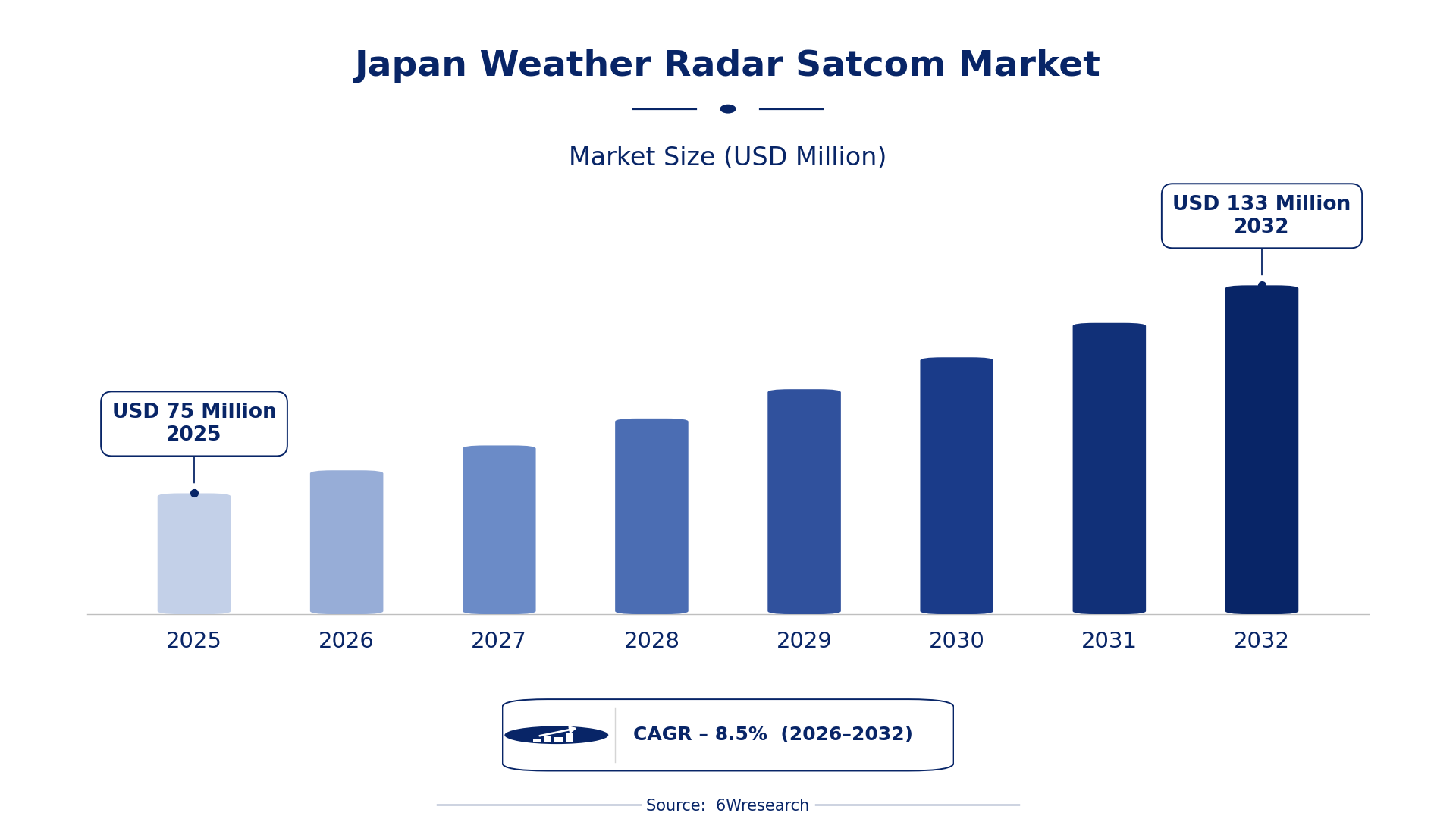
According to 6Wresearch internal database and industry insights, the Japan Weather Radar Satcom Market was valued at USD 75 Million in 2025 and is projected to reach USD 133 Million by 2032, growing at a CAGR of approximately 8.5% during 2026–2032.
Japan Weather Radar Satcom Market Highlights
| Report Metric | Details |
| Report Name | Japan Weather Radar Satcom Market (2026-2032) |
| Market Size 2025 | USD 75 Million |
| Market Size 2032 | USD 133 Million |
| Absolute Growth 2025–2032 | USD 58 Million |
| CAGR 2026–2032 | 8.5% |
| Peak Annual Growth | 9.2% in 2030 |
| Forecast Period | 2026–2032 |
| Historical Data | 2022–2025 |
| Base Year | 2025 |
| Leading Product Type, 2025 | Doppler Radars (34% share) |
| Leading Radar Function, 2025 | Storm Tracking (47% share) |
| Leading Distribution Channel, 2025 | Direct Sales (43% share) |
| Leading End User, 2025 | Weather Stations (46% share) |
| Fastest-Growing Product Type | Dual-Polarization Radar (12.1% CAGR) |
| Fastest-Growing Radar Function | Precipitation (11.3% CAGR) |
| Fastest-Growing Distribution Channel | Government Contracts (10.9% CAGR) |
| Fastest-Growing End User | Aviation Authorities (10.7% CAGR) |
| Growing Sector | Weather monitoring and forecasting |
| Key End Users | Weather Stations, Aviation Authorities, Emergency Response, Broadcast Companies |
Japan Weather Radar Satcom Market Year-wise Growth Rate and Key Drivers (2022–2032)
This graph illustrates the annual growth rates of the market from 2022 to 2032, highlighting a steady upward trajectory and projected market expansion over the forecast period.
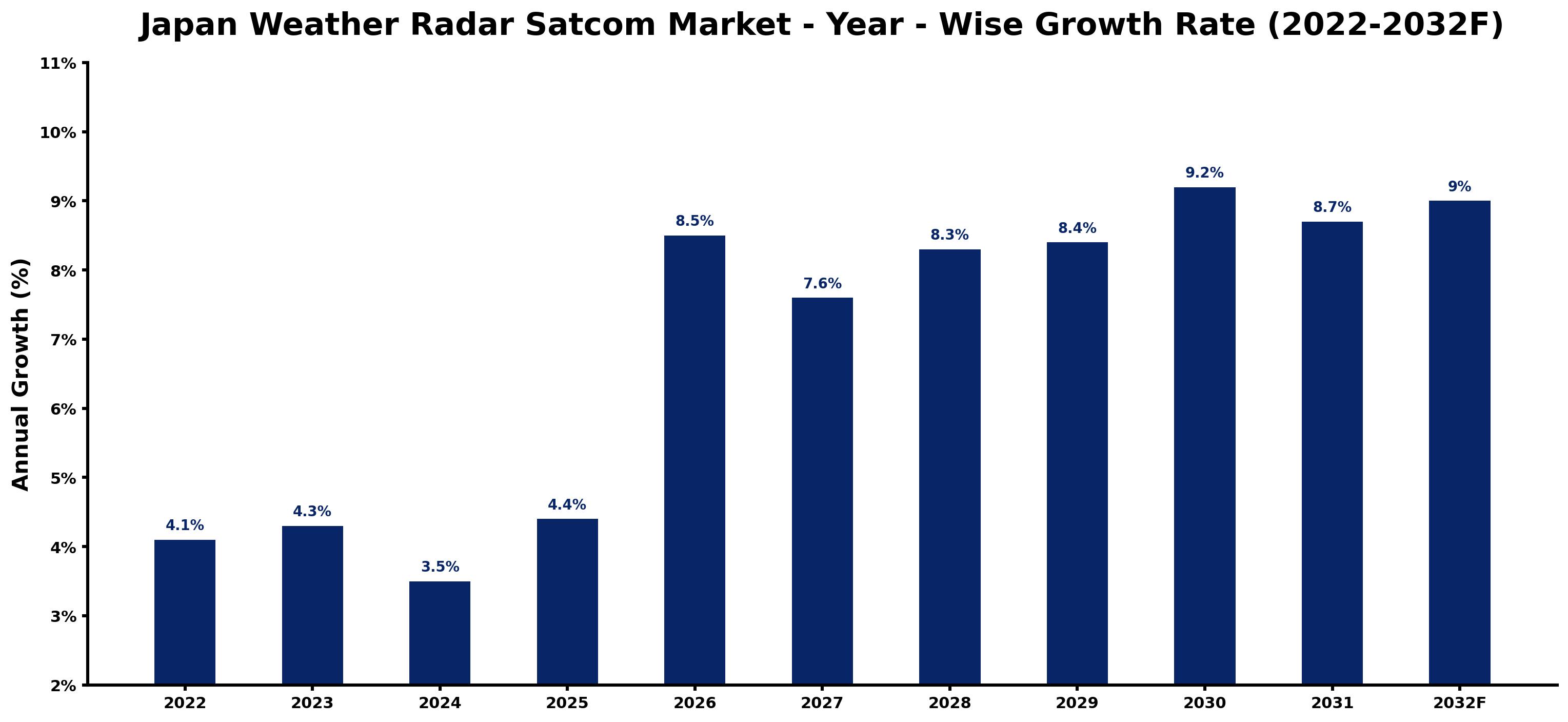
Each row of the following table gives one year's estimated growth and the event or demand shift that explains it.
| Year | Estimated Annual Growth (%) | Market Rationale |
| 2022 | 4.1 | The market showed steady growth, benefiting from increased investments in weather technology. |
| 2023 | 4.3 | Demand rose due to heightened awareness of severe weather impacts on safety and operations. |
| 2024 | 3.5 | Growth slowed as some buyers delayed upgrades amid economic uncertainties. |
| 2025 | 4.4 | The market rebounded with faster growth as government funding for weather technology increased. |
| 2026 | 8.5 | Strong demand for advanced radar systems is anticipated, driven by the need for accurate forecasting. |
| 2027 | 7.6 | Growth is projected to slow slightly as some sectors adjust to new technology implementations. |
| 2028 | 8.3 | Demand is expected to pick up again, supported by ongoing investments in satellite communication capabilities. |
| 2029 | 8.4 | Growth will continue as weather stations expand their radar capabilities for better data accuracy. |
| 2030 | 9.2 | The market is projected to peak with substantial investments in storm tracking technologies and satellite systems. |
| 2031 | 8.7 | Growth is expected to moderate as the market stabilises after reaching peak demand levels. |
| 2032 | 9.0 | Demand will rise again as new technologies are adopted for improved weather monitoring. |
Note: Market size estimations and growth projections presented in this report are based on 6Wresearch's proprietary forecasting methodology, utilizing the latest available industry data, government publications, and primary research inputs.
Japan Weather Radar Satcom Market Synopsis
Weather Radar Satcom integrates radar systems with satellite communication to deliver real-time weather data, essential for storm tracking and precipitation measurement. The Japan Weather Radar Satcom Market is expanding due to increased investments in weather technology, with over 1,000 weather stations utilizing radar. Government initiatives, such as the ¥5 billion allocated for upgrades in 2023, stimulate demand from meteorological agencies and aviation authorities, driving growth in this sector.
Market Dynamics Impact Analysis (2026–2032)
| Factor | Type | Impact | Primary Segment Affected |
| Increased government funding for weather technology upgrades | Driver | High | Weather Stations |
| Growing demand for real-time weather data in aviation | Driver | High | Aviation Authorities |
| Expansion of satellite communication capabilities for weather monitoring | Opportunity | High | Satcom-Enabled Systems |
| Rising need for precise storm tracking and forecasting | Opportunity | High | Doppler Radars |
| High costs associated with radar technology upgrades | Restraint | Medium | Weather Stations |
| Limited budget allocations for non-governmental weather services | Restraint | Medium | Broadcast Companies |
| Challenges in integrating new technologies into existing systems | Challenge | High | Emergency Response |
| Dependence on government contracts for funding and support | Challenge | High | Weather Stations |
Evaluation of Drivers in Japan Weather Radar Satcom Market (2026–2032)
These are the developments adding the most demand over the forecast period.
| Drivers | Primary Segment Affected | Why It Matters (Evidence) |
| Government funding for weather technology upgrades | Weather Stations | The government allocated ¥5 billion for upgrades, enabling weather stations to improve their radar capabilities. |
| Demand for real-time data in aviation | Aviation Authorities | Aviation authorities require accurate weather data for flight safety, leading to increased purchases of advanced radar systems. |
| Technological advancements in radar systems | Doppler Radars | New Doppler Radars provide precise storm tracking, prompting weather stations to invest in these systems. |
| Integration of satellite communication in weather monitoring | Satcom-Enabled Systems | Satcom systems facilitate remote data transmission, driving demand from meteorological agencies and weather stations. |
| Increased focus on disaster management | Emergency Response | Emergency response units rely on real-time data from radars, increasing their demand for advanced weather monitoring systems. |
Demand for real-time data in aviation is increasing as aviation authorities require accurate weather information for flight safety, prompting more purchases of advanced radar systems. New Doppler Radars provide precise storm tracking, encouraging weather stations to invest in these systems. Emergency response units prioritise real-time data from radars, especially during typhoons, further boosting demand.
Evaluation of Restraints in Japan Weather Radar Satcom Market
These restraints slow adoption and weigh on supplier margins.
| Market Restraint | Primary Segment Affected | Why It Matters (Evidence) |
| High costs associated with radar technology upgrades | Weather Stations | Weather stations face high costs when upgrading to advanced radar systems, limiting their ability to invest. |
| Limited budget allocations for non-governmental weather services | Broadcast Companies | Broadcast companies struggle with budget constraints, hindering their ability to adopt new radar technologies. |
| Challenges in integrating new technologies into existing systems | Emergency Response | Emergency response units encounter difficulties when integrating new radar technologies with their current systems. |
| Dependence on government contracts for funding | Weather Stations | Weather stations rely heavily on government contracts, which can be unpredictable and limit their operational flexibility. |
| Regulatory compliance costs for radar systems | Satcom-Enabled Systems | Compliance with ISO 9001 standards increases costs for manufacturers of Satcom-enabled radar systems. |
Japan Weather Radar Satcom Market Challenges
Japan's strict compliance standards for weather radar technology can delay production timelines by 15%, impacting producers who rely on timely system deployments. High manufacturing costs stem from the need for advanced radar technology, raising prices by 10% for weather stations and straining budgets for buyers. Supply chain disruptions hinder the availability of essential components, potentially delaying system installations for producers. Increased scrutiny on satellite communication regulations results in higher compliance costs for suppliers, which may slow down the delivery of critical data to emergency response units.
Trends in the Japan Weather Radar Satcom Market
Several trends are reshaping the Japan Weather Radar Satcom Market; the most important are set out below.
- Shift in Focus to Satellite Communication: Weather stations are increasingly adopting satellite communication for data transmission, as seen in the 2023 government program enhancing satellite relay capabilities. This shift is expected to improve data accuracy and timeliness.
- Transition to Advanced Radar Technologies: The Japan Meteorological Agency's use of Dual-Polarization Radar illustrates the transition towards advanced radar technologies for better forecasting accuracy. This change is driving demand for more sophisticated radar systems.
- Growing Importance of Real-Time Data: Emergency response units are prioritising real-time data from weather radars, especially during typhoons and heavy rainfall events. This trend highlights the critical need for timely weather information in disaster management.
- Expansion of Government Contracts in Weather Services: The government is increasing its contracts for weather services, particularly for radar installations in urban areas like Tokyo and Osaka. This expansion is creating new opportunities for suppliers in the market.
Investment Opportunities in the Japan Weather Radar Satcom Market
The following areas offer the clearest openings for investors and suppliers in the Japan Weather Radar Satcom Market.
- Timing for Investment in Advanced Radar Systems: With the government allocating ¥5 billion for upgrades, now is an ideal time to invest in advanced radar systems for weather stations. This funding supports the purchase of new technologies.
- Gap in Satellite Communication Capabilities: The need for improved satellite communication in weather monitoring presents an opportunity, with the government promoting these systems. Suppliers can enter this market by partnering with local weather agencies.
- Demand for Doppler Radars in Urban Areas: Urban areas like Tokyo are experiencing a surge in demand for Doppler Radars due to their effectiveness in storm tracking. Suppliers can focus on these regions to meet growing needs.
- Expansion of Government Contracts for Weather Services: The increase in government contracts for weather services creates opportunities for suppliers to provide advanced radar technologies. Engaging with government agencies can facilitate market entry.
Government Initiatives in the Japan Weather Radar Satcom Market
The AI Promotion Act, established in 2025, establishes a framework for AI research and development in weather forecasting, building on the Electrical Appliance and Material Safety Act of 1961. This measure requires weather radar producers to ensure compliance with safety standards, promoting innovation in radar technology.
The Digital Agency oversees the implementation of digital transformation initiatives, approving funding for projects that improve weather radar capabilities. This agency supports the integration of advanced technologies in weather services, ensuring that they meet national standards.
Future Insight of the Japan Weather Radar Satcom Market
Advancements in satellite communication technology will transform demand for weather radar systems by 2032, enabling faster data relay for meteorological applications. Government funding of ¥5 billion for weather technology upgrades will enhance system capabilities. New standards will emerge to increase the reliability of radar technologies. As urban populations expand, the need for accurate weather forecasting will drive innovation in radar systems, presenting new opportunities for both buyers and suppliers.
Market Segmentation Analysis
Japan Weather Radar Satcom Market report covers a detailed analysis of the following market segments:
By Product Type – Doppler Radars Lead, Dual-Polarization Radar Expected to Grow Fastest
According to Saurav Kr Singh, Senior Research Analyst at 6Wresearch, Doppler Radars held 34% of the Japan Weather Radar Satcom Market by product type in 2025. Doppler Radars dominate the market due to their critical role in precise storm tracking and weather analysis, essential for effective forecasting. With over 1,000 weather stations in Japan utilising this technology, it ensures reliable weather data dissemination. The quickest growth will come from Dual-Polarization Radar, forecast to expand at a CAGR of 12.1% between 2026 and 2032. The growth of Dual-Polarization Radar is fuelled by its ability to enhance precipitation measurement accuracy, particularly during extreme weather events. The Japan Meteorological Agency's adoption of this technology exemplifies its increasing significance in the industry. Suppliers should focus on advancing both Doppler and Dual-Polarization technologies to meet the growing demand for accurate weather forecasting.
By Radar Function – Storm Tracking Leads, Precipitation Expected to Grow Fastest
Storm Tracking took 47% of radar function revenue in 2025, more than any other category. Storm Tracking holds the largest share as it is crucial for predicting severe weather events, a primary concern for meteorological services. The reliance on storm tracking data during typhoons and heavy rainfall in Japan underscores its vital role in public safety. Over 2026–2032, Precipitation is expected to post the fastest growth, at a CAGR of 11.3%. Precipitation measurement is experiencing rapid growth due to its essential function in accurate weather forecasting, particularly in urban areas. The increasing incidence of severe weather events demands improved precipitation data for effective response strategies. Investing in advanced radar capabilities that enhance storm tracking and precipitation measurement will equip buyers with better tools for weather-related preparedness.
By Distribution Channel – Direct Sales Leads, Government Contracts Expected to Grow Fastest
The largest distribution channel category in 2025 was Direct Sales, at 43% of revenue. Direct Sales is the leading distribution channel, serving as the primary method for selling radar systems directly to weather stations and government authorities. This approach allows for customised solutions that effectively address the specific needs of clients. Government Contracts are projected to grow fastest, at a CAGR of 10.9% during 2026–2032. Government Contracts are expanding swiftly as they provide vital funding for public weather services, particularly in light of recent government initiatives. The ¥5 billion allocated for weather technology upgrades in 2023 highlights the importance of these contracts. Suppliers must cultivate strong relationships with government entities to secure contracts that will drive future sales growth.
By End User – Weather Stations Lead, Aviation Authorities Expected to Grow Fastest
In 2025, Weather Stations led the end user split with a 46% share. Weather Stations are the primary users of weather radar technology, utilising it for real-time data collection and forecasting. The extensive network of over 1,000 weather stations in Japan illustrates their central role in the market. Aviation Authorities are set to record the highest CAGR in this split, 10.7% over 2026–2032. Aviation Authorities are experiencing the fastest growth as they increasingly rely on accurate weather data for flight safety and planning. The mandatory use of real-time weather data for flight operations further emphasises their critical need for advanced radar systems. Suppliers should tailor their offerings to meet the specific requirements of aviation authorities to capitalise on this growth opportunity.
Key Attractiveness of the Report
- 10 Years of Market Numbers
- Historical Data Starting from 2022 to 2025
- Base Year 2025
- Forecast Data until 2032
- Key Performance Indicators Impacting the Market
- Major Upcoming Developments and Projects
Key Highlights of the Report:
- Japan Weather Radar Satcom Market Outlook
- Market Size of Japan Weather Radar Satcom Market, 2025
- Forecast of Japan Weather Radar Satcom Market, 2032
- Historical Data and Forecast of Japan Weather Radar Satcom Revenues & Volume for the Period 2022-2032F
- Japan Weather Radar Satcom Market Trend Evolution
- Japan Weather Radar Satcom Market Drivers and Challenges
- Japan Weather Radar Satcom Price Trends
- Japan Weather Radar Satcom Porter's Five Forces
- Japan Weather Radar Satcom Industry Life Cycle
- Historical Data and Forecast of Japan Weather Radar Satcom Market Revenues & Volume By Product Type for the Period 2022-2032F
- Historical Data and Forecast of Japan Weather Radar Satcom Market Revenues & Volume By Doppler Radars for the Period 2022-2032F
- Historical Data and Forecast of Japan Weather Radar Satcom Market Revenues & Volume By Dual-Polarization Radar for the Period 2022-2032F
- Historical Data and Forecast of Japan Weather Radar Satcom Market Revenues & Volume By Mobile Radar Units for the Period 2022-2032F
- Historical Data and Forecast of Japan Weather Radar Satcom Market Revenues & Volume By Satcom-Enabled Systems for the Period 2022-2032F
- Historical Data and Forecast of Japan Weather Radar Satcom Market Revenues & Volume By Radar Function for the Period 2022-2032F
- Historical Data and Forecast of Japan Weather Radar Satcom Market Revenues & Volume By Storm Tracking for the Period 2022-2032F
- Historical Data and Forecast of Japan Weather Radar Satcom Market Revenues & Volume By Precipitation for the Period 2022-2032F
- Historical Data and Forecast of Japan Weather Radar Satcom Market Revenues & Volume By Real-Time Data for the Period 2022-2032F
- Historical Data and Forecast of Japan Weather Radar Satcom Market Revenues & Volume By Satellite Relay for the Period 2022-2032F
- Historical Data and Forecast of Japan Weather Radar Satcom Market Revenues & Volume By Distribution Channel for the Period 2022-2032F
- Historical Data and Forecast of Japan Weather Radar Satcom Market Revenues & Volume By Direct Sales for the Period 2022-2032F
- Historical Data and Forecast of Japan Weather Radar Satcom Market Revenues & Volume By Government Contracts for the Period 2022-2032F
- Historical Data and Forecast of Japan Weather Radar Satcom Market Revenues & Volume By Online Platforms for the Period 2022-2032F
- Historical Data and Forecast of Japan Weather Radar Satcom Market Revenues & Volume By Tech Vendors for the Period 2022-2032F
- Historical Data and Forecast of Japan Weather Radar Satcom Market Revenues & Volume By End User for the Period 2022-2032F
- Historical Data and Forecast of Japan Weather Radar Satcom Market Revenues & Volume By Weather Stations for the Period 2022-2032F
- Historical Data and Forecast of Japan Weather Radar Satcom Market Revenues & Volume By Aviation Authorities for the Period 2022-2032F
- Historical Data and Forecast of Japan Weather Radar Satcom Market Revenues & Volume By Emergency Response for the Period 2022-2032F
- Historical Data and Forecast of Japan Weather Radar Satcom Market Revenues & Volume By Broadcast Companies for the Period 2022-2032F
- Japan Weather Radar Satcom Import Export Trade Statistics
- Market Opportunity Assessment By Product Type
- Market Opportunity Assessment By Radar Function
- Market Opportunity Assessment By Distribution Channel
- Market Opportunity Assessment By End User
- Japan Weather Radar Satcom Top Companies Market Share
- Japan Weather Radar Satcom Competitive Benchmarking By Technical and Operational Parameters
- Japan Weather Radar Satcom Company Profiles
- Japan Weather Radar Satcom Key Strategic Recommendations
Market Covered
Coverage by segment is as follows.
By Product Type
- Doppler Radars
- Dual-Polarization Radar
- Mobile Radar Units
- Satcom-Enabled Systems
By Radar Function
- Storm Tracking
- Precipitation
- Real-Time Data
- Satellite Relay
By Distribution Channel
- Direct Sales
- Government Contracts
- Online Platforms
- Tech Vendors
By End User
- Weather Stations
- Aviation Authorities
- Emergency Response
- Broadcast Companies































