Japan Whitefish Market Size & Growth Rate
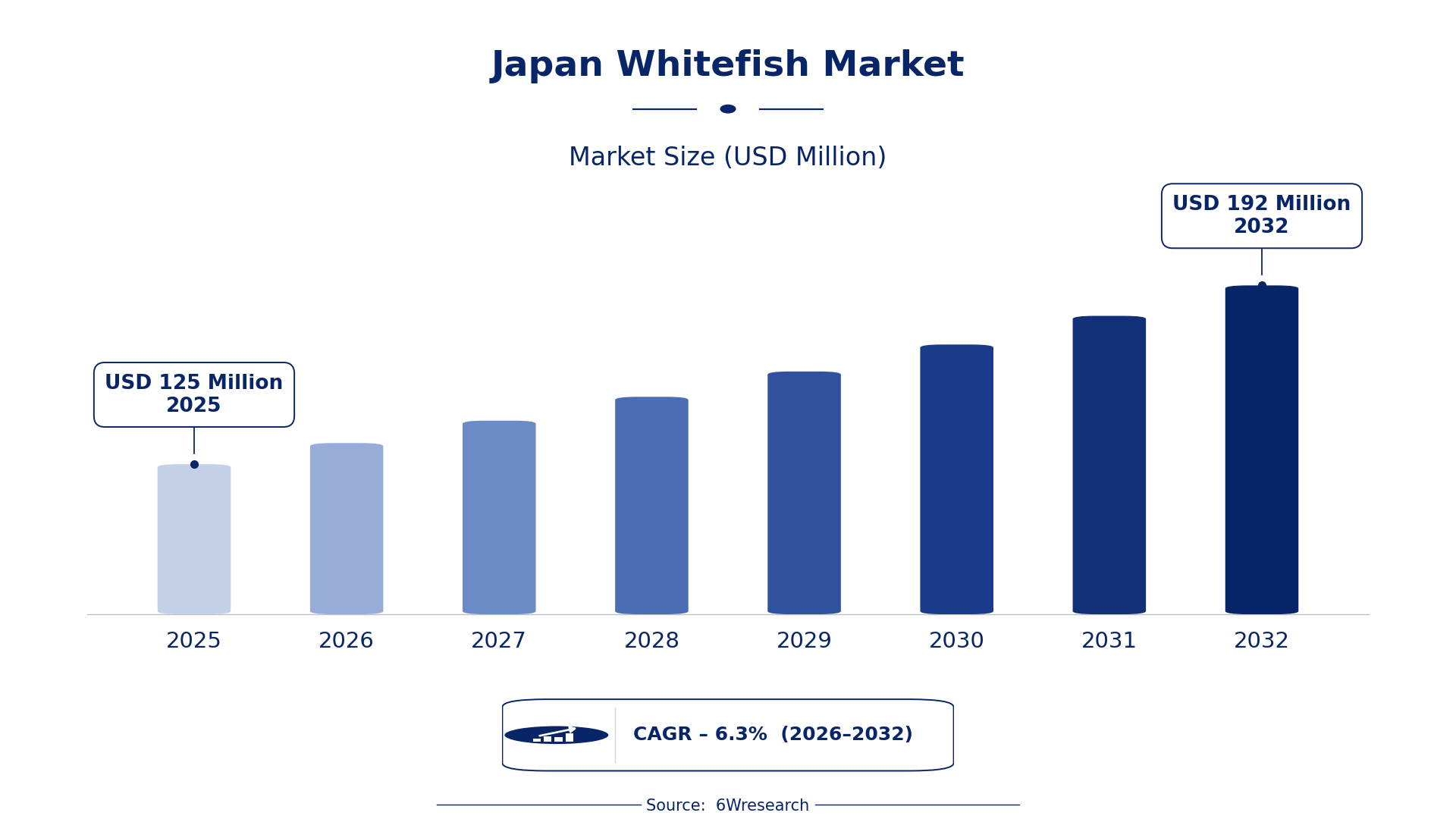
According to 6Wresearch internal database and industry insights, the Japan Whitefish Market was valued at USD 125 Million in 2025 and is projected to reach USD 192 Million by 2032, growing at a CAGR of approximately 6.3% during 2026–2032.
Japan Whitefish Market Highlights
| Report Metric | Details |
| Report Name | Japan Whitefish Market (2026-2032) |
| Market Size 2025 | USD 125 Million |
| Market Size 2032 | USD 192 Million |
| Absolute Growth 2025–2032 | USD 67 Million |
| CAGR 2026–2032 | 6.3% |
| Peak Annual Growth | 7.3% in 2028 |
| Forecast Period | 2026–2032 |
| Historical Data | 2022–2025 |
| Base Year | 2025 |
| Leading Species Type, 2025 | Cod (34% share) |
| Leading Processing Type, 2025 | Fresh (49% share) |
| Leading Distribution Channel, 2025 | Wholesale (38% share) |
| Leading End User, 2025 | Restaurants (39% share) |
| Fastest-Growing Species Type | Haddock (8.8% CAGR) |
| Fastest-Growing Processing Type | Frozen (9.1% CAGR) |
| Fastest-Growing Distribution Channel | Online Retailers (8.1% CAGR) |
| Fastest-Growing End User | Households (8.2% CAGR) |
| Growing Sector | Restaurants |
| Key End Users | Restaurants, Households, International Buyers |
Japan Whitefish Market Year-wise Growth Rate and Key Drivers (2022–2032)
This graph illustrates the annual growth rates of the market from 2022 to 2032, highlighting a steady upward trajectory and projected market expansion over the forecast period.
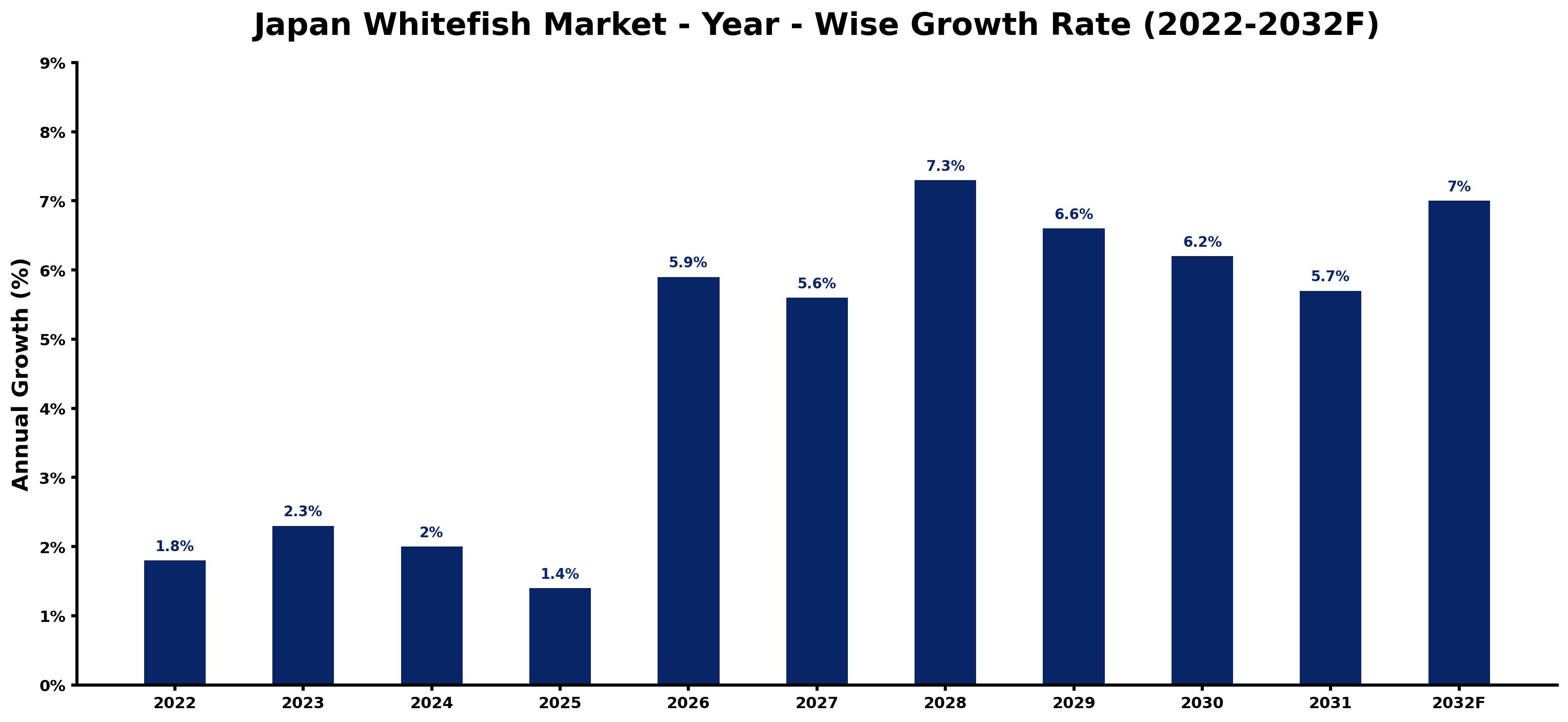
Each row of the following table gives one year's estimated growth and the event or demand shift that explains it.
| Year | Estimated Annual Growth (%) | Market Rationale |
| 2022 | 1.8 | The market experienced steady growth with increasing consumer interest in seafood. |
| 2023 | 2.3 | Demand rose as whitefish became a popular choice among urban restaurants. |
| 2024 | 2.0 | Growth slowed as consumer preferences shifted towards alternative protein sources. |
| 2025 | 1.4 | The market continued to grow, albeit at a slower rate due to market saturation. |
| 2026 | 5.9 | Demand surged as new processing technologies improved product availability. |
| 2027 | 5.6 | Growth slowed slightly as competition intensified among local suppliers. |
| 2028 | 7.3 | The market peaked with heightened interest in sustainable seafood practices. |
| 2029 | 6.6 | Demand growth decelerated as supply chain challenges emerged in the industry. |
| 2030 | 6.2 | Market growth slowed as consumer spending faced pressures from inflation. |
| 2031 | 5.7 | Demand continued to rise, driven by increasing health consciousness among consumers. |
| 2032 | 7.0 | Growth accelerated again as international markets sought Japanese whitefish. |
Note: Market size estimations and growth projections presented in this report are based on 6Wresearch's proprietary forecasting methodology, utilizing the latest available industry data, government publications, and primary research inputs.
Japan Whitefish Market Synopsis
Whitefish encompasses various species primarily harvested through trawling and longlining, making it a staple in both households and restaurants. The Japan Whitefish Market is expanding due to increasing domestic consumption and international demand, particularly from urban restaurants that represent 40% of total demand. Sustainable fishing programs and advancements in processing technology are creating new market opportunities, with frozen whitefish sales accounting for 60% of total sales, reflecting a shift towards convenience in consumer preferences.
Market Dynamics Impact Analysis (2026–2032)
| Factor | Type | Impact | Primary Segment Affected |
| Growing urban restaurant demand for whitefish dishes | Driver | High | Restaurants |
| Increased interest in sustainable seafood sourcing | Driver | High | Households |
| Rising popularity of canned whitefish products among busy households | Opportunity | Medium | Canned |
| Expansion of online seafood sales channels | Opportunity | Medium | Online Retailers |
| Seasonal fluctuations affecting supply availability | Restraint | High | Fresh |
| Competition from alternative protein sources limiting growth | Restraint | Medium | Frozen |
| Supply chain disruptions impacting product availability | Challenge | High | Wholesale |
| Rising operational costs affecting profit margins | Challenge | Medium | Cod |
Evaluation of Drivers in Japan Whitefish Market (2026–2032)
The table below links each growth driver to the segment it affects and the evidence for it.
| Drivers | Primary Segment Affected | Why It Matters (Evidence) |
| Increased whitefish consumption in urban restaurants | Restaurants | Urban areas, particularly the Tokyo Metropolitan area, have a high demand for whitefish, accounting for 40% of total consumption. |
| Growing preference for frozen whitefish for convenience | Frozen | Frozen products make up 60% of total sales, appealing to households seeking easy meal solutions. |
| Rising demand for sustainable seafood practices | Households | Sustainable fishing initiatives launched in 2023 have heightened consumer awareness and preference for responsibly sourced fish. |
| Expansion of online retail channels for seafood | Online Retailers | Online seafood sales increased by 15% in 2023, reflecting changing buying habits among consumers. |
| Increased export opportunities for high-quality Japanese whitefish | Export | Japan exports approximately 30% of its whitefish production, attracting international buyers seeking quality. |
What keeps demand rising is the growing consumption of whitefish in urban restaurants, which comprise 40% of total demand. Approximately 60% of whitefish sales are frozen, appealing to households seeking convenience. In 2023, Japan exported around 30% of its whitefish production, attracting international buyers in search of quality products. The Tokyo Metropolitan area, known for its high seafood consumption, further fuels demand for both fresh and frozen offerings.
Evaluation of Restraints in Japan Whitefish Market
Below are the constraints most often cited by buyers and suppliers, with the segment each affects.
| Market Restraint | Primary Segment Affected | Why It Matters (Evidence) |
| Seasonal fluctuations in fish availability affecting supply | Fresh | Seasonal changes can lead to reduced availability of fresh whitefish, impacting restaurant supply chains. |
| Competition from alternative protein sources limiting market growth | Frozen | The rise of plant-based proteins has diverted consumer attention from traditional seafood options. |
| High operational costs impacting processing margins | Cod | Increased costs for raw materials and labour are squeezing profit margins for processing facilities. |
| Supply chain disruptions affecting product distribution | Wholesale | Recent global supply chain issues have delayed deliveries, impacting wholesale distribution of whitefish. |
| Regulatory compliance costs for sustainable practices | Export | Exporters face increased costs to comply with sustainability regulations, affecting competitiveness. |
Japan Whitefish Market Challenges
Producers face strict regulations from the Japan Fisheries Agency that delay fishing permits, resulting in a 10% reduction in available whitefish. Importers deal with supply chain disruptions due to reliance on Hokkaido, where adverse weather can cut production by 20%, affecting their ability to maintain stock levels. Buyers encounter price volatility, with fresh whitefish averaging ¥1,200 per kg, straining budgets for restaurants that account for 40% of demand. Rising operational costs from compliance with the JIS standard can squeeze profit margins for fish processing facilities, limiting their capacity to invest in improvements.
Trends in the Japan Whitefish Market
The shifts below are changing how Japan Whitefish Market products are bought and supplied.
- Shift from Fresh to Frozen Whitefish: In 2023, the trend towards frozen whitefish gained momentum as households sought convenience in meal preparation. Frozen products now account for 60% of total sales, catering to busy lifestyles.
- Emergence of Online Seafood Sales: The growth of online seafood sales channels began in 2023, with a 15% increase in sales. This shift allows consumers to access a wider variety of whitefish products conveniently.
- Increased Focus on Sustainable Fishing Practices: The 2023 launch of a sustainable fishing initiative has shifted consumer preferences towards responsibly sourced seafood. This initiative is projected to support market growth and consumer trust.
- Rising Popularity of Canned Whitefish Products: Canned whitefish products are gaining traction among busy households, with increasing demand for ready-to-eat meals. This segment is expected to expand as convenience becomes a priority.
Investment Opportunities in the Japan Whitefish Market
The following opportunities in the Japan Whitefish Market pair current demand with a clear way in.
- Restaurants seeking sustainable seafood options: With the growing interest in sustainable seafood, restaurants can invest in sourcing responsibly caught whitefish. This aligns with consumer preferences for ethical dining experiences, especially in urban areas where demand is high.
- Households looking for convenient meal solutions: The increasing popularity of frozen whitefish presents an opportunity for suppliers to expand offerings. Households are seeking easy-to-prepare options, driving demand for frozen products, which account for 60% of sales.
- Online retailers expanding seafood offerings: The surge in online seafood sales creates an opportunity for partnerships with e-commerce platforms. Suppliers can enter this growing market by collaborating with established online retailers, which saw a 15% increase in sales in 2023.
- Export markets seeking high-quality Japanese whitefish: Japan's reputation for quality seafood opens opportunities for exporters. Suppliers can focus on international markets, utilising Japan's quality standards to attract buyers, with approximately 30% of production exported.
Government Initiatives in the Japan Whitefish Market
The Food Recycling Law, enacted in 2000, mandates food businesses to reduce waste and recycle it into feed or energy. This law impacts whitefish producers by requiring them to implement sustainable practices, ensuring compliance with environmental standards. The law has led to a 20% reduction in food waste among participating businesses, benefiting the fishing industry.
The Ministry of Agriculture, Forestry and Fisheries oversees sustainable fishing practices and funds initiatives to promote responsible fishing. This agency ensures that whitefish producers adhere to regulations that support long-term sustainability, approving over 50 projects annually to enhance fishing practices.
Future Insight of the Japan Whitefish Market
Advanced tracking technology will change demand by ensuring better traceability in the whitefish supply chain, leading to improved quality for buyers. By 2032, sustainable fishing programmes will likely boost the availability of responsibly sourced fish, appealing to environmentally aware consumers. Upgraded processing facilities will enhance efficiency, enabling suppliers to better meet demand from urban areas. With online seafood sales projected to increase by 15%, suppliers must adjust their strategies to capitalise on this growing market opportunity.
Market Segmentation Analysis
Japan Whitefish Market report covers a detailed analysis of the following market segments:
By Species Type – Cod Leads, Haddock Expected to Grow Fastest
According to Saurav Kr Singh, Senior Research Analyst at 6Wresearch, Cod held 34% of the Japan Whitefish Market by species type in 2025. Cod holds the largest share due to its versatility in various dishes, making it a staple in Japanese cuisine. For instance, its popularity in restaurants and households drives substantial demand across the nation. Haddock is set to record the highest CAGR in this split, 8.8% over 2026–2032. Haddock is experiencing rapid growth as it becomes a preferred choice for fish and chips, particularly in urban areas. The increasing trend of casual dining establishments incorporating Haddock into their menus contributes to this surge. Suppliers should focus on promoting Haddock to capitalise on its growing popularity.
By Processing Type – Fresh Leads, Frozen Expected to Grow Fastest
Fresh took 49% of processing type revenue in 2025, more than any other category. Fresh whitefish holds the largest market share as it is highly sought after by restaurants that focus on quality and flavour in their dishes. This trend is particularly prominent in urban dining establishments where fresh ingredients are essential for culinary excellence. The quickest growth will come from Frozen, forecast to expand at a CAGR of 9.1% between 2026 and 2032. Frozen whitefish is experiencing rapid growth due to its convenience for households, especially as busy lifestyles create a demand for quick meal options. The increase in home cooking trends has further accelerated this segment's expansion. Suppliers need to ensure a steady supply of frozen whitefish to cater to the growing household demand.
By Distribution Channel – Wholesale Leads, Online Retailers Expected to Grow Fastest
With 38% of distribution channel revenue in 2025, Wholesale was the largest category. Wholesale distribution holds the largest share as it is essential for supplying restaurants with substantial quantities of whitefish. This channel effectively caters to the high demand from the food service sector, particularly in urban areas like Tokyo. Over 2026–2032, Online Retailers are expected to post the fastest growth, at a CAGR of 8.1%. Online retailers are experiencing the fastest growth due to a notable 15% increase in online seafood sales in 2023. This trend reflects a shift in consumer behaviour towards the convenience of purchasing seafood online. Suppliers must enhance their online presence to take advantage of the rising trend in e-commerce for seafood.
By End User – Restaurants Lead, Households Expected to Grow Fastest
The largest end user category in 2025 was Restaurants, at 39% of revenue. Restaurants are the primary consumers of whitefish, using it extensively in their menus to meet diverse culinary demands. This consumption pattern is particularly strong in urban areas where dining options are plentiful and varied. Households are projected to grow fastest, at a CAGR of 8.2% during 2026–2032. Households represent the fastest-growing segment as families increasingly choose to buy whitefish for home cooking, reflecting a broader trend towards preparing meals at home. This shift is likely to persist as consumers seek healthier alternatives. Suppliers should focus on marketing whitefish to households, emphasising its benefits for home cooking.
Key Attractiveness of the Report
- 10 Years of Market Numbers
- Historical Data Starting from 2022 to 2025
- Base Year 2025
- Forecast Data until 2032
- Key Performance Indicators Impacting the Market
- Major Upcoming Developments and Projects
Key Highlights of the Report:
- Japan Whitefish Market Outlook
- Market Size of Japan Whitefish Market, 2025
- Forecast of Japan Whitefish Market, 2032
- Historical Data and Forecast of Japan Whitefish Revenues & Volume for the Period 2022-2032F
- Japan Whitefish Market Trend Evolution
- Japan Whitefish Market Drivers and Challenges
- Japan Whitefish Price Trends
- Japan Whitefish Porter's Five Forces
- Japan Whitefish Industry Life Cycle
- Historical Data and Forecast of Japan Whitefish Market Revenues & Volume By Species Type for the Period 2022-2032F
- Historical Data and Forecast of Japan Whitefish Market Revenues & Volume By Cod for the Period 2022-2032F
- Historical Data and Forecast of Japan Whitefish Market Revenues & Volume By Haddock for the Period 2022-2032F
- Historical Data and Forecast of Japan Whitefish Market Revenues & Volume By Pollock for the Period 2022-2032F
- Historical Data and Forecast of Japan Whitefish Market Revenues & Volume By Whiting for the Period 2022-2032F
- Historical Data and Forecast of Japan Whitefish Market Revenues & Volume By Processing Type for the Period 2022-2032F
- Historical Data and Forecast of Japan Whitefish Market Revenues & Volume By Fresh for the Period 2022-2032F
- Historical Data and Forecast of Japan Whitefish Market Revenues & Volume By Frozen for the Period 2022-2032F
- Historical Data and Forecast of Japan Whitefish Market Revenues & Volume By Filleted for the Period 2022-2032F
- Historical Data and Forecast of Japan Whitefish Market Revenues & Volume By Canned for the Period 2022-2032F
- Historical Data and Forecast of Japan Whitefish Market Revenues & Volume By Distribution Channel for the Period 2022-2032F
- Historical Data and Forecast of Japan Whitefish Market Revenues & Volume By Wholesale for the Period 2022-2032F
- Historical Data and Forecast of Japan Whitefish Market Revenues & Volume By Online Retailers for the Period 2022-2032F
- Historical Data and Forecast of Japan Whitefish Market Revenues & Volume By Supermarkets for the Period 2022-2032F
- Historical Data and Forecast of Japan Whitefish Market Revenues & Volume By Export for the Period 2022-2032F
- Historical Data and Forecast of Japan Whitefish Market Revenues & Volume By End User for the Period 2022-2032F
- Historical Data and Forecast of Japan Whitefish Market Revenues & Volume By Restaurants for the Period 2022-2032F
- Historical Data and Forecast of Japan Whitefish Market Revenues & Volume By Households for the Period 2022-2032F
- Historical Data and Forecast of Japan Whitefish Market Revenues & Volume By Retail Consumers for the Period 2022-2032F
- Historical Data and Forecast of Japan Whitefish Market Revenues & Volume By International Buyers for the Period 2022-2032F
- Japan Whitefish Import Export Trade Statistics
- Market Opportunity Assessment By Species Type
- Market Opportunity Assessment By Processing Type
- Market Opportunity Assessment By Distribution Channel
- Market Opportunity Assessment By End User
- Japan Whitefish Top Companies Market Share
- Japan Whitefish Competitive Benchmarking By Technical and Operational Parameters
- Japan Whitefish Company Profiles
- Japan Whitefish Key Strategic Recommendations
Market Covered
This report examines the market across the segments below.
By Species Type
- Cod
- Haddock
- Pollock
- Whiting
By Processing Type
- Fresh
- Frozen
- Filleted
- Canned
By Distribution Channel
- Wholesale
- Online Retailers
- Supermarkets
- Export
By End User
- Restaurants
- Households
- Retail Consumers
- International Buyers































